

Why Look for a CYPHER Learning Alternative?
CYPHER Learning (formerly NEO LMS) has built a reputation as a feature-rich learning platform that spans corporate training, K-12, and higher education. It covers a lot of ground, and for organizations that need a single platform across multiple learning contexts, that breadth is genuinely useful. But breadth comes with trade-offs, and there are specific pain points that push L&D teams and training organizations to explore CYPHER Learning alternatives.
UI complexity despite the feature depth. CYPHER packs a large number of capabilities into its interface, and navigating them is not always intuitive. Admins often report spending considerable time learning where settings live, how to configure automations, and how to structure course paths. The platform rewards deep investment, but that initial setup friction can slow down teams that need to deploy training quickly.
Opaque pricing. CYPHER does not publish its pricing publicly. Everything goes through a custom quote process, which makes it difficult to compare costs during early evaluation stages. For mid-size organizations running a structured LMS evaluation, this lack of transparency creates friction before any demo even takes place.
Steep admin learning curve. Related to the UI issue, but worth calling out separately: the administrative backend requires meaningful onboarding time. Features like competency frameworks, gamification rules, and automated learning paths are powerful, but configuring them correctly demands dedicated admin effort. Organizations without a full-time LMS administrator sometimes find this overwhelming.
Performance at scale. Some organizations report occasional slowdowns when managing large learner populations or running complex reports across multiple courses. This tends to affect enterprises with thousands of concurrent users more than smaller training operations.
Limited third-party content marketplace. Unlike platforms that offer built-in access to large off-the-shelf course libraries, CYPHER's content marketplace is relatively limited. Organizations that want to supplement their custom training with pre-built courses may need to purchase content separately from third-party providers and import it manually.
Inconsistent support experience. Customer support quality varies depending on the plan tier and the complexity of the issue. Some users praise the responsiveness; others report delays and difficulty getting resolution for technical problems. That inconsistency is a recurring theme in user reviews.
None of these are universal deal-breakers. But if your organization needs transparent pricing, a simpler admin experience, better performance at scale, or a broader content library, the alternatives below address those gaps directly.
What to Check When Migrating Off CYPHER
Moving off CYPHER Learning is a real operational project, not a like-for-like swap. CYPHER blends academic (K-20) and corporate features in one system, so the right replacement depends on which half you actually use. Anchor your shortlist on the criteria below before booking demos.
Single context or dual context. CYPHER's selling point is covering both academic and corporate learning. Most alternatives specialize. Decide whether you genuinely need one platform across both, or whether a focused corporate LMS (or a focused academic one) will serve each audience better. Forcing one tool to do both is what created the complexity you are leaving.
Pricing transparency. CYPHER quotes privately, which slows down evaluation. Platforms with published pricing let you model cost early. Compare per-user, per-active-user, and flat-tier models against your real learner count, and factor in implementation and migration. Our LMS pricing and affordable LMS guides break down how these models scale.
Content portability. Courses built in SCORM or xAPI usually transfer. CYPHER-specific assets, gamification rules, competency frameworks, and automated learning paths will need to be rebuilt. Map what is portable versus what is proprietary before you commit to a migration timeline.
AI capabilities. CYPHER markets AI 360 and Copilot for content generation and tutoring. If AI is part of why you adopted CYPHER, compare directly: Docebo applies AI across a mature LMS, while Teachfloor uses AI to draft full courses from your own material. Match the AI to the job, not the marketing.
Admin overhead. CYPHER's depth is also its friction. Be honest about whether you have a full-time administrator. If not, weight ease of setup heavily, because a cleaner admin interface compounds over months of daily use.
Integrations and reporting. Check native connectors for your HRIS, CRM, SSO, and video tools, plus the reporting depth your stakeholders actually need, from basic completion tracking to skill-gap analysis. An open API matters if you connect learning data to other business systems.
10 Best CYPHER Learning Alternatives
The platforms below span corporate training, academic learning, open-source control, and creator-focused course selling. Each one closes a different gap CYPHER leaves open, and they are ordered to put the most flexible, easiest-to-adopt option first.
| Platform | Best for | Hosting | Starting price | Free trial |
|---|---|---|---|---|
| Teachfloor | Flexible live, cohort, social, and self-paced programs | Cloud | $89/mo | 14 days |
| TalentLMS | Fast SMB corporate training | Cloud | Free, then ~$119/mo | Free plan |
| Docebo | AI-driven enterprise L&D | Cloud | Custom | Demo only |
| Absorb LMS | Polished mid-market corporate LMS | Cloud | Custom | Demo only |
| Canvas LMS | Higher education and academic | Cloud or self-host | Custom | Free for Teachers |
| Moodle | Open-source, full control | Self-host or cloud | Free (self-host) | MoodleCloud trial |
| 360Learning | Collaborative, SME-led authoring | Cloud | $8/user/mo | 30 days |
| LearnWorlds | Selling courses and creator businesses | Cloud | $24/mo | 30 days |
| iSpring Learn | PowerPoint-based content teams | Cloud | $2.29/user/mo | 30 days |
| Open edX | Large-scale structured learning | Self-host or cloud | Free (self-host) | Demo only |
Teachfloor
Overview
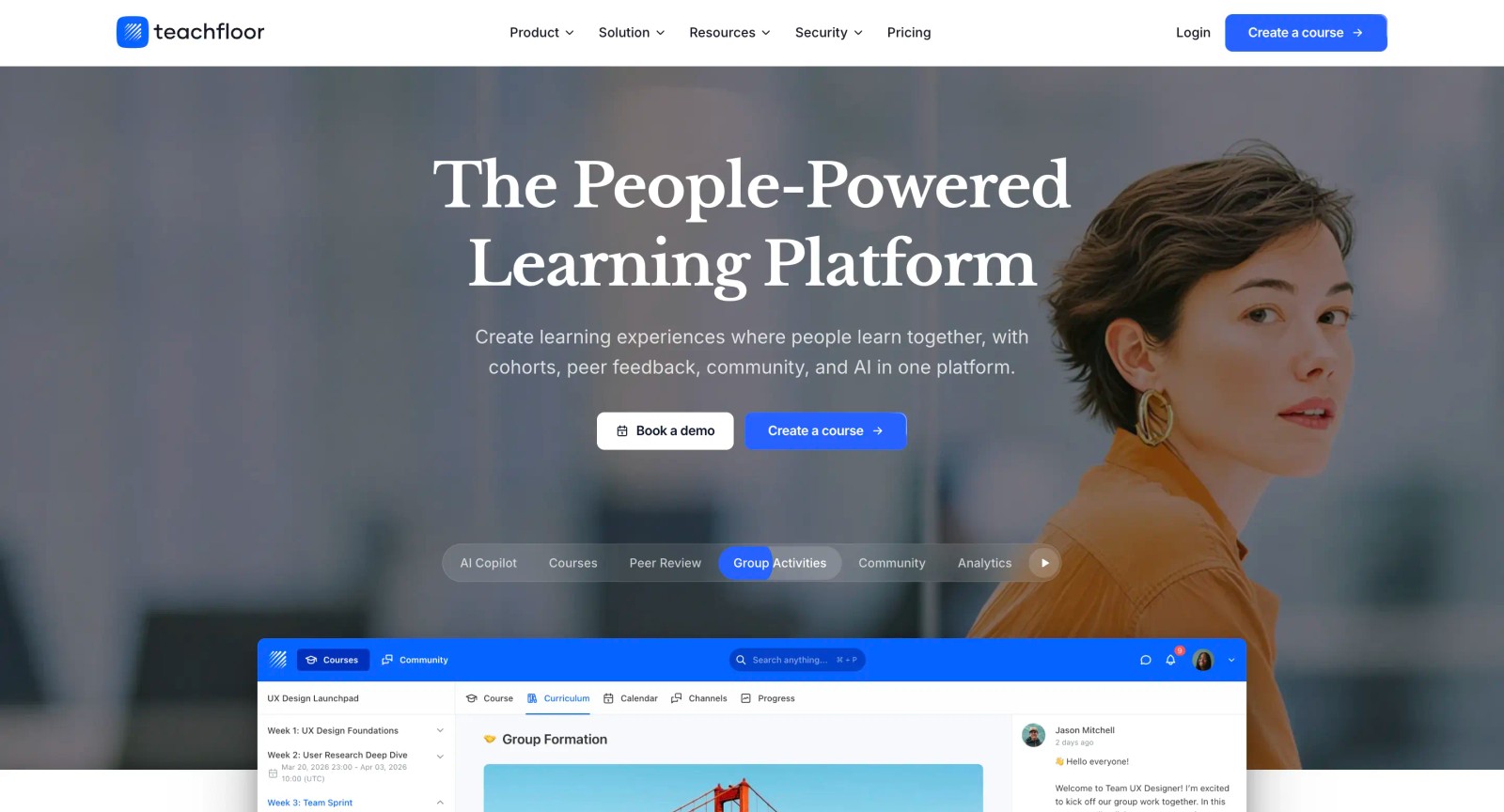
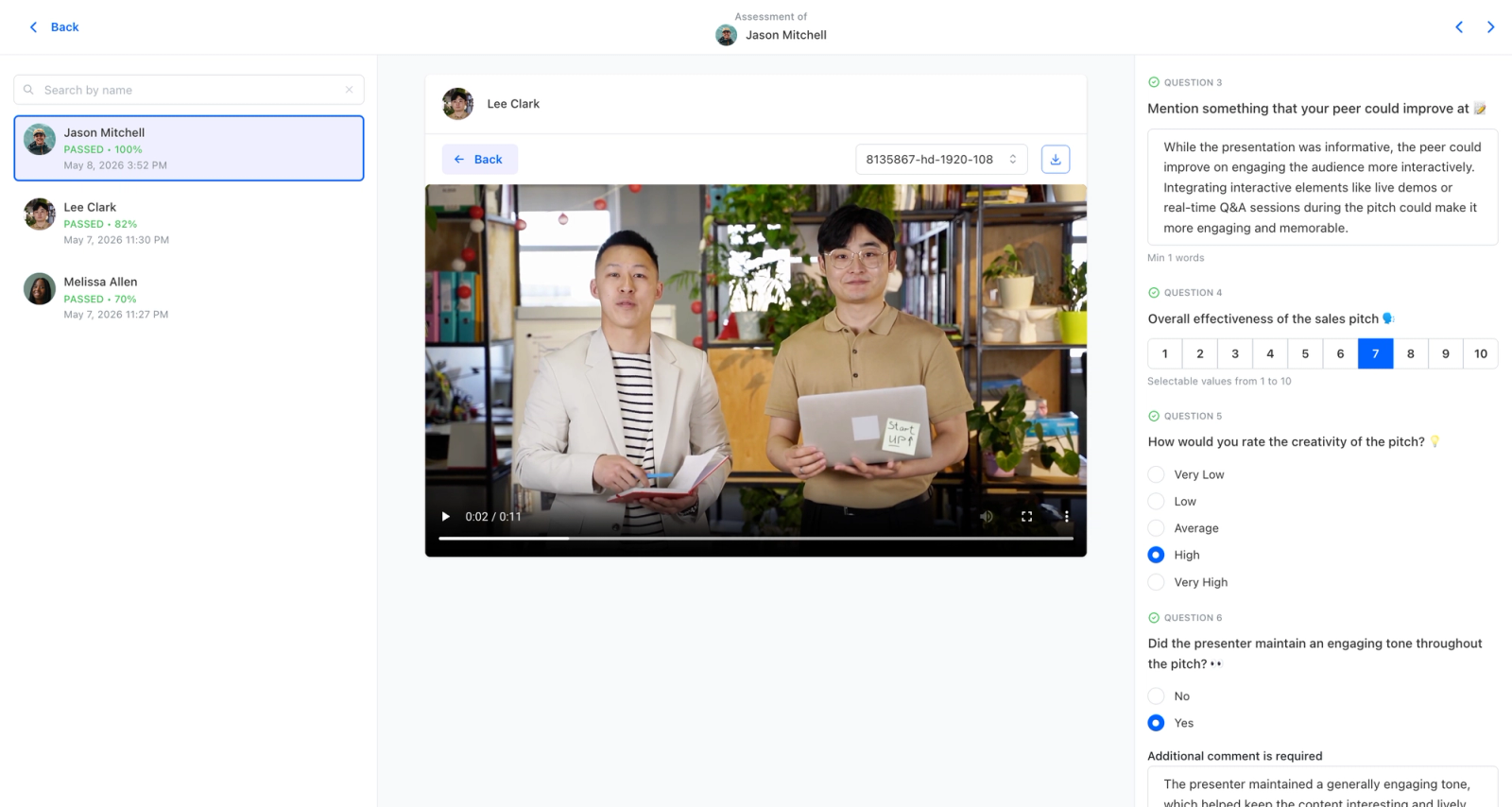
Teachfloor is a single learning platform that covers corporate training and structured education programs without splitting those use cases across separate product lines. It offers AI-assisted course authoring alongside self-paced, live, and cohort delivery in one environment. The platform's design emphasis is active learning: discussion threads, group activities, and rubric-based peer review that can be weighted into grades, making it applicable to both graded academic-style programs and corporate upskilling tracks.
Core Capabilities
- One platform covering corporate training and structured course delivery, with no product-line split to navigate between use cases
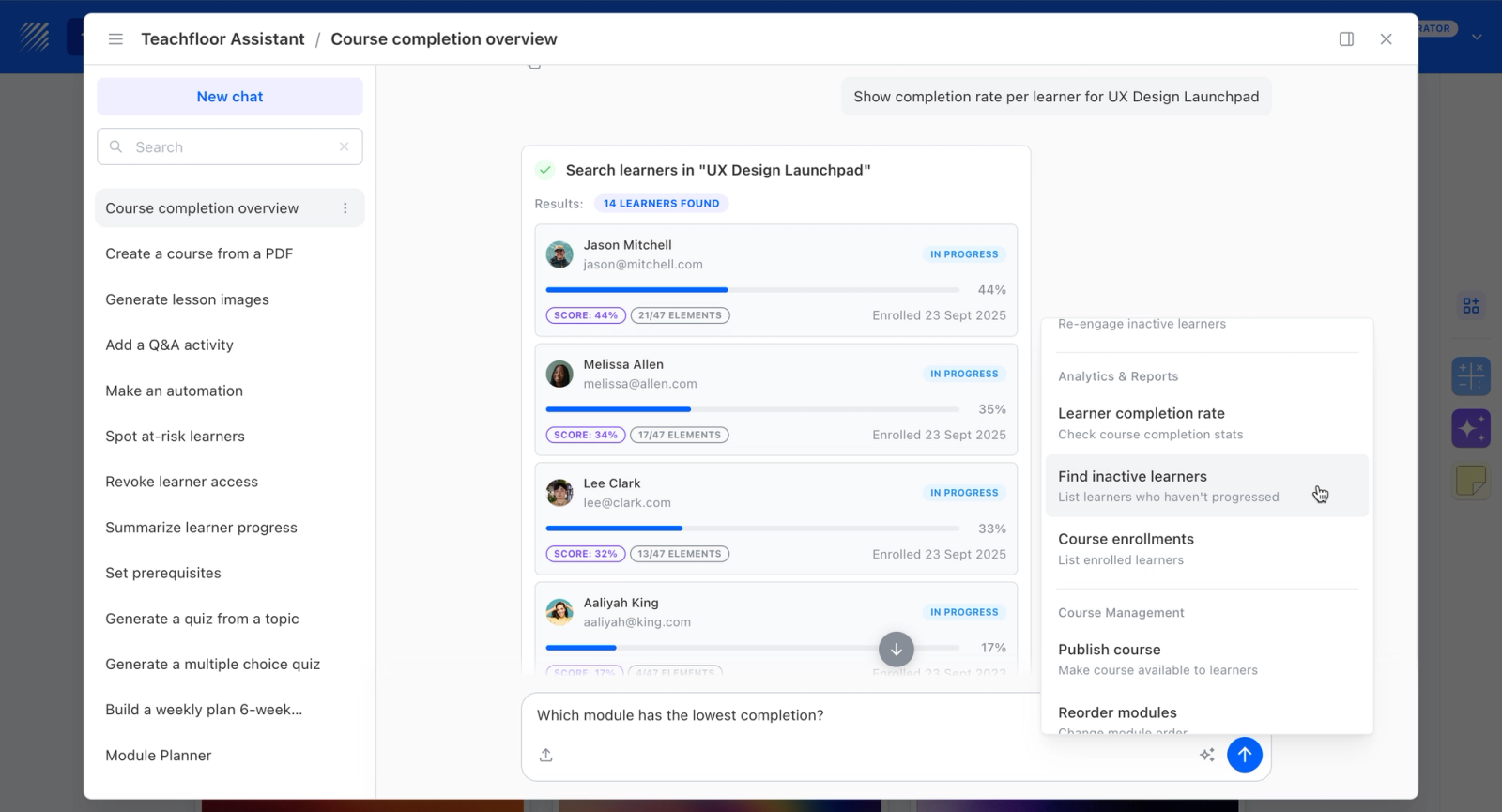
- AI-assisted authoring and flexible self-paced, live, or cohort delivery for both corporate training and structured course programs
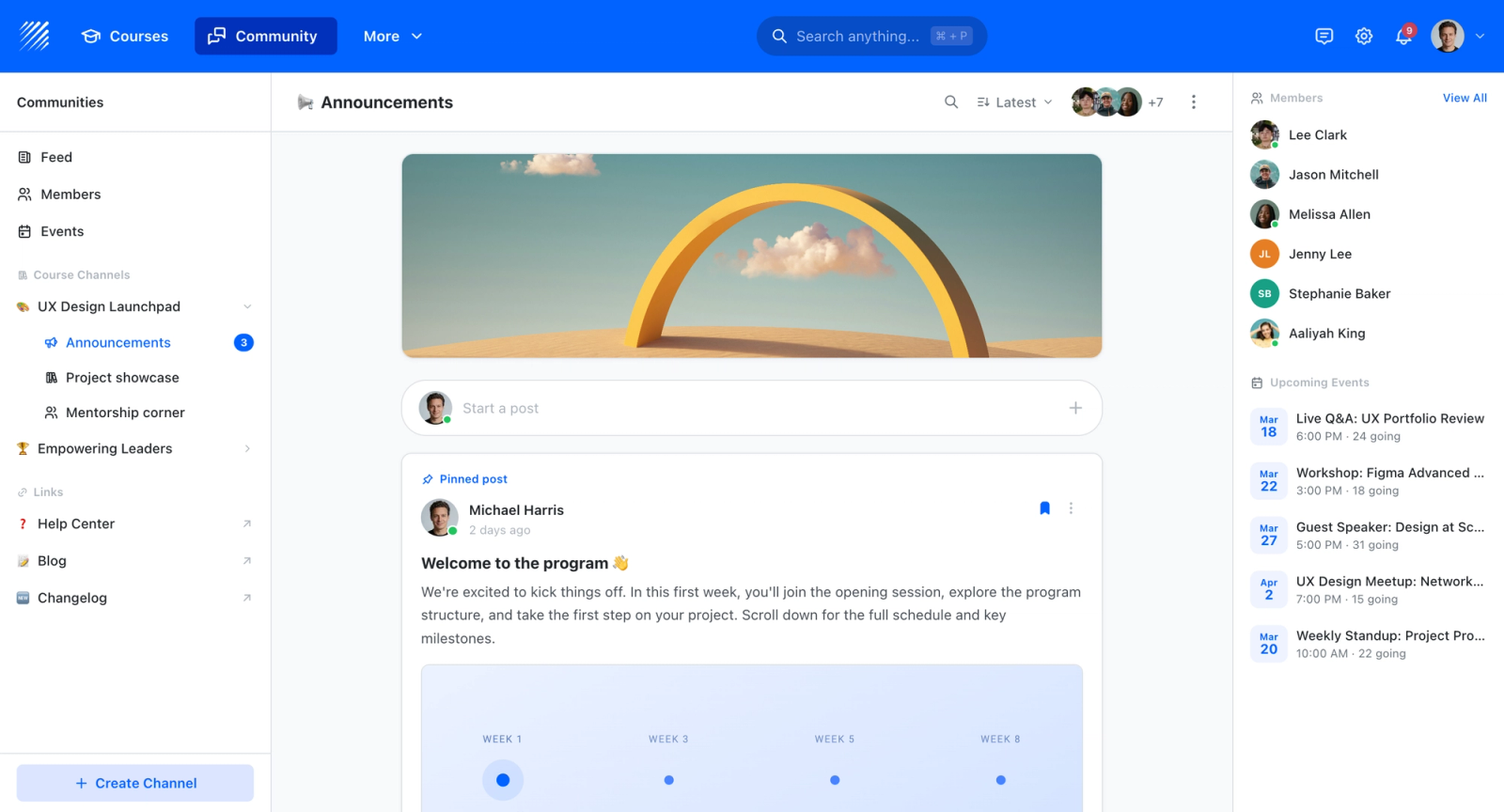
- Rubric-driven peer review weighted into grades, plus discussion and group activities, a real fit for graded, academic-style courses as well as corporate cohorts
- Quizzes, certificates, and analytics to assess and credential learners across program types
- White-label on your own domain, multi-branch structure, and SCORM support to organize and brand learning at scale
Best For
Training organizations and L&D teams who found CYPHER's breadth and three-product split more complexity than value, and want a single engagement-focused platform that handles both corporate and course-based education.
Pricing Overview
- Startup plan from $89 per month for up to 50 learners
- Full Features plan with custom pricing, white-label, SSO, and advanced integrations
- 14-day free trial; no permanent free plan
- Nonprofit discounts available
Limitations
- Not built specifically for K-12 or full higher-ed institution management, so deep academic SIS-style needs are outside its scope
- Narrower overall feature surface than CYPHER's combined lineup, by design, since the focus is depth in authoring and active learning over spanning every market
- No free plan; starts at $89/mo for up to 50 learners with custom pricing above that
Quick Comparison Insight
CYPHER covers more contexts across its three products. Teachfloor is a single platform focused on authoring and peer-driven learning, for teams that prefer one product over a split lineup.
TalentLMS
Overview
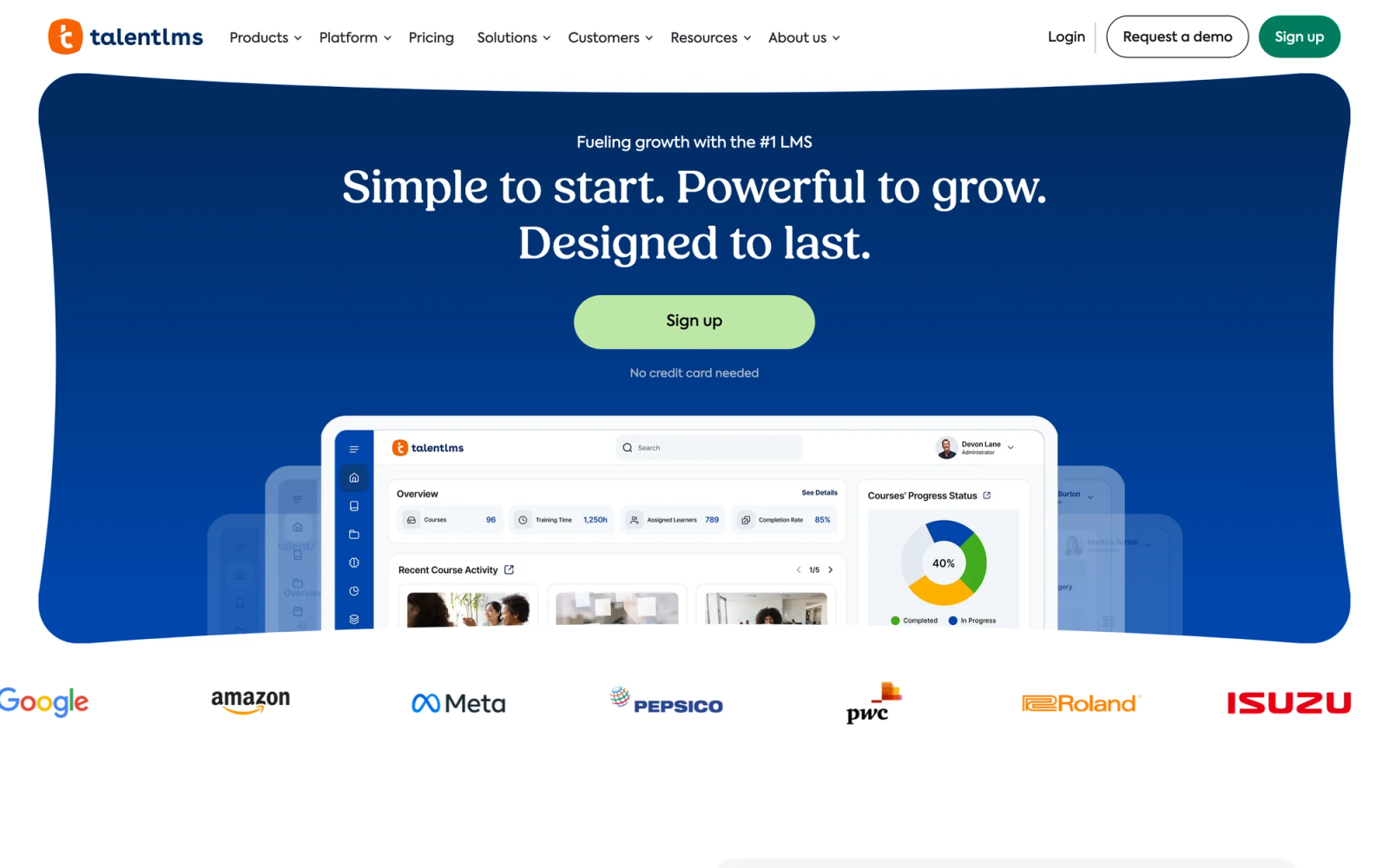
TalentLMS is a cloud-based learning management system built by Epignosis, and it has earned a strong reputation as one of the most approachable LMS platforms on the market. Where CYPHER Learning tries to cover corporate, academic, and K-12 use cases in a single product, TalentLMS focuses squarely on corporate training and does it with a notably clean interface.
TalentLMS gets a course live quickly. The admin dashboard is straightforward, the course builder uses drag-and-drop without unnecessary complexity, and user management follows patterns that anyone familiar with SaaS tools will recognize immediately. For teams that found CYPHER's admin backend overwhelming, the contrast is significant.
Core Capabilities
- Drag-and-drop course builder with support for text, video, presentations, SCORM, and xAPI content
- Built-in content authoring for creating simple courses directly inside the platform
- Learning paths that sequence multiple courses with prerequisites and completion rules
- Automated user enrollment, notifications, and certification management
- Branch functionality for managing multiple training audiences (departments, clients, partners) under one account
- Built-in video conferencing integration with Zoom, Microsoft Teams, and GoToMeeting for live training sessions
- Gamification features including points, badges, and leaderboards
- Reporting dashboard with course completion rates, learner progress, and custom report generation
- REST API for connecting to HR systems, CRMs, and other enterprise tools
- Mobile-responsive design with a dedicated mobile app for iOS and Android
Standout Strength
TalentLMS eliminates the gap between purchasing an LMS and actually using it. The time-to-first-course is measured in hours, not weeks. For SMBs and mid-size companies that need to roll out compliance training, onboarding programs, or employee training initiatives without dedicating a full-time admin, that speed of deployment is the deciding factor over more complex platforms like CYPHER.
Best For
Small-to-midsize businesses with 50 to 1,000 employees that need to deploy corporate training quickly. Particularly strong for compliance training, new hire onboarding, and organizations running training across multiple departments or client groups using the branch feature.
Pricing Overview
- Free plan available for up to 5 users and 10 courses
- Core plan starts at around $119 per month billed annually (about $149 monthly), for up to 100 users
- Higher Grow, Pro, and Enterprise tiers scale the user cap and add features
- Custom enterprise pricing available for larger deployments
Limitations
- Built-in authoring is functional for simple courses but lacks the depth needed for interactive or branching content. Teams with complex content needs will still need an external authoring tool.
- Reporting is solid for standard metrics but does not offer the advanced analytics or skill gap analysis that enterprise platforms provide.
- Customization of the learner interface is limited compared to platforms that offer full white-labeling with CSS control.
Quick Comparison Insight
Simpler and faster to deploy than CYPHER Learning, with transparent pricing. Less feature depth for complex academic or multi-context use cases, but significantly less admin overhead for corporate training.
Docebo
Overview
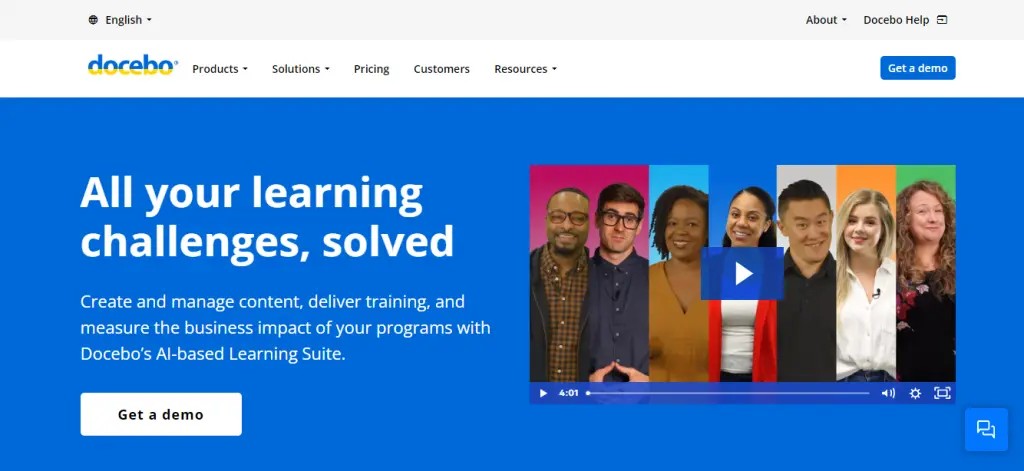
Docebo is an enterprise learning platform that has positioned itself as an AI-powered LMS for large organizations. Where CYPHER Learning spreads across corporate and academic markets, Docebo focuses entirely on enterprise learning and development, partner training, and customer education.
What differentiates Docebo from CYPHER is the depth of its enterprise tooling. The platform includes AI-driven content recommendations, skills mapping, social learning features, and a modular architecture that lets organizations enable only the components they need. The configuration options are extensive, but they are organized in a way that makes more sense for dedicated L&D teams than CYPHER's broader interface.
Core Capabilities
- AI-powered content recommendations that surface relevant courses based on learner behavior and role
- Skills ontology mapping that connects training content to organizational competency frameworks
- Social learning module with peer-to-peer knowledge sharing, Q&A forums, and expert identification
- Multi-audience support for employees, partners, and customers through configurable learning portals
- Built-in content authoring plus a content marketplace with off-the-shelf courses from third-party providers
- SCORM, xAPI, and AICC compliance for importing externally authored content
- Advanced reporting with customizable dashboards, scheduled report delivery, and data export
- Over 400 integrations including Salesforce, Workday, Microsoft Teams, and HRIS platforms
- Automated enrollment, learning path orchestration, and certification tracking
- White-label portals with custom branding for external training programs
Standout Strength
Docebo stands out for its AI capabilities and enterprise integration depth. The content recommendation engine reduces the manual work of course assignment, and the skills mapping gives L&D leaders visibility into how training connects to organizational competency frameworks. Its built-in content marketplace, which includes providers like LinkedIn Learning and Udemy Business, gives enterprises access to off-the-shelf courses directly inside the platform without a separate procurement step.
Best For
Mid-to-large enterprises with 1,000 or more employees, particularly organizations that run extended enterprise training (partner enablement, customer education) alongside internal L&D. Strong fit for companies with dedicated learning teams that need AI-driven personalization and deep HRIS integration.
Pricing Overview
- Custom enterprise pricing based on number of active users and modules selected
- No published starting price; requires a sales consultation
- Free trial available upon request
Limitations
- The platform's depth means a steeper implementation timeline. Organizations should expect a multi-week onboarding process with Docebo's customer success team.
- Pricing is not transparent and tends to sit at the higher end of the market, which may exclude smaller organizations.
- Some users report that the social learning features feel underutilized unless there is active internal promotion and facilitation.
Quick Comparison Insight
More enterprise-focused than CYPHER Learning, with stronger AI features and a broader set of integrations. Higher price point and longer implementation, but better suited for organizations running training across multiple audiences at scale.
Absorb LMS
Overview
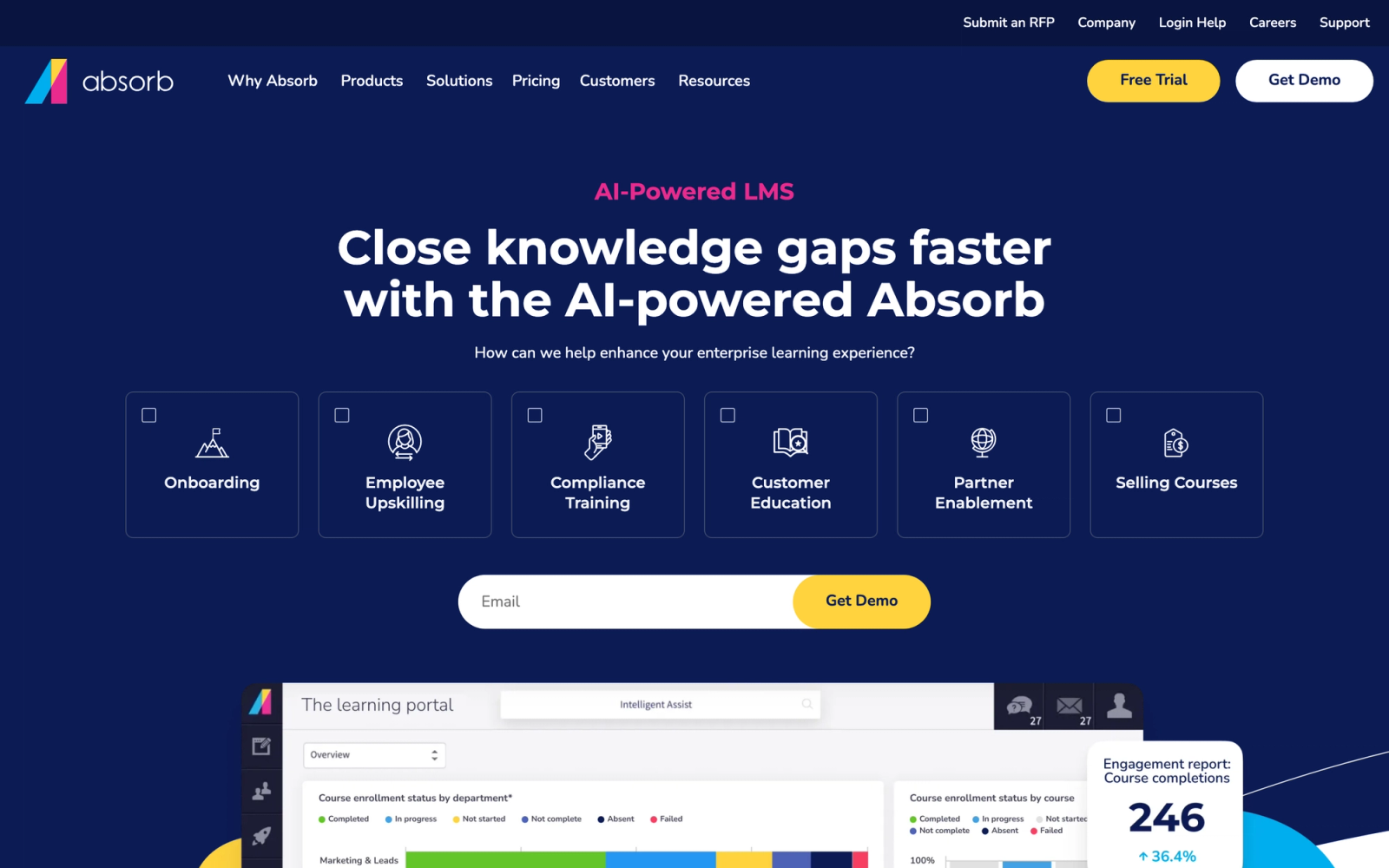
Absorb LMS is a corporate learning platform built for mid-to-large organizations that need reliability, clean design, and strong reporting without the configuration complexity that heavier enterprise systems demand. It sits in a sweet spot between lightweight SMB tools and the deep customization of platforms like Docebo.
Where CYPHER Learning sometimes overwhelms admins with the sheer number of configurable options, Absorb takes a more curated approach. The interface is modern and visually clean. Setting up a course, assigning learners, and pulling reports is noticeably smoother than CYPHER's backend. The trade-off is that Absorb offers less granular control over academic-style features like competency mapping and grading rubrics.
Core Capabilities
- Intuitive admin dashboard with streamlined course creation, user management, and enrollment workflows
- SCORM, xAPI, and AICC content support with a built-in content library (Absorb Amplify)
- Absorb Create, a lightweight built-in authoring tool for building courses without external software
- Smart administration features including automated rules for enrollment, notifications, and user grouping
- eCommerce module for selling courses externally with payment processing, coupons, and bundles
- Observation checklists for tracking hands-on skills verification and workplace assessments
- Custom reporting with visual dashboards, scheduled reports, and data export to BI tools
- Learner engagement tools including leaderboards, messaging, and social features
- REST API and native integrations with Salesforce, ADP, BambooHR, and SSO providers
- Mobile app with offline content access for field workers and distributed teams
Standout Strength
Absorb delivers a polished learner experience without heavy admin investment on the back end. The learner-facing interface is consistently praised in user reviews for its clean design and ease of navigation, and that UX quality has a measurable downstream effect: adoption is higher when learners can find what they need without friction. For organizations where completion rates and re-engagement are concerns, the platform's simplicity is a practical advantage.
Best For
Mid-to-large companies with 500 to 10,000 employees focused on corporate training, compliance, and onboarding. Particularly strong for organizations that sell training externally (via the eCommerce module) and companies with distributed or frontline workforces that need mobile and offline access.
Pricing Overview
- Custom pricing based on active user count
- No published starting price; requires a sales consultation
- Free demo and trial available upon request
Limitations
- Content authoring (Absorb Create) is useful for simple courses but does not replace a dedicated authoring tool for complex interactive content.
- Academic-style features (gradebooks, rubrics, peer review) are not a strength. This is a corporate LMS, not a higher-ed platform.
- Pricing is not transparent, and mid-market organizations sometimes find the cost higher than expected relative to TalentLMS or similar tools.
Quick Comparison Insight
Cleaner admin experience than CYPHER Learning for corporate training, with a stronger learner-facing UX. Less suitable for academic or K-12 use cases, but more focused and easier to manage for enterprise L&D.
Canvas LMS
Overview
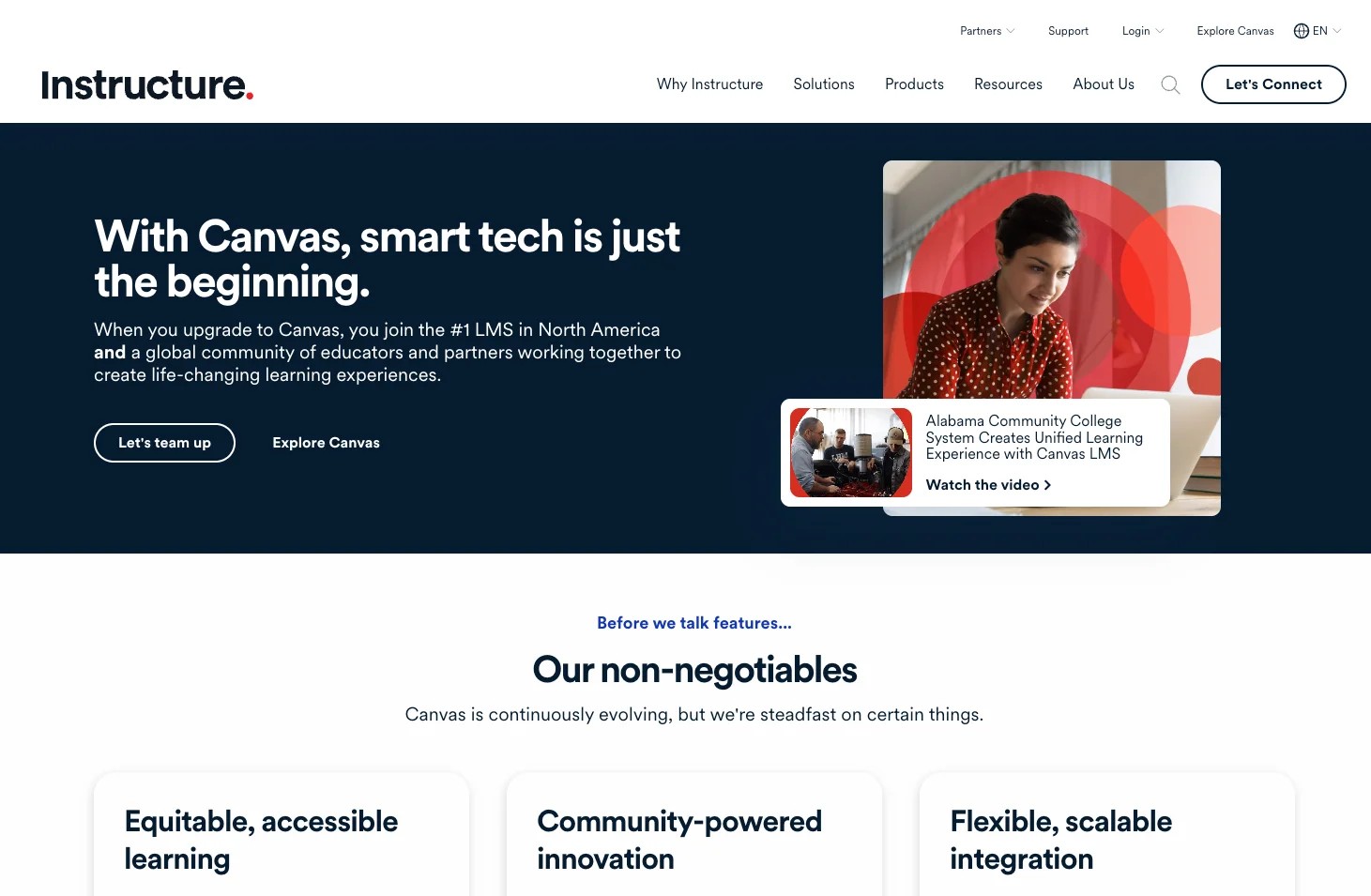
Canvas LMS, developed by Instructure, is one of the dominant learning management systems in higher education. It powers course delivery at thousands of universities and school districts worldwide. While CYPHER Learning serves both corporate and academic markets, Canvas focuses primarily on academic instruction and does it with a level of polish and integration depth that CYPHER's academic features cannot match.
The difference in academic tooling is immediately apparent. The SpeedGrader for fast assignment feedback, native integration with publisher content, and the community-driven plugin library gives instructors tools that are purpose-built for teaching. The platform assumes an academic context, which means corporate training teams may find it less natural, but for higher-ed institutions, that focus is an advantage.
Core Capabilities
- SpeedGrader for inline annotation and rapid feedback on student submissions
- Flexible assignment types including essays, quizzes, discussions, peer reviews, and group projects
- Modules system for organizing course content into sequential learning paths with prerequisites
- Outcomes and rubrics framework for standards-based grading and competency tracking
- Native LTI integration for connecting third-party tools like Turnitin, Zoom, publisher content, and more
- Discussion boards with threaded replies, media embedding, and grading capabilities
- Student analytics dashboard showing engagement, submission patterns, and at-risk indicators
- Canvas Commons for sharing and importing course content across institutions
- REST API and open architecture for custom development and institutional integrations
- Mobile app with offline support and push notifications for assignment deadlines
Standout Strength
Canvas is the LMS that higher education faculty use without resistance, and its adoption rate across universities reflects a genuine product-market fit. It was built from the ground up for how instructors teach and students learn, rather than adapted from a multi-context platform. LTI integration alone connects hundreds of educational tools, from Turnitin to publisher content libraries, giving institutions a flexible stack that few academic LMS platforms can match.
Best For
Higher education institutions, community colleges, and large school districts. Particularly strong for institutions that need strong grading workflows, LTI-based tool integrations, and a platform that faculty will adopt without extensive training.
Pricing Overview
- Canvas for institutions requires a custom quote based on enrollment count
- Canvas Free for Teachers is available as a limited free version for individual instructors
- Pricing is institution-level; individual course pricing is not available
Limitations
- Not designed for corporate training. Organizations looking for compliance tracking, HR integrations, or employee onboarding workflows will find Canvas lacks native corporate features.
- The quiz engine, while functional, has historically been a weak point compared to dedicated assessment tools. Canvas New Quizzes has improved this, but some institutions still find it limiting.
- Canvas remains open-source under the AGPLv3 license and is self-hostable from the instructure/canvas-lms repository on GitHub, though Instructure now pushes most institutions toward its managed cloud hosting.
Quick Comparison Insight
Far stronger than CYPHER Learning for academic instruction, with deeper grading tools and a larger set of education integrations. Not a viable choice for corporate L&D, but for higher-ed institutions, it is the more established and better-supported platform.
Moodle
Overview
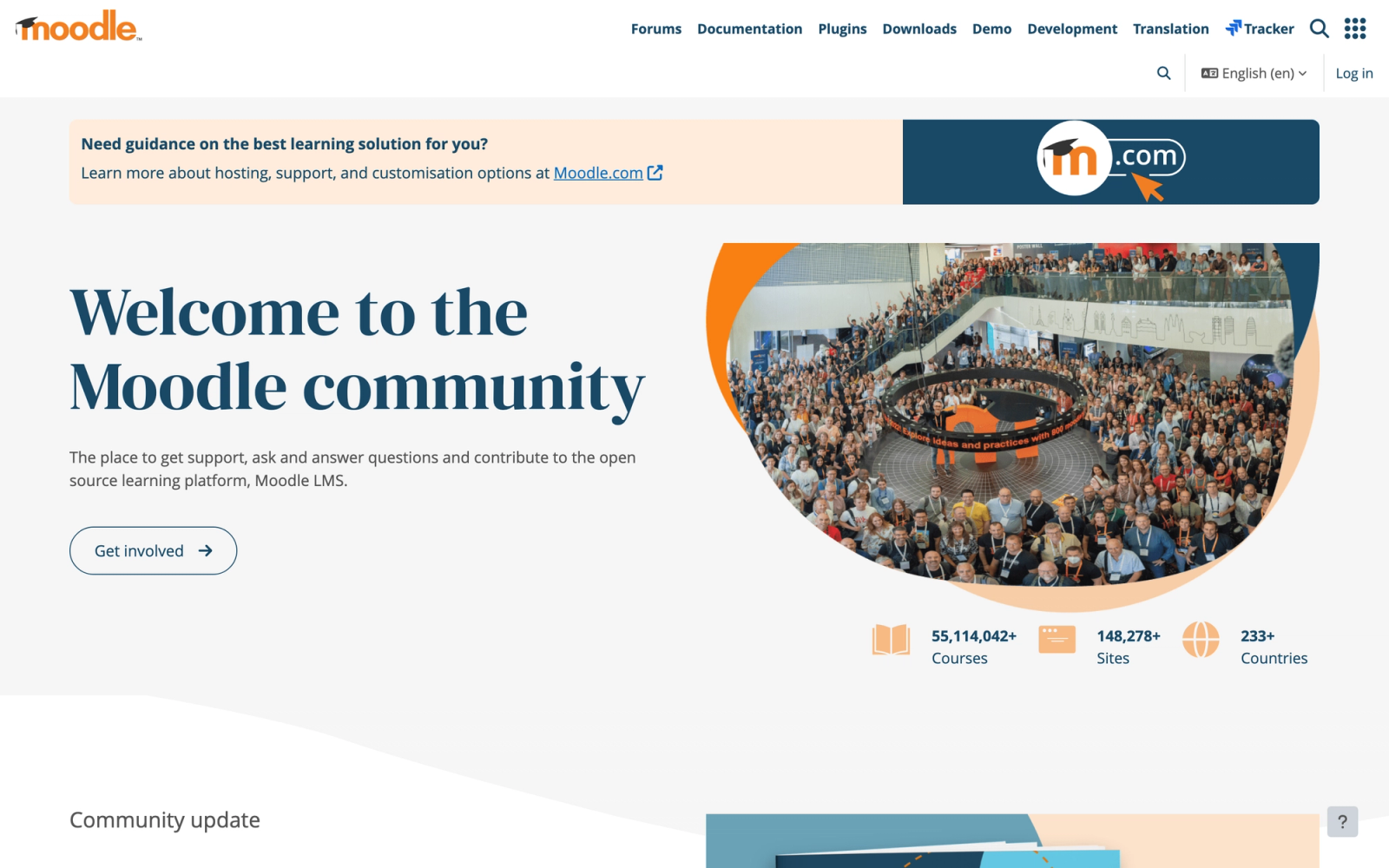
Moodle is the world's most widely deployed open-source learning management system. It is used by universities, schools, government agencies, and corporations across nearly every country. Where CYPHER Learning is a proprietary SaaS platform with custom pricing, Moodle is free to download, install, and modify, giving organizations complete control over their learning environment.
The trade-off with Moodle is well-known: the software is free, but the cost shifts to hosting, configuration, maintenance, and customization. The administration panel is dense. There are hundreds of settings, and the interface reflects Moodle's two-decade history. But for organizations with technical capacity, the flexibility is unmatched. You can customize virtually every aspect of the platform through plugins and theme modifications.
Core Capabilities
- Open-source codebase with full access to modify, extend, and self-host on any infrastructure
- Plugin library with over 2,000 community-built plugins covering analytics, gamification, content types, and integrations
- SCORM, xAPI, and LTI support for importing content and connecting external learning tools
- Flexible grading with weighted categories, rubrics, competency frameworks, and custom grading scales
- Quiz engine with 15+ question types, question banks, randomization, and adaptive testing
- Workshop activity for structured peer review with configurable assessment criteria
- Role-based access control with granular permissions at site, category, course, and activity levels
- Multi-language support with community translations covering 100+ languages
- Competency frameworks and learning plans for tracking skills development across courses
- Mobile app (Moodle App) with offline access and push notifications
Standout Strength
Moodle's defining advantage is total ownership: no vendor lock-in, no per-user fees, no feature gating behind a higher tier. Organizations with data sovereignty requirements, those that need workflows no SaaS platform can configure, or teams managing large learner populations where per-seat pricing becomes prohibitive all benefit from the open-source model. The full codebase is available to modify and self-host, which is a fundamentally different proposition from any proprietary platform.
Best For
Universities, government agencies, and large organizations with in-house technical teams (or Moodle Partner relationships) that need full control over their LMS. Strong fit for institutions with data residency requirements, organizations operating in multiple countries, and budget-constrained teams willing to invest technical effort instead of subscription fees.
Pricing Overview
- Free to download and self-host (open-source under GPL)
- Hosting costs range from $50 to $500+ per month depending on provider and scale
- MoodleCloud (hosted version) starts at $130 per year for up to 50 users
- Moodle Workplace (corporate version) uses custom enterprise pricing
Limitations
- The default user interface feels dated compared to modern SaaS platforms. Significant theme customization is needed to match the UX of tools like TalentLMS or Absorb.
- Self-hosting requires server management, security patching, and plugin compatibility testing. This is real ongoing work, not a set-and-forget deployment.
- Admin complexity is high. New administrators face a steep learning curve that exceeds even CYPHER's, and poorly configured Moodle instances can create frustrating learner experiences.
Quick Comparison Insight
Free and infinitely customizable compared to CYPHER's proprietary model. Requires technical investment that CYPHER does not, but delivers complete platform ownership and eliminates per-user pricing pressure at scale.
360Learning
Overview
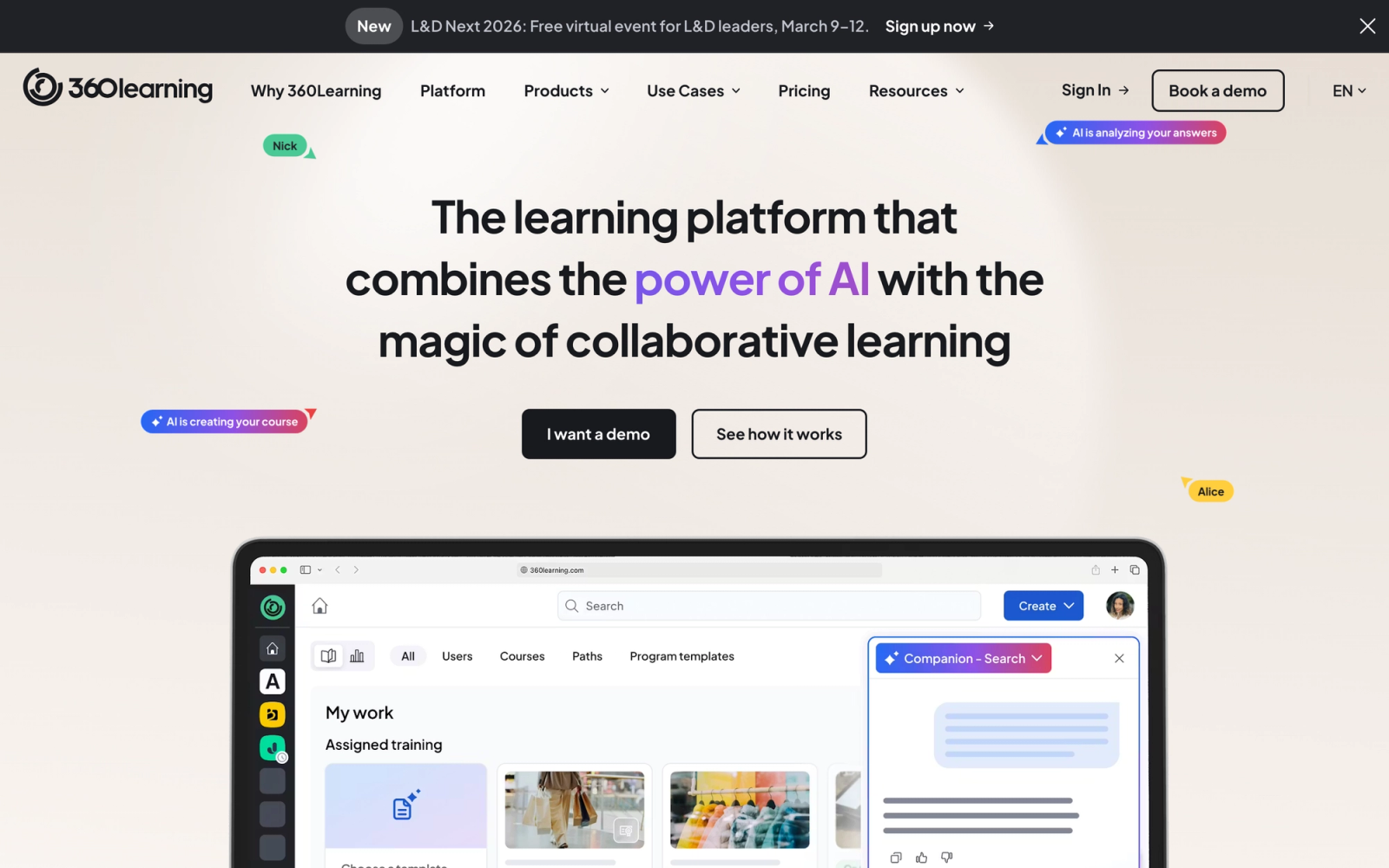
360Learning is a collaborative learning platform that takes a fundamentally different approach to how training content gets created and delivered. While CYPHER Learning and most traditional LMS platforms follow a top-down model where L&D teams build courses and push them to learners, 360Learning is built around the idea that subject matter experts across the organization should be creating and iterating on training content directly.
The platform's collaborative authoring tools stand out. Course creation is designed to be fast and accessible to non-instructional designers. Internal experts can draft a course, get peer feedback through built-in review workflows, and publish, all within the same tool. For organizations where knowledge sharing across teams is a priority, this model solves a bottleneck that traditional LMS platforms create.
Core Capabilities
- Collaborative authoring tool that lets subject matter experts create courses without instructional design backgrounds
- Built-in peer review and feedback workflows for course content before publication
- Reaction-based feedback system where learners can flag outdated, confusing, or irrelevant content in real time
- SCORM and xAPI support for importing externally authored content alongside native courses
- Learning path automation with conditional rules, prerequisites, and deadline management
- Discussion forums and collaborative activities embedded directly within courses
- Skills mapping that connects training content to organizational competency gaps
- Integrations with HRIS platforms (Workday, SAP SuccessFactors, BambooHR), Slack, Microsoft Teams, and Salesforce
- Analytics dashboards covering completion rates, learner satisfaction scores, and content quality metrics
- Mobile-responsive design with a dedicated mobile learning experience
Standout Strength
360Learning's real competitive advantage is decentralizing content creation. In organizations where the L&D team is a bottleneck because it cannot produce content fast enough to keep pace with business demand, the platform lets internal subject matter experts own the authoring process. Built-in peer review and learner reaction tools provide quality control without routing every course through a formal instructional design cycle. The result is that training content can be created, reviewed, and iterated by the people closest to the subject, rather than queuing through a central team.
Best For
L&D teams in mid-to-large organizations (500+ employees) where internal expertise is distributed across departments and the bottleneck is content creation speed. Particularly strong for compliance training that changes frequently, product training managed by product teams, and organizations investing in a culture of continuous learning.
Pricing Overview
- Team plan starts at $8 per active user per month for up to 100 users
- Business plan available with custom pricing for larger deployments
- Free trial available (30 days)
Limitations
- The collaborative model works best when the organization actively promotes internal content creation. Without cultural buy-in, the platform's core differentiator goes underutilized.
- Advanced reporting, while improving, does not yet match the depth of enterprise platforms like Docebo for complex multi-audience analytics.
- The platform is less suited for organizations that primarily purchase and deliver off-the-shelf content rather than creating their own.
Quick Comparison Insight
More collaborative than CYPHER Learning, with a content creation model that empowers subject matter experts. Less suited for top-down training delivery, but significantly faster for organizations that need to scale internal knowledge sharing.
LearnWorlds
Overview
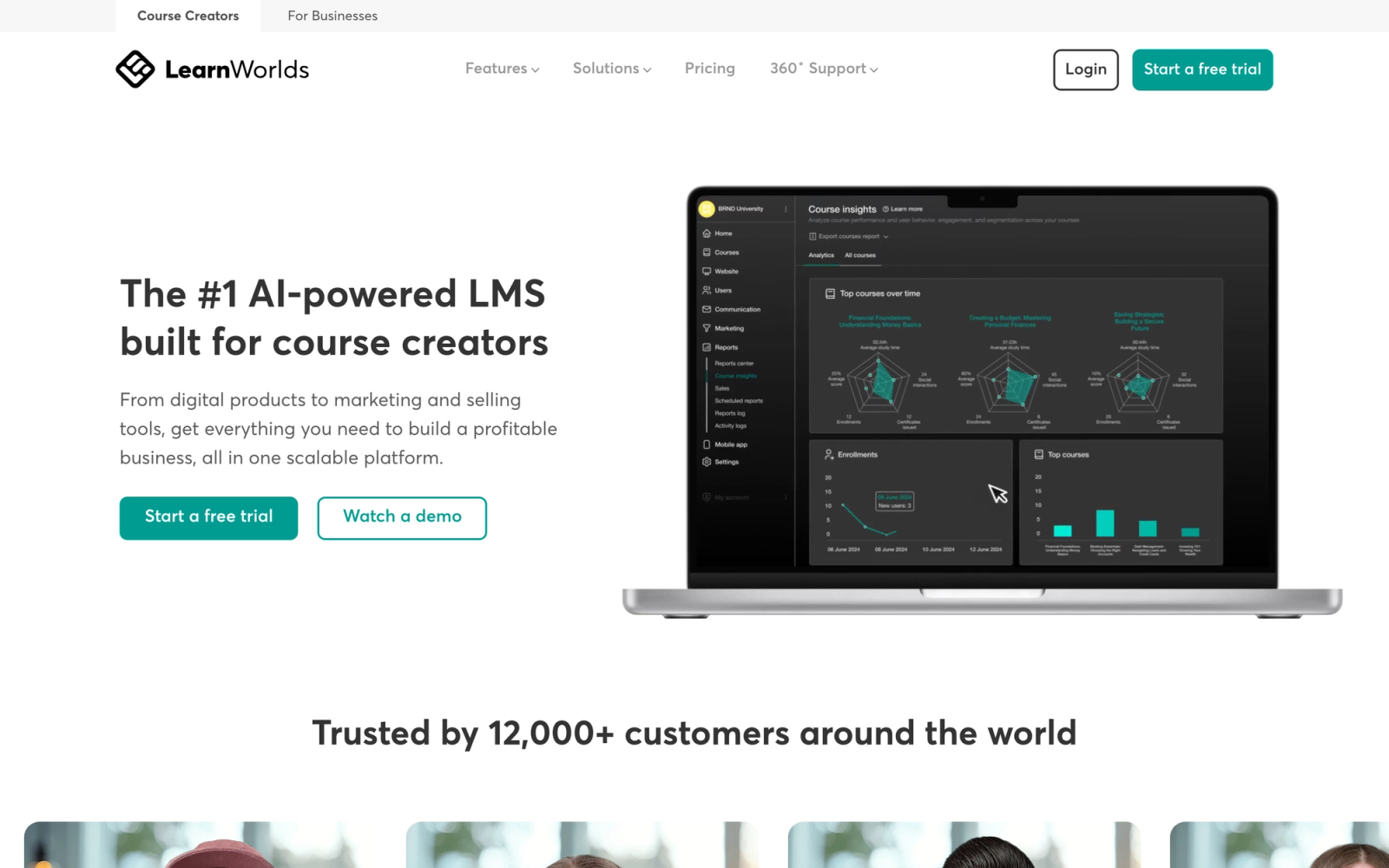
LearnWorlds is a course platform built for creators, training companies, and organizations that sell learning experiences. While CYPHER Learning is an LMS focused on managing internal training programs, LearnWorlds is designed for building, marketing, and selling courses with a strong emphasis on learner engagement and interactive content.
The interactive video editor is a standout feature. LearnWorlds lets you add clickable elements, quizzes, and branching paths directly inside video content, creating a level of interactivity that CYPHER's standard video player does not offer. The platform also includes a built-in website builder, so training businesses can create their entire online presence, from landing pages to course catalogs, without a separate CMS.
Core Capabilities
- Interactive video editor with in-video quizzes, clickable hotspots, transcripts, and note-taking overlays
- Built-in website and landing page builder with customizable templates for marketing course offerings
- SCORM support for importing externally authored content alongside native courses
- Built-in assessment engine with question banks, exam proctoring settings, and digital certificates
- eCommerce functionality with one-time purchases, subscriptions, bundles, coupons, and payment gateways
- Community features including discussion forums, social spaces, and learner profiles
- White-label customization with custom domain, branded mobile app, and CSS control
- Analytics dashboard with course sales data, learner engagement metrics, and funnel tracking
- Affiliate management system for scaling course sales through partner networks
- Zapier and native integrations with Mailchimp, HubSpot, Google Analytics, and payment processors
Standout Strength
LearnWorlds gives training businesses and course creators the tools to build, sell, and deliver courses from a single platform. The combination of interactive content authoring, eCommerce, and a built-in website builder means there is no need to stitch together a separate LMS, course hosting platform, and marketing site. Where a traditional LMS is organized around managing learner enrollment and completion, LearnWorlds is organized around generating revenue from educational content.
Best For
Independent course creators, training companies, coaching businesses, and organizations that monetize their training content. Particularly strong for businesses that need interactive video courses, branded learning portals, and integrated eCommerce without relying on third-party platforms.
Pricing Overview
- Starter plan at $24 per month (billed annually)
- Pro Trainer plan at $79 per month (billed annually)
- Learning Center plan at $249 per month (billed annually)
- High Volume and Corporate plans available with custom pricing
- 30-day free trial available on all plans
Limitations
- Not designed for managing large internal employee training programs. LearnWorlds lacks native HRIS integrations, compliance workflow automation, and multi-department admin structures.
- The website builder, while functional, does not offer the design flexibility of a dedicated platform like WordPress or Webflow for complex marketing sites.
- Transaction fees apply on the Starter plan, which can reduce margins for high-volume course sellers.
Quick Comparison Insight
Better than CYPHER Learning for selling courses and building interactive content. Not a replacement for managing internal corporate or academic training programs, but a stronger choice for monetizing educational content.
iSpring Learn
Overview
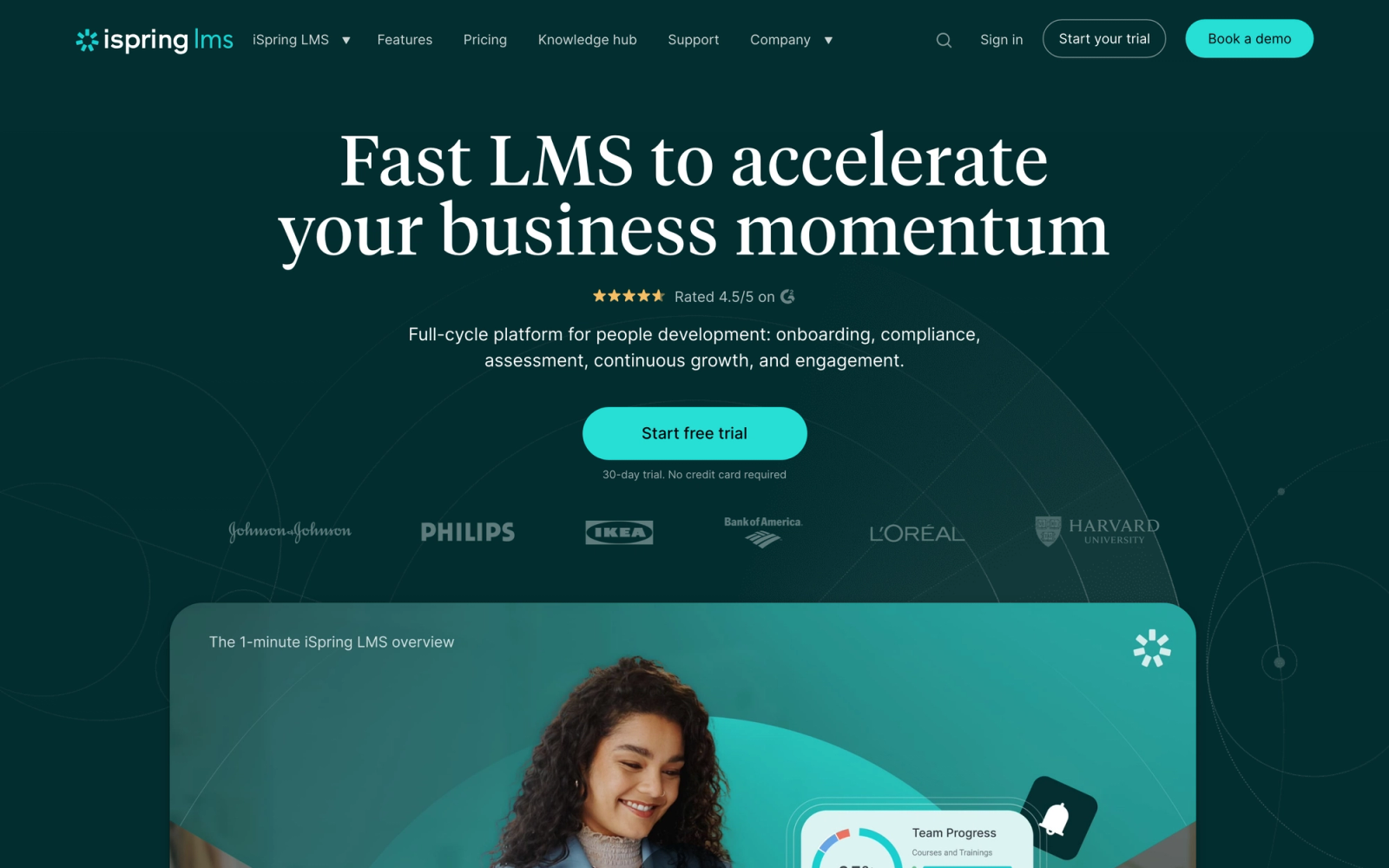
iSpring Learn is a corporate LMS developed by iSpring, a company best known for its PowerPoint-based authoring tool, iSpring Suite. This shared origin is the platform's defining characteristic: iSpring Learn is built around the assumption that most corporate training content starts in PowerPoint, and it creates the smoothest possible path from presentation to published course.
Where CYPHER Learning provides a broad platform with its own authoring environment, iSpring takes a different approach by pairing a focused LMS with one of the strongest rapid authoring tools in the market. The workflow from building a course in iSpring Suite to deploying it in iSpring Learn is as tight as you would expect from a single vendor. Courses publish directly into the LMS without export/import friction.
Core Capabilities
- Tight integration with iSpring Suite for converting PowerPoint presentations into interactive courses, quizzes, and simulations
- SCORM and xAPI support for hosting content created in any standard-compliant authoring tool
- Course assignment and learning path management with deadlines, prerequisites, and automated enrollment
- Built-in quiz engine with 14 question types, branching scenarios, and customizable feedback
- Role-play simulations (via iSpring Suite) for building dialogue-based training with branching outcomes
- Organizational structure management with department-based user organization and reporting hierarchy
- On-the-job training tracking with supervisor observation checklists and performance sign-offs
- Calendar and event management for scheduling instructor-led training sessions alongside online courses
- Mobile app with offline course access for frontline and field workers
- Detailed reporting with individual learner progress, team comparisons, and content effectiveness metrics
Standout Strength
iSpring's competitive advantage is the authoring-to-delivery pipeline. Training teams that already work in PowerPoint can convert existing presentations into interactive eLearning courses complete with quizzes, narration, and branching scenarios without adopting a new authoring environment. The continuity from a familiar format to a publishable online course reduces the production barrier significantly, especially for teams that need to update content frequently and cannot afford a lengthy rebuild cycle in an unfamiliar tool.
Best For
Corporate training teams (100 to 5,000 employees) that produce a high volume of PowerPoint-based training content. Strong fit for compliance-heavy industries (healthcare, finance, manufacturing) that need rapid content updates and on-the-job training verification.
Pricing Overview
- Starts at $2.29 per user per month for the Start plan (billed annually, 100 users minimum)
- Business plan at $3.14 per user per month with advanced features
- iSpring Suite authoring tool is licensed separately (starts at $770 per author per year)
- 30-day free trial available
Limitations
- The full value of iSpring Learn depends on purchasing iSpring Suite separately. Without the authoring tool, the LMS itself is functional but less distinctive.
- Social learning and collaborative features are minimal compared to platforms like 360Learning.
- The platform is built for corporate training delivery. It lacks academic features like gradebooks, peer review assignments, and student portfolio tools.
Quick Comparison Insight
Stronger content authoring pipeline than CYPHER Learning, especially for PowerPoint-heavy teams. Less versatile as a standalone LMS, but the combined iSpring Suite plus Learn package delivers a tighter author-to-learner workflow.
Open edX
Overview
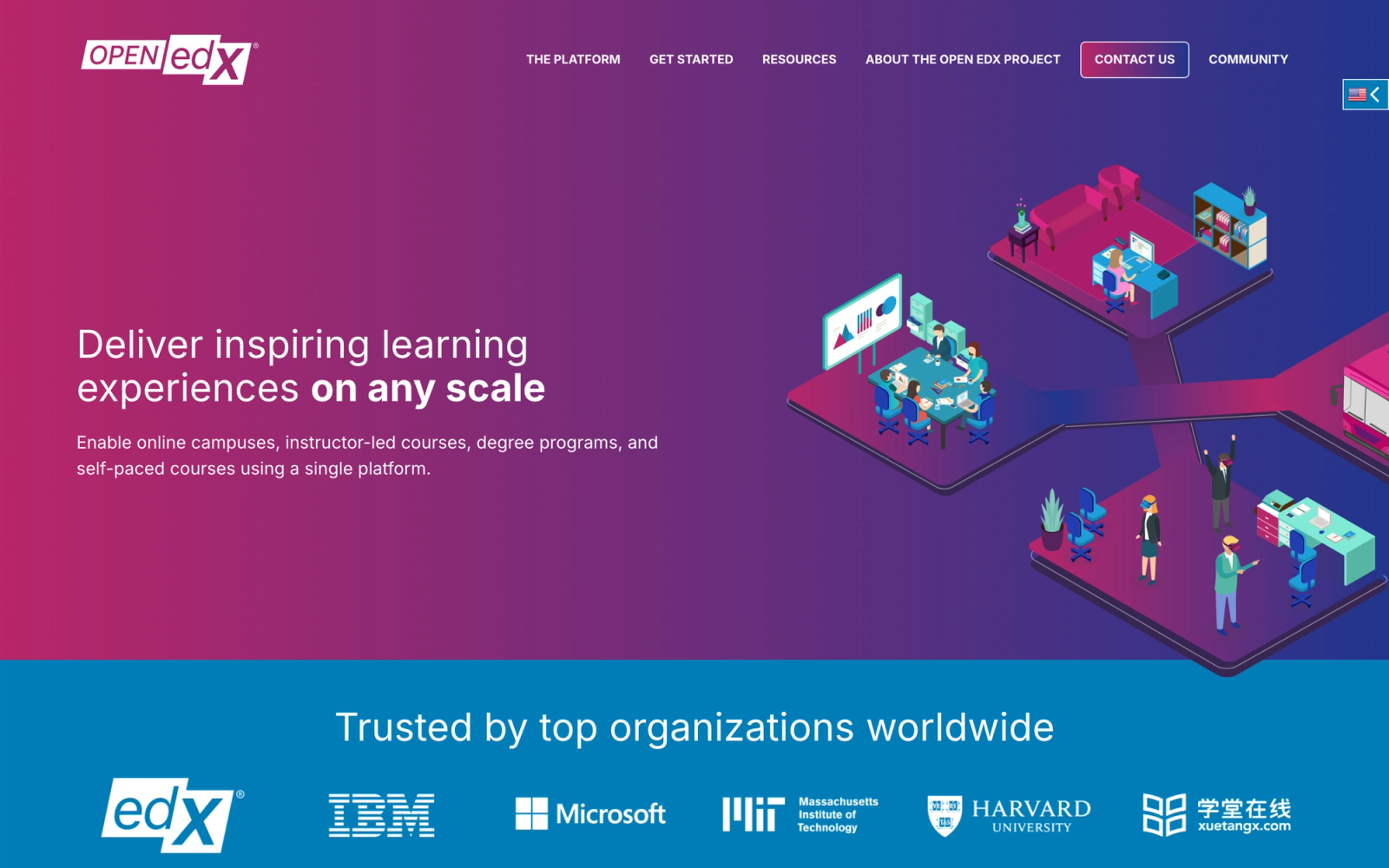
Open edX is the open-source learning platform that powers edX.org and online learning programs at MIT, Harvard, Stanford, and hundreds of other institutions and companies worldwide. It is designed for large-scale learning delivery, capable of handling hundreds of thousands of concurrent learners, a level of scale that CYPHER Learning's architecture is not typically deployed for.
Open edX is not a simple SaaS product you sign up for and start using. It is an open-source platform that requires either self-hosting or working with a hosting provider. The platform's strengths in structured course delivery and large-scale assessment are clear. The Studio authoring interface provides granular control over course structure, content sequencing, and assessment types. The trade-off is that setup, hosting, and customization demand real technical investment.
Core Capabilities
- Open-source codebase (AGPL license) with full access to modify, extend, and self-host
- Studio authoring environment for building structured courses with sequential units, components, and sections
- Proven scalability handling millions of learners (edX.org, national learning platforms, corporate academies)
- Advanced assessment types including drag-and-drop, code grading, math input, and peer-graded assignments
- XBlock plugin architecture for adding custom content types and third-party tool integrations
- Built-in discussion forums with topic threading, moderation, and learner reputation scoring
- Credential and certificate generation with verifiable digital certificates
- LTI provider and consumer support for connecting external tools
- Multi-language support with right-to-left language compatibility
- Analytics pipeline with learner event tracking and data export for custom reporting
Standout Strength
Open edX is built for scale and academic rigor at a level that few LMS platforms, proprietary or open-source, can match. Organizations running MOOCs, national education initiatives, or enterprise academies with tens of thousands of learners choose it because the platform has been proven in production at edX.org, at MIT, at Harvard, and across national learning programs worldwide. It handles massive concurrent learner populations reliably, which is a different engineering baseline than most platforms are designed around.
Best For
Universities, government education programs, and large enterprises running open learning initiatives or massive training academies. Best suited for organizations with development resources (or SaaS hosting partners) that need to deliver structured courses at scale with verifiable credentials.
Pricing Overview
- Free to download and self-host (open-source)
- Managed hosting through providers like Tutor, OpenCraft, or eduNEXT ranges from $500 to $5,000+ per month depending on scale
- edX-managed enterprise options available with custom pricing
Limitations
- Self-hosting requires significant DevOps expertise. The platform runs on a complex technology stack (Django, React, Docker, Kubernetes) that demands ongoing maintenance.
- The default learner interface, while functional, feels utilitarian compared to polished SaaS platforms. Custom theming requires frontend development work.
- Rapid course iteration is harder than in lightweight platforms. Open edX favors structured, planned course delivery over agile content updates.
Quick Comparison Insight
Far more scalable than CYPHER Learning and fully open-source, but requires meaningful technical investment. Better for large-scale structured learning programs; less practical for small teams that need quick, low-effort deployment.
How to Choose the Right Alternative
The right CYPHER Learning alternative depends less on which platform has the most features and more on how your organization delivers training.
If speed of deployment is the priority, TalentLMS gets you from setup to live courses faster than any other option on this list. It trades depth for simplicity, and for SMBs running standard training programs, that trade-off works.
If you need enterprise AI and deep integrations, Docebo is the natural fit. The implementation takes longer and costs more, but organizations running multi-audience training programs at scale need the configurability and HRIS connections that lighter platforms cannot provide.
If your training team creates content in PowerPoint, iSpring Learn paired with iSpring Suite creates the tightest authoring-to-delivery workflow. No other platform matches that specific pipeline.
If you are a university or academic institution, Canvas LMS is the established standard. For institutions that need open-source flexibility, Moodle offers full control at zero licensing cost.
If your L&D bottleneck is content creation speed, 360Learning's collaborative model decentralizes authoring so subject matter experts can create and update courses without waiting for the L&D team.
If you sell courses or training programs externally, LearnWorlds combines interactive content, eCommerce, and website building into a single platform built for that use case.
If you need proven scale for massive learner populations, Open edX handles hundreds of thousands of concurrent users, a level that most SaaS platforms cannot match.
If your training model is built around live cohorts, group activities, and peer interaction, Teachfloor is designed specifically for that facilitated learning experience.
Start with the pain point that is driving your search. If CYPHER's admin complexity is the issue, lean toward simpler platforms. If pricing opacity is the concern, prioritize tools with transparent pricing pages. If performance at scale is the problem, focus on platforms with proven infrastructure at your target learner count.
FAQ
Which CYPHER Learning alternative is best for cohort and community-based learning?
Teachfloor is the strongest fit. It supports self-paced, social, live, and cohort-based formats in one program, with built-in community, peer review, live Zoom sessions, AI course creation, and white-label branding on your own domain. Pricing starts at $89 per month for up to 50 learners with a 14-day free trial, which is more transparent and accessible than CYPHER's custom quotes.
Is CYPHER Learning the same as NEO LMS?
Largely yes. The company that built NEO LMS (for K-12 and higher education), MATRIX (for corporate training), and INDIE (for individual instructors) rebranded as CYPHER Learning and now markets a single platform under the CYPHER name. The underlying technology is shared, and CYPHER positions one product across academic and corporate use, so when people say NEO LMS today they are usually referring to CYPHER.
What is the most affordable CYPHER Learning alternative?
For self-paced corporate training, TalentLMS offers a free plan for up to 5 users, with paid Core plans starting at around $119 per month billed annually (about $149 monthly) for up to 100 users. For organizations with technical capacity, Moodle is free to download and self-host, with costs limited to hosting and maintenance. iSpring Learn also offers competitive per-user pricing starting at $2.29 per user per month.
Which CYPHER Learning alternative is best for large enterprises?
Docebo and Absorb LMS are the strongest fits for enterprise deployments. Docebo offers AI-powered recommendations, deep HRIS integrations, and multi-audience portal support. Absorb delivers a cleaner admin experience with strong reporting and mobile capabilities. Both use custom enterprise pricing.
Can I switch from CYPHER Learning without losing my course content?
Most platforms support SCORM content import, so courses built in SCORM-compliant format can transfer. Proprietary CYPHER features like gamification rules, automated learning paths, and platform-specific assessments will need to be rebuilt in the new system. Plan for a dedicated data migration phase and work with the new vendor's onboarding team to map your existing content structure.
Which alternative works best for both corporate and academic training?
CYPHER's multi-context approach is unusual. Most alternatives specialize. Moodle Workplace bridges corporate and academic use cases with open-source flexibility. If you need a single vendor, Docebo handles corporate training while Canvas serves academic needs, though using two platforms may actually deliver better results than forcing one tool across both contexts.


