

Absorb LMS is a polished, AI-enabled corporate LMS with a clean admin experience and strong content monetization. But it's priced for the enterprise — quote-based on active-learner bands, with costs that climb as you add features — and reviewers cite slow support. If you want something more social, simpler, or more affordable, there are solid alternatives.
The short answer: if you want collaborative, cohort-based learning that's simple to run and white-labeled, Teachfloor is the strongest Absorb LMS alternative. For enterprise scale, Docebo and Cornerstone are the closest peers; 360Learning leads on collaborative training; and TalentLMS is the simplest for smaller teams.
Below are the 8 best Absorb LMS alternatives in 2026, with what each does well, where it falls short, and real 2026 pricing.
Why look for an Absorb LMS alternative?
Absorb is a well-rated corporate LMS (4.6/5 on G2 across ~860 reviews). But it isn't right for everyone:
- Cost. Active-learner pricing and paid add-ons make total cost high and hard to predict.
- Gated features. Advanced capabilities sit behind higher-cost tiers and add-ons.
- Support. Reviewers report slow customer support response times.
- Less social. It's built for structured corporate delivery — lighter on social, cohort-based engagement.
If any of those describe you, the alternatives below are worth comparing.
How we evaluated these alternatives
We didn't rank these by feature count. We compared the Absorb LMS alternatives on the things that actually determine whether a platform works for you:
- Real cost: published tiers, transaction fees, and the add-ons that quietly inflate the bill.
- Depth of the learning tools: from simple self-paced modules to assessments, certificates, and structured paths.
- Engagement and community: whether the platform supports cohorts, live sessions, discussion, and peer feedback, or just content delivery.
- Customization and white-label: how much the experience can carry your brand and live on your own domain.
- Real user ratings: verified G2 and Capterra scores in 2026, plus the complaints that show up repeatedly in reviews.
A note on pricing: all prices below are in USD for annual billing and were verified in June 2026. Vendors change pricing often, so confirm the current numbers on each official site before you buy.
The 8 best Absorb LMS alternatives at a glance
| Platform | Best for | Starting price | Platform fees | User rating |
|---|---|---|---|---|
| Teachfloor | Cohort-based & community learning | $89/mo | Stripe fees only | 5.0 (G2) |
| Docebo | AI-first enterprise learning | Custom (~$25k+/yr) | — | 4.4 (G2) |
| TalentLMS | Simple SMB training | $119/mo | — | 4.6 (G2) |
| 360Learning | Collaborative team training | $8/user/mo | — | 4.6 (G2) |
| Cornerstone | Enterprise learning + talent | Custom | — | 4.0 (G2) |
| iSpring Learn | PowerPoint-based authoring | Custom (active users) | — | 4.6 (G2) |
| Moodle | Open-source / institutions | Free (self-host) | — | 4.1 (G2) |
| Continu | Modern workplace enablement | Custom | — | 4.7 (G2) |
Quick verdict: pick Teachfloor for cohort-based, collaborative learning, Docebo or Cornerstone for enterprise scale, 360Learning for collaborative training, TalentLMS or iSpring for simple SMB training, Moodle for open-source control, and Continu for modern enablement.
1. Teachfloor — best for cohort-based & collaborative training
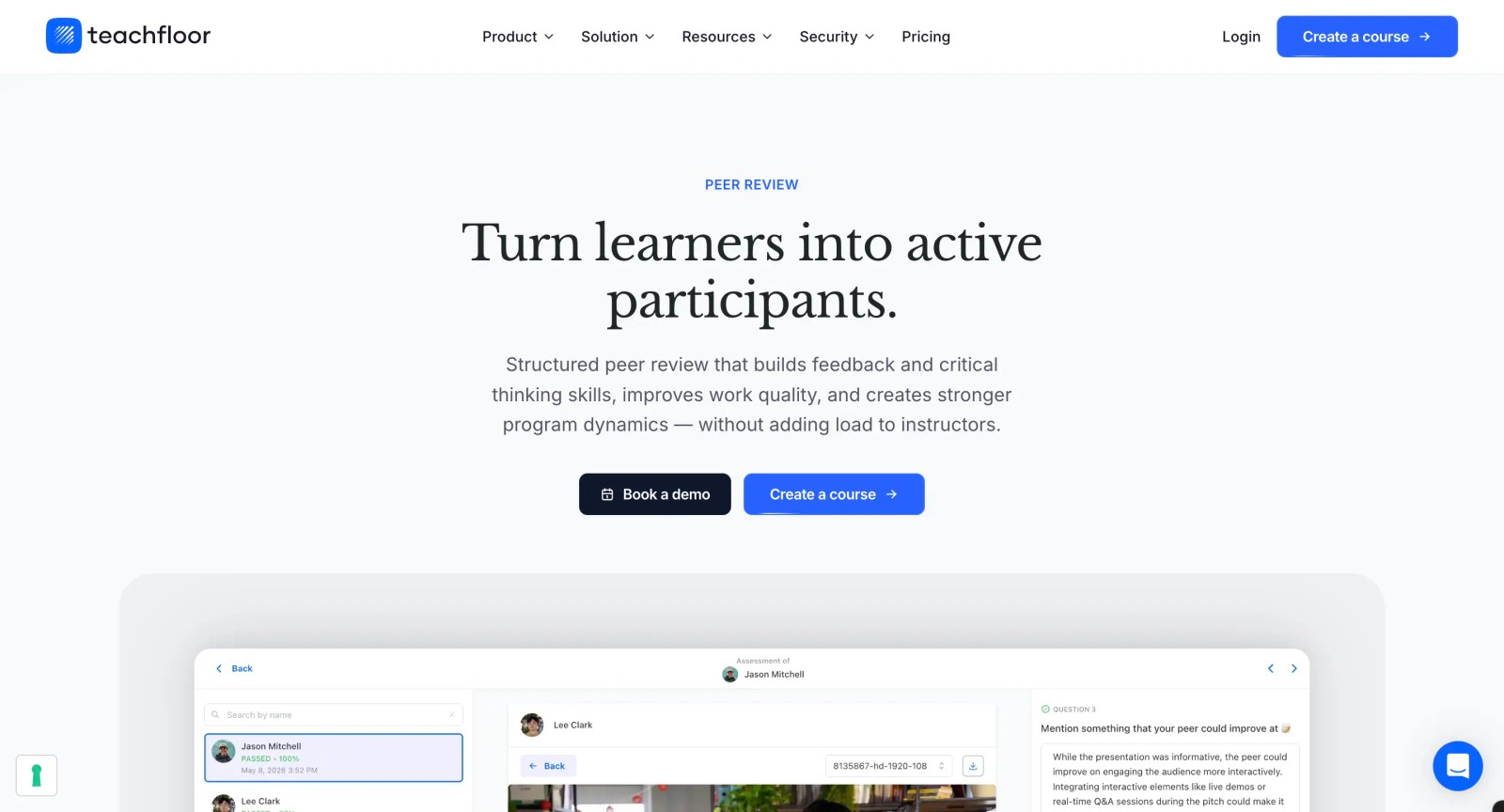
Teachfloor is a collaborative learning platform built for cohort-based and community-driven training — the social, engaging side that heavyweight corporate LMSs often miss. You get live sessions, peer review, assignments, and a community layer, all white-labeled, without enterprise complexity or enterprise pricing.
Where it beats Absorb LMS:
- Cohort-based, social learning with live sessions and peer review — not just self-paced content delivery like Absorb.
- Built-in peer review with AI-assisted rubrics and group activities that drive engagement and completion.
- White-label branding on your own domain, included without enterprise-tier pricing.
- AI course generation and grading, with a far simpler setup than a heavyweight LMS.
Where it falls short: it's built for structured academies and team training rather than massive, fully self-serve content marketplaces, plans are seat-based (the entry tier includes 50 seats), the $89/mo starting price is higher than budget tools, and the ecosystem is newer than the incumbents.
Pricing: Startup at $89/month (50 seats, unlimited courses, 10 GB) covers course creation, peer review, group activities, and Zoom/Stripe integrations. The Full Features plan (custom pricing) adds white-label, advanced automations, SSO, and priority support. A free trial is available.
Rating: 5.0/5 on G2 (~45 reviews) and 4.7/5 on Capterra.
Choose Teachfloor if you run cohort-based academies or team training and want engagement and completion over a structured content-delivery LMS.
2. Docebo — best AI-first enterprise platform
Docebo is an AI-first enterprise LMS with extended-enterprise portals and a content marketplace — a heavyweight alternative to Absorb for large, multi-audience training.
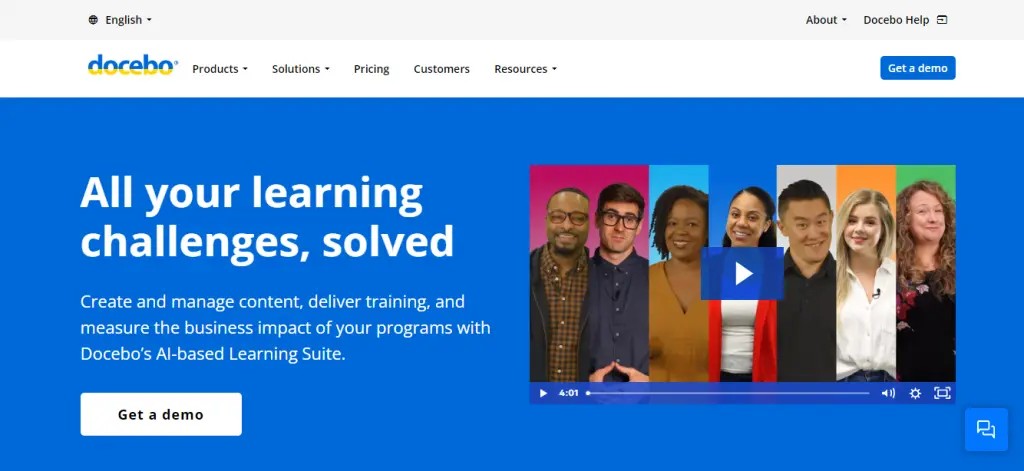
Standout strengths: the AI-first Docebo suite (AI content creation, neural search, virtual coaching, and the agentic 'Harmony' co-pilot); extended-enterprise multi-domain portals for training partners, customers, and franchisees; and a built-in content marketplace with broad HRIS and tool integrations.
Where it falls short: it's a premium platform with high minimum contracts that's expensive for smaller organizations, admin setup and configuration are complex, and reviewers report slow support and occasional performance lags.
Pricing: quote-based and billed annually across Elevate and Enterprise tiers; exact list prices aren't published, but total cost of ownership commonly starts around $25,000/year and scales by active users (roughly $7–$10/user/month in third-party estimates).
Rating: 4.4/5 on G2 (~500–740 reviews), 4.4/5 on Capterra (~230 reviews).
Choose Docebo if you want an AI-first enterprise platform for training employees, partners, and customers at scale.
3. TalentLMS — best for simple SMB training
TalentLMS is the easy, affordable option with a usable free plan — a simpler, cheaper alternative to Absorb's enterprise pricing.
Standout strengths: ease of use and fast deployment praised across reviews; the TalentCraft AI authoring suite with tiered AI credits; and a genuinely usable free plan (up to 5 users and 10 courses) plus built-in gamification.
Where it falls short: the content editor and customization are limited (restricted fonts, layout, and formatting), reporting feels basic for deeper needs, and some users report occasional bugs and unreliable notifications.
Pricing: a free plan (5 users, 10 courses), then Core $119/mo (40 users), Grow $229/mo (70 users), Pro $449/mo (100 users), and a custom Enterprise tier; all paid plans include unlimited storage.
Rating: 4.6/5 on G2 (~793 reviews), 4.7/5 on Capterra (~596 reviews).
Choose TalentLMS if you're a small-to-midsize team that wants simple, scalable training.
4. 360Learning — best for collaborative team training
360Learning blends top-down training with peer-driven, expert-led collaboration — more social than Absorb's structured delivery.
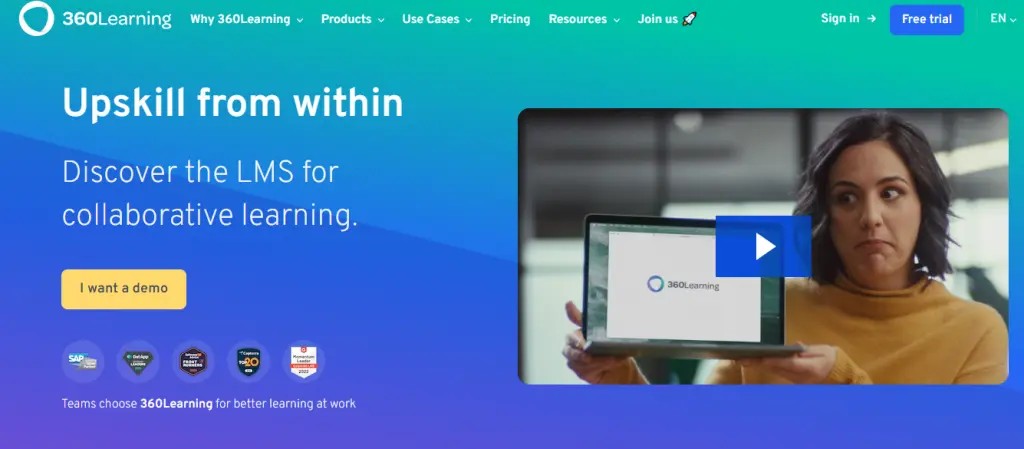
Standout strengths: collaborative authoring with built-in feedback loops, where subject-matter experts co-create and peers comment and upvote courses; AI-assisted course and quiz generation from existing documents; and structured academies with integrated coaching and forums.
Where it falls short: reporting and analytics are limited (advanced dashboards are gated or missing), branding and look-and-feel customization is constrained, and live-session capabilities are weaker than competitors.
Pricing: the Team plan is $8/user/month (up to 100 users), with custom-quoted Business and Enterprise tiers for larger orgs; there's a free trial.
Rating: 4.6/5 on G2 (~580 reviews), 4.7/5 on Capterra (~490 reviews).
Choose 360Learning if you want to scale internal, collaborative training.
5. Cornerstone — best enterprise learning and talent suite
Cornerstone unifies learning with performance, succession, and recruiting plus an AI skills graph, for large global organizations.
Standout strengths: an AI-driven skills graph (Cornerstone Galaxy) that maps gaps and personalizes learning; a full unified talent suite spanning learning, performance, succession, and recruiting; and a large content library with deep reporting and configurability.
Where it falls short: cost is high and opaque (quote-only, plus heavy implementation and content fees), rollouts are long and resource-intensive, and the learner-facing interface is frequently described as dated.
Pricing: quote-based, sold as per-user-per-month modules on annual or multi-year enterprise contracts; third-party estimates put it around $4–$10/user/month plus significant implementation costs. Exact list prices aren't published.
Rating: 4.0/5 on G2 (~800 reviews), 4.3/5 on Capterra (~232 reviews).
Choose Cornerstone if you need an integrated learning and talent suite at enterprise scale.
6. iSpring Learn — best for PowerPoint-based authoring
iSpring Learn pairs an easy LMS with PowerPoint-based authoring for fast course creation — a simpler, quick-to-deploy alternative to Absorb.
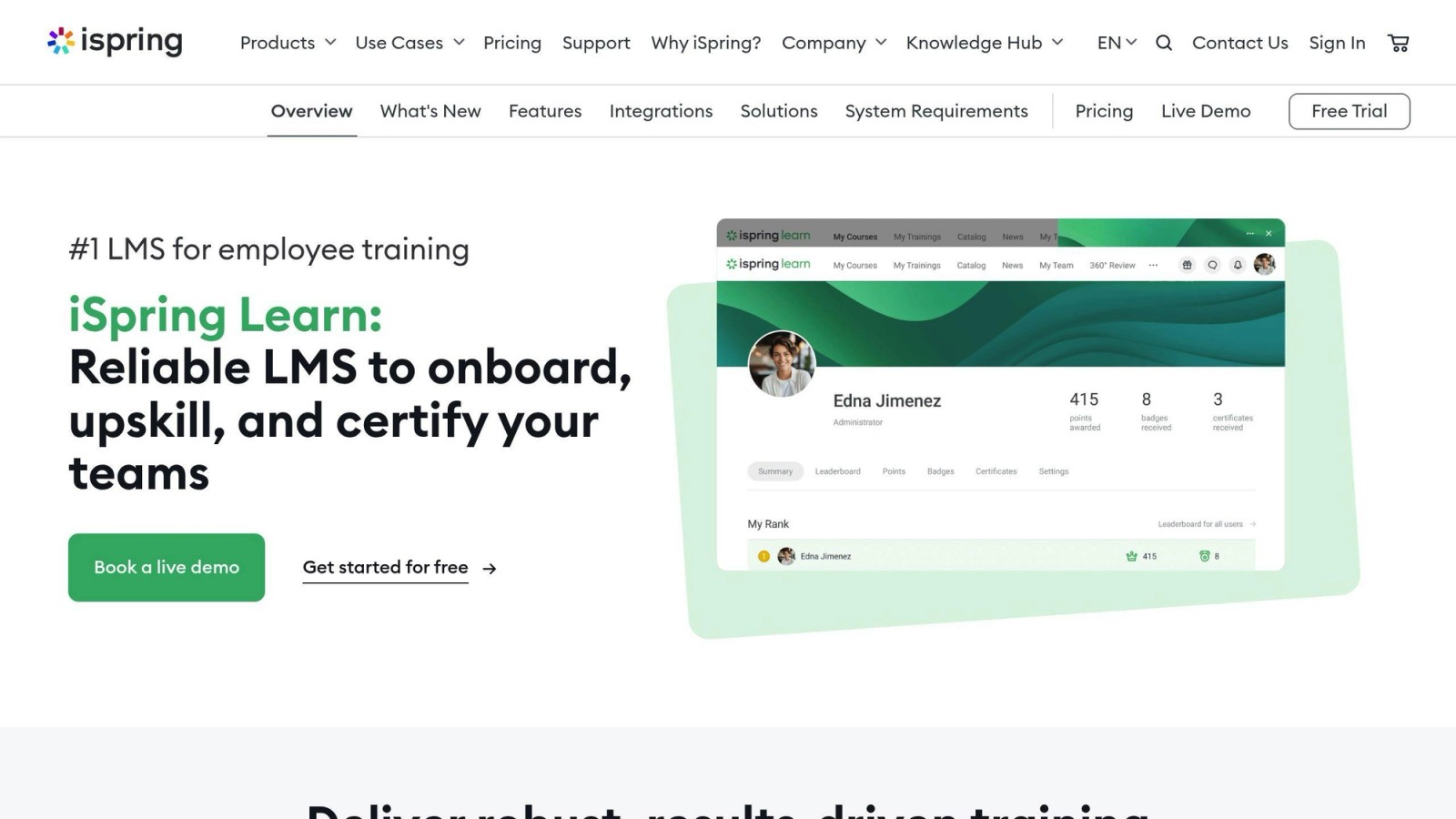
Standout strengths: PowerPoint-based authoring via iSpring Suite for fast SCORM course creation; quick setup and ease of use that admins consistently praise; and strong compliance reporting with a polished native mobile app that supports offline learning.
Where it falls short: the full authoring power lives in iSpring Suite, a separate product, branding and customization are limited, and some reviewers find advanced reporting lacking.
Pricing: an active-user model (you pay only for users who log in each month) sold in 100/300/500-user bands plus a custom Enterprise tier; iSpring doesn't publish a transparent per-user table, so confirm with sales.
Rating: 4.6/5 on G2 (~100+ reviews), 4.7/5 on Capterra (~192 reviews).
Choose iSpring Learn if you want fast deployment and PowerPoint-based course creation.
7. Moodle — best open-source option
Moodle is the open-source standard — free to self-host or managed via MoodleCloud — for organizations that want control and low licensing cost.
Standout strengths: open-source flexibility with 1,800+ plugins; strong standards support including LTI and SCORM (Teachfloor integrates with Moodle via LTI); and a deep pedagogical toolset — quizzes, assignments, workshops, and completion tracking — backed by a huge global community.
Where it falls short: self-hosting demands real technical resources for setup, updates, and security, the interface is dated and click-heavy, and there's a steep learning curve for admins and instructors.
Pricing: self-hosted Moodle is free (you pay for hosting and maintenance); MoodleCloud runs from $170/year (50 users) up to $2,120/year (750 users), with a 28-day free trial.
Rating: 4.1/5 on G2 (~437 reviews), 4.3/5 on Capterra (~3,378 reviews).
Choose Moodle if you want maximum control at low licensing cost and have technical resources.
8. Continu — best for modern workplace enablement
Continu is a modern enablement platform with a clean UX, AI authoring, and deep HRIS integrations that auto-route training to the right people.
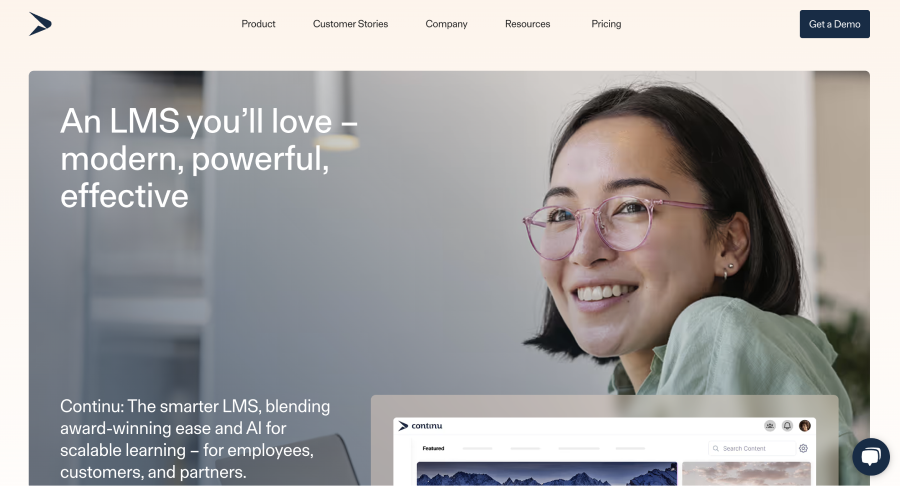
Standout strengths: a modern, intuitive UX with AI-assisted content authoring; automation via smart segmentation and an AI agent (Eddy) that delivers training inside Slack and Teams; and deep HRIS and tool integrations (Workday, BambooHR, Okta, Salesforce) for auto-provisioning.
Where it falls short: customization can require vendor support to go deeper, reviewers note occasional performance slowdowns, and some find reporting and analytics less advanced than needed.
Pricing: quote-based and billed annually per seat across Growth (under ~250 learners), Professional (~250–5,000), and Enterprise (5,000+) tiers; exact figures aren't published.
Rating: ~4.7/5 on G2, ~4.8/5 on Capterra (~72 reviews).
Choose Continu if you want a modern, well-integrated platform to train employees, partners, and customers.
How to choose the right Absorb LMS alternative
Match the platform to how your organization actually learns:
- If you want engaging, cohort-based training: Teachfloor — live sessions, peer review, and community.
- If you need a full enterprise suite at scale: Docebo or Cornerstone.
- If you want collaborative, expert-led training: 360Learning.
- If you want simple SMB training: TalentLMS, or iSpring for PowerPoint-based authoring.
- If you want SOPs and onboarding: Trainual.
- If you want open-source control: Moodle.
Where to go next
Comparing platforms? These guides and product pages go deeper:
- Docebo alternatives
- Cornerstone alternatives
- TalentLMS alternatives
- Corporate training platform
- Peer review & assessments
Frequently asked questions
What is the best Absorb LMS alternative?
It depends on your needs. For collaborative, cohort-based learning that's simple to run, Teachfloor is the best Absorb LMS alternative. For enterprise scale, Docebo and Cornerstone are the closest peers, 360Learning leads on collaborative training, and TalentLMS is simplest for smaller teams.
Is there a cheaper alternative to Absorb LMS?
Yes. TalentLMS has a free plan and starts at $119/month, iSpring and 360Learning are affordable for SMBs, and Moodle is effectively free if you self-host. Teachfloor starts at $89/month.
Why do organizations switch from Absorb LMS?
Common reasons are high, hard-to-predict active-learner pricing, advanced features gated behind add-ons, slow support, or wanting more social, cohort-based engagement than a structured corporate LMS provides.
Which Absorb alternative is best for small teams?
TalentLMS is the simplest and most affordable for SMBs, with a free plan, and iSpring Learn is great for fast, PowerPoint-based course creation. Teachfloor suits smaller teams running cohort-based, collaborative academies.
Can I migrate from Absorb LMS to another platform?
Yes. Most platforms support importing course content, including SCORM. Teachfloor lets you bring content in and rebuild it as cohort-based or self-paced courses, then add peer review, community, and white-label branding.


