

Why Look for a Schoox Alternative?
Schoox built its reputation in frontline and deskless workforce training, particularly for restaurants, retail, hospitality, manufacturing, and franchise operations that need to train hourly staff across many locations. It is a capable platform, but teams that have run it at scale often hit specific friction points that push them to compare alternatives.
Complex admin interface. Schoox packs a lot into its admin panel, and the trade-off is a steep learning curve. New administrators frequently report that building a course catalog, configuring location-based groups, or setting up automated enrollments takes longer than expected. If your L&D team is small or lacks a dedicated admin, that configuration overhead is a real drag.
Mobile app reliability. Frontline training lives or dies on mobile. Schoox offers a mobile app, but user reviews on G2 flag performance inconsistencies, slow load times, and occasional crashes. When your learners are on a shop floor or behind a counter between shifts, a stuttering mobile experience pulls completion rates down.
Reporting customization. The built-in reports cover standard metrics, but teams that need cross-location comparisons, franchise-level rollups, or custom dashboards often find the reporting module restrictive and end up exporting data to spreadsheets to do the real analysis.
Basic content authoring. Schoox handles simple content assembly, but it falls short for interactive scenarios, branching, or true bite-sized microlearning. Teams that want short, repeatable lessons for shift workers often supplement it with a separate authoring tool, which adds cost and workflow complexity.
Support response times. Several user reviews point to slow support turnaround on non-enterprise accounts. When a platform issue blocks training delivery across locations, waiting days for a fix is an operational risk, not a minor annoyance.
None of these affect every organization equally. But if your team spends more time fighting the platform than training people, the alternatives below address those gaps from different angles, from frontline-native microlearning to flexible social learning.
What to Look for in a Frontline Training Platform
Schoox serves deskless and distributed teams, so the criteria that matter most are not the same as for a desk-based corporate LMS. Before comparing tools, get clear on how your people actually learn. For a broader view of this category, our guide to the best corporate training platform options breaks down the trade-offs.
Mobile-first and offline. If you train deskless, shift, or field workers, the mobile experience is the product, not a feature. Test the real app or responsive interface, including offline access for low-connectivity sites like warehouses and back-of-house areas.
Microlearning and reinforcement. Frontline staff learn in the gaps between tasks. Short, repeatable lessons with spaced reinforcement beat hour-long modules. Look for built-in microlearning rather than a tool that only imports long SCORM packages.
Multi-location and franchise structure. You need to roll training out by location, region, or franchisee, with branded portals and per-site reporting. Audience and branch segmentation should be native, not a workaround.
Shift-worker compliance. For regulated industries, verify the platform handles certification tracking, automatic re-enrollment, audit trails, and expiration alerts natively. For a deeper look at how vendors price this, see our breakdown of LMS pricing models.
Engagement and social learning. Completion is the hard part. Platforms that add community, discussion, peer feedback, and live sessions tend to drive better retention than passive content alone. A peer learning platform approach turns frontline staff into contributors, not just consumers.
Scalability and pricing model. Per-user pricing can balloon across thousands of hourly workers. Flat-rate or tiered models sometimes offer better economics at frontline scale.
10 Best Schoox Alternatives
The platforms below range from frontline-native microlearning tools to flexible social-learning platforms and full enterprise suites. Each one addresses one or more of the pain points above. The table gives you a quick read before the detailed write-ups.
| Platform | Best for | Frontline / mobile | Starting price | Free trial |
|---|---|---|---|---|
| Teachfloor | Flexible social, live and cohort training plus branded academies | Responsive mobile web | $89/mo (50 learners) | 14 days |
| Axonify | Frontline microlearning and reinforcement | Mobile-first, daily microlearning | Custom quote | Demo only |
| eduMe | Deskless and distributed workforce onboarding | Mobile-first, SMS and QR delivery | ~$3.49/user/mo (100+ users) | Demo only |
| Trainual | Franchise and multi-location SOPs and onboarding | Mobile app | $49/mo (5 users) | 7 days |
| Continu | Modern, AI-assisted multi-audience training | Mobile access | ~$10/user/mo | Demo only |
| Litmos | Off-the-shelf compliance content library | Mobile app, offline access | ~$4/user/mo | 14 days |
| Docebo | Enterprise AI-driven learning at scale | Mobile app, offline access | ~$25,000/yr | Demo only |
| TalentLMS | Affordable, fast SMB setup | Mobile app | $149/mo (Core) | Free plan |
| Absorb LMS | Polished admin and reporting for mid-market | Mobile app, offline access | Est. $10,000+/yr | Demo only |
| LearnUpon | Multi-portal franchise and partner training | Responsive mobile web | Custom quote | Demo only |
| 360Learning | Collaborative, expert-led content creation | Mobile app | $8/user/mo | Demo only |
Teachfloor
Overview
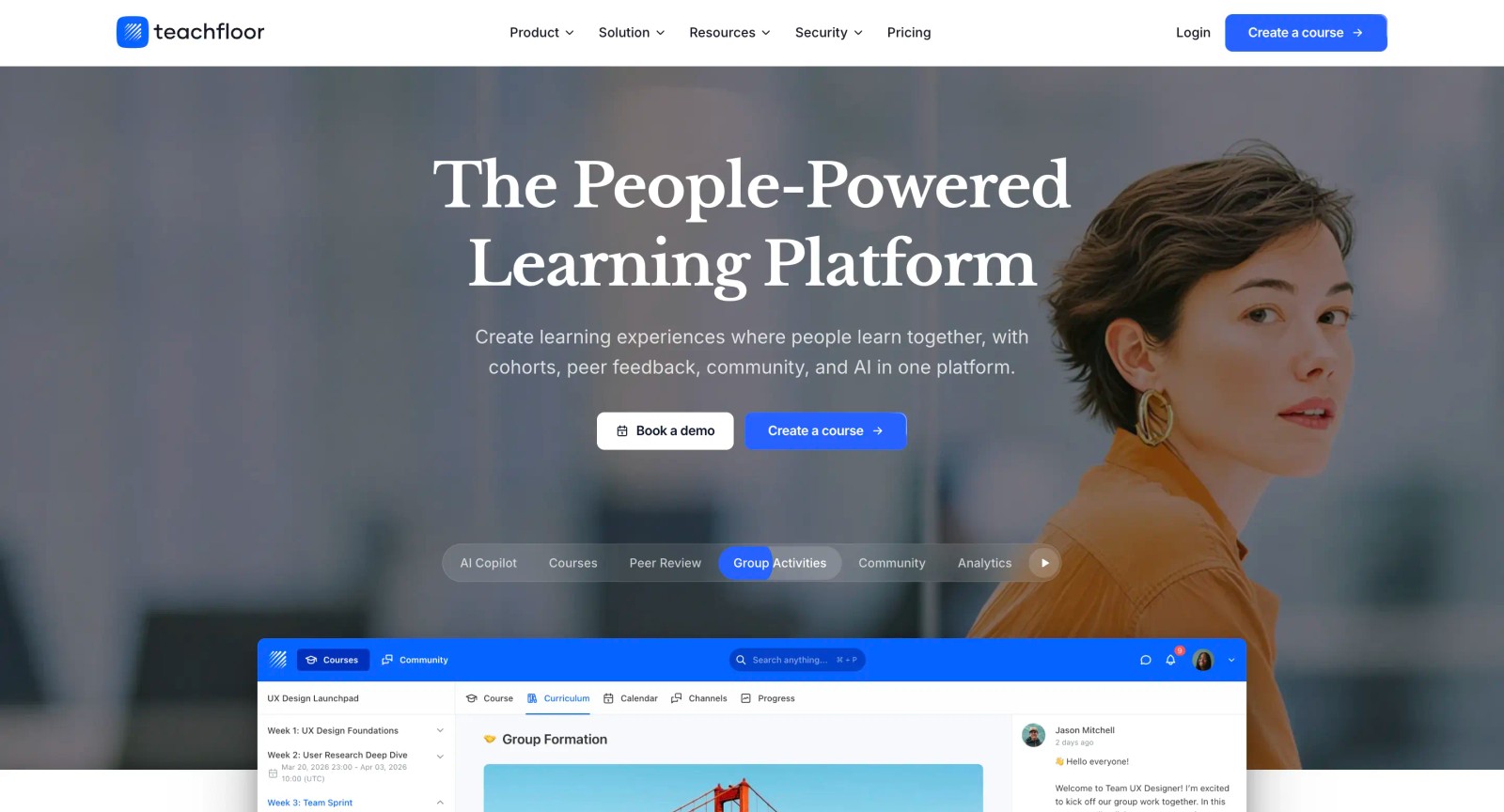
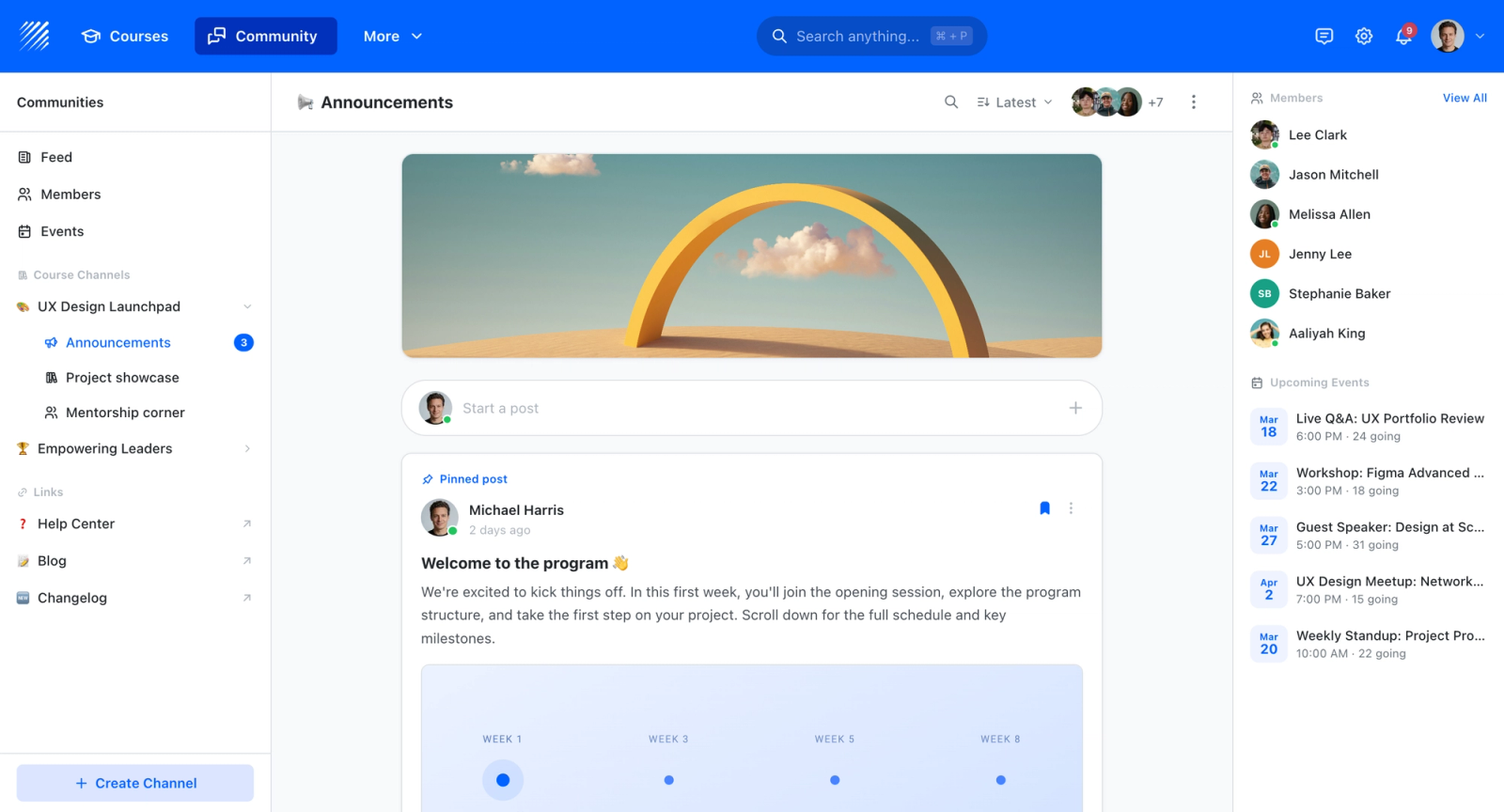
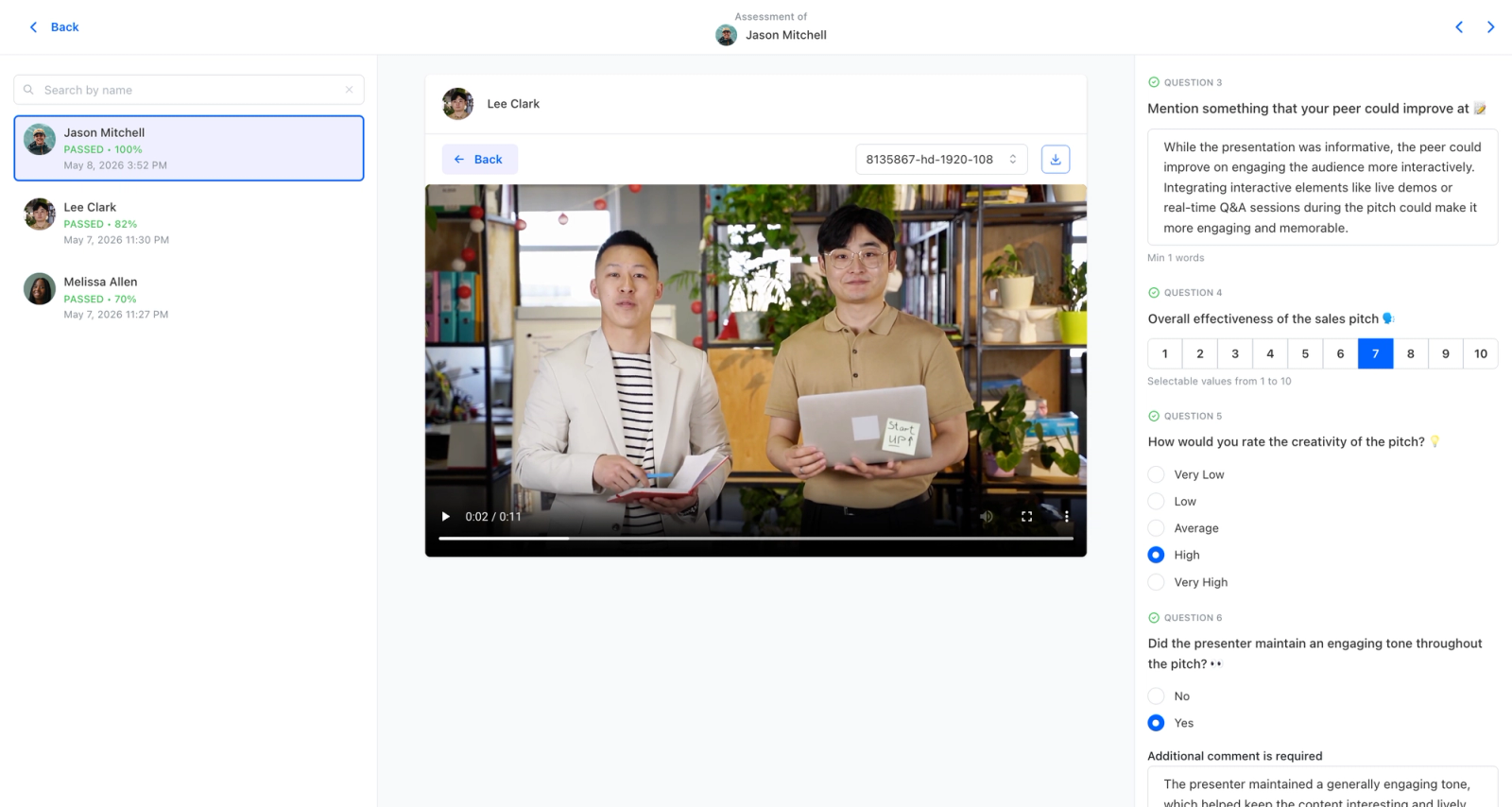
Teachfloor is a social learning platform designed for franchise operators and multi-location teams that want a simpler administration experience than Schoox. Discussion threads, group activities, and rubric-based peer review let dispersed staff learn from each other rather than clicking through modules in isolation, which fits hourly workers across branches or locations. Each branch gets its own learning space under central oversight, so regional managers see only their people while the platform admin retains full visibility. Content can be authored with AI assistance and delivered self-paced for shift workers or in scheduled cohorts for structured onboarding programs.
Core Capabilities
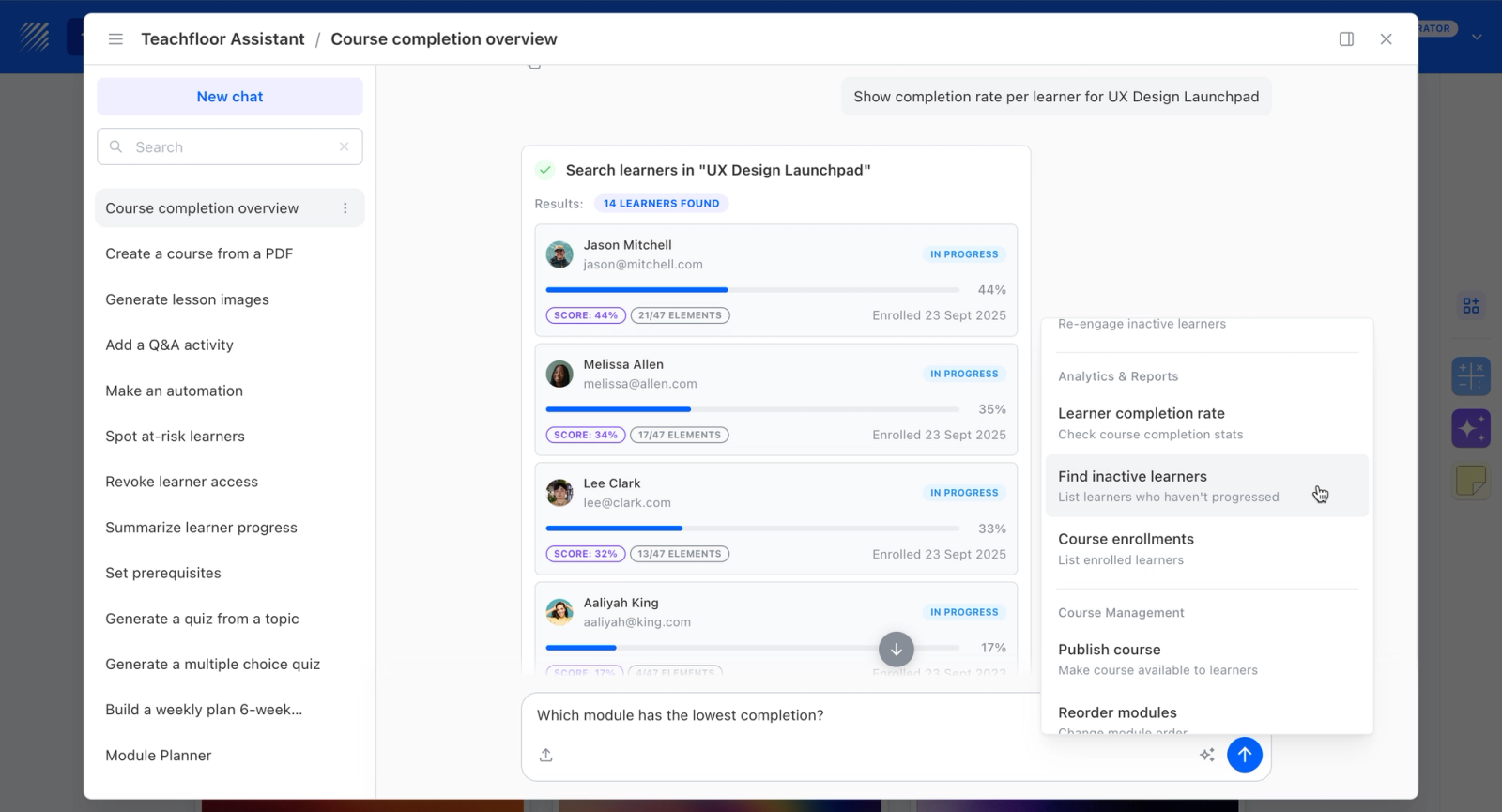
- Strong social and active learning through discussion, group activities, and weighted peer review, keeping the peer-to-peer strength Schoox is known for without the admin weight
- Multi-branch structure that fits franchise and multi-location operations, giving each branch its own learning space under central oversight
- AI-assisted authoring plus self-paced and cohort delivery, so you can produce training quickly and let shift workers learn on their own schedule
- White-label on your own domain to keep training on-brand across all locations, plus quizzes and certificates for role readiness
- SCORM support and analytics to bring in existing courses and report on completion across branches
Best For
Frontline, franchise, and multi-location operators who valued Schoox's social learning but want a cleaner platform to administer, with branch-level structure and peer engagement that hourly staff will actually use.
Pricing Overview
- Startup plan from $89 per month for up to 50 learners
- Full Features plan with custom pricing, white-label, SSO, and advanced integrations
- 14-day free trial; no permanent free plan
- Nonprofit discounts available
Limitations
- Not built as a deskless-mobile-first app the way some pure frontline tools are, so very heavy mobile-only, offline-shift use cases may want a dedicated frontline product
- Lighter on the deep gamification and content-library breadth Schoox bundles, since the focus is on authored courses and active learning
- No free plan; $89/mo for up to 50 learners means very large hourly rosters move into custom pricing territory
Quick Comparison Insight
Schoox includes more features in its admin panel. Teachfloor offers social, peer-driven learning and multi-location structure with a simpler administration experience.
Axonify
Overview
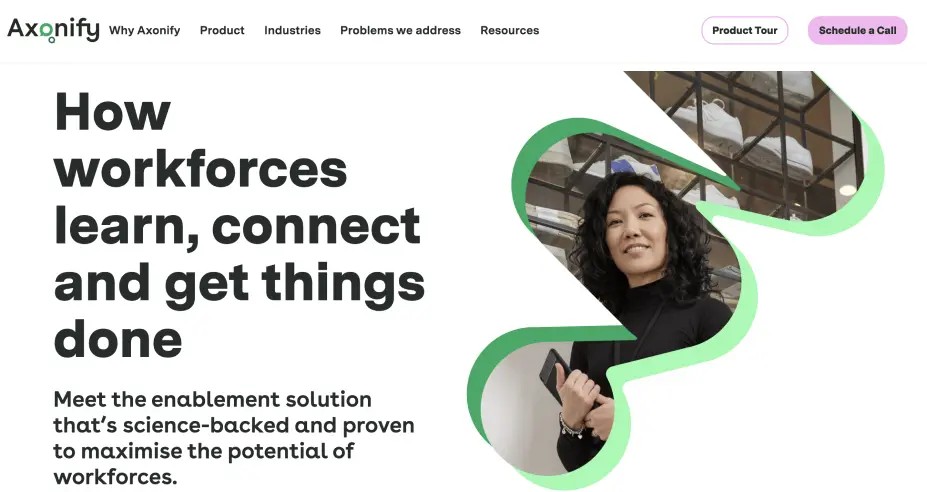
Axonify is built specifically for deskless workers in retail, manufacturing, grocery, and logistics. Its training model is daily, bite-sized microlearning: lessons run three to five minutes and are designed to slot into a shift rather than displace one. Where Schoox functions as a general workforce LMS, Axonify starts from the premise that frontline staff rarely have an uninterrupted hour to sit through a course.
The platform uses spaced repetition and adaptive questions to reinforce knowledge over time, then ties that to on-the-job behavior and operational outcomes. For organizations whose Schoox completion rates stalled because modules were too long, Axonify's microlearning cadence is a structurally different approach.
Core Capabilities
- Daily microlearning delivered in short, gamified bursts designed for shift work
- Adaptive reinforcement using spaced repetition and confidence-based questions
- Mobile-first experience built for deskless and frontline workers
- Targeted communications and task-based learning tied to operational priorities
- Analytics linking training to behavior and business outcomes
- Content authoring plus a library of ready-made frontline topics
- Integrations with HRIS, workforce management, and communication tools
Standout Strength
Axonify's spaced-repetition engine sets it apart from general-purpose LMS platforms. Instead of one-and-done modules, it distributes short questions across days and weeks so that knowledge is reinforced rather than forgotten after a single pass. This cadence suits safety compliance, product knowledge, and procedural skills for hourly staff who switch tasks constantly.
Best For
Large frontline and deskless workforces in retail, grocery, manufacturing, and logistics that need short, repeatable training and measurable behavior change across many locations.
Pricing Overview
- Custom, quote-based pricing scoped to user count and modules
- No public self-serve tier
- Demo available on request
Limitations
- Pricing is opaque; you need a sales conversation to scope cost, which complicates quick evaluation.
- The microlearning model is less suited to long-form, instructor-led, or cohort-based programs.
- Smaller organizations may find it heavier than they need for basic training.
Quick Comparison Insight
More frontline-native than Schoox, with a microlearning and reinforcement engine purpose-built for deskless staff. Less flexible than Schoox for long-form or blended programs, and pricing is enterprise-oriented.
eduMe
Overview
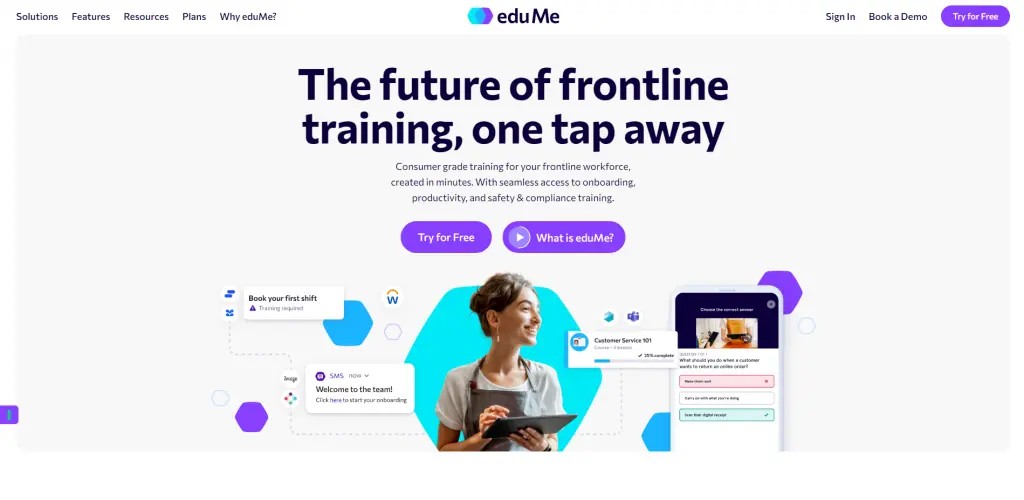
eduMe is a mobile-first training platform with a strong following among gig, logistics, retail, and hospitality operators. Its defining characteristic is delivery flexibility: training can be pushed by SMS, QR code, or embedded directly into the tools workers already use, such as Workday or Fountain. That model reaches deskless staff who would never open a conventional LMS login.
Where Schoox expects learners to come to the platform, eduMe pushes training to where workers already are. Content is broken into short, digestible chunks for viewing on a phone anywhere, which fits frontline and on-the-move teams better than a desktop-oriented course catalog.
Core Capabilities
- Mobile-first lessons designed for short, on-the-go consumption
- Delivery via SMS, QR code, or direct embed into existing workforce tools
- Microlearning content with quizzes and quick knowledge checks
- Onboarding and just-in-time training for distributed and gig workers
- Integrations with HR and workforce platforms like Workday and Fountain
- Engagement and completion analytics tuned to frontline populations
- Multi-language support for global frontline teams
Standout Strength
eduMe's delivery model removes the biggest barrier in frontline training: getting workers into the platform at all. By embedding training in existing apps and using SMS or QR access, it reaches gig and deskless workers who would never adopt a conventional LMS login.
Best For
Mid-to-large organizations with deskless, gig, or distributed teams in retail, logistics, and hospitality that need frictionless, mobile-first onboarding and just-in-time training.
Pricing Overview
- User-based Standard plan starting around $3.49 per user per month (roughly 100-user minimum)
- Custom Enterprise plans for larger deployments
- Demo available on request
Limitations
- Built for short-form mobile delivery rather than deep, long-form course building.
- Per-user pricing with a minimum can be less economical for very small teams.
- Less suited to live, cohort, or community-driven learning than platforms built for that.
Quick Comparison Insight
Reaches frontline and gig workers more directly than Schoox through SMS, QR, and embedded delivery. Narrower in scope, focused on short mobile training rather than a full workforce LMS.
Trainual
Overview
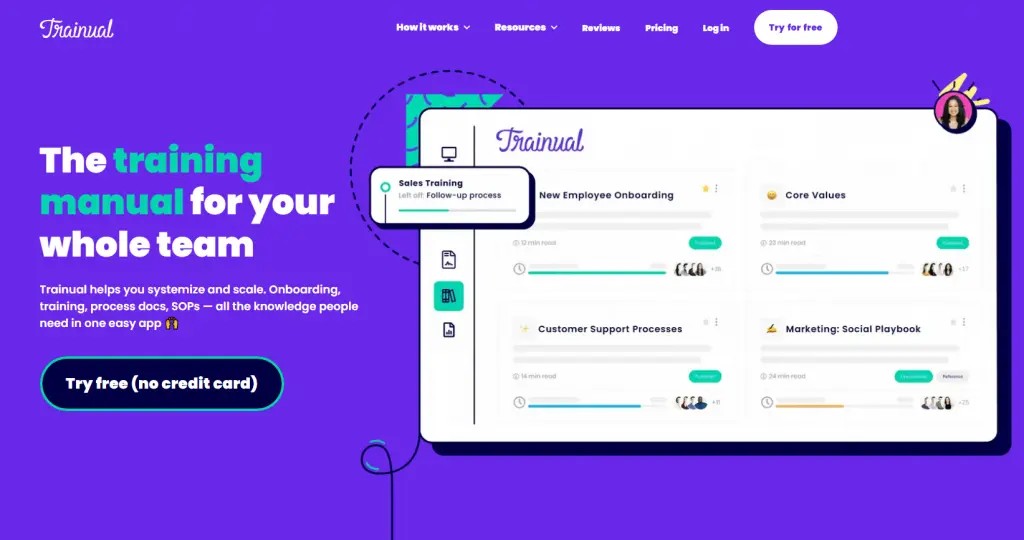
Trainual approaches frontline training from the process and SOP angle. It is built to document how your business runs, then turn those processes into onboarding and reference training that stays consistent across locations. That makes it a strong fit for franchises and multi-unit operators that need every site executing the same way.
Where Schoox is a broad LMS, Trainual is closer to a living operations manual with built-in training and accountability. For restaurant groups, retail chains, and service franchises, documenting SOPs once and rolling them out to every location is often the core problem, and Trainual is designed around exactly that.
Core Capabilities
- Process and SOP documentation that doubles as structured training
- Role-based content assignment so each position sees the right material
- Onboarding workflows for consistent new-hire ramp across locations
- Knowledge tests and completion tracking for accountability
- Mobile app for frontline and on-the-go access
- Org chart and role mapping tied to training content
- Integrations with common HR and productivity tools
Standout Strength
Trainual is strongest at standardizing execution across many locations. By turning SOPs into assigned, testable training, franchises and multi-unit businesses can ensure every site follows the same playbook, which is harder to enforce in a general content-catalog LMS.
Best For
Franchises, multi-location operators, and growing service businesses that need consistent SOP documentation, onboarding, and process training across sites.
Pricing Overview
- Small Business plan around $49 per month for up to 5 users
- Pro plan around $149 per month for up to 25 users, with custom Enterprise pricing above that
- 7-day free trial available
Limitations
- Oriented to process documentation and onboarding rather than rich interactive course authoring.
- Per-seat tiers can add up for very large hourly workforces.
- Lighter on compliance automation and advanced analytics than enterprise LMS platforms.
Quick Comparison Insight
Better than Schoox at turning SOPs into consistent, role-based onboarding across locations. Less of a full LMS, so deep compliance tracking and interactive course building are more limited.
Continu
Overview
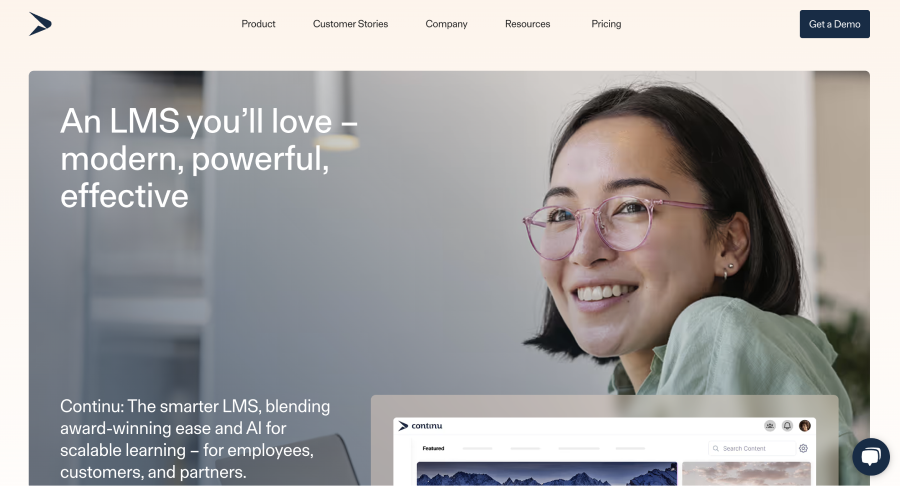
Continu is a modern learning platform built for mid-to-large organizations that want a clean, AI-assisted system without the weight of a legacy enterprise LMS. It centralizes training, onboarding, and knowledge sharing across employees, customers, and partners, and counts brands like Instacart, GoPro, and Upwork among its users.
Where Schoox can feel configuration-heavy, Continu leans on a polished interface and AI features that cut admin time and ramp-up. Built-in authoring, learning tracks, and assessments come standard, which makes it a practical step up for teams that found Schoox's authoring and admin too basic or too clunky.
Core Capabilities
- Built-in content authoring with learning tracks and assessments
- AI features for content creation and learner engagement
- Workshops and instructor-led training alongside self-paced content
- Customer, partner, and employee training from one platform
- Reporting and dashboards on completion and engagement
- Integrations with Slack, Google Workspace, Zoom, and HR tools
- Mobile access for distributed teams
Standout Strength
Continu pairs a genuinely modern interface with AI-assisted authoring, so L&D teams move from content to a published program quickly. It is consistently rated highly for ease of use and support, which matters for teams that struggled with Schoox's learning curve.
Best For
Mid-to-large, brand-conscious organizations that want a modern, easy-to-adopt LMS for employee, customer, and partner training, with AI to reduce admin overhead.
Pricing Overview
- Custom, quote-based pricing, generally starting around $10 per user per month
- Scoped to organization size and modules, typically for teams of 500 and up
- Demo available on request
Limitations
- Pricing is not published; scope requires a sales conversation.
- Oriented to mid-market and enterprise rather than small teams or pure deskless microlearning.
- Less specialized for offline frontline delivery than Axonify or eduMe.
Quick Comparison Insight
A more modern, AI-assisted interface than Schoox for multi-audience training. Better suited to brand-conscious mid-market teams than to large offline-only frontline populations.
Litmos
Overview
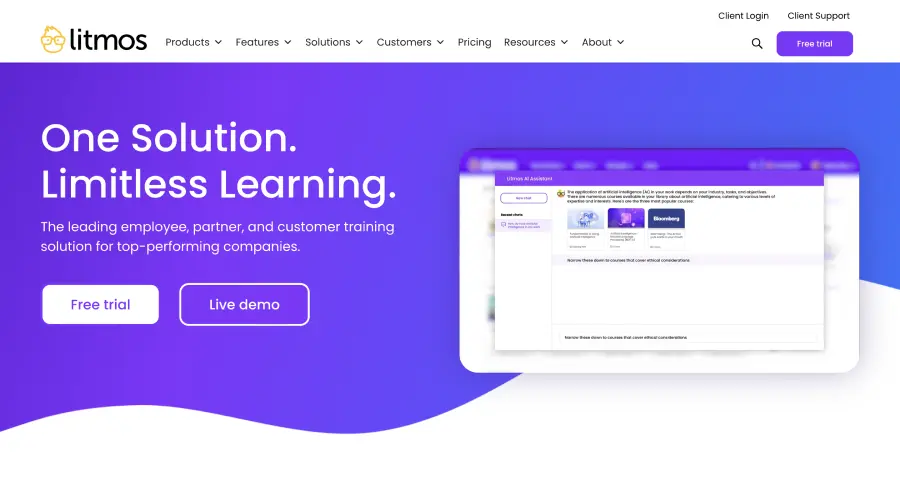
Litmos is an enterprise LMS that combines a large built-in content library with a learning management platform built for global, distributed organizations. Once part of SAP, it was carved out by Francisco Partners (a deal completed in December 2022) and now operates simply as Litmos. The platform suits teams that need to deploy training at scale across regions, languages, and locations.
What differentiates Litmos from Schoox is the scope of its off-the-shelf content. It includes a library of professionally produced courses across compliance, safety, and professional development, so organizations without the bandwidth to build everything from scratch can assign ready-made training immediately and reduce time-to-deployment.
Core Capabilities
- Built-in content library with professionally produced courses across compliance and safety
- Course builder supporting video, documents, SCORM, xAPI, and web content
- Automated assignment rules by role, department, and location
- Multi-language support and localization for global deployments
- Compliance tracking with certification management and automated re-enrollment
- Custom reporting and dashboards with scheduled delivery
- Gamification with points, badges, and leaderboards
- Mobile app with offline content access
Standout Strength
The off-the-shelf content library is what draws many organizations to Litmos. Instead of spending months building a compliance or onboarding library, teams can assign pre-built courses immediately and supplement with custom content over time, which fills the gap left by Schoox's basic authoring.
Best For
Large, distributed enterprises that need rapid training deployment with ready-made content across multiple regions and compliance-heavy industries such as manufacturing, logistics, and healthcare. Useful for teams managing employee onboarding across many sites.
Pricing Overview
- Per-user pricing from roughly $4 per user per month, scaling by features and active learners
- Quote-based for larger or feature-rich deployments
- Implementation costs apply separately
- 14-day free trial available
Limitations
- The interface can feel utilitarian and dated compared with more modern platforms.
- In-platform authoring is limited; complex interactive content still needs external tools.
- Implementation fees can be significant on top of per-user licensing.
Quick Comparison Insight
Broader content library and stronger global deployment than Schoox. Less flexible for deep authoring or a modern learner interface, and a pragmatic pick when pre-built content coverage matters most.
Docebo
Overview
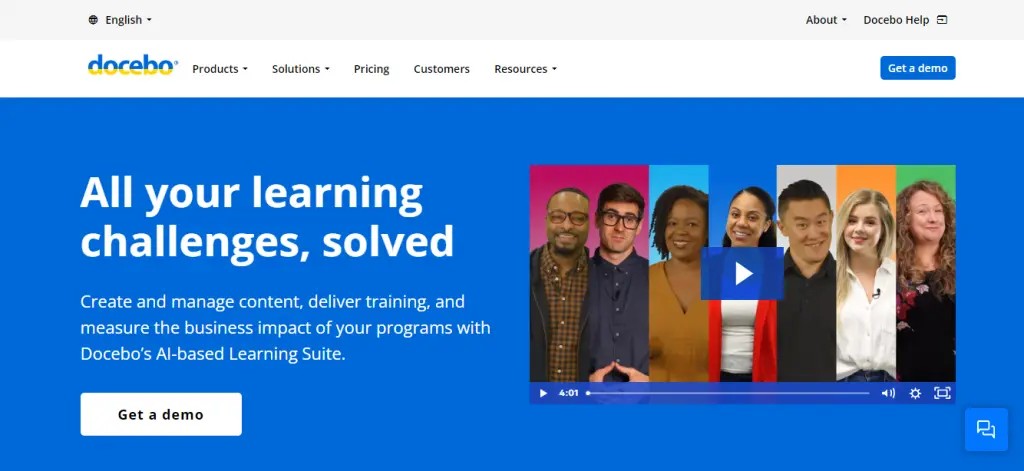
Docebo is an enterprise learning platform that combines standard LMS features with an AI layer for content recommendations, skills mapping, and learner engagement. It serves large organizations with complex needs spanning employees, partners, customers, and extended-enterprise audiences, and its mobile app includes offline access for field and frontline workers.
Where Schoox focuses on workforce compliance and frontline training, Docebo takes a broader view, with AI-powered content recommendations, social learning, and a modular architecture for tailored learning experiences across audiences from one instance. The admin experience is more sophisticated, and it is designed for organizations with dedicated L&D teams managing training at scale.
Core Capabilities
- AI-powered content recommendations based on learner behavior, role, and skill gaps
- Multi-domain architecture for separate branded portals per audience
- Built-in authoring for converting documents into microlearning
- Social learning with expert Q&A and peer-contributed knowledge
- SCORM, xAPI, and AICC content standard support
- Advanced reporting with custom dashboards and scheduled delivery
- Skills mapping and gap analysis tied to competency frameworks
- Native integrations with Salesforce, Workday, Microsoft Teams, Zoom, and 400+ connectors
- Mobile app with offline learning for field and frontline workers
Standout Strength
Docebo's AI layer differentiates it. The recommendation engine surfaces relevant content without manual curation, which saves both learner time and admin effort for enterprises with catalogs that contain thousands of items.
Best For
Mid-to-large enterprises with 500+ employees managing training across multiple audiences and geographies, with dedicated L&D teams that need AI personalization, extended-enterprise training, and deep analytics.
Pricing Overview
- Custom, quote-based pricing with a floor around $25,000 per year
- Most mid-market deployments land in the $30,000 to $50,000 per year range
- Implementation and onboarding fees apply
- Free demo and consultation available
Limitations
- Pricing is not transparent and the enterprise floor rules out smaller teams.
- The breadth of features creates configuration complexity, and setup can take weeks.
- Smaller organizations may find it over-engineered for straightforward frontline training.
Quick Comparison Insight
More powerful than Schoox in AI, reporting, and multi-audience management, and considerably more expensive and complex. The right fit once you have outgrown mid-market constraints.
TalentLMS
Overview
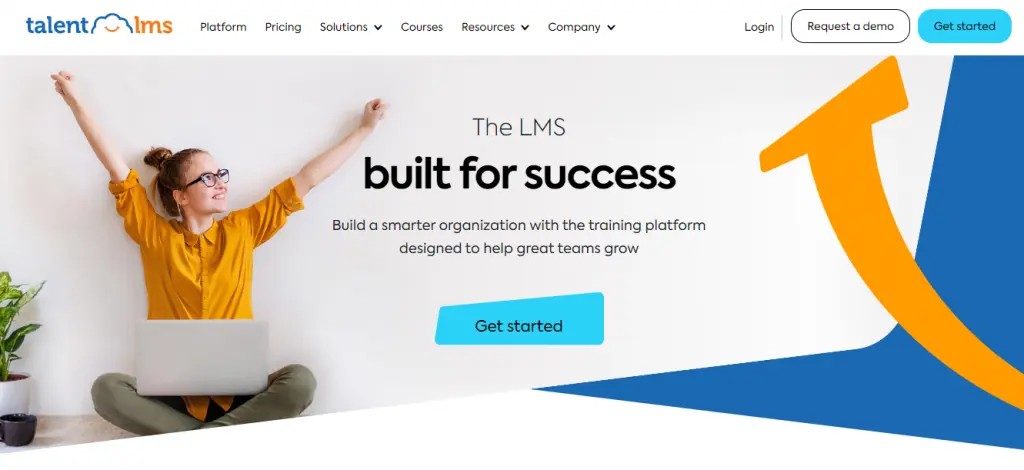
TalentLMS is one of the most widely adopted cloud LMS platforms in the SMB and mid-market segment. Built by Epignosis, it focuses on making administration accessible to teams without dedicated technical staff. Its core promise is simplicity: you can launch a training program in an afternoon, a stark contrast to Schoox's configuration-heavy setup.
The basics come together quickly. Creating a course, adding users, and assigning content is fast, and the interface is clean and predictable. For organizations where the LMS admin is also the HR manager or a store lead, that low barrier to entry is a meaningful advantage.
Core Capabilities
- Drag-and-drop course builder for video, presentations, documents, and web content
- SCORM, xAPI, and cmi5 support for externally authored content
- Built-in quiz and assessment engine with multiple question types
- Automated enrollment by groups, branches, or job roles
- Certification management with expiration tracking and re-enrollment
- Gamification with points, badges, and leaderboards
- Native Zoom and Microsoft Teams integrations for live sessions
- White-label portals for training partners and customers
- REST API and integrations with Zapier, Salesforce, BambooHR, and Slack
- Mobile app for on-the-go access
Standout Strength
TalentLMS eliminates the overhead of LMS deployment. The time from purchase to first learner login is measured in hours, not weeks, which directly answers the complaint that Schoox is too complex for small teams.
Best For
SMBs and mid-market organizations that need a general-purpose, affordable LMS for onboarding, compliance, and skills development, especially teams without a dedicated administrator.
Pricing Overview
- Free plan available for up to 5 users
- Core plan at $149 per month (about $119 per month billed annually)
- Higher tiers add custom reports, automation, and white-labeling
- Tiered by active user count
Limitations
- Reporting is functional but lacks depth for complex multi-location analytics.
- Built-in authoring handles basics but not advanced interactive scenarios.
- Gamification can feel surface-level for teams that want nuanced engagement.
Quick Comparison Insight
Far easier to set up and administer than Schoox, with a free tier to start. Less powerful for complex compliance and reporting, but a strong choice for teams that need to move fast affordably.
Absorb LMS
Overview
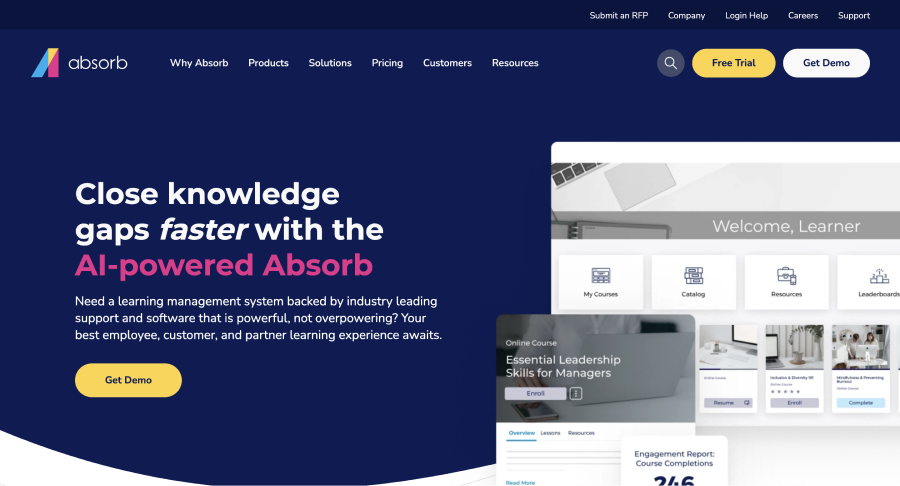
Absorb LMS is a cloud learning management system that balances administrative efficiency with a polished learner experience. It targets mid-to-large organizations that want enterprise-grade features without an enterprise-grade implementation headache, and its admin dashboard is one of the cleaner ones in its class.
Tasks that take multiple clicks in Schoox, like bulk user management, course assignment rules, and report scheduling, are quicker in Absorb. For admin teams that spend hours each week on routine operations, that efficiency compounds into real time savings across locations.
Core Capabilities
- Intelligent admin dashboard with smart panels for enrollment and activity
- Absorb Create, a built-in authoring tool for interactive courses
- SCORM, xAPI, and AICC support for third-party content
- Advanced reporting with a custom report builder and scheduled delivery
- E-commerce module for selling courses with payment processing
- Certification and compliance tracking with automated re-enrollment
- Observation checklists for assessing hands-on, in-the-field skills
- Native integrations with Salesforce, ADP, BambooHR, Zoom, and an open API
- Mobile app with offline content access and push notifications
Standout Strength
Absorb reduces the overhead of running an LMS at scale. Automated enrollment rules, smart activity panels, and bulk management tools handle the routine operations that consume hours in more configuration-heavy platforms. For teams that cited Schoox's admin as their main friction point, that efficiency is the practical argument for switching.
Best For
Mid-to-large organizations that need a polished LMS with strong admin tools and reporting, including regulated industries that require solid compliance tracking and observation-based field assessments.
Pricing Overview
- Custom pricing based on user count and selected modules
- Estimated entry around $10,000 per year and up for mid-market deployments (vendor does not publish list pricing)
- Absorb Create authoring may be an additional module
- Free demo available
Limitations
- Pricing is not published, so comparison requires going through sales.
- Absorb Create is capable but does not match dedicated authoring tools for complex interactivity.
- Initial catalog and taxonomy setup needs upfront planning to avoid structural issues.
Quick Comparison Insight
A cleaner admin experience than Schoox with stronger reporting and comparable enterprise depth. Pricing is quote-based and lands in the mid-market enterprise range.
LearnUpon
Overview
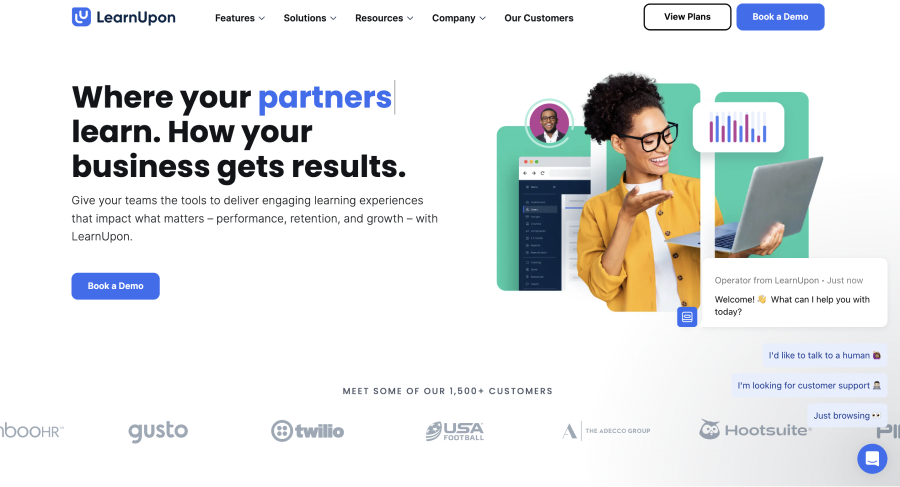
LearnUpon is a cloud LMS built around a "multi-portal" architecture. Each portal is an independent learning environment with its own branding, catalog, and user management, all run from a single admin backend. That design makes it particularly strong for franchise operations and organizations training several distinct audiences across locations.
Where Schoox treats audience segmentation as a configuration task inside one environment, LearnUpon gives each location, franchisee, or partner a fully branded, self-contained experience. For companies training employees, channel partners, and customers from the same system, that separation is cleaner to manage.
Core Capabilities
- Multi-portal architecture with independent branding, catalogs, and user groups
- Drag-and-drop course builder with SCORM, xAPI, video, and multimedia support
- Automated enrollment through rules, group membership, or integration triggers
- Certification and compliance tracking with auto-renewal and audit reporting
- Exam and assessment engine with question banks and randomization
- Reporting suite with custom reports and scheduled delivery
- Learning paths for sequencing courses by role or skill progression
- White-label learner portals with custom domains
- Native integrations with Salesforce, Teams, Zoom, BambooHR, and Zapier
- ILT and blended learning support with session scheduling
Standout Strength
The multi-portal model is LearnUpon's structural advantage. Organizations serving distinct audiences, employees at corporate, franchisees in the field, or channel partners, can give each group a fully branded, self-contained environment without sharing catalogs or user lists. The admin team manages all portals from a single backend, which is operationally cleaner than segmenting audiences through configuration inside one environment.
Best For
Mid-market and enterprise organizations delivering training to employees, customers, partners, or franchisees from one platform, especially franchise operations standardizing training across locations. Teams focused on customer training will find the architecture well aligned.
Pricing Overview
- Custom, quote-based pricing tied to user count and number of portals
- Pricing rises with each additional portal
- Free demo and consultation available
Limitations
- Built-in authoring is adequate for basics but lacks advanced interactivity.
- Costs can climb quickly for organizations running many portals.
- Learner-interface customization beyond branding is limited.
Quick Comparison Insight
Stronger multi-audience architecture than Schoox for organizations that need clean separation between franchisees, partners, or customer cohorts. Less suited to pure deskless microlearning, but well matched to multi-portal franchise training and extended-enterprise programs.
How to Choose the Right Schoox Alternative
The right choice depends on the specific problem pushing you off Schoox. Here is how to narrow the field for a frontline or multi-location operation.
If engagement and completion are the core problem, Teachfloor adds community, peer learning, and live sessions on top of self-paced content so staff contribute knowledge rather than passively consume it. It is also the most format-flexible option in this list, supporting self-paced, cohort, social, and live learning from a single program.
If you train large deskless populations in short bursts, Axonify and eduMe are the most frontline-native picks. Axonify leans on daily microlearning and reinforcement; eduMe reaches workers through SMS, QR codes, and embedded delivery.
If you run a franchise or multi-location operation, Trainual standardizes SOPs and onboarding across sites, while LearnUpon gives each location or franchisee a branded portal under central control.
If you need ready-made content fast, Litmos ships a large off-the-shelf library, and Continu offers a modern, AI-assisted interface for multi-audience training.
If you have outgrown mid-market constraints, Docebo and Absorb bring deeper AI, reporting, and admin tooling, at enterprise pricing. If budget and speed matter most, TalentLMS is the affordable, fast-to-launch option.
The worst approach is choosing on feature count alone. Match the tool to how your frontline teams actually learn, the locations and audiences you serve, and the specific gap pushing you away from Schoox.
FAQ
What is the best Schoox alternative for frontline teams?
It depends on how your people learn. For engagement, community, and flexible self-paced, live, or cohort formats, Teachfloor is the strongest pick. For pure deskless microlearning at scale, Axonify and eduMe are purpose-built. For franchise SOPs and consistent onboarding across locations, Trainual and LearnUpon fit best.
Which Schoox alternative has the best mobile and offline experience?
For deskless workers, eduMe (SMS, QR, and embedded delivery) and Axonify (mobile-first microlearning) are the most frontline-native. Among broader LMS platforms, Litmos, Docebo, and Absorb all offer mobile apps with offline content access. Always test the real app with your own content before deciding.
Are there affordable or free Schoox alternatives?
TalentLMS offers a free plan for up to 5 users and a Core plan at $149 per month. eloomi and Litmos start around $3 to $4 per user per month. Teachfloor starts at $89 per month for up to 50 learners with a 14-day free trial. For a wider view, see our guide to the most affordable LMS options.
Can I migrate my content from Schoox to another platform?
Most platforms support SCORM and xAPI imports, so courses built in standard formats transfer. Custom configurations, user data, and completion records take more planning. Ask each vendor about data migration support before committing.
Which alternative is best for franchise and multi-location training?
Trainual standardizes SOPs and onboarding across sites, LearnUpon gives each franchisee a branded portal under central management, and Teachfloor adds white-label academies on your own domain with built-in community and live sessions. The right pick depends on whether you prioritize process documentation, portal separation, or learner engagement.


