

Why Field Service Teams Need a Specialized LMS
Field service training has a different shape than office training. Technicians, installers, inspectors, and repair crews spend their days driving between jobs, working on equipment, and solving problems in real time. A platform built for desk-based employees assumes stable internet, large screens, and uninterrupted learning blocks, conditions field crews rarely have. This guide focuses on dispatch-friendly, mobile-ready platforms for field service technicians and the supervisors who train them. For the broader non-desk category, see our best LMS for frontline workers pillar.
Training happens between jobs. A technician in a van between appointments has 10 minutes, not 60. If the platform cannot deliver something useful in that window, training gets skipped. Content needs to be modular, mobile-friendly, and built for short bursts.
Connectivity is unreliable. Cell coverage drops in basements, rural areas, and inside industrial facilities. Offline download or low-bandwidth delivery keeps a lesson from dying mid-screen. For some crews this is essential; for technicians who work mostly in covered areas it is a useful fallback rather than a hard requirement.
Compliance deadlines are non-negotiable. Field roles in utilities, telecom, HVAC, and medical equipment carry regulatory requirements. Certifications expire and safety training must be documented. The platform needs to track compliance training and flag gaps before a technician shows up on site without current credentials.
Turnover means constant onboarding. Field service has high churn at the technician level. Every new hire needs product training, safety orientation, and process documentation before working independently, so the onboarding process has to be fast, repeatable, and accessible from a phone on day one.
Knowledge changes constantly. New equipment, revised procedures, and product recalls all generate training. The platform needs to push updates to distributed teams, confirm they were consumed, and record acknowledgment per technician. The ten platforms below each solve a distinct slice of that problem.
What to Look for in a Field Service LMS
Field service narrows the usual LMS checklist to the features that actually survive a technician's day. Use these criteria when you compare the platforms below.
Phone-first access, ideally with no-email login. A responsive website is not a real mobile experience. Field workers benefit from a fast app, push notifications, and login that does not depend on a corporate email. The platforms that perform best in the field offer employee-ID, QR code, or shared-device kiosk sign-in so a technician can start a lesson in seconds.
Offline or low-bandwidth delivery. Workers should be able to download lessons, finish them without connectivity, and sync progress on reconnect. Ask vendors which content types work offline; some support offline video but not assessments.
[Microlearning](/elearning-glossary/microlearning) design. Field training works best in focused modules under ten minutes. Platforms built around short-form delivery tend to produce higher completion than long course-based systems retrofitted for mobile.
Compliance and certification tracking. Automated expiry alerts, recertification workflows, and audit-ready reporting are essential in regulated field work. Look for training tracking you can filter by role, region, and certification type.
Dispatch and field-service integration. The platform should connect to the systems your crews already use. LMS integrations with Salesforce Field Service, ServiceNow FSM, dispatch tools, and HR systems keep learner records in sync and tie training to the work order. Multilingual auto-translation matters for crews that span languages.
Group-based user management. Field organizations manage technicians across regions, service lines, and skill levels, so group enrollment, role-based assignments, and location-level reporting should not require manual setup per hire.
The 10 Best LMS for Field Service Teams
The platforms below cover the full range of field service training, from flexible technician academies to mobile microlearning and enterprise compliance systems. Each addresses a different combination of field constraints, and most large field operations end up combining two of them.
| Tool | Mobile App | Offline | Microlearning | Compliance | Starting price | Free trial | Best for |
|---|---|---|---|---|---|---|---|
| Teachfloor | Mobile-friendly | No | Yes | Yes | $89/mo | 14 days | Flexible technician and supervisor academies |
| TalentLMS | Yes | Yes | Yes | Yes | $119/mo (annual) | Free plan | SMBs needing fast mobile setup |
| Litmos | Yes | Yes | Yes | Yes | Custom (~$6/user/mo) | 14 days | Compliance-heavy distributed teams |
| Absorb LMS | Yes | Yes | Yes | Yes | Custom | Demo | Enterprise field teams needing offline |
| eduMe | Yes | Yes | Yes | Yes | Custom | Demo | QR/no-login mobile microlearning |
| Docebo | Yes | Yes | Yes | Yes | Custom | Demo | AI-powered enterprise learning |
| LearnUpon | Yes | Limited | Yes | Yes | Custom (~$6-9/user/mo) | Demo | Multi-audience training across partners and staff |
| Connecteam | Yes | Limited | Yes | Yes | $29/mo (per hub, annual) | Free plan | All-in-one field workforce management |
| Trainual | Yes | No | No | Limited | $249/mo | 7 days | SOP documentation for distributed teams |
| Axonify | Yes | Limited | Yes | Yes | Custom | Demo | Daily knowledge reinforcement |
Teachfloor
Overview
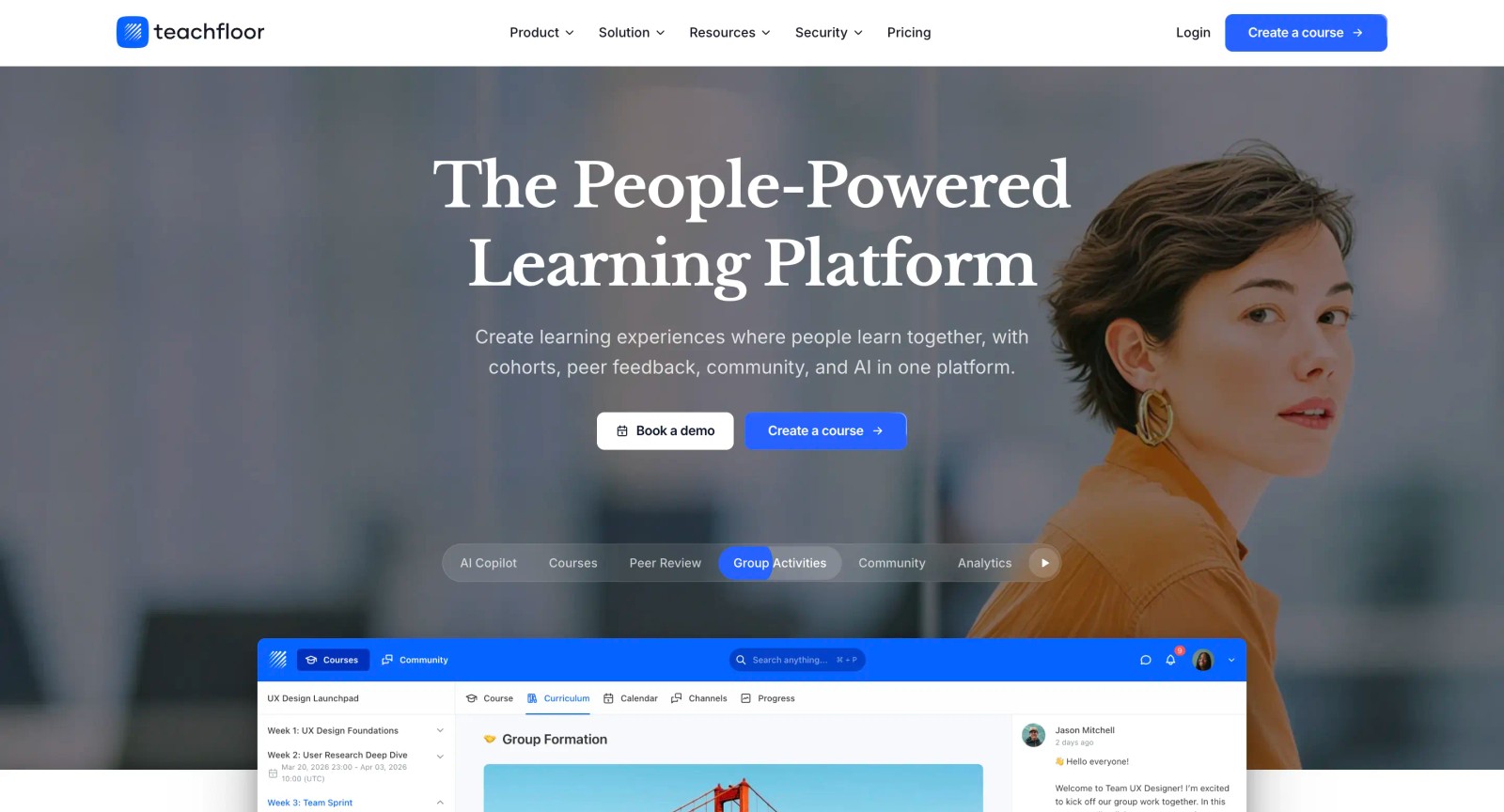
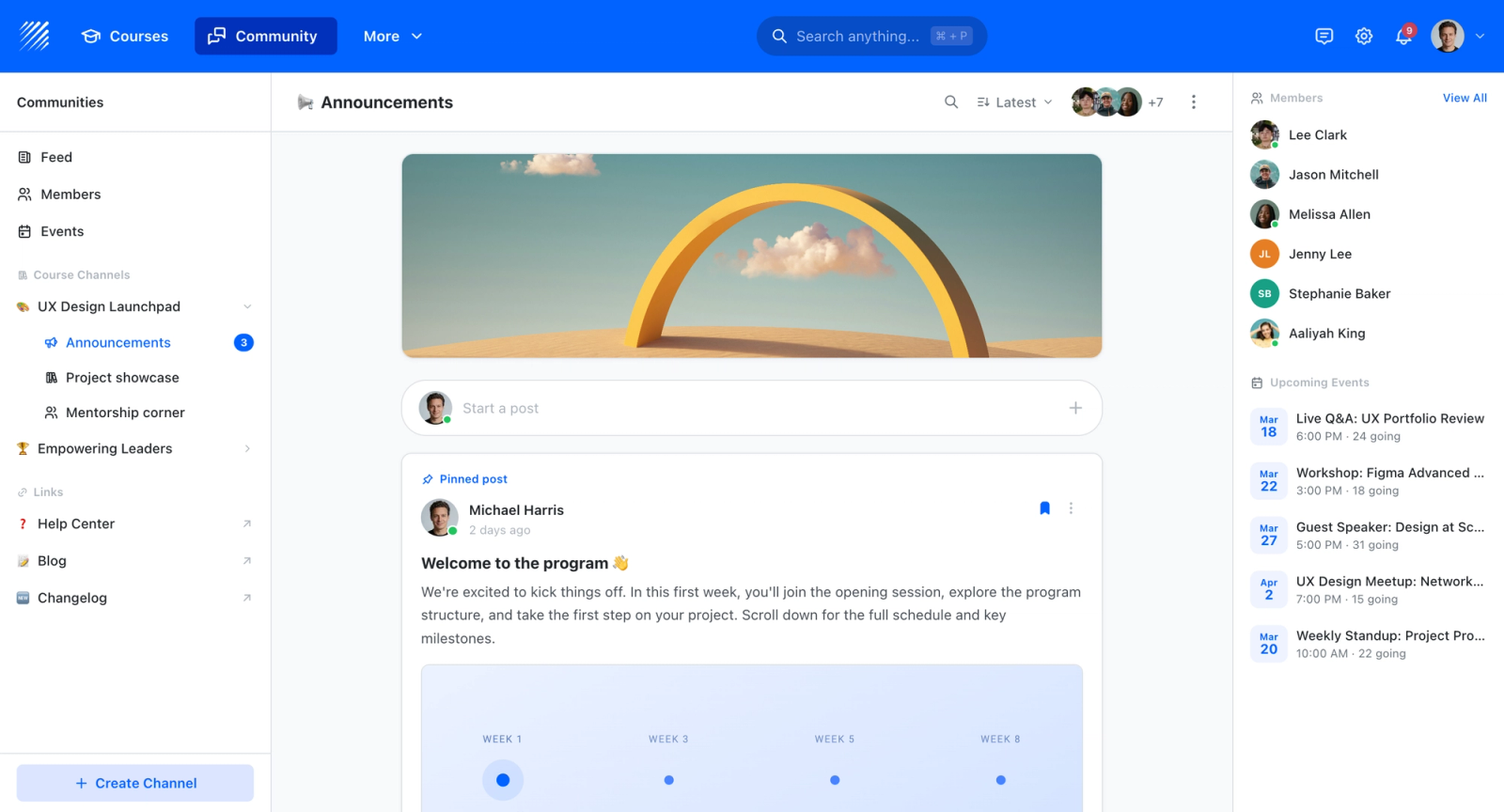
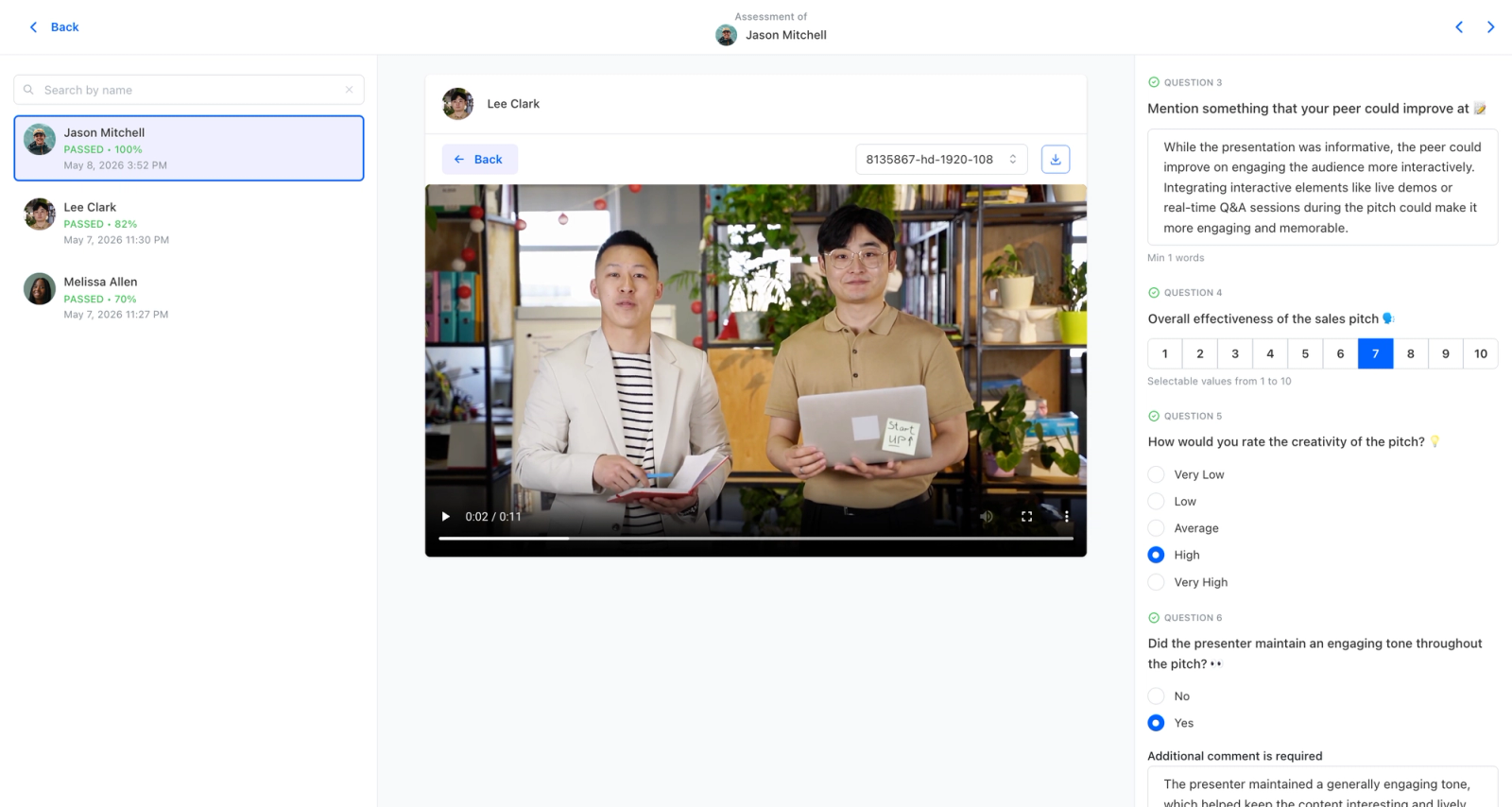
Teachfloor is built around structured, self-paced learning that fits a field schedule rather than a classroom. A training manager can build a certification track that technicians work through between service calls, push a safety refresher to an entire branch on short notice, and generate certificates that confirm a crew member is current before dispatch. AI-assisted authoring speeds up the process of converting updated procedures or compliance bulletins into structured lessons, which matters when product specs and regulations shift mid-cycle. Separate branch spaces let a company run distinct programs for internal technicians and partner or dealer installers while keeping certification reporting in one place, alongside community discussion and peer learning tools for supervisor development.
Core Capabilities
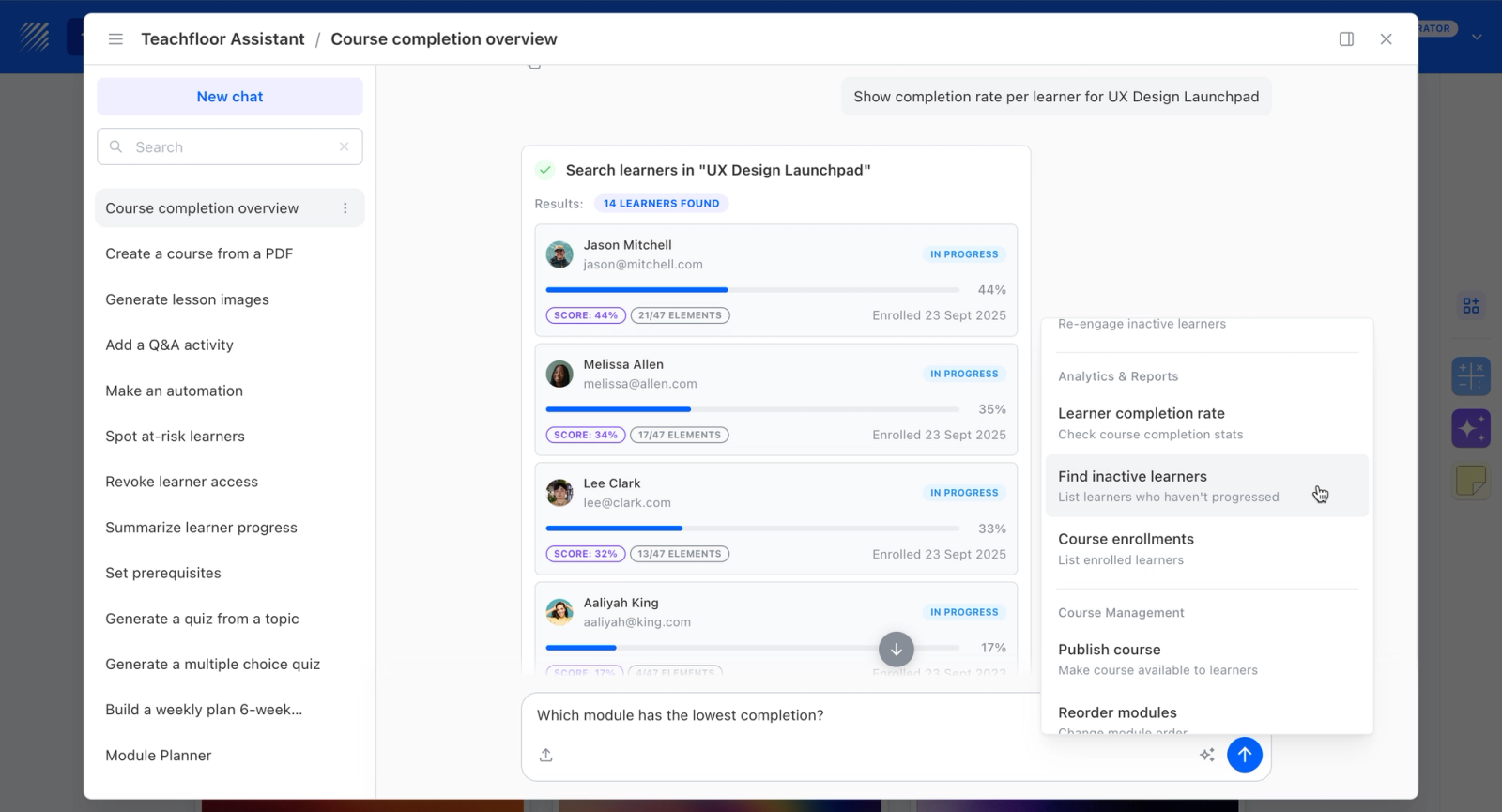
- Self-paced certification and safety tracks technicians can complete between jobs, with certificates that document a crew member is current before dispatch
- AI-assisted authoring to quickly convert updated equipment procedures and safety bulletins into structured lessons when specs or regulations change mid-cycle
- Multi-branch structure for separating internal technicians from channel or partner installers, plus centralized analytics on certification status and expiry across the workforce
Best For
Field service organizations that need to keep distributed technicians current on safety and equipment certifications and want centralized proof of completion, especially those managing both internal crews and partner installers.
Pricing Overview
- Startup plan from $89 per month for up to 50 learners
- Full Features plan with custom pricing, white-label, SSO, and advanced integrations
- 14-day free trial; no permanent free plan
- Nonprofit discounts available
Limitations
- No native offline mode, so technicians who regularly hit dead zones in basements, tunnels, or rural areas may need a platform built for offline delivery
- Not integrated with dispatch or field-service-management software, so certification status does not automatically gate job assignments
- Not a mobile-first microlearning tool like eduMe, and there is no free plan; learner-based pricing scales with crew size
Quick Comparison Insight
Best for field service teams that need certification and safety training with central tracking across internal and partner crews, rather than an offline-first or dispatch-integrated mobile tool.
TalentLMS
Overview
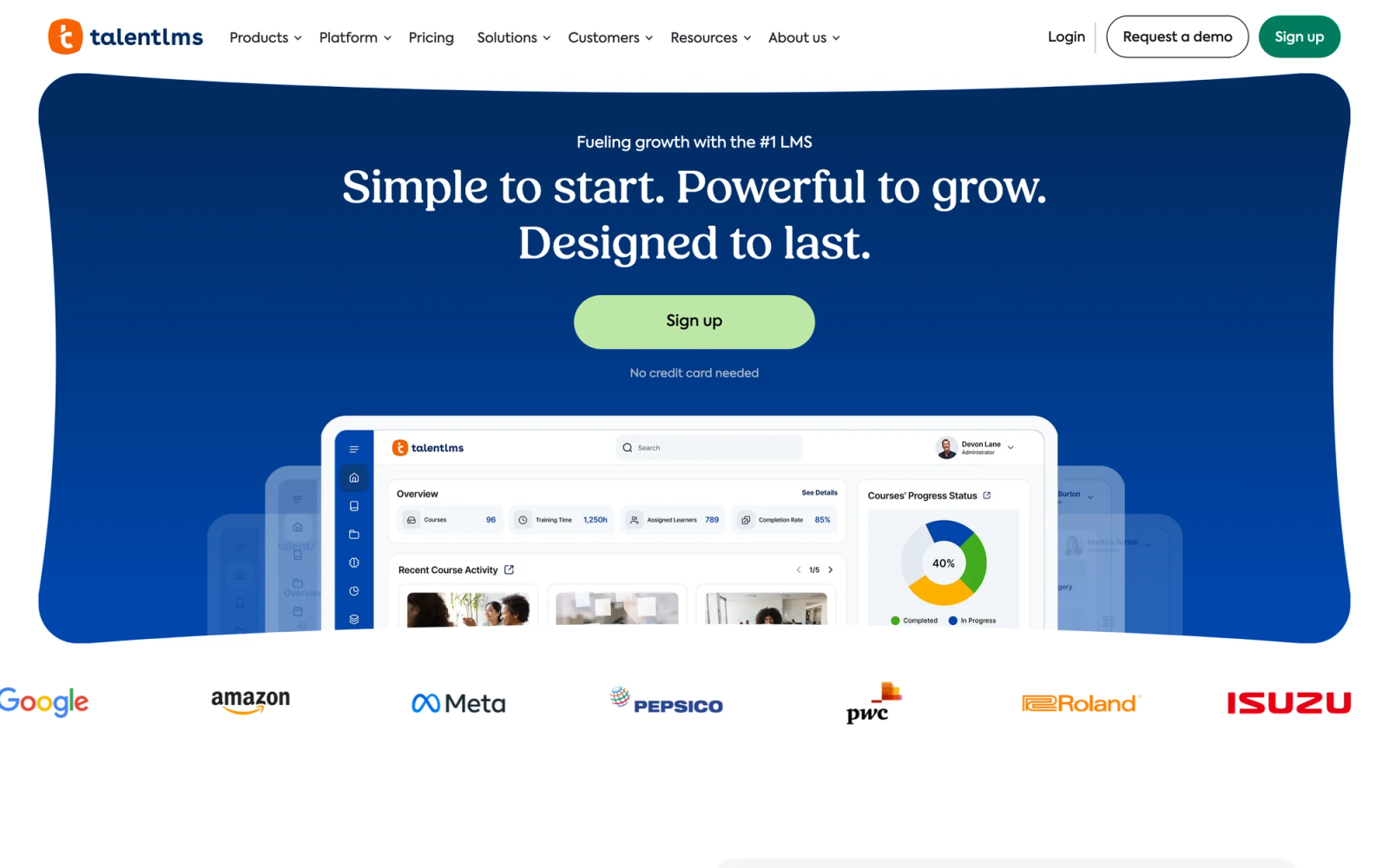
TalentLMS is a cloud-based LMS from Epignosis that consistently ranks among the easiest platforms to deploy. For field service organizations, the appeal is a clean mobile app, offline content download, and an admin experience that does not require a dedicated IT team to manage.
Course setup is fast. The drag-and-drop builder accepted video walkthroughs, PDF service manuals, and SCORM packages without friction. The native mobile app mirrors the desktop layout without the cramped feel that trips up many mobile LMS experiences. Technicians download courses over Wi-Fi, finish them without a connection, and their progress syncs automatically once they are back in range, a reliable pattern for crews who move between indoor facilities, rural routes, and urban job sites throughout the day.
Core Capabilities
- Native iOS and Android app with offline course download and automatic progress sync
- Built-in course authoring with support for text, video, SCORM, xAPI, and cmi5 content
- Branch functionality for creating separate training environments by region, service line, or client
- Gamification engine with points, badges, leaderboards, and custom reward levels
- Automated certification tracking with expiry dates and re-enrollment rules
- Built-in videoconferencing integration for live training sessions (Zoom, MS Teams)
- Custom reports with scheduled delivery and CSV export for compliance auditing
- Single sign-on (SSO) support and integration with HR systems via REST API
- Multilingual interface supporting over 30 languages
- Mass user import and automated enrollment through group and branch rules
Standout Strength
TalentLMS offers the fastest path from purchase to first completed lesson among the platforms on this list. The mobile app works as advertised, offline access is built in, and the admin interface requires no dedicated IT support, a combination that suits small-to-midsize field service companies that need training running within days, not months.
Best For
Field service companies with 50 to 500 technicians across multiple service territories. Well suited for HVAC, plumbing, electrical, and equipment maintenance companies that need to centralize training, track certifications, and onboard new hires quickly without a complex setup project.
Pricing Overview
- Free plan for up to 5 users and 10 courses
- Core plan around $119 per month billed annually, or $149 monthly, for up to 40 users
- Pricing model: Tiered by active user count
- Custom enterprise pricing available for larger deployments
Limitations
- Reporting covers the basics but lacks the depth and customization that enterprise organizations require for complex compliance matrices.
- The content authoring tool handles standard formats well but does not support branching scenarios or advanced simulations.
- Gamification features are surface-level. There is no adaptive learning or personalization engine underneath.
Quick Comparison Insight
More accessible and affordable than Litmos or Absorb LMS, with a strong mobile experience for the price. Lacks the compliance depth and AI features that larger field service organizations need.
Litmos
Overview
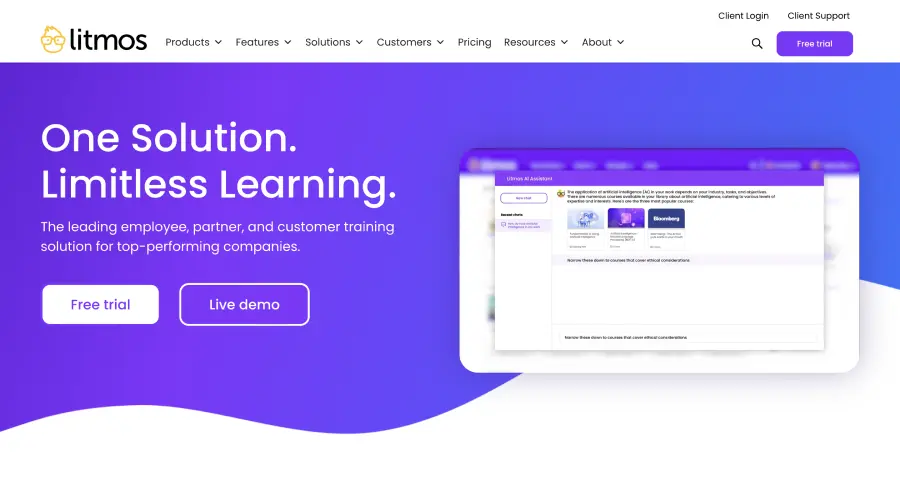
Litmos is a cloud-based LMS with a strong reputation in compliance-heavy industries. For field service organizations operating under regulatory requirements in utilities, telecom, medical devices, or industrial equipment, Litmos delivers the certification lifecycle management that keeps distributed teams audit-ready.
The compliance workflow is the most polished element of the platform. Setting up a certification path with automatic re-enrollment, expiry notifications, and manager escalations is straightforward. The platform manages the full lifecycle from initial assignment through completion to renewal, and the reporting is granular enough for regulatory audits. The mobile app supports offline content download, so field technicians can complete mandatory training even when they are working in locations without reliable connectivity.
Core Capabilities
- Compliance management with automated certification paths, expiry tracking, and renewal assignments
- Mobile app with offline access for completing training in low-connectivity field environments
- Built-in content library with thousands of off-the-shelf compliance and safety courses
- Support for SCORM, xAPI, AICC, and video-based content
- Automated notifications and escalations for overdue or expiring training
- Custom learning paths that sequence courses based on role, region, or service specialty
- Real-time reporting dashboards with scheduled delivery and audit trail exports
- Integration with Salesforce, SAP SuccessFactors, and other enterprise systems
- Multi-tenant architecture for managing training across business units or client organizations
- eCommerce module for selling training content to external partners
Standout Strength
Litmos is the strongest fit where compliance gaps carry real legal or operational consequences. Its certification lifecycle covers the full sequence, initial assignment, completion tracking, expiry notification, renewal enrollment, and manager escalation, with more automation than most competing platforms provide. For teams that face regulatory audits, that depth is the main reason to choose it.
Best For
Mid-to-large field service companies in utilities, telecom, medical equipment, and industrial services with distributed teams subject to regulatory training requirements. Particularly suited for organizations with 500 or more technicians where compliance documentation and automated recertification workflows are non-negotiable.
Pricing Overview
- Custom pricing varies by deployment size; typically starts around $6 per user per month
- Pricing model: Per-user, tiered by volume
- Free 14-day trial available
- Off-the-shelf compliance content library may carry additional costs
Limitations
- The user interface is functional but feels less modern than purpose-built mobile-first platforms. The mobile experience works but does not match the polish of frontline-first tools.
- Content authoring tools are adequate for basic compliance content but limited for creating interactive or media-rich field training.
Litmos has been independent since Francisco Partners acquired it from SAP in December 2022, so the SAP integrations are legacy rather than native to a parent suite.
Quick Comparison Insight
Stronger compliance infrastructure than TalentLMS, with better audit reporting and certification lifecycle management. Less engaging for daily mobile learning or knowledge reinforcement compared to eduMe or Axonify.
Absorb LMS
Overview
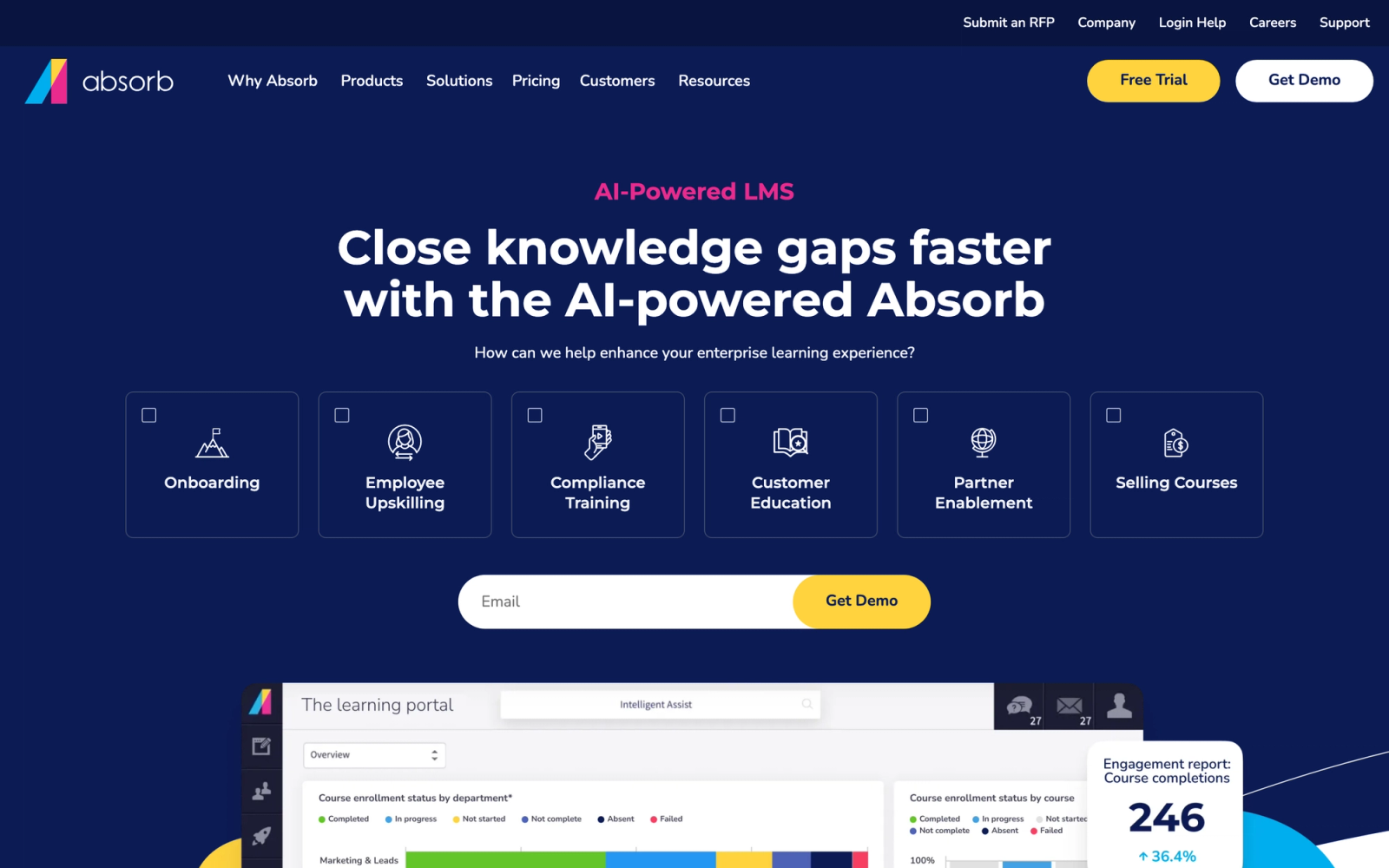
Absorb LMS is an enterprise learning platform with one of the most reliable offline mobile experiences in the LMS market. For field service teams that regularly work in facilities, tunnels, or rural service areas where cell coverage drops out, the ability to complete and sync training without an internet connection is the primary reason to choose it.
The Absorb mobile app supports full offline content download, including video lessons, SCORM packages, and assessments. The sync behavior is reliable. Learners download their assignments over Wi-Fi, complete them in the field, and the app pushes progress data back to the server when connectivity returns. The admin side benefits from Absorb Intelligent Assist, an AI layer that automates enrollment, reporting, and user management tasks that would otherwise consume hours of manual work.
Core Capabilities
- Native mobile app with offline content download, completion, and automatic sync
- Absorb Intelligent Assist for AI-powered admin automation (enrollment, reporting, user queries)
- Observation checklists for verifying hands-on field skills (manager-assessed)
- Advanced compliance management with automated certification tracking and renewal workflows
- SCORM, xAPI, video, and custom content format support
- eCommerce engine for monetizing training content through a branded storefront
- Custom reporting with scheduling, visual dashboards, and data export
- Integration with Salesforce, ADP, BambooHR, ServiceNow, and 50+ platforms
- Branded learner portals for different service divisions, regions, or client groups
- Automated enrollment rules based on role, department, location, or custom attributes
Standout Strength
Absorb has the strongest offline track record on this list. Learners download assignments over Wi-Fi, complete them wherever they are, and the app pushes results back to the server once they reconnect. The AI-powered admin automation, handling enrollment, reporting, and user queries, reduces the manual workload enough that even a small training team can keep thousands of technicians current.
Best For
Mid-to-large field service companies with 500 to 10,000+ technicians who need enterprise-grade compliance tracking combined with strong offline mobile access. Ideal for organizations in utilities, telecom infrastructure, elevator maintenance, and industrial equipment service where technicians frequently work in zero-connectivity environments.
Pricing Overview
- Custom pricing based on deployment size and feature requirements
- Typically priced per active learner per month
- Free demo and guided trial available
Limitations
- Implementation is more involved than lightweight platforms like TalentLMS. Expect a setup period of several weeks for enterprise deployments.
- The platform's breadth can be overwhelming for small teams that only need basic field training capabilities.
- Observation checklists require manager participation in the field, which can be difficult to enforce at scale across distributed service territories.
Quick Comparison Insight
More enterprise-capable than TalentLMS, with the best offline experience on this list. Less field-specific than eduMe or Connecteam, but covers a wider range of training needs in a single platform.
eduMe
Overview
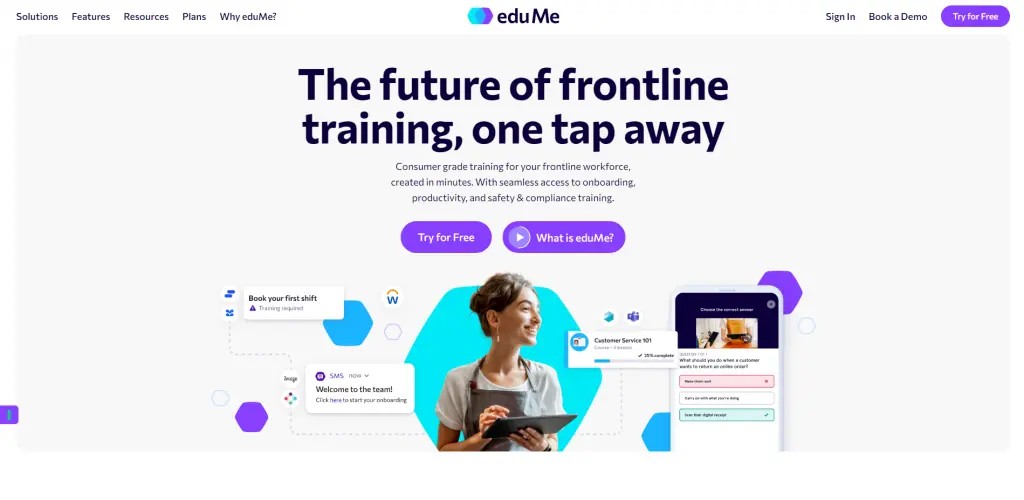
eduMe is a mobile microlearning platform built for deskless and frontline workers, which makes it a direct fit for field service crews. It replaces the role EdApp used to play on lists like this one; EdApp, later rebranded SC Training, was retired by SafetyCulture on March 31, 2026, so it is no longer a live option. eduMe centers everything on getting short, visual lessons to a phone with as little friction as possible.
The platform leans on one-tap, no-login access through smooth links and QR codes, so a technician can open a lesson without an account or corporate email. Content is deliberately light, favoring images and short video over text, and the format suits time-sensitive updates a dispatcher needs crews to see the same day.
Core Capabilities
- Mobile-first microlearning with short, image and video-led lessons
- No-login access through shareable links and QR codes for shared or personal devices
- AI-assisted lesson creation to draft content quickly from a prompt
- Spaced repetition and quizzes to reinforce safety and procedure knowledge
- Push and in-tool delivery of time-sensitive updates to distributed crews
- Multilingual content for crews that span languages
- Completion and engagement analytics by team and individual
- Integrations with Slack, Microsoft Teams, Salesforce, and workforce tools
Standout Strength
eduMe removes the login barrier that stalls mobile training adoption in the field. One-tap and QR access means a crew member can open a lesson between jobs without remembering a password or finding a corporate email, the exact friction point that leads technicians to skip training on traditional platforms.
Best For
Field service and on-demand operations that need to push frequent, short updates to phones, especially where shared devices or no corporate email make logins a problem. Strong fit for logistics, transportation, on-site services, and frontline crews where speed of delivery matters more than long-form courses.
Pricing Overview
- Custom pricing, quoted by team size and use case
- No public self-serve tier; demo available on request
Limitations
- Microlearning-focused, so it does not replace long-form certification courses or instructor-led training.
- Pricing is not published, so you need a sales conversation to scope cost.
- Most organizations pair it with a fuller LMS for onboarding and certification programs.
Quick Comparison Insight
The closest live replacement for the retired EdApp: mobile-native, fast to deliver, and built for deskless crews. Best paired with a compliance-focused platform for complete field service coverage.
Docebo
Overview
Docebo is an enterprise learning platform that has invested heavily in AI-powered content management, recommendations, and automation. For large field service organizations managing thousands of technicians across multiple service lines and regions, Docebo offers the scale, intelligence, and flexibility that lighter platforms cannot match.
The Docebo Go mobile app supports offline content access and delivers a clean experience for field learners. What sets Docebo apart at the enterprise level is the AI layer. The platform automatically suggests training content based on a technician's role, service history, and identified skill gaps. It also auto-tags uploaded content and generates descriptions, which saves significant admin time when managing large training libraries covering dozens of equipment types and service procedures.
Core Capabilities
- Docebo Go mobile app with offline content access, push notifications, and learner-friendly interface
- AI-powered content recommendations based on role, skills, and learning history
- Automated content tagging and description generation using AI
- Social learning features including expert Q&A channels and peer content sharing
- Learning path builder with conditional logic and prerequisite sequencing
- Blended learning support combining virtual classrooms, field training, and self-paced modules
- Compliance tracking with certification management and automated renewal workflows
- Extensive integration marketplace with 400+ connectors (Salesforce, ServiceNow, Workday, MS Teams)
- Custom reporting with Power BI integration and scheduled distribution
- Multi-audience architecture supporting technicians, partners, customers, and contractors
Standout Strength
Docebo cuts the administrative load of managing training at scale through AI automation. Auto-tagging eliminates manual content classification when new procedures are uploaded. Smart recommendations surface relevant courses to each technician based on role and service history. And automated enrollment and reporting tasks reduce the hours a training team spends on routine maintenance. For organizations running large, multi-region field programs, that automation compounds quickly.
Best For
Large field service enterprises with 1,000+ technicians who need a scalable learning platform serving field workers, office staff, partners, and customers from a single system. Best fit for organizations with complex training libraries covering multiple product lines, equipment types, and service procedures. Particularly strong for companies that also deliver corporate training LMS programs to non-field employees.
Pricing Overview
- Custom enterprise pricing (Docebo does not publish standard rates)
- Typically priced per active learner per month, with volume discounts
- Free demo and guided pilot available
Limitations
- The platform's configuration depth creates a steep learning curve for administrators. Implementation typically takes weeks or months, not days.
- Enterprise pricing puts Docebo out of reach for smaller field service companies. Entry-level contracts typically start in the mid-five figures annually, so budget accordingly.
- The mobile experience is solid but not purpose-built for field workers the way eduMe or Connecteam are. It serves field teams well but was not designed exclusively for them.
Quick Comparison Insight
More capable and scalable than TalentLMS, with AI features that neither Litmos nor Axonify offer. But the complexity and cost make it a better fit for large enterprises than for mid-market field service organizations seeking a simple mobile training solution.
LearnUpon
Overview
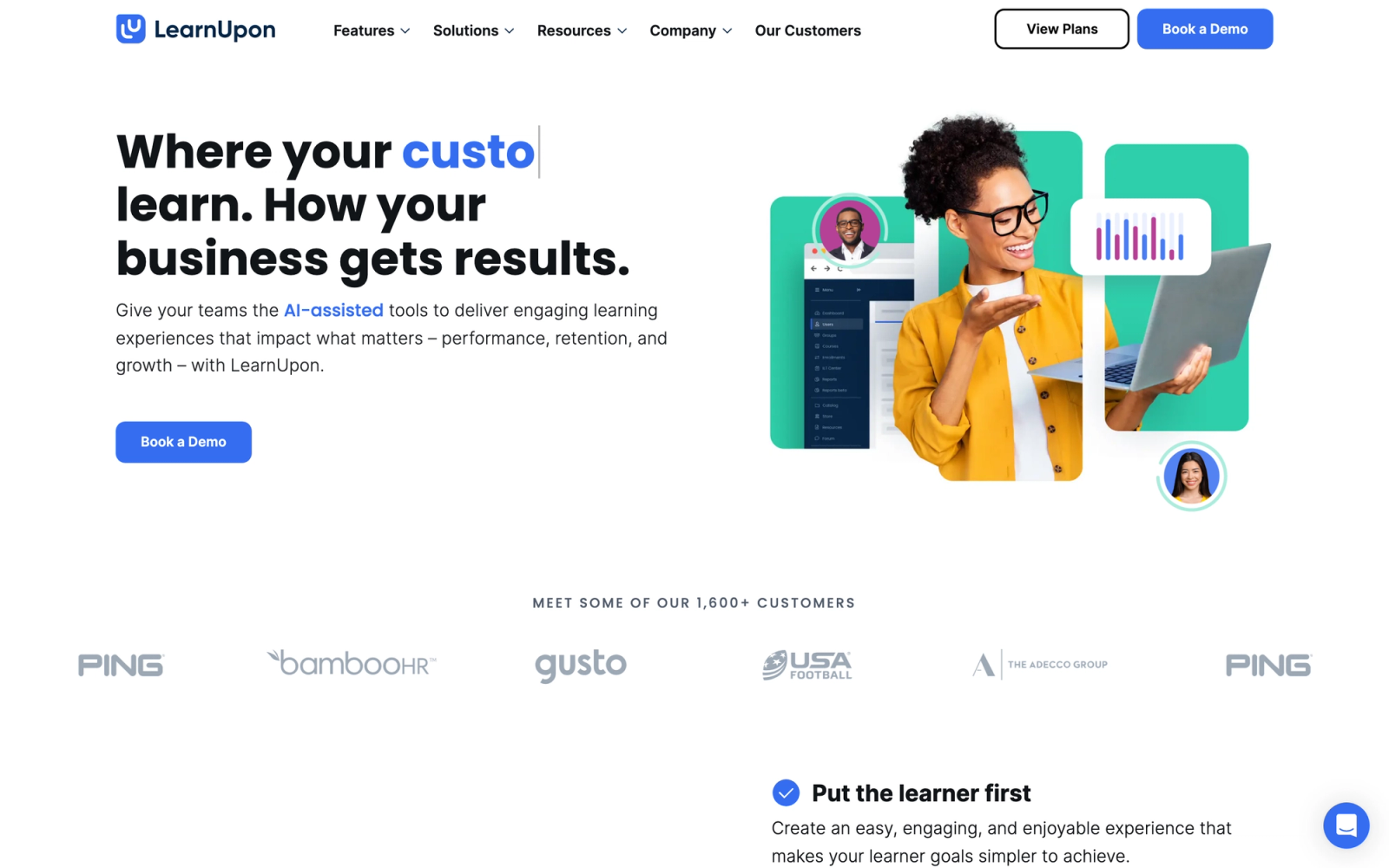
LearnUpon differentiates itself through its multi-portal architecture. A single LearnUpon instance can power separate branded learning portals for internal technicians, channel partners, equipment dealers, and customers, each with its own content, branding, and user management. For field service organizations that train both internal teams and external audiences, this consolidation is a practical operational advantage.
LearnUpon handles audience separation cleanly while keeping administration centralized. A field service company can run one portal for technician training covering equipment procedures and safety, another for dealer partners covering product knowledge and certification, and a third for customer training covering basic maintenance, all from one admin dashboard.
Core Capabilities
- Multi-portal architecture with separate branding, content, and user management per audience
- Mobile-responsive interface with learner app access optimized for field use
- Automated enrollment based on user groups, roles, or organizational hierarchy
- SCORM, xAPI, and video content support with a built-in course builder
- Certification tracking with automated expiry and re-enrollment
- Webinar and instructor-led training management with attendance tracking
- Reporting by portal, group, region, and individual with export and scheduling options
- Salesforce, Zapier, and API integrations for CRM and HRIS connectivity
- Gamification with leaderboards, badges, and completion incentives
- Multilingual support for courses and portal interfaces
Standout Strength
LearnUpon is the strongest option on this list for field service organizations that need to train multiple distinct audiences from one platform. The portal architecture eliminates the need for separate LMS instances for technicians, partners, and customers while maintaining clear separation between each group.
Best For
Field service companies that train both internal technicians and external audiences (dealers, contractors, customers). A natural fit for equipment manufacturers, medical device service companies, and franchise service organizations with 200 to 5,000 workers where training extends beyond employees to partners and channel networks.
Pricing Overview
- Quote-based pricing, typically around $6 to $9 per active user per month with annual minimums
- Pricing model: per active user, with portal add-ons and annual contracts
- Free trial and demo available
Limitations
- The mobile experience is responsive web rather than a purpose-built native app with full offline support. For technicians who regularly work in zero-connectivity environments, that gap matters.
- The multi-portal model adds administrative complexity. Field service companies that only train internal technicians may find the architecture more than they need.
- Per-user pricing at lower tiers can be expensive for small teams compared to platforms like TalentLMS.
Quick Comparison Insight
Broader audience reach than eduMe or Axonify, which focus on internal frontline training. Less specialized for field-based mobile learning but more versatile for organizations with diverse training populations.
Connecteam
Overview
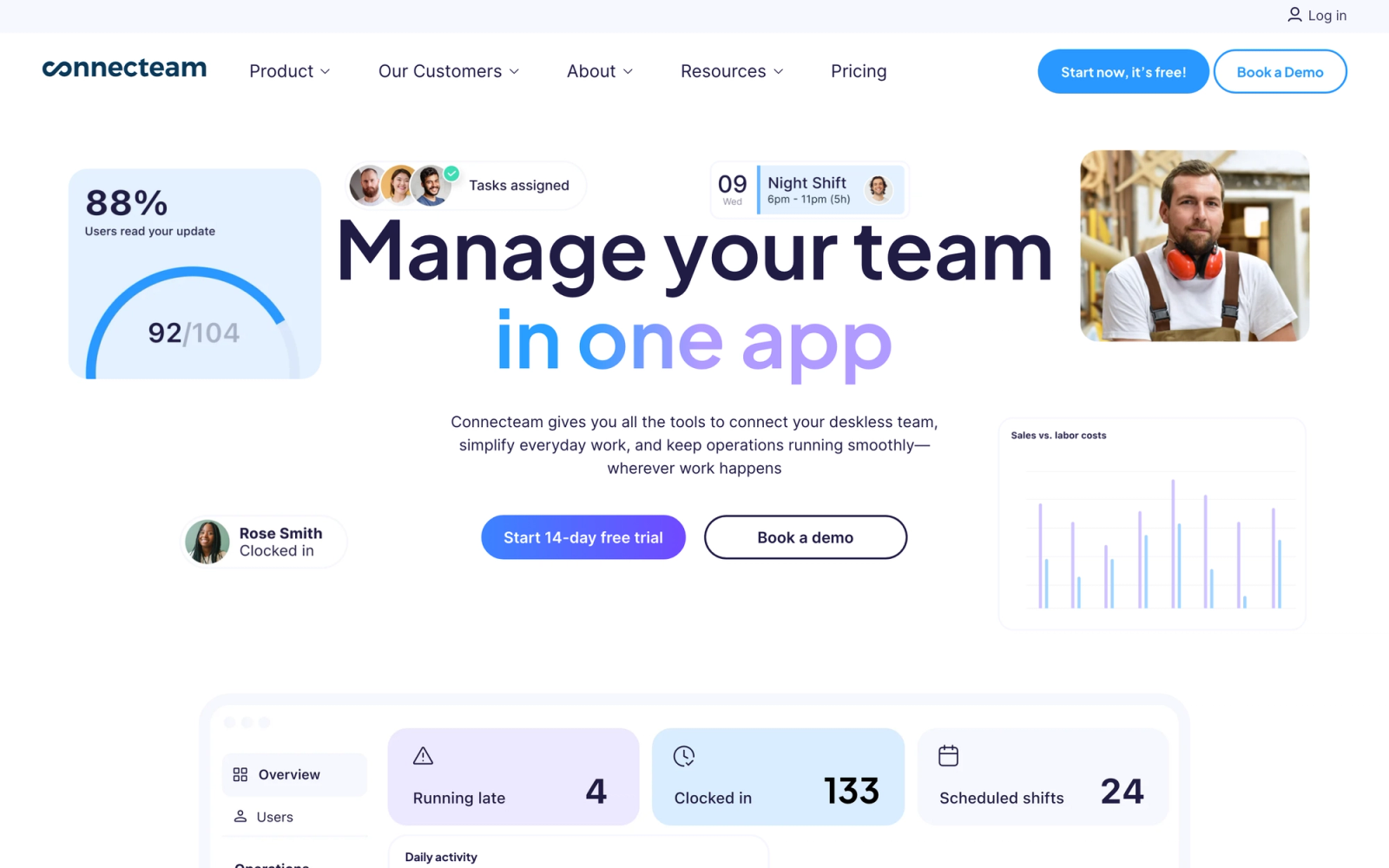
Connecteam is not a traditional LMS. It is an all-in-one workforce management platform for field teams that includes training as one module alongside scheduling, time tracking, task management, communication, and HR features. For field service companies that need to manage their entire mobile workforce from a single app, Connecteam bundles training into the tool technicians already use for their daily operations.
The training module lets you create courses from scratch using a mobile-optimized builder, import existing content, and track completion across your team. What makes Connecteam distinct for field service is context. Because training lives inside the same app where technicians clock in, receive dispatches, and communicate with their team, the barrier to accessing a lesson drops significantly. This integration is particularly valuable for just-in-time training, where a technician can pull up a procedural guide immediately before or during a service call.
Core Capabilities
- Mobile-first training module with course builder, quizzes, and media content support
- Integrated with scheduling, time tracking, task management, and team communication in one app
- Knowledge base feature for storing SOPs, manuals, and reference documents accessible in the field
- Push notifications for training assignments delivered through the same app used for daily work
- Quiz and assessment tools with pass/fail thresholds and automatic grading
- Training progress tracking with completion reports by team, location, or individual
- Digital forms and checklists for field-based skills verification and safety sign-offs
- GPS-enabled time tracking that contextualizes training completion with field activity
- Group and individual chat for real-time communication between technicians and managers
- Onboarding workflows that combine training assignments with HR documentation and task lists
Standout Strength
Connecteam removes the "separate app" problem that depresses training completion in field service teams. Because training lives inside the same app where technicians clock in, receive job assignments, and communicate with their manager, they do not need to switch contexts to complete a lesson. Completion rates tend to be higher than with standalone LMS platforms that require a separate login. For small-to-midsize field service companies, consolidating operations and training in one place reduces friction for both administrators and technicians.
Best For
Small-to-midsize field service companies with 10 to 500 workers who want a single platform for workforce management and training. Ideal for service businesses in cleaning, pest control, landscaping, HVAC, and facility maintenance where the priority is getting training into the daily workflow rather than running a sophisticated learning operation. Shares training goals with manufacturing LMS use cases where mobile-first access is critical.
Pricing Overview
- Free plan available for small teams (up to 10 users)
- Paid plans start at $29 per month for up to 30 users (per hub, billed annually)
- Pricing model: Flat monthly fee with user tiers
- Training module included in all plans
Limitations
- The training module is functional but not as deep as a dedicated LMS. Course authoring, reporting, and compliance features are basic compared to TalentLMS or Absorb.
- No SCORM support. You cannot import third-party training packages from content vendors.
- Offline training access is limited. The knowledge base works offline, but interactive courses require connectivity.
Quick Comparison Insight
Less capable as a pure LMS than any other platform on this list, but the all-in-one approach eliminates the adoption barrier of asking field workers to use a separate training app. Best for companies that value workflow integration over training depth.
Trainual
Overview
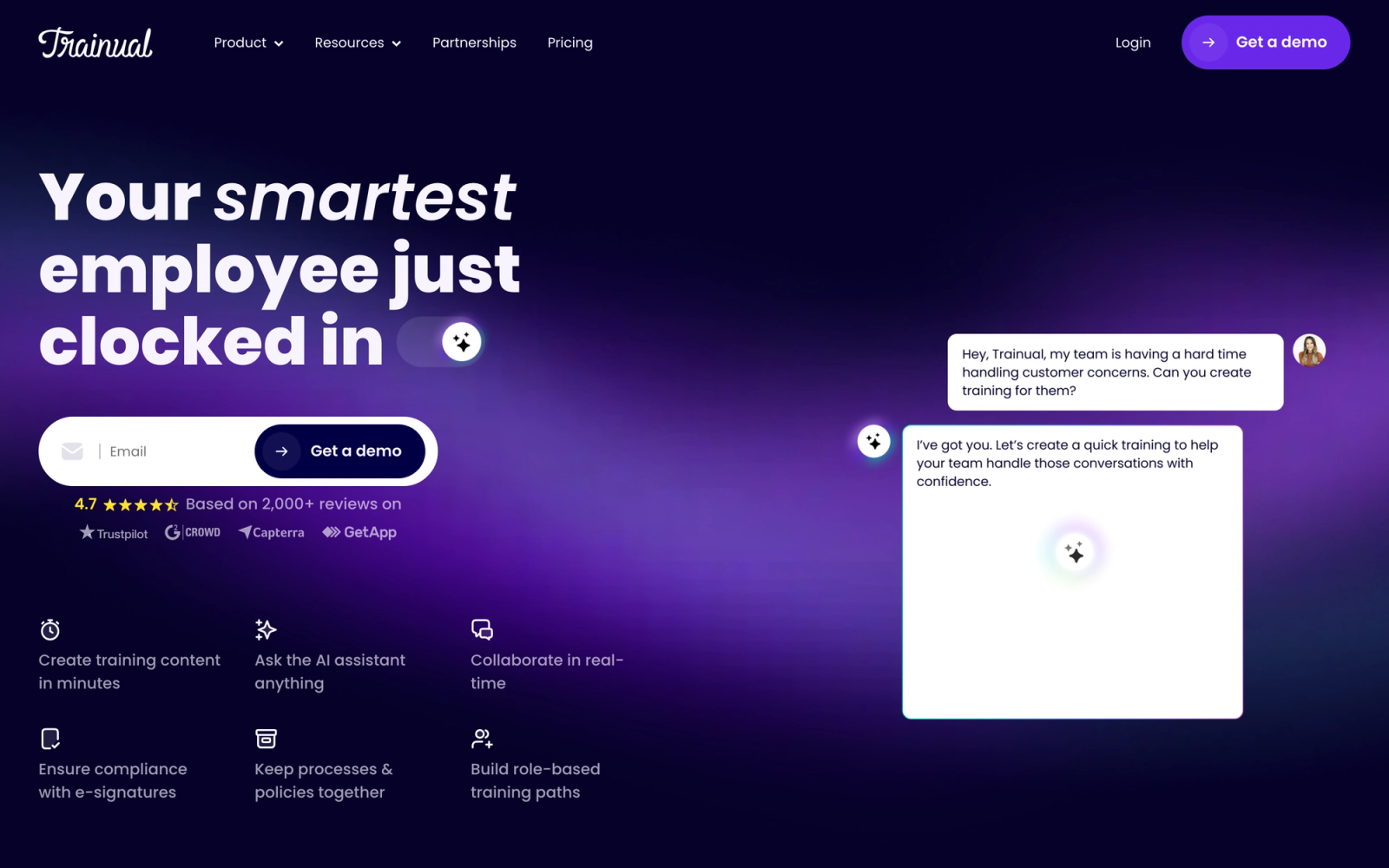
Trainual is a process documentation and training platform designed for businesses that need to standardize how work gets done across distributed teams. Rather than focusing on traditional course-based learning, Trainual organizes company knowledge into structured playbooks covering SOPs, procedures, policies, and role-specific responsibilities.
For field service organizations, this SOP-centric approach addresses a real gap. When a new technician joins the team, they need to know exactly how to handle specific service scenarios, from equipment installation procedures to customer communication protocols. Trainual structures that knowledge so it is searchable, assignable, and trackable. It is particularly effective for documenting the "tribal knowledge" that experienced field technicians carry but rarely write down.
Core Capabilities
- SOP and process documentation with structured templates for roles, responsibilities, and procedures
- Step-by-step training content organized by department, role, and subject area
- Screen recording and video embedding for creating visual procedural guides
- Role-based content assignment that automatically delivers relevant SOPs to new hires
- Completion tracking with accountability for who has reviewed and acknowledged each process
- Search functionality that lets field workers find specific procedures quickly from their phone
- Org chart and role mapping that connects training content to job responsibilities
- Integration with HR platforms (BambooHR, Gusto, Rippling) for automated onboarding triggers
- Content version control that notifies teams when procedures are updated
- Mobile-responsive interface for accessing SOPs and training from any device
Standout Strength
Trainual excels at capturing and distributing the operational knowledge that field service companies rely on but rarely formalize. For organizations where inconsistent service delivery is the training problem, Trainual provides the structure to document exactly how every procedure should be performed and ensures every technician has access to that documentation.
Best For
Field service companies with 10 to 200 employees that need to standardize processes across distributed teams. Strongest fit for growing service businesses where the founder or operations manager has been training verbally and needs to transition to documented, repeatable procedures. Less suited for organizations with heavy compliance or certification requirements.
Pricing Overview
- Starting price: $249 per month (for small teams)
- Pricing model: Tiered by number of users and features
- Free 7-day trial available
Limitations
- Not a traditional LMS. There is no SCORM support, no certification management, and no compliance automation. If you need regulatory training tracking, you need a separate platform.
- No offline access. Field workers need an internet connection to access SOPs and training content.
- The SOP documentation model works well for procedural training but is not designed for interactive skill-building, assessments, or scenario-based learning.
Quick Comparison Insight
Solves a different problem than the traditional LMS platforms on this list. Where TalentLMS and Litmos deliver and track training courses, Trainual documents and distributes operational knowledge. Best paired with a compliance-focused LMS for complete coverage.
Axonify
Overview
Axonify takes a fundamentally different approach to field service training. Instead of delivering courses that workers complete once and forget, Axonify structures learning as a daily habit. Technicians open the app, answer a few questions, receive a short reinforcement module, and close it, all in about three minutes. The entire platform is built around the principle that repeated short interactions produce better knowledge retention than occasional long training sessions.
This spaced repetition model is particularly relevant for field service. A technician who completed a safety module six months ago may not retain the critical details when they encounter that scenario in the field. Axonify keeps essential knowledge active by continuously reinforcing the topics where each individual worker shows gaps. The adaptive algorithm shifts focus away from concepts a technician has mastered and toward areas where their understanding is weaker.
Core Capabilities
- Daily three-to-five minute training sessions delivered through a mobile app
- Adaptive learning engine that adjusts content based on individual knowledge gaps
- Spaced repetition algorithm that reinforces knowledge at optimal intervals
- Content marketplace with pre-built modules covering safety, compliance, and operational topics
- Gamification with game mechanics integrated into daily learning sessions
- Compliance tracking with certification management and audit trail reporting
- Knowledge confidence scores at the individual, team, and regional level
- Content authoring tools for creating bite-sized modules and reinforcement activities
- Integration with HRIS platforms and workforce management tools
- Manager dashboards surfacing team knowledge gaps and training progress by service territory
Standout Strength
Axonify addresses the retention gap that traditional field service training leaves open. Completing a course once does not mean a technician recalls the critical detail six months later when they actually need it. With Axonify, workers open the app daily, answer a few adaptive questions, receive targeted reinforcement on their weak areas, and close it in three minutes. The platform tracks what each person actually knows, not just what they have clicked through. In safety-critical environments, that distinction has real consequences for incident rates and compliance exposure.
Best For
Large field service organizations with 500+ technicians who need continuous knowledge reinforcement beyond one-time course completion. Ideal for utilities, telecom, and industrial service companies where safety procedures, product knowledge, and regulatory awareness need to stay current across a distributed workforce. Works best alongside a traditional LMS rather than as a replacement. Similar in approach to platforms serving construction LMS use cases where safety retention is paramount.
Pricing Overview
- Custom enterprise pricing (Axonify does not publish standard rates)
- Pricing is typically per-user per-month
- Demo and pilot programs available on request
Limitations
- Not a traditional LMS. If you need long-form courses, instructor-led training management, or SCORM hosting, Axonify is not the right standalone platform.
- Enterprise-level pricing is not transparent. Smaller field service companies may find the cost difficult to justify.
- The microlearning-only approach does not cover every training need. Most Axonify customers pair it with another LMS for onboarding and extended certification programs.
Quick Comparison Insight
Where TalentLMS and Litmos deliver and track courses, Axonify ensures field workers actually retain what they learned. Deeper on engagement and retention science, narrower in overall training scope. Best used as a complement, not a replacement.
How to Choose the Right Field Service LMS
The right platform depends on the training problem you are solving, not on which tool has the longest feature list. Use this as an if/then guide.
If you are developing technicians and supervisors, Teachfloor is the strongest fit. Self-paced certification tracks, AI-assisted authoring, peer learning tools, and multi-branch structure let you build structured programs for internal crews and extend training to dealer or partner networks under the same account.
If compliance is the primary driver, Litmos and Absorb LMS offer the most mature certification lifecycle management, with automated expiry tracking, renewals, and audit-ready reporting. TalentLMS handles basic compliance at a lower price point.
If mobile delivery is the challenge, eduMe and Axonify are purpose-built for field workers who train on their phones in short windows, with no-login access and daily reinforcement that no retrofitted LMS matches.
If offline access is critical, Absorb LMS has the strongest offline experience. TalentLMS and Litmos also support offline download, but Absorb's sync reliability is a step above for zero-connectivity environments.
If you train multiple audiences, LearnUpon's multi-portal architecture manages technician, partner, dealer, and customer training from one system. Docebo offers similar multi-audience flexibility at enterprise scale with AI automation, and pairs well with a corporate training platform for office staff.
If process documentation is the gap, Trainual captures and distributes the SOPs field technicians need for consistent work. It pairs well with a training-focused LMS.
If you want training inside daily operations, Connecteam bundles training with scheduling, communication, and task management, trading training depth for workflow integration.
Most large field operations end up running two tools: a flexible academy or compliance LMS for structured development, plus a microlearning tool for daily delivery. The goal is not one platform that does everything, but a stack that matches how your crews actually learn. For a closer look at what these tools cost, see our guide to LMS pricing.
FAQ
What is the difference between a field service LMS and a traditional LMS?
A field service LMS prioritizes mobile access, offline or low-bandwidth delivery, short-form content, and compliance tracking for distributed workers who are rarely at a desk. Traditional LMS platforms assume desktop access, long time blocks, and reliable internet. A desk-first platform can technically deliver mobile training, but the experience usually drives down adoption among field crews.
Do field service teams need offline access in an LMS?
It depends on the work environment. Technicians who service equipment in low-coverage locations, dense urban basements, rural routes, or large indoor facilities, need offline download as a baseline requirement. Crews with consistent coverage can treat it as a backup. A platform like Teachfloor covers technician and supervisor development through self-paced tracks and certification management without requiring offline capability, and is often paired with a microlearning tool that handles on-site delivery for field crews.
Can I use one LMS for both field and office staff?
Yes. Docebo, Absorb LMS, and TalentLMS serve both audiences from one instance, and a corporate training platform approach keeps reporting centralized. The trade-off is that a platform optimized for both may be less specialized for field workers than a purpose-built mobile tool like eduMe or Connecteam.
How much does a field service LMS cost?
Pricing varies widely. Teachfloor starts at $89 per month for up to 50 learners. TalentLMS offers a free plan and a Core tier around $119 per month billed annually. Enterprise platforms like Docebo, Axonify, and Absorb use custom pricing that typically runs from $4 to $12 per user per month depending on volume and features. Budget for content development and implementation beyond the subscription. Our affordable LMS guide compares the lower-cost options in more detail.
What content formats work best for field service training?
Short video (under five minutes), interactive quizzes, visual step-by-step guides, and scenario questions perform best with field audiences. Long text and hour-long modules see low completion among mobile workers. Platforms with native microlearning authoring make effective field content easier to produce. According to G2's LMS category, mobile experience and ease of use are among the most-cited factors in field-team buying decisions.


