

Why Manufacturing Companies Need a Specialized LMS
Training in manufacturing is not the same as training in an office. The differences are structural, not cosmetic. Floor workers operate heavy machinery, handle hazardous materials, and follow safety protocols that carry real consequences when missed. A generic LMS built for desk-based knowledge workers rarely accounts for these realities.
The first challenge is access. Most manufacturing employees do not sit in front of a computer for eight hours. They work on production lines, in warehouses, and across rotating shifts. Training has to reach them on mobile devices, often in areas with limited connectivity. If the LMS requires a stable desktop browser session to function, it will not get used.
The second challenge is compliance. Manufacturing companies operate under regulatory frameworks like OSHA standards, ISO certifications, EPA requirements, and industry-specific mandates. Training is not optional enrichment. It is a legal obligation, and the LMS needs to track completions, manage recertifications, and produce audit-ready reports on demand.
Then there is the workforce itself. Manufacturing teams are often multilingual, span multiple facilities, and include contractors alongside full-time employees. A platform that cannot handle language localization, location-based assignments, or flexible user management creates more administrative work than it eliminates.
The stakes are also different. In most industries, a training gap means reduced productivity. In manufacturing, it can mean injuries, equipment damage, or regulatory fines. The LMS is not just a learning tool. It is part of the safety infrastructure.
What to Look for in a Manufacturing LMS
Before evaluating specific platforms, it helps to define the criteria that matter most in a manufacturing context. Not every feature marketed as "enterprise-grade" is relevant here. Focus on what directly affects your operations.
Safety and compliance management. The LMS must support mandatory training assignments with hard deadlines, automatic recertification reminders, and audit trails. Look for platforms that can generate compliance reports by location, department, or regulation type. If an OSHA auditor walks in tomorrow, you should be able to pull the relevant records in minutes, not hours.
Mobile and offline access. Floor workers need to complete training on tablets or smartphones, sometimes in areas without reliable Wi-Fi. The LMS should offer a native mobile app with offline capabilities so learners can download content, complete modules, and sync progress when they reconnect.
Multilingual support. A significant portion of the manufacturing workforce speaks a primary language other than English. The platform should support multiple interface languages and allow content to be delivered in different languages based on learner profiles. This is not a nice-to-have. It directly affects comprehension and safety outcomes.
Shift-friendly scheduling. Training schedules must accommodate rotating shifts, seasonal workers, and production deadlines. The LMS should allow managers to assign training windows that align with shift patterns, rather than assuming everyone is available during standard business hours. Effective employee training in manufacturing depends on this flexibility.
Certification and skills tracking. Manufacturing roles often require specific certifications, such as forklift operation, lockout/tagout procedures, or confined space entry. The LMS should track individual certifications with expiration dates, automatically trigger retraining, and give managers a clear view of team-wide qualification gaps.
Regulatory reporting. Different regulatory bodies require different documentation formats. The platform should support configurable reports that map to OSHA, ISO, FDA, and other frameworks your facilities need to comply with. Built-in report templates for common manufacturing regulations save significant administrative effort.
Integration with existing systems. Manufacturing companies typically run ERP systems, HRIS platforms, and quality management software. The LMS should integrate with tools like SAP, Workday, BambooHR, or proprietary plant management systems so that training records flow into the broader operational data stack without manual transfers.
8 Best LMS for Manufacturing
The platforms below range from mid-market solutions focused on ease of use to enterprise systems built for global manufacturing operations. Each addresses a different combination of the requirements outlined above, spanning a range of company sizes, technical complexity, and budget levels.
Tool Mobile/Offline Compliance Tracking Multilingual Certification Mgmt Best For TalentLMS Partial ✓ ✓ ✓ SMBs and mid-size manufacturers needing fast deployment Absorb LMS ✓ ✓ ✓ ✓ Mid-to-large manufacturers wanting polished UX with strong compliance SAP Litmos ✓ ✓ ✓ ✓ SAP-centric enterprises needing tight ERP integration Docebo ✓ ✓ ✓ ✓ Large manufacturers scaling AI-driven learning programs iSpring Learn ✓ ✓ ✓ ✓ Companies with heavy PowerPoint-based training content Axonify ✓ ✓ ✓ ✓ Frontline-heavy operations focused on daily microlearning Cornerstone OnDemand ✓ ✓ ✓ ✓ Enterprise manufacturers with complex talent management needs Teachfloor Partial ✓ ✓ ✓ Manufacturers running instructor-led and cohort-based training
Teachfloor
Overview
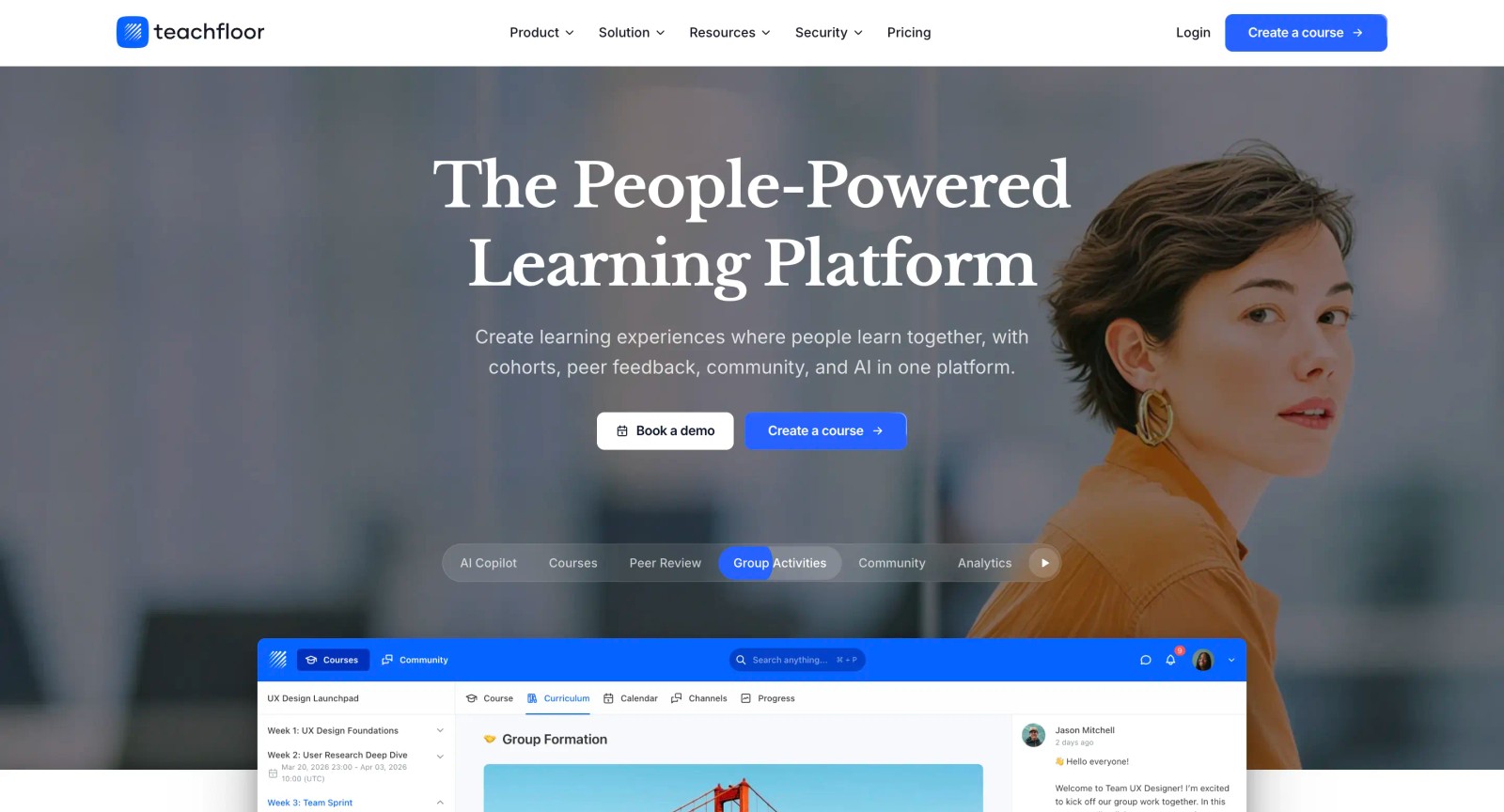
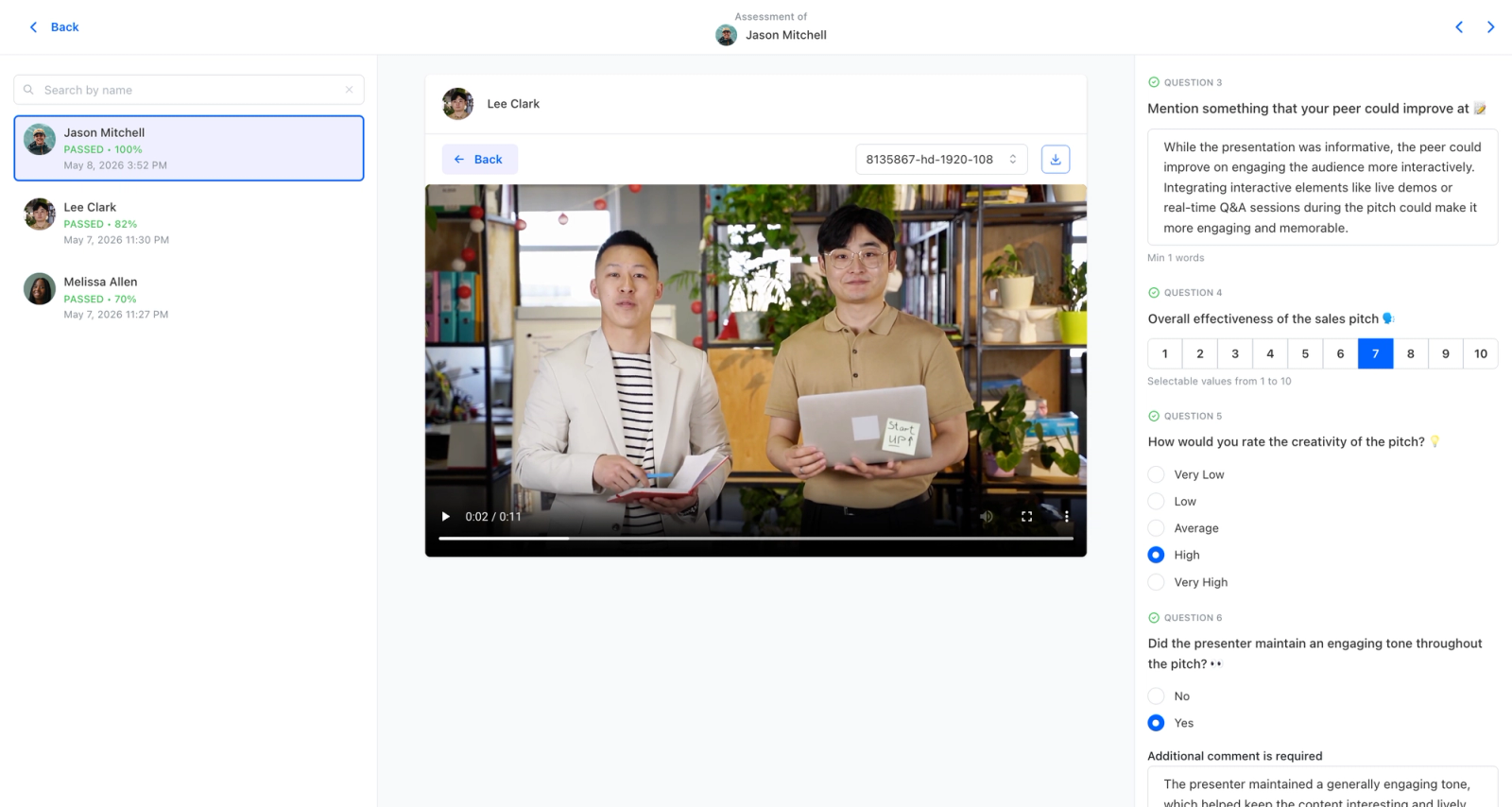
On a manufacturing floor, training is really qualification: before an operator runs a machine or handles a hazardous material, you need documented proof they were trained on the current standard operating procedure. Teachfloor is a flexible learning platform built around that loop. You publish the SOP as a module, the operator completes it self-paced between shifts or in a scheduled cohort, passes a check, and earns a certificate that records the qualification. Because most floor workers aren't at a desk, modules are mobile-accessible and short enough to fit around shift work. When an SOP revision goes out, AI-assisted authoring lets a process engineer turn the new procedure into an updated module fast, and you can re-qualify the affected operators against the change. SCORM support carries over machine-safety and compliance content you already license, and analytics give you the qualification matrix auditors and quality teams ask for.
Core Capabilities
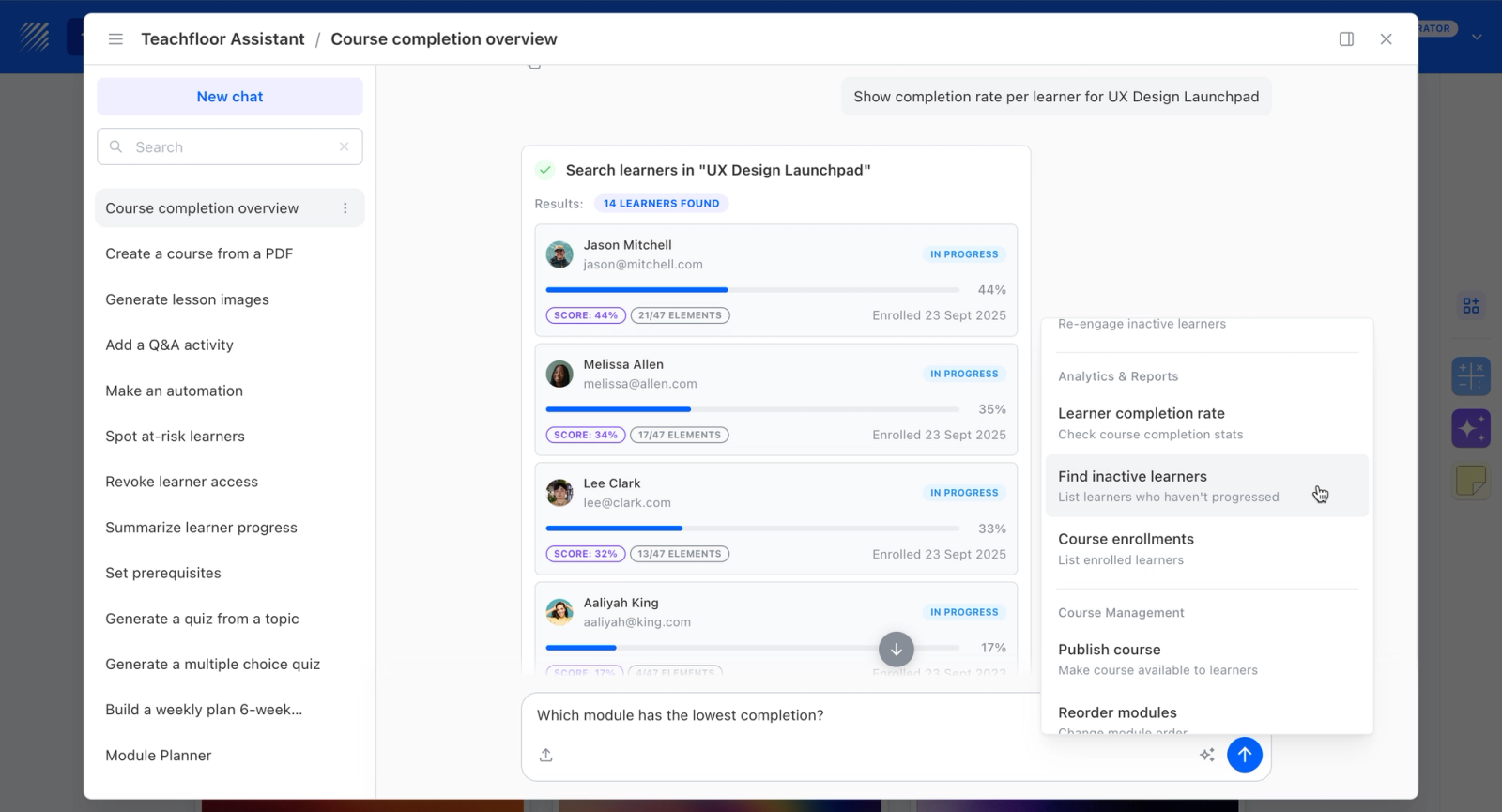
- SOP qualification flow: publish a procedure, require a pass, and issue a certificate that documents who is qualified to run a given process or machine
- Mobile access so operators complete training on the floor or between shifts rather than at a workstation they rarely use
- AI-assisted authoring to turn an SOP revision into an updated module quickly and re-qualify affected operators when the standard changes
- SCORM support to bring in existing machine-safety, lockout-tagout, and hazmat courses without rebuilding them
- Analytics that produce a qualification record by operator and procedure, the kind quality and compliance teams need for audits
Best For
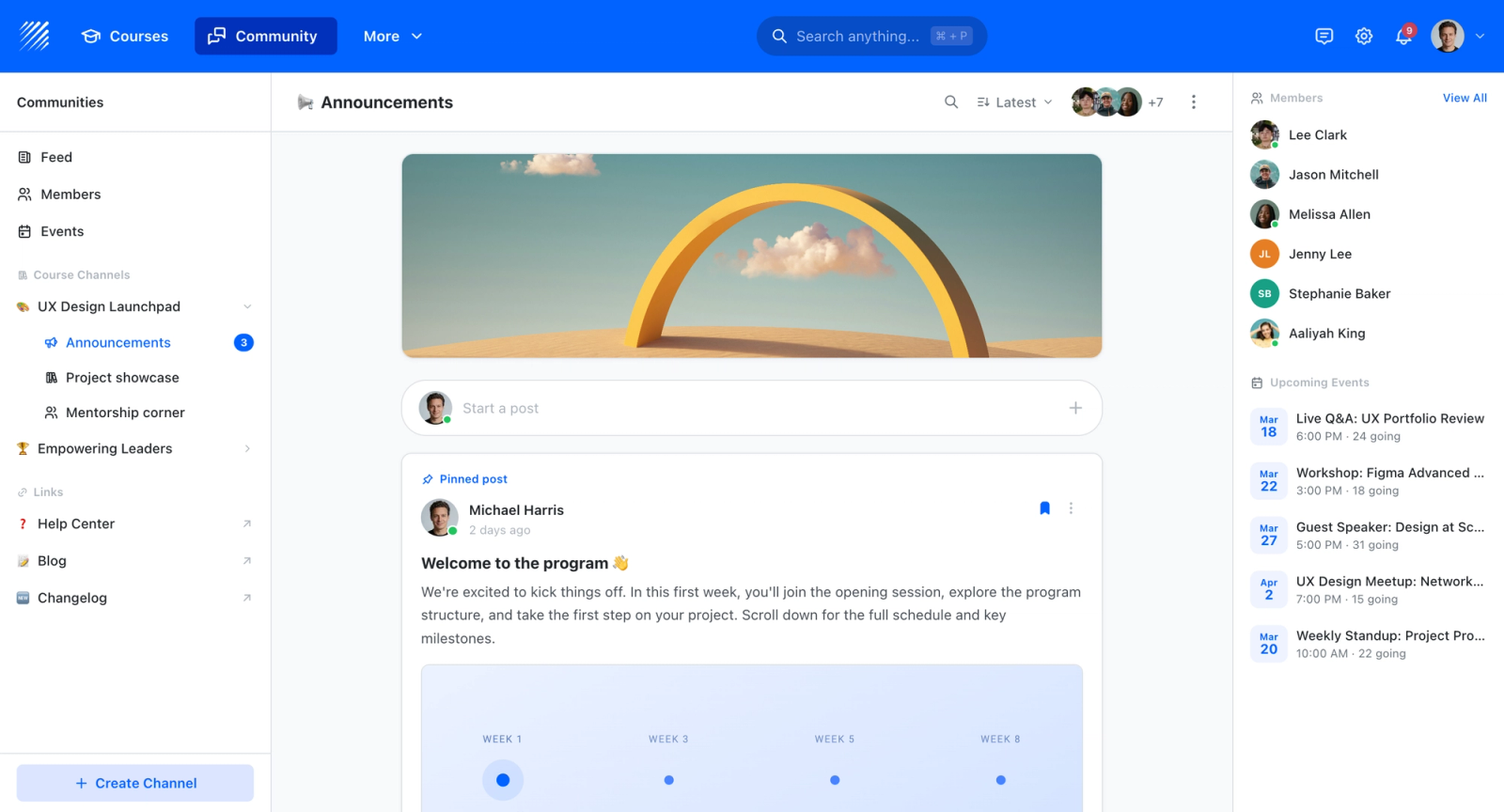
Manufacturers that need documented operator qualification tied to current SOPs, delivered to a deskless floor workforce, with a clean record for quality audits.
Pricing Overview
- Startup plan from $89 per month for up to 50 learners
- Full Features plan with custom pricing, white-label, SSO, and advanced integrations
- 14-day free trial; no permanent free plan
- Nonprofit discounts available
Limitations
- No built-in versioned SOP document control or e-signature workflow of the kind a dedicated QMS provides; Teachfloor records training and qualification, not the controlled document itself
- No offline mode, so areas of the plant with poor connectivity need a workaround for module access
- No permanent free plan; starts at $89/mo for up to 50 learners after the 14-day trial, with custom pricing for larger deployments
Quick Comparison Insight
Ties operator qualification to current SOPs with mobile modules, certificates, and an audit-ready record; not a replacement for a document-control QMS and has no offline mode.
TalentLMS
Overview
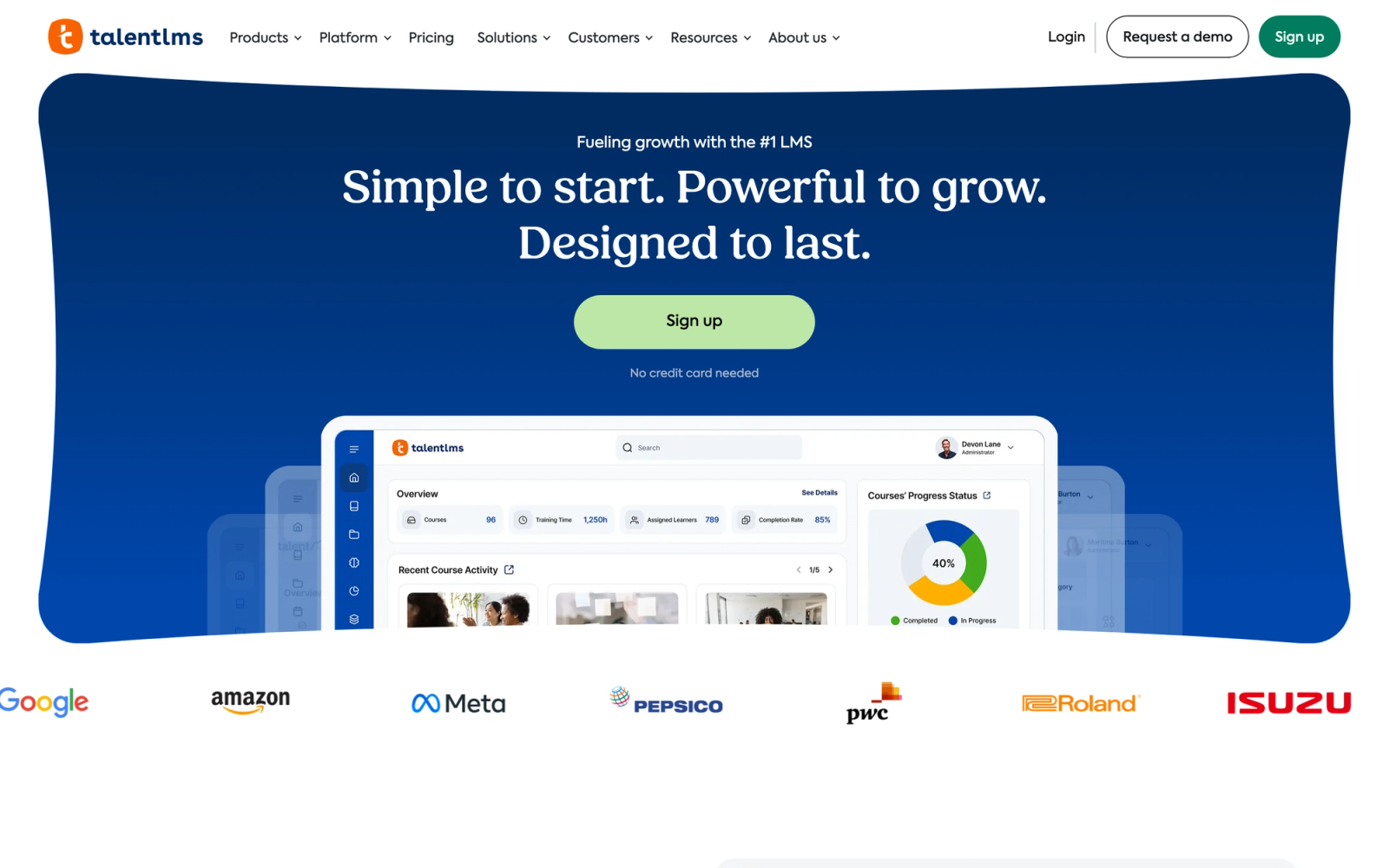
TalentLMS is a cloud-based learning management system from Epignosis that positions itself as the platform you can set up and start using in the same day. That claim holds up reasonably well. The interface is clean, the configuration is straightforward, and the learning curve for administrators is noticeably shorter than most enterprise LMS platforms.
For manufacturing companies, TalentLMS works best when you need a functional training system running quickly without a lengthy implementation project. It supports compliance training workflows, handles certification tracking, and offers enough customization to cover standard manufacturing use cases. Where it falls short is at enterprise scale, discussed in the Limitations section below.
Core Capabilities
- Branch management for separating training across multiple plant locations or departments
- Built-in course builder supporting SCORM, xAPI, video, and document-based content
- Automated certification management with expiration tracking and renewal notifications
- Custom reports for compliance auditing, including completion rates by group or location
- Native mobile app for iOS and Android with offline content access
- Multilingual interface supporting over 30 languages
- Gamification features including points, badges, and leaderboards to drive engagement
- Integration with Zapier, BambooHR, Salesforce, and other HR tools via REST API
- Custom learning paths for role-based training sequences like new hire safety onboarding
- Built-in video conferencing integration with Zoom and GoToMeeting for live sessions
Standout Strength
Manufacturers choose TalentLMS because it removes the implementation barrier. Small and mid-size companies that lack a dedicated L&D team can have training programs running within days, not months. The branch system allows multi-site manufacturers to separate content and reporting by facility while keeping centralized oversight.
Best For
Small-to-midsize manufacturing companies with 50 to 500 employees that need a straightforward LMS for safety compliance, onboarding, and skills training. Particularly strong for organizations deploying their first formal LMS and wanting fast time-to-value without heavy IT involvement.
Pricing Overview
- Starting price: Free plan for up to 5 users; paid plans start at $89 per month
- Pricing model: Tiered by active user count
- Free trial available on all paid tiers
Limitations
- Reporting is functional but lacks the depth needed for complex multi-site compliance analysis. If you need cross-facility regulatory dashboards, you will likely export data to external tools.
- The mobile offline mode has constraints. Not all content types sync reliably for offline use, which can be a friction point on the factory floor.
- Enterprise features like advanced workflow automation and deep ERP integration are limited compared to platforms built specifically for large-scale manufacturing.
Quick Comparison Insight
Faster to deploy than Absorb or Cornerstone, but lacks the depth those platforms offer for enterprise compliance management. A strong starting point for manufacturers scaling up their training operations.
Absorb LMS
Overview
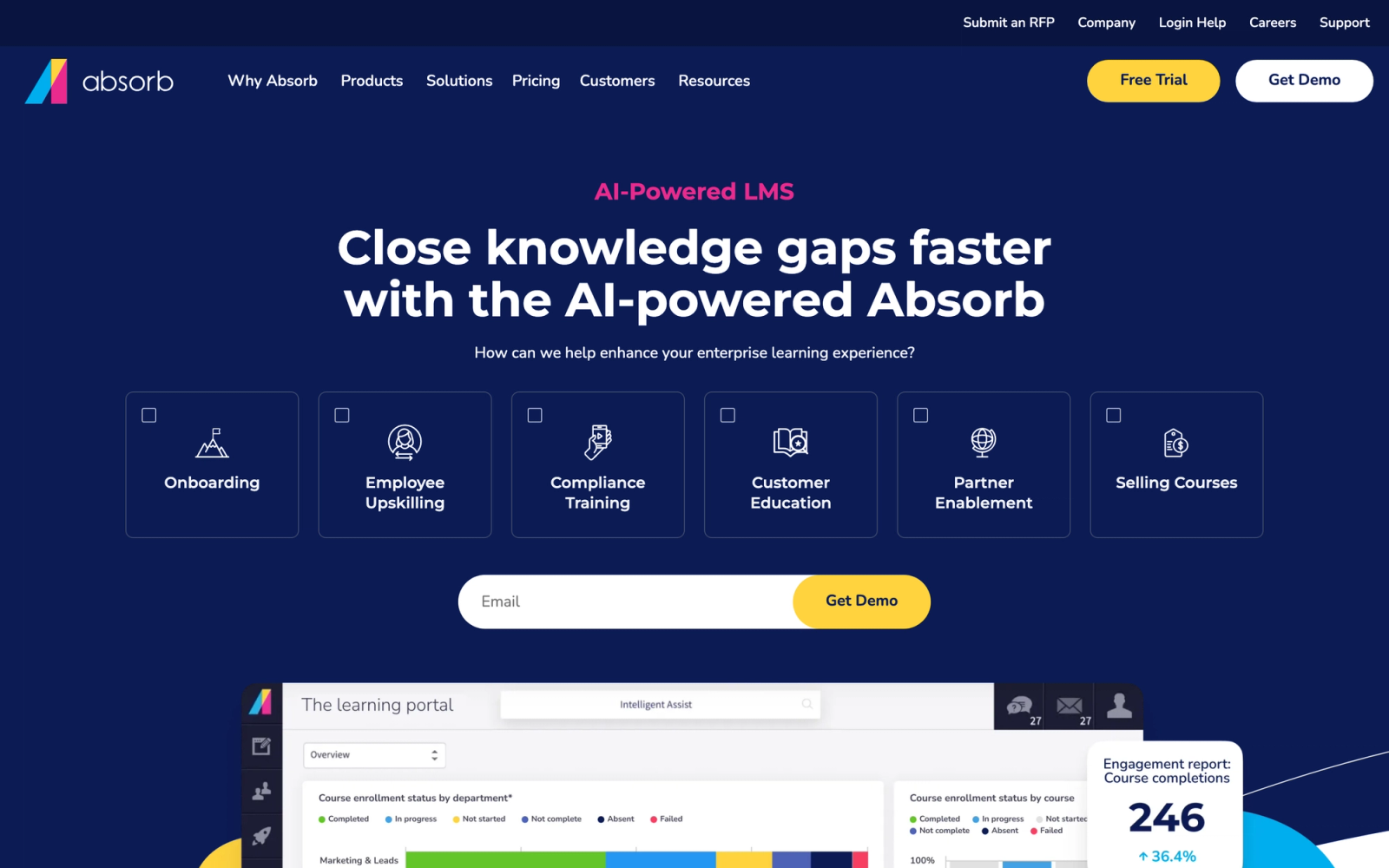
Absorb LMS is a mid-to-enterprise learning platform that consistently earns praise for its user interface and administrative experience. Built in Calgary and serving a wide range of industries, Absorb has made deliberate investments in compliance management, making it a natural fit for regulated sectors including manufacturing.
Absorb puts particular emphasis on the admin experience. Setting up compliance rules, building automated enrollment triggers, and pulling reports is noticeably smoother than on older enterprise platforms. The learner-facing side is equally clean, which matters when floor workers are not tech-savvy and need a straightforward path to completing required training on time.
Core Capabilities
- Intelligent Assist powered by AI for admin task recommendations and report generation
- Compliance engine with automated enrollment, escalation workflows, and audit-ready reports
- Native mobile app with offline learning and automatic sync when connectivity returns
- SCORM, xAPI, AICC, and cmi5 content standard support
- Observation checklists for verifying hands-on skills on the production floor
- Multi-language support across the learner interface and content delivery
- eCommerce module for selling training to external partners or distributors
- Absorb Infuse for embedding learning directly into third-party applications
- Custom reporting dashboards with scheduled automated report delivery
- Integrations with major HRIS platforms including Workday, ADP, and BambooHR
Standout Strength
The compliance automation is where Absorb differentiates itself for manufacturing. You can configure rules that automatically enroll workers in recertification courses, escalate overdue completions to supervisors, and generate audit reports on a schedule. This turns compliance tracking from a manual administrative burden into an automated system, which is critical when you are managing hundreds or thousands of certifications across multiple plants.
Best For
Mid-to-large manufacturing companies with 500 to 10,000+ employees that need a modern, user-friendly LMS with strong compliance automation. Particularly well-suited for organizations that have outgrown a basic LMS and need better reporting, mobile access, and hands-on skills verification without the complexity of a full talent suite.
Pricing Overview
- Custom enterprise pricing based on user count and feature requirements
- Pricing model: Per-user licensing, typically quoted annually
- Free demo available; no public pricing page
Limitations
- Pricing is not transparent. You must go through a sales process to get a quote, which makes budgeting harder for mid-size companies comparing options.
- While the mobile app supports offline learning, the range of offline-compatible content types is narrower than some competing platforms.
- The platform is primarily an LMS, not a full talent management suite. If you need performance reviews, succession planning, or career pathing integrated with learning, you will need additional tools.
Quick Comparison Insight
More polished and compliance-focused than TalentLMS, but at a higher price point. Less complex than Cornerstone OnDemand, making it a strong middle ground for manufacturers that want enterprise compliance features without enterprise-level implementation overhead.
SAP Litmos
Overview
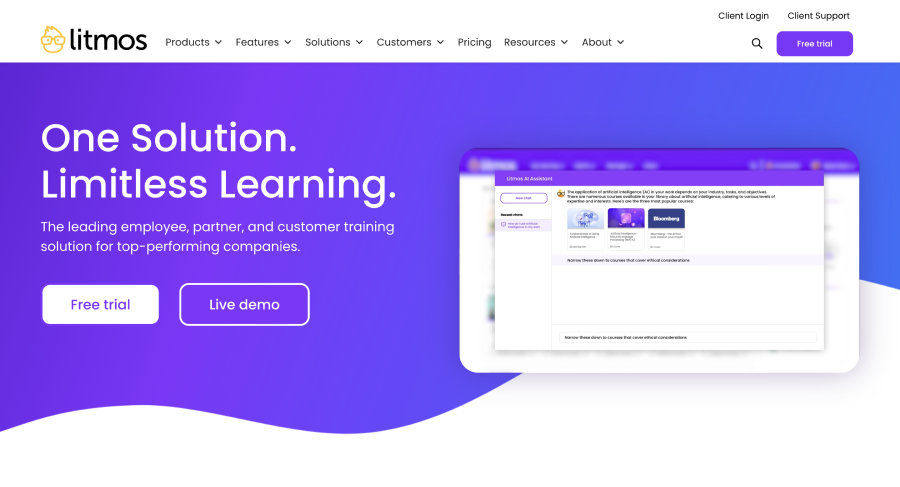
SAP Litmos is a cloud-based LMS that became part of the SAP stack through acquisition. For manufacturing companies already running SAP for ERP, supply chain, or HR, Litmos offers the advantage of native integration with a technology stack they already depend on. That integration is its primary draw in the manufacturing space.
The platform combines a built-in content library with LMS functionality, giving manufacturers access to a large catalog of pre-built compliance courses alongside the ability to create and assign custom content. Course deployment is fast: you can assign a safety training module from the library, set a compliance deadline, and have workers enrolled within minutes.
Core Capabilities
- Pre-built content library with over 2,000 courses covering safety, compliance, and professional skills
- Native integration with SAP SuccessFactors and other SAP modules
- Automated compliance management with mandatory training assignments and deadline tracking
- Mobile-responsive design with a dedicated app for on-the-go training
- Support for SCORM 1.2, SCORM 2004, xAPI, and AICC standards
- Custom learning paths with prerequisite enforcement for sequential training requirements
- Multi-language support for global manufacturing operations
- Real-time reporting dashboards and scheduled report generation
- Assessment engine with randomized question pools and timed quizzes for certification tests
- API-based integrations with Salesforce, BambooHR, and identity management providers
Standout Strength
SAP-centric manufacturing companies choose Litmos because training data flows directly into their existing SAP environment. Employee records, compliance statuses, and learning analytics stay synchronized across systems without manual exports. For plants running SAP for workforce management, this eliminates an entire category of data reconciliation work.
Best For
Mid-to-large manufacturing enterprises with 1,000+ employees that are already invested in the SAP stack and need an LMS that integrates natively. Also strong for companies that want a ready-made compliance content library to supplement custom training, reducing the burden of building every course from scratch.
Pricing Overview
- Starting price: Starts around $6 per user per month (varies by agreement)
- Pricing model: Per-user, with volume discounts for larger deployments
- Free 14-day trial available
Limitations
- The user interface feels dated compared to newer platforms like Absorb. Navigation can be unintuitive, particularly for non-technical administrators.
- The pre-built content library, while extensive, includes many generic courses. Manufacturing-specific content may still require custom development or third-party purchases.
- Reporting, while functional, lacks the visual polish and customization depth of dedicated analytics platforms. Complex cross-site reports can require workarounds.
Quick Comparison Insight
The clear choice for SAP shops. Less intuitive than Absorb and less flexible than Docebo for non-SAP environments, but the native ERP integration is a genuine operational advantage that other platforms cannot replicate.
Docebo
Overview
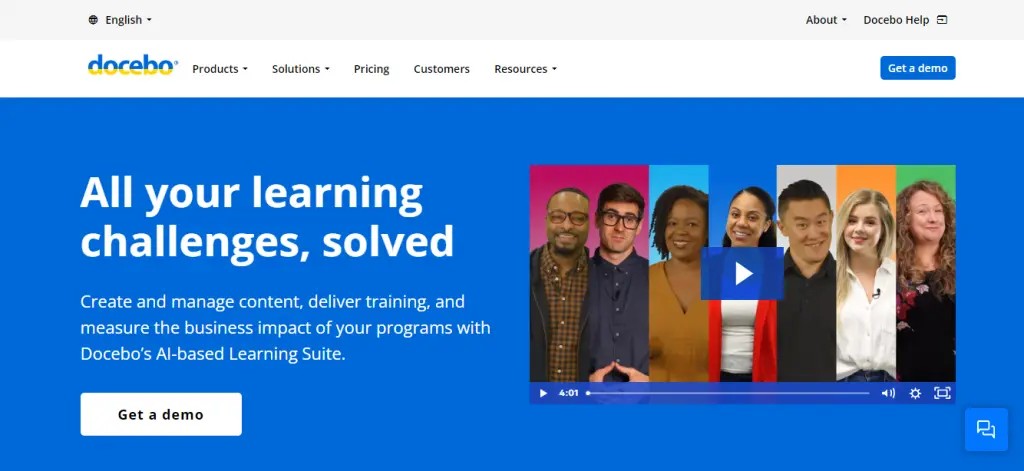
Docebo is an enterprise learning platform that has built its recent reputation on AI-powered features. The platform applies machine learning to content tagging, skill gap analysis, personalized learning recommendations, and automated content creation. For large manufacturing operations managing training needs across multiple facilities, these capabilities reduce the manual work that typically falls on small L&D teams.
What differentiates Docebo from most LMS platforms on this list is its positioning as a learning suite rather than a standalone LMS. It covers formal training, social learning, content management, and skills tracking within a single platform. The trade-off is complexity. Docebo is not something you configure in a day, and the learning curve for administrators is steeper than simpler platforms like TalentLMS.
Core Capabilities
- AI-powered content tagging and auto-categorization to reduce manual content management
- Skills ontology engine that maps training to competencies and identifies workforce gaps
- Compliance management with automated enrollment, expiration tracking, and audit reports
- Native mobile app with offline content access and push notifications
- Docebo Flow for embedding learning into the tools employees already use (CRM, ERP, intranet)
- Social learning features including channels, Q&A, and user-generated content
- Multi-domain architecture for managing different audiences (employees, contractors, partners)
- Support for SCORM, xAPI, AICC, and custom content formats
- Learning Impact measurement tools to connect training to operational KPIs
- Over 400 integrations including Salesforce, Workday, Microsoft Teams, and SAP
Standout Strength
The AI-driven skills mapping is where Docebo adds the most value for manufacturing. Instead of manually tracking which certifications each employee holds and which training they need next, Docebo's engine automates much of this process. For a plant with 2,000 workers across dozens of job roles, each requiring different safety certifications, that automation saves significant L&D time.
Best For
Large manufacturing enterprises with 1,000+ employees, multiple facilities, and complex training requirements spanning safety compliance, skills development, and contractor onboarding. Best for organizations with a dedicated L&D team that can invest in platform configuration and wants AI-driven efficiency at scale.
Pricing Overview
- Custom enterprise pricing; quotes based on active users and selected modules
- Pricing model: Modular, with separate pricing for different platform capabilities
- Free demo available; typical enterprise sales cycle
Limitations
- Implementation is a project, not a setup. Expect weeks to months of configuration, especially for complex multi-site deployments with custom compliance workflows.
- The modular pricing model means the total cost can escalate quickly as you add capabilities beyond the base LMS. Budget carefully.
- Smaller manufacturers with straightforward training needs may find Docebo over-engineered. The AI features add the most value at scale.
Quick Comparison Insight
More powerful and more complex than Absorb LMS. A strong choice for enterprise manufacturers that need AI-driven learning at scale, but excessive for organizations with fewer than 500 employees or simple compliance-only training needs.
iSpring Learn
Overview
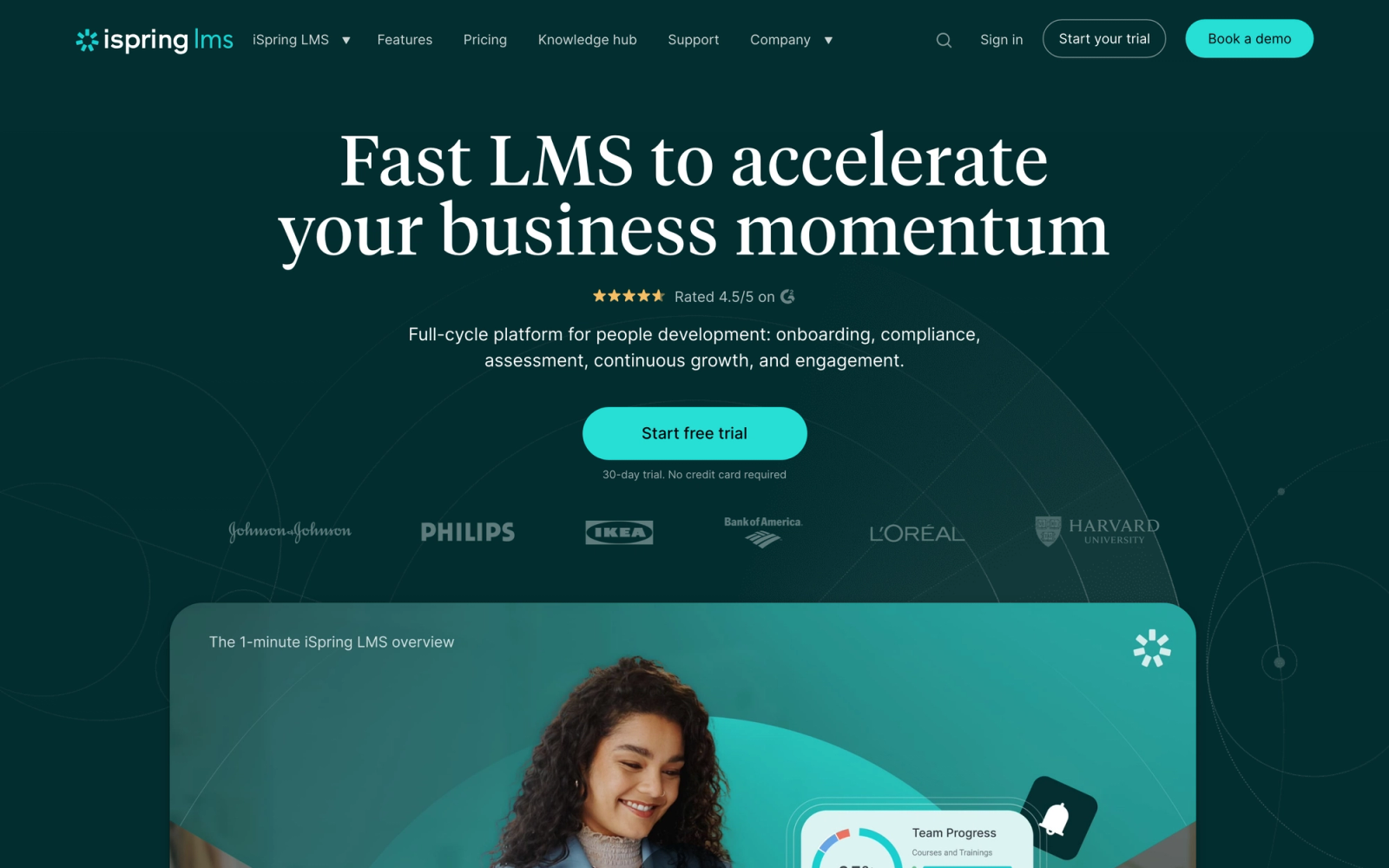
iSpring Learn takes a different approach from most platforms on this list. It is built around a tight integration with iSpring Suite, a PowerPoint-based authoring tool that converts slides into interactive eLearning content, SCORM packages, and video tutorials. For manufacturing companies whose subject matter experts already create training materials in PowerPoint, this connection removes the biggest bottleneck in content production.
The LMS itself is straightforward. It handles course assignments, tracks completions, manages certifications, and delivers content on mobile devices. It does not try to be a full talent management platform. That focused scope is actually an advantage for manufacturers who need a system that their plant managers and safety officers can operate without L&D expertise.
Core Capabilities
- Direct integration with iSpring Suite for converting PowerPoint into interactive courses
- Mobile app with offline access, allowing floor workers to train during downtime
- Automated training assignments based on department, role, or location
- Certification tracking with automatic expiration alerts and retraining enrollment
- On-the-job training (OJT) module for tracking hands-on skill verification by supervisors
- SCORM 1.2 and SCORM 2004 compliance for third-party content imports
- Calendar-based training scheduling for managing sessions around shift patterns
- Detailed completion and compliance reports with export to CSV and PDF
- Multi-language content support for diverse manufacturing workforces
- Custom branding and department-based content portals
Standout Strength
The PowerPoint-to-eLearning pipeline is what makes iSpring uniquely practical for manufacturing. Safety managers and instructional designers already have binders full of PowerPoint decks for safety procedures, equipment operation, and process documentation. iSpring Suite turns those existing assets into trackable eLearning modules without requiring a separate authoring tool or technical expertise.
Best For
Small-to-midsize manufacturers with 100 to 2,000 employees that have existing PowerPoint-based training content and need a straightforward LMS to deliver, track, and certify it. Ideal for organizations where plant managers or safety officers, not L&D professionals, own the training process.
Pricing Overview
- Starting price: $2.29 per user per month for the Start plan (billed annually)
- Pricing model: Per-user tiered pricing; Business plan at $3.14 per user per month
- iSpring Suite authoring tool priced separately (starts at $770 per author per year)
- Free 14-day trial available
Limitations
- The platform's value proposition depends heavily on using iSpring Suite for content creation. If you do not use PowerPoint-based authoring, much of the integration advantage disappears.
- Reporting is adequate for standard compliance tracking but does not match the depth or customization of Absorb or Docebo for complex multi-facility analytics.
- Social learning and collaborative features are minimal. If you need peer discussion, knowledge sharing, or community-driven learning, you will need to supplement with other tools.
Quick Comparison Insight
More affordable than Absorb or Docebo, with the fastest path from existing PowerPoint content to delivered training. Less capable for complex enterprise compliance management, but a practical choice for manufacturers who prioritize content production speed over platform sophistication.
Axonify
Overview
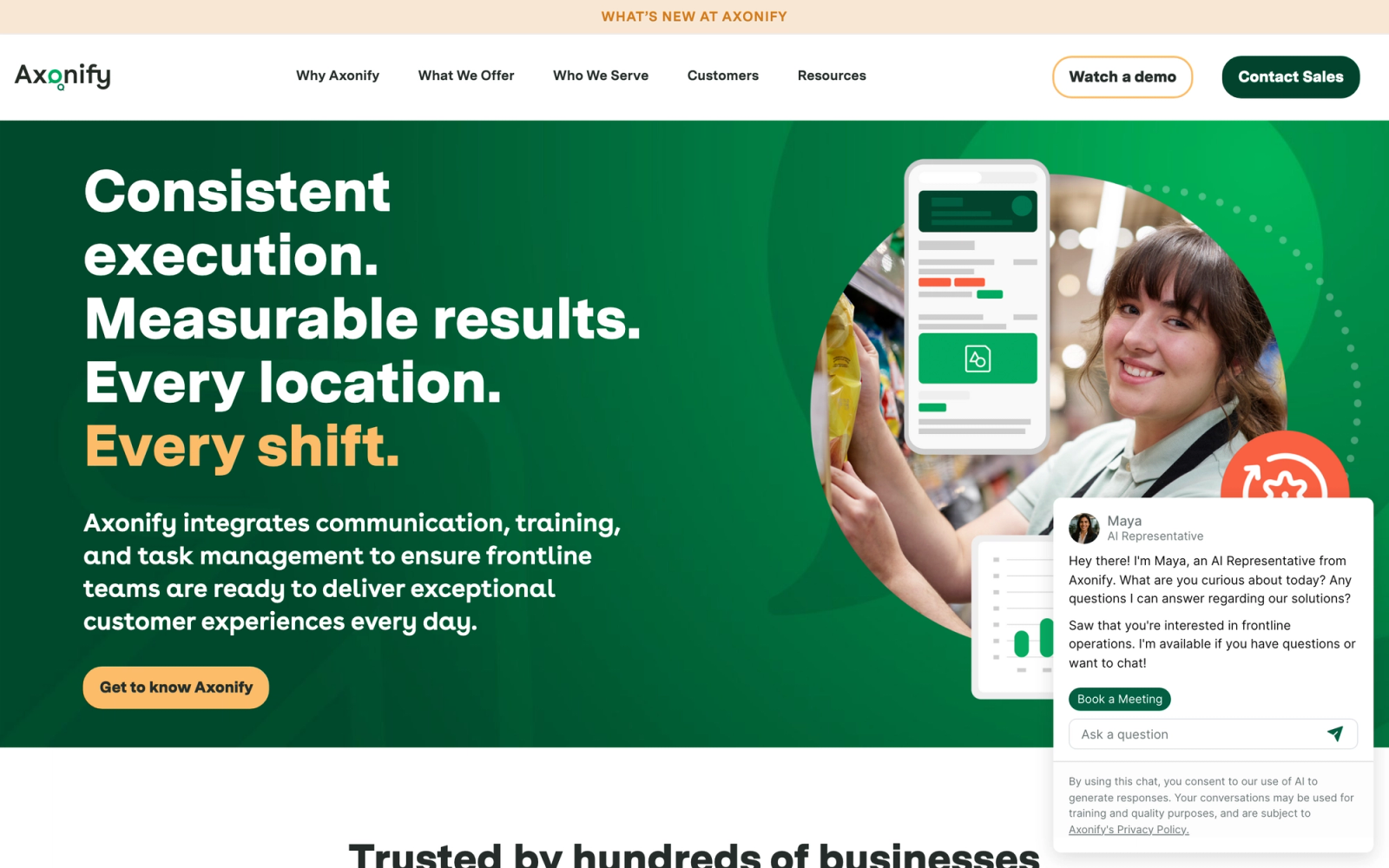
Axonify was built specifically for frontline workers, and that focus shows in every aspect of the platform. Unlike traditional LMS platforms that deliver training in 30- to 60-minute modules, Axonify is designed around microlearning sessions of three to five minutes. For manufacturing, where pulling a worker off the line for an hour-long training course is disruptive and expensive, this approach is a meaningful operational fit.
The platform uses spaced repetition and adaptive learning to reinforce knowledge over time. Instead of one-and-done compliance training that workers forget within weeks, Axonify delivers daily knowledge checks that keep critical safety and process information fresh. The science behind the approach is compelling. Spaced repetition is one of the most well-documented techniques in learning science, and Axonify applies it at scale.
Core Capabilities
- Microlearning delivery in daily three-to-five minute sessions designed for frontline workers
- Adaptive learning engine that adjusts question difficulty based on individual performance
- Spaced repetition algorithm to reinforce critical knowledge and reduce safety lapses
- Built-in content marketplace with pre-built manufacturing and safety modules
- Knowledge heat maps showing exactly where teams have knowledge gaps
- Compliance task management with tracking and verification workflows
- Native mobile experience optimized for quick sessions on tablets and phones
- Gamification built into the daily learning loop, including rewards and challenges
- Operational impact analytics connecting knowledge scores to safety and productivity metrics
- Integrations with HRIS systems, communication tools, and identity providers via API
Standout Strength
The daily microlearning model is Axonify's core advantage for manufacturing. Instead of annual compliance training that checks a box but does not change behavior, Axonify delivers continuous reinforcement. The knowledge heat maps let safety managers see exactly which topics are weak across which teams, enabling targeted interventions before incidents happen.
Best For
Manufacturing companies with large frontline workforces (500+ employees) that struggle with training engagement and knowledge retention. Particularly effective for organizations where safety incidents correlate with knowledge gaps and where traditional annual training has not produced the desired behavioral change.
Pricing Overview
- Custom pricing based on user count and deployment scope
- Pricing model: Per-user, typically with annual contracts
- Free demo and pilot program available
Limitations
- Axonify is a microlearning platform, not a full-featured LMS. If you need structured multi-module courses, detailed learning paths, or traditional eLearning delivery, you will need to pair it with another system.
- The platform requires consistent daily engagement to deliver its value. If your workforce culture does not support brief daily training sessions, adoption can stall.
- Content creation within Axonify is focused on short-form questions and scenarios. Longer, narrative-driven training content requires a separate authoring tool.
Quick Comparison Insight
A fundamentally different approach from platforms like Absorb or Docebo. Axonify does not replace a traditional LMS for structured courses, but it fills a critical gap in knowledge reinforcement that traditional platforms miss entirely. Many manufacturers run Axonify alongside a conventional LMS.
Cornerstone OnDemand
Overview
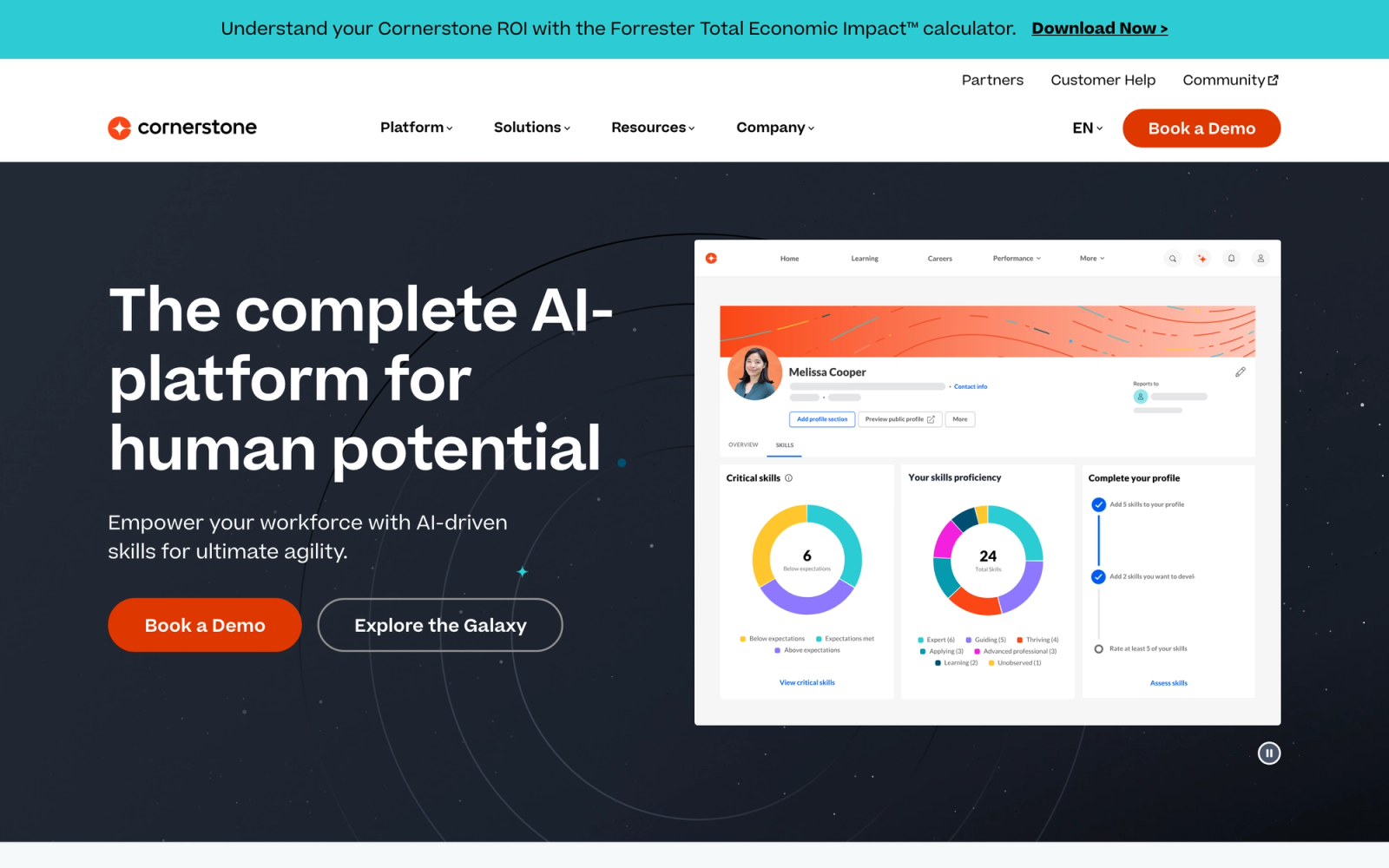
Cornerstone OnDemand is one of the largest talent management platforms in the market, and its learning module is just one part of a broader suite that includes performance management, recruiting, HR planning, and workforce analytics. For large manufacturing enterprises that want a single vendor for talent and learning, Cornerstone is one of the few platforms that can credibly deliver on that promise.
The depth of Cornerstone's compliance and regulatory management capabilities reflects its long presence in heavily regulated industries, including manufacturing, healthcare, and financial services. When I evaluated the compliance workflows, the granularity of control was impressive. You can build complex certification matrices, automate recertification across multiple regulatory frameworks simultaneously, and produce audit reports that map to specific standards like OSHA or ISO.
Core Capabilities
- Enterprise compliance engine with multi-framework certification tracking (OSHA, ISO, FDA, EPA)
- Automated recertification workflows with escalation chains and manager notifications
- Talent management integration covering performance reviews, succession planning, and career paths
- Skills and competency management linked to job profiles and organizational hierarchy
- Native mobile app with content download for offline training in plant environments
- Extended enterprise support for training contractors, suppliers, and distribution partners
- AI-powered content recommendations based on role, skills gaps, and learning history
- Multi-language support across over 40 languages for global operations
- Advanced reporting and analytics with custom dashboards and scheduled delivery
- Integrations with SAP, Workday, Oracle, ADP, and hundreds of other enterprise systems
Standout Strength
Cornerstone's value for manufacturing is the combination of compliance management depth and talent management breadth. No other platform on this list can handle OSHA compliance tracking, ISO audit reporting, performance reviews, and succession planning in a single system. For enterprise manufacturers with complex workforce development requirements, that consolidation eliminates vendor sprawl and data silos.
Best For
Large manufacturing enterprises with 5,000+ employees, multiple facilities, and complex regulatory obligations across different jurisdictions. Best for organizations that want to consolidate learning and talent management on a single platform and have the IT and L&D resources to manage an enterprise implementation.
Pricing Overview
- Custom enterprise pricing; quotes based on module selection and user count
- Pricing model: Modular subscription, typically multi-year contracts
- Free demo available through sales team
Limitations
- The platform's breadth comes at the cost of complexity. Implementation timelines are measured in months, and the administrative interface has a steep learning curve.
- Cost is significant. Cornerstone is priced for enterprise budgets, and the modular pricing means each additional capability adds to the total cost.
- The user interface, while improved in recent years, still feels heavier than newer platforms like Absorb or Docebo. Frontline workers may find navigation less intuitive.
Quick Comparison Insight
The most complete platform on this list, but also the most complex and expensive. If your organization needs a unified talent and learning management system and has the resources to implement it, Cornerstone delivers unmatched depth. For companies that only need an LMS, it is likely more platform than necessary.
How to Choose the Right Manufacturing LMS
The right platform depends on where your organization sits across three dimensions: company size, training complexity, and existing technology stack.
If you are a small-to-midsize manufacturer deploying your first LMS, TalentLMS or iSpring Learn will get you operational fastest. TalentLMS is the better general-purpose option, while iSpring Learn is ideal if your safety team already creates training in PowerPoint. Both are affordable and do not require dedicated L&D staff to manage.
If you are a mid-size manufacturer that has outgrown a basic LMS, Absorb LMS offers the strongest balance of usability and compliance depth. Its compliance automation, mobile offline support, and clean interface make it a practical upgrade from entry-level platforms without the complexity of a full enterprise suite.
If you are an SAP shop, SAP Litmos is the natural choice. The native ERP integration eliminates data synchronization headaches that other platforms create. No other LMS on this list can match that SAP-native connection.
If you are a large enterprise with complex, multi-site training needs, Docebo and Cornerstone OnDemand are your primary options. Docebo is the stronger choice if AI-driven learning efficiency is a priority. Cornerstone is the better fit if you want talent management and learning on a single platform with deep regulatory compliance support.
If your challenge is frontline knowledge retention, not just compliance tracking, Axonify's microlearning approach addresses a problem that traditional LMS platforms do not solve. Consider running it alongside a conventional LMS rather than as a replacement.
If your training mix includes instructor-led cohorts alongside self-paced compliance modules, Teachfloor is built around that combination, structured delivery with documented operator qualification, rather than treating it as an afterthought.
The most important step before choosing is auditing your actual training operations. Map every type of training you deliver, who receives it, how it is currently tracked, and where the gaps are. That ground-level picture reveals constraints, shift patterns, connectivity, language needs, regulatory frameworks, that no vendor checklist captures on its own.
FAQ
What is an LMS for manufacturing?
A learning management system for manufacturing is a platform designed to deliver, track, and manage employee training programs in a manufacturing environment. It handles safety compliance training, equipment certifications, regulatory reporting, and skills tracking. Unlike generic LMS platforms, manufacturing-focused solutions account for shift-based scheduling, mobile/offline access for floor workers, and multilingual workforces.
Why is an LMS important for manufacturing companies?
Manufacturing companies face unique training requirements driven by safety regulations, equipment complexity, and workforce diversity. An LMS centralizes compliance tracking, ensures certifications stay current, produces audit-ready reports for regulatory inspections, and delivers training in formats accessible to workers who do not sit at desks. Without a structured system, managing training across shifts, facilities, and regulatory frameworks becomes an error-prone manual process.
Can a manufacturing LMS handle OSHA compliance?
Most manufacturing LMS platforms support OSHA compliance workflows, including mandatory training assignments, completion tracking, and certification management. Platforms like Cornerstone OnDemand and Absorb LMS offer dedicated compliance engines with automated recertification, escalation workflows, and audit report generation specifically designed for OSHA and similar regulatory frameworks.
Do manufacturing workers need mobile LMS access?
In most cases, yes. Manufacturing employees work on production lines, in warehouses, and across facilities where desktop computers are not readily available. A mobile-friendly LMS with offline capabilities allows workers to complete training during breaks or downtime, on tablets stationed near workstations, or on personal devices. Platforms like Absorb, iSpring Learn, and Axonify offer dedicated mobile apps with offline content access.
How much does a manufacturing LMS cost?
Costs vary significantly by platform and scale. Entry-level platforms like TalentLMS start with a free tier and paid plans from $89 per month. Per-user pricing on platforms like iSpring Learn ranges from $2.29 to $3.14 per user per month. Enterprise platforms like Docebo, Cornerstone OnDemand, and Absorb LMS use custom pricing, typically ranging from $5 to $15+ per user per month depending on user count and selected modules. Budget for implementation, content migration, and the onboarding process alongside the subscription cost.


