


Objection handling training teaches sales reps to respond to the reasons buyers give for not moving forward. It works best as practice, not as a list of scripts to memorize: most objections fall into a handful of types, so a team can collect them, agree on how to respond, and rehearse until the response holds up under pressure.
This guide is for sales managers and enablement teams. It covers how to build an objection library, a simple response method, examples for six common objection types, six exercises and a way to measure progress. For full role play scripts on price, "just send me an email" and the cheaper competitor, see our sales role play scenarios.
TL;DR
- Collect objections from real calls, not from memory, and group them by type.
- Teach one method: pause, acknowledge, ask, respond, check.
- Practice in short, repeated rounds, with a buyer who has a hidden concern.
- Score the questions a rep asks, not only the answer they give.
- Measure in the CRM: do deals move forward after the objection?
Why objection handling needs practice, not scripts
In a Gong Labs analysis of 67,149 recorded sales calls, average reps answered objections with long monologues, about 21 seconds on average, and tended to speak faster than usual. Top performers paused longer after the objection and answered with questions before they responded. Gong's follow-up article reports talk speed rising from 173 to 188 words per minute when reps get flustered.
None of that is fixed by a script. A rep who knows the right words still rushes when a real buyer pushes back. What changes behavior is practice: role play with feedback, a basic kind of simulation training, repeated often enough that pausing and asking becomes the habit.
Build an objection library
Start with the objections your team actually hears. Three sources cover most of them:
- Call recordings. Search for phrases like "too expensive", "not right now" or "we already use".
- CRM loss reasons. Closed-lost notes show which objections ended deals.
- Rep interviews. Ask each rep for the three objections they find hardest.
Group what you find by type and count how often each appears. Gong names price, product, timing and internal buy-in as common types; your list will have its own order. Train the five or six most frequent objections first, and add the rest later.
| Type | What the buyer is really saying | Example |
|---|---|---|
| Price | The value is not clear yet | "It's more than we budgeted." |
| Timing | Something else has priority | "Not this quarter." |
| Authority | Someone else decides | "I need to run it by my boss." |
| Need | The problem does not feel big enough | "We already have a tool for that." |
| Trust | The risk feels too high | "We've been burned before." |
| Status quo | Change feels harder than the problem | "Our spreadsheet works fine." |
| Contract | A real constraint, or a way to end the call | "We're locked in until next year." |
A simple method for responding
Teams use many named frameworks. Most share the same five moves, which are easy to teach and easy to observe in role play.
The ask step is where most of the training effort goes. The first objection is often not the real one, and a rep who answers it directly may solve the wrong problem.
Objection handling examples
One example for each type except price, which our sales role play scenarios guide scripts in full. Use them as starting points for your own library, adapted to your product.
Timing
Objection: "This makes sense, but not this quarter."
- Often behind it: other projects with deadlines, or no urgency attached to the problem.
- Clarify: "What is taking priority this quarter, and what happens to this problem in the meantime?"
- Respond: connect the problem to the priority if there is a real link; if there is not, agree a date to revisit and what would need to be true by then.
Authority
Objection: "I need to run it by my boss."
- Often behind it: the buyer is not the decision maker, or does not feel able to explain the case internally.
- Clarify: "What will your boss want to know first, and how do decisions like this usually get made?"
- Respond: offer to help the buyer make the case, with a short summary in their words, or suggest a call that includes the decision maker.
Need
Objection: "We already have a tool for that."
- Often behind it: the current tool works well enough, or the buyer has not linked a gap to a cost.
- Clarify: "What do you like about it, and where does it fall short for your team?"
- Respond: if there is a gap, focus only on that gap; if there is none, say so and leave the door open. Do not attack the current tool.
Trust
Objection: "We've been burned before with this kind of project."
- Often behind it: a failed rollout, and fear of being blamed for another one.
- Clarify: "What went wrong last time?"
- Respond: address the specific failure, for example with a phased rollout, a pilot or a customer reference with a similar starting point.
Status quo
Objection: "Our spreadsheet works fine."
- Often behind it: the cost of the current way is hidden, or change looks like extra work.
- Clarify: "How much time does the team spend keeping it up to date, and what happens when it is wrong?"
- Respond: help the buyer put a number on the hidden cost, then show how small the first step of change can be.
Contract
Objection: "We're locked into a contract until next year."
- Often behind it: a real constraint, or a convenient reason to stop the conversation.
- Clarify: "When does it end, and when would you need to start evaluating to switch on time?"
- Respond: work back from the renewal date to a realistic evaluation timeline, and agree when to talk again.
For negotiation-heavy objections, our glossary entry on negotiation skills covers the basics, and our insurance sales role play scripts show objections in a regulated context.
Objection handling exercises
Run these in short sessions, weekly if you can. Most work with two reps and an observer; the call review and the objection bank run with the whole team. Most take less than 20 minutes.
Rapid-fire round
The manager reads objections from the library one after another. The rep answers each with only the acknowledge and ask steps, no pitch.
- Time: 5 to 10 minutes, 10 to 15 objections.
- Watch for: whether the rep asks a real question or slips into an answer.
Objection ladder
The buyer raises a second objection as soon as the first is handled, then a third. The rep has to stay calm and keep asking.
- Time: 10 minutes per rep.
- Watch for: talk speed and interruptions as the pressure builds.
Role swap
The rep plays the buyer and raises the objection they find hardest. A colleague plays the rep.
- Time: 10 minutes, then swap.
- Watch for: what the rep learns about why the objection is hard from the buyer's side.
Call review
The team listens to a recorded objection from a real call, pauses it, and each rep says what they would do next before hearing what happened.
- Time: 15 minutes per clip.
- Watch for: different answers to the same moment, and which ones the team agrees are strongest.
Hidden objection
The buyer gets a card with a stated objection and a different real concern. The rep wins only by uncovering the real one.
- Time: 10 minutes per round.
- Watch for: how many questions it takes, and whether the rep checks before responding.
Team objection bank
After each week of calls, reps add new objections and the best responses they heard to a shared document, and the team votes on which to add to the library.
- Time: 10 minutes in the weekly meeting.
- Watch for: objections that keep coming back, which are signals for marketing and product too.
How to measure progress
Use a short rubric in every practice round, so feedback is consistent between managers.
| Skill | Needs work | Solid | Strong |
|---|---|---|---|
| Pause | Answers before the buyer finishes | Waits for the buyer to finish | Lets a short silence happen |
| Ask | Assumes the concern | Asks one clarifying question | Finds the real concern behind the objection |
| Respond | Pitches features | Answers the stated concern | Answers the real concern in the buyer's words |
| Check | Moves on without checking | Asks if the answer helped | Agrees a specific next step |
Then look at results on real calls. In the CRM, track how often deals move to the next stage after a given objection, and which loss reasons shrink over time. Combine both with coaching from the manager, in person or through virtual coaching; our guide on role play scenarios for managers covers the coaching conversations that follow.
Practicing objections with AI roleplay
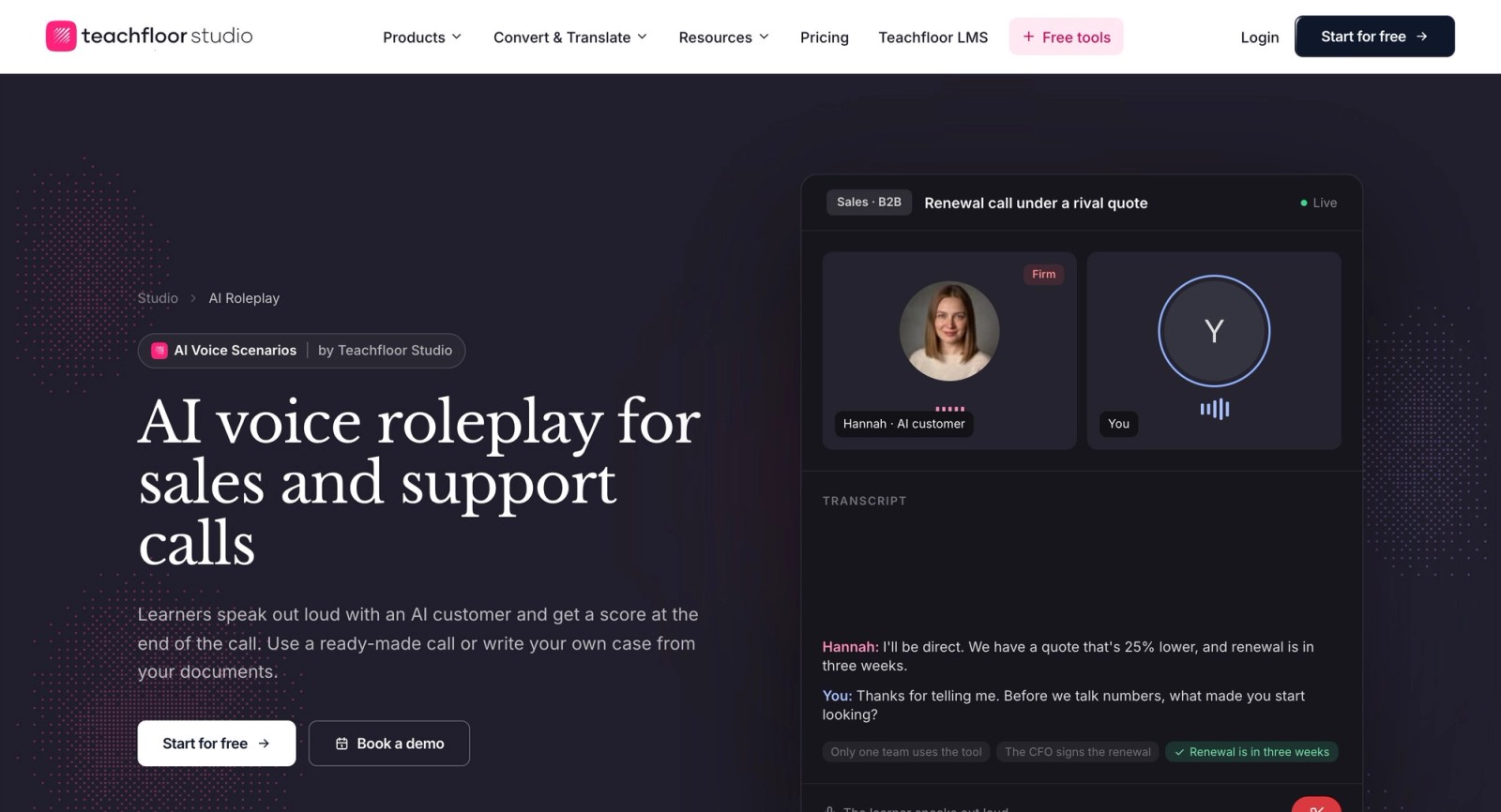
Live practice needs a manager or colleague in the room, so reps rarely rehearse the same objection twice in a week. With AI roleplay in Teachfloor Studio, a rep can repeat the hidden objection exercise alone: the AI character raises the objection on a voice call, and the rep gets a score on tone of voice and the key facts covered. You can build calls from your own objection library and export them as SCORM. For decisions with no call involved, such as approving a discount, written branching scenarios work better. Managers still review the hardest calls with the team.
To compare dedicated tools, see our list of the best AI sales roleplay software and AI sales coaching software. For the wider program, read our sales training strategies, advanced sales training and the sales training platform page, or the glossary entry on sales enablement.
FAQ
Quick answers about objection handling training.
What is objection handling training?
It is training that teaches sales reps to respond to the reasons buyers give for not moving forward, such as price, timing or authority. It combines an objection library, a response method and repeated practice with feedback.
How often should reps practice objection handling?
Short, frequent sessions work better than an occasional workshop. A 15 to 20 minute round each week, plus practice before important calls, keeps the habit in place.
What are the most common sales objections?
Price, timing, authority, need, trust and the status quo cover most of them. Gong's call analysis names price, product, timing and internal buy-in among the common types.
Can AI help with objection handling practice?
Yes. AI roleplay lets reps practice out loud with an AI buyer whenever they want and get a score after each call. It works best alongside live practice and manager coaching.


