


De-escalation training teaches employees to calm a tense conversation before it turns into a conflict: listening, choosing words and tone, setting limits, and knowing when to step away and get help. The skill is learned by practice, so this guide pairs the core techniques with eight role play scenarios your team can run.
Scope: this guide covers verbal conflict at work, such as an upset patient at reception or a frustrated colleague. If your staff may face threats or violence, use a certified de-escalation program and your organization's security procedures, and never ask employees to stay in a situation that feels unsafe, and make sure every learner knows who to call and how to leave.
TL;DR
- Safety first: keep your distance, know where the exit is, and get help early if you feel unsafe.
- Listen before you solve: let the person speak, then reflect what you heard.
- Watch your voice: slower, lower and calmer than theirs.
- Offer choices and clear limits, with the positive option first.
- Practice out loud. De-escalation is a spoken skill; reading about it is not enough.
What de-escalation training covers
The US Cybersecurity and Infrastructure Security Agency (CISA) uses the Department of Homeland Security definition in its de-escalation guide: "the use of communication or other techniques during an encounter to stabilize, slow, or reduce the intensity of a potentially violent situation without using physical force." Its framework places de-escalation between recognizing and assessing a situation and reporting it.
Workplace programs usually cover:
- Recognizing escalation: raised voice, fast speech, pacing, clenched hands, repeated demands.
- Self-control: staying calm and not taking the anger personally.
- Verbal techniques: listening, empathy, word choice, tone and pace.
- Body language and space: posture, hands and distance.
- Limits and choices: what you can and cannot do, said clearly.
- When to get help: colleagues, a manager, security or emergency services.
It overlaps with customer service training but goes further: the goal is to lower the temperature first, and solve the problem second.
Core de-escalation techniques
These techniques appear, in different words, in most de-escalation programs. Safety comes first in every one of them.
Keep yourself safe
CISA advises keeping a safe distance, not being alone with a combative person, and removing yourself if violence seems imminent. Knowing where the nearest exit is, and keeping it clear, is a common precaution in safety training. The Crisis Prevention Institute suggests standing about 1.5 to 3 feet away at a slight angle, with your hands visible, in its de-escalation tips.
Listen fully
Give the person your full attention, do not interrupt, and allow silence. Then restate what you heard: "So the refill was not ready, and this is your second trip today." People calm down when they feel heard.
Empathize without judging
You do not have to agree to acknowledge the feeling. Treat the frustration as real, even if the facts are disputed.
Change the words you use
CISA's guide suggests replacing phrases that tend to escalate with ones that invite cooperation:
| Instead of | Try |
|---|---|
| "Calm down." | "I can see that you are upset." |
| "I can't help you." | "I want to help. What can I do?" |
| "I know how you feel." | "I understand that you feel..." |
| "Come with me." | "May I speak with you?" |
Lower your tone and pace
Speak slowly, keep your volume low, and do not match a raised voice. Keep your posture relaxed, your hands visible and open, and move slowly.
Offer choices and set limits
Give simple, reasonable choices and state limits clearly, with the positive option first: "I can book you the first slot tomorrow, or you can wait for a cancellation today." If someone is rude or abusive, say calmly what will happen next, such as ending the call or asking a colleague to join, and follow through. If they threaten you or become physically aggressive, leave and get help instead.
Know when to get help
If you feel unsafe, or the person threatens violence or becomes physically aggressive, stop the conversation, move to a safe location and call security staff or local law enforcement. Do not wait for the situation to keep escalating. CISA's guide gives the same advice: when violence may occur, call for help and move yourself to safety. Knowing when to step away is part of the skill, not a failure.
De-escalation role play scenarios
Each scenario has a situation, a brief for the person playing the upset party, and what observers should watch for. Keep each round to five minutes. For angry customers in retail and contact centers, our customer service role play scenarios add more cases.
Clinic reception: a long wait
Situation: A parent has waited 50 minutes with a sick child. A patient who arrived later was just called in.
Brief for the person playing the other side: You are worried about your child and angry that someone "skipped the line". You do not know that the other patient had an earlier appointment.
What to watch for: Does the receptionist acknowledge the worry before explaining? Do they offer a concrete update or option instead of "please take a seat"?
IT help desk: locked out before a deadline
Situation: An employee is locked out of their account 30 minutes before submitting a client proposal and calls the help desk.
Brief for the person playing the other side: You are panicking about the deadline and blame IT for the password policy. You interrupt often.
What to watch for: Does the agent stay calm, separate the urgent fix from the complaint, and give a clear timeline?
Public counter: a rejected application
Situation: A resident's permit application was rejected for a missing document they say they submitted.
Brief for the person playing the other side: You took time off work to come in. You raise your voice and say the office loses paperwork on purpose.
What to watch for: Does the clerk avoid arguing about who is right, explain the options, and offer a way to fix it today?
HR: a disputed performance rating
Situation: An employee comes to HR after receiving a "below expectations" rating they believe is unfair.
Brief for the person playing the other side: You feel singled out by your manager. You are tearful at first and then angry.
What to watch for: Does the HR partner listen without defending the manager, explain the review process, and agree on next steps?
Phone: a cancelled appointment
Situation: A customer calls about an appointment that was cancelled without notice. It is their third call about the same issue.
Brief for the person playing the other side: You are tired of repeating yourself. You threaten to take your business elsewhere and post a review.
What to watch for: Does the agent acknowledge the repeated calls, take ownership, and avoid reading a script?
Hotel front desk: no room available
Situation: After a delayed flight, a guest arrives at midnight and the hotel is overbooked.
Brief for the person playing the other side: You are exhausted, have an early meeting and speak loudly in front of other guests.
What to watch for: Does the receptionist lower the volume, offer concrete alternatives and stay calm, keeping colleagues nearby if the guest stays loud?
Warehouse: a schedule change
Situation: A team lead tells an operator that their shift is moving to nights next week.
Brief for the person playing the other side: You have childcare to arrange and feel the decision was made without asking. You get defensive and loud.
What to watch for: Does the lead listen, explain the reason honestly, and explore options without promising what they cannot deliver?
Colleagues: a credit dispute
Situation: In a team meeting, one colleague accuses another of presenting their work as their own.
Brief for the person playing the other side: You feel your work was taken. You are sharp and personal.
What to watch for: Does the person being accused avoid counterattacking, suggest continuing after the meeting, with a manager present if needed, and focus on facts?
No scenario should involve moving an upset person to an isolated space. Adapt the details to your workplace, and have a supervisor or someone with relevant experience review scenarios that involve health, safety or legal topics.
How to run de-escalation practice
- Set ground rules. It is practice; nobody is judged on acting. Agree on a word to pause if a scenario feels too personal.
- Use three roles: the employee, the upset person, and an observer with a short checklist.
- Debrief with specifics. "When you said you could see they were worried, their voice dropped" is more useful than "good job". Use the basics of constructive feedback.
- Replay with one change, such as slowing down or offering a choice earlier.
- Repeat over time. Short practice every few weeks keeps the skill fresh, and fits well into microlearning refreshers.
Written decision practice works too. A branching scenario lets people choose what to say and see the reaction, which suits large teams and refreshers.
Practicing with AI
Live role play depends on having a willing partner and a facilitator. AI tools make it possible to practice alone, as often as needed, and to repeat the same scenario until the response feels natural.
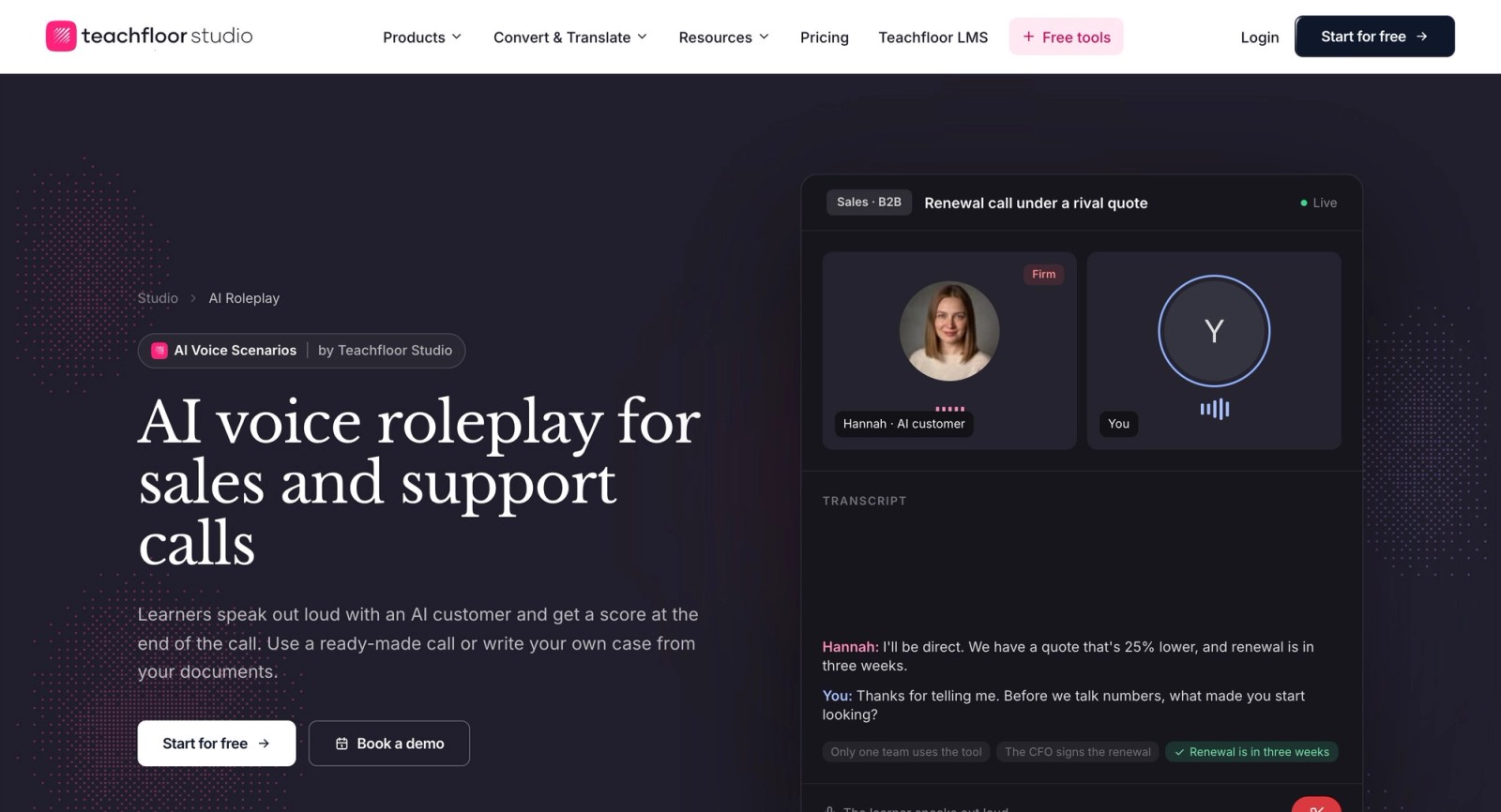
In Teachfloor Studio, AI roleplay lets learners speak out loud with an AI character who can be calm, firm or difficult, and get a score for tone of voice and the key facts they uncovered. Scenario Simulator builds branching scenarios from your own policies. Both export as SCORM for the LMS. AI practice is a complement to live sessions and certified safety training, not a replacement. Other tools are compared in our lists of call center simulation software and AI roleplay software.
FAQ
Quick answers on de-escalation training.
What is de-escalation training?
Training that teaches people to reduce tension in a conflict through listening, word choice, tone, body language and clear limits, and to recognize when to get help.
Who needs de-escalation training?
Anyone who deals with frustrated people: reception and front desk staff, healthcare workers, customer service and help desk agents, public service employees, frontline teams, HR and managers. Contact centers often run it as part of agent onboarding, alongside the platforms in our LMS for call centers guide.
What is an example of a de-escalation technique?
Replacing "calm down" with "I can see that you are upset", then listening without interrupting. If the person becomes threatening, the technique changes: step away and get help. Acknowledging the feeling usually lowers the intensity more than arguing the facts.
How do you practice de-escalation?
With role-play: short scenarios with an employee, a person playing the upset party, and an observer, followed by a debrief and a replay. AI roleplay tools add solo practice between sessions.


