


Role play scenarios for managers are short practice conversations in which a manager gives feedback, coaches or handles a difficult conversation while a colleague plays the employee. This guide includes 12 ready-to-use scenarios in three groups (feedback, coaching and difficult conversations), each with a situation, a brief for the person playing the employee and what observers should watch for.
The conversations new managers find hardest are the ones they rarely get to practice. A short role play lets them try the opening line, hear a realistic reaction and try again, before the real conversation.
TL;DR
- Keep the conversation under 10 minutes, then debrief and replay: about 25 minutes per scenario.
- Give the person playing the employee a private brief with a real motivation, not just "be difficult".
- Observers watch for specific behaviors: a clear opening, open questions, specific examples and an agreed next step.
- Start with feedback scenarios, then move to coaching and difficult conversations.
Why managers need role play practice
Feedback and coaching are skills, and skills improve with practice. According to Gallup, 80% of employees who say they received meaningful feedback in the past week are fully engaged. Gallup also reports that managers account for 70% of the variance in team engagement. Yet most new managers learn these conversations live, with real employees.
Role play gives them a safe place to make mistakes. It fits naturally into leadership training and cohort leadership programs, where peers can play each other's employees and give feedback.
How to set up a manager role play
Keep the format simple and repeatable.
- Three roles: the manager, the employee and an observer with a checklist.
- Private briefs: the employee brief includes a motivation and a reaction the manager will not see in advance.
- One goal per round: for example, "open with a specific example" or "ask before advising".
- Debrief in order: the manager reflects first, then the employee says how it felt, then the observer shares notes.
Feedback role play scenarios
These scenarios practice constructive feedback and specific praise. A useful structure is situation, behavior and impact: what happened, what the person did, and the effect it had.
Corrective feedback on a missed deadline
Situation: A team member missed the deadline for a client report by two days without warning. It is the second time this quarter.
Brief for the person playing the employee: You were overloaded with work from another team and did not want to say no. You expect to be blamed and start by defending yourself.
What to watch for: Does the manager describe the specific behavior (no warning) rather than the person, ask what happened, and agree on how delays will be flagged next time?
Specific positive feedback
Situation: A team member ran a difficult onboarding session for a new client that went very well.
Brief for the person playing the employee: You are modest and tend to brush off praise with "it was nothing". You would value hearing what exactly worked.
What to watch for: Is the praise specific about what the person did and why it mattered, or generic like "great job"?
Feedback to a senior expert
Situation: A senior engineer with more experience than the manager often dismisses junior colleagues' ideas in meetings.
Brief for the person playing the employee: You think you are being efficient and that the ideas were weak. You are skeptical that the manager understands the technical context.
What to watch for: Does the manager stay on observable behavior and its impact on the team, without debating the technical points?
Feedback to a former peer
Situation: A newly promoted manager needs to tell a former teammate, now a direct report, that their status updates are too vague.
Brief for the person playing the employee: You are friendly but a little hurt that your friend got the promotion. You joke to avoid the topic.
What to watch for: Does the manager acknowledge the change in relationship and still deliver the feedback clearly?
Coaching role play scenarios
Coaching scenarios practice asking before telling. The manager's goal is to help the employee find their own answer and commit to a next step, in the spirit of developmental feedback.
An employee who wants the answer
Situation: A team member is stuck on how to prioritize three requests from different stakeholders and asks the manager to decide.
Brief for the person playing the employee: You want a quick answer and get impatient with questions. You do have a good sense of which request matters most if asked well.
What to watch for: Does the manager ask open questions that help the employee decide, rather than deciding for them?
A growth conversation
Situation: A strong performer says they want to "grow" but has not said in which direction.
Brief for the person playing the employee: You are unsure whether you want to lead people or become a deeper specialist, and you worry that saying so sounds unambitious.
What to watch for: Does the manager explore options with questions and agree on one small next step, such as a stretch project?
Delegating a project
Situation: The manager wants to hand over a recurring report they have always owned to a team member.
Brief for the person playing the employee: You are interested but nervous about getting it wrong in front of senior leaders. You ask a lot of "what if" questions.
What to watch for: Does the manager explain the outcome and the decision rights clearly, and agree on how they will check in?
A drop in motivation
Situation: A usually engaged team member has been quiet in meetings and slower to reply for a month.
Brief for the person playing the employee: You feel your work no longer matters since a reorganization moved your favorite project elsewhere. You will open up only if you feel heard.
What to watch for: Does the manager describe what they noticed without judgment, listen, and avoid jumping to solutions?
Difficult conversation role play scenarios
These are the conversations managers postpone. The goal is to be clear and respectful at the same time. If a conversation becomes heated or involves a conflict with someone outside the team, our guide to de-escalation training scenarios covers those techniques. If you adapt these scenarios to harassment, discrimination, health or pay topics, follow your HR policies and have HR review them before use.
Performance below expectations
Situation: A team member's output has been below expectations for two months, with errors that customers noticed.
Brief for the person playing the employee: You are dealing with a family health issue that you have not mentioned at work. You get defensive at first, and share the issue only if the manager asks openly how you are doing.
What to watch for: Does the manager state the gap with facts and ask about causes, without asking for medical details? Do they keep what is shared confidential, point to HR or the employee assistance program for leave or support options, and still agree on clear expectations?
Saying no to a raise
Situation: A team member asks for a raise. The budget is frozen until the next review cycle.
Brief for the person playing the employee: You have an outside offer you have not mentioned yet. You feel underpaid compared with a new hire.
What to watch for: Is the no clear, is the budget freeze explained, and are the next review date and the criteria for a raise spelled out? The manager should not discuss the new hire's salary or tell the employee to keep pay discussions private.
Conflict between two team members
Situation: Two team members disagree about how to split work on a shared project and have stopped talking to each other directly.
Brief for the person playing the employee: You feel the other person takes the visible tasks and leaves you the routine ones. You want the manager to take your side.
What to watch for: Does the manager listen without taking sides, focus on the shared goal, and propose a joint conversation?
A decision the manager did not make
Situation: Leadership has decided to move the team's weekly planning meeting to a new, earlier format, and the manager must explain it.
Brief for the person playing the employee: You think the old format worked and that nobody asked the team. You ask the manager whether they agree with the decision.
What to watch for: Does the manager explain the reasons, acknowledge the frustration, stay loyal to the decision without pretending to love it, and collect concerns to pass upward?
Adapt names and details to your organization so the situations feel familiar to your managers.
What good looks like: an observer checklist
Give observers a short checklist so feedback is specific rather than general.
| Behavior | What it sounds like |
|---|---|
| Clear opening | States the topic in the first minute |
| Specific example | Describes what happened, when, and its impact |
| Open questions | Asks "what" and "how" questions before offering solutions |
| Listening | Summarizes what the employee said before responding |
| Next step | Ends with an agreed action and a follow-up date |
The same checklist works for 360-degree feedback on real conversations later. Teams that also want employees to give feedback upward can use our upward feedback examples, and leaders working with a coach can find more on executive coaching.
Practicing with AI
Live role play needs a partner, an observer and time in the calendar. AI practice tools let managers rehearse alone, repeat a scenario until the opening feels natural, and come to the live session better prepared.
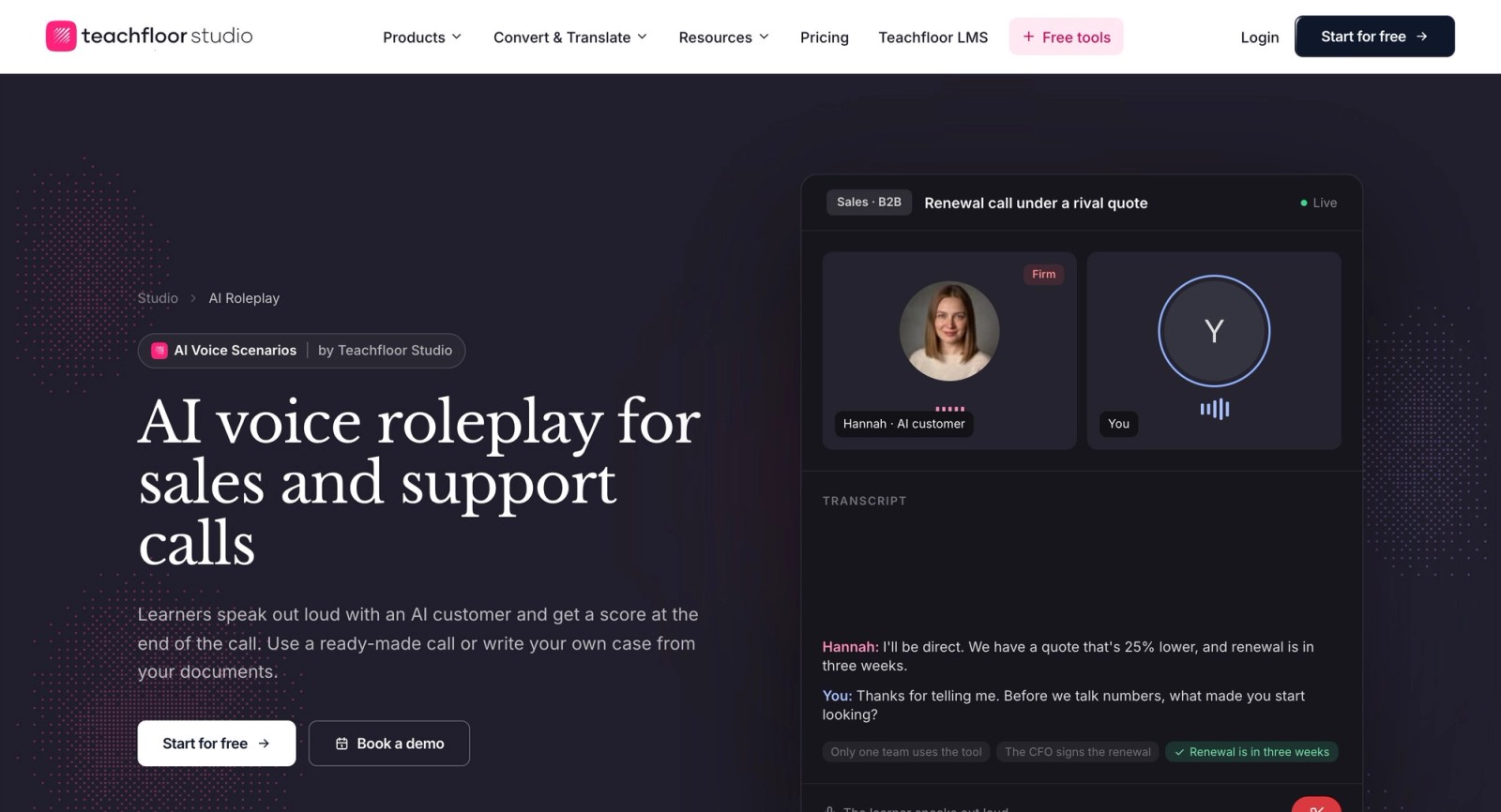
In Teachfloor Studio, AI roleplay lets managers speak out loud with an AI employee who can be calm, firm or difficult, then get a score on tone of voice and the key points covered. It includes manager starting points, such as a review with a rep who missed quota and a talk with a developer who lost a promotion to an external hire, which the AI turns into a call. Branching scenarios present the same situations as choices, which suits larger groups. Both export as SCORM for the LMS. For other practice formats, see our guides to branching scenarios, customer service role play scenarios and sales role play scenarios.
FAQ
Quick answers on manager role plays.
How long should a manager role play be?
Eight to ten minutes of conversation, followed by a debrief and a short replay, so about 25 minutes per scenario. The replay with one change is where most of the learning happens.
Should the manager know the employee's brief?
No. The employee brief should include a motivation the manager has to discover, as in real conversations. The manager gets only the situation.
What if participants feel awkward?
Start with low-stakes scenarios such as specific praise, keep groups small, and let the facilitator demonstrate one round first. Awkwardness usually fades after the first replay.
How often should managers practice?
Before a real difficult conversation, and regularly as part of manager training, for example one scenario per monthly session. New managers benefit most in their first six months.


