

Why Call Centers Need a Specialized LMS
Call centers operate under conditions that expose every weakness in a generic training platform. Agents handle hundreds of customer interactions per day, products and policies change on short cycles, and the gap between a trained agent and an untrained one shows up immediately in customer satisfaction scores.
Rapid onboarding at scale. Call center turnover rates routinely exceed 30 to 45 percent annually. That means a significant portion of your workforce is always in some stage of onboarding. A generic LMS that takes weeks to get new hires productive is a liability. Call center training platforms need to compress time-to-competency into days, not months, with structured onboarding programs that move agents from classroom to live calls quickly.
Frequent product and policy updates. When a pricing plan changes, a new product launches, or a compliance regulation shifts, every agent on the floor needs to know about it before their next call. The LMS must support rapid content updates and targeted push notifications so that training reaches the right agents without pulling them off the phones for hours.
Soft skills and communication training. Technical knowledge alone does not make a good call center agent. De-escalation, active listening, empathy, and objection handling are skills that require practice and reinforcement, not a single onboarding module. The best LMS platforms for contact centers include role-play scenarios, simulations, or coaching workflows that develop these capabilities over time.
Quality assurance alignment. QA teams evaluate calls against specific rubrics. The LMS should connect directly to those quality standards so that when an agent scores low on a particular metric, the system can assign targeted remediation training automatically. This closed loop between quality monitoring and training delivery is what separates a functional LMS from one that actually improves performance.
Real-time coaching support. Floor managers need to assign just-in-time training based on what they observe during live monitoring. An LMS that only supports scheduled, top-down course assignments misses the reality of how call center coaching works. Look for platforms that allow managers to push specific lessons or micro-modules to individual agents without going through an L&D department bottleneck.
High-volume compliance requirements. Financial services, healthcare, and insurance call centers face strict regulatory training mandates. The LMS must track compliance training completions, generate audit-ready reports, and automate recertification reminders across hundreds or thousands of agents.
What to Look for in a Call Center LMS
Before evaluating specific platforms, define the criteria that match your contact center's operational reality. Not every LMS handles call center workflows well, and the wrong choice creates more administrative burden than it solves.
Microlearning and bite-sized content support. Agents cannot leave the queue for 60-minute training sessions. The platform should support short modules, ideally 3 to 10 minutes, that agents can complete between calls or during scheduled breaks. This is not just a nice-to-have; it is an operational requirement for any center that tracks occupancy rates.
Mobile accessibility. Remote and hybrid contact centers are now common. Agents working from home need training that works on personal devices without VPN access or desktop-only requirements. A strong mobile learning experience means agents can review material before shifts, complete certifications on their own schedule, and access knowledge bases during calls.
Integration with contact center tools. The LMS should connect to your CRM, quality management system, workforce management platform, and telephony stack. Without these integrations, training data lives in a silo and you lose the ability to correlate training completion with actual call performance.
Content authoring speed. Call centers that rely on external vendors to build every training module will always lag behind operational changes. Look for platforms with built-in authoring tools that let team leads and subject matter experts create and update content without specialized eLearning development skills.
Reporting tied to business outcomes. Completion rates alone tell you very little. The LMS should provide learning analytics that connect training activity to operational KPIs: average handle time, first-call resolution, customer satisfaction scores, and quality assurance results.
Scalability for seasonal fluctuations. Many contact centers scale up dramatically during peak periods, adding temporary agents who need to be trained and productive within days. The LMS pricing model and onboarding workflow must accommodate these surges without excessive cost or administrative friction.
8 Best LMS for Call Centers
The platforms below cover a range of contact center sizes, budgets, and training complexity levels. Each addresses a different combination of the requirements outlined above, evaluated specifically against call center training workflows.
| Tool | Microlearning | Live/cohort | Built-in authoring | Starting price | Free trial | Best for |
|---|---|---|---|---|---|---|
| Teachfloor | Yes | Yes | Yes (AI) | $89/mo | 14 days | Agent onboarding plus supervisor and coach development |
| TalentLMS | Yes | Live only | Yes | ~$119/mo | Free plan | SMBs and mid-size centers needing fast setup |
| Lessonly (Seismic Learning) | Yes | No | Yes | ~$300/mo | Demo only | Practice and coaching for customer-facing teams |
| Absorb LMS | Yes | No | Yes | Custom | Demo only | Mid-to-large centers needing enterprise scale |
| SAP Litmos | Yes | No | Yes | ~$6/user/mo | Yes | Large enterprises wanting a big content library |
| Docebo | Yes | No | Moderate | Custom | Demo only | Enterprise centers wanting AI personalization |
| Axonify | Yes | No | Yes | Custom | Demo only | Daily reinforcement and knowledge retention |
| iSpring Learn | Yes | Live only | Yes | ~$3.14/user/mo | Yes | PowerPoint-based rapid authoring |
Teachfloor
Overview
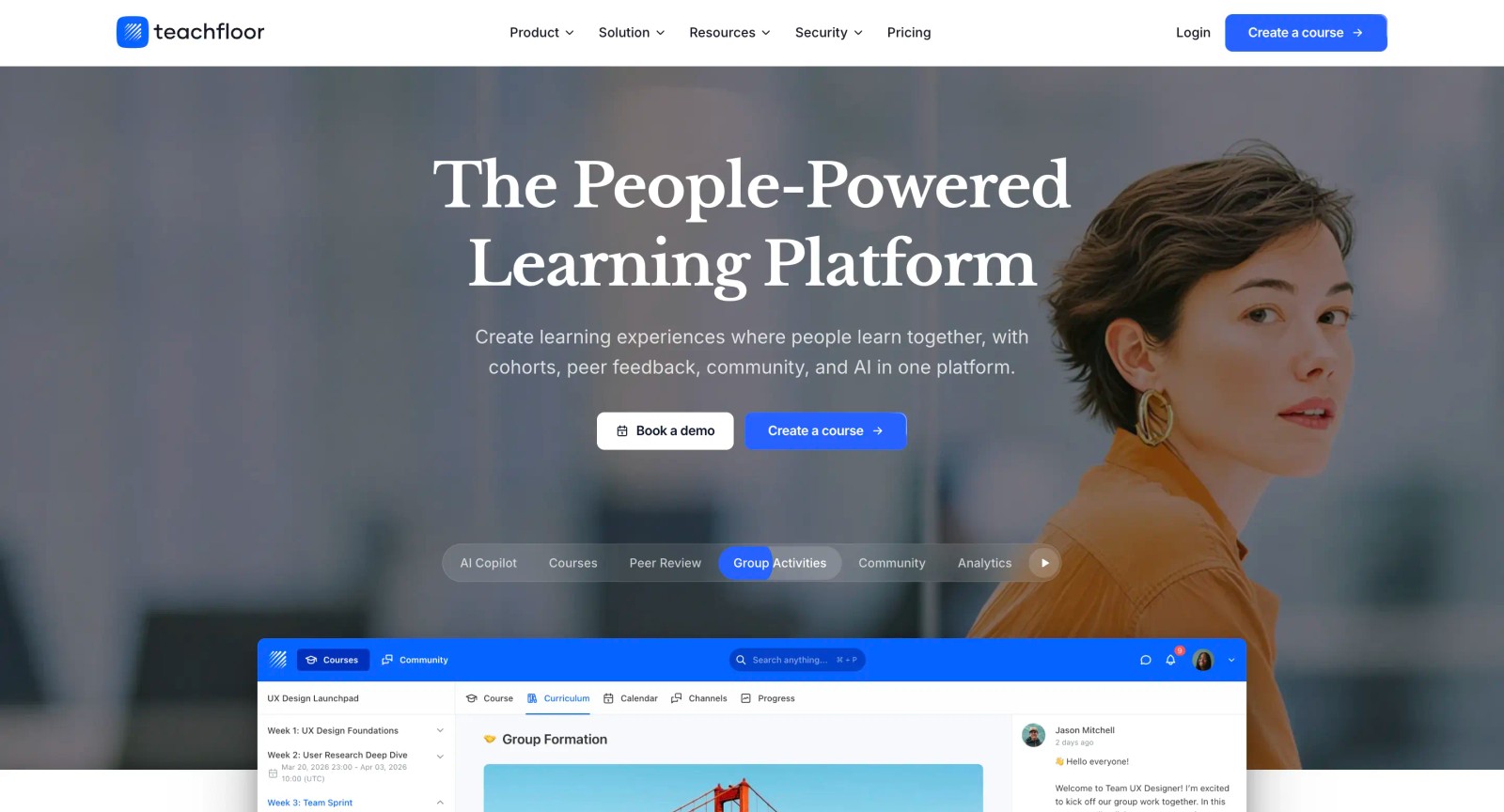
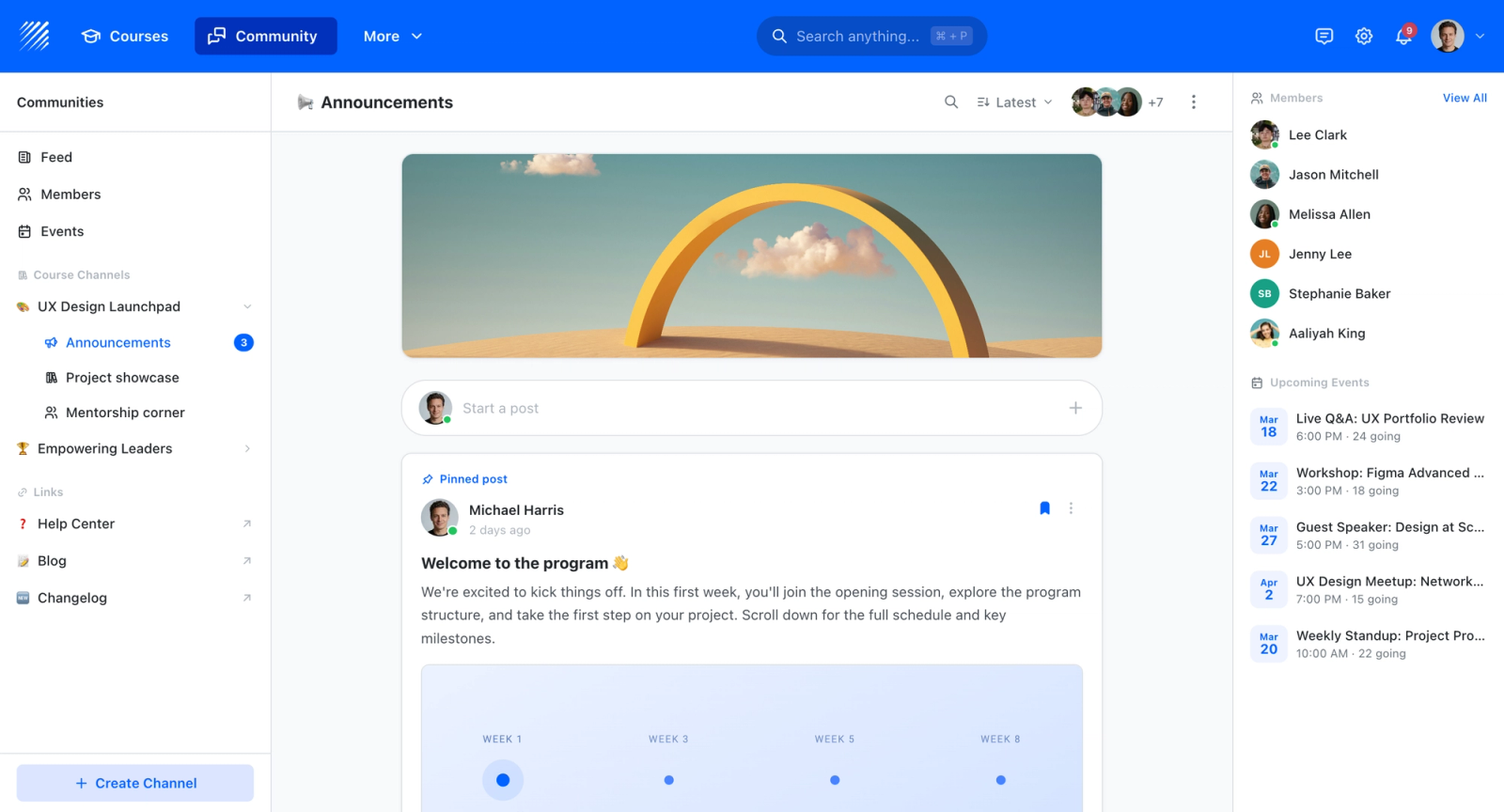
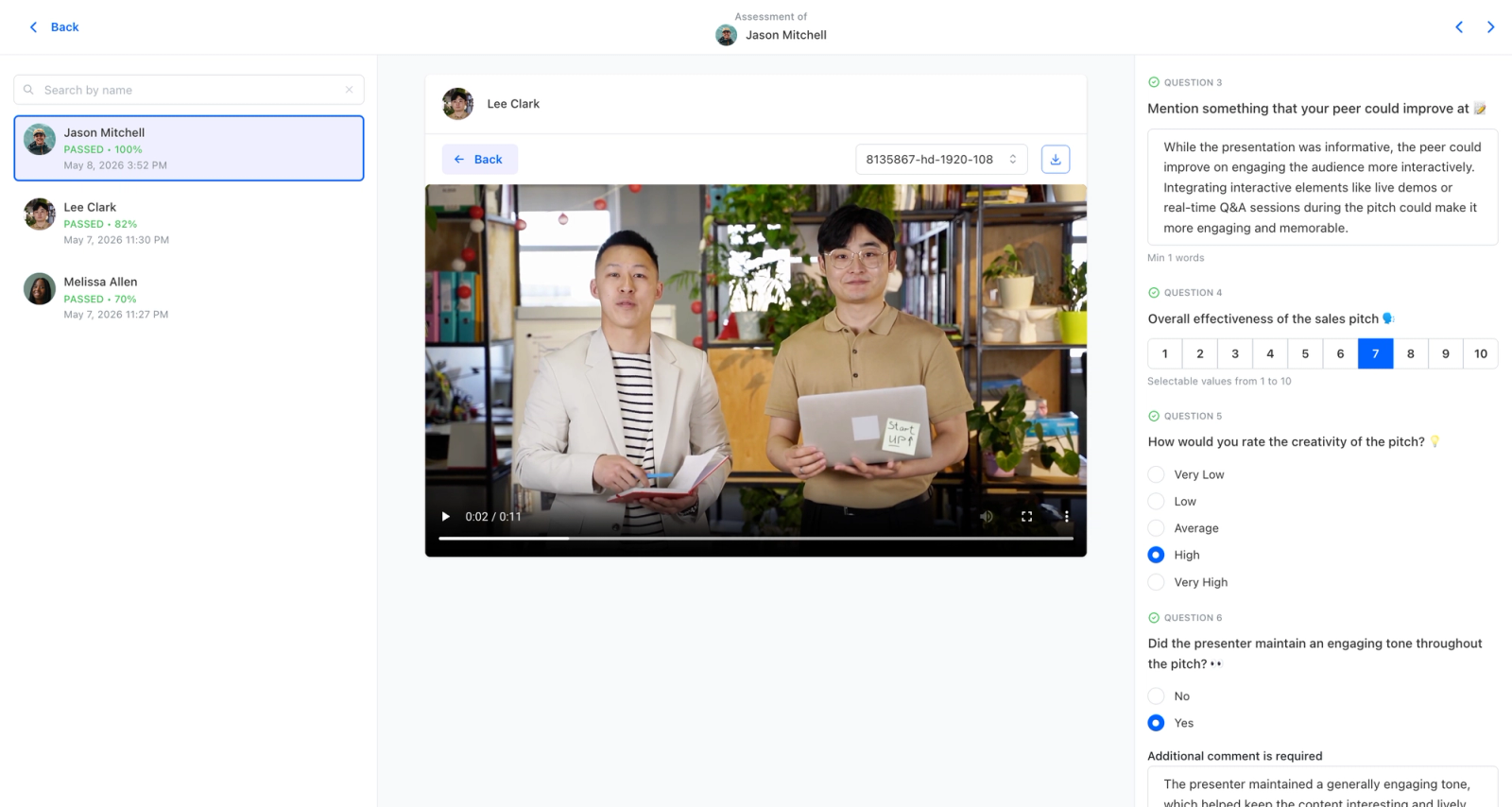
Teachfloor is a flexible learning platform that fits the two rhythms a contact center actually runs on: getting a new cohort of agents queue-ready fast, then coaching the floor every time a product, script, or policy shifts. New hires can move through self-paced onboarding modules on their own clock, while supervisors run live sessions for the harder skills, objection handling, de-escalation, complaint recovery, that don't land well as static slides. The part that separates it from a generic LMS is the social layer. Agents learn by discussing real calls with each other and by submitting recorded mock calls for structured peer review against a rubric, which is closer to how QA coaching already happens on a good floor. With attrition running high in most centers, the AI-assisted authoring matters too: a team lead can convert an updated script or policy memo into a published module in an afternoon instead of waiting on instructional design.
Core Capabilities
- Self-paced onboarding tracks so a new agent cohort can ramp toward queue-readiness without pulling a trainer off the floor for every hire
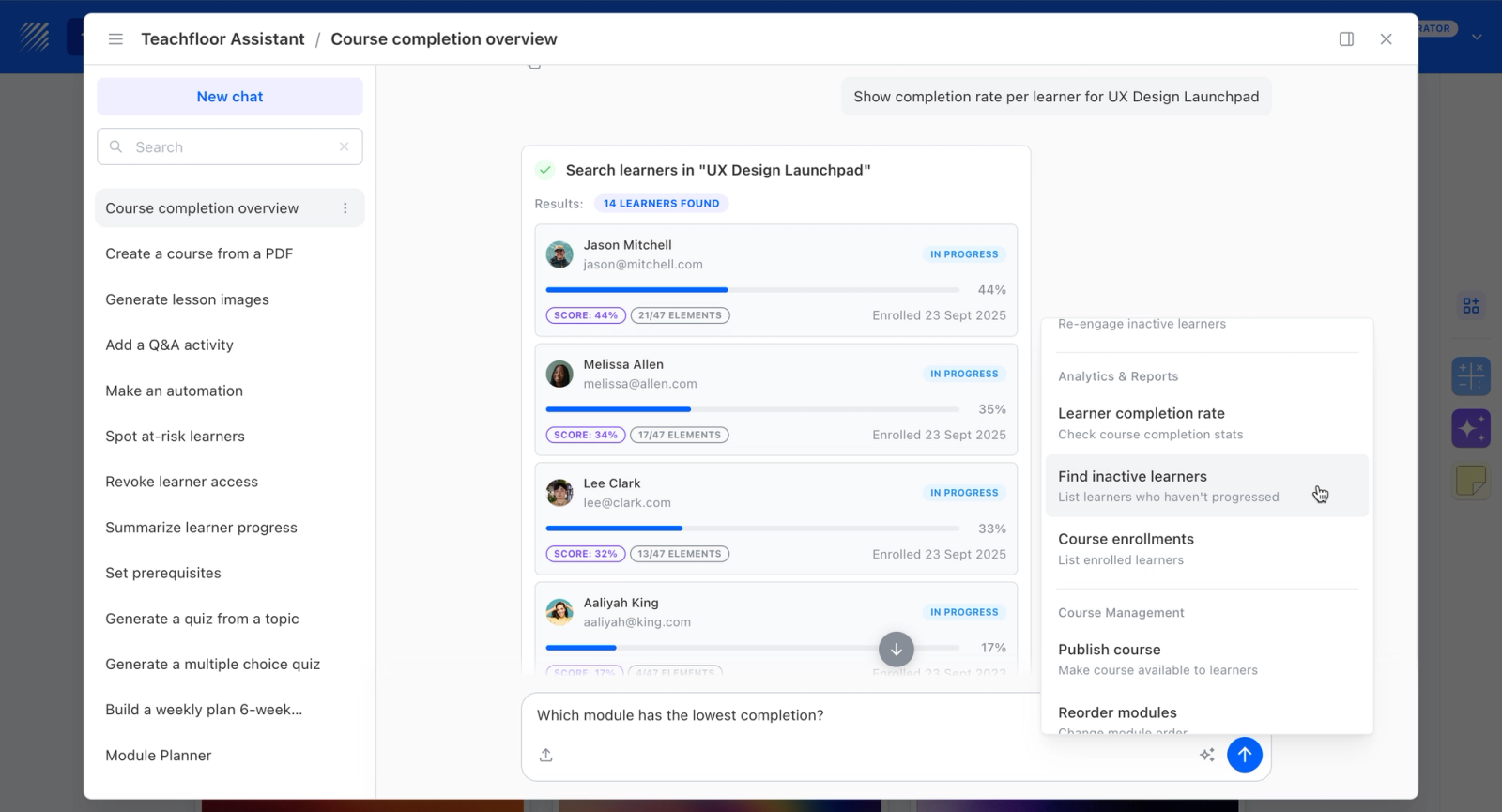
- Rubric-driven peer review where agents grade each other's mock calls against defined QA criteria, with scores that feed into the grade, turning training into the same muscle as live call scoring
- Live and cohort delivery for the coaching-heavy skills (de-escalation, upsell, complaint handling) that work better as facilitated sessions than as recorded modules
- AI-assisted authoring to convert an updated script, policy memo, or product change into a module quickly, which is the only realistic way to keep pace with short-cycle product changes
- Quizzes, certificates, and analytics to verify an agent has cleared a topic before they take live calls, plus completion data you can line up against operational KPIs
Best For
Contact centers that train continuously rather than once, and want onboarding plus ongoing QA-style coaching in the same platform. It fits small-to-mid centers and growing BPOs better than a 1,000-seat enterprise floor that needs deep telephony integrations.
Pricing Overview
- Startup plan from $89 per month for up to 50 learners
- Full Features plan with custom pricing, white-label, SSO, and advanced integrations
- 14-day free trial; no permanent free plan
- Nonprofit discounts available
Limitations
- No native, pre-built connectors for telephony or WFM platforms like Genesys or Five9; you would push completion data through the API rather than rely on a turnkey integration
- Not a microlearning-first tool, so if your model is daily two-minute reinforcement bursts in the style of Axonify, that is not Teachfloor's core design
- No permanent free plan, and pricing starts at $89/mo for up to 50 learners, so very small teams pay from day one after the 14-day trial
Quick Comparison Insight
A flexible platform whose peer-review and discussion layer mirrors real QA coaching; strongest for centers that onboard cohorts and coach continuously, less suited to those needing native telephony integrations or pure daily microlearning.
TalentLMS
Overview
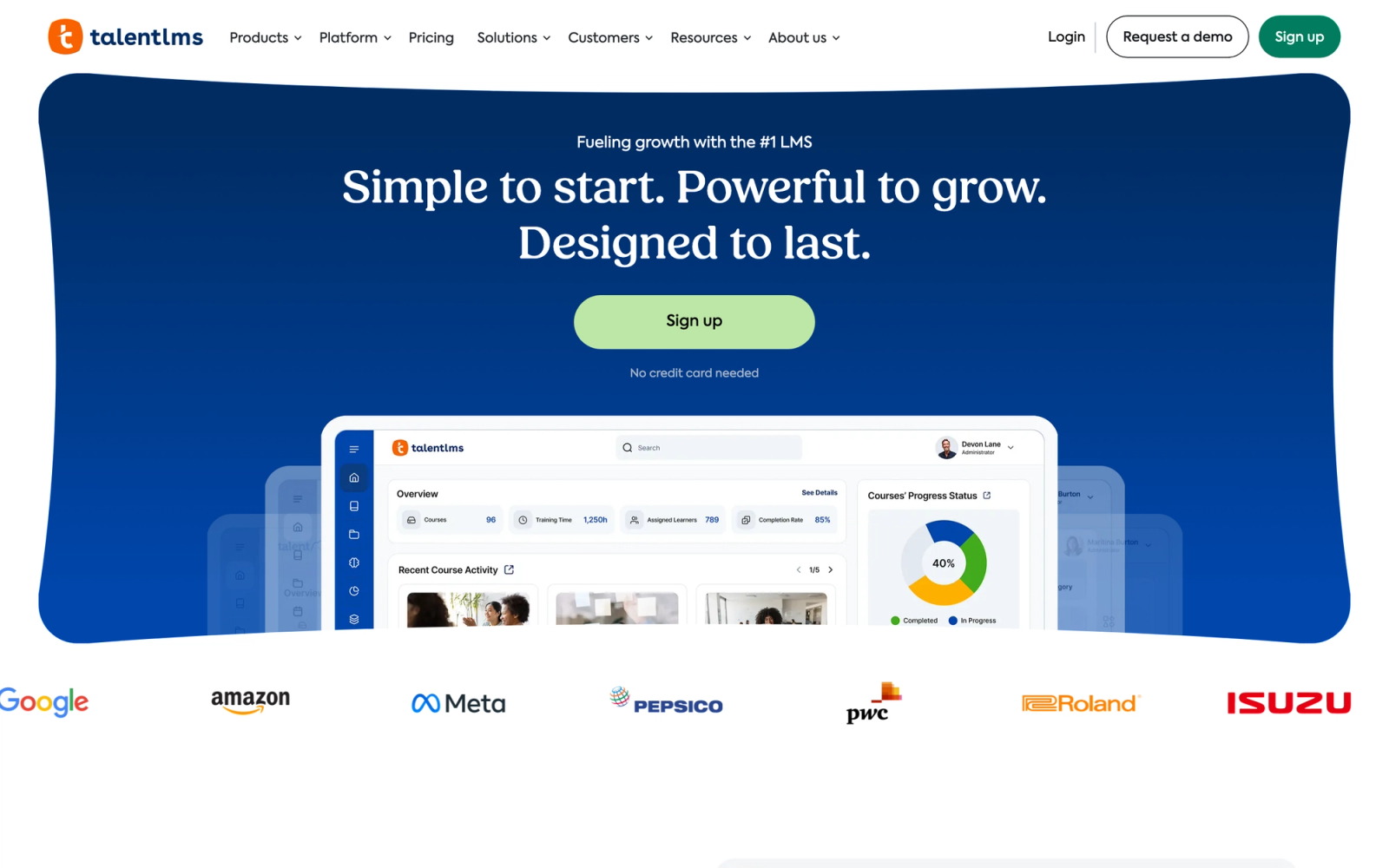
TalentLMS is a cloud-based learning management system built for organizations that need to get training running quickly without a long implementation cycle. It positions itself as the LMS that "just works," and that claim largely holds. A basic course structure, user groups, and branding can be configured in under an hour.
For call centers, TalentLMS hits a practical sweet spot. It is affordable enough for small and mid-size operations, simple enough for team leads to manage without dedicated L&D staff, and flexible enough to handle the mix of compliance training, product knowledge, and soft skills modules that contact centers require.
Core Capabilities
- Built-in course authoring with support for text, video, presentations, and SCORM/xAPI packages
- Branching logic and conditional learning paths that adapt based on agent performance or role
- Automated enrollment rules that assign training based on department, role, or manager designation
- Gamification engine with points, badges, and leaderboards to drive completion rates
- Built-in video conferencing for live training sessions and virtual classroom delivery
- Custom reports and scheduled report delivery to managers and supervisors
- Multi-branch architecture that lets you run separate training portals for different teams or locations
- REST API and native integrations with Salesforce, Zoom, Microsoft Teams, Zapier, and BambooHR
- SCORM 1.2 and xAPI compliance for importing third-party courseware
- Mobile-responsive design with a dedicated mobile app for iOS and Android
Standout Strength
Speed to deployment is TalentLMS's real competitive advantage. Contact centers dealing with high turnover or seasonal hiring surges need an LMS they can configure, populate, and start assigning within days. TalentLMS delivers on that without requiring a dedicated implementation team or consulting engagement. For a mid-size center that needs to onboard 50 new agents next week, this matters more than having the most advanced feature set.
Best For
Small-to-mid-size call centers with 50 to 500 agents that need an affordable, easy-to-manage LMS. It suits operations where the training manager wears multiple hats, budgets are tight, and the priority is getting training live quickly rather than building sophisticated learning architecture.
Pricing Overview
- Free plan available for up to 5 users and 10 courses
- Paid Core plan starts around $119 per month billed annually (up to 100 users)
- Pricing scales with user count; enterprise plans available for larger deployments
- Annual billing discounts available
Limitations
- Reporting depth is adequate for basic needs but falls short for contact centers that want to correlate training data with call quality metrics at a granular level.
- The built-in authoring tools handle standard content well, but creating interactive simulations or branching call scenarios requires importing content from external authoring tools.
- Native integrations with specialized contact center platforms (Genesys, Five9, NICE) are limited. You will need Zapier or API work for those connections.
Quick Comparison Insight
More affordable and faster to deploy than Absorb or SAP Litmos, but reporting depth and automation fall short for enterprise-scale contact centers.
Lessonly (Seismic Learning)
Overview
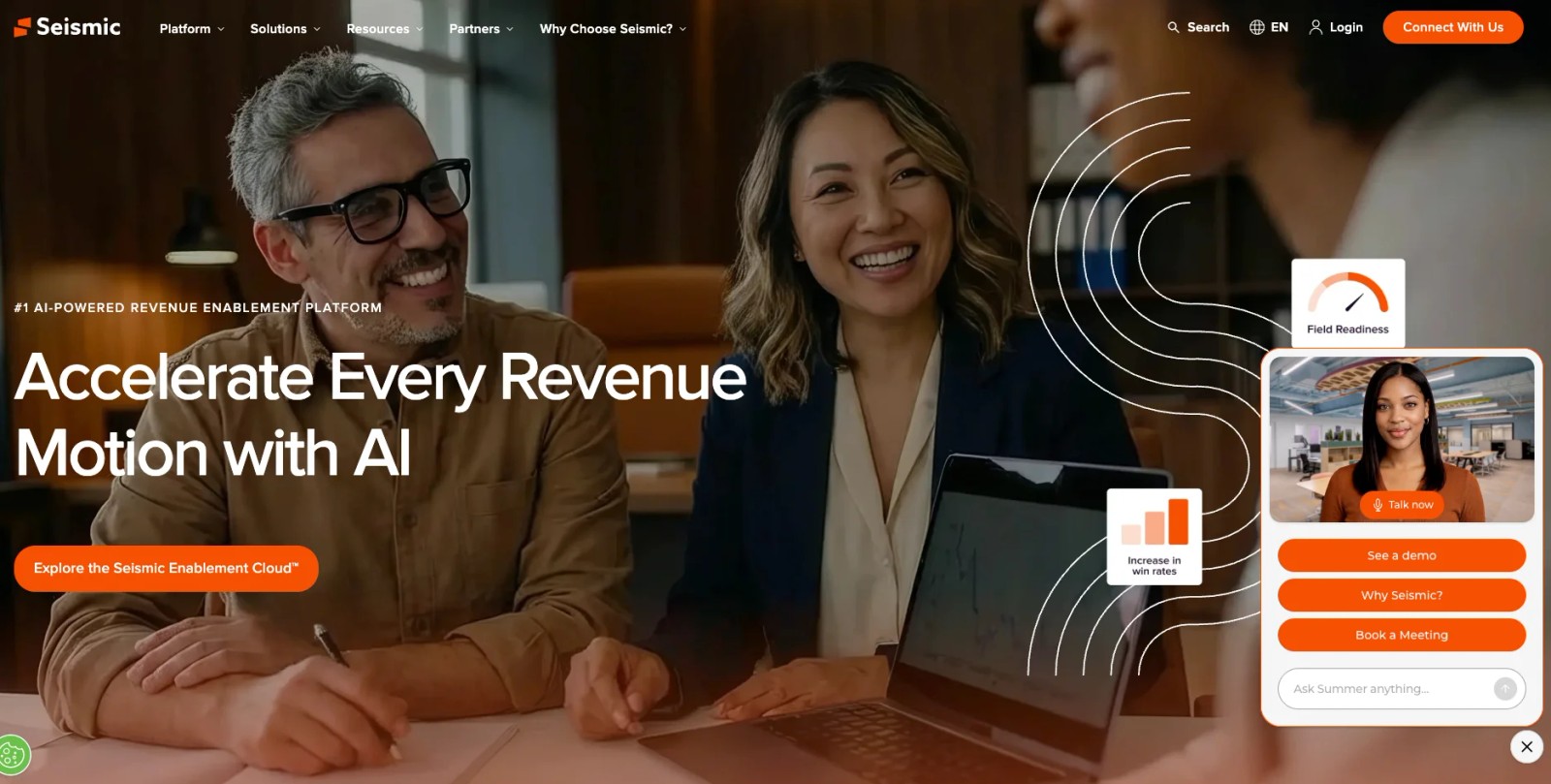
Lessonly, now part of the Seismic platform and rebranded as Seismic Learning, was built from the ground up for customer-facing teams. Where most LMS platforms started as generic training tools and then added sales and service features, Lessonly started with the premise that the fastest path to better customer interactions is practice, not just content consumption.
What stands out about Lessonly is how much emphasis it places on practice exercises. Agents do not just read about handling an angry customer; they record themselves responding to a simulated scenario and submit it for manager review. For contact centers where soft skills directly impact customer satisfaction and retention, this practice-first approach addresses a gap that content-only platforms miss entirely.
Core Capabilities
- Drag-and-drop lesson builder with support for text, images, video, screen recordings, and embedded content
- Practice exercises where agents record video or written responses to realistic customer scenarios
- Coaching workflows that let managers review, score, and provide feedback on practice submissions
- Learning paths with prerequisite logic and milestone tracking for structured onboarding programs
- Automation rules for enrolling agents in training based on role, team, start date, or performance triggers
- Knowledge base with searchable articles that agents can access during live calls
- Integration with Salesforce, Zendesk, and major CRM platforms for contextual training delivery
- Analytics dashboard tracking completion rates, quiz scores, practice submission quality, and time-to-competency
- Slack and Microsoft Teams integration for training notifications and reminders
- Content tagging and organization system for managing large libraries across multiple teams
Standout Strength
The practice and coaching loop is what makes Lessonly genuinely different for contact center training. Most LMS platforms measure whether an agent completed a course. Lessonly measures whether they can actually demonstrate the skill. For call centers where the difference between a scripted response and a confident, natural one directly affects customer experience, this practice-oriented model provides a feedback mechanism that passive training cannot replicate.
Best For
Mid-size call centers with 100 to 1,000 agents, particularly those that run sales-focused or customer success operations where soft skills and consultative communication matter as much as product knowledge. Organizations already using Seismic for sales enablement will find the most value in having both capabilities under one contract.
Pricing Overview
- Custom pricing based on team size and feature requirements
- Typically packaged as part of the broader Seismic platform
- Demo-only pricing, commonly quoted around $300 per month for the learning module; no free trial
Limitations
- Pricing is not transparent. Small contact centers may find the cost prohibitive, especially if they only need the learning module without the full Seismic enablement suite.
- SCORM and xAPI support is limited compared to traditional LMS platforms, which can be a constraint if you have a large library of existing eLearning content built in other tools.
- The platform is purpose-built for customer-facing teams. If you also need to train back-office staff, IT teams, or non-customer-facing departments, you may outgrow its scope.
Quick Comparison Insight
More focused on practice and coaching than TalentLMS or Absorb, but narrower in scope. Best suited when improving agent communication quality is the primary training goal and the team does not need to train back-office or non-customer-facing staff in the same system.
Absorb LMS
Overview
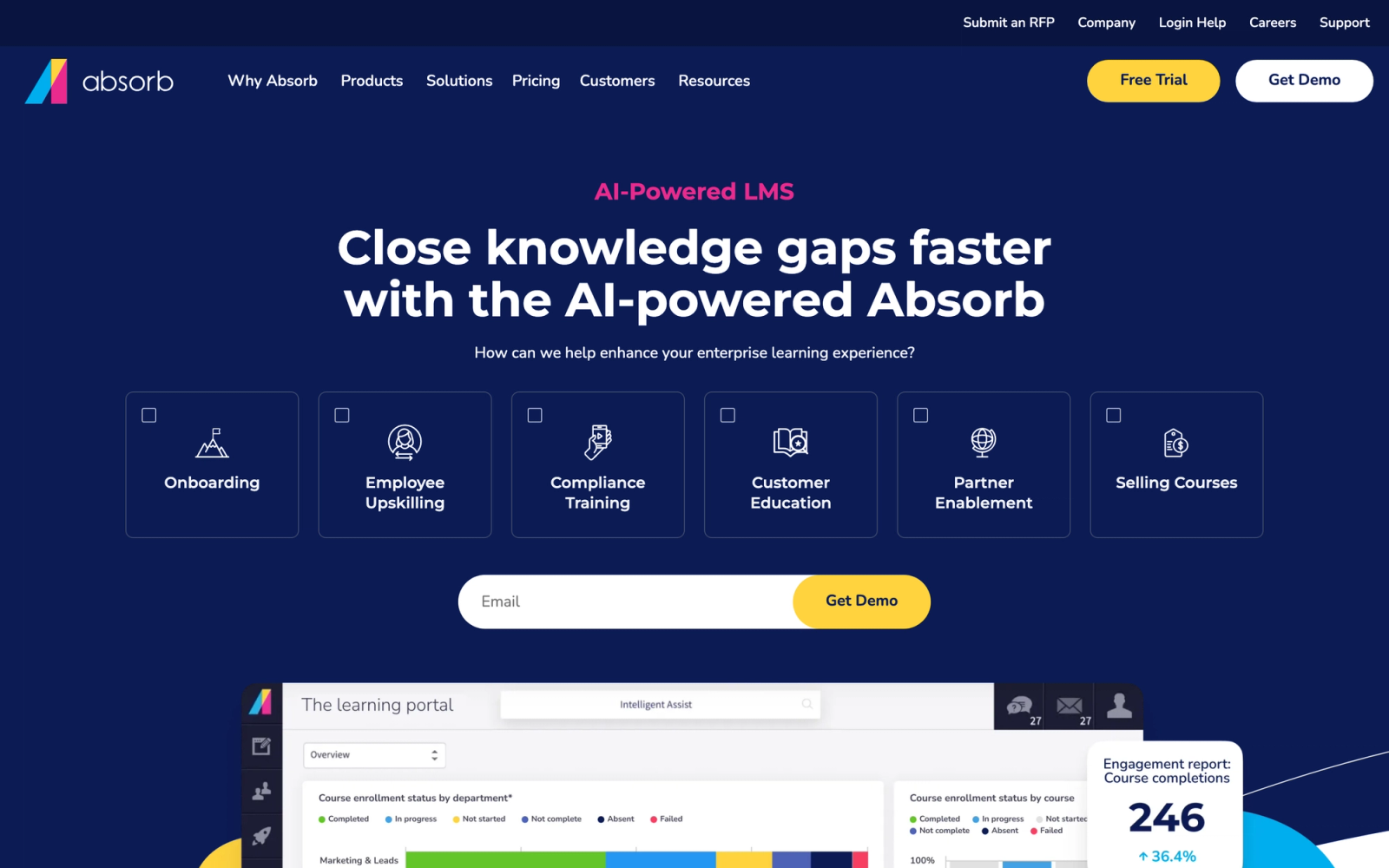
Absorb LMS is an enterprise learning management system that balances a clean user interface with the depth of features that large contact center operations demand. It serves organizations across multiple industries, but its combination of scalable architecture, strong reporting, and content marketplace makes it particularly relevant for contact centers with hundreds or thousands of agents.
Absorb's standout is the admin experience. The dashboard is visually clean without sacrificing configuration depth. Setting up automated enrollment rules, building learning paths, and pulling reports is substantially smoother than on platforms that offer similar functionality but bury it under layers of menus. For a training manager overseeing 500 agents across three shifts, that admin efficiency saves real time every week.
Core Capabilities
- Intelligent assist powered by AI that automates admin tasks like user enrollment, reporting, and course recommendations
- Absorb Create, an integrated authoring tool for building interactive courses without external software
- Absorb Infuse, an API layer that embeds learning content directly into other applications (CRM, help desk, intranet)
- Content marketplace with access to a library of pre-built compliance, customer service, and professional development courses
- Automated learning paths with prerequisite logic, due dates, and escalation notifications
- Advanced reporting engine with custom dashboards, scheduled reports, and data export capabilities
- SCORM 1.2, SCORM 2004, xAPI, and AICC content standard support
- Native integrations with Salesforce, BambooHR, ADP, Workday, and SSO providers
- Mobile app for iOS and Android with offline content access
- Multi-tenant architecture for managing separate training environments by department or location
Standout Strength
Absorb's intelligent automation reduces the administrative load that bogs down training managers in high-turnover environments. Automated enrollment, AI-powered course recommendations, and proactive admin alerts mean less time managing the system and more time improving training quality. For large contact centers where the training team is small relative to the agent population, this operational efficiency is the deciding factor.
Best For
Mid-to-large contact centers with 500 to 5,000+ agents that need enterprise-grade reliability, advanced reporting, and scalable content delivery. Operations with dedicated L&D teams tend to get the most from its depth; smaller training functions may find the configuration overhead exceeds the return.
Pricing Overview
- Custom pricing based on user count and feature modules
- Pricing is not publicly listed; typical enterprise LMS range
- Free trial and demo available
Limitations
- Pricing is enterprise-oriented. Small contact centers with under 100 agents will likely find it cost-prohibitive compared to TalentLMS or iSpring Learn.
- The built-in authoring tool (Absorb Create) is functional but does not match the depth of dedicated tools like iSpring Suite or Articulate for complex interactive simulations.
- Initial setup and configuration require more time than lighter platforms. Budget 2 to 4 weeks for a full implementation with custom integrations.
Quick Comparison Insight
More scalable and feature-rich than TalentLMS, but less practice-oriented than Lessonly. It earns its place when you need an enterprise LMS that handles both compliance administration and skill development at scale without sacrificing admin clarity.
SAP Litmos
Overview
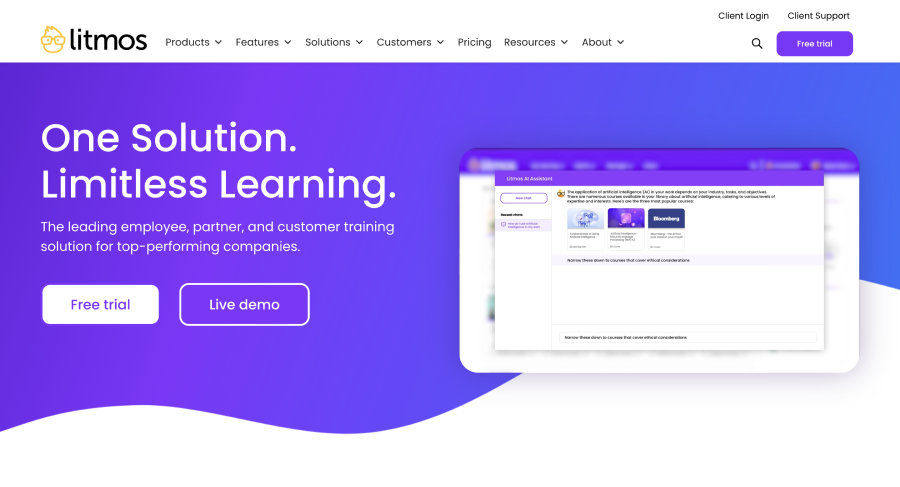
SAP Litmos is a cloud-based LMS that operates within the SAP suite while keeping enough independence to serve organizations that do not use other SAP products. It combines a built-in content library with LMS administration, which simplifies procurement for organizations that would otherwise buy an LMS and a content library separately.
The platform's strongest asset for call centers is its content marketplace. SAP Litmos includes access to a library of more than 95,000 pre-built courses covering topics directly relevant to contact centers: customer service, communication skills, compliance, data privacy, and management development. For a contact center that needs to launch a training program quickly without building everything from scratch, this bundled content significantly reduces time to value.
Core Capabilities
- LMS administration with automated assignments, learning paths, and due date tracking
- Built-in content library with 95,000+ courses covering compliance, customer service, IT, and management topics
- Video assessments where agents record responses to scenarios for manager evaluation
- Custom course builder with support for video, documents, SCORM packages, and quizzes
- Automated notifications and escalation alerts for overdue or incomplete training
- Custom reporting dashboards with the ability to schedule and distribute reports to stakeholders
- Multi-language support for global contact center operations
- SSO integration and compatibility with Salesforce, SAP SuccessFactors, and 30+ HR and CRM tools
- Mobile app with offline content access for remote agents
- Gamification features including badges, points, and achievement tracking
Standout Strength
The bundled content library eliminates the cold-start problem. Contact centers can assign pre-built customer service and compliance courses on day one while simultaneously developing custom content specific to their products and processes. This two-track approach means agents get foundational training immediately, without waiting for the internal team to finish building bespoke modules.
Best For
Large contact centers and enterprise organizations with 1,000+ agents, particularly those with global operations that need multi-language support and a ready-made content library. Strong fit for companies already using SAP products that want to consolidate their learning technology within the SAP suite.
Pricing Overview
- Custom pricing based on user count
- Plans typically start around $6 per user per month for LMS-only access
- Bundled LMS + content library packages available at higher tiers
- Free trial available
Limitations
- The admin interface has improved over the years, but some workflows still require more clicks than competing platforms. Complex reporting configurations can feel cumbersome compared to Absorb or Docebo.
- Pre-built content quality varies. Some courses in the library feel dated or generic. You will still need to build custom content for product-specific and process-specific training.
- Customization depth for branding, user experience, and workflow automation is more limited than what Docebo or Absorb offer at the enterprise tier.
Quick Comparison Insight
Broader content library than TalentLMS or Lessonly, but less configurable than Absorb or Docebo at the platform level. The right choice when bundled content and fast deployment outweigh the need for deep customization.
Docebo
Overview
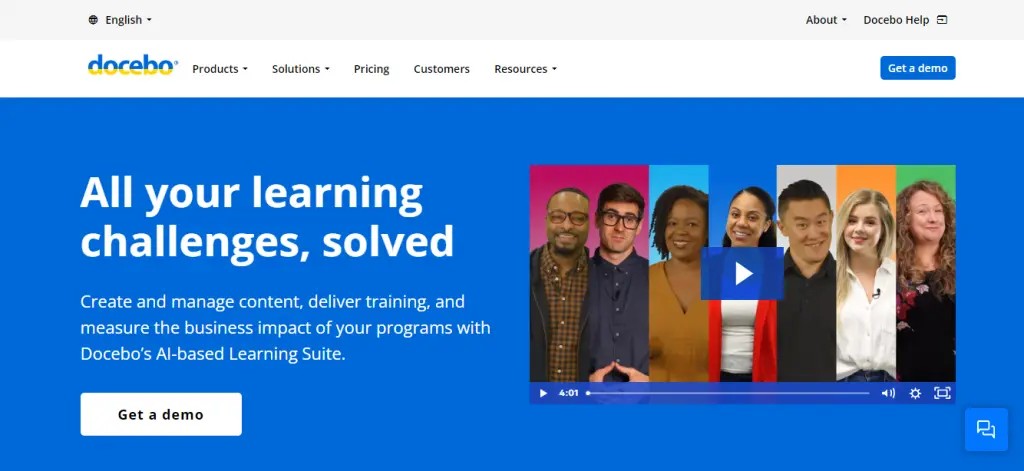
Docebo is an AI-powered learning platform built for enterprise organizations that need more than a basic LMS. It positions itself as a learning suite rather than a single product, combining content management, social learning, content marketplace integrations, and AI-driven recommendations into a unified platform.
For large contact centers, Docebo's strength lies in personalization. The platform uses AI to analyze learner behavior and recommend content based on skill gaps, learning history, and role requirements. The recommendations tend to be contextually appropriate rather than generic, which matters when you are managing training for agents across different product lines, customer segments, or support tiers.
Core Capabilities
- AI-powered content recommendations based on learner role, behavior, and skill gaps
- Content marketplace integrations (LinkedIn Learning, Skillsoft, OpenSesame) for expanding the course library
- Social learning features including channels, user-generated content, and peer Q&A
- Automated learning paths with conditional logic, prerequisites, and competency tracking
- Advanced reporting with customizable dashboards, data visualization, and export capabilities
- Multi-audience architecture for managing separate learning experiences by team, role, or customer segment
- External training portals for partner or customer education programs
- Integration network with native connectors to Salesforce, Workday, BambooHR, and 400+ tools via open API
- SCORM, xAPI, AICC, and cmi5 content standard support
- Mobile app with push notifications and offline access
Standout Strength
The AI layer is Docebo's primary competitive advantage. In a large contact center where different agents need different training based on their product specialization, tenure, and performance data, manually curating learning paths for every segment is impractical. Docebo's recommendation engine automates that curation, surfacing the right content at the right time without requiring the training manager to build and maintain hundreds of manual rules.
Best For
Enterprise contact centers with 1,000+ agents and complex training requirements spanning multiple product lines, compliance domains, and skill levels. Organizations with established L&D teams that want AI-driven curation at scale will use more of its depth than those without dedicated training functions.
Pricing Overview
- Custom enterprise pricing
- Typically starts in the mid-range for enterprise LMS platforms
- Free demo available; no free plan or published starting price
Limitations
- Implementation complexity is higher than mid-market platforms. Expect a 6 to 12 week deployment timeline for a full enterprise rollout with integrations.
- The platform's depth can overwhelm smaller teams. If you do not have a dedicated L&D function, you may not use enough of Docebo's capabilities to justify the investment.
- Built-in content authoring is functional but not its strongest area. Most Docebo customers pair it with a dedicated authoring tool for creating interactive content.
Quick Comparison Insight
More sophisticated than SAP Litmos or TalentLMS for AI-driven personalization, but more complex to implement and administer. Worth the investment when the training needs have outgrown simpler platforms and the team has the L&D capacity to configure it properly.
Axonify
Overview
Axonify takes a fundamentally different approach to workplace learning. Rather than organizing training into courses that employees complete once and forget, Axonify delivers daily reinforcement through short, adaptive questions and micro-content sessions. The platform is built specifically for frontline workers, making it one of the few LMS options designed from the ground up for the operational realities of environments like call centers.
What distinguishes Axonify from every other platform on this list is its spaced repetition engine. The system tracks what each agent knows and what they are starting to forget, then automatically adjusts the daily question mix to reinforce weak areas before gaps show up on live calls. In a contact center where agents must recall hundreds of product details, compliance rules, and process steps on demand, that adaptive reinforcement addresses a gap that one-time course completion cannot.
Core Capabilities
- Daily micro-training sessions of 3 to 5 minutes using adaptive questioning algorithms
- Spaced repetition engine that identifies knowledge decay and reinforces weak areas automatically
- Gamification with leaderboards, rewards, and competitions to drive daily participation
- Content marketplace with pre-built compliance, customer service, and safety training modules
- Communication hub for broadcasting updates, product changes, and policy announcements alongside training
- Advanced analytics connecting training activity to operational performance metrics
- Manager dashboards showing individual and team knowledge confidence levels
- Integration with HRIS, workforce management, and quality management systems
- Mobile-first design optimized for frontline workers accessing training on personal devices
- AI-driven content recommendations and automated remediation pathways
Standout Strength
The spaced repetition model is Axonify's defining feature and its most meaningful advantage for call centers. Research consistently shows that people forget roughly 70 percent of new information within 24 hours without reinforcement. Axonify addresses this directly by delivering short daily sessions that keep critical knowledge fresh. For contact centers where agents must recall product details, compliance protocols, and troubleshooting procedures accurately during live calls, this retention-focused approach produces measurable improvements in call quality.
Best For
Contact centers of any size where agent accuracy on product, process, and compliance information degrades over time. Particularly effective for high-volume, repetitive call environments where small knowledge gaps compound into measurable drops in call quality.
Pricing Overview
- Custom pricing based on user count and deployment scope
- No publicly listed starting price
- Free demo available
Limitations
- The micro-training model is excellent for knowledge reinforcement but less effective for teaching complex new skills that require longer-form instruction, practice, and feedback loops.
- Content creation within Axonify follows its own format (question-based micro-modules), which means existing SCORM or video-based content libraries may not translate directly.
- The platform is optimized for frontline environments. If your training needs extend significantly into management development, leadership programs, or extended enterprise learning, you will need a supplementary platform.
Quick Comparison Insight
Unlike traditional LMS platforms like Absorb or SAP Litmos, Axonify is not a course library or compliance tracker. It solves one specific problem, keeping agents accurate on information they need to recall daily, and solves it better than any full-featured platform on this list. Most organizations that use it run it alongside a traditional LMS rather than as a replacement.
iSpring Learn
Overview
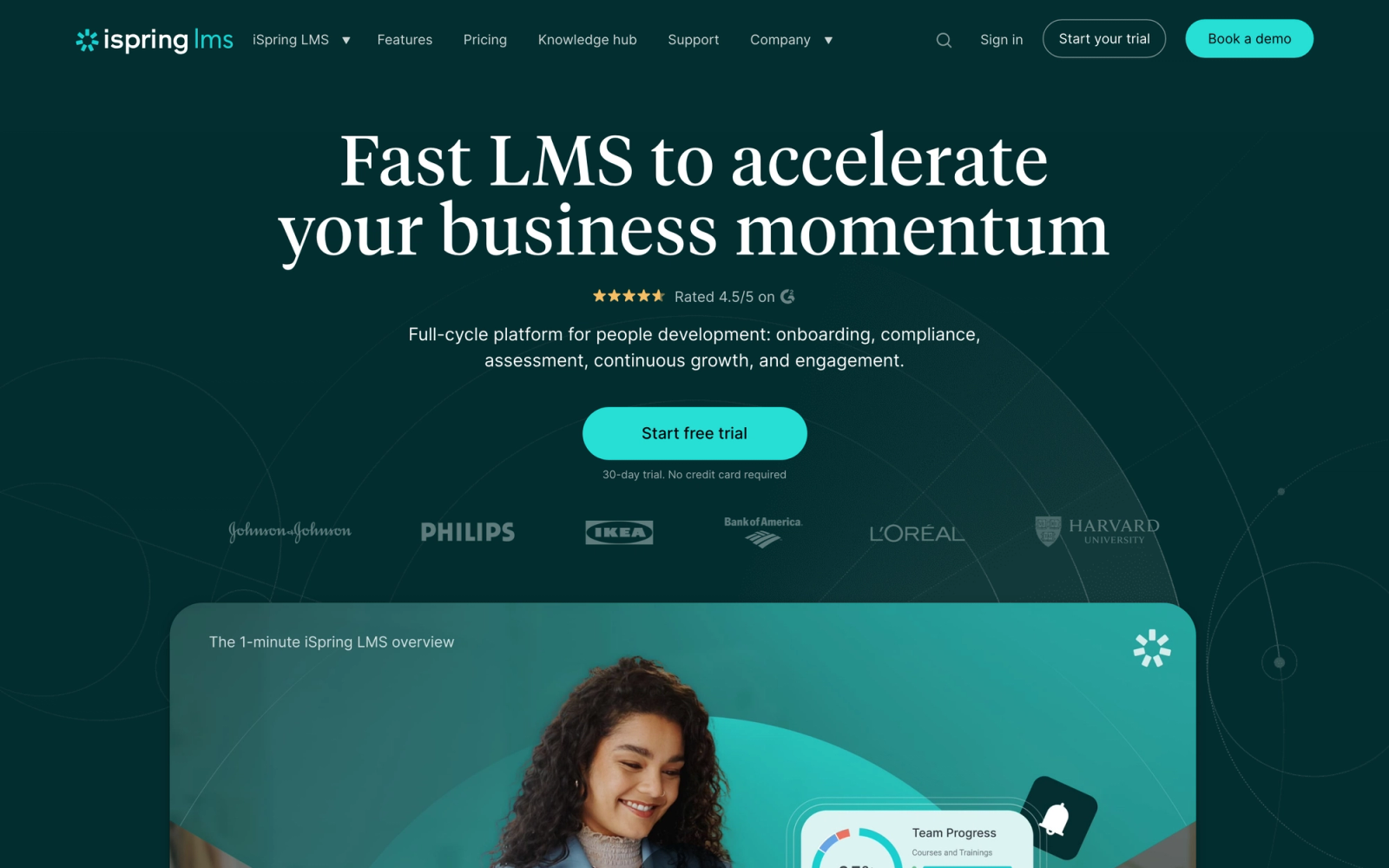
iSpring Learn is a cloud-based LMS that pairs directly with iSpring Suite, one of the most widely used rapid authoring tools in corporate training. The combination is the platform's core value proposition: create interactive eLearning content in PowerPoint using iSpring Suite, then publish and manage it through iSpring Learn.
For call centers where team leads and product owners need to create and update training content without an instructional designer in the loop, iSpring's authoring pipeline is unusually fast. A typical product update module, slide deck, narration, quiz, can go from raw PowerPoint to published course in under an hour. In centers where product changes arrive weekly, that compression between announcement and trained agents is a real operational advantage.
Core Capabilities
- Deep integration with iSpring Suite for creating interactive courses, quizzes, dialogue simulations, and screen recordings directly from PowerPoint
- Dialogue simulation builder that lets you create branching conversation scenarios for call handling practice
- Learning tracks with assignments, deadlines, automatic enrollment, and completion certificates
- Built-in quiz engine with 14 question types, scoring rules, and anti-cheating measures
- Calendar module for scheduling instructor-led training sessions and blended learning events
- Organizational structure module that mirrors your contact center hierarchy for role-based assignments
- Reporting with completion tracking, quiz performance analytics, and learner progress monitoring
- SCORM 1.2, SCORM 2004, xAPI, and cmi5 content support
- Mobile app with offline access and push notifications
- REST API and integrations with Zoom, Microsoft Teams, and major HRIS platforms
Standout Strength
The PowerPoint-to-course pipeline is what makes iSpring uniquely practical for call center environments. Team leads and product managers already create PowerPoint decks for internal communication. With iSpring Suite, those same decks become interactive training modules with quizzes, narration, and branching dialogue simulations, without involving an instructional designer or external vendor. This reduces the bottleneck between operational changes and training delivery to near zero.
Best For
Small-to-mid-size contact centers with 50 to 500 agents where team leads or product trainers create the majority of training content. It works particularly well for organizations that already rely on PowerPoint for internal communication and want to turn those assets into structured training without a separate authoring tool budget. Centers that need branching dialogue simulations for call handling practice will also find the built-in scenario builder practical without the cost of a dedicated simulation platform.
Pricing Overview
- iSpring Learn runs about $3.14 to $3.58 per user per month at 100 users (billed annually); the $2.29 per-user rate applies only to the 300-plus user tier
- iSpring Suite authoring tool is a separate purchase (starting at $770 per author per year)
- Combined pricing makes it one of the more affordable options for mid-size teams
- Free trial available for both LMS and authoring tool
Limitations
- The LMS itself is functional but not as feature-deep as Absorb or Docebo. Advanced automation, AI-driven recommendations, and sophisticated workflow rules are limited.
- Reporting capabilities cover the basics but lack the depth for advanced analytics or custom data visualizations that larger operations may need.
- The platform's value is closely tied to iSpring Suite. If your content team prefers other authoring tools (Articulate, Lectora), iSpring Learn's advantage diminishes significantly.
Quick Comparison Insight
Fastest content-to-delivery pipeline on this list, but lighter on LMS administration depth than Absorb, Docebo, or SAP Litmos. The tradeoff makes sense when the bottleneck is content creation speed, not platform sophistication.
How to Choose the Right LMS for Your Contact Center
Selecting the right LMS depends on your contact center's size, training maturity, and the specific problem you are trying to solve. Here is a practical way to approach the decision.
If speed of deployment is your priority, start with TalentLMS or iSpring Learn. Both platforms can be configured and populated with content within days, not months. TalentLMS is the simpler admin experience; iSpring Learn is the faster content creation pipeline if your team already works in PowerPoint.
If agent coaching and practice matter more than content delivery, Lessonly (Seismic Learning) is the strongest option. Its practice and feedback loop is designed specifically for customer-facing teams and fills a gap that traditional LMS platforms leave open.
If you need enterprise scale and advanced reporting, Absorb LMS and Docebo are the primary options. Absorb offers a cleaner admin experience and faster implementation. Docebo provides more AI-driven personalization and a broader set of integrations. Both handle thousands of users well.
If your biggest problem is knowledge retention, Axonify is purpose-built for that challenge. Its daily reinforcement model keeps agents accurate on product details and compliance requirements over time. Consider running it alongside a traditional LMS rather than as a replacement.
If you need a large pre-built content library, SAP Litmos bundles more ready-made courses than any other platform on this list. This reduces the upfront investment in content development, which matters for centers that need to launch training programs quickly.
If you are investing in supervisor and leadership development, Teachfloor's cohort-based model creates the collaborative learning environment that self-paced platforms cannot. Pair it with your agent-level LMS for a complete training stack.
The most important step is mapping your contact center's specific pain points before evaluating features. An LMS evaluation checklist that ties requirements to operational outcomes keeps the selection grounded in what actually matters to your business.
FAQ
Can one LMS handle both agent training and supervisor development?
Yes, if the platform supports more than one delivery model. Most call center LMS tools are tuned for high-volume, self-paced agent content. Teachfloor covers both sides in one system: fast, AI-built microlearning for agents, and live, cohort-based programs with peer review for team leads, supervisors, and quality coaches. That avoids running a separate tool for leadership development.
Does call center training need AI call simulation or role-play?
Role-play and scenario practice are where call center training earns its return, because de-escalation, objection handling, and active listening only improve with reps. Look for platforms that combine AI authoring to build scenarios quickly with a way to practice and get feedback. Teachfloor pairs AI course creation with peer review and live sessions; Lessonly (Seismic Learning) and iSpring's dialogue simulations also support recorded practice and branching scenarios.
What is the best LMS for call center training?
The best LMS for call center training depends on your center's size and primary training challenge. For small-to-mid-size centers that need fast deployment and simplicity, TalentLMS is a strong starting point. For enterprise operations needing advanced reporting and scalability, Absorb LMS and Docebo are better fits. If knowledge retention is your main concern, Axonify's spaced repetition model addresses that problem directly. There is no single best platform because call center training spans compliance, product knowledge, soft skills, and leadership development, each with different requirements.
How much does a call center LMS cost?
Call center LMS pricing varies widely. Budget options like TalentLMS start around $119 per month for small teams, while iSpring Learn runs about $3.14 per user per month at 100 users. Enterprise platforms like Absorb, Docebo, and SAP Litmos use custom pricing that typically ranges from $5 to $15 per user per month depending on volume and feature requirements. Factor in implementation costs, content development, and any supplementary authoring tools when calculating total cost of ownership.
Can an LMS integrate with contact center software like Genesys or Five9?
Most enterprise LMS platforms offer open APIs that enable integration with contact center software, though native, pre-built connectors for telephony platforms like Genesys, Five9, or NICE are uncommon. Absorb, Docebo, and SAP Litmos offer the most flexible API sets of connectors for building these connections. Integration typically requires middleware (Zapier, Workato) or custom development to pass data between the LMS and your telephony or quality management stack.
Is microlearning effective for call center training?
Microlearning is highly effective for call center training because it aligns with the operational reality of the environment. Agents cannot leave the queue for extended sessions, so short modules of 3 to 10 minutes fit between calls and during breaks. Axonify's entire model is built on this principle. TalentLMS, iSpring Learn, and SAP Litmos all support microlearning content formats as well, though they also accommodate longer-form training when needed.
How do I measure the ROI of call center training?
Measuring training ROI in a contact center requires connecting LMS data to operational KPIs. Track metrics like time-to-competency for new hires, first-call resolution rates, average handle time, quality assurance scores, and customer satisfaction ratings before and after training initiatives. Platforms with strong analytics capabilities make this correlation easier by providing dashboards that overlay training completion with performance data.


