

Continu is a modern, well-liked workplace enablement platform, used to route training to employees, partners, and customers with a clean UX and deep HRIS integrations. But it's enterprise, quote-based software, and teams sometimes want more transparent pricing, deeper customization, or more engaging, social learning. If any of that sounds familiar, there are strong alternatives.
The short answer: if you want collaborative, cohort-based training with peer learning and community (run self-paced or live), Teachfloor is the standout. For collaborative authoring at scale, 360Learning leads; for an AI-first enterprise suite, Docebo and Sana; and for customer plus employee training, WorkRamp and LearnUpon.
Below are the 8 best Continu alternatives in 2026, with what each does well, where it falls short, and real 2026 pricing.
Why look for a Continu alternative?
Continu is highly rated (~4.7/5 on G2) and genuinely modern. But it isn't right for everyone:
- Pricing transparency. It's quote-based enterprise software with no public rates, which makes budgeting and quick comparison hard.
- Customization. Going deeper on customization can require vendor support rather than self-serve configuration.
- Performance. Reviewers note occasional slowdowns on certain tasks.
- Less social. It's built to route self-paced content to employees, lighter on cohort-based, collaborative, and peer learning.
If any of those describe you, the alternatives below are worth comparing.
How we evaluated these alternatives
We didn't rank these by feature count. We compared the Continu alternatives on the things that actually determine whether a platform works for you:
- Real cost: published tiers, transaction fees, and the add-ons that quietly inflate the bill.
- Depth of the learning tools: from simple self-paced modules to assessments, certificates, and structured paths.
- Engagement and community: whether the platform supports cohorts, live sessions, discussion, and peer feedback, or just content delivery.
- Customization and white-label: how much the experience can carry your brand and live on your own domain.
- Real user ratings: verified G2 and Capterra scores in 2026, plus the complaints that show up repeatedly in reviews.
A note on pricing: all prices below are in USD for annual billing and were verified in June 2026. Vendors change pricing often, so confirm the current numbers on each official site before you buy.
The 8 best Continu alternatives at a glance
| Platform | Best for | Starting price | Platform fees | User rating |
|---|---|---|---|---|
| Teachfloor | Collaborative, cohort-based training | $89/mo | Stripe fees only | 5.0 (G2) |
| 360Learning | Collaborative team training | $8/user/mo | — | 4.6 (G2) |
| Docebo | AI-first enterprise learning | Custom (~$25k+/yr) | — | 4.4 (G2) |
| Sana Labs | AI-personalized learning | Custom (~$8/user) | — | 4.8 (G2) |
| Absorb LMS | Polished corporate LMS | Custom | — | 4.6 (G2) |
| WorkRamp | Employee + customer training | Custom | — | 4.4 (G2) |
| LearnUpon | Multi-audience training | Custom (~$18k+/yr) | — | 4.6 (G2) |
| Cornerstone | Enterprise learning + talent | Custom | — | 4.0 (G2) |
Quick verdict: pick Teachfloor for collaborative, cohort-based training, 360Learning for collaborative authoring, Docebo or Sana for an AI-first enterprise suite, Absorb for polish and e-commerce, WorkRamp or LearnUpon to train employees and customers together, and Cornerstone for a full learning-and-talent suite.
1. Teachfloor — best for collaborative, cohort-based training
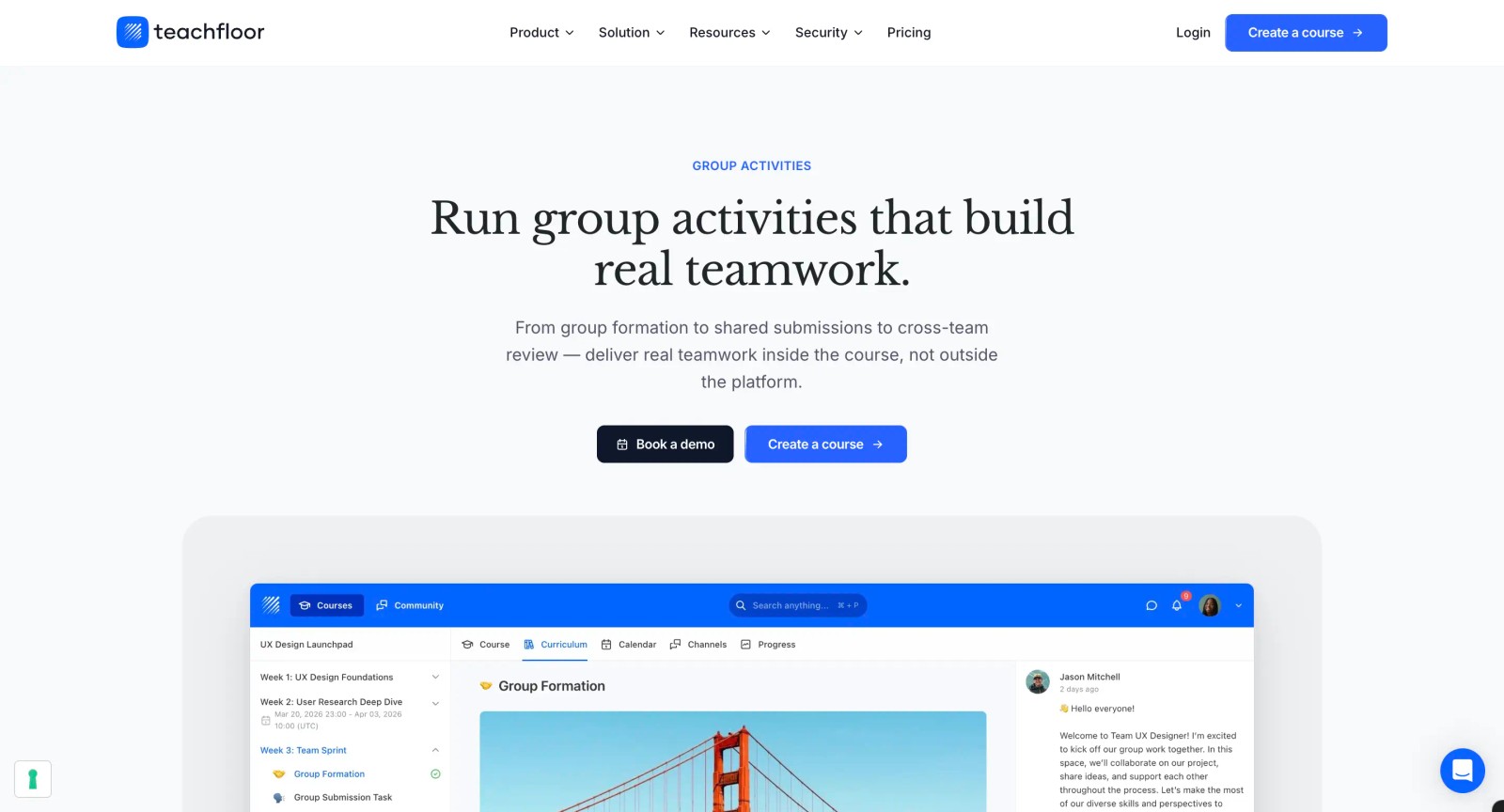
Continu routes self-paced content to employees efficiently, but it's light on social learning. Teachfloor flips that: run team training as cohorts with live sessions, peer review, and a community, or keep it self-paced and simply add discussion and group activities to make it more engaging. It's flexible, white-labeled on your own domain, simpler to set up, and far more transparent on price.
Where it beats Continu:
- Cohort-based, social learning with live sessions and peer review, not just routed self-paced content.
- A built-in community with channels and group activities that keeps learners engaged.
- Run it your way, self-paced or cohort, and mix formats per program.
- Transparent pricing from $89/month and a simpler setup, with white-label branding and AI course creation.
Where it falls short: it's built for structured academies and team training rather than massive, fully self-serve content marketplaces, plans are seat-based (the entry tier includes 50 seats), the $89/mo starting price is higher than budget tools, and the ecosystem is newer than the incumbents.
Pricing: Startup at $89/month (50 seats, unlimited courses, 10 GB) covers course creation, peer review, group activities, and Zoom/Stripe integrations. The Full Features plan (custom pricing) adds white-label, advanced automations, SSO, and priority support. A free trial is available.
Rating: 5.0/5 on G2 (~45 reviews) and 4.7/5 on Capterra.
Choose Teachfloor if you want engaging, collaborative team training without enterprise pricing or setup complexity.
2. 360Learning — best for collaborative authoring
360Learning turns internal experts into course authors, blending top-down training with peer-driven collaboration, a strong, social alternative to Continu's content-routing model.
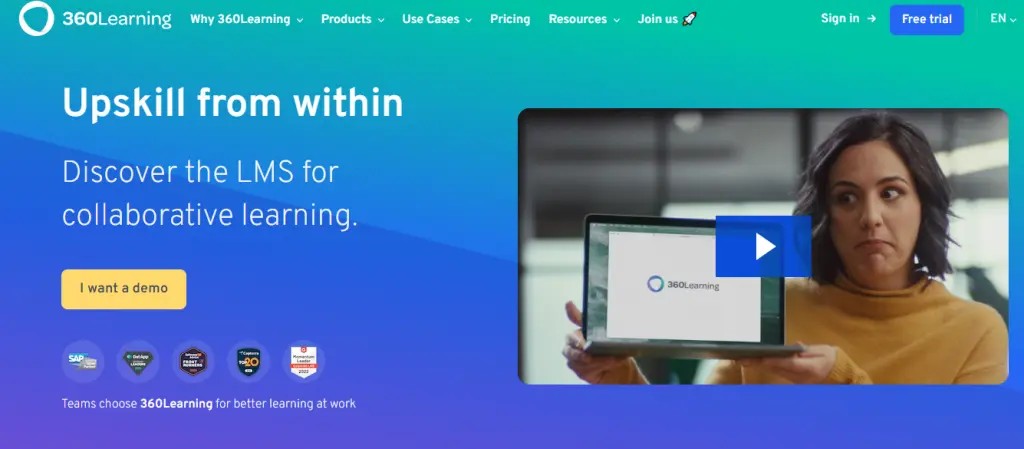
Standout strengths: collaborative authoring with built-in feedback loops, where subject-matter experts co-create and peers comment and upvote courses; AI-assisted course and quiz generation from existing documents; and structured academies with integrated coaching and forums.
Where it falls short: reporting and analytics are limited (advanced dashboards are gated or missing), branding and look-and-feel customization is constrained, and live-session capabilities are weaker than competitors.
Pricing: the Team plan is $8/user/month (up to 100 users), with custom-quoted Business and Enterprise tiers for larger orgs; there's a free trial.
Rating: 4.6/5 on G2 (~580 reviews), 4.7/5 on Capterra (~490 reviews).
Choose 360Learning if you want to scale internal, expert-led collaborative training.
3. Docebo — best AI-first enterprise platform
Docebo is an AI-first enterprise LMS with extended-enterprise portals and a content marketplace, built for training employees, partners, and customers at scale.
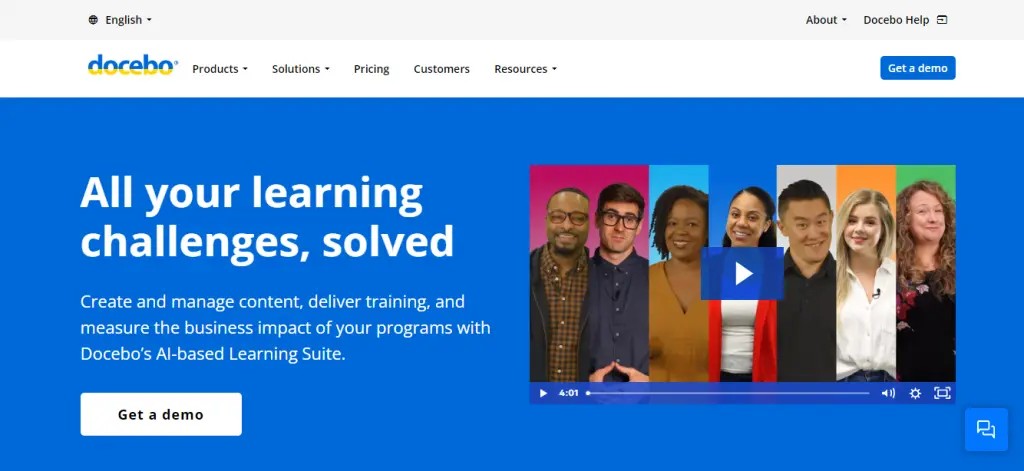
Standout strengths: the AI-first Docebo suite (AI content creation, neural search, virtual coaching, and the agentic 'Harmony' co-pilot); extended-enterprise multi-domain portals for training partners, customers, and franchisees; and a built-in content marketplace with broad HRIS and tool integrations.
Where it falls short: it's a premium platform with high minimum contracts that's expensive for smaller organizations, admin setup and configuration are complex, and reviewers report slow support and occasional performance lags.
Pricing: quote-based and billed annually across Elevate and Enterprise tiers; exact list prices aren't published, but total cost of ownership commonly starts around $25,000/year and scales by active users (roughly $7–$10/user/month in third-party estimates).
Rating: 4.4/5 on G2 (~500–740 reviews), 4.4/5 on Capterra (~230 reviews).
Choose Docebo if you want an AI-first enterprise platform for multi-audience training at scale.
4. Sana Labs — best for AI-personalized learning
Sana is an AI-native platform that auto-generates courses and personalizes learning in real time, unifying live and self-paced, a modern, AI-forward alternative to Continu.
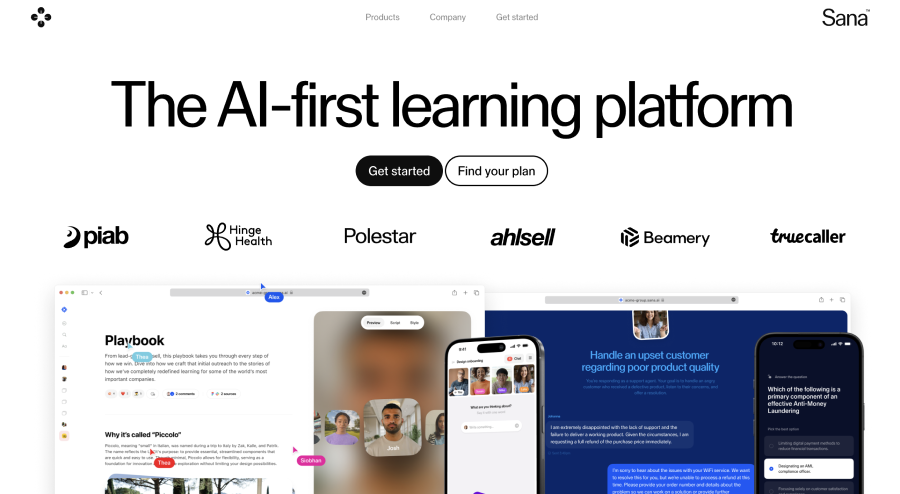
Standout strengths: AI content generation that builds courses from source files (users report cutting production from weeks to hours) with adaptive, personalized paths; the Sana AI assistant and no-code AI agents grounded in company data; and unified live plus self-paced delivery with auto-generated analytics.
Where it falls short: pricing is perceived as high and is quote-only at the enterprise level, content authoring can feel restrictive for advanced needs, and AI suggestions aren't always reliable and need sense-checking.
Pricing: quote-based enterprise pricing; Sana Core is listed from around $8/license with a 300-license minimum, while Sana Enterprise (SSO, SCIM, SLA, HR connectors) is custom and unpublished.
Rating: 4.8/5 on G2 (~103 reviews), 4.9/5 on Capterra (small sample).
Choose Sana Labs if you want an AI-first platform that builds and personalizes training automatically.
5. Absorb LMS — best polished LMS with e-commerce
Absorb is a polished corporate LMS with strong AI and built-in global e-commerce, a solid fit for internal training plus selling external courses.
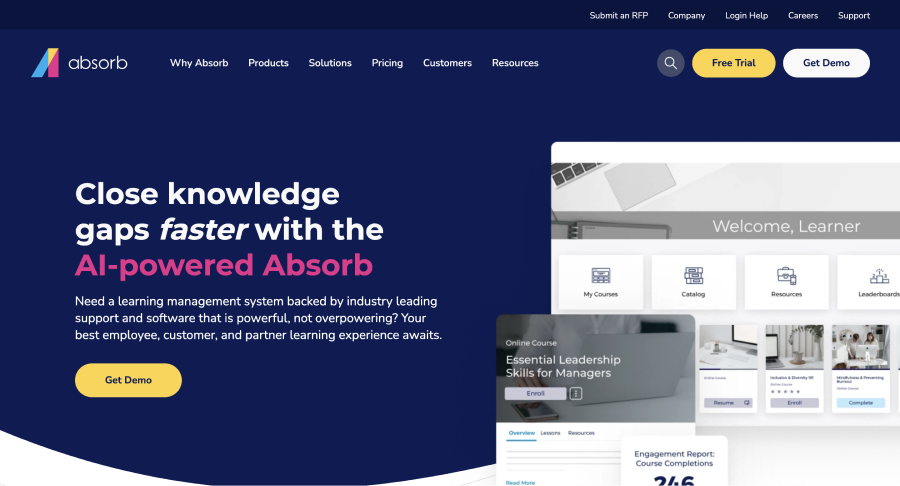
Standout strengths: the Absorb AI suite (generative course building, personalized skill paths, and intelligent recommendations); built-in global e-commerce to sell courses externally; and the Amplify content library with multi-portal branding and a widely praised clean admin UX.
Where it falls short: advanced features and active-learner-based pricing make total cost high and hard to predict, customer support can be slow, and some users want deeper reporting and more UI customization.
Pricing: quote-based enterprise subscription priced on active-learner bands; third-party estimates run roughly $36,000–$60,000/year for ~100 users and higher at enterprise scale. Exact list prices aren't published.
Rating: 4.6/5 on G2 (~861 reviews), 4.5/5 on Capterra (~342 reviews).
Choose Absorb LMS if you want a polished LMS with built-in course-selling.
6. WorkRamp — best for employee plus customer training
WorkRamp runs both internal and external learning from one platform, with separate Employee and Customer Learning Clouds and a strong AI content engine.
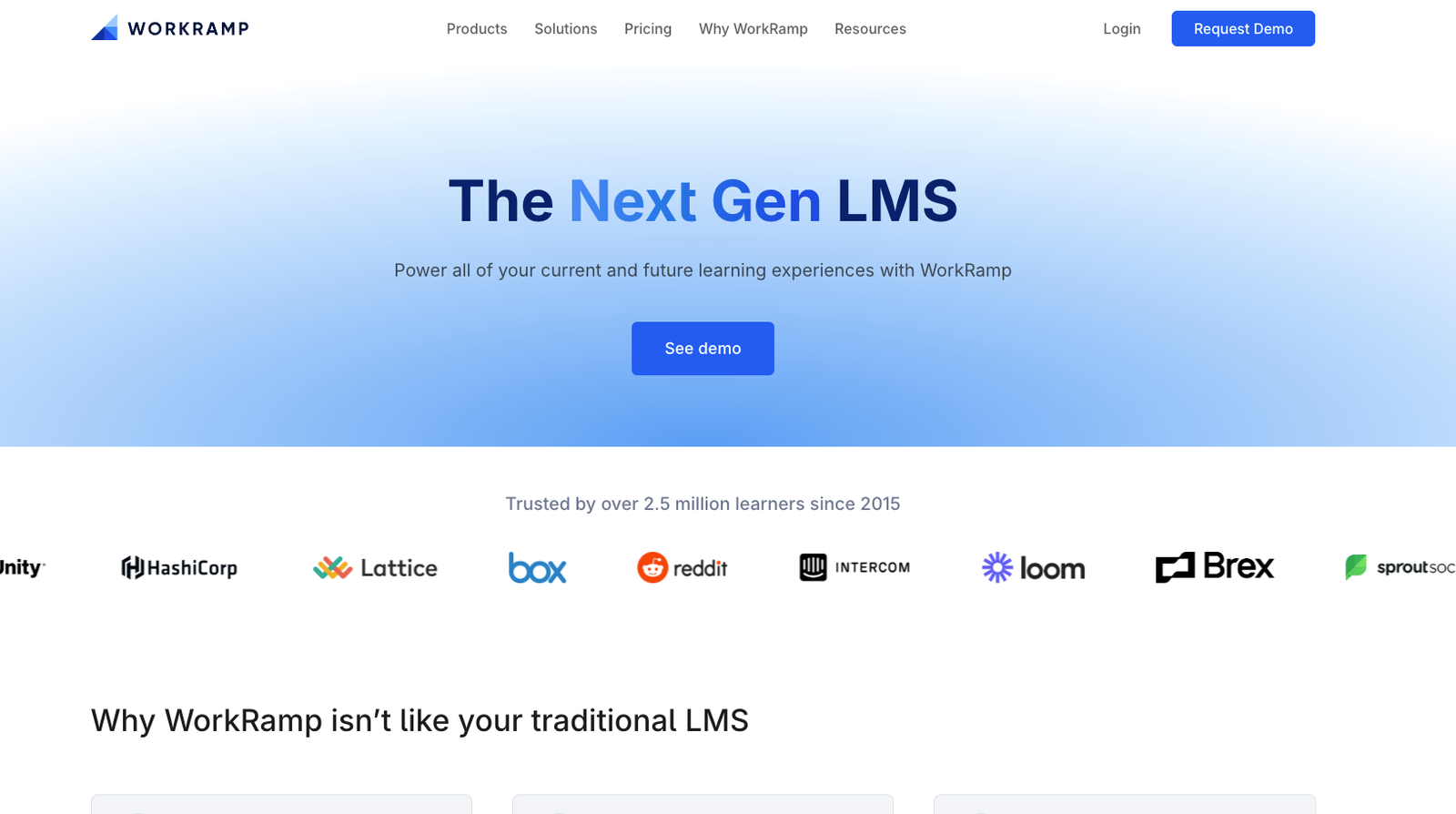
Standout strengths: separate Employee and Customer/Partner Learning Clouds on one platform; WorkRamp AI that drafts courses from your files, generates quizzes, and runs role-play coaching; and enterprise authoring with SCORM, HRIS and Salesforce connectors, and SSO.
Where it falls short: reporting and completion tracking are widely cited as weak, there are standards gaps (inconsistent SCORM, no xAPI), and it can't schedule recurring recertification, with limited offline access.
Pricing: quote-based annual contracts priced by total users, with each cloud offered in Professional and Enterprise tiers; AI, HRIS/Salesforce connectors, and SSO sit on the Enterprise tier or as add-ons. Exact list prices aren't published.
Rating: 4.4/5 on G2 (~295 reviews), 4.5/5 on Capterra (~80 reviews).
Choose WorkRamp if you want one platform for both employee enablement and customer training.
7. LearnUpon — best for training multiple audiences
LearnUpon spins up multiple branded portals from a single back-end, so you can train employees, customers, and partners side by side, with an easy-to-use interface.
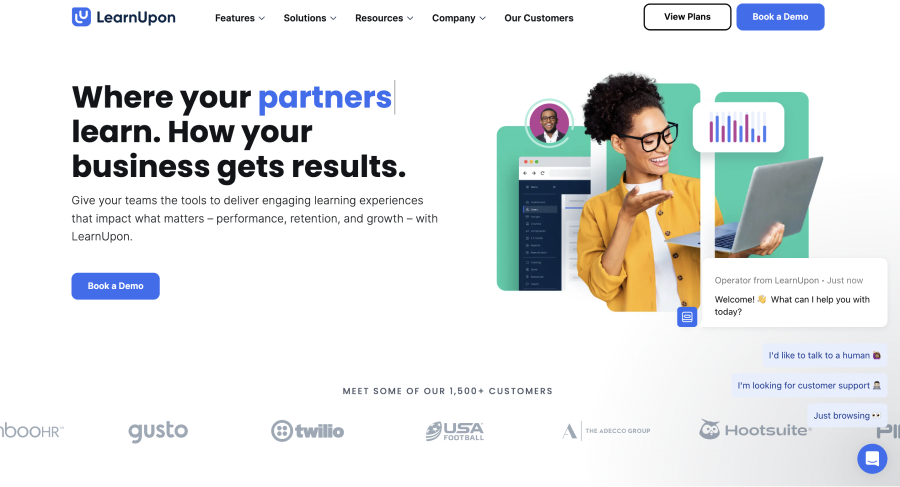
Standout strengths: multiple independent, branded portals from one back-end for training employees, customers, and partners at once; a consistently praised, easy-to-use interface with dedicated onboarding and 24/7 support; and broad integrations (CRM, API, Zapier) plus e-commerce, certifications, and live (ILT) learning.
Where it falls short: reporting is limited and not very customizable, learning paths are rigid and can't be edited once created, and some users hit integration friction with Microsoft and HR systems.
Pricing: quote-based annual contracts negotiated per active learner, with stated minimums (from 100 users for employee training, 300 for customer education); Capterra lists pricing from about $18,000/year. Exact per-tier prices aren't published.
Rating: 4.6/5 on G2 (~250 reviews), 4.7/5 on Capterra (~132 reviews).
Choose LearnUpon if you need to train several distinct audiences and value ease of use.
8. Cornerstone — best learning and talent suite
Cornerstone unifies learning with performance, succession, and recruiting plus an AI skills graph, for large organizations that want one platform for learning and talent.
Standout strengths: an AI-driven skills graph (Cornerstone Galaxy) that maps gaps and personalizes learning; a full unified talent suite spanning learning, performance, succession, and recruiting; and a large content library with deep reporting and configurability.
Where it falls short: cost is high and opaque (quote-only, plus heavy implementation and content fees), rollouts are long and resource-intensive, and the learner-facing interface is frequently described as dated.
Pricing: quote-based, sold as per-user-per-month modules on annual or multi-year enterprise contracts; third-party estimates put it around $4–$10/user/month plus significant implementation costs. Exact list prices aren't published.
Rating: 4.0/5 on G2 (~800 reviews), 4.3/5 on Capterra (~232 reviews).
Choose Cornerstone if you need an integrated learning and talent suite at enterprise scale.
How to choose the right Continu alternative
Match the platform to how your team actually learns:
- If you want engagement and collaboration: Teachfloor, cohort-based and social, self-paced or live, with transparent pricing.
- If you build training in-house: 360Learning for collaborative, expert-led authoring.
- If you want an AI-first enterprise suite: Docebo or Sana Labs.
- If you train employees and customers together: WorkRamp or LearnUpon, with portals for each audience.
- If you need learning plus talent management: Cornerstone, or Absorb for polish and e-commerce.
Where to go next
Comparing enterprise learning platforms? These guides and pages go deeper:
- Docebo alternatives
- 360Learning alternatives
- Best customer education platforms
- Corporate training platform
- Teachfloor's peer review
Frequently asked questions
What is the best Continu alternative?
It depends on your model. For collaborative, cohort-based training with peer learning and community, Teachfloor is the best Continu alternative, with transparent pricing from $89/month. For collaborative authoring, 360Learning leads, while Docebo and Sana Labs are strong AI-first enterprise options.
Why do companies switch from Continu?
Common reasons are its quote-based pricing with no public rates, customization that can require vendor support, occasional performance slowdowns, or wanting more engaging, cohort-based, collaborative learning than a content-routing platform offers.
Is there a cheaper alternative to Continu?
Yes. Teachfloor starts at $89/month with transparent pricing, far simpler to budget than Continu's enterprise quotes. 360Learning's Team plan is $8/user/month, while most enterprise alternatives (Docebo, Absorb, WorkRamp) are quote-based and comparable.
What is Continu best used for?
Continu is a modern workplace enablement platform for routing training to employees, partners, and customers, with automation and deep HRIS integrations (Workday, BambooHR, Okta) and an AI agent that delivers learning inside Slack and Teams.
Can I migrate from Continu to another platform?
Yes. Most platforms support importing course content, including SCORM. Teachfloor lets you bring content in and rebuild it as collaborative cohorts or keep it self-paced, then add community, peer review, and white-label branding.


