

Why Look for a Kritik Alternative?
Kritik built a strong reputation in higher education as an AI-powered peer assessment platform. Its scoring algorithms, calibration mechanisms, and structured review workflows gave instructors a way to scale feedback in large courses without drowning in grading. But several practical issues drive academic teams and training organizations to explore Kritik alternatives.
Pricing pressure for smaller programs. Kritik's per-student pricing model can strain budgets for departments with large enrollment but limited instructional technology funding. Programs running multiple sections of the same course across semesters see costs compound quickly, especially when the platform is used for only one or two assignments per term.
Rigid workflow structure. Kritik's peer review process follows a specific sequence: create, evaluate, provide feedback on evaluations. This structure works well for writing-intensive courses, but instructors teaching STEM, design, or project-based courses sometimes find the workflow too linear for their assessment needs. Adapting the platform to non-standard assignment types requires workarounds.
Student onboarding friction. Students unfamiliar with calibrated peer review often struggle with Kritik's evaluation criteria and scoring logic during the first few assignments. The learning curve is steeper than a simple rubric-based grading tool, and some instructors report spending significant class time explaining how the system works rather than focusing on course content.
Limited LMS integration depth. While Kritik connects to major LMS platforms, instructors sometimes report that grade passback, assignment syncing, and roster management require manual steps that create administrative overhead. For institutions deeply embedded in Canvas, Blackboard, or Moodle, this friction is noticeable.
Feedback quality inconsistency. Kritik uses AI to score the quality of peer evaluations, but the system does not always capture nuanced or discipline-specific feedback accurately. In subjects where qualitative judgment matters more than rubric compliance, the AI scoring layer can feel like a blunt instrument.
Narrow focus on peer review only. Kritik does peer assessment well, but it does not offer broader collaborative learning features like group projects, social annotation, discussion facilitation, or cohort management. Instructors who want a more complete participation toolkit often need to pair Kritik with additional tools.
These limitations are not dealbreakers for every program. Kritik remains a solid choice for writing-heavy courses with large enrollments. But if your assessment strategy requires more flexibility, deeper LMS integration, or a broader set of collaboration features, the alternatives below cover a wide range of approaches.
What to Look for in a Peer Assessment Platform
Selecting a Kritik alternative requires more than comparing feature checklists. The right tool depends on your course design, student population, institutional infrastructure, and how central peer feedback is to your learning outcomes.
Peer review workflow flexibility. Some platforms enforce a rigid review sequence. Others let you configure single-blind, double-blind, or open review with custom rubrics. If your courses span multiple disciplines, you need a tool that adapts its workflow to different assignment types rather than forcing every assessment into the same template.
Calibration and scoring transparency. Kritik's strength is its calibration system, where students' evaluation scores are weighted based on demonstrated reviewer accuracy. Look for alternatives that offer similar calibration mechanisms or at least provide clear rubric-based scoring so students understand how their feedback is evaluated. Transparency in scoring reduces student complaints and increases trust in formative assessment processes.
LMS integration depth. Grade passback, roster sync, and assignment creation should work natively within your LMS. Check for LTI 1.3 compliance, single sign-on support, and whether the integration requires manual configuration by your IT team. Shallow integrations create ongoing administrative work that defeats the purpose of adopting the tool.
Feedback quality mechanisms. The best peer assessment tools include structured feedback prompts, evaluation rubrics, and mechanisms that incentivize substantive comments over generic praise. Some use AI to evaluate feedback quality; others rely on instructor moderation or peer rating of reviews. The approach matters for maintaining academic integrity in the review process.
Scalability. If you teach sections of 200 or more students, the platform needs to handle assignment distribution, review matching, and grade aggregation without manual intervention. Test how the tool performs at your actual enrollment size, not just the demo environment.
Analytics and reporting. Instructors need visibility into participation rates, feedback quality trends, and individual student performance over time. Platforms with strong learning analytics help identify students who are disengaged or consistently producing low-quality reviews before it affects outcomes.
Broader learning features. Consider whether you need just peer review or a more complete participation toolkit. Some alternatives bundle peer assessment with discussion forums, social annotation, group projects, or active learning features that reduce the number of separate tools in your course stack.
10 Best Kritik Alternatives
The platforms below are active, paid Kritik competitors you can adopt today. Some focus narrowly on calibrated peer review. Others fold peer feedback into a larger set of learning tools. They are ranked to cover the full range of use cases, from writing-intensive courses to STEM grading to social reading. If you are migrating away from a discontinued tool rather than from Kritik itself, the Eduflow alternatives guide covers that scenario, since Eduflow and Peergrade were shut down for higher education after Multiverse acquired them.
| Tool | Peer Review | AI Scoring | LMS Integration | Starting price | Free trial | Best For |
|---|---|---|---|---|---|---|
| Teachfloor | Yes | Yes | Yes | $89/mo | 14-day | Engaging, interactive courses with community + AI |
| FeedbackFruits | Yes | Yes | Deep LTI 1.3 | Custom | Pilot only | Universities wanting modular peer review inside the LMS |
| Peerceptiv | Yes | Calibrated scoring | Canvas, Blackboard, Moodle | Per student (custom) | Pilot only | Writing courses using calibrated peer review at scale |
| Eli Review | Yes | No | LTI, Canvas | ~$19 per student/term | Demo | Writing courses focused on revision and feedback |
| PeerStudio | Yes | AI-assisted | LTI | Custom | Contact team | MOOCs needing rapid peer feedback loops |
| Turnitin Feedback Studio | Yes (PeerMark) | No | Canvas, Blackboard, Moodle | Institutional (custom) | Demo | Schools combining plagiarism checks with peer review |
| Crowdmark | No | No | Canvas, Blackboard, D2L | Free tier, then custom | Free tier | Collaborative instructor grading of handwritten work |
| Gradescope | No | Yes | Canvas, Blackboard, Sakai | Free tier, then custom | Free tier | STEM courses needing AI-assisted rubric grading |
| Perusall | Yes | Yes | Canvas, Blackboard, Moodle | Free (instructor content) | Free | Courses using social annotation for reading |
| Packback | No | Yes | Canvas, Blackboard, Moodle | ~$30-45 per student | Pilot | AI-moderated student inquiry and discussion |
Teachfloor

Overview
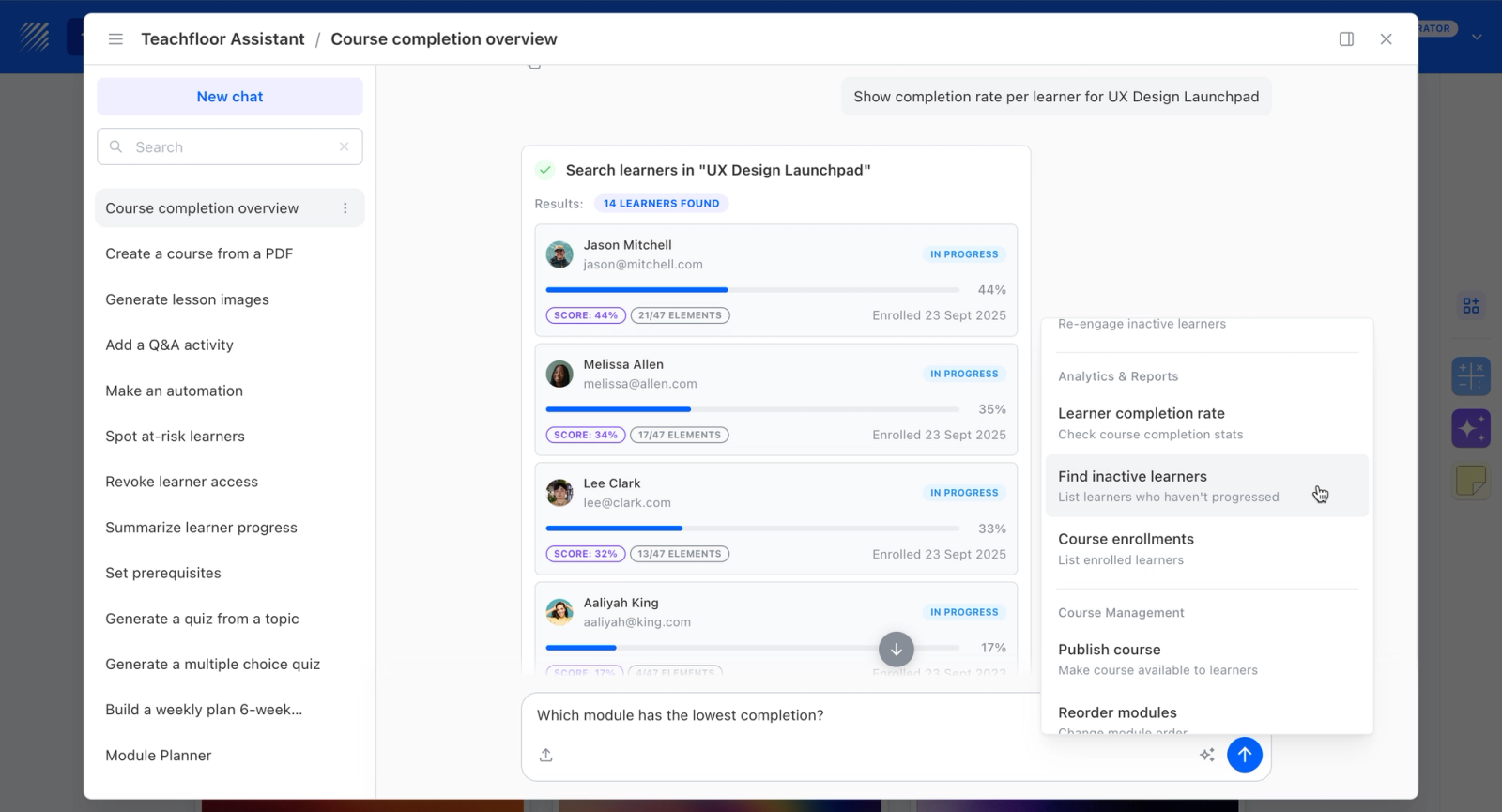
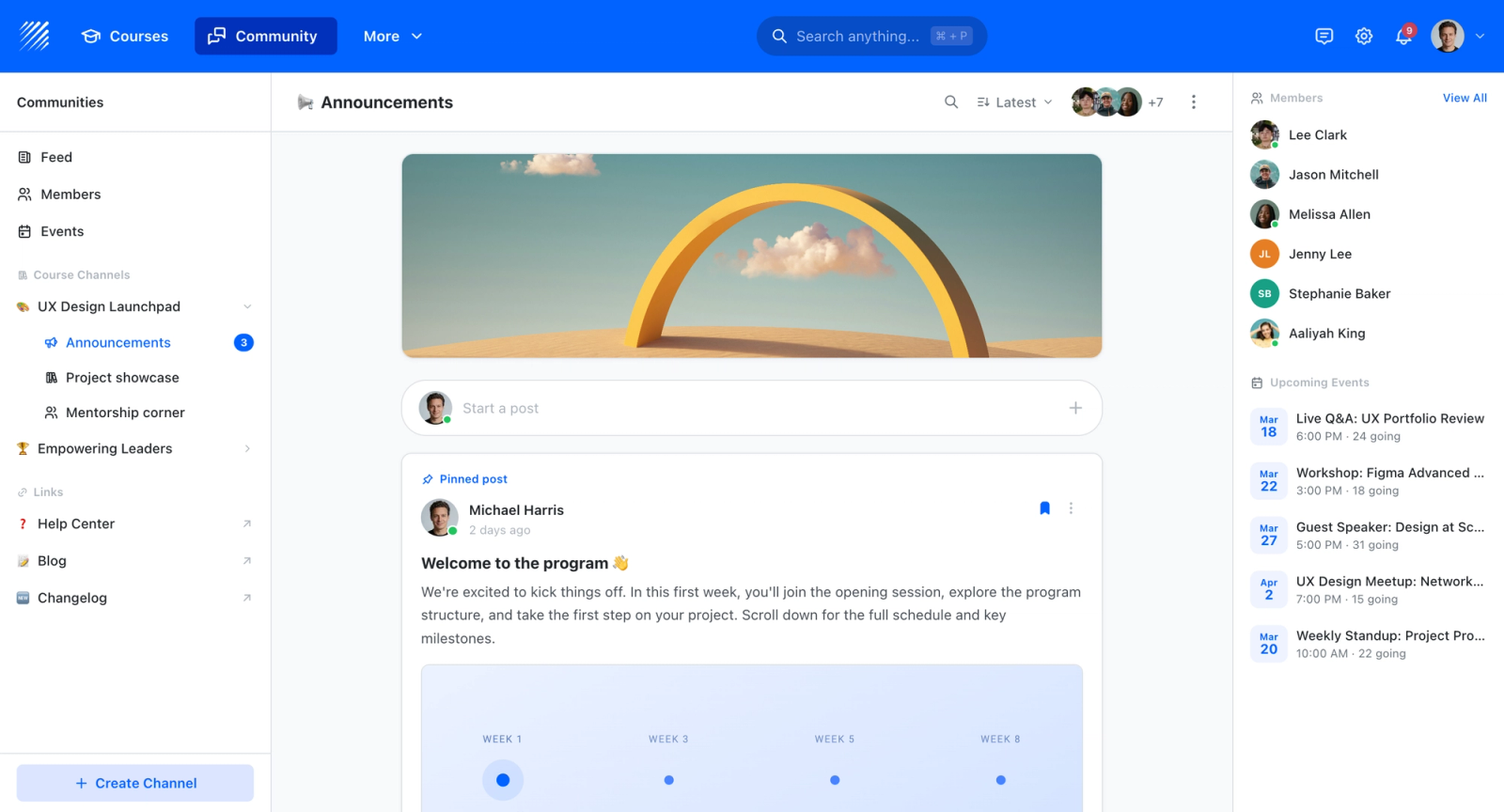
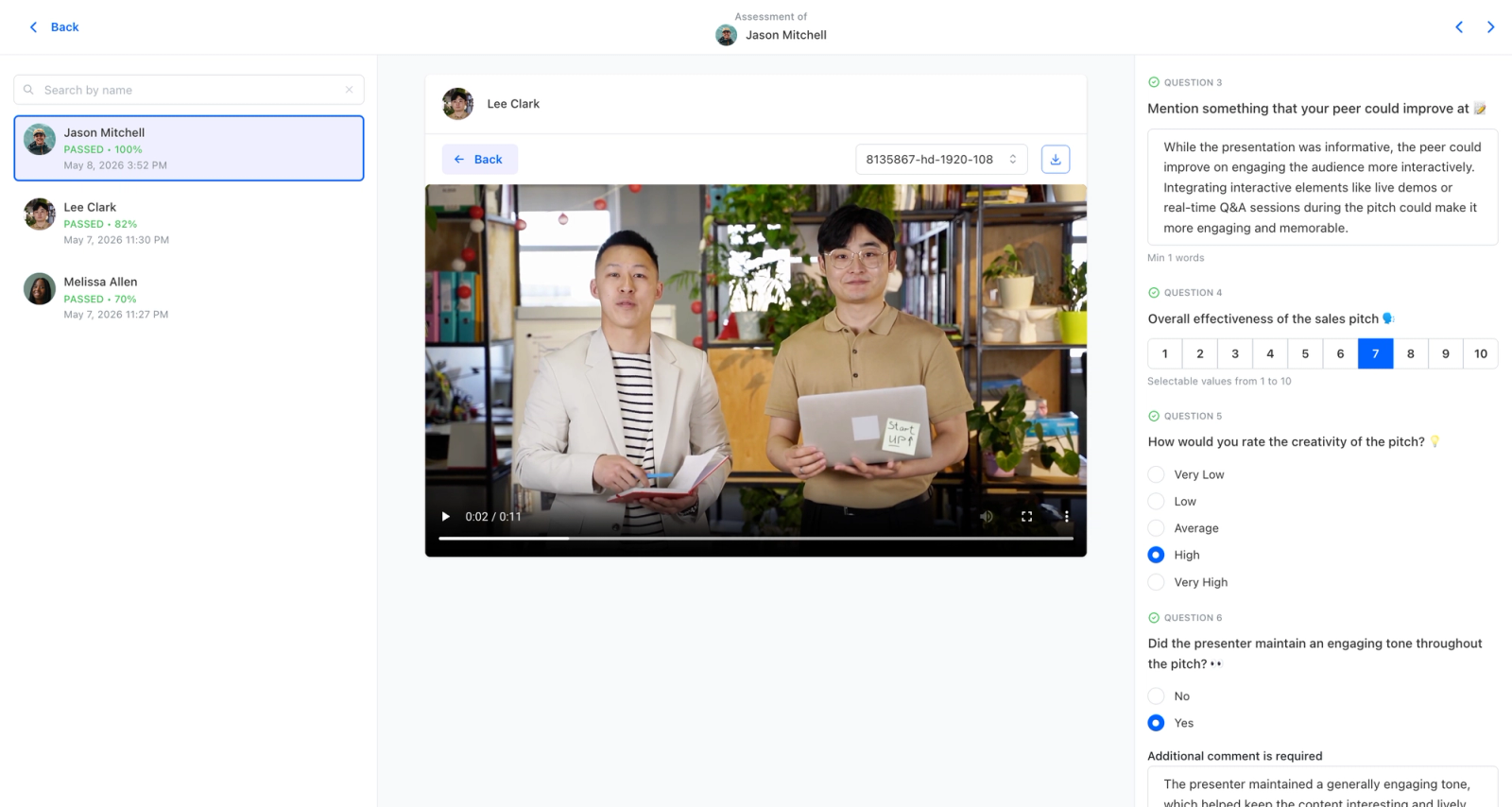
Teachfloor brings peer assessment out of the higher-ed silo and into any learning program, with a rubric-driven peer-review engine that you control end to end. Like Kritik, it lets students evaluate each other's work against defined criteria, but the reviews are weighted directly into grades and can run anonymously or named depending on the assignment. Where Kritik prices per student and centers on the academic classroom, Teachfloor sits inside a full course platform, so peer review lives alongside your content, discussions, and certificates rather than as a bolt-on. That makes it a fit for training teams and bootcamps that want Kritik's review mechanics without the per-seat academic billing.
Core Capabilities
- Rubric-driven peer-review engine where you set the criteria, the number of reviewers per submission, and whether reviews stay anonymous or are attributed
- Peer scores weighted into the final grade, so review quality becomes part of assessment rather than an optional exercise
- Built-in community and threaded discussion, so feedback continues beyond the formal review window
- Self-paced, live, or cohort delivery, letting you run review cycles on a fixed schedule or open-ended
- White-label on your own domain with multi-branch workspaces for separating programs or client groups
- Completion analytics and certificates to track who finished and reviewed against expectations
Best For
Training organizations and bootcamps that want Kritik's structured peer-evaluation model inside a full course platform rather than a standalone academic tool, and want flat program pricing instead of per-student fees.
Pricing Overview
- Startup plan from $89 per month for up to 50 learners
- Full Features plan with custom pricing, white-label, SSO, and advanced integrations
- 14-day free trial; no permanent free plan
- Nonprofit discounts available
Limitations
- After the 14-day trial ends, you must move to a paid plan; there is no ongoing free tier
- Lacks Kritik's gamified Kritik Score and the calibration-heavy academic research framing some universities expect
- Built for course programs, so it is heavier than a tool you would adopt only for one-off peer-review assignments
Quick Comparison Insight
Against Kritik, Peerceptiv, and Eli Review, Teachfloor trades the single-purpose academic peer-review focus for a full platform where review is one part of a larger course; pick it when you need rubric-based reviews woven into delivery, grading, and community rather than a standalone assessment app.
FeedbackFruits

Overview
FeedbackFruits is a modular suite of peer learning tools designed to integrate directly into existing LMS environments. Rather than operating as a standalone platform, FeedbackFruits lives inside Canvas, Blackboard, Moodle, or Brightspace as a set of LTI-based activities. This architecture means students never leave the LMS, and instructors configure peer review assignments the same way they set up any other course activity.
What stands out about FeedbackFruits is its breadth. It is not just a peer review tool. The suite includes separate modules for peer assessment, group member evaluation, interactive documents, automated feedback, and self-assessment. Each module can be deployed independently, so instructors pick the components that fit their instructional design rather than adopting an all-or-nothing platform.
Core Capabilities
- Peer review module with configurable single-blind, double-blind, and open review workflows
- Group member evaluation for assessing individual contributions within team projects
- Interactive document annotation where students comment on specific sections of uploaded files
- AI-powered feedback quality analysis that flags superficial or low-effort reviews
- Self-assessment tools that prompt students to evaluate their own work against rubric criteria
- Deep LTI 1.3 integration with Canvas, Blackboard, Moodle, D2L Brightspace, and other LMS platforms
- Automated grade passback to the LMS gradebook without manual export
- Customizable rubrics with both quantitative scales and qualitative comment prompts
- Analytics dashboard showing participation rates, feedback quality distributions, and individual reviewer performance
- Multi-language support for international student populations
Standout Strength
FeedbackFruits integrates into the LMS workflow rather than pulling students to a separate platform. The modular architecture means a biology instructor can use just the peer review component while an MBA program uses group member evaluation and self-assessment. This flexibility, combined with AI feedback quality scoring, makes FeedbackFruits a practical fit for universities that want peer assessment capabilities embedded inside their existing LMS rather than deployed as a separate platform.
Best For
Mid-to-large universities and higher education institutions that use Canvas, Blackboard, or Moodle as their primary LMS and want peer assessment tools that live natively inside that environment. Particularly strong for institutions deploying peer review across multiple departments with varying needs. Programs focused on student engagement through structured feedback benefit from the suite's modular approach.
Pricing Overview
- Institutional licensing model based on enrollment size
- Modular pricing: institutions can license individual tools rather than the full suite
- Pilot programs available for evaluation
- No per-student or per-assignment charges under institutional licenses
Limitations
- The platform requires LMS integration to function; it does not operate as a standalone tool, which limits options for programs not on a supported LMS
- Calibration features exist but are less mature than Kritik's proprietary scoring algorithm for weighting reviewer accuracy
- Setup and configuration require coordination with institutional LMS administrators, which can slow initial deployment
Quick Comparison Insight
Broader feature set than Kritik with stronger LMS integration, but less specialized in calibrated scoring. Better for institutions that want a full peer learning toolkit rather than a single-purpose peer review engine.
Peerceptiv
Overview
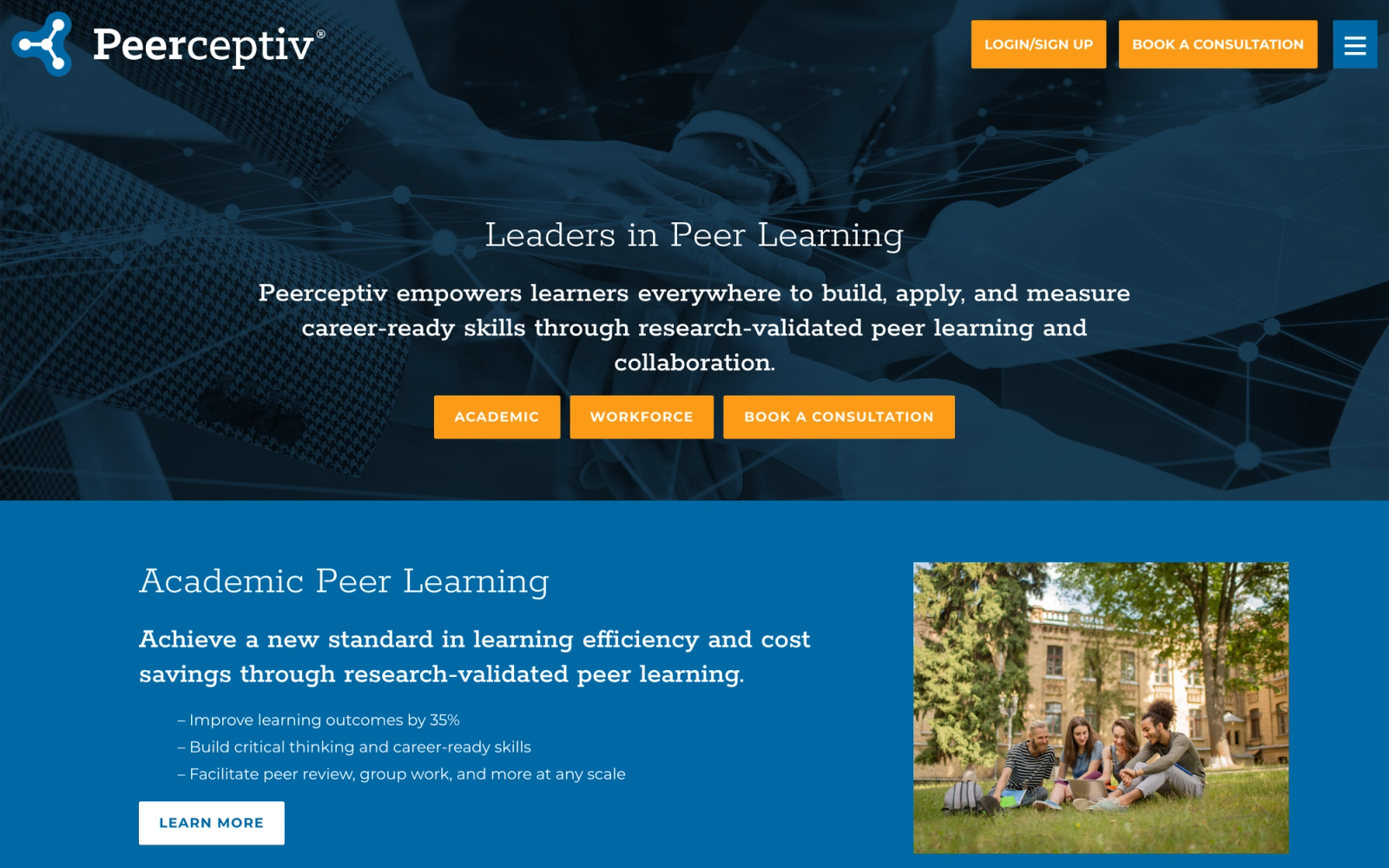
Peerceptiv is a calibrated peer review platform developed out of research at the University of Pittsburgh. Its approach is rooted in writing pedagogy: students submit drafts, review peers' work using structured rubrics, and receive calibrated scores based on how well their evaluations align with expert benchmarks. This calibration layer is the closest direct analogue to Kritik's scoring model.
Peerceptiv's defining trait is its emphasis on reviewer reliability. The platform uses a statistical model to weight each peer evaluation based on how closely that reviewer's judgments match instructor benchmarks over time. Students whose reviews consistently align with expert scoring carry more influence in the final grade than students who evaluate erratically. For writing-intensive courses where the variance in student feedback quality is high, this produces more defensible aggregate scores than treating every peer review as equally valid.
Core Capabilities
- Calibrated peer review with statistical weighting of reviewer accuracy against instructor benchmarks
- Multi-draft workflows that support revision cycles (submit, review, revise, re-review)
- Structured rubrics with both holistic and criterion-level scoring
- Back-evaluation where students rate the helpfulness of feedback they received
- Instructor calibration essays that train students on evaluation standards before live assignments
- LTI integration with Canvas, Blackboard, and Moodle for grade passback and roster sync
- Writing analytics that track improvement across multiple submissions within a course
- Anonymized peer matching with configurable review group sizes
- Instructor override capabilities for adjusting scores when calibration produces outliers
- Exportable reports for accreditation documentation and program assessment
Standout Strength
In large writing courses where instructors cannot grade every paper individually, the statistical weighting ensures that a student's grade reflects the consensus of their most reliable reviewers rather than a random sample of whoever was assigned. Research comparing calibrated peer grades to instructor grades shows tighter correlation than raw peer averages, which is the practical argument for using a calibration layer at all, particularly in online and hybrid courses where instructor contact time is limited.
Best For
Writing-intensive courses in English composition, communications, business writing, and social sciences at universities with enrollments of 100 or more students per section. Programs that use multiple drafts and revision cycles will extract the most value from Peerceptiv's multi-stage workflow. Not ideal for STEM courses with problem-set grading or courses where peer review is a minor component rather than a central assessment method.
Pricing Overview
- Per-student pricing based on course enrollment
- Volume discounts available for multi-department or institution-wide adoption
- Pilot programs available for qualifying institutions
- No additional per-assignment charges
Limitations
- Heavily oriented toward writing courses; instructors in STEM or design disciplines find the workflow less adaptable
- The calibration training phase requires upfront instructor effort to create benchmark essays and scoring standards
- Interface design feels functional rather than modern, which can affect student perception
Quick Comparison Insight
The closest alternative to Kritik's calibrated scoring model, with stronger writing pedagogy features. Less flexible for non-writing disciplines, but more research-validated for composition and communication courses.
Eli Review
Overview
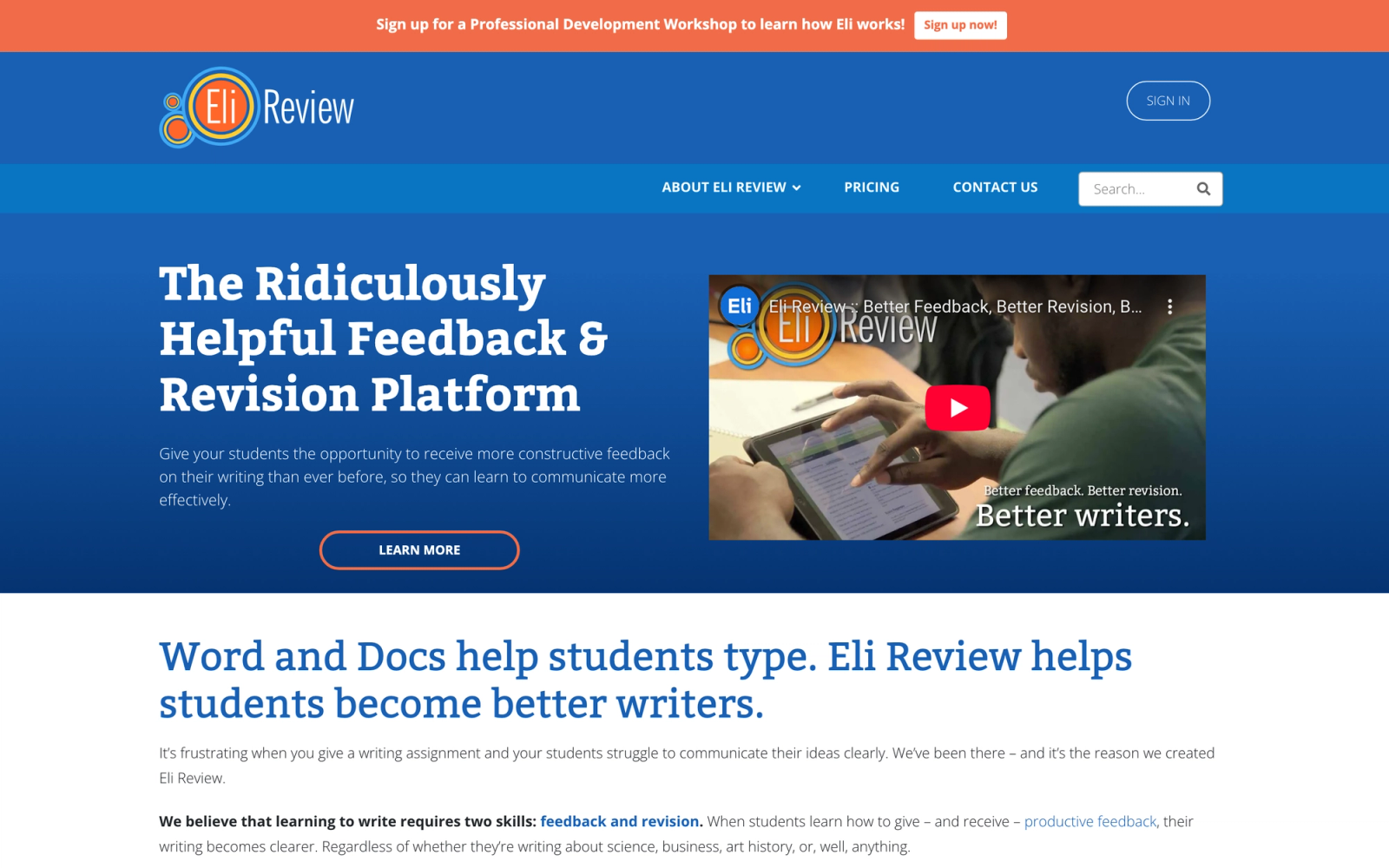
Eli Review is an active peer review and feedback platform built specifically for writing instruction, with more than 500,000 students having used it across composition, communication, and writing-intensive courses. Where Kritik centers on calibrated scoring, Eli Review centers on the revision cycle: students give structured feedback, rate the helpfulness of feedback they receive, and revise their work based on the comments. It is a genuine, supported alternative for programs that previously relied on Peergrade, which was discontinued for higher education after Multiverse acquired it.
The platform's emphasis is on teaching students to give better feedback, not just to assign scores. Instructors create review tasks with targeted prompts, and the system surfaces which comments led to actual revisions, which makes feedback quality visible rather than assumed.
Core Capabilities
Structured peer review tasks with criterion-based prompts and comment libraries
Revision plans that turn received feedback into concrete next steps for students
Helpfulness ratings where students evaluate the quality of feedback they receive
Instructor analytics on participation, comment quality, and revision activity
Multi-round review cycles that support draft, review, and revise workflows
LTI and Canvas integration for roster sync and access
Markup and inline commenting on student writing
Endorsement tools that let instructors highlight strong feedback as models
Standout Strength
Eli Review is built around the idea that feedback only matters if it changes the work. The platform tracks which comments students acted on, so instructors can coach better reviewing rather than just collecting scores. For writing programs that care about the revision process, this focus is more useful than a numerical calibration layer.
Best For
Composition, professional writing, and communication courses where the goal is teaching students to give and use feedback. Strong for programs that previously used Peergrade and need an active replacement with a similar, flexible, writing-focused approach. Less suited to STEM problem-set grading or courses that need automated calibrated scoring.
Pricing Overview
Student term subscriptions in the range of roughly $19 to $25 per student
Institutional licenses that provide access at no direct cost to students
Bookstore access codes for student purchase
Demo and trial access available for instructors
Limitations
No calibrated scoring algorithm; the focus is feedback quality and revision, not weighted grades
Oriented toward writing; less adaptable for design, STEM, or multimedia submissions
Interface is functional and writing-centric rather than broadly multi-format
Quick Comparison Insight
A focused, active alternative to Kritik for writing courses, and the most direct replacement for the discontinued Peergrade. Stronger on revision pedagogy, weaker on automated scoring accuracy.
PeerStudio
Overview
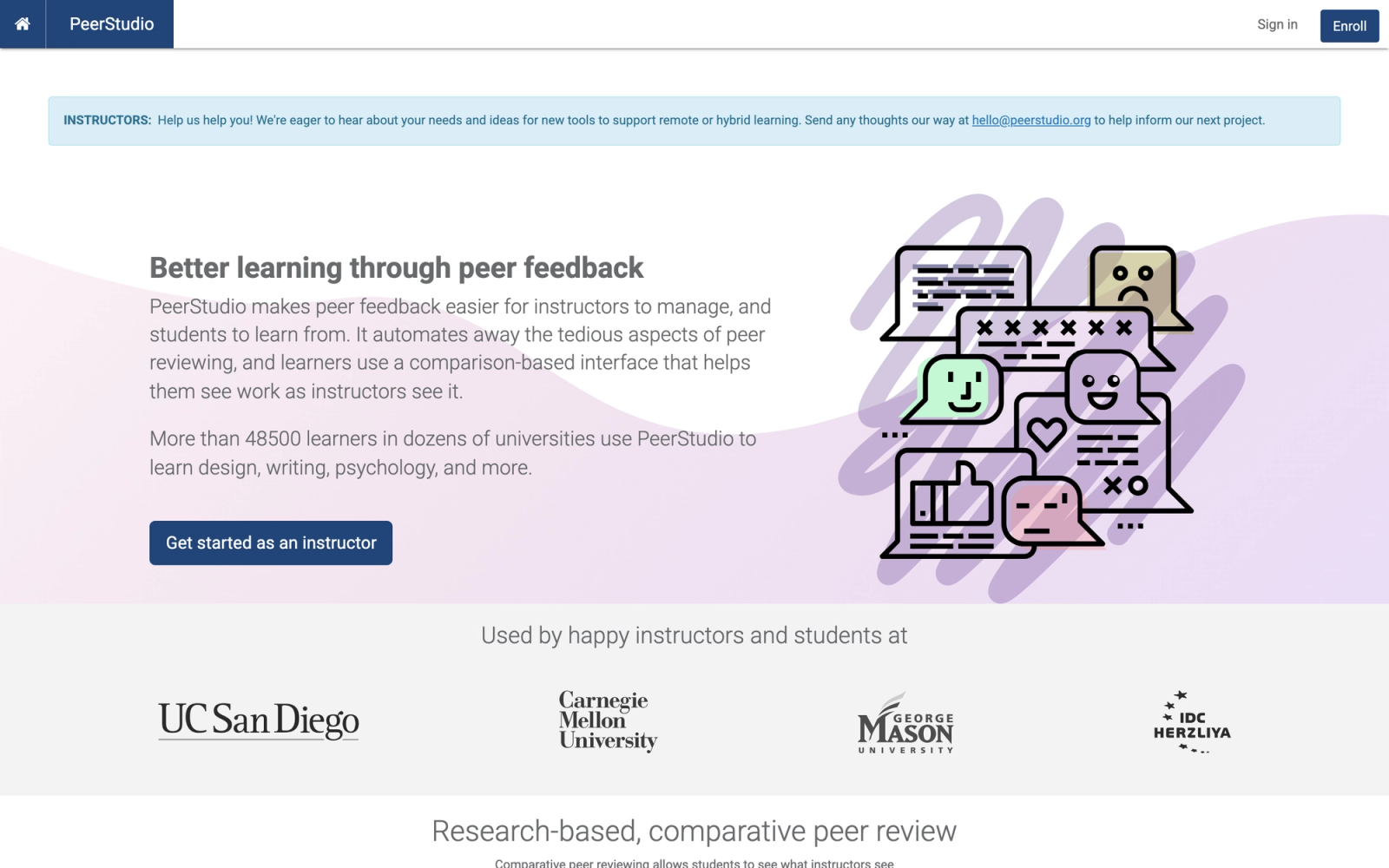
PeerStudio was built to solve a specific problem: providing rapid peer feedback in massive courses where turnaround time matters as much as feedback quality. Developed out of Stanford's HCI research group, PeerStudio uses a real-time matching system that pairs students for review as soon as submissions come in, rather than waiting for all students to submit before assigning reviewers. This dramatically reduces the feedback cycle from days to hours.
The speed-first philosophy produces a different tradeoff than Kritik's calibration model. In courses where students iterate across multiple drafts, getting feedback within hours lets students revise while the assignment is still in progress rather than after attention has moved to the next task.
Core Capabilities
- Real-time peer matching that assigns reviewers immediately as submissions arrive
- Rapid feedback cycles designed to return reviews within hours, not days
- Rubric-based evaluation with structured prompts for actionable feedback
- Support for iterative draft-review-revise workflows across multiple rounds
- AI-assisted feedback analysis that identifies patterns in peer comments
- Designed for courses with hundreds or thousands of students (MOOC-scale)
- LTI integration for embedding into LMS environments
- Dashboard showing feedback turnaround times and review completion rates
- Configurable review group sizes and anonymity settings
- Research-backed design informed by learning science studies on feedback timing
Standout Strength
PeerStudio solves the timing problem that plagues most peer review tools. In a traditional setup, students submit by a deadline, then wait for everyone else to submit, then wait for reviews to be assigned and completed, a cycle that can stretch across a week or more. PeerStudio collapses that timeline by matching reviewers as submissions arrive. For instructors who believe that feedback is most useful when it arrives while students are still working, this turnaround speed is the primary reason to choose it over a calibration-focused platform.
Best For
Large-enrollment courses, MOOCs, and multi-section programs where feedback turnaround speed is critical. Strong for courses that use iterative drafting processes and want students to revise based on peer input before a final submission. Less suited for courses where calibrated scoring accuracy matters more than feedback speed, or where enrollment is small enough that the instructor can provide timely feedback directly.
Pricing Overview
- Research-oriented tool with institutional licensing arrangements
- Pricing varies based on deployment context and scale
- Contact the development team for current availability and terms
Limitations
- Does not offer calibrated scoring; feedback speed is prioritized over reviewer reliability weighting
- Originally built for research contexts and may lack the polish of commercial peer review platforms
- Smaller support infrastructure compared to tools backed by larger EdTech companies
Quick Comparison Insight
Faster feedback cycles than Kritik, but without calibrated scoring. Designed for speed and scale rather than grading precision. Strongest when rapid iteration matters more than score reliability.
Turnitin Feedback Studio
Overview
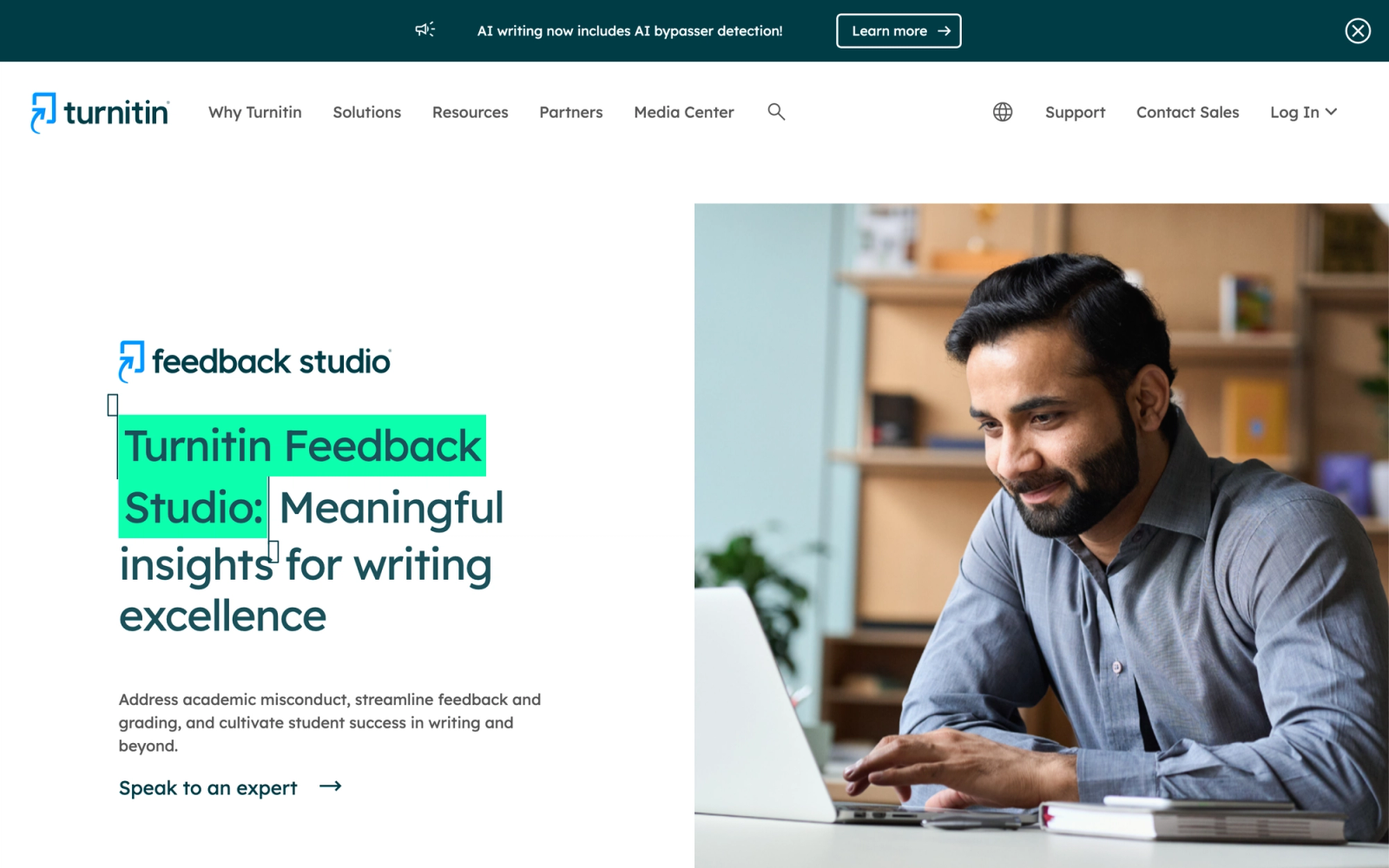
Turnitin Feedback Studio is best known for plagiarism detection, but the platform includes a complete feedback and grading toolkit that extends well beyond originality checking. The peer review component, PeerMark, lets instructors set up structured peer feedback assignments where students review and comment on each other's work within the same environment used for originality reports and instructor grading.
What makes Turnitin relevant as a Kritik alternative is the integration between plagiarism checking and peer assessment. Students submit a paper, receive an originality score, then participate in peer review, all within a single workflow. For institutions already paying for Turnitin, adding peer review does not require adopting a separate tool or managing another vendor relationship.
Core Capabilities
- PeerMark peer review module with structured question prompts and rubric-based evaluation
- Originality checking against a database of academic papers, web content, and student submissions
- QuickMark comment library for reusable feedback annotations
- Rubric and grading form builder with criterion-level scoring and qualitative comments
- GradeMark inline annotation for marking up student submissions directly
- Deep LMS integration with Canvas, Blackboard, Moodle, D2L Brightspace, and Schoology
- Grade passback and assignment syncing through LTI
- Similarity reports with source matching and exclusion controls
- Draft Coach add-on for Google Docs that provides real-time writing feedback
- Institutional analytics on submission patterns, originality trends, and grading consistency
Standout Strength
Schools that already use Turnitin for plagiarism detection can activate PeerMark without deploying a new platform. The unified submission pipeline means a student's paper is checked for originality and routed through peer review in one place. For programs where academic integrity and peer assessment are both priorities, this consolidation eliminates the tool sprawl that comes from running Kritik alongside Turnitin separately.
Best For
Universities and colleges that already have institutional Turnitin licenses and want to add peer review without adopting a separate platform. Particularly effective in writing-intensive programs, composition courses, and graduate seminars where both originality verification and peer feedback are standard practices. Institutions that value a unified grading workflow over specialized peer review features.
Pricing Overview
- Institutional licensing as part of Turnitin's broader product suite
- PeerMark is typically included or available as an add-on to existing Turnitin subscriptions
- Pricing negotiated at the institutional level based on enrollment
- Contact Turnitin for current pricing and bundling options
Limitations
- PeerMark's peer review capabilities are less sophisticated than dedicated platforms like Kritik or Peerceptiv; no calibrated scoring or reviewer reliability weighting
- The interface is designed primarily for plagiarism checking, and the peer review module can feel secondary
- Turnitin's institutional pricing is significant, and adding it solely for peer review is not cost-effective if you do not need originality checking
Quick Comparison Insight
Best as a Kritik alternative when you already use Turnitin and want consolidated workflows. Weaker as a standalone peer review tool; PeerMark's feedback mechanisms are less developed than purpose-built alternatives.
Crowdmark

Overview
Crowdmark takes a different angle on collaborative assessment. Rather than focusing on peer-to-peer student review, Crowdmark is designed for collaborative instructor grading. The platform lets multiple graders work on the same set of assessments simultaneously, each handling specific questions or rubric criteria. Students upload handwritten or typed submissions, and the grading team annotates, scores, and provides feedback in a shared digital workspace.
Crowdmark is particularly relevant for courses where assessment involves handwritten work, multi-page exams, or problem sets that do not fit neatly into a rubric-based peer review format. While it is not a peer assessment tool, it addresses the same scaling pressure: how to return meaningful feedback to large student cohorts without overwhelming instructors or TAs.
Core Capabilities
- Collaborative grading workflow where multiple instructors or TAs grade different questions simultaneously
- Support for handwritten, typed, and multi-page submission formats through scan or photograph upload
- Inline annotation and commenting directly on student work
- Rubric-based grading with reusable comment libraries
- Automatic distribution of specific questions to designated graders for consistency
- Grade analytics showing score distributions, question-level performance, and grader consistency
- LMS integration with Canvas, Blackboard, and D2L Brightspace for grade export
- Exam booklet processing for digitizing and distributing physical exam papers
- Student feedback portal where students view annotated work and grader comments
- Flexible assessment types including assignments, quizzes, tests, and team evaluations
Standout Strength
Crowdmark shines in courses where the bottleneck is instructor grading time rather than peer feedback volume. A calculus course with 400 students and a team of eight TAs can use Crowdmark to divide the grading load by question, ensuring each TA grades the same question across all papers. This produces more consistent scores than having each TA grade complete papers independently. The platform also handles handwritten math, diagrams, and lab reports that peer review tools cannot process effectively.
Best For
STEM departments, mathematics courses, and any program where assessments involve handwritten problem-solving, diagrams, or multi-page exams. Strong for courses with grading teams (multiple TAs or co-instructors) that need to coordinate feedback. Also useful for programs that want to digitize and archive physical exam papers. Not designed for student peer review or peer learning workflows.
Pricing Overview
- Institutional licensing based on course or department size
- Free tier available for individual instructors with limited features
- Enterprise pricing for university-wide deployment
- Free trial and demo available
Limitations
- Not a peer assessment tool; students do not review each other's work through the platform
- Does not include AI-powered feedback quality scoring or calibrated review mechanisms
- LMS integration is functional but less deeply embedded than tools built specifically for LTI environments
Quick Comparison Insight
Addresses a different bottleneck than Kritik. Crowdmark scales instructor and TA grading capacity rather than distributing feedback work to students. Strongest in STEM departments and any course where handwritten work, multi-page submissions, or grading team coordination are the primary constraints.
Gradescope
Overview
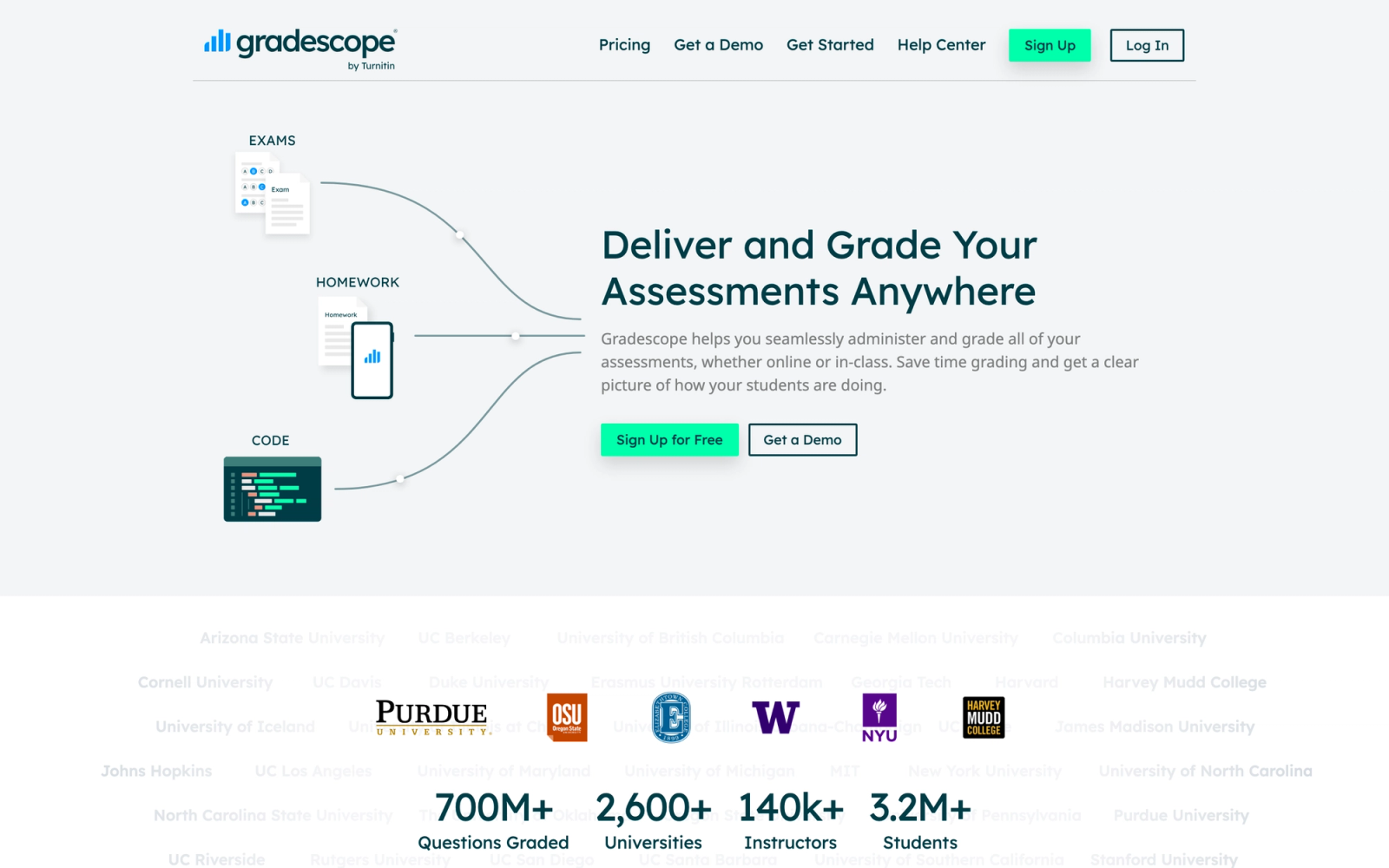
Gradescope is an AI-assisted grading platform now part of the Turnitin family. For a full breakdown of how it works, see the Gradescope explainer. Its core proposition is reducing the time instructors spend on repetitive grading tasks by using AI to group similar student responses, suggest rubric applications, and automate scoring for common answer patterns. While not a peer review tool, Gradescope directly addresses the same scaling problem that drives instructors to Kritik: handling assessment feedback in courses with large enrollments.
Gradescope's standout feature is its AI-assisted grouping. When grading a question, the platform clusters similar student answers together and lets the instructor grade one representative response, then apply that score and feedback to the entire cluster. For a 300-student exam with a question that produces 15 distinct answer patterns, this reduces grading from 300 individual reviews to 15 cluster evaluations.
Core Capabilities
- AI-assisted answer grouping that clusters similar student responses for batch grading
- Support for handwritten, typed, and code-based submissions through scan upload and online assignment
- Flexible rubric creation where rubric items are added and refined as grading progresses
- Programming assignment autograding with code execution, test case evaluation, and output comparison
- Bubble sheet and multiple-choice scanning for automated exam scoring
- Regrade request workflow where students can submit targeted appeals on specific questions
- LMS integration with Canvas, Blackboard, Sakai, and other platforms through LTI
- Grading analytics showing score distributions, time per question, and rubric item frequency
- Multi-grader support with question-level assignment for grading teams
- LaTeX rendering for math-heavy submissions and rubrics
Standout Strength
Gradescope's AI grouping is a genuine time-saver for STEM courses. Grading 300 calculus exams question-by-question is tedious. Grading 15 answer clusters is manageable. The platform also handles programming assignments with autograding, which makes it a well-rounded assessment tool for computer science departments. For instructors who want to reduce grading time without relying on students to provide the feedback, Gradescope offers an AI-assisted instructor grading path rather than a peer-to-peer path.
Best For
STEM departments, computer science programs, and any course with large enrollments and structured problem-set grading. Particularly strong for courses where answer patterns cluster naturally (math, physics, chemistry, introductory programming). Also valuable for courses using handwritten exams that need to be digitized and graded efficiently. Not designed for open-ended writing courses or programs where peer feedback is the pedagogical goal.
Pricing Overview
- Free tier (Gradescope Basic) for individual instructors with core features
- Institutional licensing (Gradescope Complete) with full AI-assisted features, LMS integration, and admin controls
- Part of the Turnitin product family; bundling options may be available for existing Turnitin customers
- Contact sales for institutional pricing
Limitations
- Not a peer review tool; all grading is done by instructors or TAs, not students
- AI grouping works best for structured answers with predictable patterns; less effective for essays or open-ended responses
- The platform is grading-focused rather than feedback-focused; the emphasis is on efficient scoring rather than developmental peer commentary
Quick Comparison Insight
Solves the grading scale problem through AI-assisted instructor workflow rather than peer review. Stronger than Kritik for STEM problem-set grading; not applicable for courses where the goal is student-to-student feedback and evaluation skill development.
Perusall
Overview
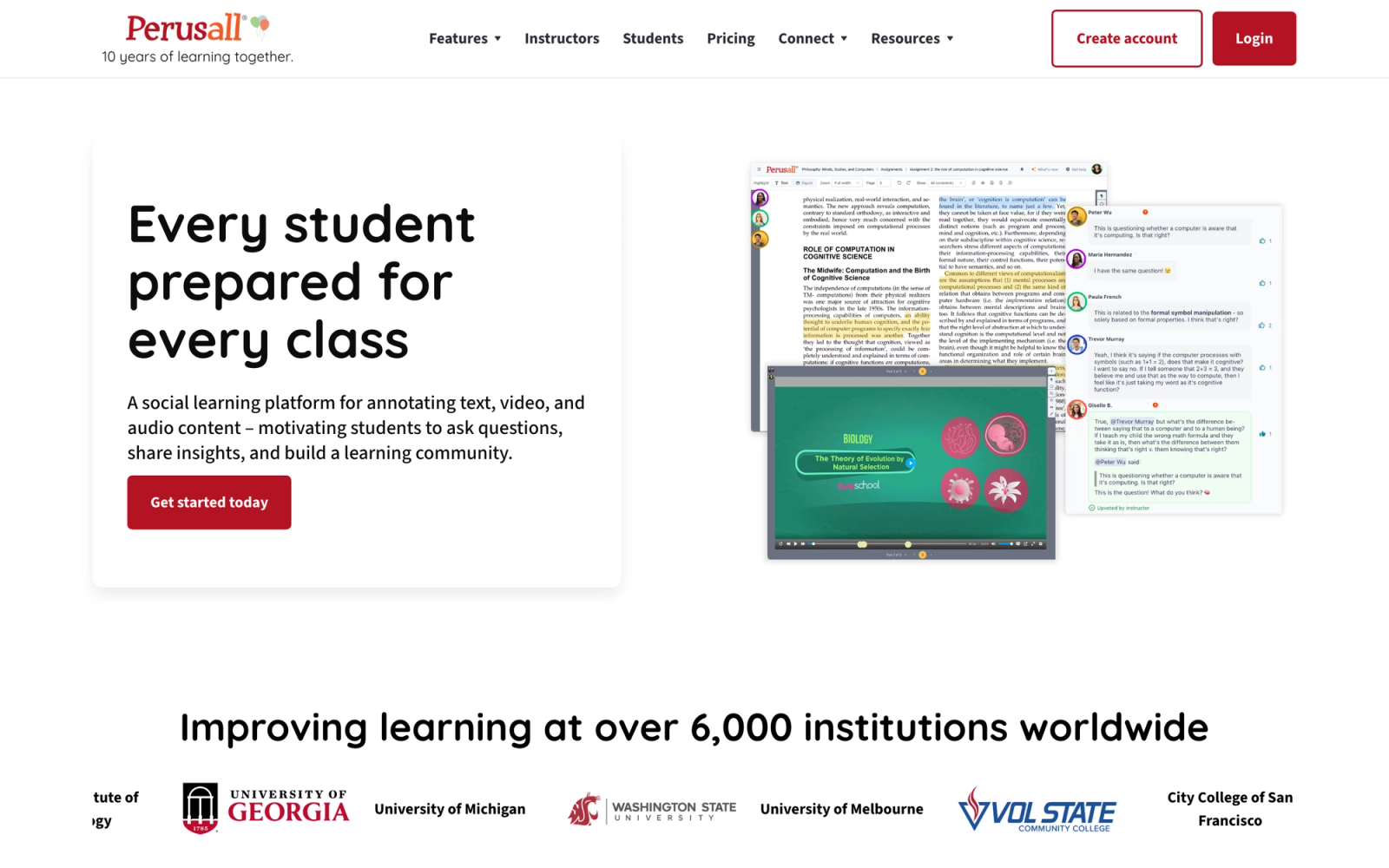
Perusall is a social annotation platform that turns reading assignments into collaborative, discussion-based activities. Students read assigned texts together, highlighting passages, posting questions, and responding to each other's annotations directly in the document. The platform uses AI to score the quality and engagement level of each student's annotations, generating participation grades automatically.
Perusall is not a traditional peer review tool, but it serves a related function: students engage critically with content and evaluate each other's interpretations in a structured format. For instructors who want to move beyond end-of-assignment peer review toward ongoing peer learning throughout the reading process, Perusall represents a fundamentally different model of collaborative assessment.
Core Capabilities
- Social annotation on PDFs, ePubs, web pages, and publisher-provided digital textbooks
- AI-generated participation scores based on annotation quality, quantity, timing, and engagement with peers' comments
- Confusion reports that surface passages where multiple students ask questions or express uncertainty
- Threaded discussions anchored to specific text locations within the document
- Upvoting and emoji reactions for student annotations
- Integration with publisher catalogs including Pearson, McGraw-Hill, and OpenStax
- LTI integration with Canvas, Blackboard, Moodle, D2L Brightspace, and Sakai
- Automatic grade passback to LMS gradebooks based on AI scoring
- Instructor analytics showing reading completion, annotation density, and student engagement patterns
- Support for multimedia content including video and audio annotation
Standout Strength
Perusall excels at making reading an active, collaborative process rather than a passive one. The AI scoring system incentivizes students to annotate thoughtfully and engage with peers' contributions. For instructors who spend class time reviewing readings that students did not actually do, Perusall provides both accountability and data. The confusion reports are particularly valuable for identifying which concepts need more class time before students even walk into the room.
Best For
Humanities, social sciences, law, and any discipline where reading assigned texts is a core course activity. Strong for flipped classroom models where students engage with material before class sessions. Programs prioritizing student engagement with assigned readings rather than just checking completion. Not suited for courses where peer review of original student work is the primary assessment need.
Pricing Overview
- Free for instructors using openly licensed or instructor-uploaded content
- Publisher textbook integrations may involve student purchase of digital access
- Institutional licensing available for campus-wide deployment
- No per-assignment or per-annotation charges
Limitations
- Focused on reading annotation rather than assessment of original student work; not a replacement for peer review of essays, projects, or presentations
- AI participation scoring can feel opaque to students who are unsure why their score was lower than expected
- Heavy annotation activity on popular passages can create cluttered reading experiences
Quick Comparison Insight
Different category than Kritik. Where Kritik structures peer review of completed assignments, Perusall structures peer engagement during the reading process. Complementary rather than competitive for many course designs.
Packback
Overview
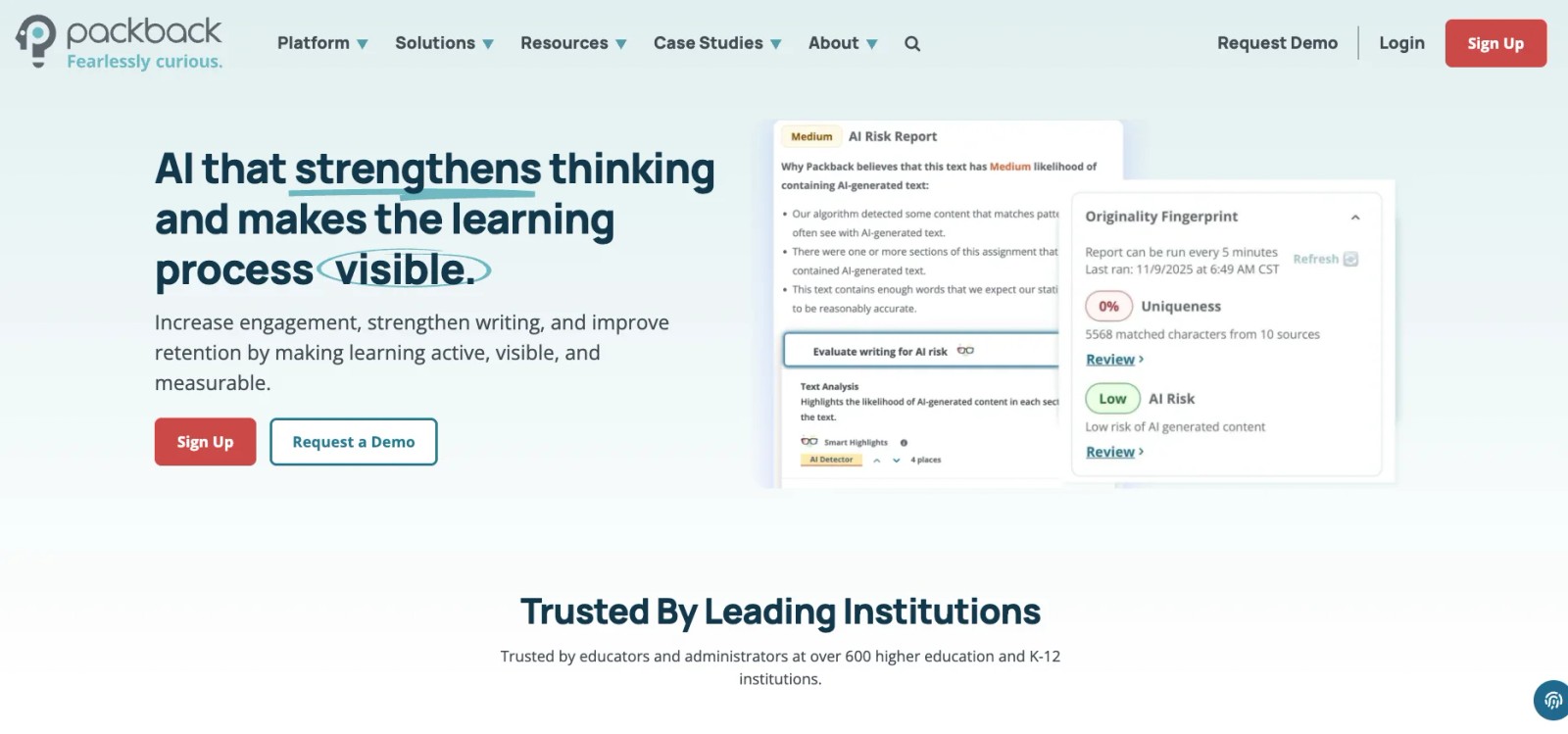
Packback is an AI-moderated discussion platform designed to improve the quality of student inquiry in online discussions. The platform uses natural language processing to evaluate each post for curiosity, depth, and constructiveness, providing real-time coaching nudges before students submit. This AI layer pushes students toward higher-order thinking rather than the superficial "I agree with your point" responses that plague standard discussion boards.
Packback is relevant as a Kritik alternative for instructors who care more about the quality of peer-to-peer intellectual exchange than formal rubric scoring. Its AI coaching and community moderation push students to challenge, build on, and respond to each other's ideas in ways that standard discussion boards do not enforce.
Core Capabilities
- AI-powered post evaluation that scores submissions for curiosity, depth, and constructiveness before publishing
- Real-time coaching prompts that guide students to improve weak posts before they go live
- Curiosity scoring algorithm that incentivizes question-driven inquiry over simple responses
- Instructor moderation dashboard with AI-flagged posts and participation analytics
- Community guidelines enforcement through automated content analysis
- LTI integration with Canvas, Blackboard, Moodle, and D2L Brightspace
- Automatic grade passback based on participation quality metrics
- Leaderboard and recognition features that apply gamification principles to discussion engagement
- Source citation prompts that encourage evidence-based argumentation
- Exportable participation reports for grade documentation and accreditation
Standout Strength
Packback's real-time AI coaching is its distinguishing feature. Instead of grading discussion posts after the fact, the platform intervenes before publication, nudging students to elaborate, cite sources, or rephrase superficial comments. This pre-submission loop produces measurably better discussion quality than post-hoc scoring. For courses where discussion is the primary assessment, that shift in timing changes what students actually write.
Best For
Undergraduate courses with required discussion components, particularly in humanities, social sciences, and general education. Strong for instructors who find traditional discussion boards produce low-quality posts and want AI assistance to raise expectations without adding to their own grading load. Programs focused on developing critical thinking, inquiry skills, and evidence-based argumentation. Less suited for formal peer review of completed assignments or structured rubric-based evaluation.
Pricing Overview
- Per-student fee typically charged as a course material cost
- Institutional pricing available for campus-wide deployment
- Pilot programs offered for qualifying institutions
- Student payment model similar to textbook access codes
Limitations
- Not a peer review tool; does not support rubric-based evaluation of submitted work
- The student-pay model creates equity concerns for programs with cost-sensitive student populations
- AI scoring of discussion quality, while improved, still struggles with discipline-specific nuances and unconventional argumentation styles
Quick Comparison Insight
Complements rather than replaces Kritik. Packback improves discussion quality through pre-submission AI coaching; Kritik structures formal rubric-based evaluation of completed assignments. Strongest for courses where the discussion itself is the primary graded activity.
How to Choose the Right Alternative
The right Kritik alternative depends on what you are actually trying to solve, not just which tool has the longest feature list.
If you want the closest match to Kritik's calibrated scoring model, Peerceptiv is the most direct analogue. Its statistical weighting of reviewer accuracy produces reliable aggregate scores in writing-intensive courses with large enrollments. The trade-off is a narrower focus on writing pedagogy.
If you want peer review embedded inside your LMS, FeedbackFruits is the strongest option. Its modular LTI architecture means students never leave Canvas, Blackboard, or Moodle, and instructors configure activities using familiar LMS tools. The suite's breadth, covering peer review, group evaluation, and self-assessment, reduces the need for multiple platforms.
If you already use Turnitin, activating PeerMark within Turnitin Feedback Studio avoids adding another vendor. The peer review features are less sophisticated than Kritik, but the consolidated workflow and existing institutional license make it a pragmatic choice.
If you teach STEM courses with problem-set grading, Gradescope and Crowdmark solve the scaling problem through AI-assisted and collaborative instructor grading rather than peer review. Neither involves student-to-student feedback, but they address the same time constraint that drives instructors to peer assessment.
If reading engagement is the priority, Perusall turns passive reading into active learning through social annotation. It complements rather than replaces a peer review tool, but for courses where reading discussion is the primary assessment, it may reduce the need for formal peer grading.
If discussion quality is the pain point, Packback's AI coaching raises the floor on student contributions without adding grading work. It does not replace rubric-based peer review, but it structures the kind of peer-to-peer intellectual exchange that discussion boards are supposed to produce.
If your focus is writing and revision, Eli Review structures peer feedback around the revision cycle and is the most direct active replacement for the discontinued Peergrade. It trades calibrated scoring for stronger revision pedagogy.
If you want peer review inside an engaging program rather than as an isolated grading step, Teachfloor is the most flexible option. It runs self-paced, social, live, or cohort-based formats in one place, with community, group projects, and AI course creation alongside peer feedback, which suits training teams, bootcamps, and education businesses that want collaboration to drive learning.
Start with the underlying constraint, not the feature list. If grading workload is the bottleneck, AI-assisted instructor tools like Gradescope may be more effective than adding peer review. If feedback quality is the problem, calibrated platforms like Peerceptiv or pre-submission coaching tools like Packback address that directly. If student disengagement is the pattern, collaborative models that make assessment social, through annotation, discussion, or cohort-based projects, change what the assessment experience feels like from the student side.
FAQ
How much does Kritik cost, and is there a cheaper alternative?
Kritik uses a student-pay model at roughly $29 per student per course, or an institution-pay license quoted by their team. If that per-student cost is the issue, several alternatives are more budget-friendly: Perusall and Gradescope Basic are free for individual instructors, Eli Review runs around $19 to $25 per student per term, and Teachfloor starts at $89 per month for a whole program rather than charging per student. For a wider view of pricing models, see the affordable LMS guide and the LMS pricing breakdown.
What replaced Peergrade and Eduflow?
Peergrade and Eduflow were acquired by Multiverse in 2023 and shut down for higher education, with FeedbackFruits and Kritik running the official migration. Active replacements include Eli Review for writing-focused peer review and FeedbackFruits for LMS-embedded review. If you are specifically migrating from those discontinued tools, the Eduflow alternatives guide walks through the options in detail.
What is the best free alternative to Kritik?
Several tools offer free access for individual instructors. Perusall is free when you use openly licensed or instructor-uploaded content, and Gradescope Basic provides free AI-assisted grading for individual instructors. For peer review specifically, Crowdmark offers a free tier with limited features. Peergrade, once a popular free option, was shut down for higher education after Multiverse acquired it, so it is no longer a viable choice. The best free option depends on whether you need peer review (Crowdmark), reading engagement (Perusall), or grading efficiency (Gradescope).
Can I use peer review tools in STEM courses?
Yes, but with caveats. Calibrated peer review tools like Peerceptiv are optimized for writing assignments and do not handle mathematical notation or code well. For STEM courses, Gradescope's AI-assisted grading and Crowdmark's collaborative grading handle problem sets and handwritten work more effectively. FeedbackFruits supports peer review across disciplines including STEM, though the rubric design needs to account for technical accuracy.
How do calibrated peer review tools work?
Calibrated peer review platforms train students on evaluation standards using instructor-graded benchmark submissions. Students then review peers' work, and the platform weights each reviewer's scores based on how closely their evaluations match the instructor benchmarks. Reviewers who consistently align with expert standards carry more weight in the final score. This produces aggregate scores that approximate instructor grading accuracy at scale.
Do peer assessment tools integrate with Canvas and Blackboard?
Most tools in this list integrate with major LMS platforms through LTI standards. FeedbackFruits, Peerceptiv, Turnitin Feedback Studio, Gradescope, and Perusall all offer direct integrations with Canvas, Blackboard, Moodle, and D2L Brightspace. Integration depth varies: some tools offer full grade passback and roster sync, while others require manual configuration. Test the specific integration with your LMS version before committing to an institutional license.
Is peer review effective for large courses?
Research consistently shows that structured peer review produces assessment outcomes comparable to instructor grading when calibration and rubric design are done carefully. Unstructured peer feedback, without training exercises, quality controls, or rubric frameworks, produces unreliable results. Platforms like Peerceptiv and FeedbackFruits include the structural elements that close that gap: calibration exercises, criterion-level rubrics, and feedback quality analysis that flag low-effort reviews before they affect grades.
What is the difference between peer review and collaborative grading?
Peer review involves students evaluating each other's work, developing both the reviewer's critical thinking skills and the author's understanding of their performance. Collaborative grading involves instructors and TAs dividing the grading workload across a team using tools like Crowdmark or Gradescope. Peer review is a learning activity; collaborative grading is a workload management strategy. Some programs benefit from both, using peer review for formative assessment and collaborative grading for summative exams.


