

Why Look for an Honorlock Alternative?
Honorlock is a popular AI-driven proctoring service that combines automated monitoring with on-demand live proctor intervention. Its Chrome extension model and cell phone detection feature make it a strong choice for many universities. But several recurring pain points push institutions and training organizations to explore Honorlock alternatives.
Chrome-only requirement limits student access. Honorlock works exclusively as a Chrome browser extension. Students who rely on Firefox, Safari, or institutional browsers with restricted extension policies cannot use it without switching their setup. For institutions with a wide mix of student devices or strict IT governance, this single-browser dependency creates unnecessary friction. Honorlock’s own minimum system requirements list Chrome 120+ as the only supported browser, with Firefox, Safari, and Edge unsupported.
Per-exam pricing scales unpredictably. Honorlock charges on a per-session basis. For programs with high exam frequency, such as nursing, accounting, or certification programs, costs compound quickly. Budget planning becomes difficult when the total spend depends on how many students take how many exams each semester.
AI false positives generate faculty review burden. Honorlock's AI monitoring flags behaviors like gaze deviation, background noise, and head movement. In home environments where students share spaces with family or roommates, false flags are common. Faculty then spend hours reviewing flagged sessions that turn out to be benign, which is the opposite of the time savings proctoring is supposed to deliver.
Student privacy concerns persist. Honorlock records webcam footage, audio, and screen activity. It also scans for secondary devices. Students and advocacy groups have raised concerns about the scope of data collection, particularly when recordings are stored by a third party. Institutions navigating FERPA, GDPR, or state-level privacy regulations need to weigh these trade-offs.
Limited configurability for low-stakes assessments. Some instructors want a lighter monitoring touch for quizzes and formative assessments but find Honorlock's monitoring settings offer less granularity than they need. Using the same proctoring intensity for a weekly quiz and a final exam creates unnecessary student anxiety on routine assignments.
Accessibility gaps for some learners. Students with certain disabilities report difficulties with Honorlock's ID verification process, room scanning requirements, and movement-tracking algorithms. Institutions committed to inclusive online assessment design sometimes find that the accommodations workflow is more rigid than expected.
These issues do not apply to every institution. Honorlock works well for many programs. But if your team is dealing with browser restrictions, budget unpredictability, or student pushback, the alternatives below cover a range of approaches from AI-only automation to collaborative assessment models.
What to Look for in an Online Proctoring Solution
Choosing a proctoring tool involves more than comparing feature lists. The right fit depends on your exam volume, student population, technical infrastructure, and how much monitoring intensity your program actually requires.
Proctoring model. Platforms range from fully automated AI monitoring to live human proctors watching in real time, with various hybrid approaches in between. Automated proctoring is cheaper and scales instantly but generates more false flags. Live proctoring is more accurate but introduces scheduling bottlenecks and higher per-session costs.
LMS integration depth. A proctoring tool that works natively inside your LMS eliminates context switching for instructors and students. Look for LTI-compliant integrations with Canvas, Blackboard, Moodle, or D2L Brightspace. The best LMS integrations let instructors enable proctoring directly from the assignment settings without leaving the platform.
Student experience. Every pre-exam step adds friction: software installation, webcam checks, room scans, ID verification. Tools that require extensive setup increase test anxiety and help desk tickets. Consider how your student population, especially remote learning students with varying hardware, will handle the onboarding process.
Privacy and data handling. Where does the proctoring data go? How long are recordings retained? Does the vendor comply with FERPA, GDPR, or CCPA? Institutions need answers to these questions before signing a contract, not after a student files a complaint.
Pricing model and total cost. Per-exam pricing works for low-volume programs but creates budget surprises at scale. Institutional or per-student licensing offers cost predictability. Run the math on your actual exam volume before comparing sticker prices. For a wider view of how learning tools price their tiers, compare LMS pricing models and affordable LMS options before committing to a per-exam contract.
Accessibility compliance. Proctoring tools must accommodate students with documented disabilities. Check for VPAT documentation, screen reader compatibility, extended time settings, and configurable environment rules. A tool that penalizes students for atypical movement patterns defeats the purpose of accessible assessment.
Flagging accuracy and review workflow. AI proctoring generates incident flags that instructors must review. What matters is the false-positive rate and how efficiently the review dashboard surfaces genuine concerns. A tool that flags every ambient sound or slight head turn creates more administrative work than it saves.
The 9 Best Honorlock Alternatives and Competitors
The platforms below cover the full range of assessment approaches institutions move to when they leave Honorlock: fully automated AI, live human proctors, browser lockdown, hybrid models, and collaborative or applied assessment. Each one answers a specific Honorlock switching trigger, from the Chrome-only browser limit to per-exam cost and false-positive fatigue. The comparison table shows starting price and free trial at a glance, and the write-ups go deeper on fit.
| Tool | Approach | Starting price | Free trial | Best for |
|---|---|---|---|---|
| Proctorio | Automated AI proctoring | Custom (institutional) | Pilot | Large institutions needing scalable AI proctoring at a flat rate |
| ExamSoft (Examplify) | Device lockdown + psychometrics | Custom | Demo | Law, medical, nursing programs needing secure exams plus analytics |
| ProctorU (Meazure Learning) | Live + AI hybrid | Per-exam | Pilot | High-stakes exams needing continuous live human oversight |
| Respondus LockDown Browser | Browser lockdown + optional monitor | ~$2,795/yr (campus) | Trial | Budget-conscious institutions needing baseline lockdown |
| Proctortrack | AI + post-exam review | Per-exam | Pilot | Mid-size universities wanting identity assurance and post-exam review |
| Safe Exam Browser | Open-source browser lockdown | Free (MPL 1.1) | Free | Privacy-first and zero-budget device lockdown |
| Examity (Meazure Learning) | Tiered AI-to-live proctoring | Per-exam | Pilot | Institutions mixing high- and low-stakes exams in one vendor |
| Mercer Mettl | Assessment authoring + proctoring | Custom | Trial | Corporate recruitment and certification testing |
| Talview | Behavioral AI + interviews | Custom | Demo | Recruitment and education teams needing proctoring plus interviews |
Proctorio
Overview
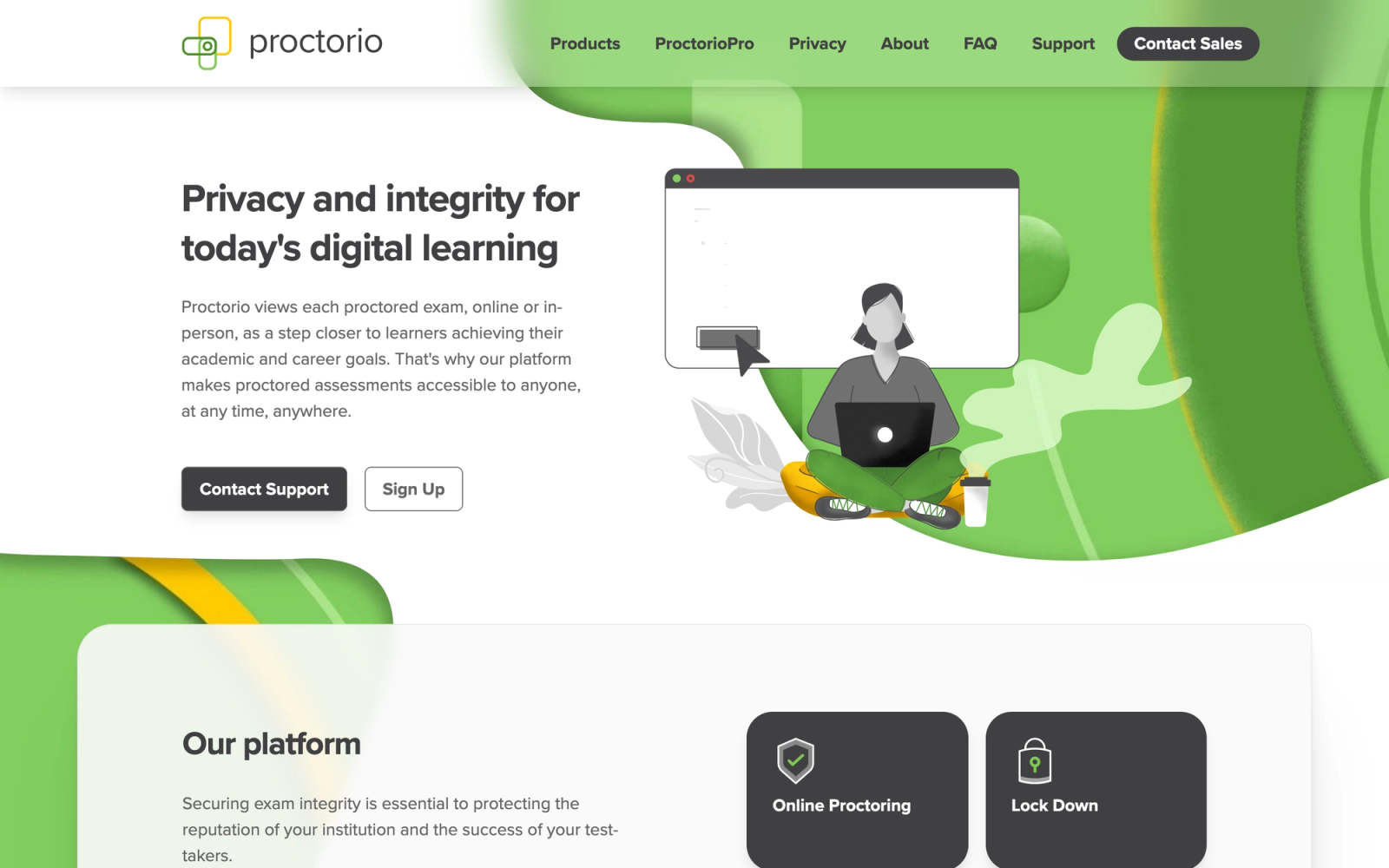
Proctorio is a fully automated proctoring platform that runs entirely through a browser extension. There are no live human proctors involved at any point. The system uses AI to monitor webcam feeds, microphone input, browser activity, and system processes during an exam, then generates a report with flagged incidents for instructor review.
The core advantage over Honorlock is scalability without scheduling constraints. Because Proctorio eliminates the human proctor entirely, it can handle tens of thousands of simultaneous exam sessions without queues or wait times. The instructor review interface is well organized. Flagged moments are timestamped and categorized by type (gaze deviation, audio anomaly, new browser tab), which makes post-exam review faster than scrubbing through full recordings.
Core Capabilities
- Fully automated AI proctoring with no live proctor involvement at any stage
- Chrome and Edge browser extension with no standalone software installation required
- Configurable exam settings allowing instructors to choose which monitoring features to enable (webcam, microphone, screen recording, browser lockdown)
- Behavior analytics dashboard with incident flags, severity ratings, and timestamp links to video evidence
- Deep LMS integration with Canvas, Moodle, Blackboard, D2L Brightspace, and Sakai
- Zero-knowledge encryption architecture where Proctorio cannot access exam content or recordings
- Originality verification tools for written-response exams
- Instructor-controlled lockdown settings (disable printing, copy-paste, external URLs, right-click)
- Automated ID verification using facial recognition matching
- FERPA, GDPR, and CCPA compliance with data stored in the institution's preferred region
Standout Strength
Proctorio runs at unlimited scale on a flat institutional rate. Unlike Honorlock's per-exam pricing, Proctorio's annual license means the cost stays the same whether you proctor 1,000 exams or 100,000. The configurable monitoring levels let instructors dial intensity up or down per assessment, so a weekly quiz can get lighter monitoring than a midterm.
Best For
Large public universities and community college systems with high enrollment and frequent online assessments. Institutions on Canvas or Moodle get the deepest integration, with proctoring enabled directly inside the assignment editor. Departments running both high-stakes exams and routine quizzes benefit from the ability to configure monitoring intensity per assessment type.
Pricing Overview
- Pricing model: Institutional license, typically annual, based on enrollment or exam volume
- No per-exam fee structure; flat institutional rate
- Pricing is not publicly listed; institutions request a custom quote
- Free pilot available for qualifying institutions
Limitations
- No live proctor option, which means edge cases that confuse the AI have no real-time human fallback
- AI false-positive rates for gaze tracking and audio detection remain a common faculty complaint, particularly in non-ideal home environments
- Has faced public controversy around student privacy, which has led some institutions to drop the platform
Quick Comparison Insight
More scalable and more cost-predictable than Honorlock. Trades the on-demand live proctor safety net for a flat-rate pricing model that works better at high volume.
ExamSoft (Examplify)
Overview
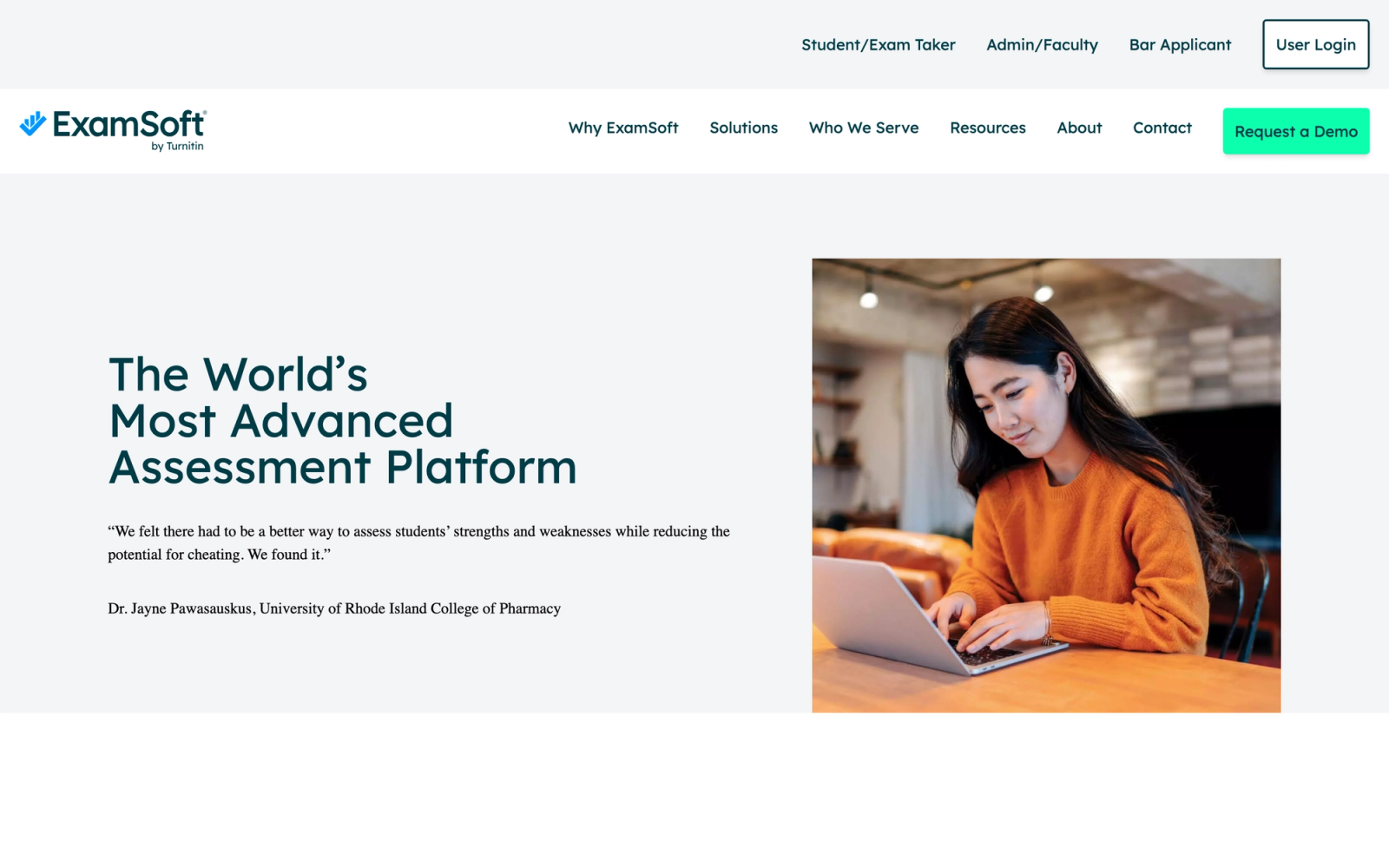
ExamSoft takes a fundamentally different approach to exam security. Rather than monitoring students through a webcam during an online exam, ExamSoft's desktop application, Examplify, locks down the testing device entirely. It disables copy-paste, screen capture, application switching, and internet access during the exam. The exam runs locally on the student's machine, and the answer file is encrypted and uploaded once the student submits.
This model is especially popular in professional education. Law schools, medical schools, nursing programs, and pharmacy programs use ExamSoft heavily because it pairs device lockdown with detailed learning analytics on exam performance. The psychometric reporting engine is where ExamSoft separates itself from Honorlock and other monitoring-focused proctoring tools.
Core Capabilities
- Examplify desktop application that locks down Windows and Mac devices during exams
- Offline exam delivery that does not require internet during the test, only for download and upload
- ExamID facial recognition for identity verification at exam start
- ExamMonitor AI-based video and audio monitoring (optional add-on for remote exams)
- Item analysis with psychometric reporting including difficulty index, discrimination index, and point-biserial correlation
- Category tagging for questions mapped to learning outcomes or competency standards
- Secure question bank with randomization, sequencing, and version control
- Rubric-based grading tools for constructed-response questions
- ADA-compliant accommodations including extended time, alternative formats, and assistive technology compatibility
- Integration with LMS platforms and student information systems for grade passback
Standout Strength
The differentiator is psychometric depth. Beyond securing the exam, it helps faculty analyze item performance, identify weak curriculum areas, and map assessment results to accreditation standards. For professional programs undergoing accreditation review, this reporting is not a nice-to-have but a requirement. Honorlock monitors the exam but offers nothing comparable on the analytics side.
Best For
Professional education programs in law, medicine, nursing, pharmacy, and allied health that need both exam security and accreditation-aligned analytics. Programs already administering in-person exams on student laptops will find the transition to remote delivery straightforward. Not designed for lightweight quiz proctoring or institutions that do not need psychometric reporting.
Pricing Overview
- Custom institutional pricing based on program size and exam volume
- Pricing model: Annual license, typically per-student or per-program
- ExamMonitor (remote proctoring add-on) is an additional cost
- Free demo available through the ExamSoft website
Limitations
- Requires a dedicated desktop application installation, which can conflict with institutional device management policies
- Primarily designed for high-stakes summative exams; overkill for low-stakes quizzes or formative assessments
- The learning curve for faculty setting up item-tagged question banks is steeper than most proctoring-only tools
Quick Comparison Insight
Deeper assessment analytics than Honorlock, but a heavier implementation footprint. Better for programs that need psychometric data, not just surveillance.
ProctorU (Meazure Learning)

Overview
ProctorU, now operating under Meazure Learning, is one of the longest-running live proctoring services in higher education. Its core offering is a human proctor who watches the student in real time via webcam, verifies identity, monitors the testing environment, and intervenes if suspicious behavior occurs. ProctorU also offers AI-automated and recorded proctoring options for institutions that want lower-cost alternatives to live monitoring.
The key difference from Honorlock is the emphasis on live human oversight. Where Honorlock uses AI as the primary layer and escalates to a live proctor only when the AI flags an issue, ProctorU gives institutions the option of having a human proctor present throughout the entire exam. For high-stakes assessments where a live witness matters, such as professional licensing exams or graduate admissions tests, this continuous human presence is a meaningful differentiator. Note that ProctorU and Examity (covered below) are now sister brands under the same owner, Meazure Learning, so weigh them as one vendor relationship rather than two independent options.
Core Capabilities
- Live proctoring with a human proctor watching via webcam for the full exam duration
- AI-automated proctoring option (Guardian) for institutions wanting a lower-cost, scalable alternative
- Recorded proctoring for post-exam review by instructors or trained reviewers
- Multi-factor identity verification using photo ID, facial recognition, and knowledge-based authentication
- Secure browser that restricts access to other applications and websites during the exam
- LMS integrations with Canvas, Blackboard, Moodle, D2L Brightspace, and others via LTI
- 24/7 proctor availability with global staffing to support exams across time zones
- Instructor portal for reviewing flagged sessions, proctor notes, and incident reports
- Accommodation workflows for students with documented disabilities
- FERPA, GDPR, and SOC 2 compliance
Standout Strength
ProctorU fits programs that need a human in the loop for the entire exam, not just when an algorithm flags something. This matters for programs where the consequences of cheating are severe, such as nursing board prep, bar exam practice tests, and certification assessments. The live proctor model provides a level of real-time judgment that pure AI systems cannot replicate.
Best For
Universities and certification bodies running high-stakes exams where continuous live human oversight is required or preferred. Programs that need the flexibility to move between live and AI-automated proctoring depending on the exam, without switching vendors, will find the tiered model practical. Particularly useful when the institution needs a human witness on record for integrity purposes.
Pricing Overview
- Per-exam pricing based on proctoring mode (live is highest, automated is lowest)
- Volume discounts available for institutions with high annual exam counts
- Custom enterprise agreements for large university systems and certification bodies
- Free pilot available for qualifying institutions
Limitations
- Live proctoring creates wait times during peak exam periods, sometimes 15 to 30 minutes
- Per-exam pricing scales directly with volume, making it expensive for high-frequency assessment programs
- Some students report the live proctor experience as more stressful than AI-only monitoring
Quick Comparison Insight
Stronger human oversight than Honorlock, but at a higher per-exam cost and with potential wait times. Better for programs that prioritize live proctoring over AI-first automation.
Respondus LockDown Browser + Monitor
Overview
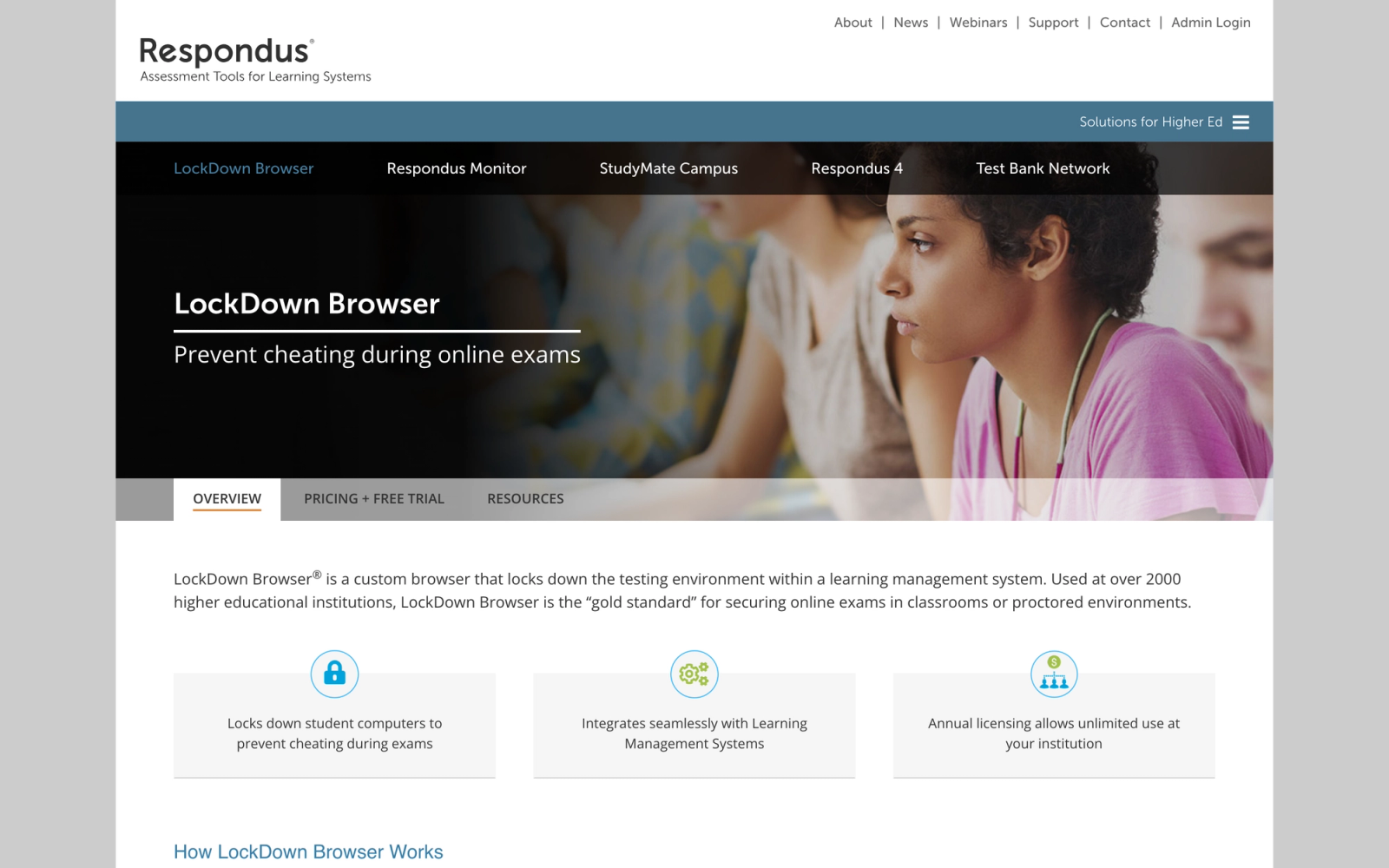
Respondus LockDown Browser is one of the longest-running exam security tools in higher education. Its approach is straightforward: lock the student's computer into the exam, preventing access to other applications, websites, or system functions until submission. Respondus Monitor, an add-on product, layers webcam-based AI proctoring on top of the locked browser.
What makes Respondus distinct from Honorlock is its simplicity and price point. It does not try to be a full proctoring service. It is a browser lockdown tool first, with optional monitoring second. For institutions that view full proctoring as overkill for most assessments but still want to prevent basic screen-switching and copy-paste cheating, Respondus fills that gap without the cost or complexity of Honorlock's per-exam model.
Core Capabilities
- Custom browser that prevents access to other applications, URLs, screen capture tools, and copy-paste functions during exams
- Respondus Monitor add-on that records webcam video and uses AI to flag suspicious behaviors
- Deep integration with Canvas, Blackboard, Moodle, D2L Brightspace, and Schoology
- iPad app (LockDown Browser for iPad) for institutions using tablets in testing centers
- Instructor dashboard for reviewing flagged webcam recordings with time-stamped incident markers
- Pre-exam environment checks including webcam test, microphone test, and connectivity verification
- Support for calculator and spreadsheet tools within the locked environment when permitted by the instructor
- Startup sequence that checks for unauthorized applications and virtual machines before launching the exam
- ADA accommodations for extended time and assistive technology
- Campus-wide and system-wide licensing models for predictable budgeting
Standout Strength
Respondus is the default choice for institutions that want exam security without the overhead of full proctoring. The campus-wide license model means unlimited exams for a flat annual fee, which makes it dramatically cheaper than Honorlock's per-session pricing at scale. For departments that just need to stop students from Googling answers during a quiz, Respondus delivers that at a fraction of the cost.
Best For
Community colleges and universities with large online course catalogs that need basic exam security across hundreds of sections. Ideal for institutions that want a baseline lockdown tool for all online courses and only need webcam proctoring for select high-stakes exams. Budget-conscious IT departments that prefer flat-rate licensing over per-exam charges.
Pricing Overview
- LockDown Browser: campus-wide license, annual fee scaled by institution FTE (roughly $2,795 per year up to 2,000 FTE, scaling to $5,045 or more for larger enrollments)
- Respondus Monitor (webcam add-on): Additional annual license fee
- No per-exam or per-student charges under the campus license
- Free trial available for evaluation
Limitations
- LockDown Browser alone does not verify student identity or monitor behavior; it only restricts the device
- Respondus Monitor's AI flagging is less sophisticated than Honorlock's behavior analysis
- Windows and Mac only; limited Chromebook support and no native Linux support
Quick Comparison Insight
Far less expensive than Honorlock at scale, but also far narrower in scope. Best understood as a lockdown tool with optional monitoring, not a full proctoring replacement.
Proctortrack
Overview
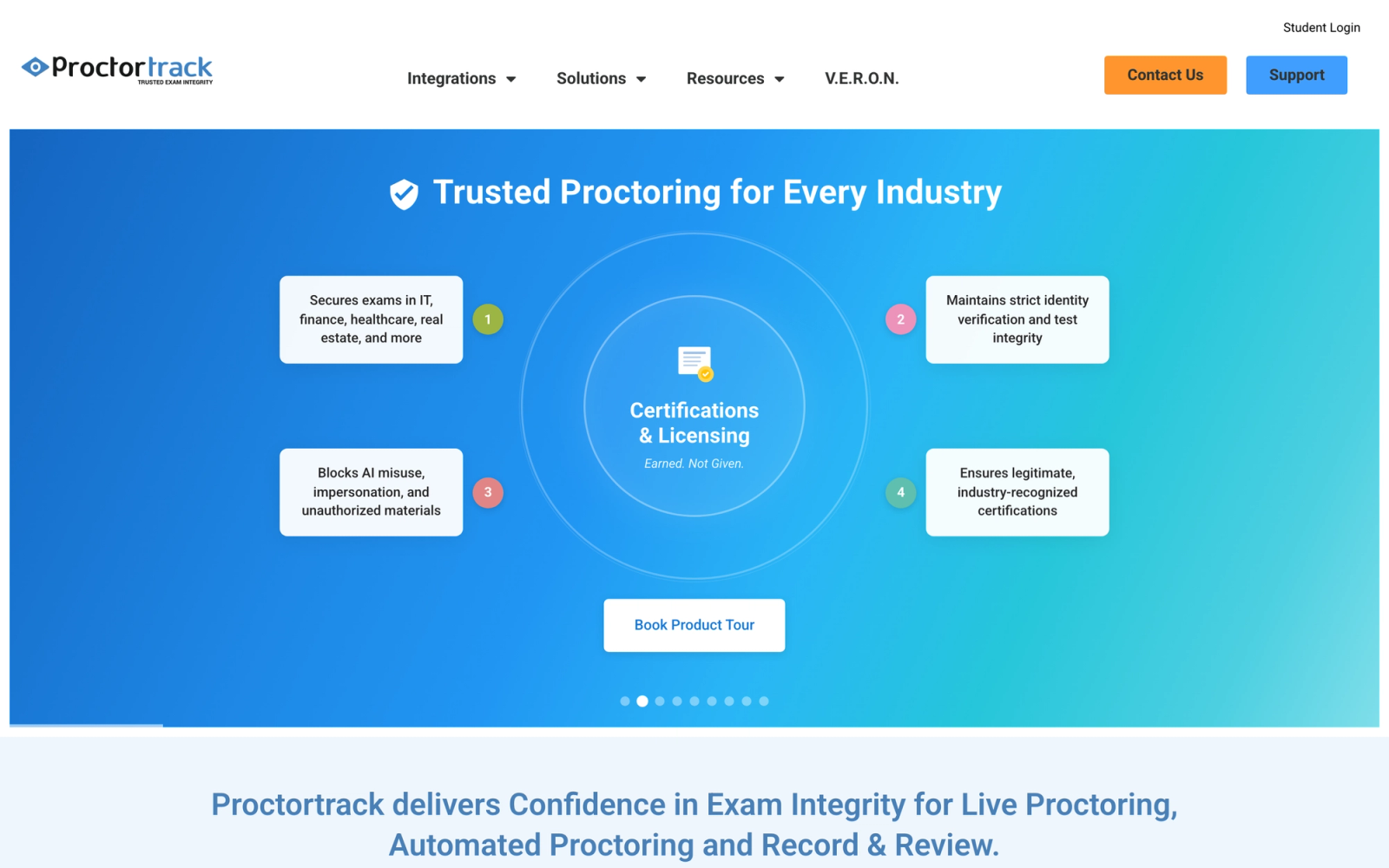
Proctortrack, developed by Verificient Technologies, is an AI-based proctoring platform that emphasizes identity verification and post-exam review over real-time intervention. The system captures webcam video, screen activity, and audio during exams, then applies machine learning algorithms to flag suspicious behavior for instructor review after the exam concludes.
What sets Proctortrack apart from Honorlock is the focus on post-exam analysis rather than real-time AI or live proctor escalation. The platform uses facial recognition to verify identity continuously throughout the exam and generates a detailed trust score for each session. Instructors review flagged sessions after the fact, which eliminates the real-time monitoring overhead while still catching integrity issues.
Core Capabilities
- AI-based behavior monitoring with webcam, audio, and screen capture analysis
- Continuous facial recognition that verifies the test-taker's identity throughout the session
- Post-exam review dashboard with flagged incidents, trust scores, and video clips
- Knuckle-based biometric authentication as an alternative identity verification method
- Browser lockdown that prevents access to unauthorized applications and websites
- LMS integrations with Canvas, Blackboard, Moodle, and D2L Brightspace via LTI
- Automated proctoring reports with severity ratings and timestamp markers
- Multi-camera support for secondary device monitoring when required
- FERPA and GDPR compliant with configurable data retention policies
- API access for custom integration with institutional systems
Standout Strength
Proctortrack's continuous identity verification is stronger than most competitors. The system does not just check ID at the start and move on. It uses facial recognition throughout the exam to confirm that the same person who started the test is the one finishing it. For institutions concerned about proxy test-taking, this continuous verification addresses the problem more directly than Honorlock's periodic checks.
Best For
Mid-size universities and online program managers that want AI proctoring centered on identity assurance and post-exam review rather than real-time monitoring. Institutions that prefer to let students test without active surveillance but still want a thorough integrity review afterward will find the post-exam workflow practical. Programs managing student anxiety will benefit from the less intrusive monitoring posture.
Pricing Overview
- Per-exam pricing, typically lower than live proctoring services
- Volume discounts available for institutional contracts
- Custom pricing for large university systems
- Free pilot available for evaluation
Limitations
- No live proctor option; all review happens after the exam, which means real-time cheating intervention is not available
- Post-exam review still requires faculty time to evaluate flagged sessions
- Facial recognition accuracy can vary across skin tones and lighting conditions, a known bias concern in AI proctoring
Quick Comparison Insight
Less intrusive than Honorlock during the exam itself, with stronger continuous identity verification. Trades real-time intervention for lower student anxiety and a detailed post-exam review process.
Safe Exam Browser
Overview
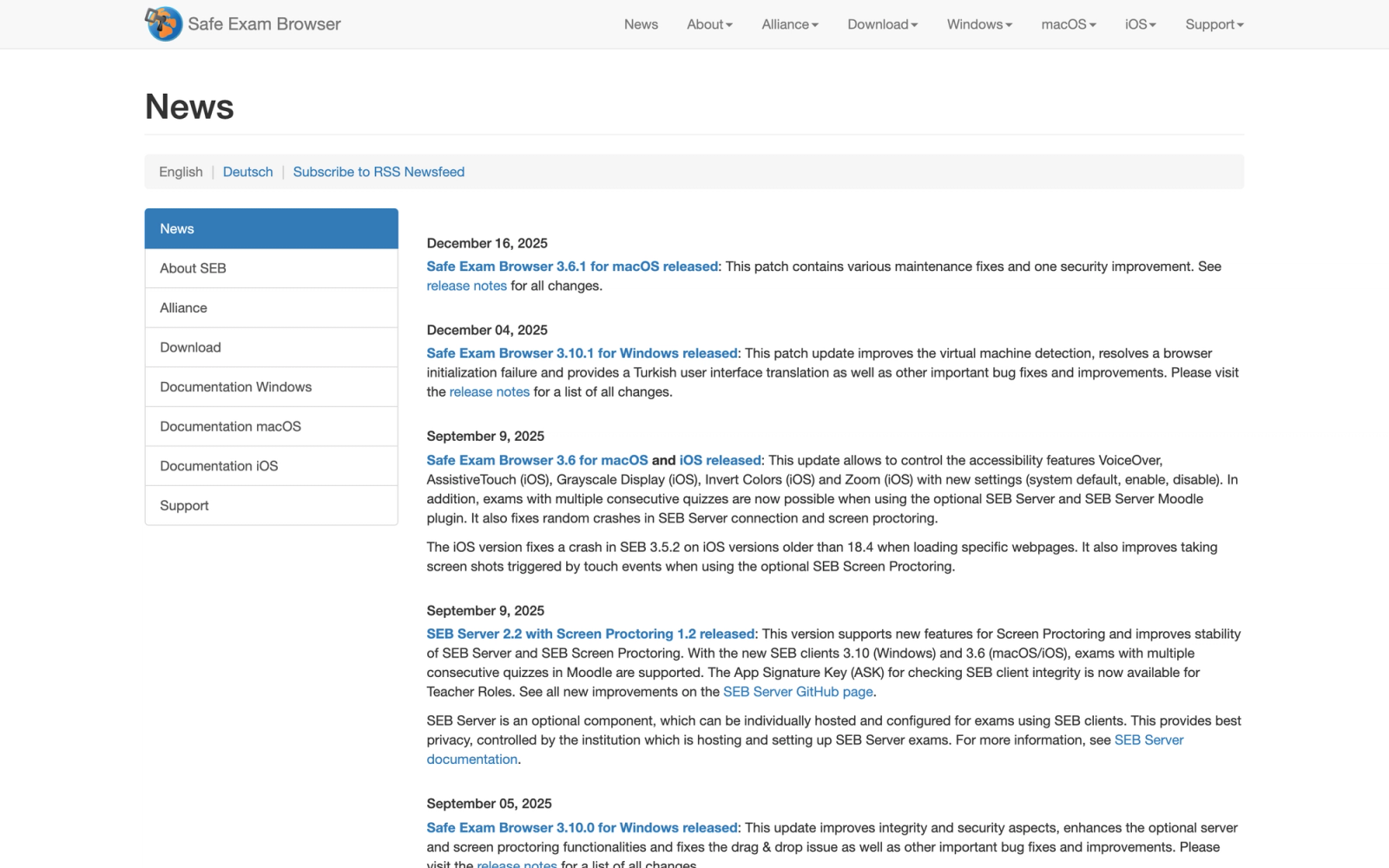
Safe Exam Browser (SEB) is an open-source browser lockdown application developed by ETH Zurich and the University of Giessen. It takes a fundamentally different approach from Honorlock and every commercial proctoring tool on this list: it is free, community-maintained, and focused exclusively on locking down the testing environment. There is no proctoring, no webcam monitoring, and no AI behavior analysis.
SEB works by replacing the student's standard desktop environment with a locked kiosk browser that only permits access to the exam URL. It disables task switching, screen capture, clipboard functions, and system-level shortcuts. For institutions that believe device lockdown is sufficient for exam integrity, or that combine SEB with in-person invigilation, this is a zero-cost solution that does exactly one thing well.
Core Capabilities
- Full desktop lockdown that prevents access to other applications, the taskbar, and system functions during exams
- Cross-platform support for Windows, macOS, and iOS (iPad)
- Configuration files (.seb) that instructors create and distribute to enforce specific exam settings
- Integration with Moodle, ILIAS, OpenOLAT, and other LMS platforms that support SEB configuration keys
- URL filtering to restrict access to specific approved URLs during the exam
- Spell-check, dictionary, and calculator controls configurable per exam
- Kiosk mode that hides desktop and system menus entirely during the exam session
- Open-source codebase with active development community on GitHub
- No data collection, no cloud dependency, and no third-party data sharing
- Configuration management server (SEB Server) for institutional-scale deployment and monitoring
Standout Strength
Safe Exam Browser is the free Honorlock alternative on this list, and the only open-source one. For institutions that object to commercial proctoring on privacy grounds, or that simply lack budget for per-exam or annual licensing fees, SEB provides exam security with zero vendor lock-in and zero data collection. European universities have adopted it widely because it aligns with GDPR requirements by design: no student data ever leaves the institution.
Best For
European universities and any institution that prioritizes privacy and zero-cost exam security. Institutions administering exams in physical testing centers or proctored classrooms get device lockdown without any remote monitoring or data sharing. Technical teams comfortable with open-source configuration and deployment will get the most out of it. Not suited for fully remote, unmonitored online exams where identity verification is required.
Pricing Overview
- Free and open-source under the Mozilla Public License 1.1
- No licensing fees, no per-exam charges, no institutional subscription
- SEB Server (optional management tool) is also free and open-source
- Support is community-based; commercial support available through partners
Limitations
- No identity verification, no webcam monitoring, and no behavior analysis, so it does not prevent proxy test-taking on its own
- Requires technical staff to configure .seb files and manage deployment, more hands-on than commercial proctoring tools
- Linux support is experimental, and Chromebook support is not available
Quick Comparison Insight
Zero cost versus Honorlock's per-exam fees, but also zero monitoring. Best understood as a lockdown tool for controlled environments, not a replacement for remote proctoring.
Mercer Mettl
Overview
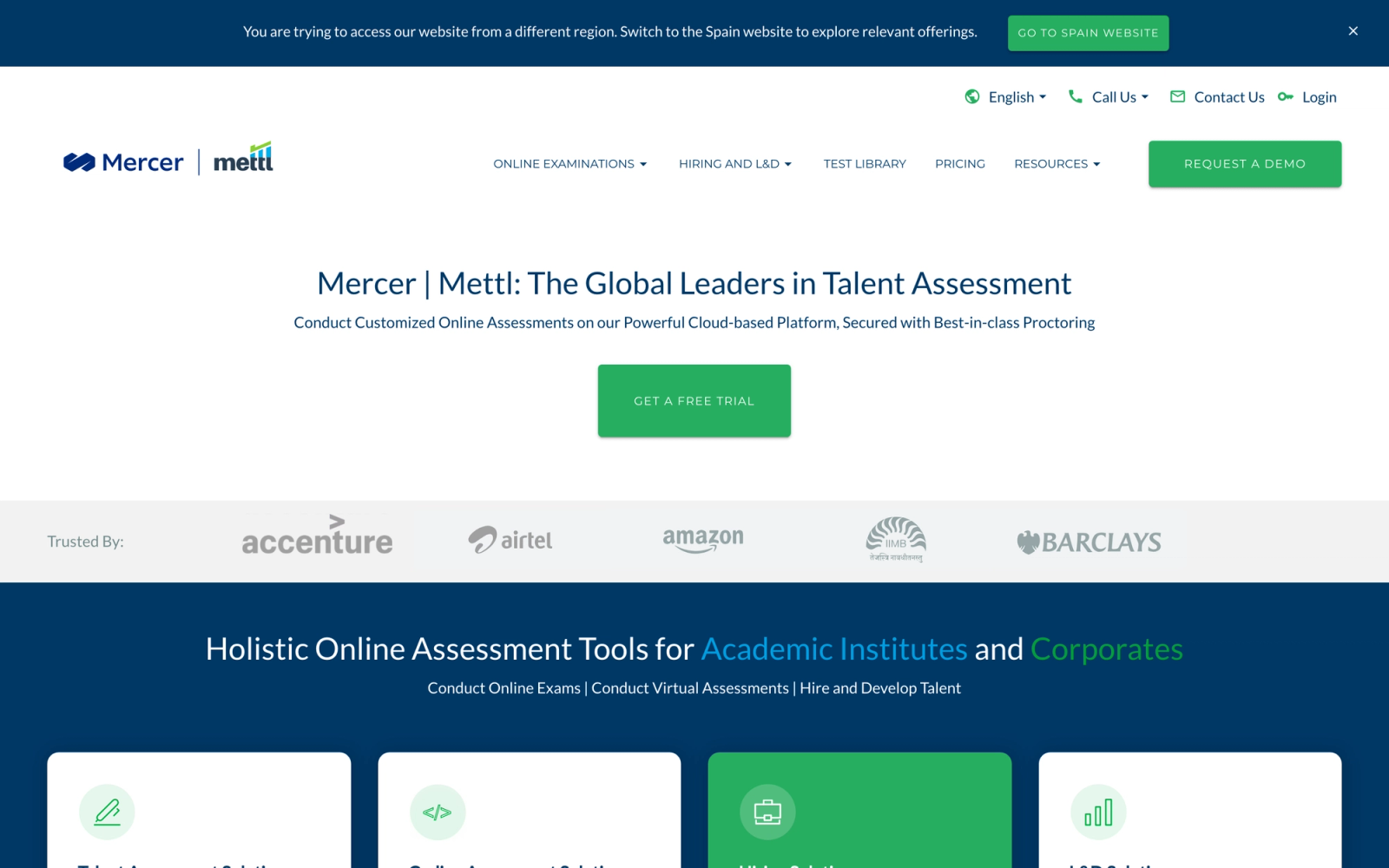
Mercer Mettl comes from a different world than most tools on this list. While Honorlock and Proctorio serve higher education, Mercer Mettl is built primarily for corporate recruitment, certification testing, and professional assessment at scale. The platform combines online proctoring with a full assessment creation engine, including psychometric tests, coding challenges, and simulation-based evaluations.
Mercer Mettl stands out for the depth of its assessment library. It is not just a proctoring layer sitting on top of an existing exam tool; it is a full assessment platform with its own authoring environment that happens to include proctoring. For organizations that need to create and proctor exams in the same place, rather than build in an LMS and pipe sessions to a third-party proctor, this represents a different operating model than Honorlock.
Core Capabilities
- Three proctoring modes: AI-based automated proctoring, live human proctoring, and a hybrid model combining both
- Built-in assessment authoring with support for MCQ, coding challenges, case studies, and psychometric instruments
- Pre-built assessment library with validated tests for cognitive ability, personality, domain knowledge, and technical skills
- Browser lockdown that prevents tab switching, copy-paste, and access to external applications
- Multi-camera support allowing candidates to share both screen and secondary camera views
- Automated proctoring reports with AI-generated trust scores and flagged incident summaries
- Bulk scheduling and invitation management for large-scale assessment campaigns
- White-labeling and custom branding for certification bodies and enterprise clients
- API access for integrating proctoring and assessment data into HRIS, ATS, and LMS platforms
- Compliance with ISO 27001, SOC 2, and GDPR data handling standards
Standout Strength
Mercer Mettl consolidates assessment authoring and proctoring under one vendor, which matters most for HR teams running global recruitment campaigns and certification bodies issuing credentials. Rather than building exams in one system and routing sessions to a separate proctor, both functions live in the same dashboard. For L&D teams that need proctored skills assessments alongside their training programs, this reduces the number of vendor relationships to manage.
Best For
Corporate L&D teams, HR departments running pre-employment assessments, and professional certification bodies that need both assessment authoring and proctoring. Particularly strong for organizations conducting high-volume recruitment testing across multiple geographies. Less suited for traditional higher education institutions that already build exams inside their LMS.
Pricing Overview
- Custom pricing based on assessment volume and proctoring mode
- Per-candidate pricing available for recruitment use cases
- Enterprise licensing for organizations with ongoing assessment programs
- Free trial available with limited assessment credits
Limitations
- The platform's corporate focus means the UX is optimized for HR and L&D workflows, not academic course structures
- LMS integrations are available but not as deeply embedded as proctoring tools built specifically for higher education
- Pricing can be opaque; smaller organizations may find the sales process oriented toward enterprise contracts
Quick Comparison Insight
Broader assessment capabilities than Honorlock, but designed for corporate and certification contexts rather than academic exam proctoring. A stronger fit when you need to build the test and proctor it in one place.
Talview
Overview
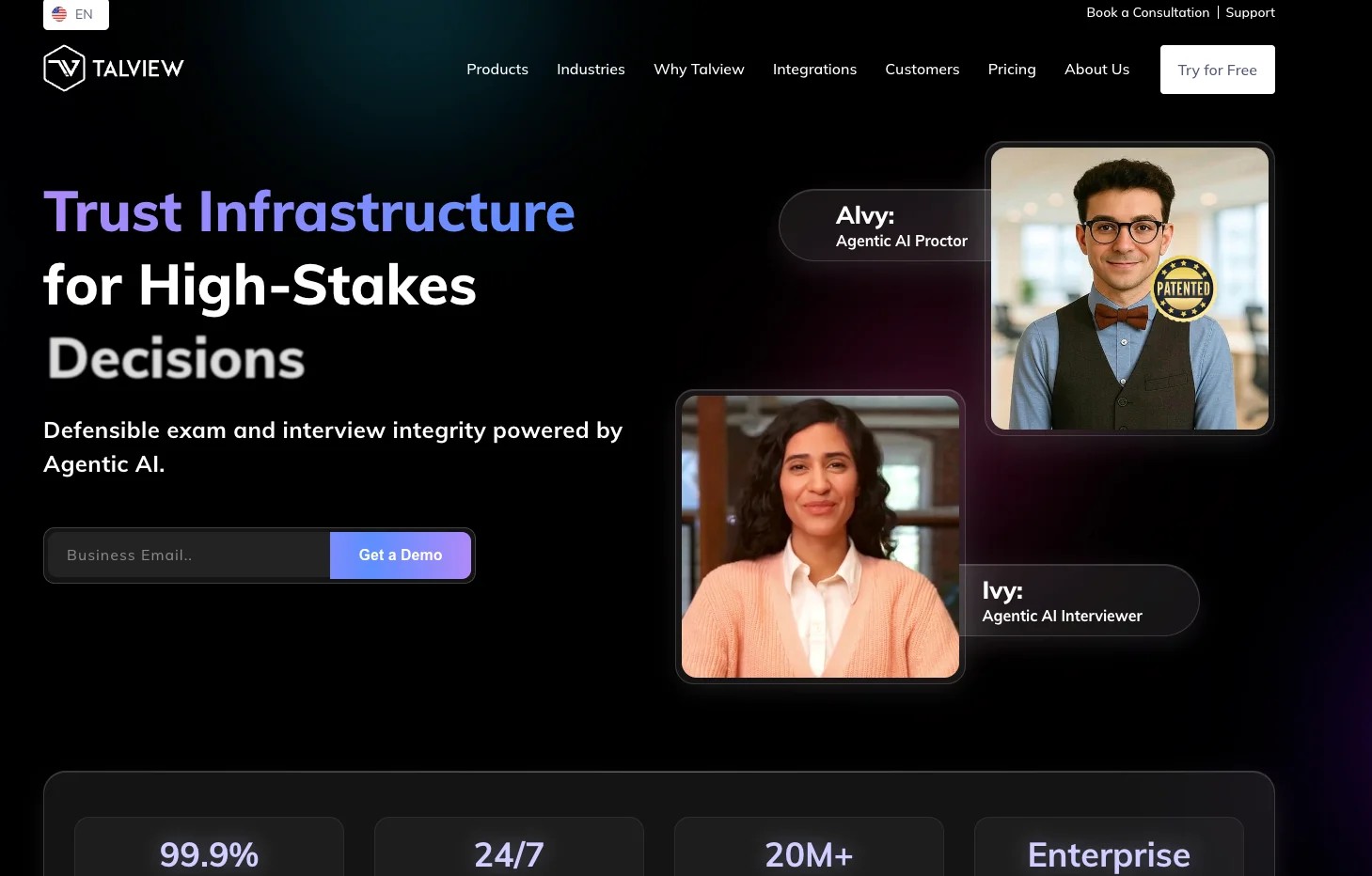
Talview is an AI-powered proctoring and assessment platform that started in the recruitment space and expanded into education. Its proctoring engine combines facial recognition, voice analysis, and behavioral pattern detection to monitor exam sessions. What distinguishes Talview from Honorlock is its behavioral AI, which analyzes patterns beyond simple gaze tracking, including keystroke dynamics, typing cadence, and audio sentiment.
The platform offers both automated and live proctoring modes, along with an asynchronous video interview tool that makes it a dual-purpose platform for organizations handling both assessments and candidate screening. For institutions or companies running both proctored exams and structured interviews, Talview consolidates those functions into a single vendor.
Core Capabilities
- AI proctoring with facial recognition, voice analysis, and behavioral pattern detection
- Live proctoring with human monitors available for high-stakes exams
- Keystroke dynamics and typing cadence analysis for continuous identity verification
- Browser lockdown with copy-paste restriction, tab-switching prevention, and application blocking
- Asynchronous video interview module for recruitment and admissions screening
- Multi-language support for global assessment deployments
- AI-generated trust scores and detailed incident reports for post-exam review
- Integration with major ATS, HRIS, and LMS platforms via API and LTI
- Automated scheduling and candidate communication tools for large-scale exam campaigns
- SOC 2 and GDPR compliance with configurable data residency options
Standout Strength
Talview's behavioral AI monitors more signals than most academic proctoring tools. Where Honorlock flags gaze deviations and secondary devices, Talview also analyzes typing cadence and voice characteristics across the session, building a behavioral profile that changes if someone other than the registered test-taker takes over mid-exam. For organizations with documented proxy testing problems, this continuous behavioral fingerprint is harder to defeat than a one-time ID check at the start.
Best For
Recruitment teams and educational institutions that run both proctored assessments and structured interviews. Organizations running global hiring at scale in IT, BPO, and consulting sectors will get the most from the behavioral AI features. Educational institutions that want richer behavioral data than standard gaze-tracking produces, without switching to a live proctor model, are the relevant academic use case.
Pricing Overview
- Custom pricing based on volume, proctoring mode, and feature modules selected
- Per-candidate pricing for recruitment use cases
- Enterprise licensing for organizations with ongoing assessment and interview programs
- Free demo available
Limitations
- Recruitment-first design means the education-specific workflows feel less polished than purpose-built academic proctoring tools
- Behavioral AI analysis adds complexity to the review process; instructors need training to interpret behavioral flags meaningfully
- Smaller vendor footprint in higher education compared to established academic proctoring platforms
Quick Comparison Insight
Deeper behavioral analysis than Honorlock, with dual proctoring and interview capabilities. Better for organizations that need both functions. Less proven in traditional higher education than education-native proctoring tools.
Where Teachfloor Fits
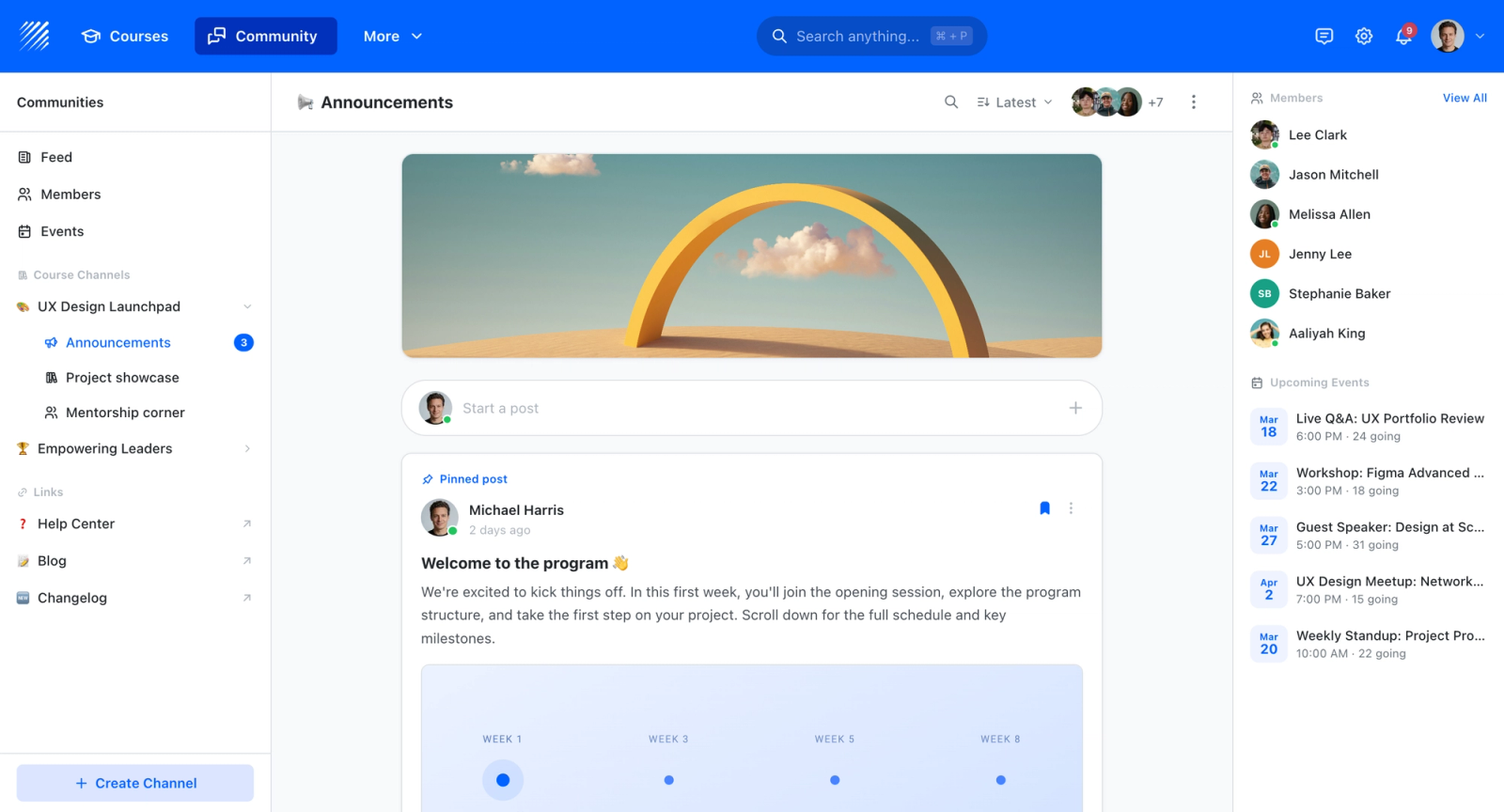
One note worth adding for training teams reading this: Teachfloor is not a proctoring tool and does not belong on this list. It is the course and assessment platform your exams live on, where you build quizzes, grade submissions, issue certificates, and keep completion records. If a specific high-stakes test needs identity checks or live monitoring, pair Teachfloor with one of the proctoring services above rather than choosing between them.
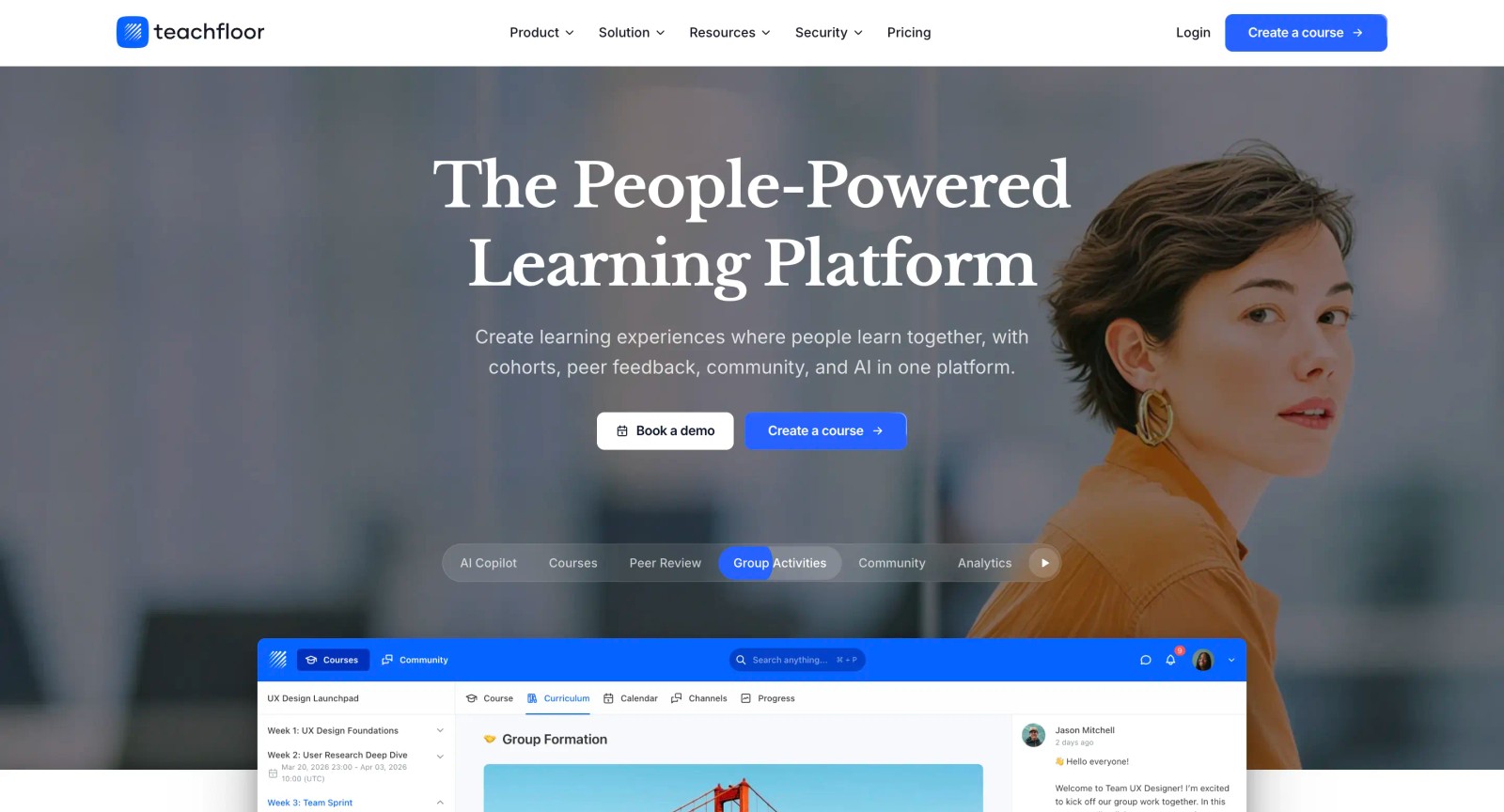
If you are choosing a home for your courses rather than a single-purpose tool, Teachfloor is worth a look. It starts at $89 per month with a 14-day free trial.
How to Choose the Right Alternative
The right Honorlock alternative depends less on features and more on your assessment philosophy, budget structure, and student population.
If you want to remove surveillance from assessment entirely, Teachfloor offers an assessment model built on collaboration, peer review, and applied work, delivered through flexible self-paced and cohort-based learning formats. It is the strongest fit when applied learning is part of the instructional design, and it supports white-label delivery on your own domain.
If you want fully automated proctoring at a flat rate, Proctorio is the closest match. Its institutional licensing eliminates per-exam costs, and the configurable monitoring levels give instructors control over intensity per assessment. The trade-off is no live proctor fallback.
If you need live human proctors for high-stakes exams, ProctorU (Meazure Learning) is the established option. The live proctoring model provides continuous human oversight, which matters for professional licensing and certification exams. Expect higher per-session costs and potential wait times during peak periods.
If you want tiered proctoring levels within a single platform, Examity (Meazure Learning) offers the most granular control. Assign automated AI to quizzes and live proctoring to finals without switching vendors. This flexibility optimizes cost across mixed-stakes assessment programs.
If you need assessment analytics alongside exam security, ExamSoft delivers psychometric reporting that maps to accreditation standards. Professional programs in law and medicine rely on it for item analysis and outcome tracking that goes well beyond what proctoring-only tools provide.
If your budget is the primary constraint, Respondus LockDown Browser offers campus-wide licensing for a flat annual fee, and Safe Exam Browser is completely free. Both are lockdown tools rather than full proctoring services, so they work best when combined with other integrity measures.
If your assessments are for corporate recruitment or certification, Mercer Mettl and Talview combine assessment authoring with proctoring. Mercer Mettl offers the deeper assessment library; Talview adds behavioral AI analysis and video interview capabilities.
Start with the question your institution is actually trying to answer. If the problem is cost, compare pricing models first. If the problem is student experience, test the student-facing workflow before evaluating features. If the problem is privacy, filter by data handling practices. The tool that solves your specific pain point matters more than the one with the longest feature list.
FAQ
What is the main difference between Honorlock and Proctorio?
Honorlock uses AI as the primary monitoring layer and escalates to a live human proctor on demand when the AI detects a potential integrity issue. Proctorio is fully automated with no live proctor involvement at any stage. Honorlock charges per exam session, while Proctorio typically uses flat institutional licensing. The choice depends on whether your institution values having a human fallback (Honorlock) or prefers unlimited-scale automation at a predictable cost (Proctorio).
Can I use a browser lockdown tool instead of full proctoring?
Yes. Respondus LockDown Browser and Safe Exam Browser restrict what students can access on their devices during exams without monitoring them through a webcam. This approach prevents basic cheating methods like tab switching, copy-paste, and screen sharing. Browser lockdown alone does not verify identity or detect collaboration, so it works best for moderate-stakes assessments or as a complement to in-person invigilation.
Are there free alternatives to Honorlock?
Safe Exam Browser is completely free and open-source. It locks the testing device without webcam monitoring or data collection, and there are no licensing fees or per-exam charges. Configuration requires technical staff to build and distribute .seb files, and the platform provides no identity verification or behavior analysis. Institutions that need only browser lockdown for in-person or low-stakes remote exams can use SEB at no cost.
Which Honorlock alternative works best for corporate training?
Mercer Mettl is the strongest option for corporate training and recruitment assessments. It combines proctoring with a full assessment authoring engine, pre-built test libraries, and API integrations with HRIS and ATS platforms. Talview is a strong second choice, particularly for organizations that also need structured video interviews alongside proctored assessments. Both platforms are designed for the workflows that HR and L&D teams use daily, unlike academic-focused tools such as Honorlock or Proctorio.
Is there a free Honorlock alternative?
These two questions overlap, see the answer above for the full breakdown of Safe Exam Browser as a free alternative. In short: SEB provides device lockdown under the Mozilla Public License 1.1 with no fees and no data collection, but requires technical configuration and does not replace webcam proctoring.
How can I reduce false-positive flags and privacy complaints?
Two paths help. First, choose a tool with configurable monitoring so low-stakes quizzes get lighter settings than finals. Second, reconsider whether every assessment needs webcam proctoring at all. Platforms like Teachfloor assess through peer review and collaborative work, which removes the surveillance layer that generates false flags and student pushback in the first place.


