

Why Look for a PeerStudio Alternative?
PeerStudio introduced a promising concept: AI-supported peer review that lets students give and receive feedback quickly, even in large courses. The platform focused on speed, using algorithmic matching and structured rubrics to make peer learning practical at enrollment numbers where instructor feedback alone breaks down.
But PeerStudio has not kept pace with what instructors and program designers now need. The platform's feature set remains narrow, limited mostly to text-based peer review for individual assignments. If you need multimedia submissions, group-based assessment, calibration exercises, or integration with your existing LMS, PeerStudio leaves gaps. Its rubric builder lacks flexibility for complex assessment criteria, and the analytics available to instructors offer limited insight into review quality or learner growth over time.
There are also practical concerns. Institutional support and documentation have thinned out, making onboarding new faculty harder than it should be. For programs that depend on online assessment at scale, reliability and vendor stability matter as much as features.
The alternatives below each solve one or more of these problems. Some specialize in calibrated peer review with statistical rigor. Others wrap peer assessment into a broader collaborative learning platform. The right choice depends on whether you need a focused peer review tool or a full environment where peer feedback is one part of a larger learning design.
What to Look for in a Scalable Peer Assessment Tool
Before comparing specific platforms, it helps to define the capabilities that separate effective peer assessment infrastructure from a basic submission-and-comment workflow.
Rubric quality and flexibility. A useful rubric builder supports weighted criteria, multiple rating scales, and qualitative comment prompts tied to specific dimensions. Generic "rate 1 to 5" fields produce low-quality feedback. The best tools let you design rubrics that guide reviewers through the exact evaluation your assignment requires.
Reviewer calibration. Untrained peer reviewers produce inconsistent results. Platforms that include calibration exercises, where students evaluate sample work and compare their ratings to expert benchmarks, produce significantly more reliable feedback. This is one of the strongest predictors of peer review quality.
Anonymous and configurable review workflows. Anonymity affects honesty. Some contexts benefit from double-blind review; others from identified feedback. The platform should let you configure anonymity settings, reviewer count per submission, and review deadlines without manual coordination.
LMS integration. If your institution runs on Canvas, Blackboard, Moodle, or Brightspace, your peer assessment tool needs to work within that stack. LTI integration, grade passback, and single sign-on reduce friction for both students and administrators. Solid LMS integrations save hours of manual setup each term.
Learning analytics. Instructors need visibility into who reviewed, how thoroughly, and whether review quality improved over the term. Dashboards that surface reviewer reliability, feedback sentiment, and participation patterns turn peer review from a black box into a formative assessment tool instructors can actually manage.
Scalability. A tool that works for 30 students but collapses at 300 is not an alternative worth considering. The platform should handle large enrollments with automated reviewer assignment, batch rubric application, and performance that does not degrade with class size.
10 Best PeerStudio Alternatives
Each platform below takes a different approach to peer assessment. Some focus exclusively on structured review workflows. Others embed peer feedback within a broader learning platform. The platforms are compared against the criteria above.
Tool Calibration Rubrics LMS Integration Analytics Best For Peerceptiv ✓ ✓ ✓ ✓ Writing-intensive courses needing calibrated peer review FeedbackFruits ✓ ✓ ✓ ✓ Universities wanting modular peer review inside their LMS Kritik ✗ ✓ ✓ ✓ Higher ed with gamified, reputation-based peer assessment Peergrade ✗ ✓ ✓ ✓ Structured peer feedback with customizable rubrics Crowdmark ✗ ✓ ✓ ✓ Large-enrollment collaborative grading workflows Turnitin Feedback Studio ✗ ✓ ✓ ✓ Plagiarism detection combined with peer review Gradescope ✗ ✓ ✓ ✓ AI-assisted grading with rubric automation Perusall ✗ ✗ ✓ ✓ Collaborative reading with social annotation Eli Review ✓ ✓ ✓ ✓ Writing pedagogy-focused peer feedback Teachfloor ✗ ✓ ✓ ✓ Cohort-based programs with built-in peer review
Teachfloor

Overview
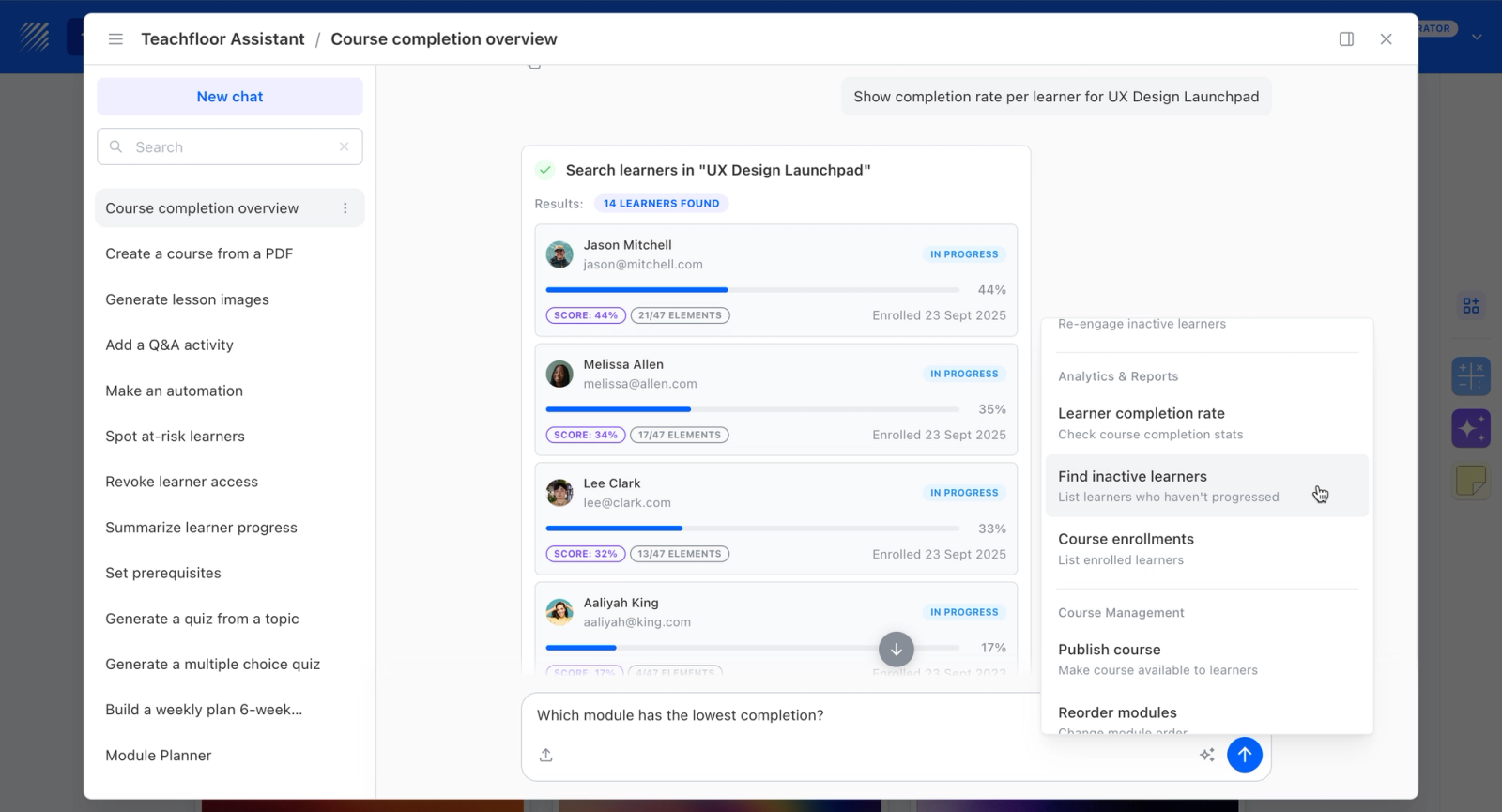
Teachfloor combines structured peer assessment with a full learning environment, content delivery, community, live sessions, certificates, and analytics, so programs do not have to stitch together separate tools. Its peer-review engine assigns multiple reviewers per submission against a shared rubric, meaning feedback volume grows with enrollment rather than bottlenecking on the instructor. Reviews can run anonymously or with identified feedback, and scores feed weighted grades, giving programs defensible assessment data whether they run self-paced courses, instructor-led cohorts, or blended formats.
Core Capabilities
- Multiple-reviewer assignment per submission so feedback throughput scales with class size rather than instructor hours
- Shared rubrics with weighted scoring that turn fast peer feedback into a grade you can stand behind
- Cohort delivery with scheduled review windows to keep large groups moving through the same cycle
- Multi-branch workspaces for running the same review-based course across separate groups or clients
- Completion analytics showing who submitted, who reviewed, and where reviews stalled
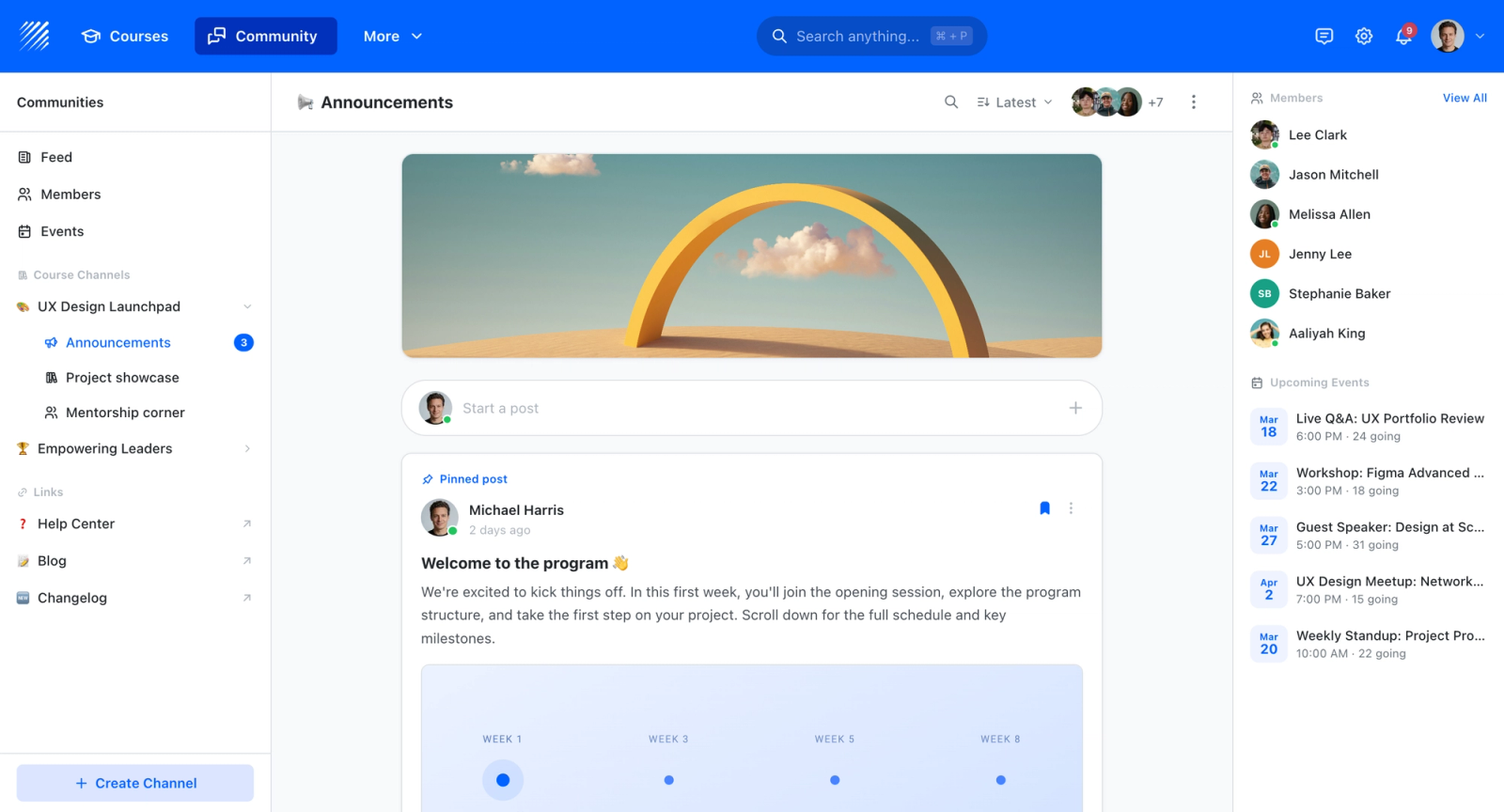
- Built-in discussion so reviewers and authors can resolve feedback without leaving the platform
Best For
Program designers who need peer review capacity to grow with enrollment and want course delivery, grading, and analytics in a single platform, whether running self-paced courses, scheduled cohorts, or client-facing training programs.

Pricing Overview
- Startup plan from $89 per month for up to 50 learners
- Full Features plan with custom pricing, white-label, SSO, and advanced integrations
- 14-day free trial; no permanent free plan
- Nonprofit discounts available
Limitations
- No permanent free tier after the trial period
- Does not replicate PeerStudio's specific research-lab origins or its singular focus on feedback turnaround speed
- Full-platform scope means more initial setup than a tool you would use purely for quick peer feedback
Quick Comparison Insight
Where standalone peer review tools require separate platforms for content, grading, and community, Teachfloor handles all of those inside one environment. It distributes reviewers across submissions and folds scores into grades, making it practical for programs that need peer assessment to work alongside course delivery rather than as a separate activity.
Peerceptiv
Overview
Peerceptiv is the most research-grounded peer review platform on this list. Developed from decades of peer assessment research at the University of Pittsburgh, it focuses on one thing and does it with statistical rigor: calibrated peer review for writing-intensive courses. The platform trains students to evaluate accurately before they review real peer work, producing feedback that consistently correlates with expert instructor ratings.
Peerceptiv's calibration workflow is its clearest differentiator. Before students review classmates' submissions, they evaluate pre-selected sample papers and compare their scores against instructor benchmarks. The system flags reviewers whose calibration scores suggest they will produce unreliable feedback and adjusts the weighting of their reviews accordingly. No other platform on this list replicates that mechanism at the same depth.
Core Capabilities
- Calibration exercises that train students against instructor-benchmarked sample submissions before live peer review
- Multi-criteria rubric builder with weighted dimensions, rating scales, and required qualitative comments
- Statistical reliability scoring that identifies and adjusts for low-quality reviewers
- Automated reviewer assignment with configurable anonymity (single-blind or double-blind)
- Back-evaluation stage where students rate the helpfulness of reviews they received
- Instructor override capabilities for disputed reviews or edge cases
- LTI integration with Canvas, Blackboard, Moodle, and Brightspace for grade passback
- Detailed analytics dashboards showing individual reviewer reliability, class-wide trends, and calibration accuracy
- Support for text, document, and file-based submissions
- Batch assignment creation for courses with multiple sections
Standout Strength
The calibration system produces measurably more reliable peer reviews than platforms that rely on rubrics alone. Research published on Peerceptiv's methodology shows peer ratings that correlate with expert instructor ratings at levels comparable to inter-rater reliability between trained graders. For instructors who need peer review data they can trust for grading decisions, this statistical foundation is what sets Peerceptiv apart.
Best For
Higher education faculty running writing-intensive courses with enrollments above 50 students, particularly in composition, STEM lab reports, social sciences, and any discipline where structured written argumentation is central. Works well for programs where instructional design demands evidence-based assessment quality.
Pricing Overview
- Institutional licensing based on number of students and courses
- Per-student pricing available for individual faculty adoption
- Free pilot program available for institutions evaluating the platform
- Contact sales for volume pricing
Limitations
- Narrowly focused on written peer review. Does not support multimedia submissions, group projects, or collaborative activities beyond individual review workflows.
- The calibration setup requires instructor effort upfront: selecting and benchmarking sample papers, configuring calibration exercises, and reviewing flagged reviewers. The payoff is high, but the initial investment is real.
- The interface prioritizes function over aesthetics. Students accustomed to polished LMS interfaces may find the design utilitarian.
Quick Comparison Insight
The gold standard for calibrated peer review accuracy, but limited to written submissions. Choose Peerceptiv when review quality and statistical reliability are the primary requirements.
FeedbackFruits

Overview
FeedbackFruits takes a modular approach to peer assessment. Rather than a single peer review tool, it offers a suite of interconnected activities: peer review, group member evaluation, interactive study materials, and self-assessment. Each module plugs directly into major LMS platforms through deep LTI integration, so students never leave Canvas or Blackboard to complete peer review tasks.
What makes FeedbackFruits stand out is its flexibility. Instructors can combine modules to build assessment workflows that match specific pedagogical goals. A single assignment might include individual submission, peer review with a structured rubric, group evaluation of team contributions, and student self-reflection, all within one activity flow. The active learning design philosophy is embedded throughout.
Core Capabilities
- Peer review module with structured rubrics, inline annotation, and configurable anonymity settings
- Group member evaluation tool for assessing individual contributions within team projects
- Self-assessment module with guided reflection prompts and criteria-based self-evaluation
- Interactive document tool that lets students annotate and discuss course materials collaboratively
- Automated assignment of peer reviewers with options for random, manual, or criteria-based matching
- LTI 1.3 integration with Canvas, Blackboard, Moodle, Brightspace, and other LMS platforms
- Automatic grade passback to the LMS gradebook
- AI-driven feedback quality suggestions that prompt students to improve vague or superficial reviews
- Analytics dashboard showing participation rates, feedback quality scores, and engagement trends
- Multi-language support for international institutions
- WCAG accessibility compliance across all modules
Standout Strength
FeedbackFruits' LMS integration is the deepest on this list. Students and instructors interact with peer review entirely within their existing LMS environment, with grades, submissions, and analytics flowing back automatically. For institutions that have invested heavily in Canvas or Blackboard, this eliminates the adoption friction that comes with standalone tools.
Best For
Universities and colleges that want to add structured peer assessment and group evaluation without migrating away from their existing LMS. Particularly strong for institutions standardizing peer review across multiple departments, where consistent tooling and centralized analytics matter.
Pricing Overview
- Institutional licensing based on full-time equivalent student count
- Modular pricing allows institutions to purchase only the tools they need
- Pilot programs available for evaluation
- Contact sales for institutional pricing
Limitations
- The modular structure means the full feature set comes at a higher cost. Institutions that only need basic peer review may find the pricing hard to justify compared to simpler tools.
- Workflow configuration has a learning curve. The flexibility that makes FeedbackFruits powerful also means instructors need training to set up activities effectively.
- Less effective for programs outside a traditional LMS environment. If your platform is not Canvas, Blackboard, or Moodle, the integration advantages diminish.
Quick Comparison Insight
The best choice when LMS integration and modular assessment design are top priorities. Less specialized than Peerceptiv on calibration, but broader in the types of peer activities it supports.
Kritik

Overview
Kritik brings gamification into peer assessment. The platform assigns each student a "Kritik Score" that reflects the quality of their reviews over time, creating an incentive system where giving thoughtful feedback directly affects a student's standing. It is a three-stage process: create, evaluate, and then evaluate the evaluations. That third stage, where students rate the quality of feedback they received, is what makes the reputation system self-correcting.
The gamification layer drives measurable engagement, particularly in courses where students would otherwise treat peer review as an obligation. The reputation scoring means consistently careless reviewers see their influence on peers' grades decrease, while thorough reviewers gain more weight. Over a full semester, review quality tends to improve without additional instructor intervention.
Core Capabilities
- Three-stage assessment workflow: submission, peer evaluation, and feedback-on-feedback evaluation
- Kritik Score reputation system that weights reviews based on reviewer track record
- AI-powered feedback analysis that flags superficial or low-effort reviews
- Multi-criteria rubric builder with customizable scales and comment requirements
- Automated reviewer assignment with double-blind anonymity
- Support for text, document, image, video, and link-based submissions
- LTI integration with Canvas, Blackboard, Moodle, and Brightspace
- Instructor dashboard with individual and class-level review quality metrics
- Grade export and LMS grade passback
- Mobile-responsive interface for review completion on any device
Standout Strength
The self-correcting reputation system. Unlike calibration-based approaches where the instructor pre-sets benchmarks, Kritik's scoring adjusts based on community feedback patterns. Review quality tends to improve across the semester without instructors continuously managing calibration exercises, a practical benefit for faculty who want maintained standards with less overhead.
Best For
Higher education instructors in courses with recurring peer assessment assignments (four or more per semester) where the reputation system has time to develop meaningful differentiation between reviewers. Strong in business, engineering, design, and health sciences courses where diverse submission types are common.
Pricing Overview
- Per-student pricing, typically ranging from $10 to $20 per student per course
- Institutional licensing available with volume discounts
- Free trial available for individual instructors
- Free tier available for limited use
Limitations
- The gamification layer is polarizing. Some students thrive on the competitive scoring; others find it stressful or feel penalized during their initial learning curve with the platform.
- The three-stage workflow adds time to each assignment cycle. In courses with tight weekly schedules, the evaluate-the-evaluation step may feel burdensome.
- No calibration exercises. Review quality improves organically over time but is less controlled in early assignments compared to Peerceptiv's calibration approach.
Quick Comparison Insight
More self-correcting than Peerceptiv over time, but less controlled at the start. The right choice when you want review quality to improve organically across a full semester of assignments.
Peergrade
Overview
Peergrade focuses on making peer feedback structured and actionable through customizable rubrics and guided feedback workflows. The platform is designed for instructors who want granular control over what reviewers evaluate and how they communicate their assessment. Every rubric dimension can include specific prompts that guide students toward constructive, criteria-focused feedback rather than vague impressions.
Peergrade balances rubric depth with a straightforward student experience. The rubric builder handles complex multi-criteria assessments, but the student-facing interface stays clean. Students step through each rubric dimension sequentially, providing ratings and written comments at each stage. The result is feedback organized by criteria rather than delivered as a single undifferentiated block.
Core Capabilities
- Customizable multi-criteria rubrics with configurable rating scales, qualitative prompts, and weighted dimensions
- Sequential rubric walkthrough interface that guides reviewers through each criterion
- Anonymous and identified review modes with instructor-configurable settings
- Flagging system where students can dispute reviews they believe are unfair or inaccurate
- Automated reviewer assignment with balanced distribution across submissions
- Support for document, text, image, and link-based submissions
- Instructor review of flagged feedback with override capabilities
- LTI integration with major LMS platforms
- Grade export and analytics on reviewer participation and feedback quality
- Group assignment support with individual accountability metrics
Standout Strength
The rubric design and guided walkthrough make Peergrade produce consistently structured feedback. Students cannot skip criteria or submit a one-sentence review for a multi-dimensional rubric. The sequential interface ensures every dimension gets attention, and the prompts at each step reduce the cognitive load of writing useful feedback.
Best For
Instructors who want maximum control over rubric design and feedback structure, particularly in project-based courses where submissions are evaluated across multiple distinct dimensions. Works well in design, engineering, writing, and applied sciences where assessment criteria vary significantly by assignment.
Pricing Overview
- Free plan available with limited features for small classes
- Pro plans with per-student pricing for full feature access
- Institutional licensing available
- Contact sales for university-wide pricing
Limitations
- No calibration system. Rubric quality drives review quality, but there is no mechanism to train reviewers against benchmarks before live assessment.
- The platform's focus is peer feedback rather than collaborative learning. It does not include community features, live sessions, or group project infrastructure beyond peer review.
- Analytics are functional but not as deep as Peerceptiv or Kritik in surfacing reviewer reliability patterns.
Quick Comparison Insight
Stronger rubric design tools than most competitors, but without calibration or reputation systems to ensure review quality beyond rubric structure. Best when the instructor's rubric expertise is strong and the goal is structured, criteria-specific feedback.
Crowdmark

Overview
Crowdmark approaches assessment from the grading side rather than the peer review side. It is a collaborative grading platform built for large-enrollment courses where multiple graders, TAs, and instructors need to evaluate exams, assignments, and student work efficiently. While not a pure peer assessment tool, Crowdmark's workflow for distributing, annotating, and evaluating student submissions at scale makes it a viable PeerStudio alternative for institutions focused on assessment efficiency.
The platform's strength is in logistics. Crowdmark digitizes paper-based assessments, distributes grading tasks across a team, and enforces rubric consistency through shared annotation libraries. For courses where online assessment involves TAs grading hundreds of papers, Crowdmark reduces the coordination overhead that typically makes large-course assessment painful.
Core Capabilities
- Distributed grading workflows that split assessments across multiple graders by question or section
- Digital annotation tools for marking up student submissions with comments, highlights, and stamps
- Shared rubric and comment libraries that ensure grading consistency across TAs
- Support for handwritten, typed, and uploaded document submissions
- Automated exam booklet scanning and question-level distribution
- Real-time grading analytics showing progress, inter-rater consistency, and score distributions
- Student-facing feedback portal where learners view annotated submissions and scores
- LTI integration with Canvas, Blackboard, and other LMS platforms
- Peer review mode for student-to-student feedback on assignments
- Batch grade export and LMS grade passback
Standout Strength
Crowdmark excels at coordinating grading across large teaching teams. The ability to assign specific exam questions to different graders, enforce rubric consistency, and track grading progress in real time solves a logistical problem that most peer assessment tools do not address. For courses with 500+ students and multiple TAs, this coordination layer is essential.
Best For
Large-enrollment higher education courses (300+ students) with teaching assistant teams that need to grade exams and assignments collaboratively. Particularly strong in STEM disciplines where handwritten problem sets and exams are standard.
Pricing Overview
- Free plan available for individual instructors with limited features
- Institutional licensing based on student count
- Per-course pricing available for smaller deployments
- Contact sales for enterprise pricing
Limitations
- Peer review is a secondary feature, not the platform's core strength. The peer review mode exists but lacks the depth of dedicated tools like Peerceptiv or Kritik.
- Not designed for multimedia submissions or project-based assessment. The focus is on document and exam grading.
- The value proposition weakens for courses without large grading teams. Solo instructors get less benefit from the distributed workflow.
Quick Comparison Insight
The strongest option for coordinated TA-team grading at scale, but peer review is a supplementary feature rather than the primary workflow. Choose Crowdmark when your bottleneck is grading logistics, not peer feedback quality.
Turnitin Feedback Studio
Overview
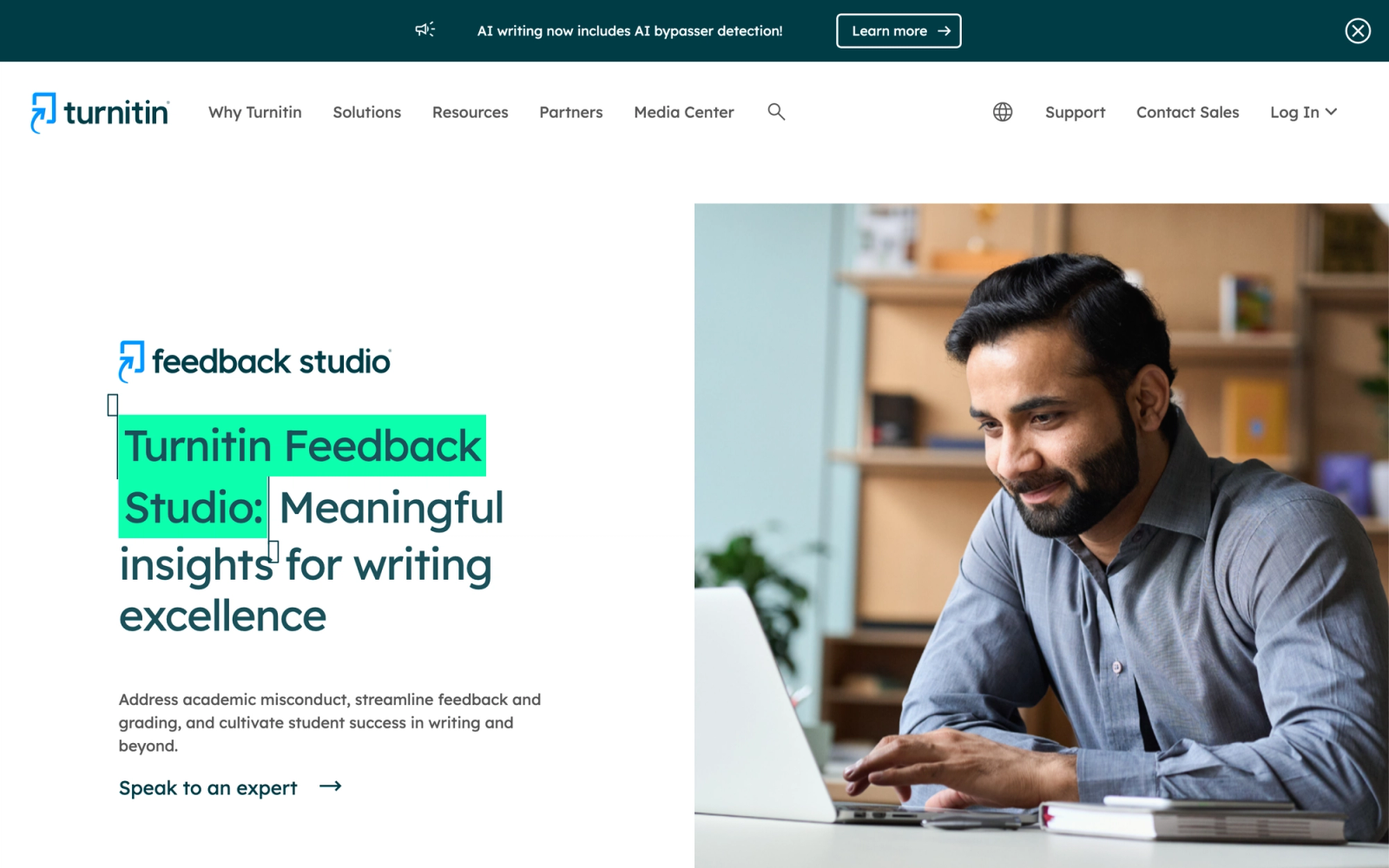
Turnitin Feedback Studio combines plagiarism detection with assignment feedback tools. Most institutions already have Turnitin for academic integrity, which makes its feedback and peer review capabilities an incremental addition rather than a new platform adoption. The peer review component, PeerMark, allows instructors to set up structured peer review assignments where students evaluate each other's writing using instructor-defined questions and rubrics.
The advantage here is stack. If your institution already pays for Turnitin, activating PeerMark does not require a separate procurement process, new student accounts, or additional LMS integration. Students submit their work, it runs through the originality check, and then peer review happens within the same interface. That integration with academic integrity workflows is something standalone peer assessment tools cannot replicate.
Core Capabilities
- PeerMark peer review module with instructor-defined review questions and rubric criteria
- Originality reports integrated with the submission and review workflow
- QuickMark comment library for reusable instructor feedback annotations
- Rubric and grading form builder for instructor and peer evaluation
- Automated and manual peer reviewer assignment with anonymity controls
- Draft and revision workflow support for iterative writing assignments
- LTI integration with all major LMS platforms (Canvas, Blackboard, Moodle, Brightspace)
- Grade passback and reporting to LMS gradebook
- Similarity scoring that helps both instructors and peer reviewers evaluate source use
- Institutional reporting on submission volumes, originality trends, and review completion
Standout Strength
The integration between plagiarism detection and peer review within a single assignment workflow. Students and instructors see originality data alongside peer feedback, creating a more complete picture of writing quality. For institutions where academic integrity and peer review are both priorities, Turnitin eliminates the need to manage two separate tools.
Best For
Institutions that already use Turnitin for plagiarism detection and want to add peer review without adopting a new platform. Strongest in writing-intensive disciplines where both originality checking and peer feedback on argumentation, structure, and citation practices are standard.
Pricing Overview
- Institutional licensing, typically bundled with Turnitin's core plagiarism detection subscription
- PeerMark is included in most institutional Turnitin licenses at no additional per-student cost
- Contact Turnitin sales for pricing details specific to your institution's agreement
Limitations
- PeerMark is functional but not deep. It lacks calibration, reputation scoring, and the rubric sophistication of dedicated peer assessment platforms. The review questions are structured but limited compared to what Peerceptiv or Peergrade offer.
- Turnitin is primarily a writing-focused tool. Peer review of multimedia, design work, or non-text submissions is not supported.
- The interface is dated compared to newer peer assessment tools. Students may find the review workflow less intuitive than platforms built specifically for peer feedback.
Quick Comparison Insight
The lowest-friction option for institutions already on Turnitin. Peer review quality is adequate but not specialized. Choose this when adding peer review to an existing Turnitin deployment matters more than having best-in-class peer assessment features.
Gradescope
Overview
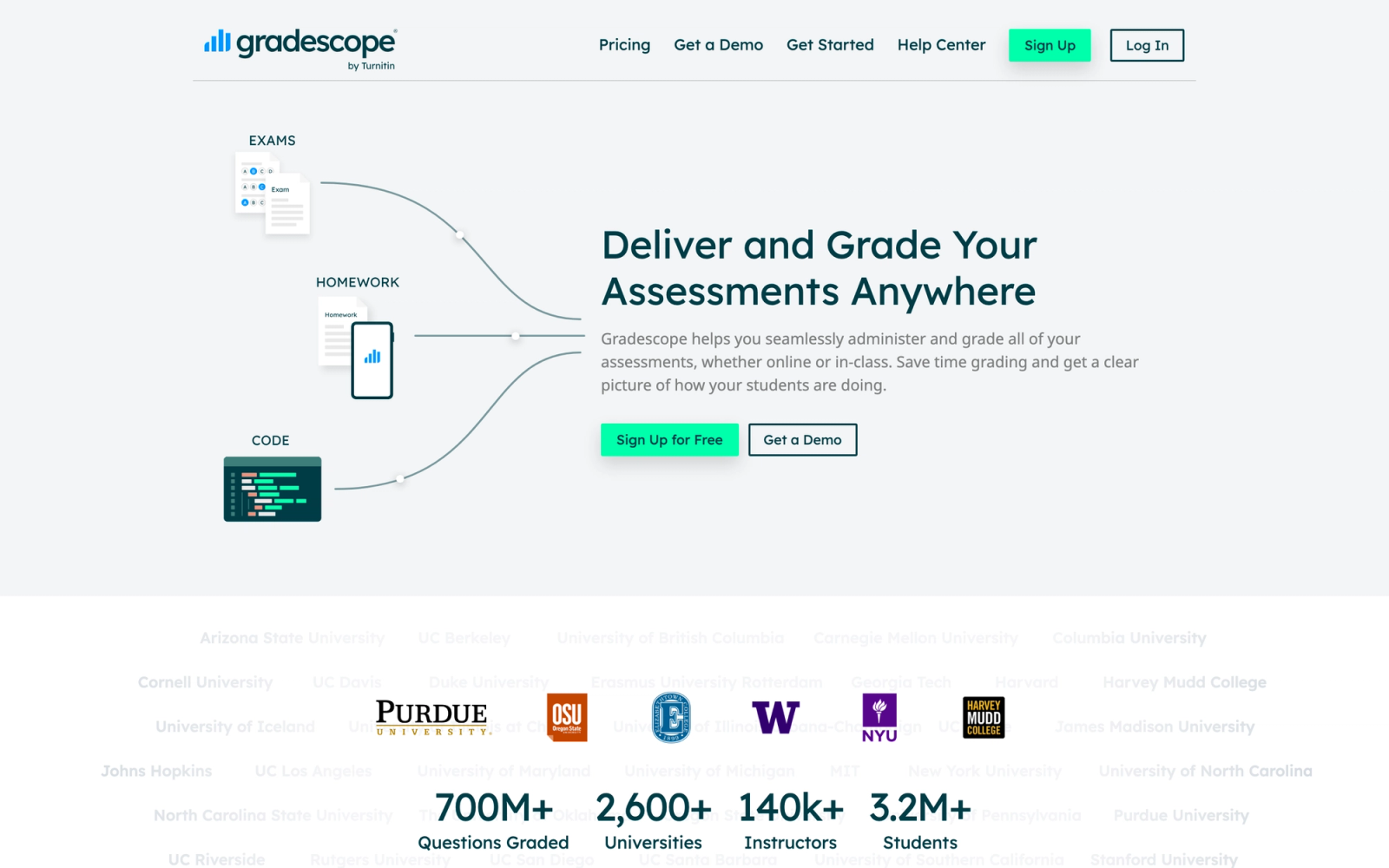
Gradescope uses AI to speed up grading across a range of assessment types: exams, homework, code, and projects. The platform groups similar student responses and suggests rubric items, allowing instructors and TAs to grade batches of similar answers simultaneously rather than one at a time. While Gradescope is primarily an instructor grading tool, its rubric infrastructure and collaborative grading workflows make it relevant as a PeerStudio alternative for programs that want AI-assisted assessment at scale.
The AI-assisted rubric feature is the most distinctive part of Gradescope's approach. After an instructor grades a handful of responses, Gradescope identifies patterns and suggests how remaining submissions might be categorized. This can compress a ten-hour grading session to a fraction of that time, particularly for large-enrollment courses. The platform handles both digital and scanned paper submissions.
Core Capabilities
- AI-assisted answer grouping that clusters similar responses for batch grading
- flexible rubric builder that evolves as graders apply criteria to real submissions
- Support for handwritten, typed, code, and multiple-choice submissions
- Automated grading for multiple-choice, fill-in-the-blank, and programming assignments
- Collaborative grading workflows where multiple TAs grade different questions on the same assessment
- Regrade request system where students can dispute specific rubric items
- Detailed grade analytics with score distributions, question-level performance, and tag-based analysis
- LTI integration with Canvas, Blackboard, Moodle, and Brightspace
- Scanned paper exam processing with automatic question detection
- Code autograding with custom test cases for programming courses
Standout Strength
The AI-assisted answer grouping is the most significant efficiency gain on this list for instructor-side grading. No other tool here replicates the ability to apply a single rubric decision to a batch of similar responses simultaneously. For courses with large enrollments and recurring assessments, that time reduction compounds across every assignment.
Best For
STEM departments and large-enrollment courses where grading efficiency is the primary bottleneck. Particularly strong for math, physics, computer science, and engineering courses with problem-based assessments where answer grouping provides the greatest time savings.
Pricing Overview
- Free plan available for individual instructors with basic features
- Institutional licensing through Turnitin (Gradescope's parent company)
- Pricing based on institutional size and feature tier
- Contact sales for institutional pricing
Limitations
- Gradescope is a grading tool, not a peer assessment platform. There is no student-to-student review workflow. Its relevance as a PeerStudio alternative is limited to programs where AI-assisted instructor grading can replace the need for peer review.
- The AI grouping works best for structured, convergent responses (math problems, short answers). Open-ended essays or creative projects benefit less from the clustering approach.
- Requires Turnitin institutional relationship for full-featured access at many institutions.
Quick Comparison Insight
The best choice when the goal is faster instructor grading rather than peer feedback. Gradescope and peer review tools solve different problems, but for programs considering whether AI-assisted grading could replace peer assessment, it is worth evaluating.
Perusall
Overview
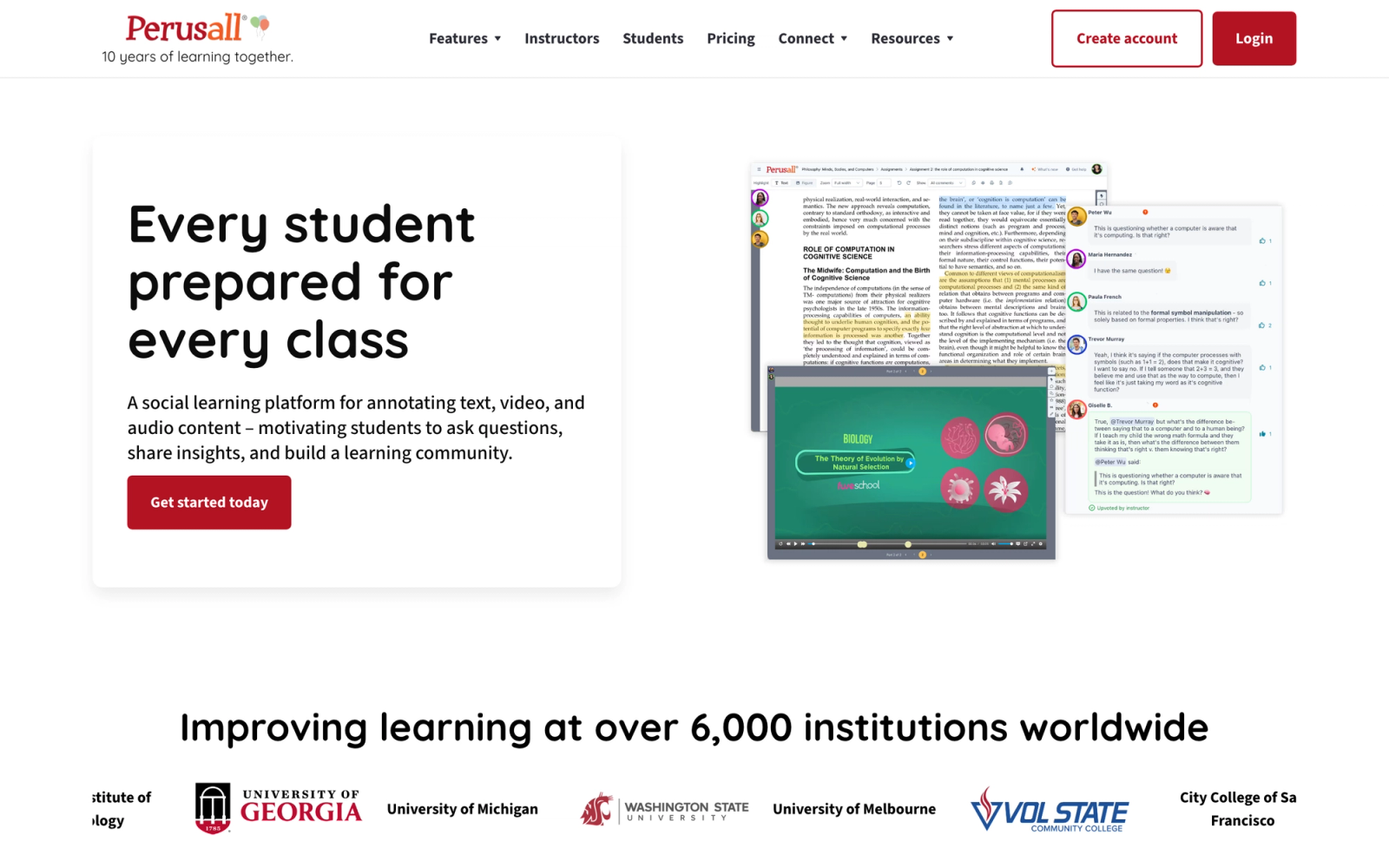
Perusall reframes peer interaction around reading rather than writing. The platform turns assigned readings into collaborative experiences where students annotate, highlight, comment on, and discuss texts together in the margins. It is social annotation rather than traditional peer review, but the result is a form of peer-to-peer assessment where students evaluate and build on each other's interpretations of course material.
The approach works because it makes reading visible. Instructors can see who engaged with which sections, what questions students raised, and where confusion clusters. The "Confusion Report" identifies passages where annotation patterns suggest difficulty, giving instructors usable data before the next class session. For flipped or blended models, that pre-class engagement picture directly shapes how instructors use in-class time.
Core Capabilities
- Social annotation tools allowing students to highlight, comment, and reply to each other within assigned readings
- Support for PDFs, ePubs, web pages, and video content with timestamped annotation
- AI-generated engagement scoring based on annotation quality, quantity, and interaction patterns
- Confusion Report that identifies passages where student annotations suggest difficulty
- Automatic reading assignment grading based on annotation engagement metrics
- LTI integration with Canvas, Blackboard, Moodle, Brightspace, and most LMS platforms
- Publisher partnerships providing access to annotatable textbook content
- Threaded discussions within the document margin for focused, context-specific conversation
- Instructor analytics showing per-student and per-section engagement
- Group formation tools for smaller reading discussion cohorts
Standout Strength
Perusall makes the pre-class reading experience collaborative and measurable. The automatic engagement scoring gives instructors a graded reading assignment without manual review, while the social annotation creates a form of peer-to-peer intellectual exchange directly in the course material. No other tool on this list addresses reading engagement as its primary function.
Best For
Courses in humanities, social sciences, law, and any discipline where assigned reading is central to the learning experience. Strong for flipped classroom models where pre-class reading engagement directly impacts in-class discussion quality.
Pricing Overview
- Free for instructors using open-access or uploaded course materials
- Publisher content available through Perusall's integrated bookstore at textbook prices
- No per-student platform fee for basic annotation features
- Institutional licensing available for advanced analytics and features
Limitations
- Not a peer assessment tool in the traditional sense. Students annotate and discuss, but there are no structured rubrics, reviewer assignments, or calibrated feedback workflows for evaluating submitted work.
- The AI engagement scoring is opaque. Students and instructors cannot always understand why a particular annotation received the score it did, which can create frustration.
- Works best for text-heavy disciplines. Courses focused on problem-solving, lab work, or creative production get less value from social annotation.
Quick Comparison Insight
The only tool on this list focused on peer interaction during reading rather than after submission. Perusall is not a replacement for structured peer review, but it fills a gap that no traditional assessment tool addresses.
Eli Review
Overview
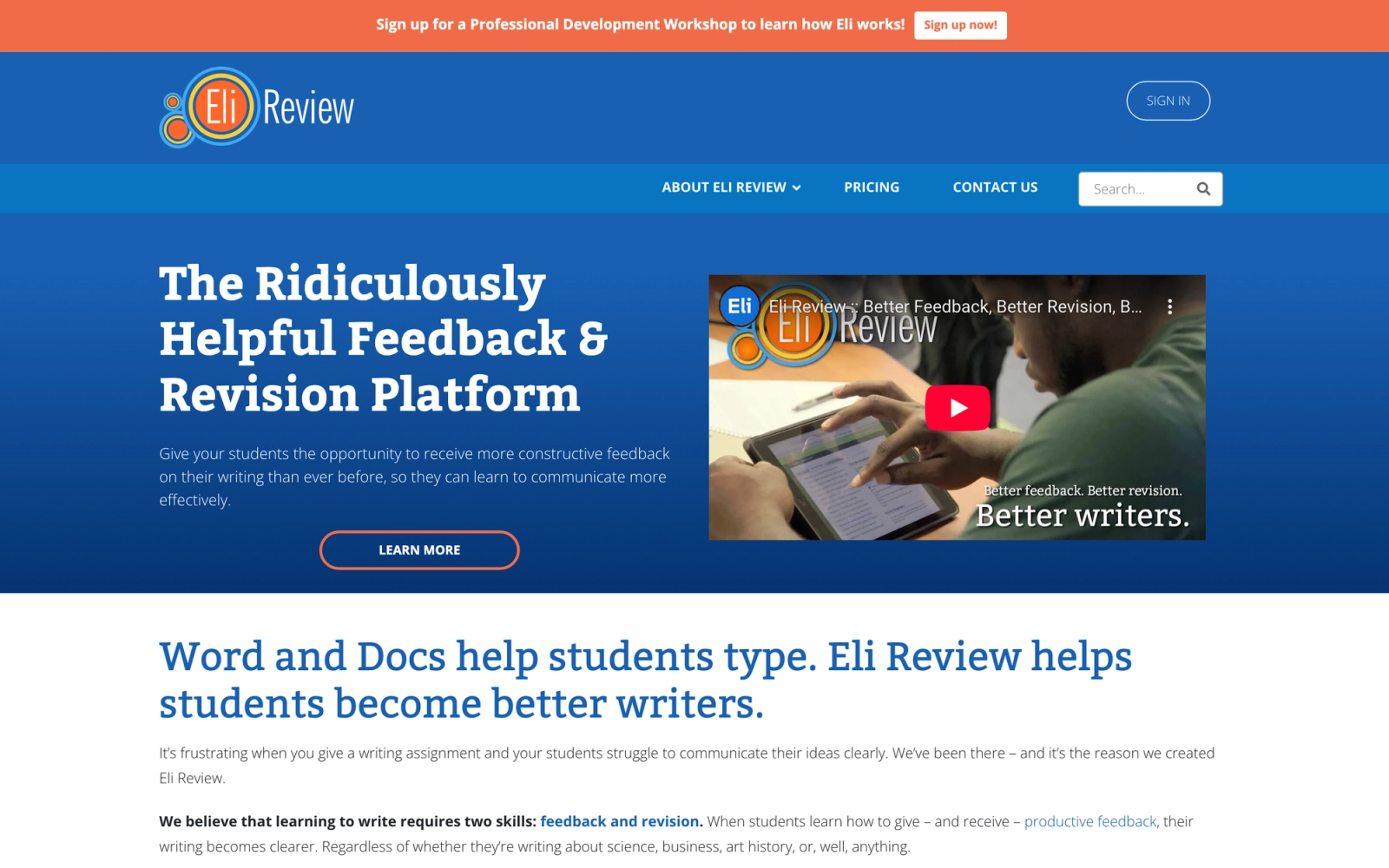
Eli Review is built specifically for writing pedagogy. The platform operationalizes the revision cycle that writing instructors know produces better writers: write, give feedback, revise based on feedback, and reflect on the process. Every feature is designed around this pedagogical model, making it the most writing-instruction-specific peer feedback tool on this list.
What separates Eli Review from general peer review tools is its emphasis on what happens after feedback. The platform tracks whether students actually use the peer feedback they receive in their revisions. The "revision plan" feature asks students to explicitly identify which feedback they will incorporate and which they will set aside, with reasoning. This closes the feedback loop in a way that generic review tools do not, turning peer review into a genuine formative assessment practice rather than a grading exercise.
Core Capabilities
- Review task builder with structured criteria, comment prompts, and Likert-scale ratings aligned to writing pedagogy
- Revision plan feature where students map received feedback to specific revision decisions
- Helpfulness ratings that let writers evaluate the usefulness of each piece of feedback they received
- Review quality analytics that surface patterns in feedback giving and receiving across the class
- Flexible grouping options for review assignments (random, instructor-assigned, or criteria-based)
- Support for text submissions with inline commenting
- Instructor dashboard showing write-review-revise cycle completion and engagement
- Writing analytics that track feedback patterns across multiple drafts
- Export capabilities for grades and review data
- Designed for integration with writing program administration workflows
Standout Strength
The revision plan and feedback-to-revision tracking. Eli Review is the only platform on this list that explicitly connects peer feedback to subsequent revision behavior. For writing instructors, this is the missing piece in most peer review tools: evidence that peer feedback actually influenced the writing.
Best For
Writing programs, composition courses, and any instructional context where the revision cycle is the primary learning mechanism. Particularly strong for first-year writing programs, WAC/WID (Writing Across the Curriculum / Writing in the Disciplines) initiatives, and graduate-level writing workshops.
Pricing Overview
- Per-student pricing, typically low cost per student per semester
- Volume discounts available for writing programs and departments
- Free trial available for evaluation
- Contact sales for institutional pricing
Limitations
- Exclusively focused on writing. Does not support multimedia, presentation, design, or code submissions.
- The platform design reflects writing pedagogy assumptions. Instructors in other disciplines may find the workflow overly prescriptive for their assessment needs.
- Smaller user base and development team compared to platforms like Turnitin or FeedbackFruits. Feature updates and support responsiveness may be slower.
Quick Comparison Insight
The most pedagogically intentional peer feedback tool for writing instruction. Narrow focus, but for writing programs, no other platform matches its alignment with revision-based pedagogy.
How to Choose the Right Alternative
The right PeerStudio alternative depends on your specific context. Choosing based on feature lists alone misses the operational and pedagogical differences between these tools.
If calibrated peer review accuracy is your priority, start with Peerceptiv. Its research-backed calibration system produces the most statistically reliable peer ratings. This matters most in courses where peer review scores contribute directly to grades.
If peer assessment must live inside your existing LMS, FeedbackFruits offers the deepest LTI integration, activities, submissions, and grades all stay within Canvas or Blackboard. Turnitin Feedback Studio is a lower-friction addition if your institution already holds a Turnitin license.
If you want review quality to improve organically over a semester, Kritik's reputation-based scoring rewards thoughtful reviewers and deprioritizes careless ones without requiring instructor-managed calibration exercises.
If rubric design flexibility is critical, Peergrade gives instructors the most control over how reviewers step through evaluation criteria. This works best when the instructor has strong instructional design expertise in rubric construction.
If your bottleneck is grading efficiency rather than peer feedback, Gradescope's AI-assisted answer grouping and Crowdmark's distributed TA grading workflows solve the logistics problem from the instructor side.
If you teach writing and want feedback tied to revision, Eli Review's pedagogical model explicitly connects peer feedback to student revision behavior. No other tool tracks whether feedback actually influenced the rewrite.
If peer reading engagement matters, Perusall fills a niche no other tool addresses by turning assigned readings into collaborative, annotated discussions.
If you run cohort-based programs where peer review, group projects, community, and live sessions all need to work together, a unified platform eliminates the tool-stitching problem and keeps all learner activity in one place.
A practical approach: identify whether your primary need is specialized peer assessment (Peerceptiv, Kritik, FeedbackFruits, Peergrade, Eli Review), efficient instructor grading (Gradescope, Crowdmark), an extension of your existing tools (Turnitin, FeedbackFruits), or a unified collaborative learning environment. That narrows the field to two or three options you can pilot with a real course.
FAQ
What is PeerStudio and why are people looking for alternatives?
PeerStudio is a peer review platform that uses algorithmic matching to facilitate structured peer feedback on student submissions. People look for alternatives because the platform's feature set is limited compared to newer tools, particularly around LMS integration, multimedia support, rubric flexibility, and analytics depth. Institutions also weigh vendor stability when selecting assessment infrastructure.
Can peer assessment really replace instructor grading?
Not entirely, but it can dramatically reduce the grading burden while improving learning outcomes. Research shows that well-designed peer review with calibration produces ratings that correlate strongly with expert instructor ratings. The pedagogical value is also distinct: students who review peers' work develop critical evaluation skills that passive assessment does not build. Most effective implementations use peer assessment as a formative assessment complement to instructor evaluation, not a full replacement.
Which tool is best for large courses with 300+ students?
Peerceptiv and Kritik are purpose-built for large-enrollment peer assessment. Crowdmark and Gradescope handle large courses from the instructor grading side. FeedbackFruits scales well within LMS environments. The choice depends on whether you need peer-to-peer feedback (Peerceptiv, Kritik) or efficient instructor/TA grading workflows (Crowdmark, Gradescope).
Do these tools integrate with Canvas, Blackboard, or Moodle?
Most do. FeedbackFruits has the deepest LMS integration through LTI 1.3, with full grade passback and embedded activity support. Peerceptiv, Kritik, Peergrade, Turnitin, Gradescope, and Perusall all offer LTI integration with major LMS platforms. Integration depth varies, so test the specific workflows that matter for your courses.
What is the difference between calibrated peer review and reputation-based scoring?
Calibrated peer review (Peerceptiv's approach) trains reviewers by having them evaluate instructor-benchmarked sample submissions before live peer review. Reviewers who score accurately get higher weight. Reputation-based scoring (Kritik's approach) adjusts reviewer influence based on feedback quality ratings from the students who received their reviews. Calibration gives more control upfront; reputation scoring improves organically over time.
Is there a free peer assessment tool I can try?
Several options have free tiers. Peergrade offers a free plan for small classes. Kritik has a limited free tier. Crowdmark and Gradescope provide free plans for individual instructors. Perusall is free when using open-access or uploaded course materials. Most other tools offer free trials or pilot programs for evaluation.
Can I use these tools for group project assessment?
FeedbackFruits includes a dedicated group member evaluation module. Peergrade and Teachfloor support group assignments with individual accountability tracking. Other tools on the list focus primarily on individual submission review. If group assessment is a core need, prioritize platforms that explicitly support team contribution evaluation rather than tools designed for individual peer review.
How do I ensure students take peer review seriously?
Three approaches work: calibration training (Peerceptiv), reputation consequences (Kritik), and structured rubrics with mandatory comment fields (Peergrade, FeedbackFruits). The common element is accountability. When students know their review quality is measured and has consequences, either for their grade or their standing, review effort increases. Back-evaluation stages, where writers rate the helpfulness of reviews they received, add another accountability layer.


