


Why Look for a Peerceptiv Alternative?
Peerceptiv introduced calibrated peer review to higher education in a structured, research-backed way. Its core idea was sound: train students to evaluate peer work against faculty-calibrated standards, then use those evaluations as both a learning tool and a grading mechanism. For writing-intensive courses and large lecture sections, it solved a real problem.
But the platform has not kept pace with what instructors and institutions now expect from online assessment tools. The interface feels dated. Assignment setup requires significant upfront configuration that discourages faculty who teach across multiple sections. LMS integration options remain narrow, and the calibration workflow, while pedagogically solid, adds friction that many students find confusing rather than instructive.
Pricing is another pressure point. Institutional licensing costs are opaque, and per-student models become expensive at scale. For departments already stretched on software budgets, the value proposition has to justify itself against newer tools that bundle peer review with broader assessment and feedback capabilities.
There is also the question of scope. Peerceptiv was built almost exclusively for calibrated peer review of written work. If you need peer assessment for presentations, code, multimedia projects, or group work, you will hit the walls quickly. The Peerceptiv alternatives in this article cover that wider range while still supporting the structured review workflows that made Peerceptiv useful in the first place.
What to Look for in a Peer Review Platform
Choosing a replacement is not just about matching Peerceptiv feature-for-feature. It is about identifying what your courses actually require from a peer review and assessment tool.
Calibration and reviewer training. Peerceptiv's strongest feature was calibration: students reviewed instructor-scored samples before evaluating peers. If this matters for your assessment design, look for platforms that replicate or improve on that training step. Not every tool includes it.
Rubric flexibility. A good formative assessment tool should let you build custom rubrics with weighted criteria, qualitative comments, and multiple scoring scales. Templates are helpful, but rigid rubric formats will limit how you assess different assignment types.
Anonymous and identified review modes. Some courses benefit from blind peer review to reduce bias. Others work better when students know who is evaluating their work. The platform should support both configurations.
LMS integration. If your institution runs Canvas, Blackboard, Moodle, or Brightspace, the peer review tool needs to connect cleanly. LTI 1.3 compliance is the standard to look for. Standalone tools that require separate student logins create adoption friction. Strong LMS integrations save time for both faculty and students.
Feedback quality controls. Raw peer feedback varies wildly. The best platforms include mechanisms to improve feedback quality: minimum word counts, structured comment prompts, back-evaluation (rating the reviewer), or AI-assisted feedback analysis.
Analytics and reporting. Faculty need to see participation rates, score distributions, reviewer reliability, and individual performance over time. Solid learning analytics turn peer review from a checkbox activity into a genuine assessment strategy.
Scalability. A tool that works for a 25-student seminar should also handle a 400-student lecture section without manual overhead becoming unmanageable.
10 Best Peerceptiv Alternatives
The platforms below range from purpose-built peer review tools to broader assessment and learning platforms with strong peer feedback capabilities, organized to cover different use cases, institution sizes, and pedagogical priorities.
Tool Calibration Rubric Builder LMS Integration Anonymous Review Best For FeedbackFruits ✓ ✓ ✓ ✓ Universities wanting a full peer review suite inside their LMS Kritik ✓ ✓ ✓ ✓ Institutions using AI-powered motivation and scoring Peergrade ✓ ✓ ✓ ✓ Instructors needing structured peer feedback with minimal setup Turnitin Feedback Studio ✗ ✓ ✓ ✓ Institutions bundling plagiarism detection with peer review Crowdmark ✗ ✓ ✓ ✓ Large STEM courses with handwritten or multi-format submissions Gradescope ✗ ✓ ✓ ✗ High-volume grading with AI-assisted rubric grouping Perusall ✗ ✓ ✓ ✗ Courses built around social reading and annotation Eli Review ✓ ✓ ✓ ✓ Writing-intensive courses focused on revision cycles Packback ✗ ✗ ✓ ✗ AI-moderated student discussion and inquiry-based learning Teachfloor ✗ ✓ ✓ ✓ Cohort-based programs with built-in peer review workflows
Teachfloor

Overview
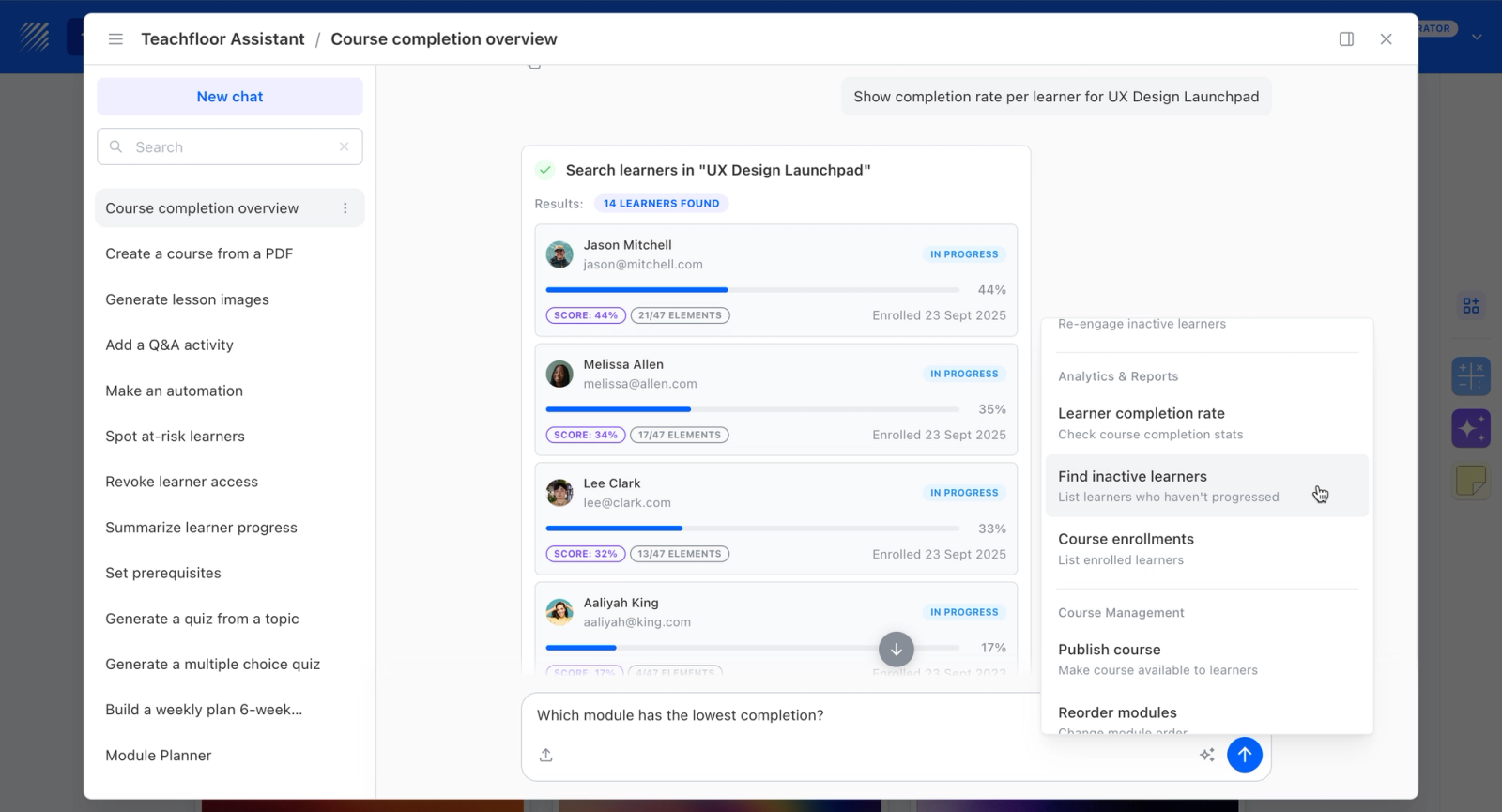
Teachfloor offers calibrated, rubric-anchored peer review like Peerceptiv, but inside a course platform you fully brand and run on your own domain. Instructors define the evaluation criteria, students assess multiple peers against them, and those reviews are weighted into grades, with the option to keep reviewers anonymous or named. The difference is reach: where Peerceptiv stays a research-grounded tool aimed at university writing and lecture courses, Teachfloor extends the same disciplined review model to corporate training, professional cohorts, and bootcamps. It keeps the rigor of structured peer assessment without tying you to an academic LMS context.
Core Capabilities
- Criteria-anchored rubrics that hold every reviewer to the same standard, the core of calibrated review
- Reviews weighted into grades, treating peer evaluation as assessment rather than a side activity
- Anonymous or named review modes selectable per assignment to fit sensitive or open feedback
- White-label delivery on your own domain so the review experience carries your brand, not a vendor's
- SCORM support and certificates for programs that need portable content and credentialing
- Self-paced or cohort options so review cycles fit either continuous enrollment or fixed terms
Best For
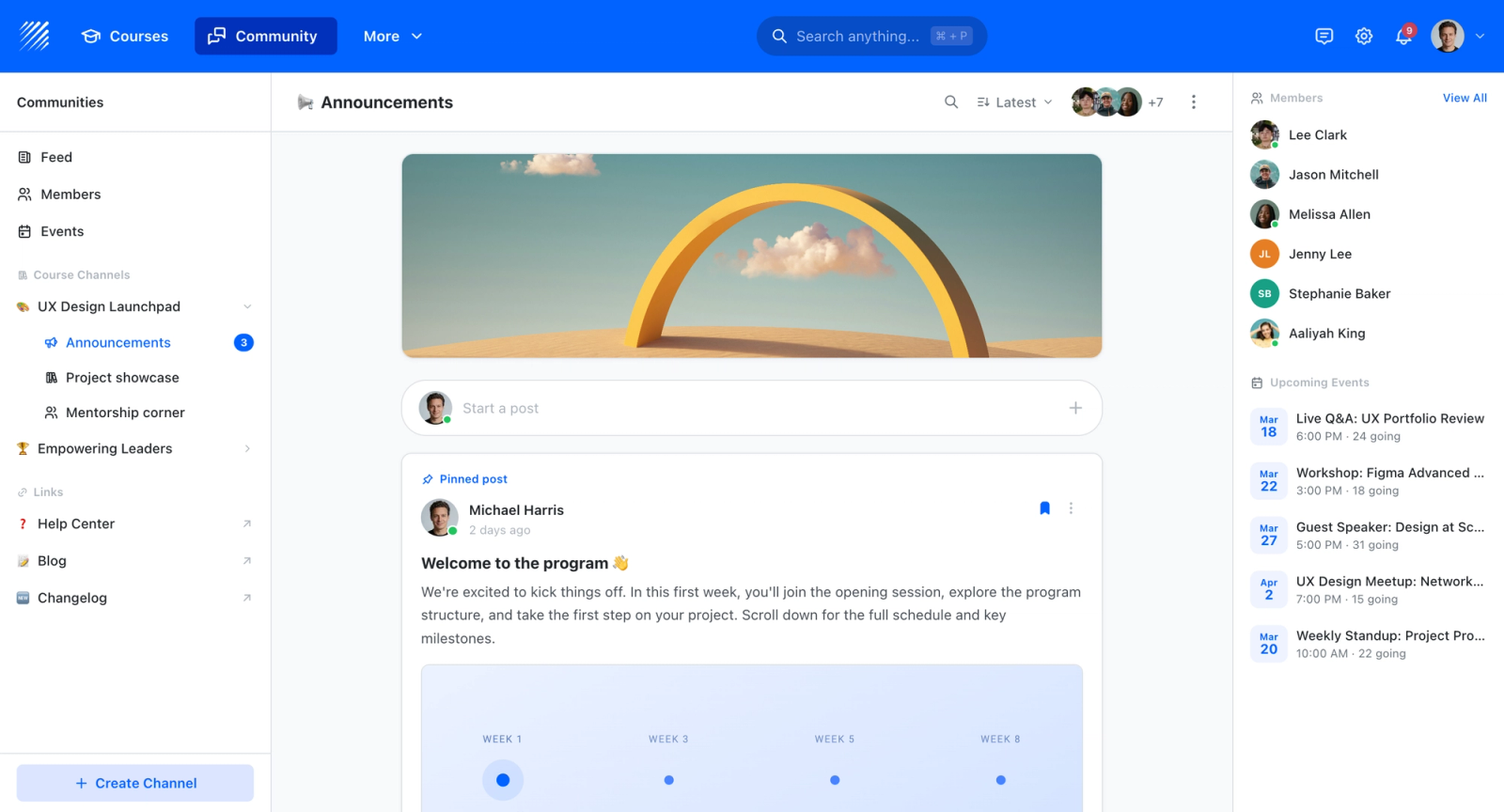
Teams that want Peerceptiv's calibrated, criteria-based review discipline but applied to branded professional or corporate programs rather than academic writing courses.

Pricing Overview
- Startup plan from $89 per month for up to 50 learners
- Full Features plan with custom pricing, white-label, SSO, and advanced integrations
- 14-day free trial; no permanent free plan
- Nonprofit discounts available
Limitations
- No permanent free plan; entry tier is $89/mo for up to 50 learners with a 14-day trial
- Does not carry Peerceptiv's published academic research validation or its writing-pedagogy specialization
- Not a drop-in tool for an existing university LMS; it is a platform you run programs on
Quick Comparison Insight
Versus Peerceptiv, FeedbackFruits, and Peergrade, Teachfloor keeps the calibrated rubric model but delivers it through a white-label course platform, making it the choice when peer review needs to live inside your own branded program rather than a university system.
FeedbackFruits

Overview
FeedbackFruits is a suite of pedagogical tools designed specifically for higher education. Rather than offering a single monolithic platform, it delivers modular activities: Peer Review, Group Member Evaluation, Interactive Study Materials, Comprehension, and more. Each module plugs directly into your existing LMS through LTI integration.
What sets FeedbackFruits apart as a Peerceptiv alternative is the depth of its peer review configuration. Instructors can design multi-stage review workflows where students submit, review peers using custom rubrics, reflect on feedback received, and revise. The platform includes calibration options, feedback quality indicators, and AI-driven analytics that surface students who may need additional support.
The group member evaluation module is worth noting for team-based courses. Students assess each other's contributions using configurable criteria, and those scores feed into individual grades, a direct mechanism for addressing the free-rider problem that plagues group assignments across disciplines.
Best For
Universities and colleges that want a full peer learning toolkit, peer review, group evaluation, social annotation, integrated into Canvas, Blackboard, Brightspace, or Moodle via LTI without standalone student accounts.
Key Features
- Modular peer review, group evaluation, and interactive document activities
- Custom rubric builder with weighted criteria and qualitative feedback fields
- Multi-stage review workflows: submit, review, reflect, revise
- AI-powered feedback quality analysis and reviewer reliability metrics
- LTI 1.3 integration with Canvas, Blackboard, Brightspace, Moodle
- Anonymous and identified review configurations
- Automated assignment of reviewers with configurable group sizes
- Instructor dashboard with participation tracking and score distributions
Pricing
Institutional licensing model. Pricing varies by institution size and modules selected. No public per-student pricing. Free pilot programs available for evaluation.
Limitation
The modular structure means you pay for each activity type separately. Smaller departments may find the licensing negotiation process slow. The interface, while functional, takes time for students to learn on first use.
Kritik

Overview
Kritik combines peer assessment with a motivation scoring system that tracks and rewards student engagement across the review process. Students create, evaluate, and provide feedback on peer work. Each student receives a "Kritik Score" based on the quality of their evaluations over time, creating an incentive to take peer review seriously rather than rushing through it.
The AI layer analyzes feedback quality in real time, flagging superficial or off-topic comments. This addresses one of the biggest complaints instructors have about peer review: inconsistent feedback quality. The platform also uses the accumulated evaluation data to weight peer scores, meaning a student with a strong track record of accurate reviewing carries more influence in the final assessment.
For courses where students treat peer review as a chore, Kritik's combination of gamification and quality tracking changes the incentive structure: reviewers who invest effort earn more influence over grades, making thoroughness rational rather than optional.
Best For
Institutions and instructors who want AI-powered quality control over peer assessments, along with built-in motivation mechanics to improve reviewer effort.
Key Features
- AI-powered feedback quality analysis with real-time flagging
- Kritik Score system that tracks reviewer reliability over time
- Weighted peer scoring based on evaluator track record
- Custom rubric creation with multiple evaluation criteria
- Support for text, image, video, and file-based submissions
- LTI integration with Canvas, Blackboard, Brightspace, Moodle
- Anonymous peer review with configurable reviewer assignments
- Instructor override and moderation tools
Pricing
Per-student pricing model. Institutional licensing available. Free trial period for instructors. Contact sales for volume pricing.
Limitation
The motivation scoring system adds complexity that some students find confusing initially. The platform works best when used consistently across a semester, making one-off assignments less impactful. The AI feedback analysis, while useful, sometimes flags legitimate concise feedback as low quality.
Peergrade
Overview
Peergrade focuses on making structured peer feedback accessible without a steep learning curve. Instructors create assignments, define rubrics, and set review criteria. Students submit work, receive random or instructor-assigned peer reviewers, and provide feedback using the rubric. A back-evaluation step lets students rate the usefulness of feedback they received.
The simplicity is the point. Where Peerceptiv required calibration exercises and multi-phase setup, Peergrade gets a peer review cycle running in minutes. The rubric builder supports both quantitative scales and open-ended comment prompts, and the platform handles reviewer assignment automatically.
The "feedback on feedback" loop is Peergrade's most useful accountability mechanism. When students rate the quality of reviews they received, it creates a record of who is contributing meaningfully versus coasting, data instructors can act on without manually auditing every review thread.
Best For
Instructors across disciplines who need a straightforward peer feedback tool that works for essays, projects, presentations, and multimedia submissions without requiring extensive training or calibration setup.
Key Features
- Drag-and-drop rubric builder with quantitative and qualitative criteria
- Automatic and manual reviewer assignment options
- Back-evaluation system for rating feedback quality
- Support for text, file, image, video, and link submissions
- Anonymous and identified review modes
- LTI integration with major LMS platforms
- Instructor dashboard with feedback quality metrics and participation tracking
- Customizable review deadlines and late submission handling
Pricing
Free tier available for individual instructors with limited features. Institutional plans with volume pricing. Contact for academic licensing.
Limitation
The free tier is restrictive for larger classes. Calibration features are not as developed as Peerceptiv's original calibration workflow. The platform is less suited for high-stakes summative assessment where precise score alignment matters.
Turnitin Feedback Studio
Overview
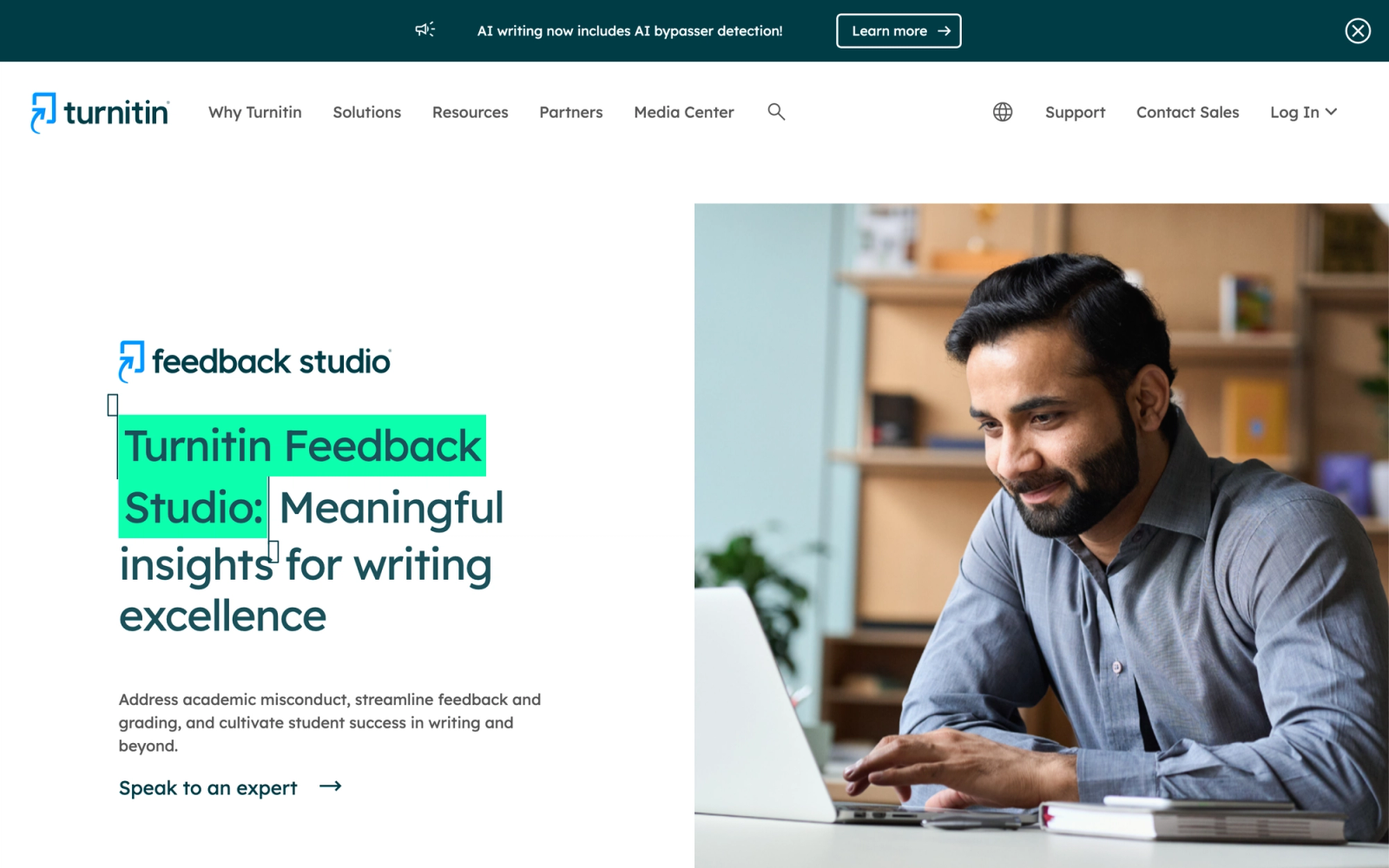
Turnitin is already embedded in most university workflows for plagiarism detection. Feedback Studio extends that foundation with inline grading tools, customizable rubrics, and a peer review module called PeerMark. For institutions already paying for Turnitin, adding peer review functionality requires no additional student onboarding because the interface is familiar.
PeerMark lets instructors set up peer review assignments where students read and comment on each other's papers directly within the Turnitin environment. Feedback can be anonymous or attributed. The rubric builder supports both holistic and analytic scoring, and instructors can attach QuickMark comments for recurring feedback patterns.
The real advantage here is consolidation. Plagiarism detection, instructor grading, and peer review happen in a single environment. For writing-intensive courses concerned with academic integrity, this combination eliminates the need to juggle multiple tools.
Best For
Institutions already using Turnitin that want to add peer review without introducing a separate platform, especially for writing courses where originality checking and peer feedback happen together.
Key Features
- PeerMark peer review module with anonymous and identified modes
- Originality checking with 99B+ web pages, academic papers, and publications
- Inline grading with drag-and-drop QuickMark comments
- Analytic and holistic rubric builder with criteria weighting
- Feedback summary reports for students
- LTI integration with Canvas, Blackboard, Moodle, Brightspace, and others
- GradeMark for instructor annotation and markup
- Similarity report with source matching and exclusion rules
Pricing
Institutional licensing. Pricing varies by student enrollment and modules. Turnitin does not publish public pricing. Most institutions negotiate multi-year contracts.
Limitation
PeerMark is a secondary feature within Turnitin, not the core product. The peer review workflow is less configurable than purpose-built tools like FeedbackFruits or Kritik. No calibration mechanism for training reviewers. The cost of Turnitin overall is significant, and adding PeerMark access may require a higher licensing tier.
Crowdmark

Overview
Crowdmark started as a collaborative grading platform for large courses, particularly in STEM fields where handwritten exams and problem sets are common. The platform lets instructors upload scanned work, divide it into individual questions, and distribute grading across a team of TAs or faculty. Annotations, comments, and scores are applied directly on the student's original submission.
The peer review functionality in Crowdmark allows students to evaluate each other's work using the same annotation-based interface. This is especially valuable for courses where submissions are not just typed essays but include diagrams, equations, lab reports, or design sketches. Students can circle specific areas, leave contextual comments, and score against defined rubrics.
For departments running large sections with multiple graders, Crowdmark's workflow distributes the grading load evenly and maintains consistency through shared rubrics and grading teams.
Best For
Large STEM and quantitative courses (math, physics, engineering, chemistry) where submissions include handwritten work, diagrams, or mixed-format documents, and where grading needs to be distributed across multiple evaluators.
Key Features
- Upload and grade scanned handwritten exams and assignments
- Question-level grading with distributed evaluator assignment
- Annotation-based inline commenting on any submission format
- Peer review mode with rubric-based student evaluation
- Automatic grade aggregation and export to LMS gradebooks
- Team grading with workload distribution and consistency tools
- LTI integration with Canvas, Blackboard, Brightspace
- Detailed analytics on grade distributions and grader patterns
Pricing
Free tier for individual instructors. Institutional licensing with volume pricing based on enrollment. Contact for pricing.
Limitation
Crowdmark's strengths are in grading and assessment workflow, not in structured peer review pedagogy. It lacks calibration features, reviewer training, and the feedback quality controls found in peer review-specific platforms. Better suited as a grading accelerator than a dedicated peer learning tool.
Gradescope
Overview
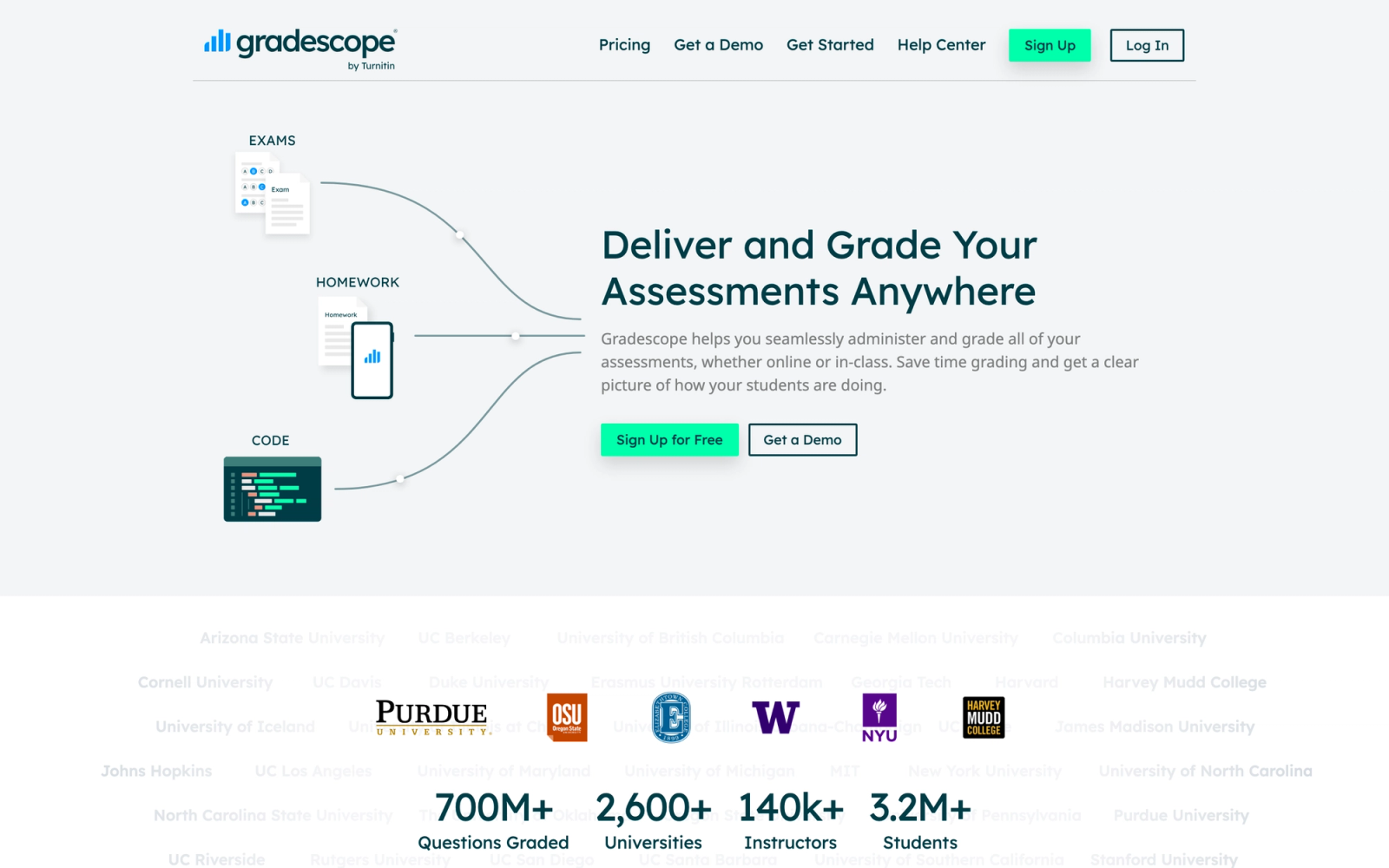
Gradescope, now part of the Turnitin family, uses AI to accelerate grading for both handwritten and digital submissions. The core feature is AI-assisted answer grouping: after an instructor grades one instance of a particular answer type, Gradescope identifies similar responses across the class and applies the same rubric item. For a 300-student exam, this can reduce grading time from hours to minutes.
While Gradescope is primarily an instructor grading tool rather than a peer review platform, its rubric infrastructure and submission handling make it relevant as a Peerceptiv alternative for courses where the primary need is efficient, consistent assessment at scale. Instructors define detailed rubrics, and the platform enforces consistent application across all submissions.
The AI grouping capability works well for courses with predictable answer patterns, particularly in STEM. Handwritten work recognition has improved steadily, and institutions already running Turnitin get originality checking on the same submissions without a separate tool.
Best For
High-volume courses in STEM and quantitative fields where consistent rubric-based grading at speed matters more than peer-to-peer feedback workflows.
Key Features
- AI-assisted answer grouping for rapid rubric application
- Support for handwritten, typed, and code-based submissions
- flexible rubric builder with regrade request workflow
- Bubble sheet and multiple-choice scanning
- Programming assignment auto-grading with code execution
- LTI integration with Canvas, Blackboard, Brightspace, Sakai
- Time-limited online assessments with submission tracking
- Grade export and synchronization with LMS gradebooks
Pricing
Free tier for individual courses. Institutional licensing through Turnitin. Contact for pricing based on enrollment and feature set.
Limitation
Gradescope is a grading tool, not a peer assessment platform. It offers no student-to-student review, no calibration, and no feedback exchange between learners. It belongs in this list because a portion of instructors leaving Peerceptiv are solving a grading efficiency problem, not a peer learning problem, and Gradescope solves the former better than most alternatives here.
Perusall
Overview
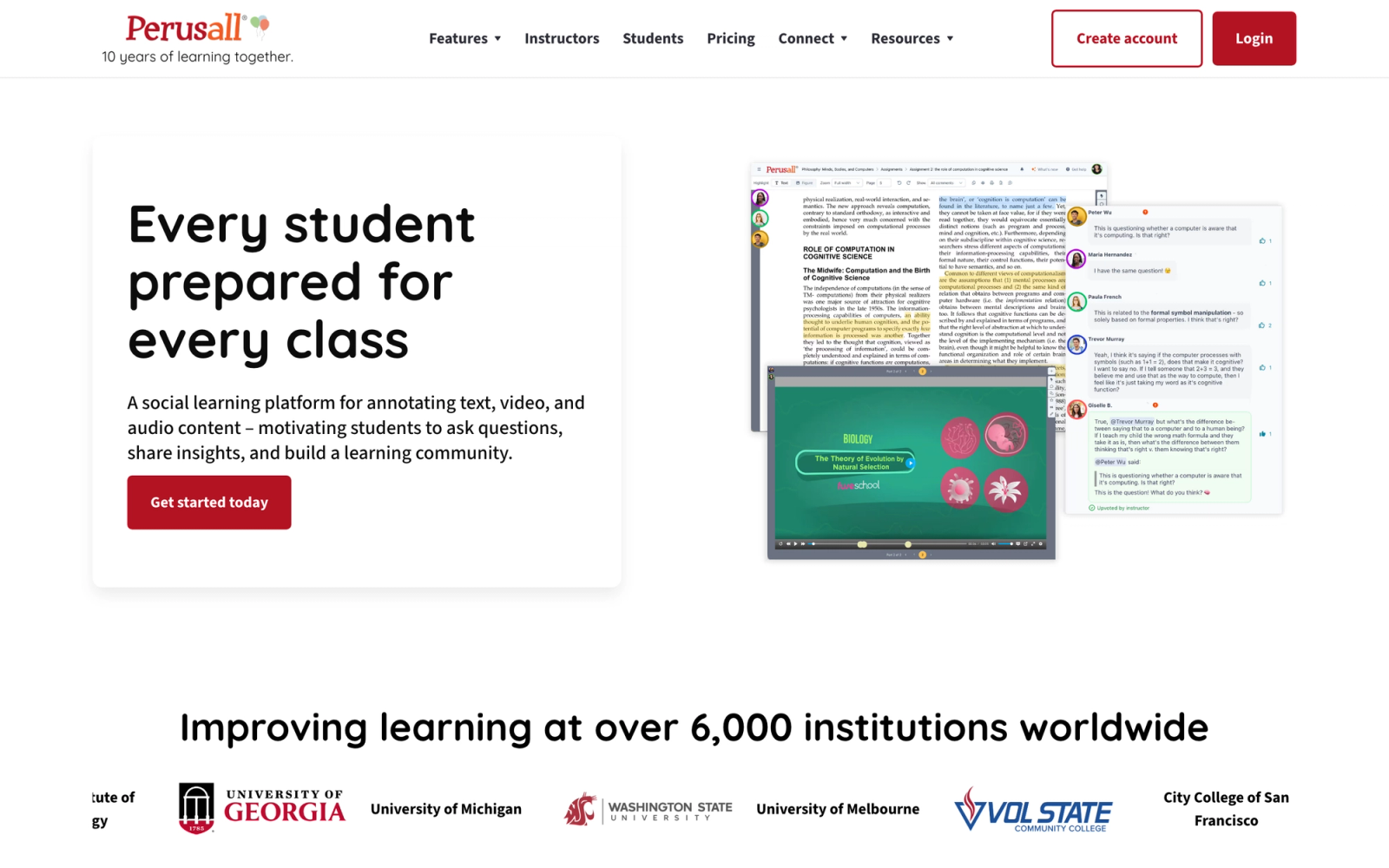
Perusall takes a different approach to peer engagement. Instead of reviewing finished assignments, students annotate readings collaboratively. The platform assigns readings, and students highlight passages, ask questions, and respond to each other's comments directly in the document. An AI scoring engine evaluates the quality and quantity of annotations to generate participation grades.
This model makes Perusall more of a collaborative learning platform for pre-class preparation than a traditional peer review tool. But for instructors who used Peerceptiv primarily to get students engaging critically with text, Perusall achieves a similar outcome through a different mechanism: collaborative annotation instead of post-submission review.
The AI scoring system analyzes comment depth, relevance, and interaction patterns. It distinguishes between a student who writes "I agree" and one who poses a substantive follow-up question. This automated quality assessment reduces the grading burden for instructors managing large sections.
Best For
Courses structured around reading-heavy syllabi where the goal is to ensure students engage deeply with assigned texts before class, especially in humanities, social sciences, and law.
Key Features
- Social annotation on PDFs, websites, EPUBs, and video content
- AI-powered automatic scoring based on annotation quality and engagement
- Threaded discussions within document annotations
- Confusion reports that flag passages where students struggle
- Pre-class reading analytics showing completion and engagement
- LTI integration with Canvas, Blackboard, Brightspace, Moodle
- Publisher partnerships for integrated textbook access
- Customizable scoring rubrics for annotation evaluation
Pricing
Free for instructors when using open-access materials. Publisher-integrated content may carry per-student textbook costs. Institutional licensing available.
Limitation
Perusall does not support submission-based review, rubric-graded evaluation, or calibrated assessment. If the core use case is having students submit and evaluate completed work, Perusall does not fill that role. It works alongside a peer review platform, not instead of one.
Eli Review
Overview
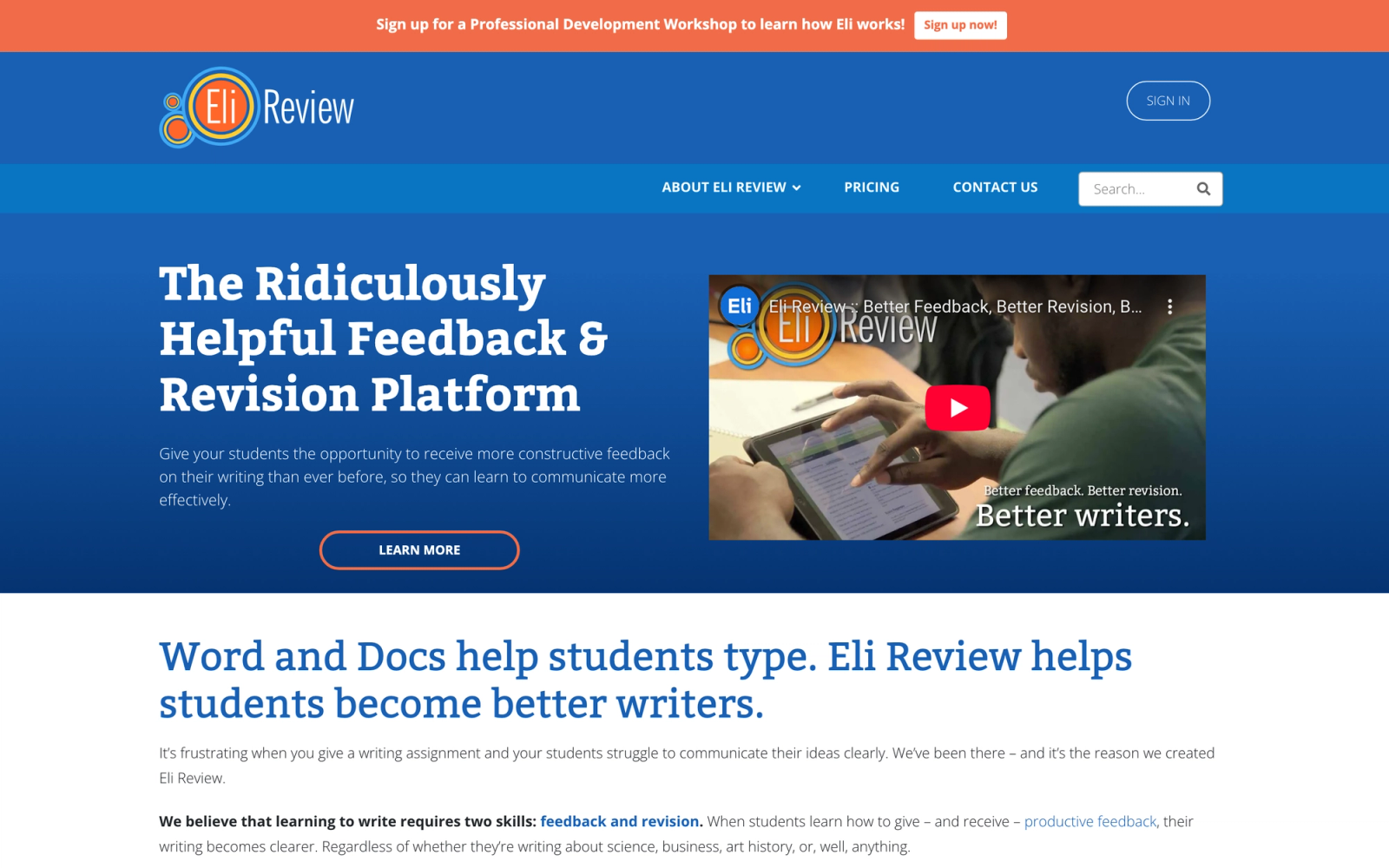
Eli Review was built by writing studies researchers specifically for revision-focused peer feedback. The platform structures the feedback process around the idea that review exists to improve the next draft, not just to assign a score. Students submit drafts, review peers using instructor-designed prompts, and then write revision plans based on the feedback they received.
This three-step model (write, review, revise) aligns with how writing pedagogy actually works. The review prompts guide students to focus on specific rhetorical choices rather than surface-level editing. Helpfulness ratings let writers flag which feedback was actionable, creating data that instructors can use to coach better reviewing.
For writing-intensive courses, Eli Review's approach is closer to what Peerceptiv aimed for than most alternatives. The emphasis is on using peer review as a tool for instructional design that drives revision, not just on generating a number.
Best For
Writing-intensive courses in composition, rhetoric, English, and communication where the pedagogical goal is iterative revision through structured peer feedback.
Key Features
- Write-Review-Revise workflow designed for iterative feedback cycles
- Instructor-designed review prompts targeting specific writing criteria
- Helpfulness ratings where writers evaluate feedback quality
- Revision plans that link received feedback to planned changes
- Instructor analytics on feedback patterns and revision effectiveness
- Support for multiple draft rounds within a single assignment
- LTI integration with major LMS platforms
- Class-level and student-level participation reports
Pricing
Subscription-based pricing. Per-student rates available for individual instructors. Institutional licensing for departments and programs. Contact for pricing.
Limitation
Eli Review is purpose-built for writing. It does not handle non-text submissions (video, code, design) well. The platform's focus on revision pedagogy means it is less useful for one-off assessment tasks. The interface is functional but not visually modern compared to newer platforms.
Packback
Overview
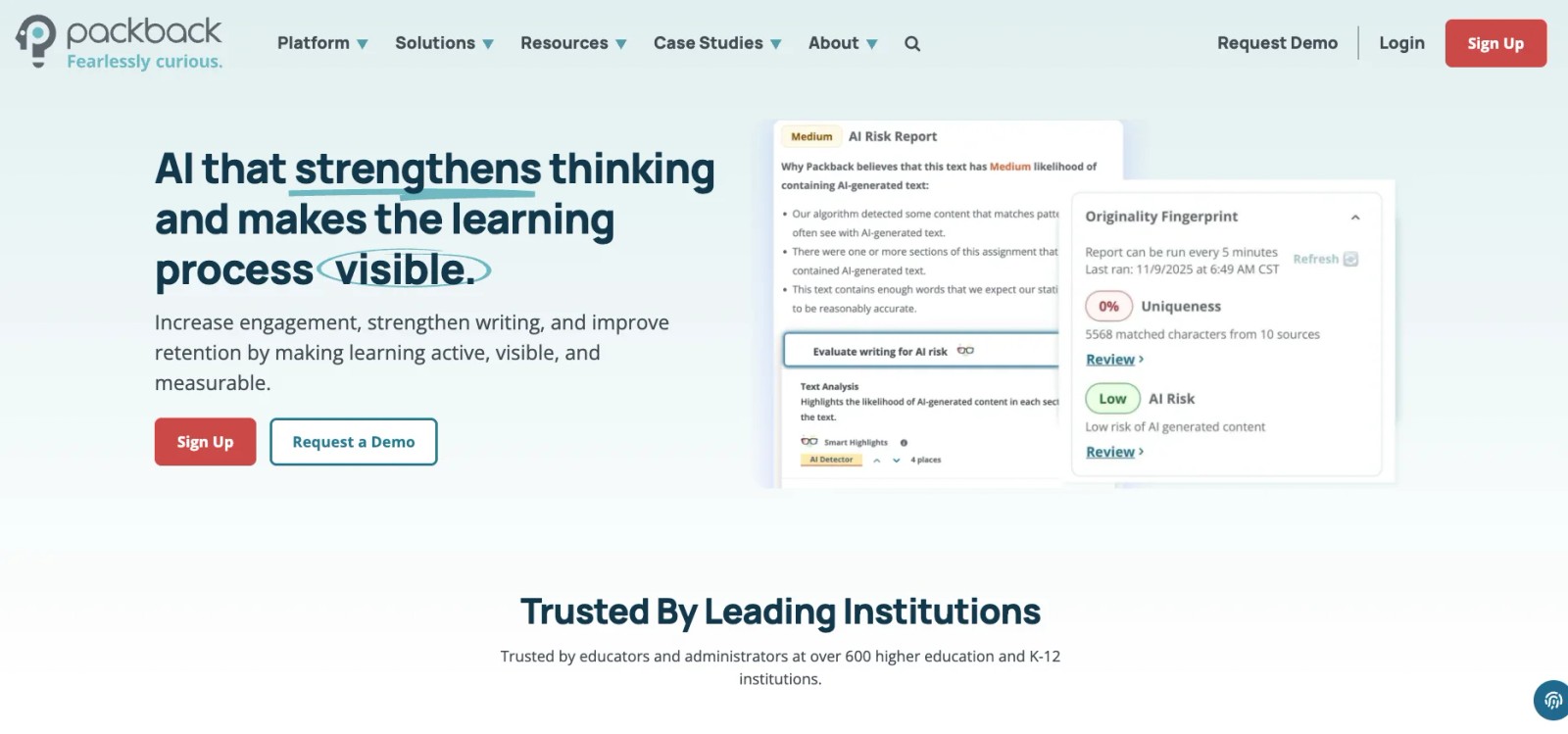
Packback uses AI to moderate student discussion and push students toward higher-order thinking. The platform prompts students to ask curiosity-driven questions rather than post surface-level responses. An AI coach provides real-time feedback on post quality before submission, nudging students to revise weak contributions.
While not a direct peer review tool, Packback addresses the same student engagement problem that motivates many instructors to use peer review in the first place: getting students to think critically about course material and engage with each other's ideas. The discussion-based model works particularly well for courses where the goal is inquiry and debate rather than formal assignment evaluation.
Faculty receive analytics dashboards showing discussion quality trends, participation rates, and individual student progress. The AI moderation cuts the time instructors spend reading and grading posts, which matters most in sections with hundreds of students.
Best For
Courses that prioritize inquiry-based learning and student discussion over formal peer review of submitted assignments, especially large introductory courses in social sciences, humanities, and business.
Key Features
- AI-powered coaching that evaluates post quality before submission
- Curiosity-scoring algorithm that rewards higher-order questions
- Real-time feedback prompts encouraging deeper thinking
- Community moderation with AI and instructor controls
- Discussion analytics with participation and quality metrics
- LTI integration with Canvas, Blackboard, Brightspace, Moodle
- Customizable discussion prompts and topic categories
- Automated participation grading based on configurable thresholds
Pricing
Per-student pricing, typically billed as a course fee. Institutional licensing available for campus-wide deployment. Contact for pricing.
Limitation
Packback handles discussion, not assessment of submitted work. There is no rubric evaluation, no calibration, and no structured feedback on drafts or projects. If the reason to leave Peerceptiv was the quality of assignment review, Packback does not address it. It fits as a complement for courses where discussion and inquiry are themselves learning goals.
How to Choose the Right Alternative
The right Peerceptiv alternative depends on what you were actually using Peerceptiv for and where it fell short.
If calibrated peer review is your core need, FeedbackFruits and Eli Review come closest to replicating that structured review-and-revise workflow. FeedbackFruits adds calibration options and AI-driven feedback analysis. Eli Review focuses specifically on writing revision cycles.
If you need peer review inside your existing LMS, FeedbackFruits, Kritik, and Peergrade all offer LTI integration that embeds the review experience directly in Canvas, Blackboard, or Brightspace. Turnitin Feedback Studio is another option if your institution already has a Turnitin contract.
If your primary problem is grading efficiency, not peer learning, Gradescope and Crowdmark solve the right problem. They accelerate instructor and TA grading rather than creating student-to-student feedback loops.
If you want students engaging with content before class, Perusall turns reading assignments into collaborative annotation activities. It replaces the "review finished work" model with "discuss the source material together."
If discussion and inquiry matter more than formal review, Packback pushes students toward curiosity-driven questions and higher-order thinking. It is not peer review, but it addresses the engagement gap that peer review is often meant to fill.
If peer review is one part of a larger learning design, a platform that integrates review with course delivery, live sessions, and group work may be more practical than a standalone tool. This is where cohort-based platforms fit.
Consider running a pilot. Most platforms offer free trials or limited free tiers. Test with a single section before committing to an institutional license.
FAQ
Can I use more than one tool together?
Yes. Many institutions combine a general-purpose LMS with a specialized peer review tool. For example, you might use Canvas for course management and FeedbackFruits for peer review activities via LTI. Perusall for reading engagement and Kritik for assignment review is another common pairing.
Do any of these tools include calibration like Peerceptiv?
FeedbackFruits and Kritik offer calibration-like features where students can be trained against instructor benchmarks. Eli Review takes a different approach by using helpfulness ratings and revision plans to improve feedback quality over time. None replicate Peerceptiv's exact calibration model identically, but several achieve the same pedagogical goal.
What if my institution already pays for Turnitin?
Check whether your contract includes PeerMark access. If it does, you already have a peer review tool available. If not, the upgrade cost may be lower than licensing a separate platform.
How do I handle students who give low-quality peer feedback?
Platforms like Kritik and FeedbackFruits use AI to flag low-quality feedback. Peergrade and Eli Review use back-evaluation where students rate the feedback they received. Both approaches create accountability. The most effective strategy is combining platform controls with clear instructions and rubric examples.
Are these tools suitable for graduate-level courses?
Most are designed for higher education broadly. FeedbackFruits, Eli Review, and Kritik are used in graduate seminars, professional programs, and doctoral courses. Gradescope and Crowdmark handle the assessment complexity typical of graduate-level STEM work.
What about accessibility compliance?
Check each platform for WCAG 2.1 AA compliance. FeedbackFruits, Turnitin, and Gradescope have documented accessibility statements. Always verify with the vendor and test with your institution's accessibility team before campus-wide deployment.


