
After testing both TalentLMS vs Trainual over several years, it’s clear that each serves a distinct purpose in modern learning. TalentLMS delivers structured, data-focused training that scales with growing teams, while Trainual streamlines onboarding and knowledge transfer for smaller organizations.
In this comparison, we draw from firsthand experience to show how both LMS platforms perform across usability, content creation, and reporting, helping you decide which one truly aligns with your team’s long-term learning strategy in 2025.
Inside TalentLMS
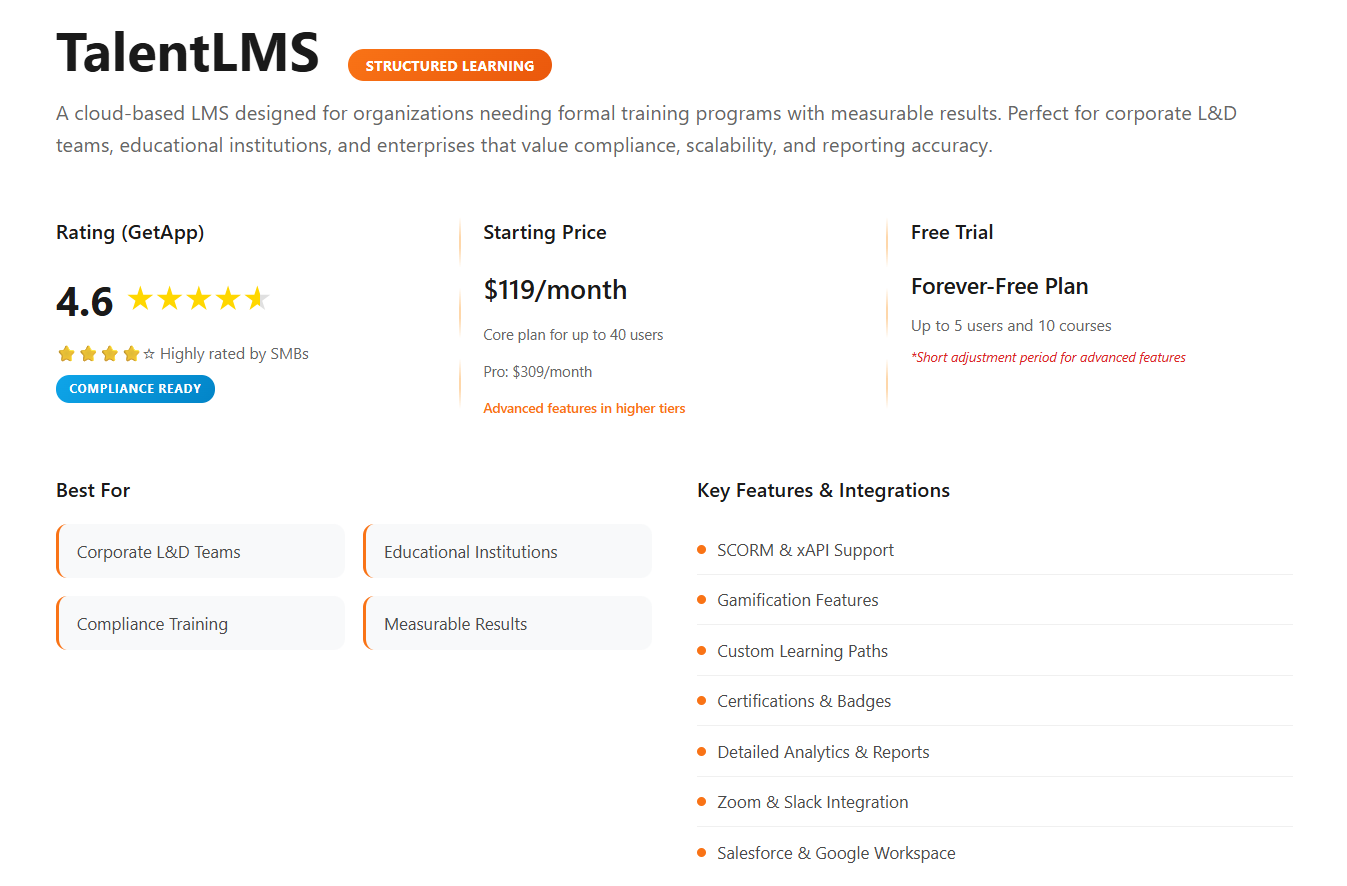
TalentLMS is a structured, cloud-based learning management system designed for organizations that need formal training programs with measurable results. It supports SCORM, xAPI, gamification, custom learning paths, certifications, and detailed analytics. The platform works well for corporate L&D teams, educational institutions, and enterprises that value compliance, scalability, and reporting accuracy.
By connecting with Google Workspace, Salesforce, Zoom, and Slack, it brings all your learning tools together into one unified stack. While it’s feature-rich, new users often find there’s a short adjustment period before they can take full advantage of its advanced capabilities.
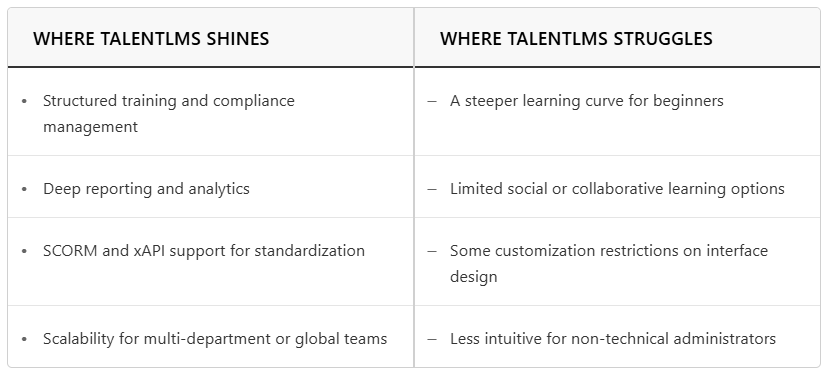
Where It Shines and Where It Struggles
Inside Trainual
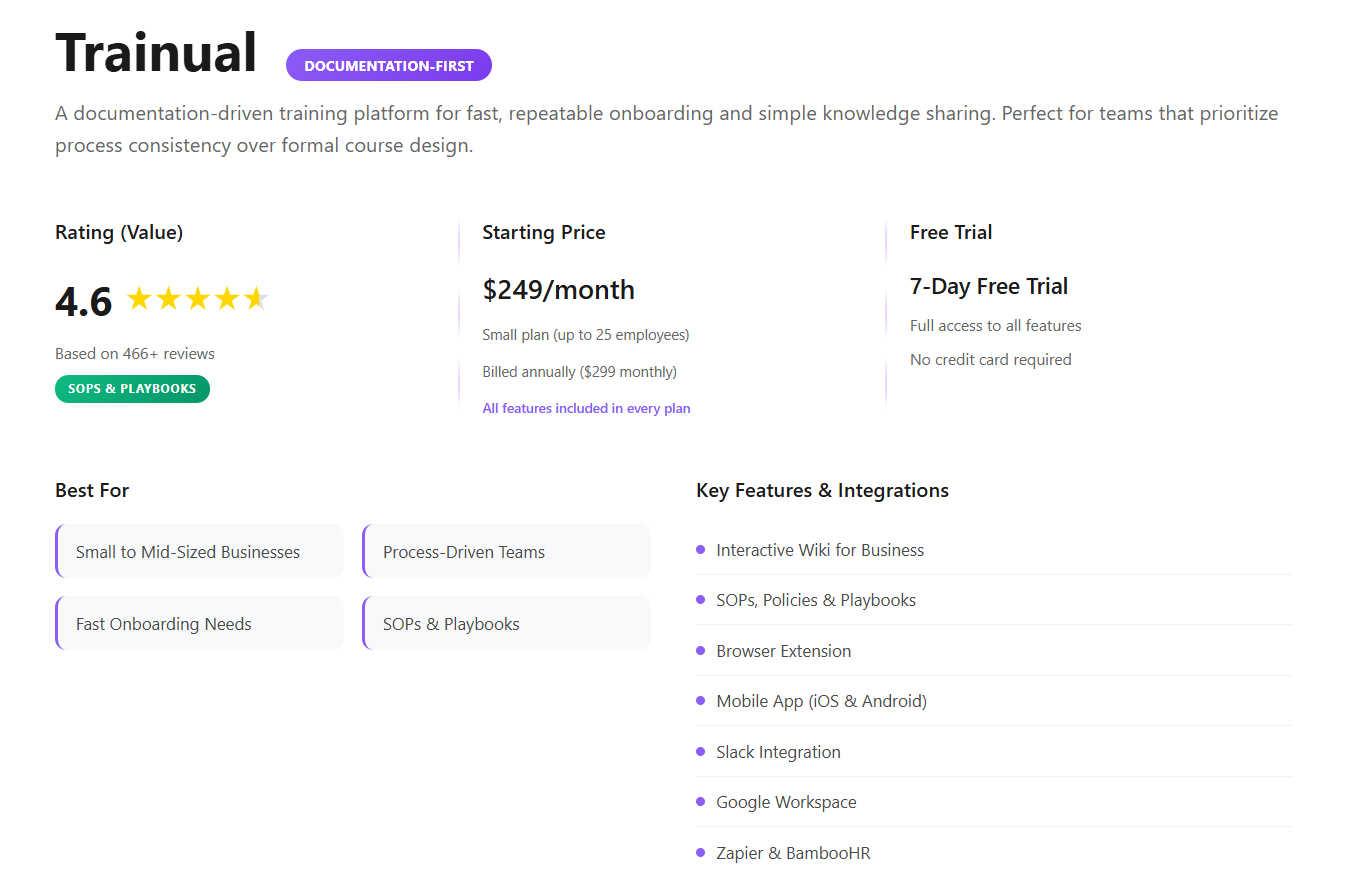
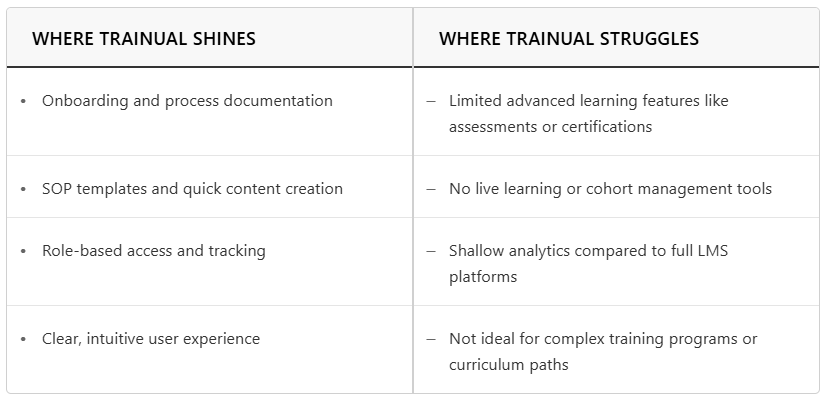
Trainual is a documentation-driven training platform built for teams that want fast, repeatable onboarding and simple knowledge sharing. Instead of focusing on formal learning paths, it centralizes company SOPs, policies, and playbooks into an interactive, searchable workspace.
It’s ideal for small to mid-sized businesses that prioritize clarity and process consistency over course design. With integrations for Slack, Google Workspace, and Zapier, Trainual makes it easy to embed training into daily workflows.
Where It Shines and Where It Struggles
TalentLMS vs Trainual: Course Creation & Authoring
This is where the personality of each platform shows.
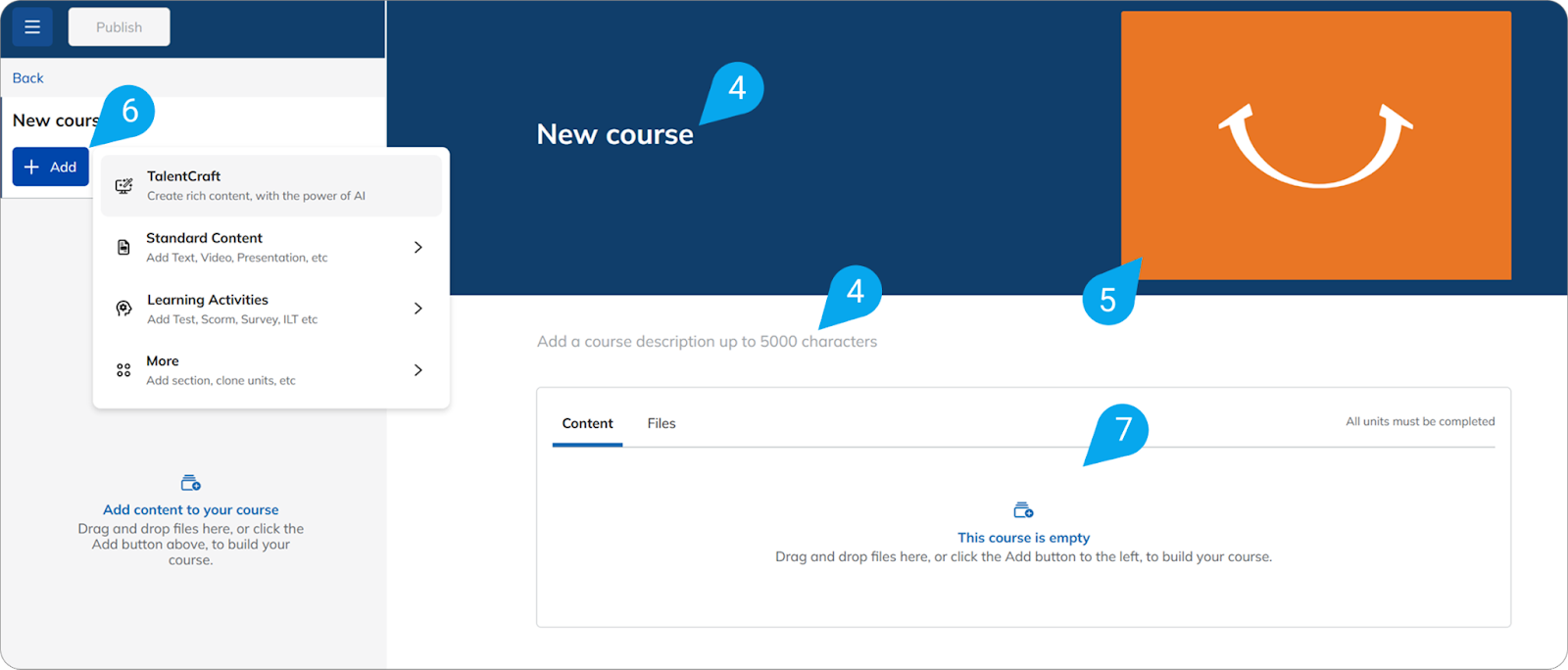
TalentLMS gives you room to build complex learning paths without losing control. You can add modules, reuse materials, and mix videos, quizzes, or SCORM files in the same flow. It feels built for instructional designers who care about detail and structure.
Here’s what stands out:
- You can clone courses or sections to save setup time.
- Quizzes support branching and randomization for deeper evaluation.
- The interface balances flexibility with organization once you learn its rhythm.
It takes a little time to master, but once you do, course creation becomes quick and deliberate.
Trainual keeps things lighter. It’s made for teams that need to turn daily processes into repeatable lessons fast. You build with text, images, and short videos. Templates guide you so the focus stays on the message, not the design.
Here’s what helps most:
- Anyone can create a module without formal training experience.
- Templates make structure effortless.
- Built-in video recording adds context where needed.
You won’t get complex quiz logic or SCORM support, but you’ll move faster from idea to published content.
Highlight: TalentLMS is for structured learning that measures growth. Trainual is for fast onboarding that keeps teams aligned. Each delivers value when used for what it does best.
TalentLMS vs Trainual: User Experience (UX) & Accessibility
Both platforms get usability right, but in different ways.
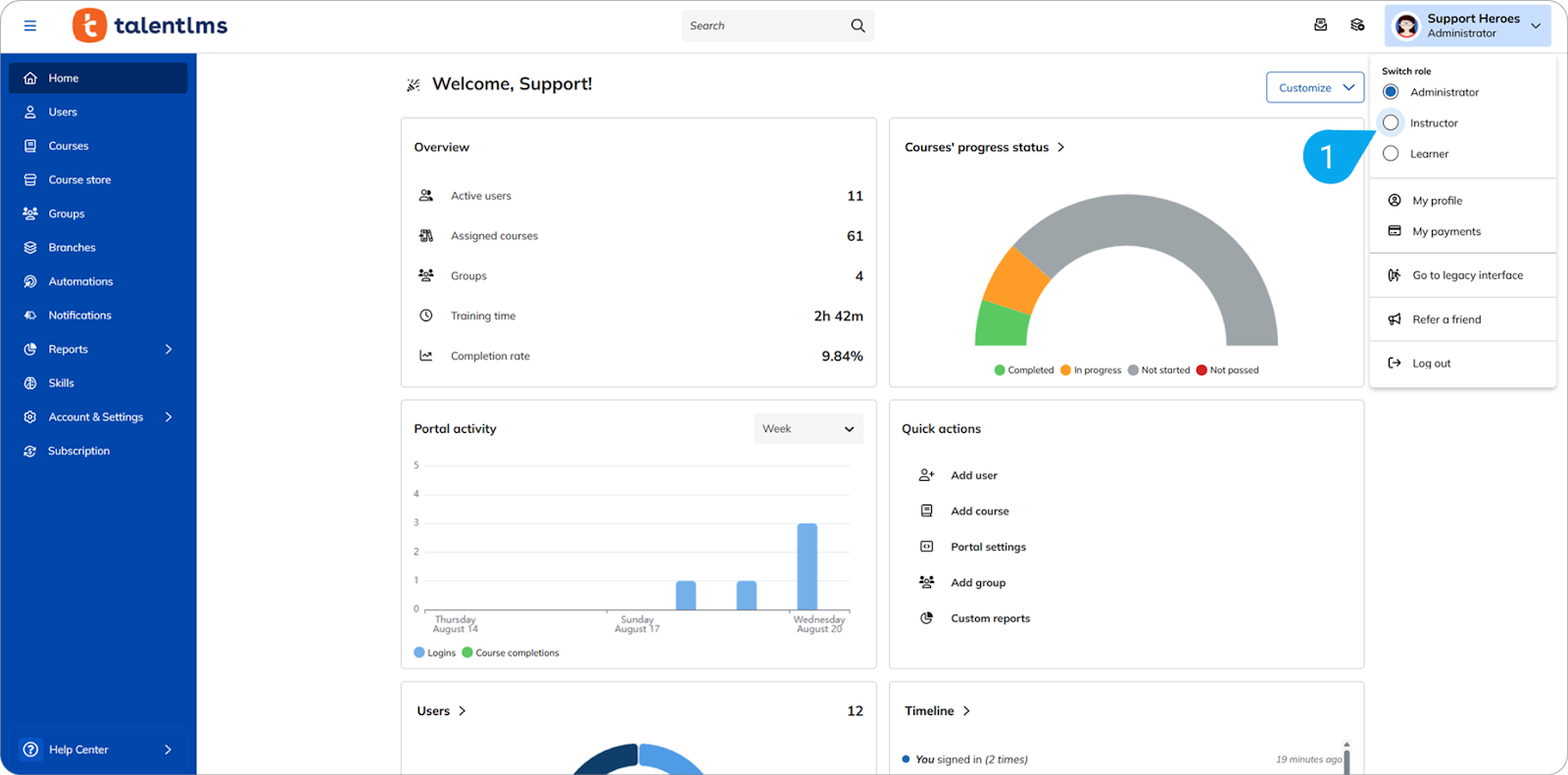
TalentLMS feels refined and structured. The interface is tidy, loading times are quick, and navigation stays intuitive even with large course libraries. Small touches like smart tooltips, clear progress indicators, and smooth mobile access make daily use smooth and predictable. It’s the kind of platform that quietly supports power users without overwhelming newcomers.
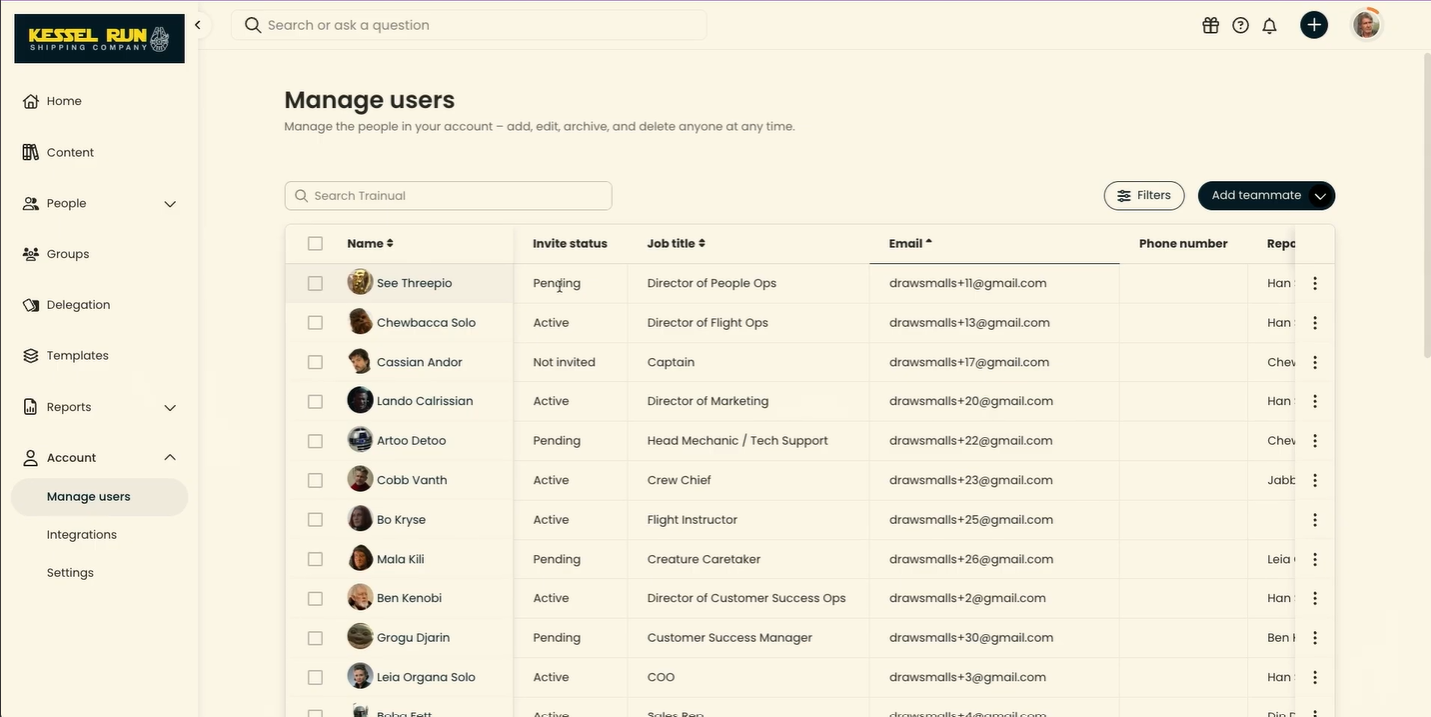
Trainual's interface is sparse by design. Content is organized by subject and role, navigation is flat, and the search function surfaces SOPs quickly. The layout translates well to mobile, which matters for distributed teams looking up process steps mid-task.
On accessibility, TalentLMS offers more granular controls, including stronger screen reader compatibility and contrast settings. Trainual's advantage is layout simplicity: less to configure means fewer barriers for non-technical users.
TalentLMS vs Trainual: Integrations & stack
This is where the tools start to show what kind of teams they were built for.
TalentLMS plays well with larger tech stacks. It integrates smoothly connects with essential platforms such as Google Workspace, Salesforce, Slack, and Zoom. There’s also an API for custom setups, which matters if your organization wants training data tied to performance dashboards or HR systems. Once configured, it quietly keeps everything in sync without much maintenance.
Trainual leans toward simplicity again. Its integrations are practical rather than broad. You’ll find quick connections to Slack, Zapier, Loom, and Google Workspace. The focus is on helping teams link everyday tools rather than building complex data bridges.
A few practical notes:
- TalentLMS is ideal if you need learning data to flow into other systems.
- Trainual fits better for teams that just want easy automation without IT help.
- Both have strong mobile experiences, but TalentLMS has more flexibility for scaling integrations as teams grow.
Highlight: TalentLMS offers a connected stack. Trainual keeps it clean and focused on getting things done.
TalentLMS vs Trainual: Assessment, Feedback & Analytics
This is where the learning depth shows. TalentLMS handles assessments like a seasoned instructor who’s seen every learning curve. You can build quizzes, tests, and assignments that measure understanding instead of just checking boxes. Results flow into detailed reports that show completion rates, scores, and engagement trends. It’s powerful when you need data to justify your training outcomes or spot where learners struggle.
Here’s what makes it strong:
- Flexible question types, randomized quizzes, and automated grading.
- Course-level analytics that highlight both learner and course performance.
- Exportable data for deeper analysis or executive reports.
Trainual takes a simpler path. It’s built to confirm comprehension, not to track complex skill development. Tests are straightforward and quick to create. The reporting is easy to read, giving managers a clear view of who’s completed what and where knowledge gaps might exist.
You’ll notice:
- Completion tracking that keeps accountability visible.
- Basic quiz features for verifying key takeaways.
- Clear dashboards that make progress obvious at a glance.
Highlight: TalentLMS wins on insight and depth. Trainual wins on simplicity and speed. Both get the job done, just at different levels of detail.
TalentLMS vs Trainual: Customization & Branding
How much an LMS lets you make it your own says a lot about who it’s built for.
TalentLMS lets you customize every part of its appearance. You can add your logo, tweak colors, create custom domains, and even tailor the learner dashboard to match your brand voice. For teams running client-facing academies or internal programs that need a polished identity, this flexibility is a real advantage. It feels professional, not just functional.
Here’s what stands out:
- White labeling across portals and sub-accounts.
- Custom themes that align with company visuals.
- Personalized certificates and automated email templates.
Trainual keeps things simpler but purposeful. You can add your logo, set brand colors, and customize lesson templates so they reflect your company’s tone. It’s not built for deep visual control, but it’s enough to make training feel familiar and on-brand.
You’ll notice:
- Clean, minimal layouts that let your content take focus.
- Branded onboarding flows for a cohesive employee experience.
Highlight: If branding is part of your learner engagement strategy, TalentLMS delivers more flexibility. If clarity and speed matter most, Trainual keeps it lean and consistent.
TalentLMS vs Trainual: Ease of Use & Implementation
Getting started is where you feel the real difference between these two.
TalentLMS takes a bit of setup, but it rewards that effort. The onboarding process is guided, with clear tooltips and starter templates that help you structure your first course. Once you get familiar, the system feels logical and scalable. It’s ideal for organizations planning long-term learning programs that need structure and reporting from day one.
Here’s what helps most:
- Step-by-step setup wizards for admins.
- Easy import of existing materials like SCORM files or videos.
- A clean dashboard that grows with your course library.
Trainual is plug-and-play. You can sign up in the morning and have your first process training ready by lunch. It’s designed for teams that want minimal configuration and maximum speed. The learning curve is practically flat, which makes it popular with small businesses or startups rolling out SOPs.
A few things to note:
- Built-in templates help you skip setup time.
- Onboarding guides show exactly what to do next.
- Team invites and role assignments are quick and intuitive.
Highlight:If you want depth and long-term scalability, TalentLMS is the steady choice. If you value instant setup and ease, Trainual gets you running fast.
TalentLMS vs Trainual: Customer Support & Reliability
Support and stability are what keep an LMS running smoothly after launch. Both platforms understand that, but they serve different types of users.
TalentLMS offers ticket-based support, a detailed knowledge base, and active community forums. The documentation is thorough enough that most configuration questions can be answered without opening a ticket. Uptime is consistently strong, and platform updates typically roll out without disrupting active courses.
Here’s what stands out:
- 24/7 email support on paid plans.
- strong self-service documentation and tutorials.
- Stable cloud hosting with a few performance hiccups.
Trainual leans on accessibility and human touch. Support feels personal and fast, especially for smaller teams. You can reach their team by chat or email, and responses usually come within hours. The platform runs smoothly with minimal downtime, and new updates arrive regularly without disrupting active training sessions.
You’ll notice:
- In-app chat for quick help.
- Guided onboarding and webinars for new admins.
- Consistent reliability across browsers and devices.
Highlight: If you want deep technical resources and scale-ready infrastructure, TalentLMS delivers. If you prefer approachable, hands-on support that feels close to your team, Trainual keeps it simple and dependable.
TalentLMS vs Trainual: Pricing, Plans, and ROI
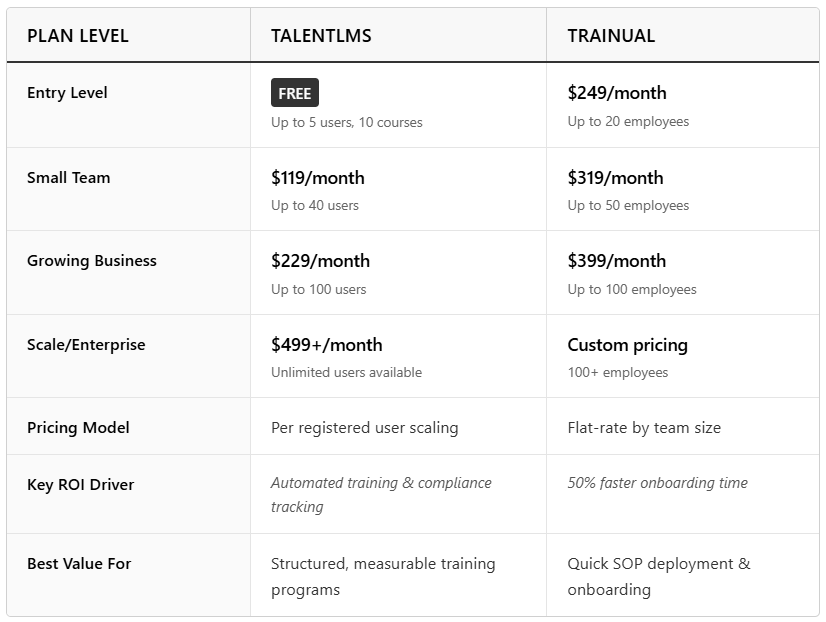
Pricing is where the choice often comes into focus. It’s not just what you spend each month, but what kind of return you see once people start using the system.
TalentLMS feels more like a long-term investment. There’s a free plan for small teams, then paid tiers starting around $119 a month and scaling up to $499. Pricing is based on registered users, so it’s worth mapping out your growth before committing.
Here’s what usually stands out:
- Free plan for testing and small pilots
- Transparent scaling based on user count
- Built-in reporting and automation that save time and reduce admin work
It’s a platform for organizations that view training as a structured, ongoing process.
Trainual keeps pricing straightforward. Plans start near $249 per month, with higher tiers at $319 and $399. All plans include the same core features, so cost changes mainly with team size.
Teams often appreciate:
- Predictable pricing without hidden add-ons
- Flat-rate model that’s easy to budget for
- Fast ROI through reduced onboarding time and fewer repeated explanations
Highlight:If your goal is depth and measurable progress, TalentLMS offers more value over time. If you want speed and clarity from day one, Trainual gives quick, reliable payoff.
TalentLMS vs Trainual: Use Case Scenarios
Choosing the right LMS depends on the kind of organization you run and how your team prefers to learn. Each platform brings its own rhythm, strengths, and practical fit depending on size and goals.
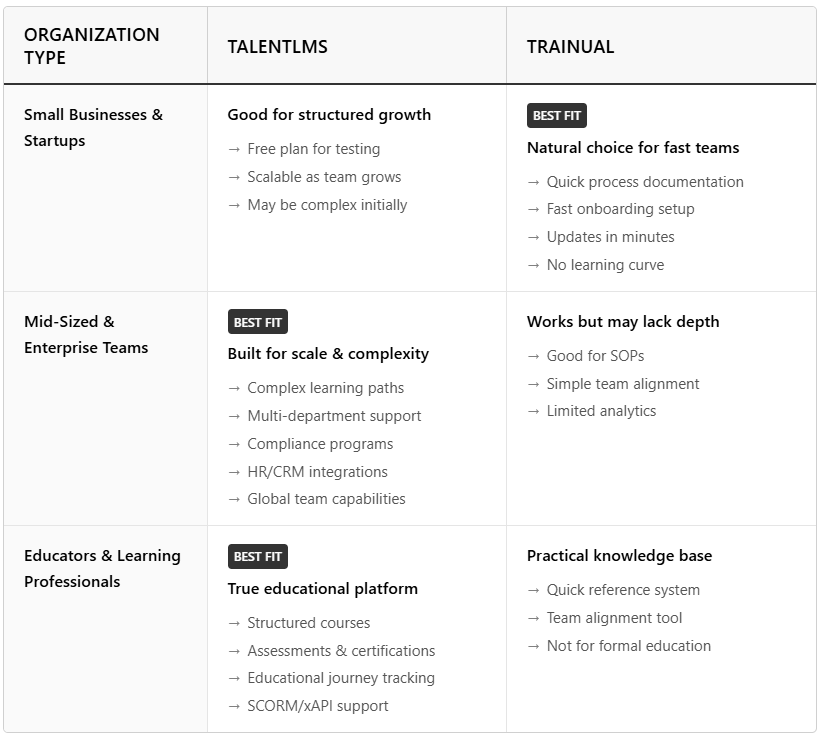
Small Businesses and Startups
Trainual often feels like the natural fit here. It helps teams document what they do best, capture essential processes, and onboard new hires quickly. Its straightforward setup and easy navigation make it perfect for growing teams that need fast, consistent training without a steep learning curve. Managers can update content in minutes, keeping everything current and accessible.
Mid-Sized and Enterprise Teams
TalentLMS comes into its own at scale. It supports complex learning paths, multiple departments, and compliance programs while maintaining structure and reporting clarity. Organizations with formal training requirements benefit from its analytics, multilingual options, and integrations with HR and CRM systems. It’s reliable for managing professional development across large or global teams.
Educators and Learning Professionals
TalentLMS offers the flexibility needed for structured courses, assessments, and certifications. It’s designed for those who view training as an ongoing educational journey. Trainual, on the other hand, works best as a practical knowledge base where teams can find answers fast and stay aligned on how things get done.
Alternative to Consider: Teachfloor
If you’ve ever wished that TalentLMS felt a little more human or that Trainual went beyond checklists and SOPs, you’re not alone. Most learning teams today want structure and connection. They want courses that feel alive, not just videos and quizzes locked behind menus. That’s exactly the space where Teachfloor steps in.
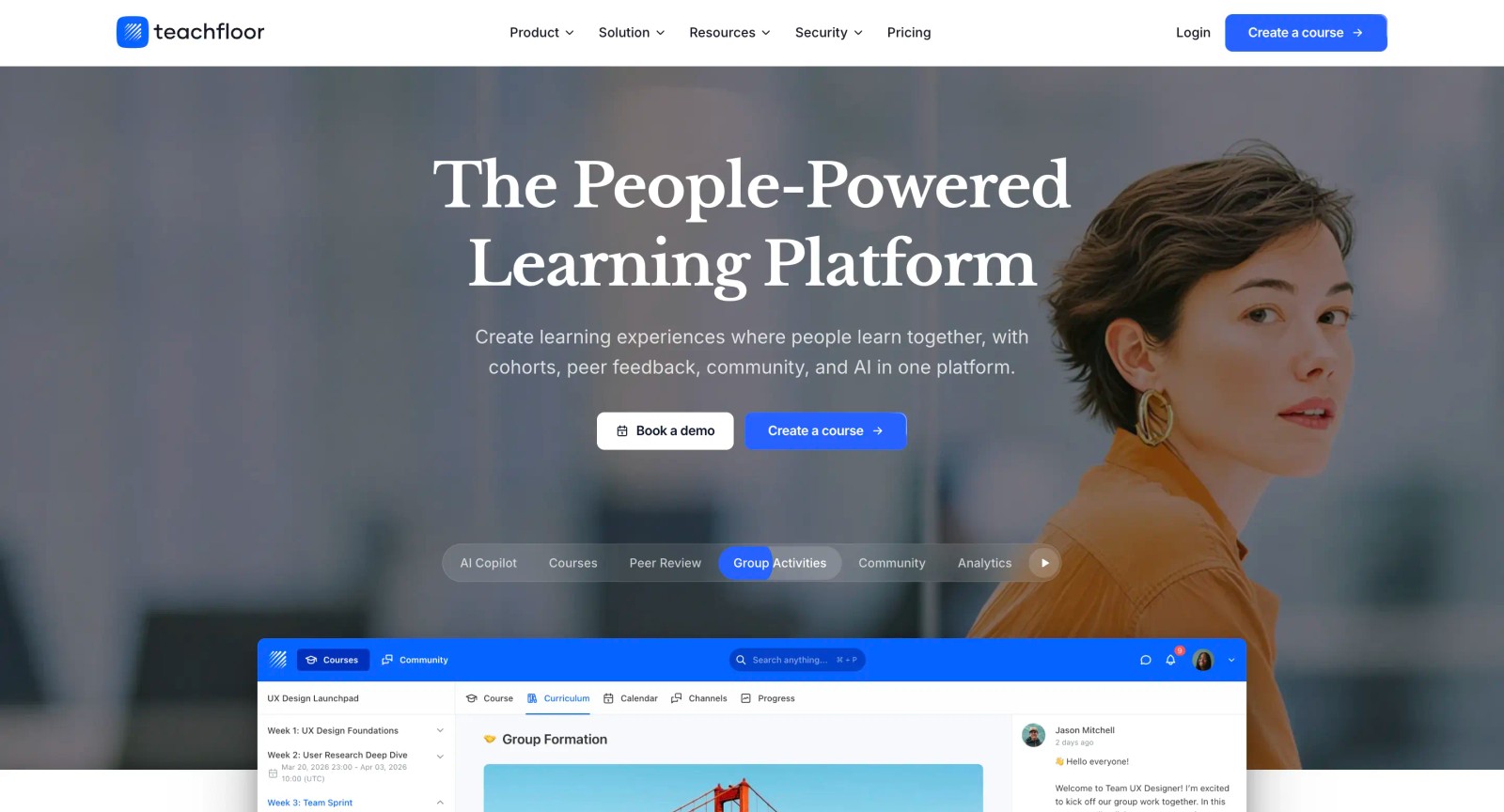
Teachfloor blends the discipline of a traditional LMS with the energy of a live classroom. It’s built for modern learning teams, training providers, and educators who want to run serious programs without getting buried in admin work. You can build interactive courses, run live cohorts, automate workflows, and brand your entire experience, all from a clean, intuitive dashboard. It’s the kind of platform that makes learning feel collaborative, not mechanical.
Teachfloor Features
- Cohort-based and self-paced learning
- AI-powered course builder (TeachAI)
- Live sessions via Zoom or Google Meet
- Peer review and group collaboration
- Instructor feedback and progress tracking
- Built-in community discussions
- SCORM upload and auto conversion
- White-label branding and custom domains
- Multi-branch client and team management
- Enrollment and certificate automation
- Custom learner tagging and workflows
- Gradebook and advanced analytics
- Integrations with Stripe, Slack, and Google Workspace
- SSO, API, and webhooks for enterprise use
- Embedded tools like Miro and Google Docs
Teachfloor feels like what learning software was always supposed to be: powerful enough for professional training, flexible enough for creative teaching, and simple enough that anyone can run with it. It doesn’t just manage learning. It brings it to life.
TalentLMS vs Trainual: Final Verdict 2025
Choosing between TalentLMS and Trainual depends on your learning goals. TalentLMS is best for structured, standards-based training with strong analytics and scalability, making it ideal for larger organizations focused on compliance and measurable growth. Trainual excels in speed and simplicity, helping small teams document processes and onboard new hires quickly.
For many, though, the real balance lies with Teachfloor. It combines the structure of an LMS with the flexibility and collaboration modern learning needs. You can run live or self-paced training, automate tasks, and connect learners through peer interaction.
If structure and compliance are priorities, choose TalentLMS. For fast onboarding and clear process training, Trainual fits best. But if you want scalable, engaging learning that blends both worlds, Teachfloor is the smarter choice for 2025.


