

Why Hospitality Needs a Specialized LMS
Hospitality training is not like training in a typical office environment. The operational realities of hotels, restaurants, and resorts create a set of requirements that generic learning platforms were never designed to address.
Turnover is constant. The hospitality sector consistently reports annual turnover rates above 70%, according to the U.S. Bureau of Labor Statistics. Every new hire needs to reach competency fast. If onboarding takes two weeks of shadowing because your LMS cannot deliver structured, self-paced content to a phone, you are burning labor hours you cannot afford.
Multilocation operations demand consistency. A hotel chain with 40 properties needs every front desk agent handling check-in the same way, every housekeeper following the same room standards, every F&B team executing the same service sequence. Without a centralized training system that pushes standardized content to every location, brand standards drift. Local managers improvise. Guest experience becomes unpredictable.
Most staff do not sit at desks. Housekeepers, line cooks, servers, bellhops, and maintenance crews are on their feet for entire shifts. Training has to work on a mobile device, in short bursts, between tasks. A platform that requires a desktop browser and 45-minute modules is functionally unusable for this workforce.
Multilingual teams are the norm. In many hospitality operations, the workforce speaks three, four, or more languages. An LMS that only supports English content locks out a significant portion of the team. Multilingual content delivery is not a nice-to-have; it is a basic operational requirement.
Compliance is non-negotiable. Food safety certifications (ServSafe, HACCP), alcohol service permits (TIPS, RBS), fire safety protocols, OSHA workplace safety, and brand-specific standards all require tracked, auditable training. If an inspector asks for proof that your kitchen staff completed food handler training, you need records, not a verbal assurance from a shift manager.
Brand standards require visual, procedural training. Hospitality training is often procedural: how to set a table, how to fold a towel, how to greet a guest at check-in. This type of training relies on video, images, and step-by-step walkthroughs rather than text-heavy slide decks. The LMS needs to support rich media delivery, especially on mobile.
These constraints mean that a general-purpose corporate LMS will often fall short. The platforms in this guide were selected because they address some or all of these hospitality-specific challenges.
Hotels and restaurants are not the same buyer. Hotels lean toward multi-department onboarding (front desk, housekeeping, F&B, maintenance), brand-standard service consistency across properties, and guest-experience training. Restaurants lean harder on food-safety certification (ServSafe, HACCP), responsible alcohol service (TIPS, RBS), and fast onboarding for high-turnover line and service roles. A platform that fits a 40-property hotel group is not automatically the right fit for a 200-unit quick-service brand, so weigh the criteria below against your own operating model.
This guide stays focused on hotel, restaurant, and resort operators. If your model is built around franchisor-to-franchisee governance across many owners, our best LMS for franchise operations roundup covers multi-unit governance in more depth, and for distributed maintenance and engineering crews, the best LMS for field service teams guide focuses on offline-first mobile delivery. For the broader category, see our corporate training platform overview.
What to Look for in a Hospitality LMS
Before comparing individual platforms, it helps to anchor on the criteria that matter most for hospitality operations. Not every hotel or restaurant group will weigh these equally, but each one should be on your evaluation list.
Mobile-first delivery. This is the single most important factor. If training does not work smoothly on a smartphone without requiring an app download or a VPN login, adoption will be low. Look for platforms with native mobile apps, offline access, and content formats optimized for small screens. Understanding different training delivery methods helps clarify why mobile-first matters so much in service industries.
Rapid onboarding workflows. High turnover means your onboarding process runs continuously. The LMS should support automated enrollment, pre-configured learning paths for each role (front desk, housekeeping, F&B, maintenance), and progress tracking that lets managers see who is on track without manual check-ins.
Compliance tracking and certification management. The platform must track completion dates, expiration dates, and recertification deadlines automatically. Audit-ready reports that show who completed what, when, and with what score are essential. Bonus if the system sends automated reminders before certifications expire.
Multilingual content support. At minimum, the LMS should allow you to upload translated versions of each course and assign them by language preference. More advanced platforms offer built-in translation or auto-translated interfaces.
Multilocation management. You need the ability to manage training across multiple properties from a single dashboard while still giving individual general managers or department heads visibility into their own team's progress. Role-based permissions and location-based reporting are key.
Content format flexibility. Hospitality training benefits from video, interactive checklists, image-based walkthroughs, quizzes, and short microlearning modules. Platforms that only support SCORM uploads or text-based content miss the mark for this industry.
Integration with HR and scheduling systems. If your LMS connects to your HRIS or workforce management system, new hires can be enrolled automatically and training status can feed back into scheduling decisions. This reduces manual data entry and speeds up the time from hire to floor-ready.
Cost structure that fits high headcount. Hospitality organizations often have large workforces relative to revenue per employee. Per-user pricing models can become expensive quickly. Look for platforms that offer bulk pricing, active-user billing, or flat-rate models that accommodate seasonal staffing swings.
8 Best LMS for Hospitality and Hotel Training
The platforms below range from enterprise systems built for global hotel chains to lightweight mobile-first tools designed for frontline teams. Each one addresses a different combination of the hospitality training challenges outlined above, covering a wide range of organization sizes, budgets, and operational complexity.
| Tool | Starting price | Free trial | Mobile-first | Multilocation | Compliance | Multilingual | Best for |
|---|---|---|---|---|---|---|---|
| Teachfloor | $89/mo | 14 days | Yes | Yes (branches) | Certificates | Yes | Brand-consistent service training, onboarding academies, and leadership cohorts |
| TalentLMS | $119/mo | Free plan | Yes | Yes | Yes | Yes | Mid-size hotel groups and restaurant chains on a budget |
| Docebo | Custom | Demo only | Yes | Yes | Yes | Yes | Global hotel brands with complex, multi-audience training |
| Axonify | Custom | Demo only | Yes | Yes | Yes | Yes | Daily microlearning reinforcement for large frontline teams |
| eduMe | Custom | Demo only | Yes | Limited | Basic | Yes | Passwordless onboarding for high-turnover deskless staff |
| Litmos | Custom | 14 days | Yes | Yes | Yes | Yes | Compliance-led hospitality training with a large course library |
| Absorb LMS | Custom | Demo only | Yes | Yes | Yes | Yes | Mid-to-large hotel chains wanting a polished learner experience |
| Schoox | Custom | Demo only | Yes | Yes | Yes | Yes | Multi-unit restaurant and franchise operations |
Teachfloor
Overview
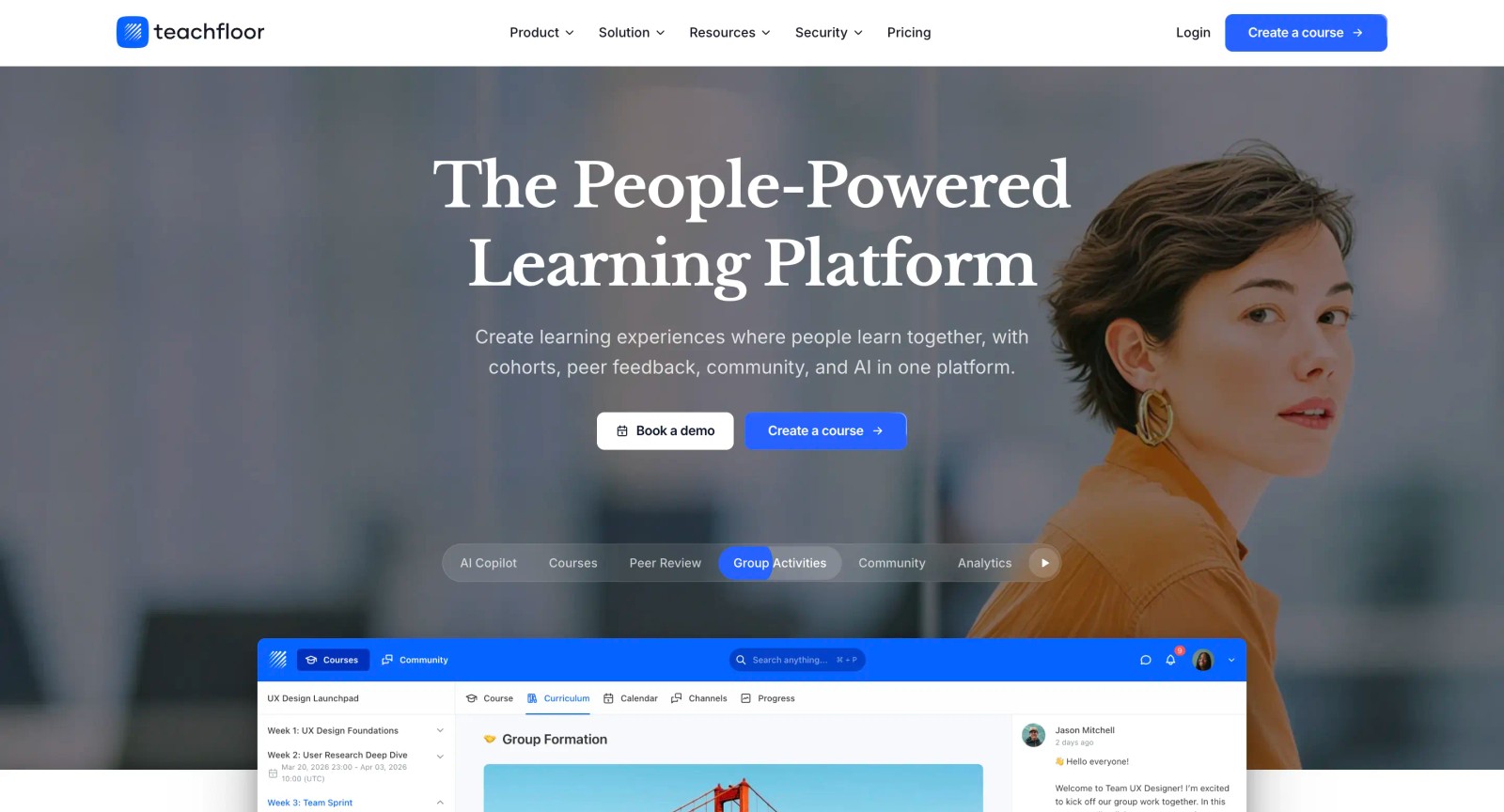
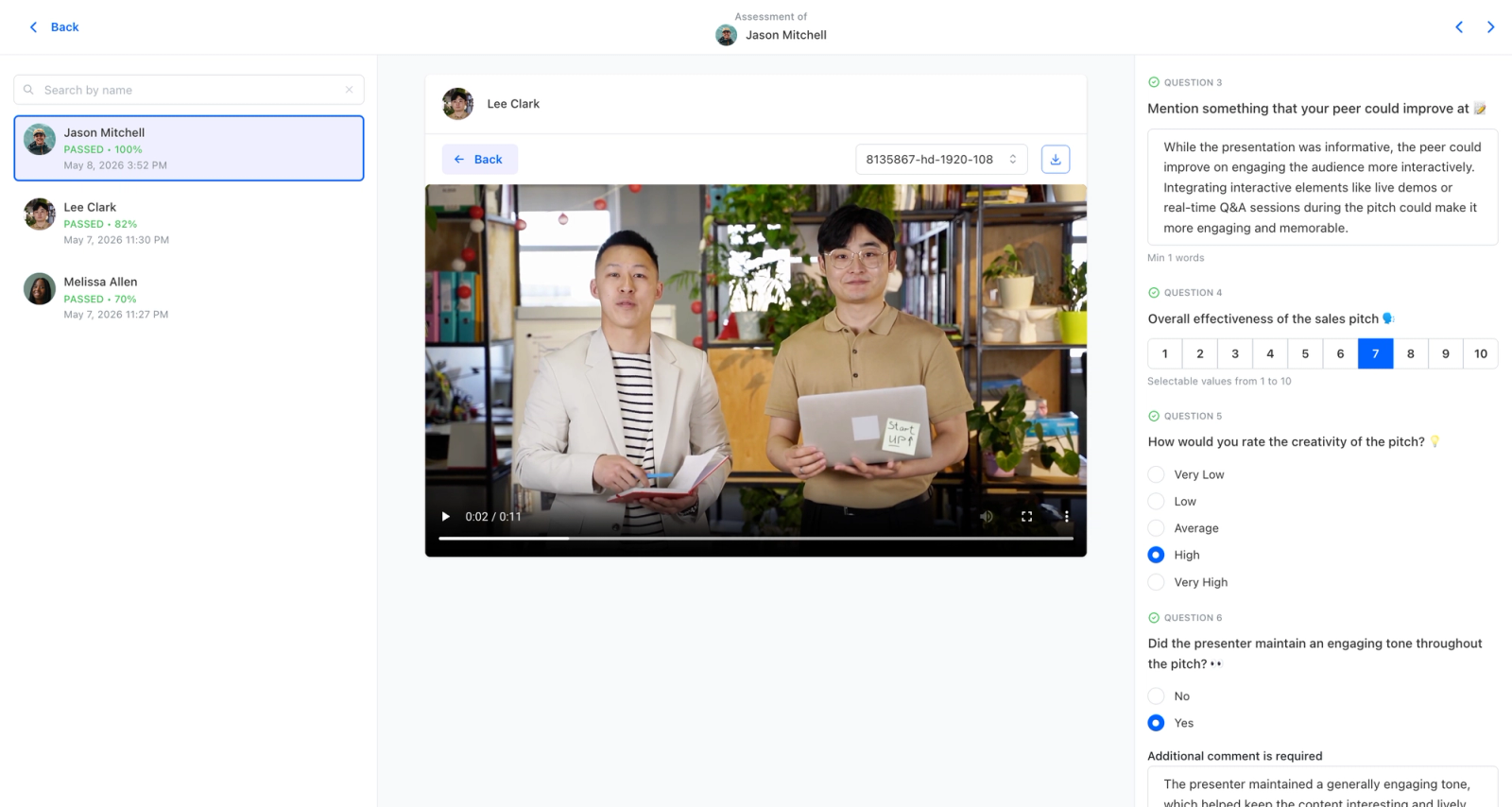
Hospitality lives and dies on consistency: a guest should get the same welcome at a flagship property and a new location that opened last month. Teachfloor is a flexible learning platform that helps hotel and restaurant groups deliver that consistency by combining white-label, branded training on their own domain with multi-branch structure, so each property or region can have its own space while headquarters controls the core brand and service standards. With turnover as high as it is in hospitality, the AI-assisted authoring matters too: a training lead can build a new server or front-desk module fast instead of waiting on an outside designer. Teachfloor supports self-paced onboarding for a new housekeeper, live sessions for a manager rollout, and certificates that prove a staff member completed food safety or brand-standard training, with analytics so a regional director can see completion across every location at once.
Core Capabilities
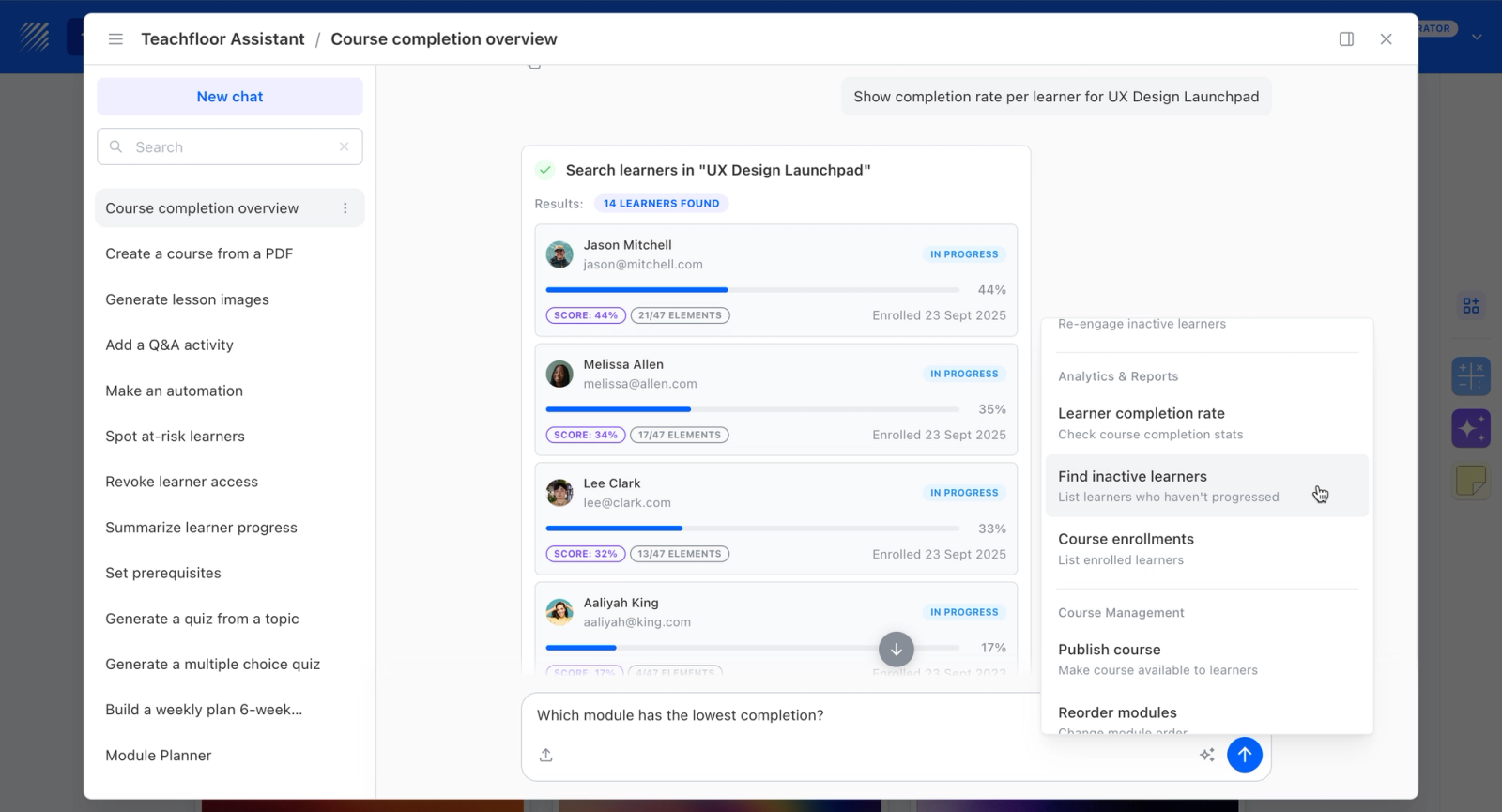
- White-label training on the brand's own domain plus multi-branch structure, so each hotel, restaurant, or region gets its own branded space while corporate keeps control of core service-standard content and reporting
- AI-assisted authoring to spin up new onboarding and brand-standard modules quickly, which matters in a sector where turnover routinely runs above 70 percent and content has to be rebuilt and refreshed constantly
- Self-paced onboarding, certificates for compliance items like food safety, and cross-location analytics so regional managers can compare completion and competency across properties
Best For
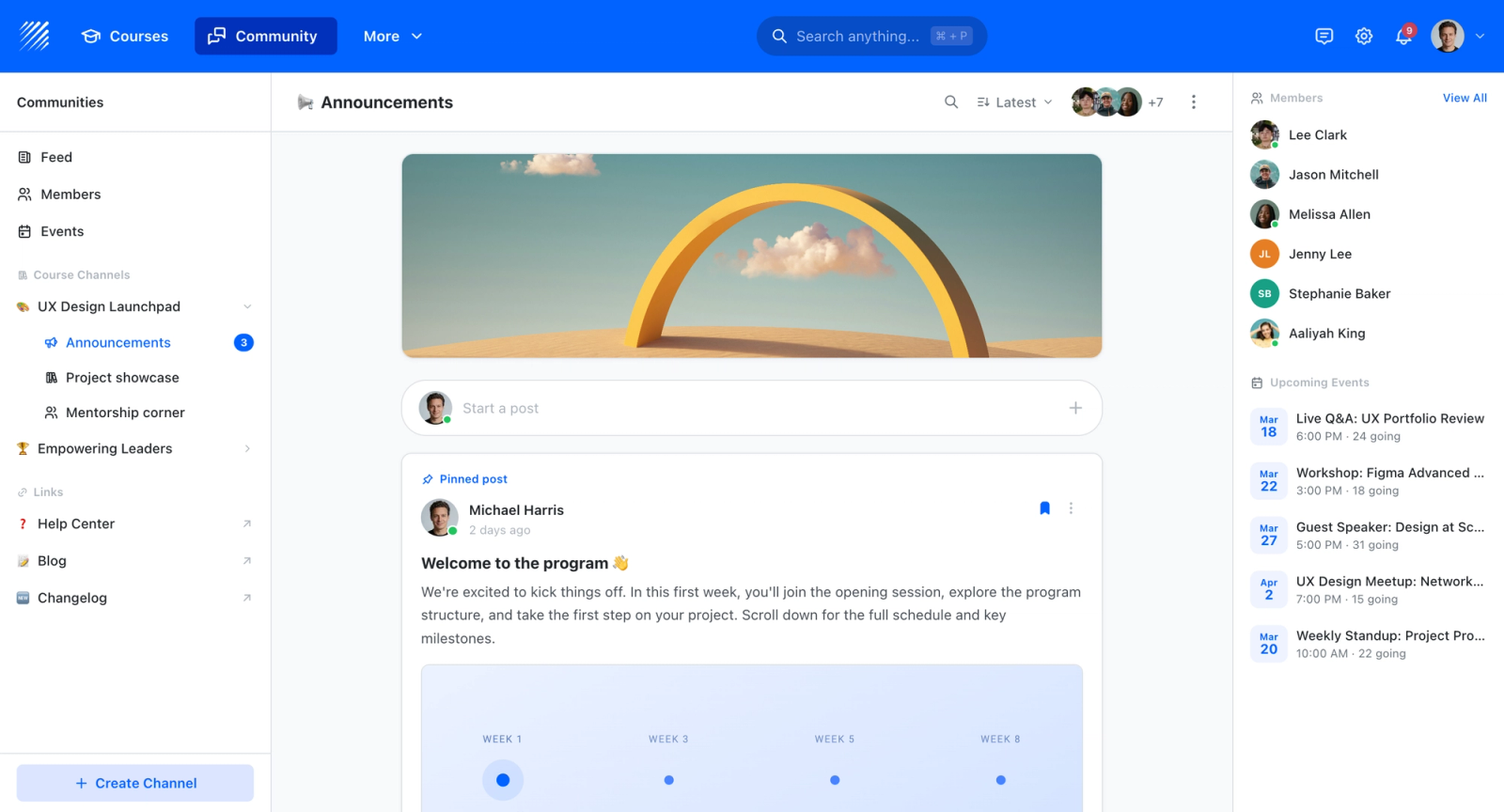
Hotel groups, restaurant chains, and resorts that run multiple locations and need consistent, on-brand training with central oversight, especially operators who care about a polished branded learner experience and proof-of-completion for service and compliance standards.
Pricing Overview
- Startup plan from $89 per month for up to 50 learners
- Full Features plan with custom pricing, white-label, SSO, and advanced integrations
- 14-day free trial; no permanent free plan
- Nonprofit discounts available
Limitations
- Not a dedicated deskless, mobile-microlearning platform like eduMe or Axonify, so very short daily reinforcement sessions for frontline staff are not its core model
- No native offline mode, which can be a constraint for staff training in areas with poor connectivity
- No free plan, and learner-based pricing means seasonal headcount spikes can raise costs
Quick Comparison Insight
Best for multi-location hospitality brands that want branded, centrally controlled training with certificates and cross-property analytics, rather than a purely mobile microlearning tool for the floor.
TalentLMS
Overview
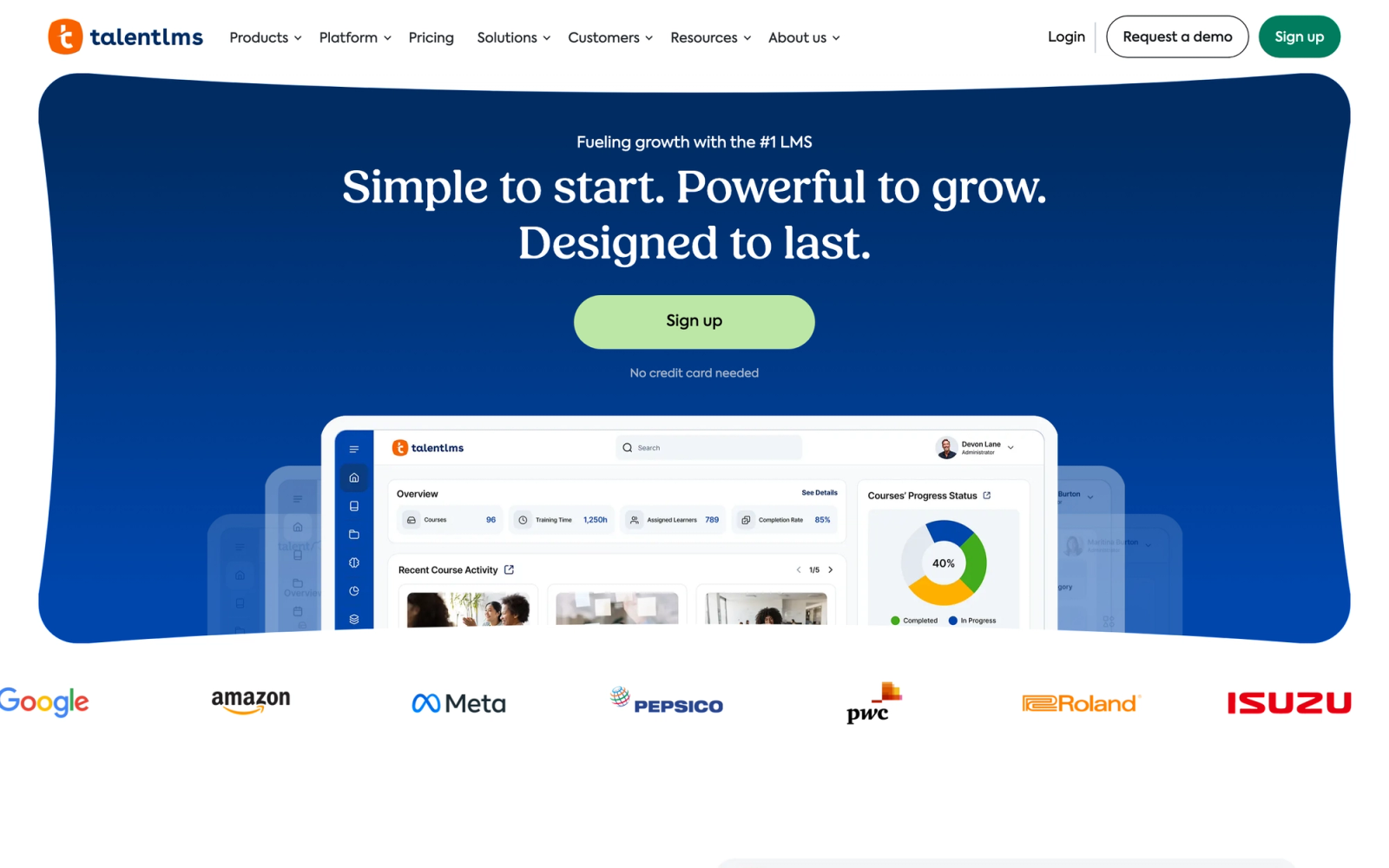
TalentLMS is a cloud-based learning platform from Epignosis that positions itself as an LMS that is easy to set up and straightforward to administer. It does not market itself as a hospitality-specific tool, but its combination of affordability, flexible content creation, and branch management features makes it a practical fit for hotel groups and restaurant chains that need a centralized training system without enterprise-level complexity.
TalentLMS goes from account creation to a delivered course quickly. The interface is clean, the course builder is intuitive, and the learning curve for administrators is noticeably shallow compared to platforms like Docebo or Litmos. For hospitality organizations where the L&D function is often one person wearing multiple hats, that simplicity matters.
Core Capabilities
- Branch management that lets you create separate training environments for each hotel property or restaurant location, each with its own branding, user groups, and content assignments
- Built-in course authoring with support for video, presentations, SCORM/xAPI packages, and text-based content
- Automated user enrollment and learning path assignment based on roles, departments, or custom fields
- Native mobile app (iOS and Android) with offline content access for staff training between shifts
- Certification tracking with automatic expiration alerts and recertification enrollment
- Multilingual interface supporting over 30 languages, with the ability to upload translated course content
- Gamification features including points, badges, and leaderboards to drive completion rates
- Built-in reporting with scheduled report delivery and the ability to filter by branch, department, or user group
- Integration with Zapier, BambooHR, and other HR tools for automated user provisioning
- White-labeling and custom domain support for branded training portals
Standout Strength
TalentLMS balances usability with enough depth to handle multilocation training management. The branch feature is particularly valuable: a regional training director can oversee all properties from one dashboard while individual GMs only see their own teams. For organizations that evaluated platforms like Docebo but found them too complex or expensive, TalentLMS covers the essential ground at a fraction of the cost.
Best For
Mid-size hotel groups (5 to 50 properties), restaurant chains, and hospitality management companies that need a centralized LMS with multilocation support but do not require the advanced AI-driven features or deep enterprise integrations of larger platforms. Strong for teams where the administrator is an HR generalist or operations manager rather than a dedicated L&D professional.
Pricing Overview
- Starting price: Free tier for up to 5 users and 10 courses
- Core plan starts at about $119 per month billed annually (around $149 month-to-month), for up to 40 users
- Pricing scales by active user count; enterprise plans available for 1,000+ users
- Free trial available on all paid tiers
Limitations
- The built-in course authoring is functional but basic. Teams that need interactive simulations or complex branching scenarios will likely need an external authoring tool.
- Reporting is adequate for standard compliance tracking but lacks the depth for advanced workforce analytics. Cross-branch comparison reports require manual work.
- The gamification system is surface-level; it drives completion but does not support deeper engagement mechanics like adaptive learning.
Quick Comparison Insight
More affordable and easier to administer than Docebo or Litmos, but with less depth in AI-driven recommendations and enterprise integrations. A strong middle-ground choice for hospitality organizations that need structure without complexity.
Docebo
Overview
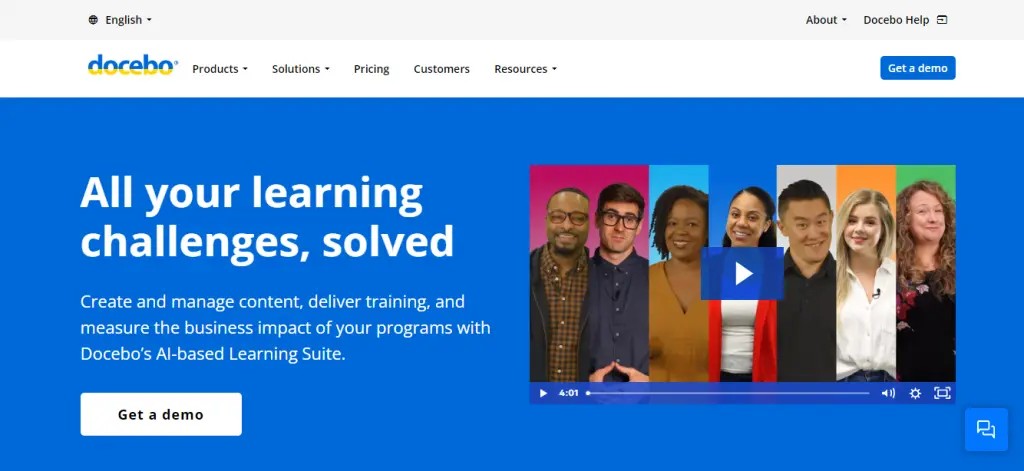
Docebo is an enterprise learning platform that uses AI to power content recommendations, skill mapping, and learning path automation. It targets large organizations with complex training needs across multiple audiences: employees, partners, customers, and franchisees. For global hospitality brands operating hundreds of properties across multiple countries, Docebo offers the kind of scalability and configurability that smaller platforms cannot match.
What separates Docebo from the other tools on this list is the depth of its learning stack. It is not just a place to host courses; it functions as a learning experience platform with social learning features, content marketplace integrations, and AI-powered skill gap analysis. The range of configuration options is genuinely extensive, though that depth comes with a steeper learning curve and longer implementation timeline.
Core Capabilities
- AI-powered content tagging, recommendations, and auto-enrollment based on role, skill gaps, and learning history
- Extended Enterprise functionality for training franchisees, partners, and seasonal contractors alongside internal staff
- Multi-tenant architecture allowing separate branded learning environments per region, brand, or property group
- Content marketplace integration (LinkedIn Learning, Coursera for Business, OpenSesame) for supplementing proprietary hospitality content
- Advanced compliance management with automated recertification workflows and audit trail reporting
- Social learning features including discussion forums, content sharing, and peer-to-peer knowledge exchange
- Mobile app with push notifications, offline access, and microlearning delivery
- Deep set of integrations including Salesforce, Workday, BambooHR, Microsoft Teams, and custom API connections
- Skill-based learning paths with competency mapping tied to hospitality role frameworks
- Advanced analytics with customizable dashboards, predictive insights, and exportable data
Standout Strength
Docebo manages complex, multi-audience training programs at global scale. A hotel group that needs to train 15,000 employees across 200 properties in 12 countries, while also certifying franchise partners and delivering guest-facing brand training, will find Docebo's multi-tenant and Extended Enterprise capabilities genuinely difficult to replicate with a simpler tool. The AI-driven skill gap identification is also a differentiator for organizations investing in workforce analytics to guide career development.
Best For
Large hospitality enterprises (100+ properties), global hotel chains, and franchise-model restaurant groups with annual training budgets above $100K. Particularly strong for organizations with a dedicated L&D team that can manage implementation and ongoing configuration. Not ideal for small or mid-size operators who need something quick to deploy.
Pricing Overview
- Custom enterprise pricing; no public pricing page
- Pricing model: Typically based on active users and modules selected
- Implementation fees apply; expect a multi-week onboarding process
- Free demo available through the Docebo website
Limitations
- Implementation complexity is significant. Plan for 8 to 16 weeks of setup, configuration, and content migration for a full enterprise deployment.
- The admin interface, while powerful, has a steep learning curve. Casual administrators will find it overwhelming without proper training on the platform itself.
- Pricing is opaque and typically high. Smaller hospitality organizations will find better value elsewhere.
Quick Comparison Insight
More powerful than TalentLMS and Absorb LMS for enterprise-scale deployments, but requires substantially more investment in implementation, administration, and budget. The right choice when scale and sophistication justify the overhead.
Axonify
Overview
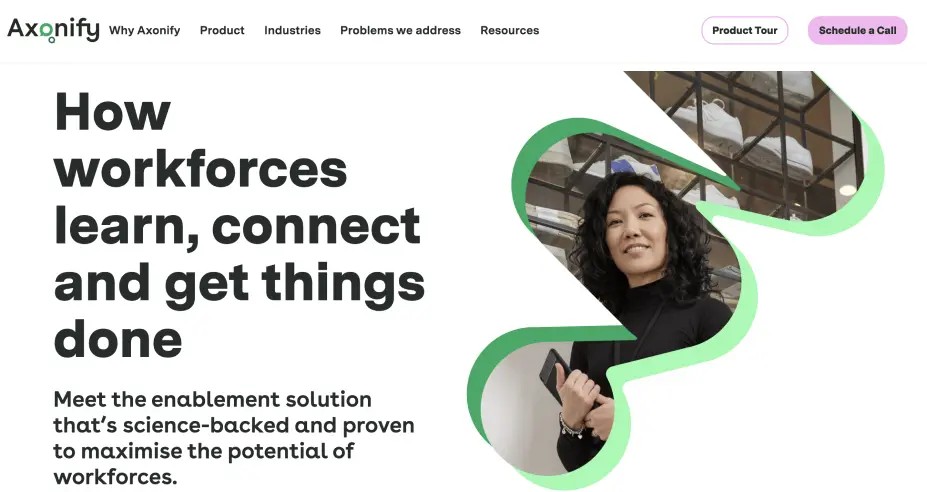
Axonify takes a fundamentally different approach to corporate training. Instead of traditional course completion, it uses daily microlearning reinforcement sessions, typically three to five minutes long, to build and maintain knowledge over time. The platform was built specifically for frontline workers, which makes it one of the most naturally aligned tools for hospitality training on this list.
The core idea behind Axonify is grounded in cognitive science: spaced repetition and retrieval practice improve long-term retention far more effectively than one-time training events. The daily sessions feel more like a knowledge check than a training module. Staff answer a few targeted questions, receive immediate feedback, and move on. For a line cook or front desk agent who has five minutes before a shift, this format fits the workflow in a way that 30-minute modules never will.
Core Capabilities
- Adaptive microlearning engine that delivers personalized daily knowledge checks based on each learner's performance gaps
- Spaced repetition algorithm that resurfaces topics a learner is struggling with until mastery is demonstrated
- Built-in content marketplace with pre-built hospitality-relevant topics including food safety, workplace safety, and customer service
- Gamification with daily challenges, leaderboards, and reward points redeemable for prizes
- Task-based training modules for procedural walkthroughs (room setup, check-in process, allergen protocols)
- Compliance tracking with automated certification management and expiration alerts
- Mobile-first design built for frontline access on personal devices without requiring a company email
- Multilingual support with content delivery in 60+ languages
- Advanced analytics showing knowledge gaps by topic, team, and location
- Integration with major HRIS platforms for automated user provisioning and deprovisioning
Standout Strength
Axonify is the strongest option on this list for ongoing knowledge reinforcement. Most hospitality LMS platforms focus on initial training and annual compliance. Axonify addresses the gap between training completion and actual on-the-job behavior by keeping critical knowledge fresh through daily engagement. For hotels and restaurants where food safety, service standards, and safety protocols must be consistently top-of-mind, not just checked off once a year, this is a meaningful operational advantage. The approach aligns with what research on microlearning consistently shows about retention and behavior change.
Best For
Large hospitality operations (hotel chains, resort groups, multi-unit restaurant brands) with 500+ frontline employees who need continuous knowledge reinforcement beyond initial onboarding. Particularly strong for organizations where food safety, brand standards, and safety compliance are recurring training priorities, not just annual checkboxes.
Pricing Overview
- Custom pricing based on user count and modules selected
- No publicly listed pricing; expect enterprise-level investment
- Implementation support included in most packages
- Free demo available
Limitations
- Axonify is not a traditional LMS. If you need to deliver long-form courses, instructor-led training management, or complex certification programs, you will likely need to pair it with another platform.
- The daily microlearning format requires organizational commitment. If managers do not reinforce the expectation that staff complete their daily sessions, engagement drops.
- Pricing is enterprise-oriented. Smaller hospitality operators with 50 to 100 staff will find it disproportionately expensive.
Quick Comparison Insight
Fundamentally different from TalentLMS or Absorb LMS in approach. Axonify does not replace a full LMS for course delivery and compliance tracking, but it outperforms every other tool on this list for sustained knowledge retention among frontline staff.
eduMe
Overview
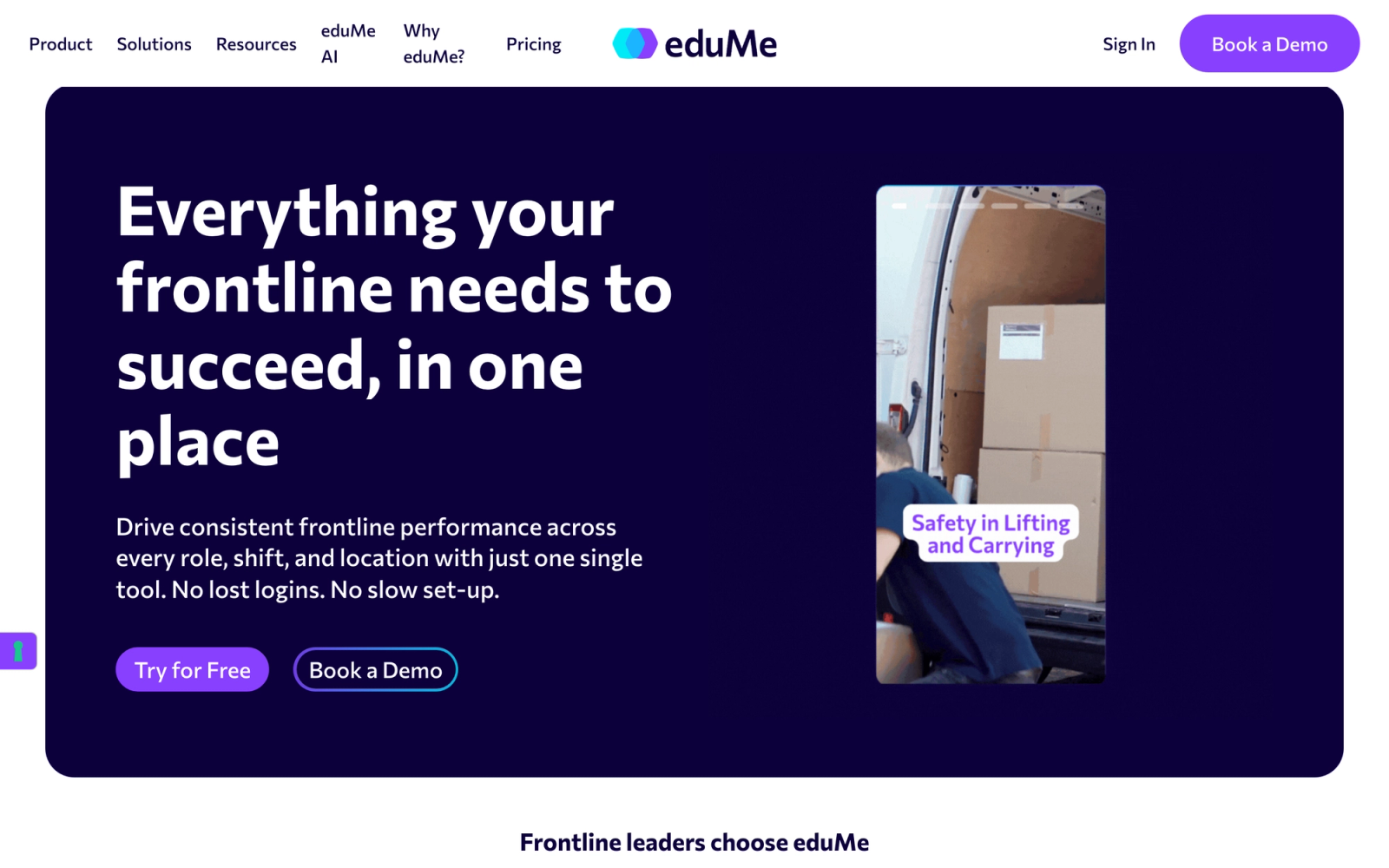
eduMe is a mobile-first training platform designed specifically for deskless workers. It strips away the complexity of traditional LMS platforms and focuses on delivering short, engaging training content directly to a worker's smartphone, often without requiring an app download, a company email, or an account login. For hospitality organizations where most staff do not have corporate email addresses and may not even have regular computer access, this frictionless entry point is a significant advantage.
The design philosophy behind eduMe prioritizes speed and simplicity. The content creation tools are built around short-form content: brief video lessons, image-based guides, quizzes, and surveys. You can build a five-minute onboarding module in under 20 minutes. The platform does not try to be a full enterprise LMS; it focuses on getting critical information to frontline workers as fast as possible.
Core Capabilities
- Passwordless access via magic links, QR codes, or SMS, eliminating the friction of account creation for seasonal and part-time staff
- Mobile-native content builder optimized for vertical video, image carousels, and short-form quizzes
- AI-powered content creation tools that convert existing documents and SOPs into mobile-friendly lessons
- Delivery through existing communication channels (SMS, WhatsApp, Teams, Slack) rather than requiring a separate app
- Pre-built hospitality content templates for onboarding, food safety basics, and customer service
- Real-time analytics on completion rates, quiz scores, and content engagement by location and team
- Multilingual content support with built-in translation capabilities
- Integration with HR platforms including Workday, SAP SuccessFactors, and BambooHR for automated enrollment
- Embeddable training within existing workforce apps and internal portals
- Survey and feedback collection tools tied to training completion for measuring impact
Standout Strength
eduMe's passwordless, app-free access is its defining advantage for hospitality. In an industry where a new hire might start their first shift two days after being hired, the ability to send a text message with a training link that works instantly on any phone removes the biggest adoption barrier that traditional LMS platforms create. No app download, no IT setup, no account creation. This matters enormously when you are onboarding employees who may only stay for a season.
Best For
Hospitality organizations with large deskless workforces (quick-service restaurants, event venues, seasonal resorts, staffing agencies serving the hospitality sector) that need to deliver fast, mobile-first training without the overhead of a traditional LMS. Strong for organizations where the priority is getting staff floor-ready within hours, not building long-term career development programs.
Pricing Overview
- Custom pricing; no publicly listed plans
- Pricing typically based on active users and content volume
- Pilot programs available for proof-of-concept testing
- Free demo available through the eduMe website
Limitations
- eduMe is not a full-featured LMS. It lacks SCORM support, traditional course management, and the depth of compliance tracking that platforms like Litmos or Absorb LMS provide.
- Reporting is improving but still basic compared to enterprise platforms. Advanced workforce analytics and cross-property benchmarking require workarounds.
- The simplicity that makes it great for frontline training limits its usefulness for management development or complex certification programs.
Quick Comparison Insight
Faster to deploy and easier to access than any other tool on this list, but narrower in scope. Best paired with a more traditional LMS if you also need compliance management, long-form courses, or leadership development.
Litmos
Overview
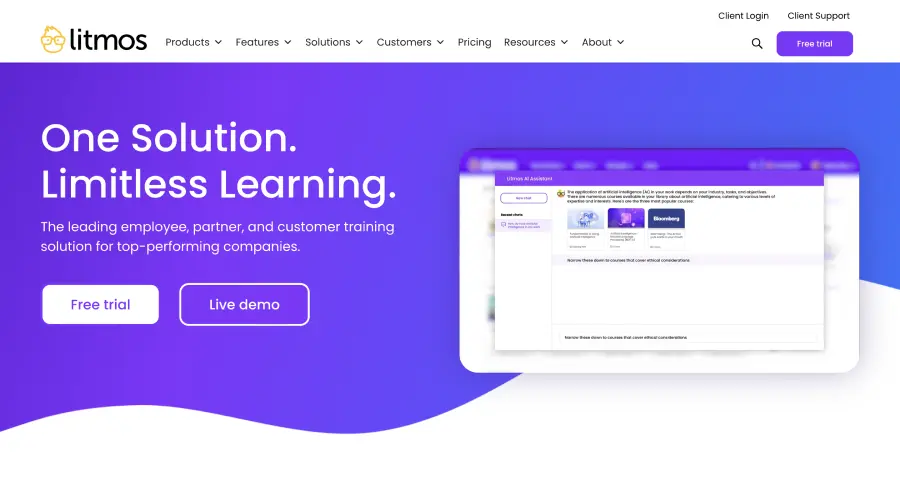
Litmos is a corporate learning platform now owned by Francisco Partners, which acquired it from SAP. It still carries deep compliance and content-library roots from its enterprise years. It combines a straightforward course authoring tool with a built-in content library and compliance management features that make it a practical choice for hospitality organizations where regulatory training is a primary concern. The platform's strength lies in its balance between simplicity for administrators and depth for compliance tracking.
Litmos places heavy emphasis on getting learners into training quickly. The auto-enrollment rules, content library of pre-built courses (including food safety, workplace safety, and harassment prevention), and automated compliance workflows mean that a new hire can be assigned their full onboarding path before their first shift. For a hotel group managing rolling hiring across multiple departments, that automation saves significant administrative time.
Core Capabilities
- Built-in content library with thousands of off-the-shelf courses (and access to 95,000+ titles via its marketplace) covering compliance, safety, customer service, and professional skills
- SCORM, xAPI, and AICC support for importing content from external authoring tools
- Automated compliance workflows with recertification tracking, expiration alerts, and audit trail reports
- Course authoring tool with video, quizzes, surveys, and assessment creation built into the platform
- Multilingual support for both the interface and course content
- Mobile app with offline access and push notifications for assignment reminders
- Team hierarchies and organizational structure mapping for multilocation training management
- Integration with Salesforce, BambooHR, and 30+ other enterprise systems via API
- eCommerce module for selling hospitality training content to external partners or franchisees
- Instructor-led training management with session scheduling, attendance tracking, and virtual classroom integration
Standout Strength
Litmos stands out for compliance training management. The combination of a pre-built compliance content library, automated recertification workflows, and detailed audit reporting makes it one of the most efficient platforms for ensuring that every staff member across every property maintains current certifications. For hospitality organizations that face regular health department inspections, liquor licensing audits, or brand standard assessments, this audit-readiness is a concrete operational benefit.
Best For
Mid-to-large hospitality organizations (20+ properties) where compliance training is the primary driver for LMS adoption. Also suitable for organizations that want access to a large pre-built content library without investing heavily in custom course development.
Pricing Overview
- Custom, quote-based pricing; Litmos does not publish per-seat rates
- Higher tiers add the off-the-shelf content library and advanced compliance features
- Volume discounts available for large user counts
- Free 14-day trial available on request
Limitations
- The admin interface feels dated compared to newer platforms like Docebo or Absorb LMS. Navigation can be unintuitive, and some configuration tasks require more clicks than they should.
- The built-in content library, while large, includes courses of varying quality. Some hospitality-relevant courses feel generic rather than industry-specific.
- Advanced reporting requires the Premier tier. The Foundation tier's reporting capabilities are limited for organizations needing location-level benchmarking.
Quick Comparison Insight
Stronger than TalentLMS for compliance management and content-library breadth, but less modern in UX and less flexible in content creation. A practical choice when compliance is the main reason you are buying an LMS.
Absorb LMS
Overview
Absorb LMS is a corporate learning platform known for its clean interface, reliable performance, and balance between ease of use and enterprise-grade features. It sits in the mid-to-large market, competing with platforms like Docebo and Litmos but consistently earning recognition for its user experience on both the admin and learner sides.
Where Absorb stands out immediately is the learner experience. The interface is modern, responsive, and works smoothly on mobile without the sluggishness that older enterprise platforms carry. For hospitality organizations where frontline staff need to find and complete training without hand-holding, a clean learner-side UI directly reduces friction and the volume of support tickets managers field during onboarding pushes. An LMS evaluation checklist would consistently rank Absorb well on usability.
Core Capabilities
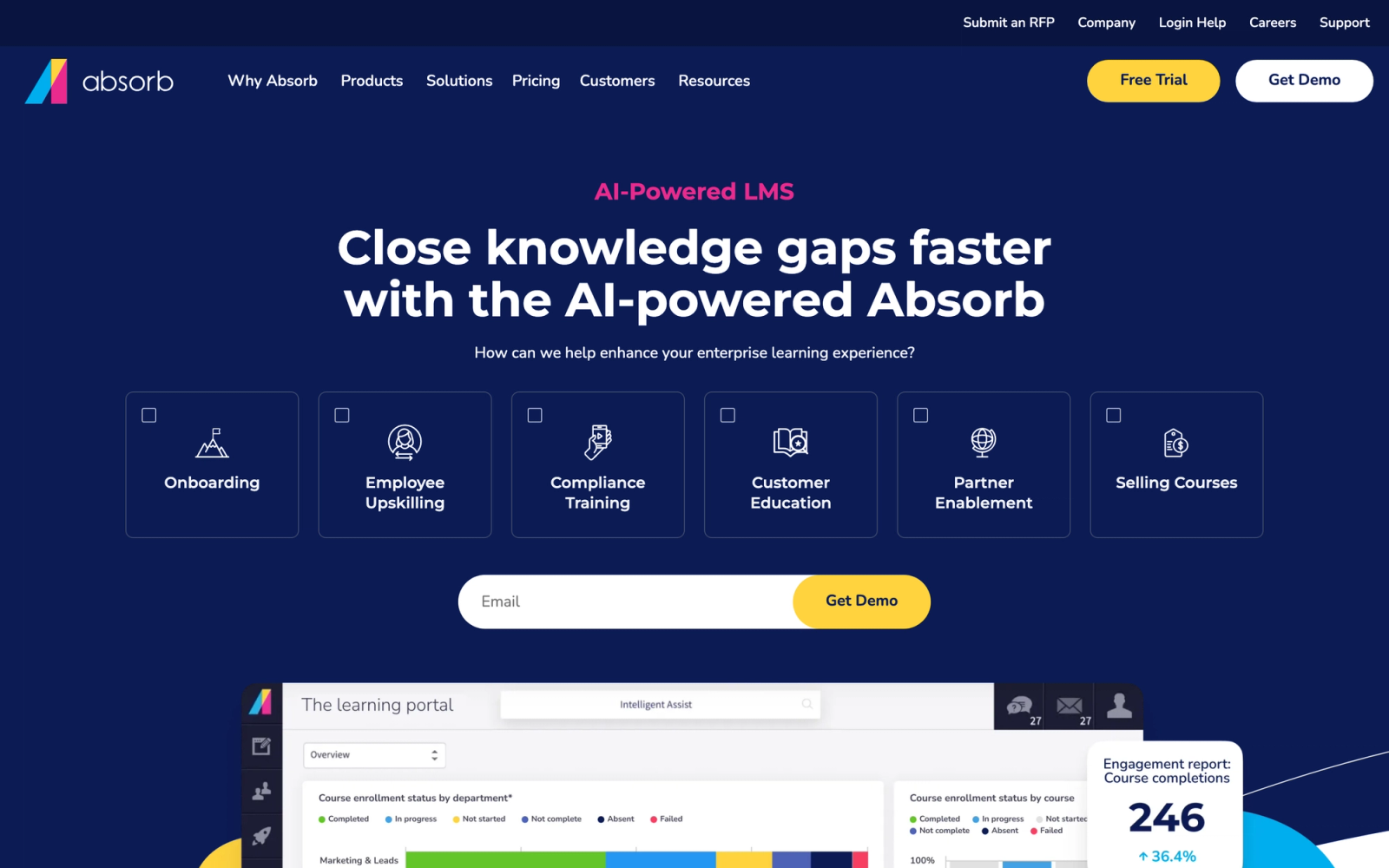
- Intelligent Assist, an AI-powered admin tool that automates repetitive tasks like enrollment, notifications, and report scheduling
- Custom learner dashboards with role-based content display tailored to each department or position
- Compliance management with automated certification tracking, expiration alerts, and re-enrollment triggers
- SCORM, xAPI, AICC, and LTI support for flexible content import from third-party authoring tools
- Native mobile app with offline learning, push notifications, and responsive design for on-the-go training
- eCommerce module for selling training content to franchise partners or external hospitality operators
- Multi-department and multi-property management through organizational hierarchies and custom user groups
- Observation checklists for verifying on-the-job skill demonstration (useful for service standard assessments)
- Integration with Workday, BambooHR, ADP, Salesforce, and an open REST API for custom connections
- Advanced reporting with scheduled delivery, visual dashboards, and customizable data exports
Standout Strength
Absorb's observation checklists are the feature most directly relevant to service-industry training. Beyond course completion, managers use the checklist tool to verify that a staff member actually performs a task correctly on the floor: executing a proper room turndown, greeting guests per brand standards, or following allergen handling protocols. This bridges the gap between digital training completion and real-world competency verification, a step that purely content-delivery platforms skip. It supports the kind of structured approach that turns classroom knowledge into consistent on-the-job behavior.
Best For
Mid-to-large hospitality organizations (50 to 500+ properties) that want an LMS with a clean user experience, solid compliance features, and the flexibility to serve multiple departments and locations. Particularly strong for hotel brands that value both admin efficiency and a polished learner-facing interface. A good fit for teams evaluating corporate LMS options and want something that balances capability with usability.
Pricing Overview
- Custom pricing based on user count and feature set
- No publicly listed starting price; expect mid-market to enterprise-level investment
- Implementation support packages available
- Free demo and guided trial available through the Absorb website
Limitations
- The built-in course authoring is limited. Most organizations using Absorb rely on external tools like Articulate or Lectora for content creation, which adds cost and complexity.
- Some advanced features (Intelligent Assist, eCommerce) are available only at higher pricing tiers, making the entry-level offering less compelling than it appears.
- While the multilocation management works well, it is not as deeply customizable as Docebo's multi-tenant architecture for organizations needing fully separate branded environments per region.
Quick Comparison Insight
Better learner experience than Litmos, more affordable than Docebo, and more polished than TalentLMS at the enterprise level. The observation checklist feature gives it a practical edge for hospitality training verification that most competitors lack.
Schoox
Overview
Schoox is a learning management platform that was built with frontline and service industries in mind. Unlike general-purpose corporate LMS platforms that were adapted for hospitality after the fact, Schoox has deep roots in restaurant, retail, and franchise training. The platform combines traditional LMS features with talent development tools, including performance management and skills tracking, creating a more connected system for organizations that want training tied to career progression.
Schoox is distinguished by its focus on multi-unit franchise operations. If franchise governance is your priority, see our roundup of the best LMS for franchise operations for a deeper comparison.
Core Capabilities
- Multi-unit franchise architecture with corporate-level content control and franchisee-level administration and reporting
- Role-based learning paths that automatically assign training based on job title, department, and location
- Built-in performance management with goal tracking, reviews, and skills assessments tied to learning activities
- Compliance management with automated tracking, certification management, and audit-ready reporting
- Mobile app optimized for frontline workers with offline access and push notification reminders
- Content authoring tools with support for video, documents, quizzes, and SCORM packages
- Social learning features including discussion boards, content sharing, and peer recognition
- Multilingual interface and content support for global hospitality operations
- Integration with major HRIS and POS systems used in hospitality (ADP, UKG, Paycom)
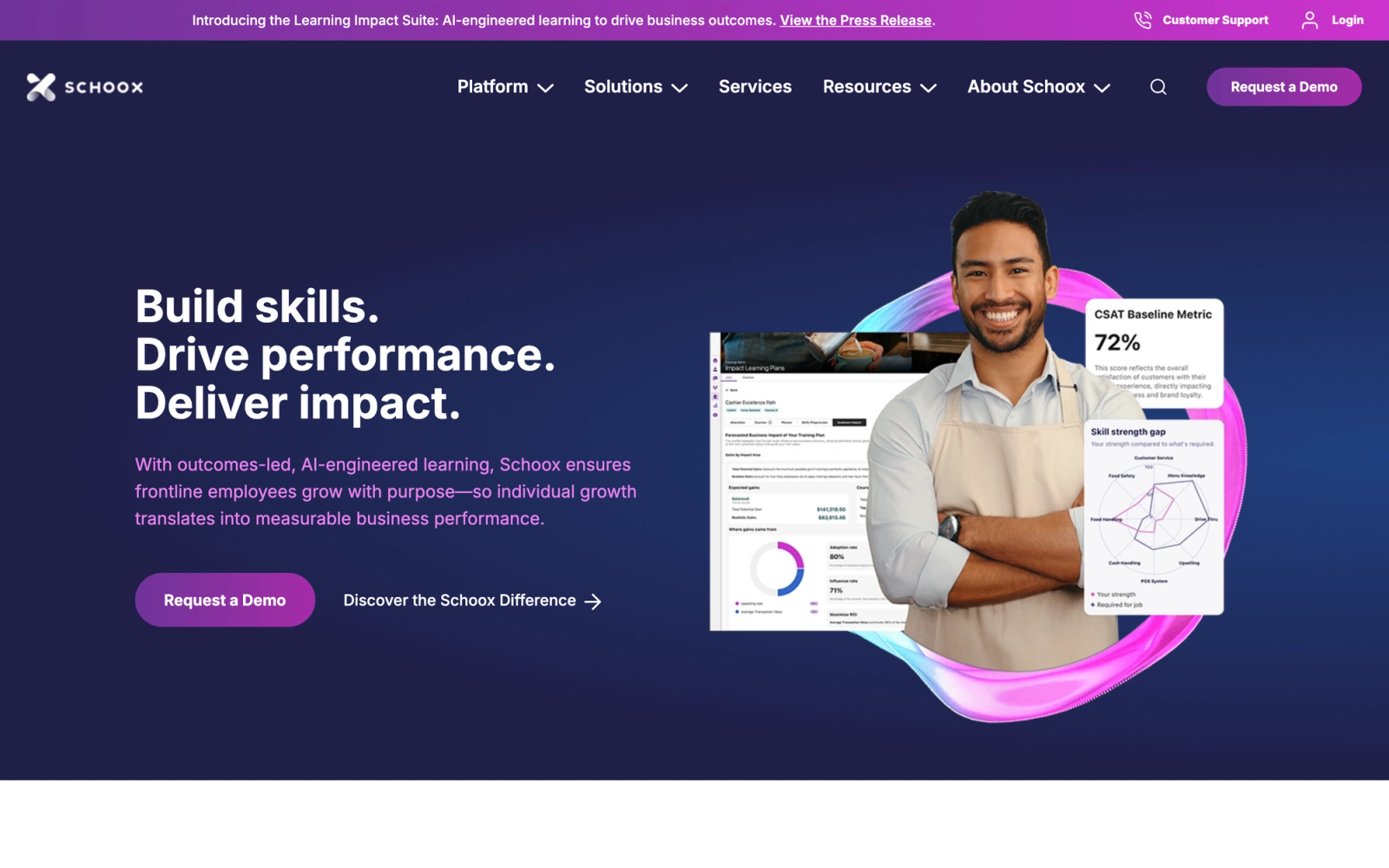
- Impact dashboards that connect training completion to operational KPIs like retention, safety incidents, and customer satisfaction
Standout Strength
Schoox's clearest differentiator is the impact dashboard layer that links training completion to operational metrics: employee retention by location, safety incident frequency, and guest satisfaction scores. For a restaurant group justifying its L&D investment to a CFO or ownership group, the ability to correlate completion rates with retention or incident data shifts the conversation from activity metrics to business outcomes. Few platforms in the mid-market tier surface this kind of operational correlation without requiring a custom data integration.
Best For
Multi-unit restaurant groups, hotel franchises, and hospitality management companies with 10 to 500+ locations that need centralized training management with franchise-level autonomy. Strong for organizations that want training connected to performance management and business outcomes, not just completion tracking. Especially relevant for brands running a mix of corporate-owned and franchised properties.
Pricing Overview
- Custom pricing based on user count and modules selected
- No publicly listed starting price
- Pricing typically competitive with Absorb LMS and TalentLMS at scale
- Free demo available through the Schoox website
Limitations
- The interface, while functional, is not as visually polished as Absorb LMS or Docebo. Some users report that navigation feels cluttered in the admin console.
- The performance management module, while useful, is less mature than standalone performance management tools. Organizations with sophisticated talent management needs may find it limiting.
- Reporting depth is strong at the location level but can require custom configuration for cross-region or cross-brand analysis.
Quick Comparison Insight
Better suited for franchise and multi-unit restaurant operations than TalentLMS or Absorb LMS, thanks to its franchise-native architecture. Less polished than Docebo at the enterprise level, but more accessible in terms of cost and implementation time.
How to Choose the Right LMS for Your Hospitality Organization
The right platform depends on what problem you are solving first. Hospitality organizations rarely have a single training need; the challenge is prioritizing.
If compliance is your primary driver, Litmos and Absorb LMS give you the strongest combination of automated certification tracking, audit-ready reporting, and pre-built compliance content. For organizations where health inspections and licensing audits are regular occurrences, compliance infrastructure should be the first filter.
If you operate a franchise or multi-unit restaurant group, Schoox was built for your operating model. Its franchise-native architecture, impact dashboards, and connection between training and business KPIs align with how multi-unit operators actually manage and measure performance. TalentLMS is a more affordable alternative if your franchise structure is simpler.
If you need to reach deskless staff with zero friction, eduMe's passwordless, app-free access model removes adoption barriers that defeat other platforms. For high-turnover environments where seasonal workers need to be floor-ready within hours, reducing login friction directly impacts training completion rates.
If ongoing knowledge retention matters more than initial training, Axonify's daily microlearning approach is in a category of its own. It does not replace a full LMS, but for food safety, brand standards, and safety protocols that must stay top-of-mind year-round, it outperforms every traditional LMS for sustained behavior change.
If you need enterprise scale and global reach, Docebo is the platform with the deepest configurability, the most advanced AI features, and the broadest set of integrations. The trade-off is cost and implementation complexity, which makes it appropriate for organizations with dedicated L&D teams and budgets to match.
For management training, cross-property learning communities, and facilitated group programs, Teachfloor fills a gap that purely self-paced platforms leave open. Its support for both structured live sessions and self-paced paths, combined with white-label branding and multi-branch oversight, makes it a practical fit for operators running centralized manager development programs alongside frontline onboarding.
Start by identifying your most urgent training gap. Then narrow the list based on your organization's size, budget, technical capacity, and the specific audience you need to reach first. An LMS features comparison can help structure the evaluation, but the most important question is not which platform has the most features. It is which platform's strengths align with your most pressing operational need.
FAQ
Which LMS is best for restaurant food-safety and alcohol-service compliance?
For restaurants where ServSafe, HACCP, and TIPS or RBS tracking drive the decision, Litmos and Absorb LMS offer the strongest automated certification tracking, recertification reminders, and audit-ready reporting, with large off-the-shelf compliance libraries. Schoox is a strong alternative for multi-unit restaurant groups that also want training tied to performance and business KPIs. If you want compliance plus brand-consistent service training and onboarding in one flexible platform, Teachfloor handles certificates and structured paths while adding community, peer practice, and live sessions.
Is Teachfloor a good fit for hotel and restaurant training?
Yes. Teachfloor suits hospitality groups that want training tied to guest experience and brand consistency: self-paced onboarding for frontline staff, community and peer practice for service standards, and live cohort-based programs for manager and GM development. Its AI course creation turns existing SOPs and brand manuals into structured courses quickly, and white-label branding lets you run a branded service academy on your own domain. It is part of the wider corporate training platform category but built around interaction rather than passive content libraries.
What is the best LMS for hotel training?
There is no single best LMS for all hotel training needs. For multilocation compliance management, Absorb LMS and Litmos are strong choices. For reaching frontline deskless staff quickly, eduMe offers the lowest-friction onboarding experience. For enterprise-scale hotel chains with complex training programs, Docebo provides the deepest configurability. The best fit depends on your property count, workforce size, and whether compliance, onboarding speed, or ongoing knowledge retention is your priority.
Can I use a regular corporate LMS for hospitality training?
You can, but you will likely hit friction points. Generic corporate LMS platforms often assume desk-based learners with company email addresses and regular computer access. Hospitality staff are mobile-first, multilingual, and high-turnover. Platforms built for or adapted to frontline workforces (Axonify, eduMe, Schoox) address these realities directly. A general corporate LMS works if your training needs are straightforward, but specialized platforms reduce the operational workarounds.
How important is mobile access for hospitality LMS?
It is essential, not optional. The majority of hospitality employees do not have assigned workstations. Training that requires a desktop computer or a classroom session competes with operational demands and rarely gets completed. Every platform on this list offers mobile learning capabilities, but the depth varies significantly. eduMe and Axonify were built mobile-first; others adapted their desktop platforms for mobile afterward.
What compliance training does hospitality staff typically need?
The requirements vary by role and jurisdiction, but common compliance training areas include food safety certification (ServSafe, HACCP), responsible alcohol service (TIPS, RBS), workplace safety (OSHA), fire safety and emergency procedures, anti-harassment training, ADA accommodation protocols, and brand-specific service standards. An LMS with automated recertification tracking is particularly valuable because many of these certifications expire annually and must be renewed.
How do I handle training for seasonal and part-time hospitality staff?
Look for platforms with low-friction onboarding: passwordless access (eduMe), SMS or QR code enrollment, and no requirement for a company email address. Pricing models matter here too; per-user pricing becomes expensive when you have high seasonal headcount. Platforms with active-user billing (charging only for users who log in during a given period) or flat-rate pricing handle seasonal fluctuations more cost-effectively. Having scalable onboarding processes in place makes the difference between smooth seasonal ramp-ups and chaotic ones.


