

Why Look for a Bloomerang Alternative?
Bloomerang is a well-regarded donor management CRM, and its focus on donor retention metrics is a genuine differentiator in the nonprofit space. But no platform works equally well for every organization, and there are specific pain points that push nonprofits to explore Bloomerang alternatives.
Reporting limitations. Bloomerang's built-in reporting is straightforward for standard nonprofit metrics, but organizations that need custom cross-tabulated reports, multi-dimensional donor analysis, or board-level dashboards often find it restrictive. If your team spends time exporting data to spreadsheets just to get the views you need, that is a signal.
Pricing that scales with record count. Bloomerang's per-contact pricing model means costs increase as your donor database grows. Starting at roughly $125 per month for up to 1,000 records, the price climbs as you add constituents. For organizations experiencing rapid growth or managing large legacy databases, this creates budget pressure that flat-rate or per-user models do not.
Limited native functionality beyond donor management. Bloomerang focuses tightly on donor tracking and retention. It does not include native event management, membership tracking, grant management, or major gift pipeline tools. Organizations that need those capabilities have to bolt on third-party integrations, which adds cost and complexity.
Basic email marketing. While Bloomerang includes a built-in email tool, it lacks the automation depth, template flexibility, and segmentation sophistication that many fundraising teams expect. Teams with complex communication workflows often supplement it with a separate email platform.
Integration constraints. Bloomerang's integration library has grown over time, but organizations with specific needs around accounting software, payment processors, or marketing automation sometimes find the available connections limited compared to more open platforms.
None of these are deal-breakers for every nonprofit. But if your organization has outgrown Bloomerang's reporting, needs broader functionality, or is looking for a different pricing model, the alternatives below address those gaps directly.
What to Look for in a Donor CRM
Switching donor CRMs is a significant operational decision. Before comparing individual tools, it helps to anchor on the criteria that matter most for your organization.
Reporting and data access. Can you build the exact reports your board, grant funders, and development team need without exporting to spreadsheets? Look for platforms with custom report builders, saved report templates, and real-time dashboards.
Total cost of ownership. Subscription fees are only part of the picture. Factor in implementation costs, data migration, employee training time, add-on modules, and payment processing fees. A platform with a lower monthly price can end up costing more if it requires expensive integrations or consulting.
Fundraising channel coverage. Some organizations only need a donor database. Others need event registration, peer-to-peer fundraising, membership management, grant tracking, and major gift pipelines in one place. Identify which channels your team actively uses before evaluating features you will never touch.
Ease of use versus depth. Simpler platforms get staff productive faster. Deeper platforms handle more complex workflows. There is a real trade-off here, and the right answer depends on your team's technical comfort and the complexity of your operations. Resources like the NTEN Community can help nonprofit technology teams evaluate these trade-offs with peer input.
Integration ecosystem. Check for native connections to your accounting software (QuickBooks, Xero), email platform (Mailchimp, Constant Contact), and payment processor. An open API matters if you need custom integrations and connections to your existing tech stack.
Scalability. A CRM that works well for 2,000 contacts may struggle at 50,000. Consider not just your current size but where you expect to be in three to five years. Switching CRMs again is expensive.
Data migration support. How does the vendor handle importing your existing data? Dedicated migration support, mapping tools, and historical data preservation should be standard, not premium add-ons. A smooth onboarding process for your team during the switch matters just as much as the technical migration itself.
12 Best Bloomerang Alternatives
The tools below range from budget-friendly databases to enterprise platforms. Each addresses a different combination of the gaps outlined above, spanning a wide range of organization sizes, budgets, and operational complexity.
Tool
Pricing
Best For
Neon CRM
From $99/mo
Small-to-midsize nonprofits with annual budgets between $500K and $10M that
DonorPerfect
From $99/mo
Mid-size nonprofits with 1,000 to 50,000+ donor records that need detailed
Little Green Light
From $45/mo
Small nonprofits with annual budgets under $1M, donor databases under 5
Kindful
From $119/mo
Small-to-midsize nonprofits that use multiple best-of-breed tools and need a
Virtuous CRM
Contact for pricing
Mid-to-large nonprofits with annual budgets above $2M and fundraising teams of
Network for Good
From $100/mo
Small nonprofits with annual budgets under $3M that are either adopting a donor
Blackbaud eTapestry
From $100 to $150/mo
Small-to-midsize nonprofits already considering the Blackbaud ecosystem or
Salsa CRM
Contact for pricing
Advocacy-driven nonprofits with annual budgets above $1M that need to track
Sumac
From $35 to $50/mo
Small-to-midsize nonprofits, particularly human service organizations
Funraisin
From $500 to $1,000
Nonprofits whose primary fundraising strategy centers on peer-to-peer
CiviCRM
Free plan available; paid from $30 to $150/mo
Budget-constrained nonprofits with access to a technical volunteer
Salesforce Nonprofit Cloud
Free plan available; paid from $36 to $60/user
Mid-to-large nonprofits with annual budgets above $2M
Neon CRM
Overview
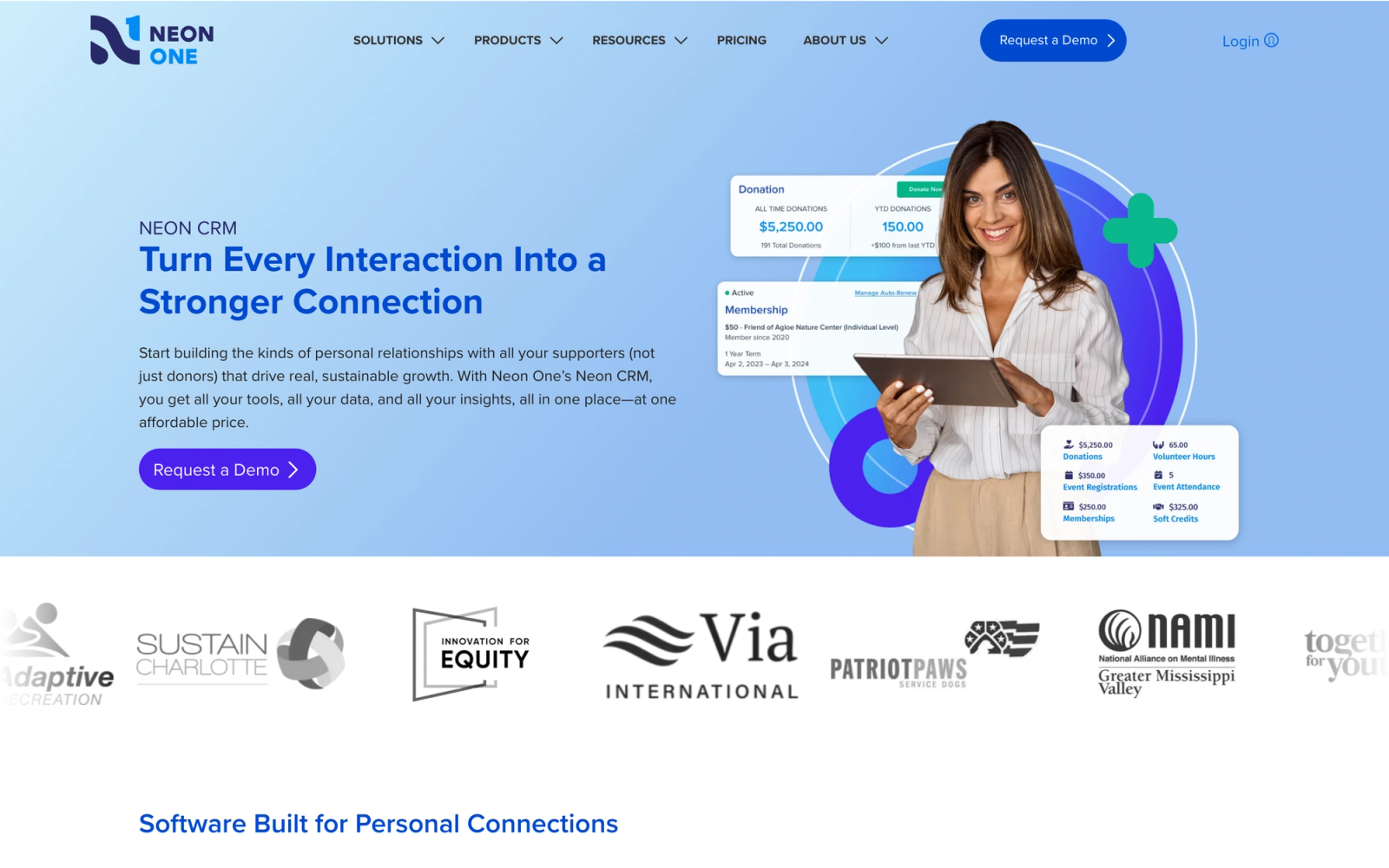
Neon CRM is the flagship product of Neon One, a company that positions itself as a "connected nonprofit ecosystem." Where Bloomerang focuses tightly on donor management and retention, Neon CRM bundles donor tracking, event registration, membership management, email marketing, and payment processing into a single platform with a shared database.
The first thing that stands out about Neon CRM is how many separate tools it replaces. Event attendee data flows directly into donor records. Membership renewals and fundraising page donations appear in the same constituent timeline. For organizations currently juggling three or four separate systems, that consolidation alone is a compelling reason to consider it.
Core Capabilities
- Centralized donor and constituent profiles with full interaction history, giving timelines, and custom fields
- Built-in customizable online donation forms with recurring giving, tribute gifts, and pledge management
- Native event registration and ticketing with attendee tracking, check-in tools, and table management
- Membership management with automated renewal reminders, member directories, and tiered membership levels
- Built-in email marketing with templates, segmentation based on CRM data, and performance tracking
- Pre-built nonprofit reports (LYBUNT/SYBUNT, retention, giving summaries) plus a custom report builder
- Volunteer management with hour tracking, sign-up forms, and volunteer-to-donor record linking (useful for nonprofits that also manage volunteer training)
- Automated workflows for thank-you emails, task assignments, and acknowledgment letters
- Neon Pay integrated payment processing that keeps payment data connected to donor records
- Neon Fundraise for peer-to-peer and crowdfunding campaigns that feed data back into the CRM
Standout Strength
Organizations choose Neon CRM because it eliminates the need to connect and sync multiple separate tools. The native integration between CRM, events, memberships, and payments means less data reconciliation and fewer sync errors. For membership-based organizations that also engage community members through events and programs, this unified approach is a meaningful operational advantage over Bloomerang's more focused model.
Best For
Small-to-midsize nonprofits with annual budgets between $500K and $10M that need donor management, event registration, and membership management in a single platform. Particularly strong for membership-based organizations (associations, museums, public media), event-heavy nonprofits running galas or walks, and teams consolidating multiple separate systems.
Pricing Overview
- Starting price: $99 per month (billed annually) for the Essentials tier
- Pricing model: Tiered subscription based on the number of contacts in the database
- Mid-tier plans range from $149 to $249 per month
- Neon Pay charges standard per-transaction fees (around 2.9% + $0.30)
- Free demo available; check neonone.com for current trial options
Limitations
- Steeper learning curve than Bloomerang. The breadth of features means more configuration time and longer staff onboarding.
- Email marketing is functional but not on par with dedicated platforms like Mailchimp for advanced automation and A/B testing.
- Custom report building can be less intuitive than expected, particularly for cross-module reports combining event and donation data.
Quick Comparison Insight
Broader than Bloomerang across events, memberships, and payments. Less focused on donor retention metrics, but replaces more tools in a single subscription.
DonorPerfect
Overview
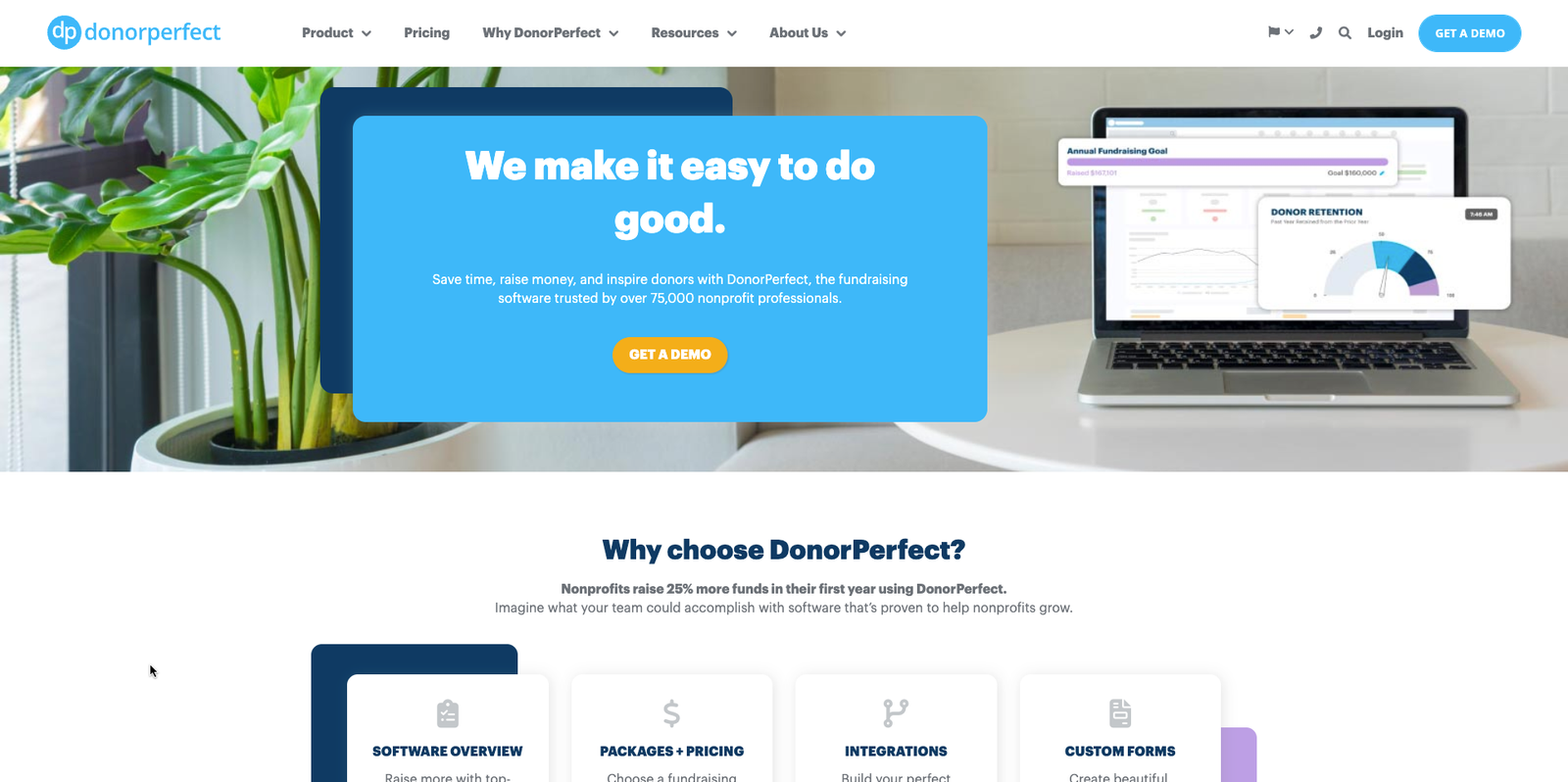
DonorPerfect has been in the nonprofit CRM market for over four decades, giving it one of the longest track records in the space. Developed by SofterWare and now part of the Community Brands family, it sits in the mid-market between simple donor databases and enterprise systems like Raiser's Edge NXT.
What sets DonorPerfect apart from Bloomerang is the depth of its data model. Unlimited custom fields, a flexible custom report builder, and cross-tabulated reporting give development teams analytical power that Bloomerang's simpler reporting cannot match. The range of available filters and grouping options in the report builder is noticeably richer than what most mid-market CRMs offer. For teams that value data-driven analytics to guide fundraising strategy, that reporting depth makes a tangible difference.
Core Capabilities
- Donor records with unlimited custom fields, relationships, and household/organization linking
- Online donation forms with one-time, recurring, tribute, and pledge options
- Recurring gift management with automated card updater services and failed payment handling
- Custom report builder with 50+ pre-built templates, LYBUNT/SYBUNT analysis, and visual dashboards
- Moves management system for major gift tracking with cultivation steps, solicitation strategies, and task reminders
- Native integration with Constant Contact for email marketing (also a Community Brands product)
- Event management including registration, ticketing, table management, and auction tracking
- Pledge and grant tracking with scheduled payment reminders and restricted fund accounting
- Automated thank-you letters, tax receipts, and acknowledgment workflows triggered by gift type or amount
- Integration marketplace connecting to QuickBooks, DonorSearch, Double the Donation, and an open API
Standout Strength
Development teams choose DonorPerfect when they need reporting flexibility and data customization that approach enterprise tools, without the enterprise price tag or complexity. The combination of unlimited custom fields, a granular report builder, and strong recurring gift tools makes it a natural upgrade path for organizations that have hit Bloomerang's reporting ceiling.
Best For
Mid-size nonprofits with 1,000 to 50,000+ donor records that need detailed custom reporting, grant compliance documentation, and structured major gift pipelines. Strong fit for development teams with 3 to 15 staff members who outgrow simpler CRMs but are not ready for a Salesforce-level investment.
Pricing Overview
- Starting price: $99 per month for the base plan (up to roughly 1,000 records)
- Pricing model: Tiered by number of donor records, unlimited users included
- Mid-tier plans range from $179 to $299 per month as record counts scale
- Free 30-day trial available
- Some features (payment processing, Constant Contact, wealth screening) carry additional fees
Limitations
- The interface feels dated compared to Bloomerang's cleaner design. Navigation can be cluttered, and the learning curve is steeper for non-technical staff.
- Add-on costs accumulate. Email marketing, payment processing, and wealth screening are often separate charges that raise total cost above the base subscription.
- Customer support quality is inconsistent based on user reviews, with some reporting long response times.
Quick Comparison Insight
Deeper reporting and more customizable than Bloomerang, but trades away ease of use. A common next step for organizations that have outgrown Bloomerang's analytics capabilities.
Little Green Light
Overview
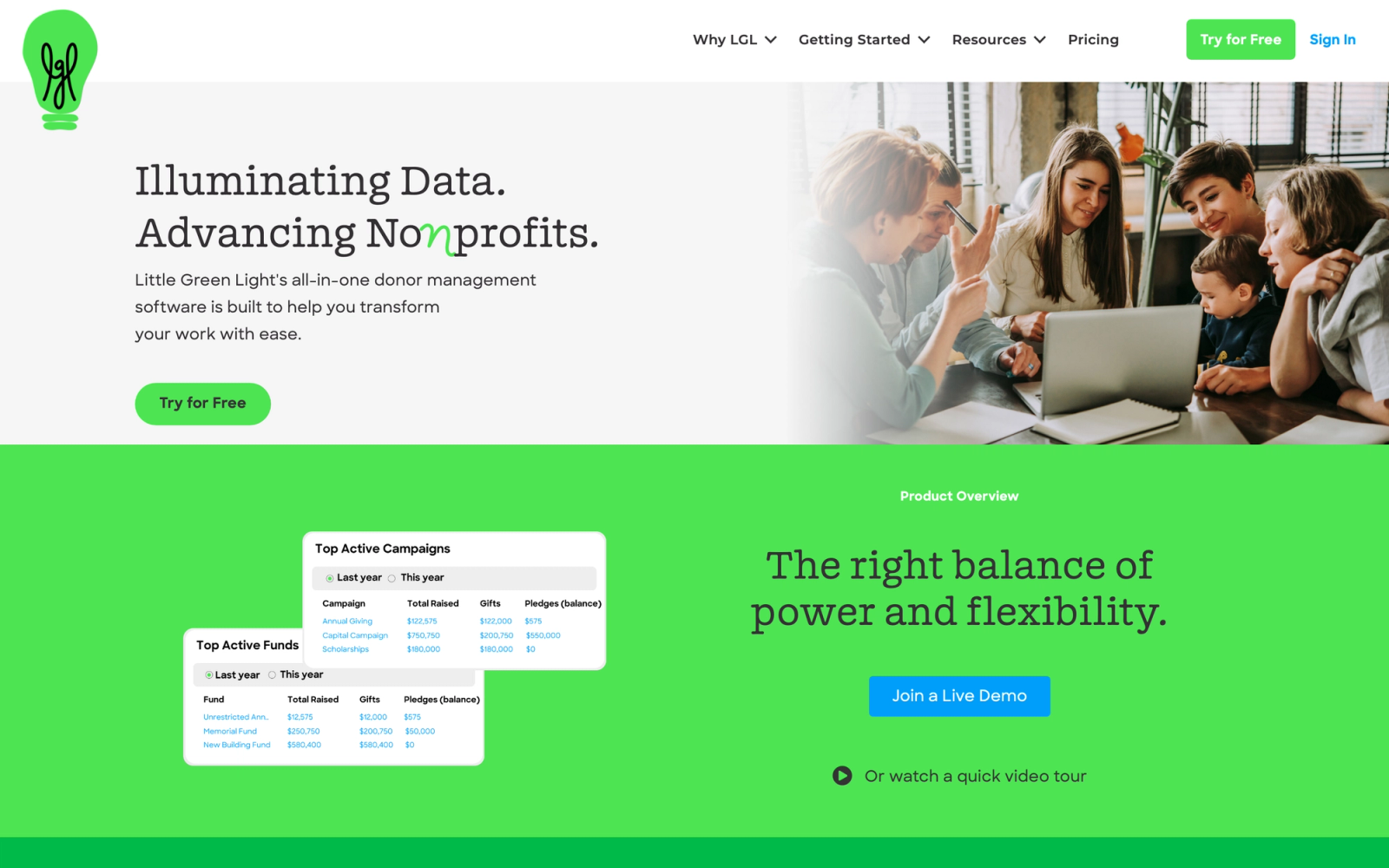
Little Green Light takes the opposite approach from feature-heavy platforms. It is a streamlined donor management tool built for small nonprofits that need clean contact records, gift tracking, and basic reporting without the complexity or cost of larger systems.
The experience of using Little Green Light is refreshingly simple. There are no modules to configure or add-ons to evaluate. You get a donor database, gift entry, acknowledgment tracking, and reporting in a straightforward interface that volunteers and part-time staff can learn in an afternoon. For organizations where Bloomerang feels like more than they need (and more than they want to pay for), Little Green Light delivers the essentials at a fraction of the price.
Core Capabilities
- Contact management with custom fields, tags, relationships, and household grouping
- Gift entry and tracking with recurring donations, pledges, soft credits, and in-kind gifts
- Acknowledgment and receipt tracking with merge-letter generation
- LYBUNT/SYBUNT reports, giving summaries, and donor retention tracking
- Flexible data import and export with CSV mapping tools
- Mail merge integration for printed letters and appeals
- Activity and interaction tracking with notes and task reminders
- Integration with Mailchimp for email marketing
- Integration with QuickBooks for accounting sync
- Customizable constituent codes and gift categories
Standout Strength
Little Green Light offers a clean, no-frills donor management experience at a price point that makes dedicated CRM software accessible to the smallest nonprofits. Organizations choose it because it does exactly what they need, nothing more, and charges accordingly.
Best For
Small nonprofits with annual budgets under $1M, donor databases under 5,000 records, and small or volunteer-driven teams. Ideal for organizations that need a step up from spreadsheets but do not require event management, membership tools, or advanced automation.
Pricing Overview
- Starting price: $45 per month for up to 2,500 records
- Pricing model: Tiered by contact count
- Scales to roughly $90 per month for up to 10,000 records
- Free 30-day trial available
Limitations
- No built-in online donation forms. Organizations need a separate tool (like GiveWP or a payment form) for online giving.
- Limited automation. There are no workflow triggers or automated email sequences.
- No native event management, membership tracking, or peer-to-peer fundraising.
Quick Comparison Insight
Far simpler and far less expensive than Bloomerang. The right choice when you need core donor tracking without the extras, not when you need to grow into advanced fundraising workflows.
Virtuous CRM
Overview
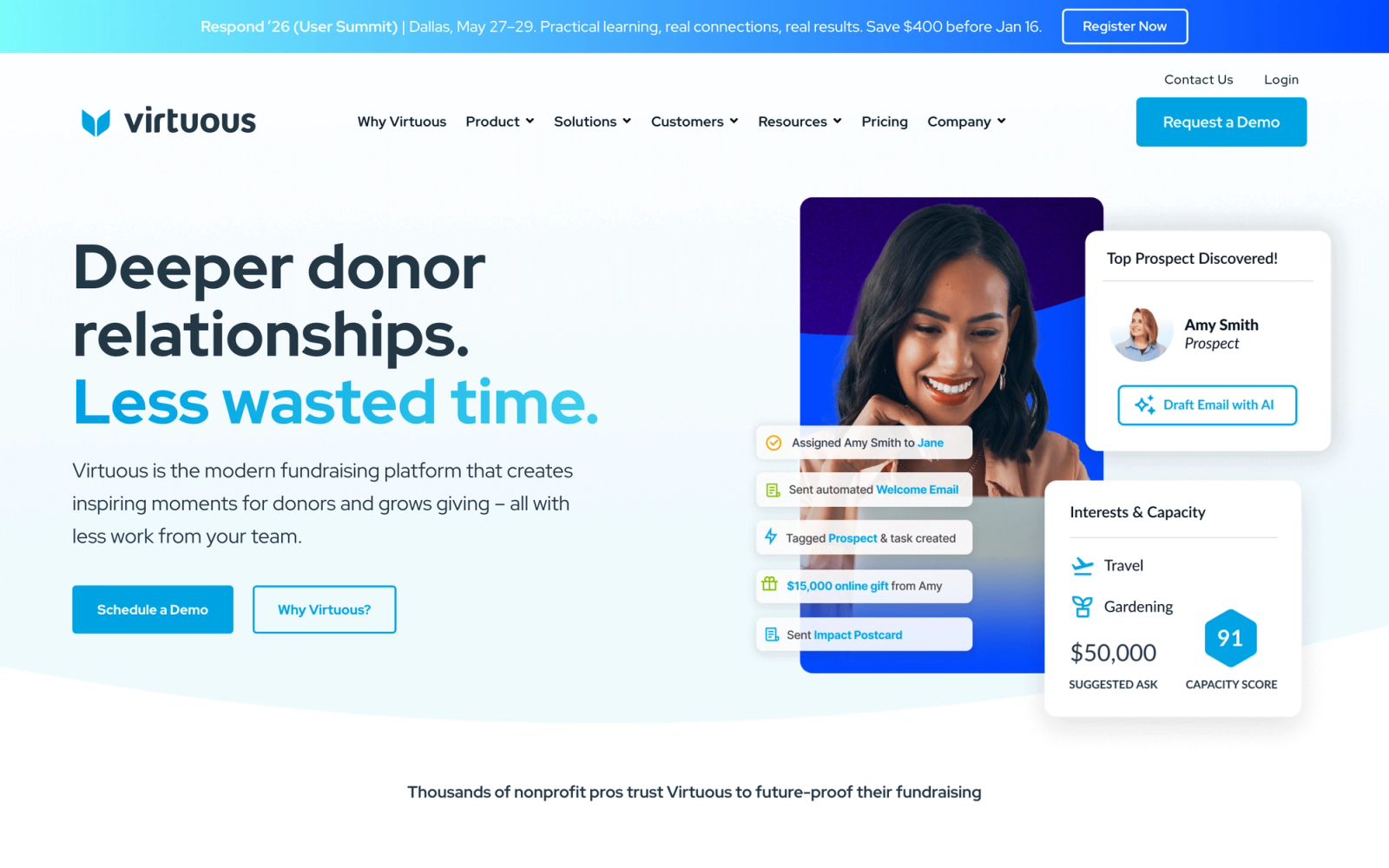
Virtuous CRM positions itself around a concept it calls "responsive fundraising," which means using behavioral data, automation, and personalized communication to tailor donor engagement based on how each individual actually interacts with your organization. It is a mid-to-upper-market CRM that goes beyond traditional donor tracking into marketing automation territory.
Where Bloomerang centers on showing you donor retention metrics, Virtuous tries to help you act on them automatically. The platform watches donor signals (email opens, website visits, giving patterns) and triggers personalized outreach based on those signals. For fundraising teams that want to move from static donor lists to dynamic, behavior-driven engagement, that automation layer is the main draw.
Core Capabilities
- Donor management with behavioral tracking across email, web, and giving activity
- Responsive automation engine that triggers personalized communications based on donor signals
- Built-in email marketing with dynamic content, segmentation, and send-time optimization
- Online giving pages with recurring, one-time, and campaign-specific donation options
- Volunteer management with scheduling, hour tracking, and volunteer-to-donor linking
- Grant and pledge management with tracking and reporting
- Wealth and giving capacity insights integrated into donor profiles
- Custom dashboards and reporting with real-time analytics
- Direct mail coordination tools alongside digital campaigns
- Integration with accounting platforms, payment processors, and third-party tools via API
Standout Strength
Virtuous stands out by embedding marketing automation principles directly into the CRM. Instead of treating donor management and communication as separate workflows, it connects them so that donor behavior automatically shapes outreach. Organizations that want to personalize constituent engagement at scale without manually segmenting lists and scheduling sends find this approach significantly more effective than static CRM workflows.
Best For
Mid-to-large nonprofits with annual budgets above $2M and fundraising teams of 5+ staff who want to move beyond batch-and-blast communication into genuinely personalized, behavior-driven donor engagement. Strong fit for faith-based organizations, higher education advancement offices, and large social service agencies.
Pricing Overview
- Custom pricing, typically in the $400 to $600+ per month range
- Pricing model: Based on organization size and selected modules
- Implementation and onboarding fees apply
- Demo available on request
Limitations
- Significantly more expensive than Bloomerang or other mid-market CRMs. The price point puts it out of reach for many small nonprofits.
- The automation engine requires time to configure properly. Organizations that do not invest in setup and training may not realize the platform's full value.
- Smaller organizations with straightforward fundraising needs may find the automation features unnecessary overhead.
Quick Comparison Insight
More sophisticated automation than Bloomerang, with a higher price tag to match. Best suited for organizations where personalized donor engagement at scale justifies the investment.
Network for Good
Overview
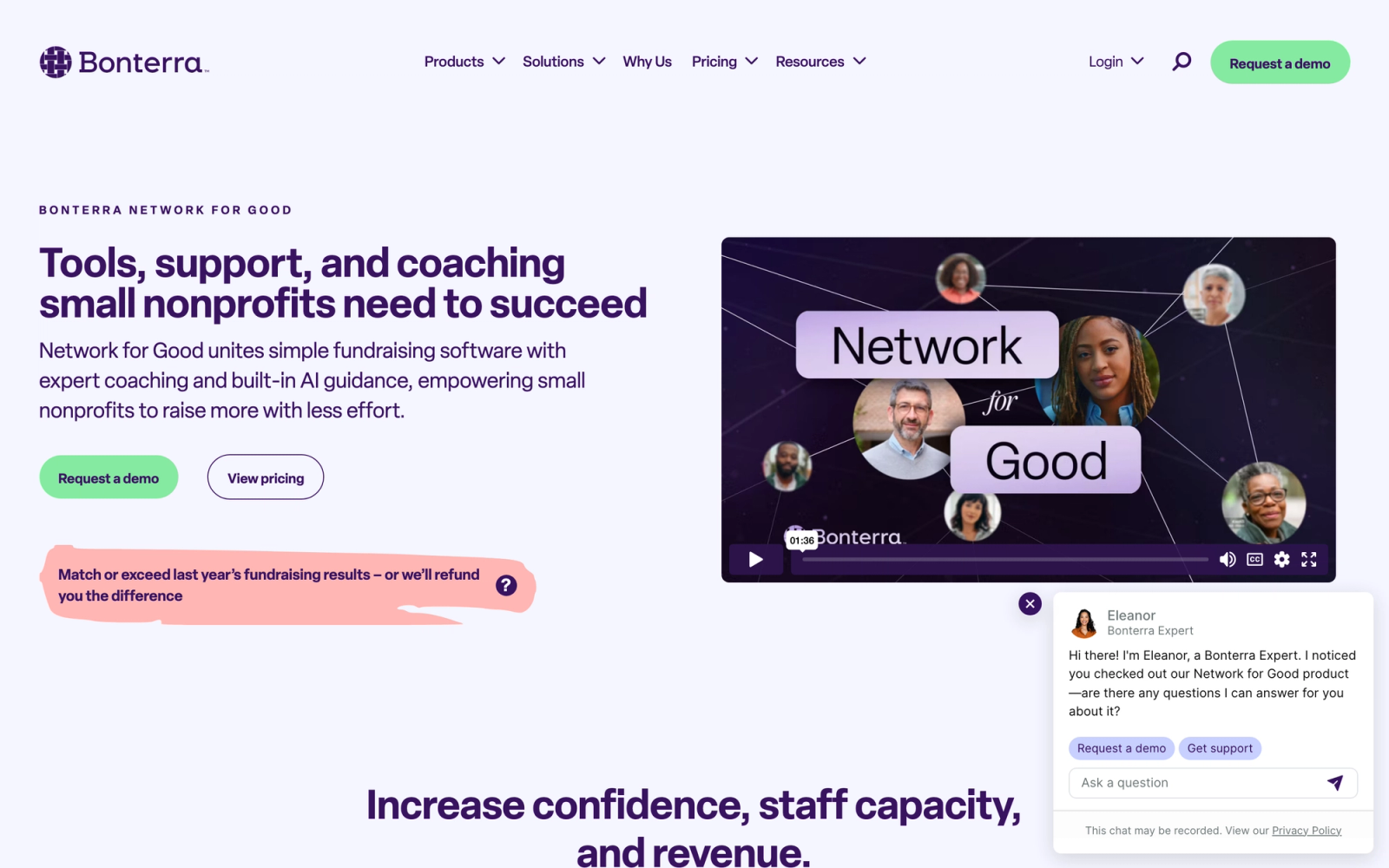
Network for Good takes an approach that most CRM vendors do not: it pairs its donor management platform with personal fundraising coaching. The software itself covers donor tracking, online fundraising, email communications, and event management. But the real differentiator is the advisory layer, where dedicated coaches help nonprofit teams build fundraising plans, improve campaigns, and use the platform more effectively.
The coaching element is genuinely useful for smaller organizations. Many nonprofits adopt a CRM and then underutilize it because staff lack the fundraising expertise to apply it fully. Network for Good addresses that gap directly. Bloomerang provides the tools and expects you to bring the strategy; Network for Good builds in an advisory service that shapes how you use the platform.
Core Capabilities
- Donor management with contact records, giving history, and relationship tracking
- Online donation pages with customizable branding and recurring giving options
- Built-in email marketing with templates, scheduling, and donor segmentation
- Event management including ticketing, registration, and post-event donation follow-ups
- Fundraising coaching from dedicated advisors included in all plans
- Move management features for tracking major donor cultivation
- Automated thank-you emails and tax receipts
- Reporting dashboards with fundraising summaries, donor retention, and campaign performance
- Peer-to-peer fundraising pages
- Integration with QuickBooks and third-party tools
Standout Strength
The embedded coaching and fundraising advisory service is what sets Network for Good apart. For organizations without a seasoned development director, having a dedicated coach (similar to how online coaching platforms structure guided support) who helps plan campaigns, interpret data, and improve donor retention strategy is a practical advantage that no amount of software features can replicate.
Best For
Small nonprofits with annual budgets under $3M that are either adopting a donor CRM for the first time or have struggled to fully utilize previous platforms. Particularly strong for organizations with small staff who wear multiple hats and need fundraising guidance alongside the technology.
Pricing Overview
- Starting price: Around $100 per month
- Pricing model: Tiered based on features and organization size
- Coaching included in all plans
- Free demo available
Limitations
- The software itself, separate from the coaching, is less feature-rich than platforms like DonorPerfect or Neon CRM. Organizations that need deep custom reporting or advanced automation will find it limited.
- Integration options are narrower than competitors with larger ecosystems.
- The coaching model may feel unnecessary for larger organizations with experienced fundraising staff.
Quick Comparison Insight
Less feature depth than Bloomerang, but the coaching component fills a gap that Bloomerang and most other CRMs leave entirely to the user.
Blackbaud eTapestry
Overview
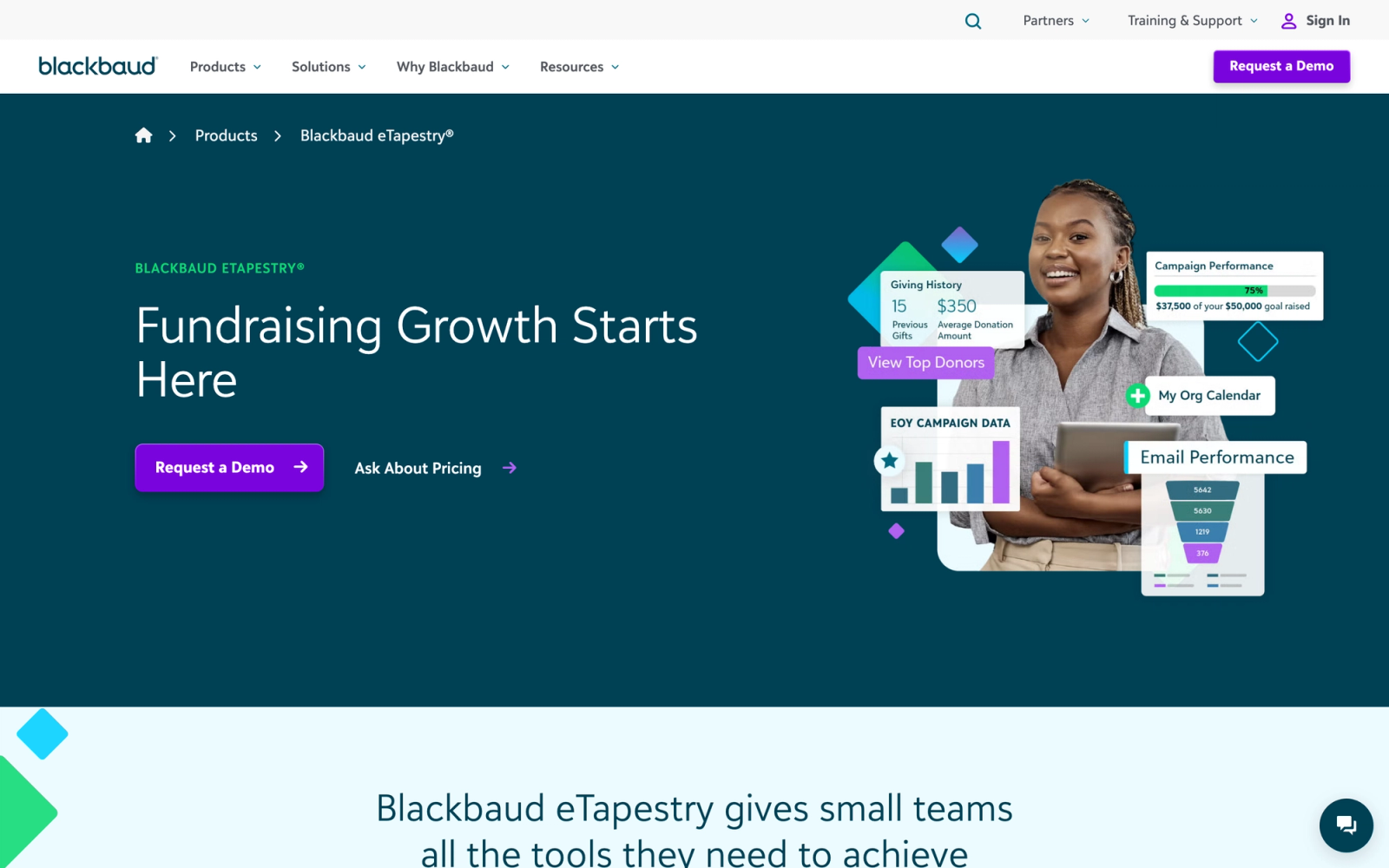
Blackbaud eTapestry is the entry-level cloud CRM in the Blackbaud ecosystem, which also includes Raiser's Edge NXT for mid-to-large organizations and Financial Edge for nonprofit accounting. For organizations that want to start within the Blackbaud family without committing to the cost and complexity of Raiser's Edge, eTapestry provides a more accessible starting point.
The platform covers donor management, online giving, email, and reporting. Functionally, it competes with Bloomerang and other mid-market tools. But the real strategic consideration is the Blackbaud ecosystem: organizations that plan to eventually move into Raiser's Edge NXT, Blackbaud's payment processing (BBMS), or their analytics tools may find it easier to start with eTapestry and migrate within the family than to start elsewhere and switch ecosystems later.
Core Capabilities
- Donor and constituent management with custom fields, relationship mapping, and interaction tracking
- Online donation forms (DIY Forms) with customizable branding and recurring giving
- Email marketing with templates, list management, and scheduling (eConnections)
- Reporting with pre-built templates and a custom query builder
- Volunteer tracking and management
- Pledge management with scheduled payment reminders
- Event registration and management tools
- Integration with Blackbaud's payment processing and merchant services
- Export tools for data portability
- Role-based user permissions and audit trails
Standout Strength
eTapestry is the most affordable entry point into the Blackbaud ecosystem. For organizations that foresee a future need for Raiser's Edge NXT, Blackbaud analytics, or other Blackbaud products, starting with eTapestry creates a smoother migration path than switching from a completely different vendor later.
Best For
Small-to-midsize nonprofits already considering the Blackbaud ecosystem or planning to grow into Raiser's Edge NXT within a few years. Also relevant for organizations where Blackbaud is a known quantity in their sector (higher education, healthcare, faith-based organizations) and institutional familiarity matters.
Pricing Overview
- Starting price: $100 to $150 per month
- Pricing model: Based on contact volume and selected features
- Blackbaud often requires annual contracts
- Free demo available; no self-service free trial in most cases
Limitations
- The interface feels dated. eTapestry's design has not evolved at the same pace as newer competitors, and staff accustomed to modern SaaS interfaces may find it cumbersome.
- Locked into the Blackbaud ecosystem for integrations. Connecting to non-Blackbaud tools can be more difficult than with platforms that prioritize open integrations.
- Customer support is a recurring pain point in user reviews, with reports of slow response times and limited self-service resources.
Quick Comparison Insight
Similar in scope to Bloomerang but with the strategic advantage of belonging to the Blackbaud family. The trade-off is a less modern interface and less open integration model.
Salsa CRM
Overview
Salsa CRM is part of the Salsa Labs platform, which also includes Salsa Engage (online fundraising and marketing) and Salsa Advocacy (grassroots lobbying and action alerts). The CRM's distinguishing angle is that it connects donor management directly to advocacy campaigns, making it one of the few platforms purpose-built for organizations that both raise money and mobilize supporters around policy issues.
For nonprofits where advocacy and fundraising are intertwined (environmental organizations, human rights groups, civic engagement nonprofits), the ability to track a supporter's donations, event attendance, petition signatures, and advocacy actions in a single record is genuinely useful. Bloomerang focuses exclusively on the fundraising side. Salsa connects both.
Core Capabilities
- Donor and supporter management with unified records spanning donations, advocacy actions, and event participation
- Integration with Salsa Engage for online donation pages, email campaigns, and peer-to-peer fundraising
- Integration with Salsa Advocacy for petition campaigns, action alerts, and legislative tracking
- Automated donor acknowledgments and communication workflows
- Segmentation and targeting based on both giving behavior and advocacy engagement
- Event management and registration
- Reporting across fundraising and advocacy metrics
- Major gift tracking and moves management
- Direct mail campaign coordination
- Open API for custom integrations
Standout Strength
Salsa is one of the only CRMs that natively bridges fundraising and advocacy. Organizations that need to mobilize supporters for policy campaigns while simultaneously managing a donor pipeline get both functions in a connected platform. This community-led growth approach keeps advocacy and fundraising data in one place rather than stitching together a CRM and a separate advocacy tool.
Best For
Advocacy-driven nonprofits with annual budgets above $1M that need to track both fundraising and advocacy engagement in a single system. Strong fit for environmental organizations, civil rights groups, policy institutes, and civic engagement nonprofits where supporter mobilization is as important as fundraising.
Pricing Overview
- Custom pricing, typically in the $300 to $400+ per month range depending on modules selected
- Pricing model: Based on organization size and selected Salsa products
- Demo available on request
Limitations
- Higher price point than Bloomerang, and the full value requires subscribing to multiple Salsa products (CRM + Engage + Advocacy).
- The CRM's standalone fundraising features are less deep than DonorPerfect or Neon CRM. The value is in the advocacy connection.
- The interface and user experience have received mixed reviews, with some users finding navigation unintuitive.
Quick Comparison Insight
More expensive and more specialized than Bloomerang. The right fit only when advocacy integration is a core operational requirement, not just a nice-to-have.
Sumac
Overview
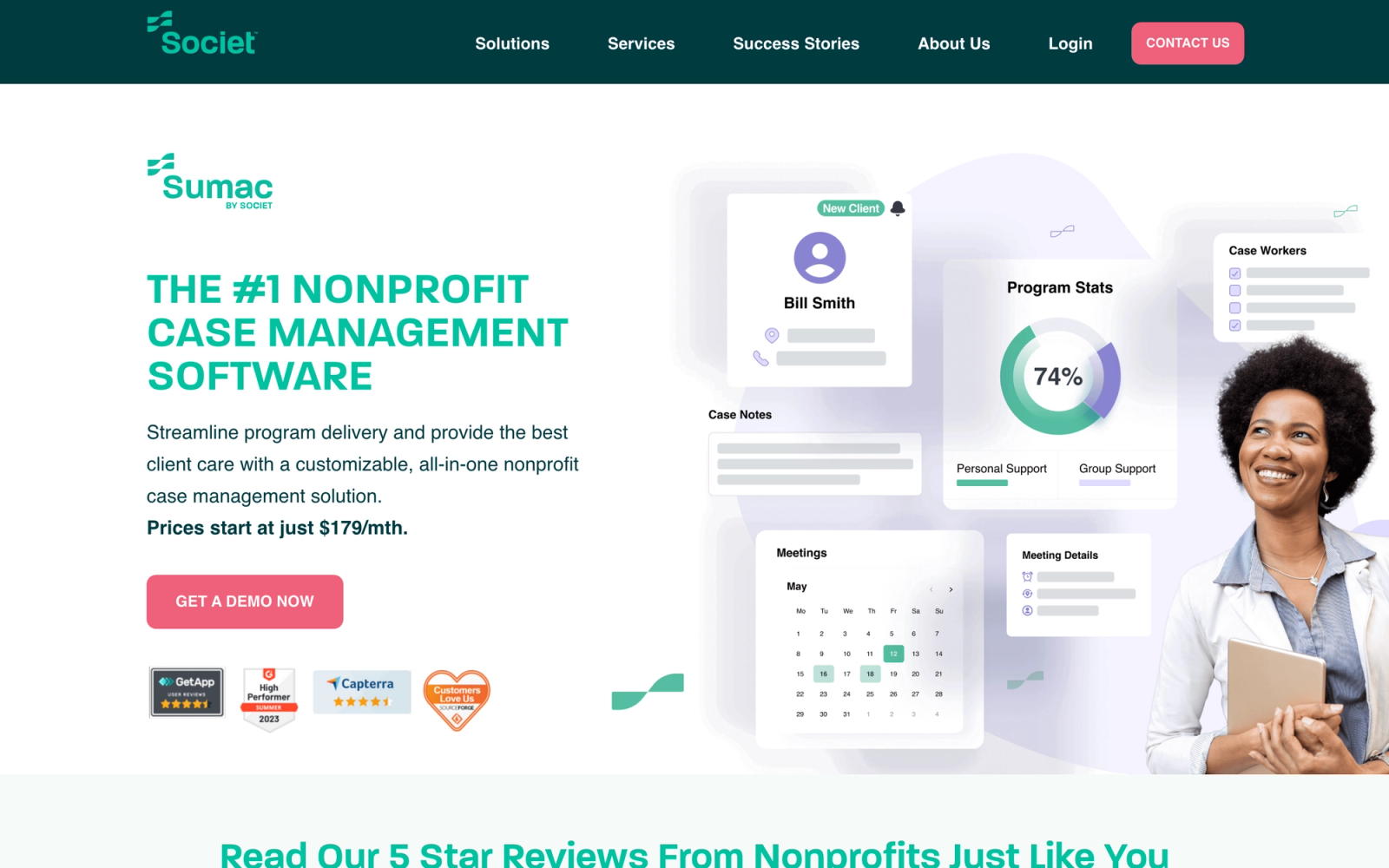
Sumac is a modular nonprofit CRM based in Canada that takes a pick-and-choose approach to feature selection. The base CRM provides contact and donation management, and organizations add modules for specific needs: case management, grant tracking, volunteer coordination, course registration, or membership management. This means you pay only for the capabilities you actually use.
Sumac's standout is the case management module. While most donor CRMs treat contact records as fundraising objects, Sumac can track service delivery, client interactions, and case progress alongside donor data. For human service organizations, legal aid nonprofits, and social service agencies, that dual capability removes the need for a separate case management system.
Core Capabilities
- Contact and donor management with custom fields, tags, and relationship mapping
- Gift tracking with one-time, recurring, pledge, and in-kind donation support
- Modular add-ons: case management, grant tracking, volunteer management, course registration, memberships
- Case management module with intake forms, case notes, service tracking, and outcome recording
- Online donation forms with customizable branding
- Reporting with pre-built templates and custom report builder
- Email marketing tools for donor communications and appeals
- Integration with QuickBooks for accounting sync
- Data import/export with CSV mapping
- Role-based user permissions and multi-site support
Standout Strength
The case management module makes Sumac one of very few donor CRMs that can also serve as a lightweight client services platform. Organizations that manage both fundraising relationships and service delivery cases get a unified system instead of maintaining two separate databases.
Best For
Small-to-midsize nonprofits, particularly human service organizations, legal aid agencies, and social service providers that need case management alongside donor tracking. Also a practical choice for Canadian nonprofits familiar with the platform's local presence and support.
Pricing Overview
- Starting price: $35 to $50 per month for the base CRM
- Pricing model: Per-module add-ons on top of the base subscription
- Total cost depends on which modules are selected
- Free trial available
Limitations
- The interface is functional but not modern. Organizations coming from polished SaaS platforms may find the design dated.
- Each add-on module increases cost, so a fully featured configuration can approach the price of more inclusive platforms like Neon CRM.
- Integration ecosystem is smaller than competitors. Organizations needing connections beyond QuickBooks and basic email tools may find options limited.
Quick Comparison Insight
Less polished than Bloomerang, but the modular approach and case management capability address needs that Bloomerang cannot. Best evaluated as a CRM-plus-case-management solution rather than a pure donor CRM.
Funraisin
Overview
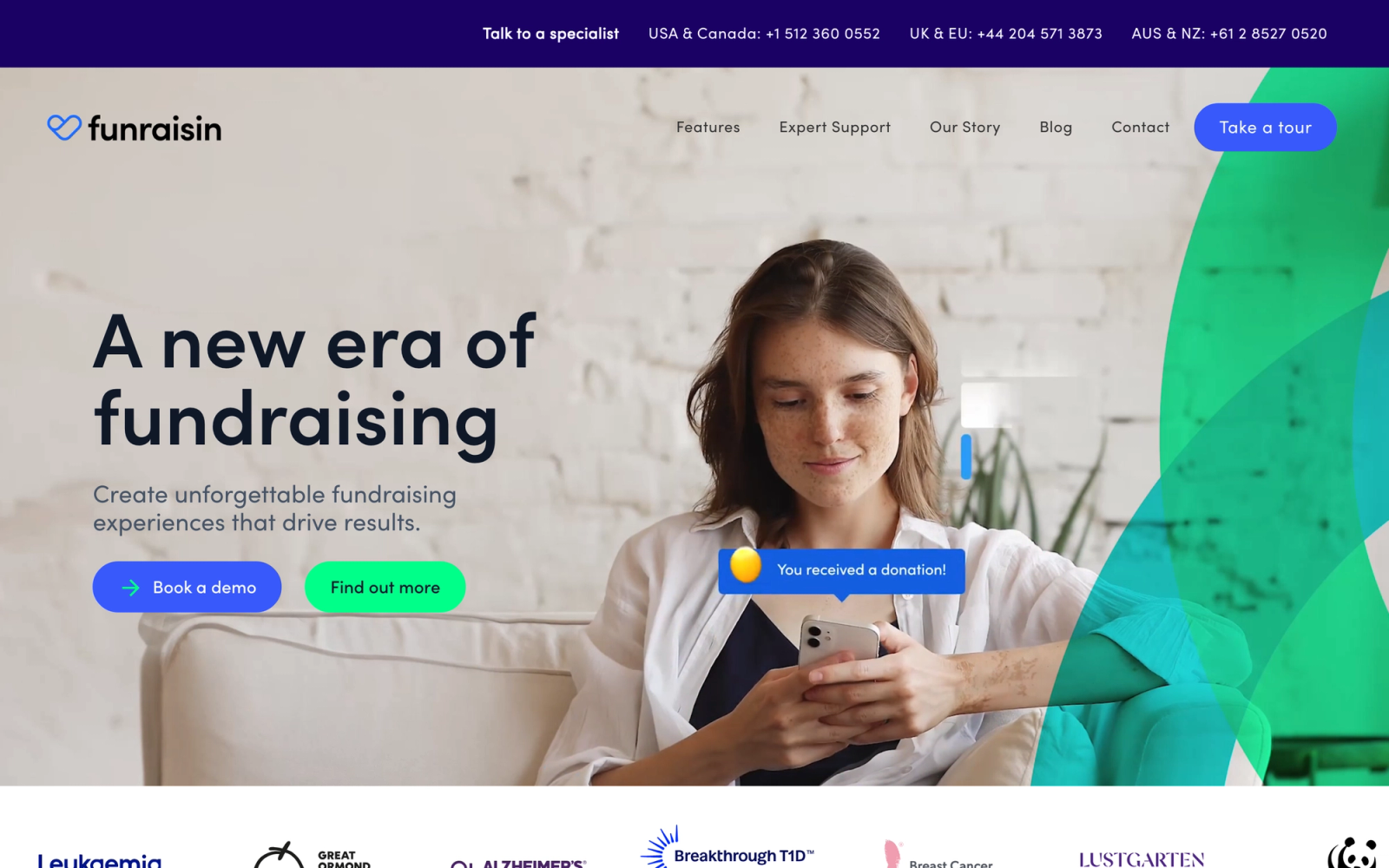
Funraisin is not a traditional donor CRM. It is a specialized peer-to-peer and community fundraising platform designed for nonprofits that run large-scale fundraising events, challenges, and campaigns where supporters raise money on behalf of the organization. Think charity runs, bike rides, giving days, and DIY fundraising campaigns.
This distinction matters. If you are looking for a direct Bloomerang replacement that manages your entire donor database, Funraisin is not it. But if your organization's primary growth channel is peer-to-peer fundraising, and Bloomerang's limited P2P capabilities are the specific gap you need to fill, Funraisin is one of the most specialized tools available for that purpose. Many organizations use it alongside a traditional CRM rather than as a replacement.
Core Capabilities
- Customizable peer-to-peer fundraising campaign pages with individual and team fundraiser profiles
- Gamification features including leaderboards, milestones, badges, and progress trackers
- Fitness and activity tracking integration for challenge-based campaigns
- Automated email communications for participants, donors, and teams
- Real-time fundraising dashboards with campaign performance analytics
- White-label branding for campaign microsites
- Social media sharing tools optimized for fundraiser amplification
- Recurring giving options within campaign pages
- Event management for fundraising walks, rides, and challenge events
- API and integrations for syncing fundraiser data to external CRMs
Standout Strength
Funraisin is purpose-built for peer-to-peer fundraising with a level of depth (gamification, fitness tracking, team management) that general-purpose CRMs cannot match. Organizations running large P2P campaigns choose it because generic donation forms and basic P2P modules in CRMs like Bloomerang cannot deliver the participant engagement and fundraiser activation tools that drive P2P revenue.
Best For
Nonprofits whose primary fundraising strategy centers on peer-to-peer campaigns: charity walks, challenge events, giving days, and community-driven fundraising. Particularly relevant for health charities, environmental organizations, and large social impact nonprofits with established event-based fundraising programs.
Pricing Overview
- Custom pricing, typically ranging from $500 to $1,000+ per month depending on campaign scale
- Pricing model: Often based on campaign volume, transaction fees, or annual contract
- Demo available on request
Limitations
- Not a full CRM. Funraisin does not replace a donor database, and organizations still need a separate CRM for general donor management, reporting, and acknowledgments.
- High cost relative to CRM-only tools, reflecting its specialized P2P focus.
- Less relevant for organizations that do not run peer-to-peer or event-based fundraising campaigns as a primary strategy.
Quick Comparison Insight
Solves a specific problem Bloomerang handles poorly (peer-to-peer fundraising) but does not replace Bloomerang's core donor management functions. Best used as a complement, not a substitute.
CiviCRM
Overview
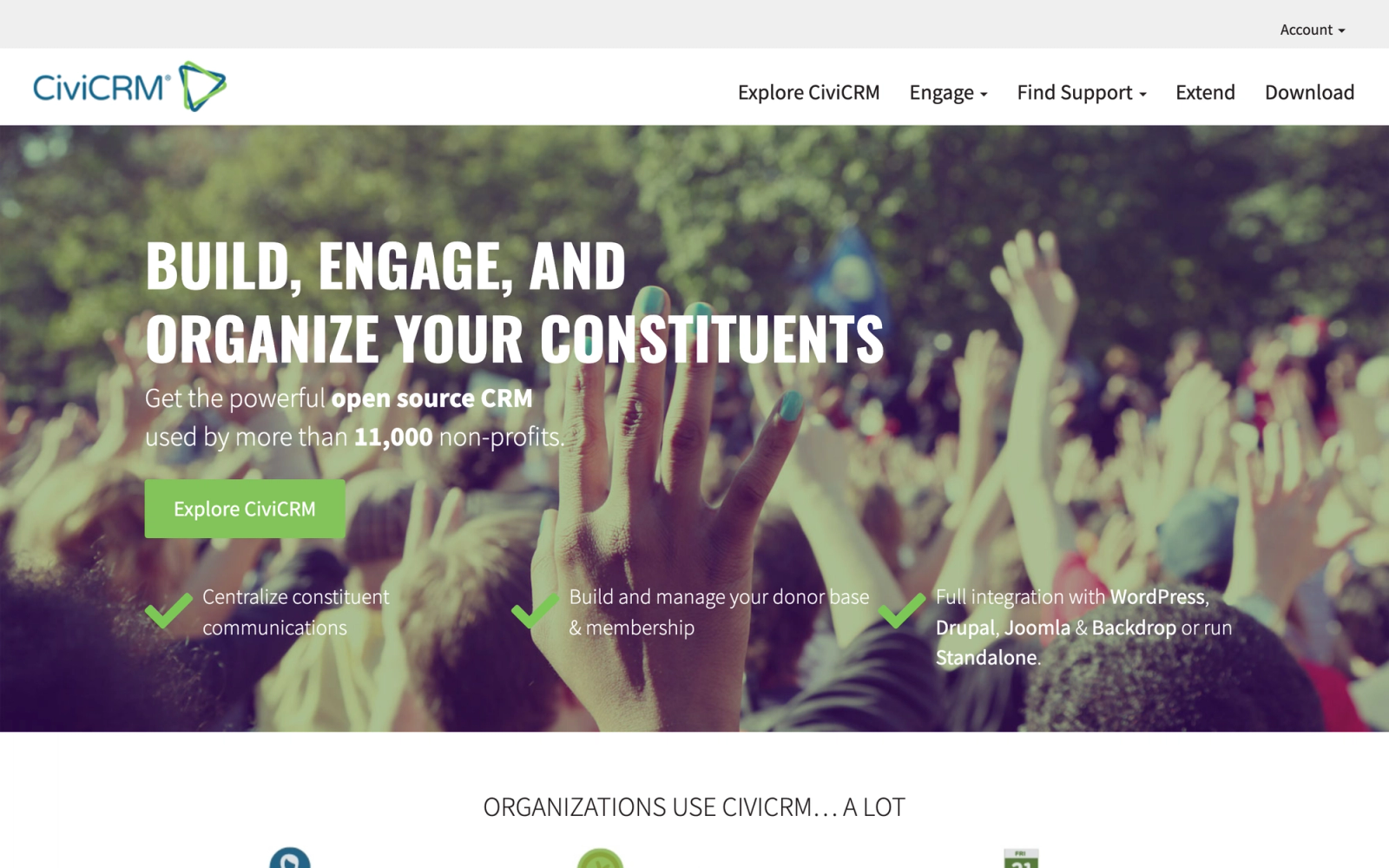
CiviCRM is the only fully open-source CRM purpose-built for nonprofits on this list. It runs as an integrated module on top of WordPress, Drupal, Joomla, or Backdrop CMS, and it carries zero licensing fees. The software is free. What you pay for is hosting, implementation, and optional support.
That pricing model makes CiviCRM fundamentally different from every other tool here. An organization with 100,000 contacts and 15 users pays the same license fee as one with 500 contacts: nothing. For nonprofits with large databases that are paying thousands per year in per-contact CRM fees, the economic argument is straightforward. But the trade-off is equally clear: CiviCRM requires technical capacity that SaaS tools like Bloomerang do not.
Core Capabilities
- Contact management with custom fields, tags, groups, relationships, and household/organization linking
- CiviContribute for donation tracking, online giving pages, recurring gifts, and pledge management
- CiviMember for membership management with automated renewals, self-service portals, and tiered membership levels
- CiviEvent for event registration, ticketing, waitlists, and paid/free event management
- CiviMail for bulk email with merge fields, A/B testing, bounce handling, and list segmentation
- CiviCase for workflow-driven case management (used by legal aid, social services, and advocacy organizations)
- CiviCampaign and CiviPetition for advocacy, petitions, surveys, and campaign tracking
- Hundreds of community-contributed extensions for grant management, volunteer tracking, SMS, and more
- REST and PHP API for custom integrations and data access
- Multi-language support with strong international user community
Standout Strength
Zero licensing fees and complete data ownership. CiviCRM eliminates per-contact and per-user fees entirely, and organizations retain full control over their data and infrastructure. For nonprofits with the technical capacity to manage it, the long-term cost savings compared to SaaS tools are substantial, especially as contact databases grow.
Best For
Budget-constrained nonprofits with access to a technical volunteer, staff developer, or CiviCRM implementation partner. Also strong for organizations already running WordPress or Drupal that want their CRM tightly integrated with their website, international and multilingual nonprofits, and advocacy organizations that need petition and case management tools alongside donor management.
Pricing Overview
- Software license: Free (open source, AGPL v3)
- Hosting: $30 to $150 per month depending on provider and scale
- Implementation: $2,000 to $10,000+ for a typical small organization setup
- Ongoing support: Community support is free; paid partner support contracts range from $100 to $200 per month
- No per-user or per-contact fees
Limitations
- Steep learning curve and dated administrative interface. Staff onboarding takes significantly longer than with SaaS tools. Investing in proper training delivery during rollout is essential.
- Requires technical capacity for installation, updates, server management, and troubleshooting. There is no "sign up and start" experience.
- Email deliverability is your responsibility. Without proper SPF, DKIM, and mail server configuration, CiviMail can have lower inbox placement rates than SaaS email tools.
Quick Comparison Insight
Far more powerful and flexible than Bloomerang, but trades all of Bloomerang's simplicity for that power. The right choice when technical capacity is available and per-contact SaaS pricing is a constraint.
Salesforce Nonprofit Cloud
Overview
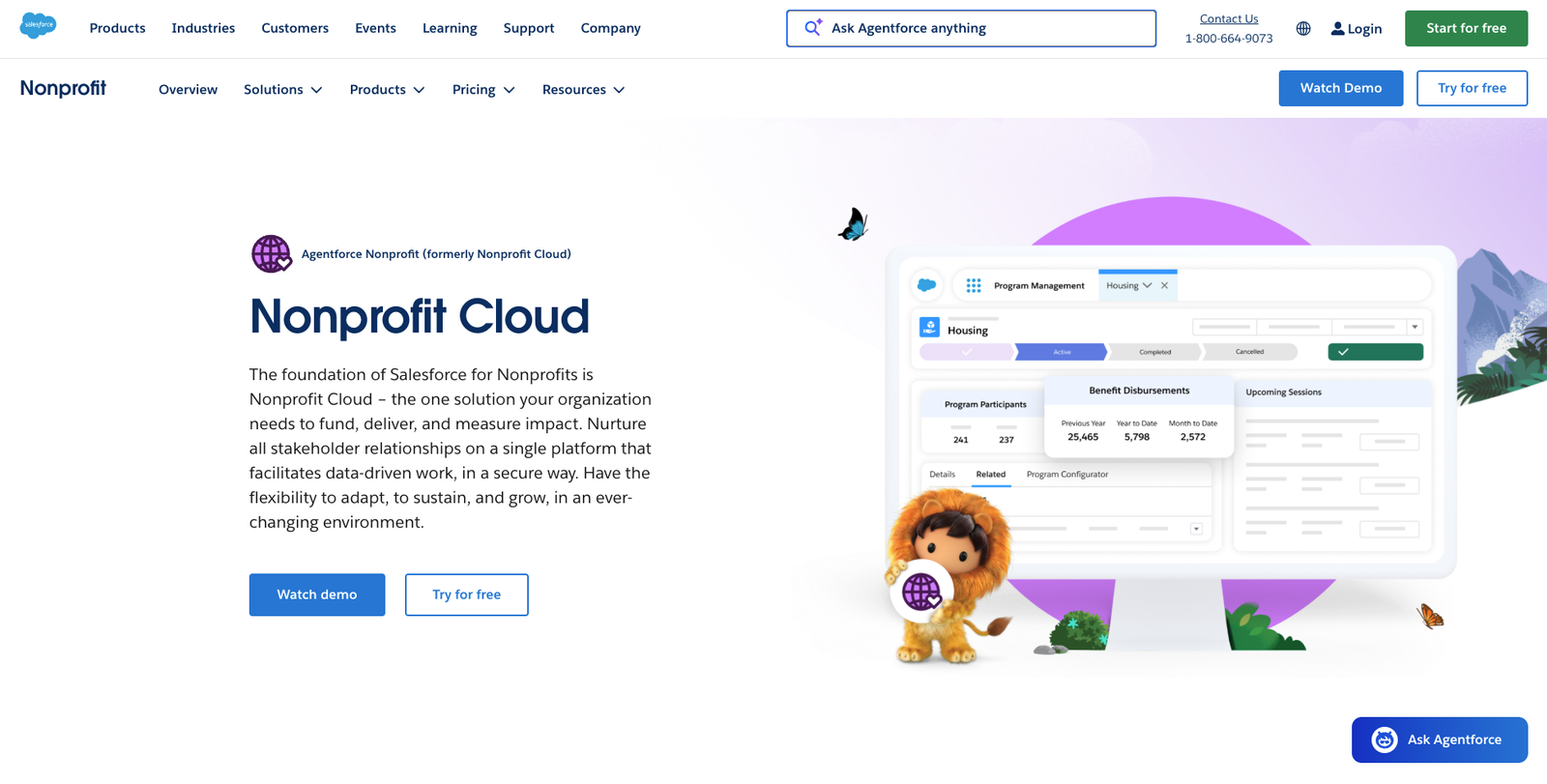
Salesforce Nonprofit Cloud is the enterprise end of the nonprofit CRM spectrum. Built on the Salesforce platform, it provides fundraising, program management, outcome tracking, marketing automation, and operational tools within one of the most customizable and scalable technology ecosystems available.
Including Salesforce on a list of Bloomerang alternatives requires context. These are not comparable products in the way that Neon CRM or DonorPerfect are. Salesforce is a platform, not just a product. Organizations that adopt it are committing to a level of investment, complexity, and administrative overhead that is orders of magnitude beyond Bloomerang. But for organizations that have genuinely outgrown what any mid-market donor CRM can offer, Salesforce is often the only destination that does not require another migration later.
Core Capabilities
- 360-degree constituent records with household and organizational account models
- Full fundraising pipeline with opportunity stages, recurring giving, pledges, matching gifts, and soft credits
- Program Management Module for tracking programs, services, enrollment, and participation
- Outcome and impact measurement with indicators, goals, and progress tracking
- Grant management with application tracking, deliverables, and funder relationship management
- Moves management for major gift cultivation with solicitation stages and forecasting
- Customizable dashboards and reporting with drag-and-drop report builder and cross-object queries
- Salesforce Flow for multi-step process automation (acknowledgments, task assignments, approvals)
- AppExchange marketplace with thousands of pre-built nonprofit apps and integrations
- Experience Cloud for building branded self-service portals for donors, volunteers, or grantees
- Einstein AI for predictive analytics and donor scoring (on higher tiers)
- Power of Us program providing 10 free Enterprise Edition licenses for eligible 501(c)(3) organizations
Standout Strength
No other nonprofit CRM matches Salesforce's combination of platform scalability, customization depth, and third-party ecosystem. An organization can start with donor tracking and grow into program management, outcome measurement, advanced automation, and AI analytics without switching platforms. The strength of Us program (10 free licenses) makes the entry point more accessible than the sticker price suggests.
Best For
Mid-to-large nonprofits with annual budgets above $2M, dedicated operations or IT staff (or budget for a Salesforce administrator), complex multi-department operations spanning fundraising, programs, and grants, and a need for a platform they will not outgrow. Also relevant for federated and multi-chapter organizations that need one system across many locations.
Pricing Overview
- Power of Us program: 10 free Enterprise Edition licenses for eligible 501(c)(3) nonprofits
- Additional licenses: $36 to $60 per user per month (nonprofit pricing, varies by edition)
- Implementation: $10,000 to $50,000+ for a standard guided implementation
- Add-ons: Marketing Cloud, Experience Cloud, and Einstein Analytics carry additional monthly fees
- Ongoing administration: Most organizations need a part-time or full-time Salesforce admin or consulting retainer
- 30-day free trial available
Limitations
- Complexity is the defining trade-off. Salesforce requires significant implementation investment, ongoing administration, and structured staff training. Without proper setup, it becomes underutilized "shelfware."
- True total cost far exceeds license fees. Implementation consulting, add-on products, training, and administration can make the first-year cost 10 to 20 times higher than a mid-market donor CRM.
- Not designed for simplicity. Basic tasks like entering a donation or pulling a report require more steps and more training than purpose-built donor management tools.
Quick Comparison Insight
A fundamentally different class of product than Bloomerang. The right move for organizations that have genuinely outgrown mid-market CRMs, not for those looking for a simpler or cheaper alternative.
How to Choose the Right Alternative
The right Bloomerang alternative depends on what is driving the switch. Here is a use-case framework to narrow the list.
If you need broader native functionality (events, memberships, payments): Neon CRM consolidates the most operational functions into a single platform. Network for Good is a simpler option if you also want built-in coaching.
If you need deeper reporting and data customization: DonorPerfect offers the strongest custom reporting at a mid-market price. Salesforce Nonprofit Cloud provides even more power for organizations willing to invest in administration.
If budget is the primary constraint: Little Green Light delivers core donor management at the lowest monthly cost. CiviCRM eliminates licensing fees entirely for organizations with technical capacity.
If you need advocacy and fundraising in one system: Salsa CRM is the only option on this list that natively bridges fundraising and advocacy campaigns.
If you need behavior-driven automation: Virtuous CRM offers the most sophisticated responsive fundraising automation, but at a higher price point than most mid-market options.
If peer-to-peer fundraising is your main growth channel: Funraisin is the most specialized P2P platform, though it works alongside a CRM rather than replacing one.
If you need case management alongside donor tracking: Sumac's modular approach includes a case management module that most donor CRMs lack.
If you plan to grow into the Blackbaud ecosystem: Blackbaud eTapestry provides the most natural on-ramp to Raiser's Edge NXT and other Blackbaud products.
If integration ecosystem matters most: Kindful's 700+ native connections make it the most "connectable" option, though its ownership by Bloomerang is a consideration.
Start with the pain point, not the feature list. A structured evaluation checklist helps organizations define what is not working before they weigh what could replace it. One related note: if your nonprofit also runs volunteer or staff training, a learning platform like Teachfloor handles that side, separate from your donor CRM.
Frequently Asked Questions
Is Bloomerang good for large nonprofits?
Bloomerang works best for small-to-midsize nonprofits with up to roughly 15,000 donor records. Larger organizations with complex reporting requirements, multi-department structures, or advanced fundraising workflows often find it limiting. DonorPerfect, Salesforce Nonprofit Cloud, and Virtuous CRM are stronger fits for organizations at that scale.
Can I migrate my data from Bloomerang to another CRM?
Most donor CRMs support data migration from Bloomerang. Standard approaches include CSV export from Bloomerang followed by mapped import into the new platform. Some vendors (DonorPerfect, Neon CRM, Salesforce) offer dedicated migration support or consulting services. Plan for 2 to 6 weeks of migration work depending on data complexity and historical record volume.
What is the cheapest Bloomerang alternative?
Little Green Light starts at $45 per month, making it the most affordable paid option. CiviCRM has no licensing fees at all, though it requires hosting and technical setup that add to the effective cost. Both are significantly less expensive than Bloomerang's starting price.
Is Kindful still independent from Bloomerang?
Kindful was acquired by Bloomerang in 2021 and currently operates as a separate product with its own interface. However, its product roadmap is now managed by Bloomerang, so long-term independence is uncertain. Organizations evaluating Kindful should consider this governance overlap when making a decision.
Do I need a Salesforce admin if I choose Salesforce Nonprofit Cloud?
In most cases, yes. Salesforce is a platform that requires ongoing configuration, maintenance, and troubleshooting. Organizations without a part-time or full-time Salesforce administrator (or a consulting retainer) frequently underutilize the platform. Budget for administration costs when evaluating Salesforce's total cost of ownership.


