


What Is AgentOps?
AgentOps is the set of tools, practices, and processes for managing, monitoring, and optimizing AI agents in production. The term borrows from DevOps and MLOps, applying operational discipline to the specific challenges of deploying, observing, and maintaining autonomous AI agents at scale.
As teams move from experimenting with AI agents to running them in production workflows, the operational problems multiply. Agents that behave reliably in testing can act unpredictably once deployed. Tasks that usually complete may fail in ways that are hard to detect. Costs climb as agents execute longer task chains or retry failed operations. AgentOps provides a framework for handling these issues systematically.
AgentOps covers monitoring agent performance and behavior, tracking costs and resource use, logging actions for debugging and compliance, managing configurations and versions, and keeping deployed agents inside defined boundaries. Skip these practices and you risk shipping agents that are expensive, unreliable, or unaccountable.
Why AgentOps Matters
Traditional software operations assume deterministic behavior: the same input produces the same output. AI agents break that assumption. They reason about tasks, make decisions, and can take different paths to the same goal across executions. This non-determinism creates problems that conventional monitoring and management tools were never built to handle.
Visibility into agent behavior. When an agent runs a multi-step task, you need to know what happened at each step, which decisions were made, and why specific actions were taken. That detail drives debugging, improvement, and compliance verification. AgentOps supplies the observability layer that makes agent behavior transparent and auditable.
Cost management. Autonomous agents consume API calls, compute, and external tool invocations at every step. A misconfigured agent running an open-ended task can rack up substantial bills through repeated model calls and tool usage. AgentOps adds cost tracking and budget controls that catch runaway spending.
Reliability and error handling. Agents fail in ways traditional software does not. They hallucinate outputs, lose context mid-task, enter infinite loops, or return subtly wrong results that look correct. AgentOps sets up monitoring, alerting, and recovery built for these failure modes.
Governance and accountability. As agents take actions with real consequences, teams need audit trails that record what the agent did, when, and under what authorization. Regulators increasingly require this documentation for automated decision systems. AgentOps provides the logging and governance to meet those rules.
Core Components of AgentOps
Observability and Tracing
Agent observability goes beyond traditional application monitoring. It requires tracing the full execution path of an agent: every model call, tool invocation, decision point, and output. Distributed tracing systems adapted for agent workflows allow operators to reconstruct exactly what an agent did during any task execution.
Effective observability tracks token usage per step, records the reasoning chain behind each decision, logs tool inputs and outputs, and captures error states and recovery attempts. This level of detail lets teams find bottlenecks, spot anomalies, and tune agent behavior on real operational data.
Performance Monitoring and Evaluation
Measuring agent performance requires metrics beyond traditional software KPIs. Relevant performance metrics for AI agents include task completion rate, accuracy of outputs, average steps per task, cost per task, time to completion, and failure recovery rate.
Evaluation frameworks compare agent outputs against expected results, either through automated scoring or human review. Continuous evaluation ensures that agent performance does not degrade over time as models are updated, data distributions shift, or task complexity changes.
Cost Tracking and Optimization
Every model call, API request, and tool invocation carries a cost. AgentOps cost tracking attributes spending to specific agents, tasks, and steps. That granularity shows which tasks pay off, which agents waste budget, and where optimization moves the needle most.
Cost optimization tactics include setting token budgets per task, capping iteration depth, caching frequent results, matching model size to task type, and routing simple work to cheaper models while saving expensive ones for hard reasoning. Measuring return on agent investment depends on this cost visibility.
Configuration and Version Management
AI agents are defined by their prompts, tool configurations, model selections, and behavioral parameters. Managing these configurations across multiple agents, environments, and versions requires systematic version control. AgentOps configuration management tracks changes, enables rollbacks, and ensures that the agent running in production matches the version that was tested and approved.
This matters most when agents move to new models or when prompts are refined for better performance. Without version management, you cannot tell whether a behavior change came from a configuration update, a model swap, or an environmental shift.
| Type | Description | Best For |
|---|---|---|
| Observability and Tracing | Agent observability goes beyond traditional application monitoring. | — |
| Performance Monitoring and Evaluation | Measuring agent performance requires metrics beyond traditional software KPIs. | — |
| Cost Tracking and Optimization | Every model call, API request, and tool invocation carries a cost. | Cost optimization strategies include setting token budgets per task |
| Configuration and Version Management | AI agents are defined by their prompts, tool configurations, model selections. | A configuration update, a model change, or an environmental factor |
AgentOps Tools and Platforms
The AgentOps ecosystem includes specialized tools designed for different aspects of agent operations.
Agent observability platforms. Dedicated platforms provide tracing, logging, and visualization for agent execution. These tools capture the full execution trace of agent tasks, display step-by-step breakdowns, and enable operators to drill into specific execution paths for debugging or analysis.
LLM monitoring tools. Tools focused on language model monitoring track token usage, latency, error rates, and cost across model calls. They provide dashboards that aggregate model performance data across all agents in the organization, supporting capacity planning and cost optimization.
Evaluation and testing frameworks. Automated evaluation tools score agent outputs against defined criteria, run regression tests when configurations change, and benchmark agent performance across standardized task sets. These frameworks support continuous quality assurance for deployed agents.
Orchestration and workflow platforms. Platforms that manage agent deployment, scaling, and lifecycle operations handle the infrastructure layer of AgentOps. They manage agent instances, route tasks, handle failover, and coordinate multi-agent workflows.
Teams building AgentOps capability do not need every tool category at once. Observability and cost tracking deliver the highest immediate value, with evaluation and orchestration added as the deployment matures. Mapping the available tool landscape helps teams prioritize where to invest.
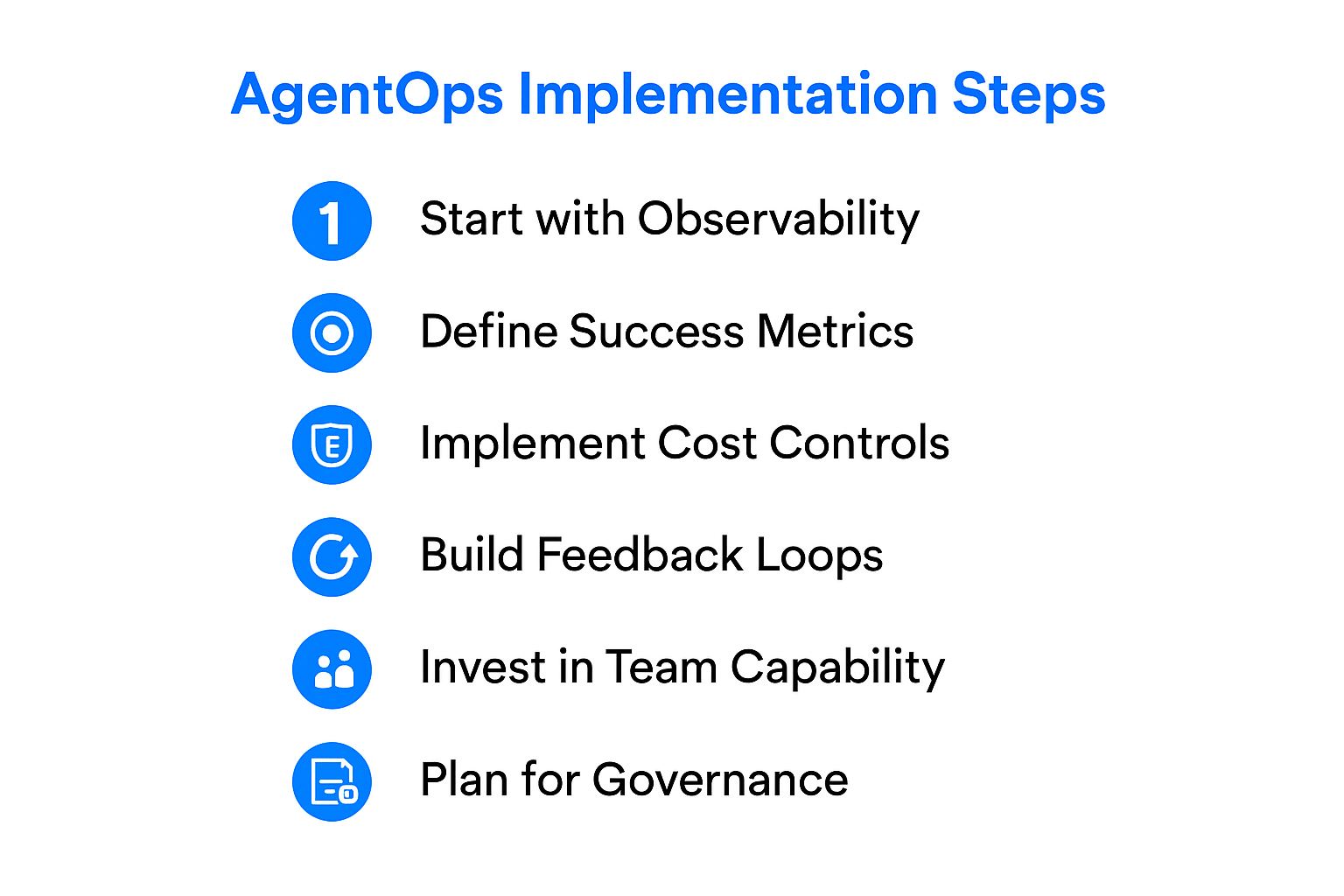
Implementing AgentOps in Your Organization
Start with observability. Before tuning performance, make sure you can see what your agents are doing. Log and trace every agent action, model call, and tool invocation. Visibility is the foundation for every other AgentOps capability.
Define success metrics before deployment. Set clear evaluation criteria for each agent: what does a successful task look like, what error rates are acceptable, what cost thresholds apply? Pin these down upfront to avoid shipping agents you cannot actually grade.
Implement cost controls early. Set budget limits per agent, per task, and per time period. Configure alerts when spending approaches thresholds. Cost overruns from uncontrolled agent execution are one of the most common and avoidable problems in early agent deployments.
Build feedback loops. Create mechanisms for human reviewers to flag agent errors, and feed those corrections back into prompt optimization, configuration adjustments, and evaluation benchmarks. Continuous improvement depends on systematic feedback collection and incorporation.
Invest in team capability. AgentOps spans software engineering, data science, and operations management. Training programs that build cross-functional AgentOps skills let teams run the full agent lifecycle, from configuration through monitoring to optimization.
Plan for governance from the start. Implement audit logging, access controls, and authorization boundaries before agents begin taking consequential actions. Retrofitting governance after deployment is significantly more expensive and risky than building it in from the beginning.
Organizations operating under digital transformation initiatives should integrate AgentOps governance into their broader technology governance framework.
Frequently Asked Questions
What is the difference between AgentOps and MLOps?
MLOps focuses on the lifecycle of machine learning models: training, deployment, monitoring, and retraining. AgentOps encompasses MLOps concerns but extends to the operational challenges specific to AI agents: multi-step task execution, tool use coordination, cost management across execution chains, non-deterministic behavior monitoring, and governance of autonomous actions. MLOps manages models; AgentOps manages the agents that use those models to take actions.
Do I need AgentOps if I only have a few AI agents?
Even small deployments benefit from basic AgentOps practices, especially observability and cost tracking. Without visibility into behavior and spending, a single autonomous agent can generate surprise costs or errors that slip by unnoticed. Tooling scales with deployment size, but the foundational practices apply at any scale.
What skills are needed for AgentOps?
AgentOps draws on software engineering (monitoring, logging, infrastructure management), data science (evaluation metrics, performance analysis, model selection), and operations management (cost optimization, incident response, process improvement).
Teams with experience in DevOps or MLOps have a strong foundation, but the agent-specific aspects, particularly non-deterministic behavior monitoring and multi-step task tracing, require additional learning and practice.


