


What Is Neuromorphic Computing?
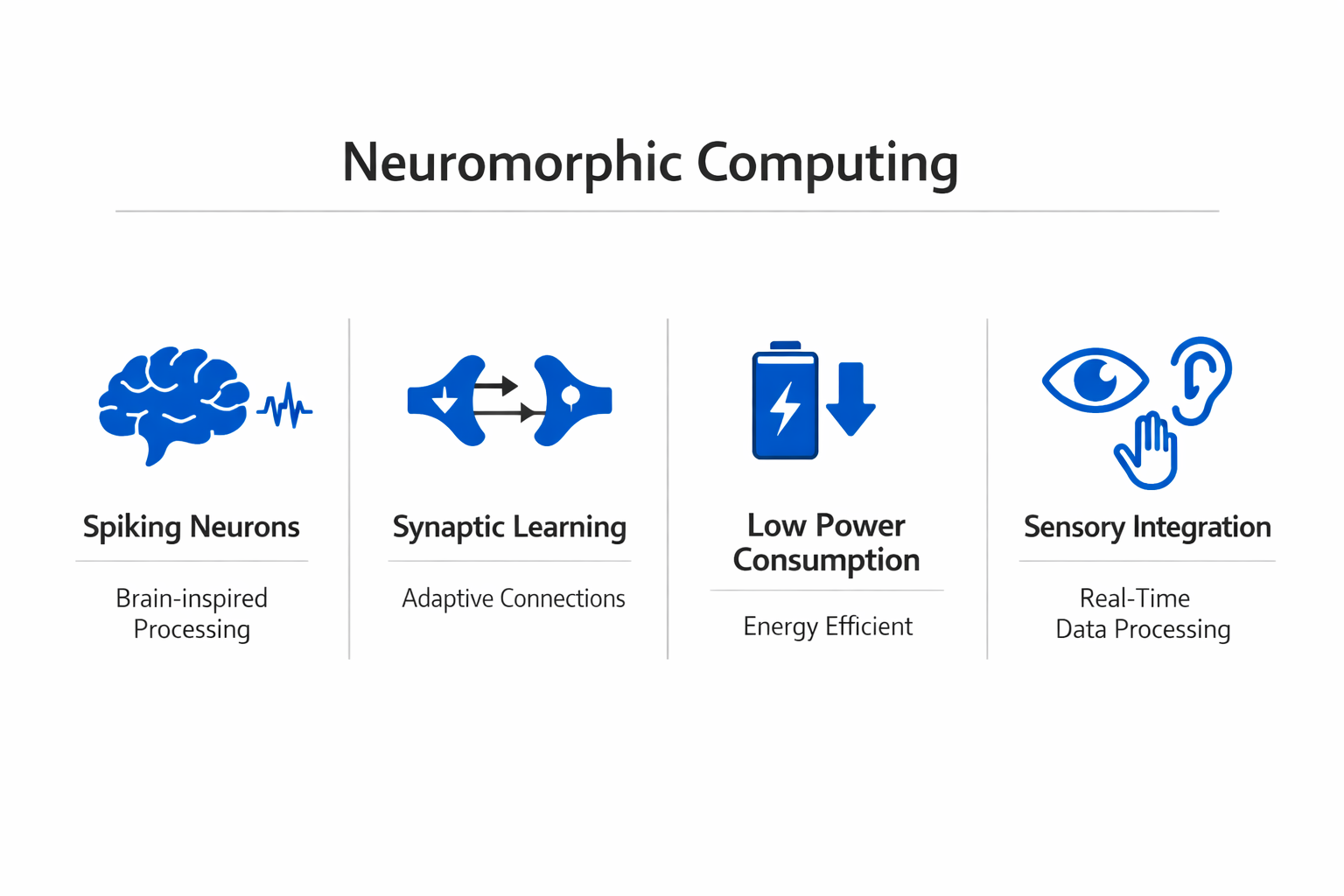
Neuromorphic computing is a branch of computer engineering that designs processors and systems modeled on the structure and function of the biological brain. Unlike conventional processors that separate memory and computation, neuromorphic chips integrate both into distributed networks of artificial neurons and synapses that communicate through discrete electrical pulses called spikes.
The term was coined by Carver Mead at the California Institute of Technology in the late 1980s. Mead observed that silicon transistors operating in subthreshold mode could mimic the analog behavior of biological ion channels, and he proposed building circuits that replicated neural computation directly in hardware.
That foundational insight has since evolved into a multidisciplinary field spanning chip design, computational neuroscience, and artificial intelligence.
Neuromorphic computing differs from conventional computing in a fundamental way. Standard processors, whether CPUs or GPUs, execute instructions sequentially or in parallel batches, shuttling data between separate memory and processing units. This architecture, known as the von Neumann model, creates a data transfer bottleneck that consumes significant energy. Neuromorphic systems eliminate that bottleneck by processing information where it is stored, just as biological neurons do.
Each artificial neuron accumulates input signals and fires an output spike only when a threshold is reached, consuming energy only during active computation.
This event-driven approach stands in contrast to the clock-driven cycles of traditional processors. A neuromorphic chip does not perform calculations on every clock tick. It responds to incoming data events, which means large portions of the chip remain idle and power-free when there is no relevant input.
The result is a computing paradigm with sharp energy gains on specific workloads, particularly real-time sensory processing, pattern recognition, and adaptive learning.
How Neuromorphic Computing Works
Understanding neuromorphic computing requires examining three interconnected layers: the neuron model, the synapse model, and the network architecture that connects them.
The Neuron Model
Biological neurons receive electrochemical signals through dendrites, integrate those signals in the cell body, and fire an action potential down the axon when the accumulated input exceeds a threshold. Neuromorphic processors replicate this behavior using electronic circuits or digital logic that implement mathematical neuron models.
The most common model is the leaky integrate-and-fire (LIF) neuron. It accumulates incoming charge over time, with a built-in decay rate that causes the stored potential to leak away if no new input arrives. When the membrane potential crosses a threshold, the neuron emits a spike and resets.
More complex models, such as the Izhikevich model or the Hodgkin-Huxley model, capture additional biological dynamics like bursting and adaptation, but the LIF model offers the best balance of biological plausibility and hardware efficiency.
Each artificial neuron on a neuromorphic chip operates independently and asynchronously. There is no global clock synchronizing all neurons simultaneously. This asynchronous operation is one of the key architectural differences from conventional processors and a primary source of energy savings.
The Synapse Model
Synapses are the connections between neurons. In biology, synaptic strength determines how much influence one neuron has on another. Neuromorphic systems represent synaptic weights as configurable parameters, either analog voltages stored on capacitors or digital values stored in local memory. When a presynaptic neuron fires, the spike is transmitted through the synapse and modifies the postsynaptic neuron's membrane potential by an amount proportional to the synaptic weight.
Neuromorphic synapses can also change weight over time through local learning rules. Spike-timing-dependent plasticity (STDP) is the most widely implemented rule. It strengthens a synapse when the presynaptic neuron fires just before the postsynaptic neuron (indicating a causal relationship) and weakens it when the order is reversed.
This allows neuromorphic systems to learn from incoming data without the centralized gradient computation that deep learning requires during backpropagation.
The Network Architecture
Neuromorphic chips organize neurons and synapses into cores or tiles, each containing a local cluster of neurons with their associated synaptic connections. Cores communicate with each other through a network-on-chip routing infrastructure that transmits spike events. This architecture is massively parallel. Thousands or millions of neurons can operate simultaneously within a single chip, and multiple chips can be tiled together to build larger systems.
Intel's Loihi 2 chip, for example, contains 128 neuromorphic cores with up to 1 million neurons and 120 million synapses. IBM's TrueNorth chip packs 4,096 neurosynaptic cores onto a single die, with 1 million neurons and 256 million synapses. These chips process information through spiking neural networks, which are the software counterpart to the hardware architecture.
Spiking neural networks (SNNs) encode information in the timing and frequency of spikes rather than in continuous activation values. A neural network in the conventional sense computes a weighted sum of inputs, applies an activation function, and outputs a continuous value. An SNN neuron accumulates spike inputs over time and produces a discrete spike event.
This temporal coding allows SNNs to represent and process time-varying signals, such as audio, video, and sensor streams, in a naturally efficient way.
| Component | Function | Key Detail |
|---|---|---|
| The Neuron Model | Biological neurons receive electrochemical signals through dendrites. | The Izhikevich model or the Hodgkin-Huxley model |
| The Synapse Model | Synapses are the connections between neurons. | — |
| The Network Architecture | Neuromorphic chips organize neurons and synapses into cores or tiles. | Audio, video, and sensor streams, in a naturally efficient way |
Why Neuromorphic Computing Matters
Neuromorphic computing addresses concrete limits in current architectures, and those limits grow more pressing as AI workloads scale.
Energy Efficiency
Training and running machine learning models on conventional hardware consumes substantial energy. A single large language model training run can use as much electricity as dozens of households consume in a year. Inference workloads, while individually smaller, accumulate massive energy costs at scale when deployed across millions of devices and data center servers.
Neuromorphic chips consume orders of magnitude less power for inference tasks. Intel's Loihi 2 has demonstrated pattern recognition tasks using less than one milliwatt, compared to hundreds of milliwatts or watts for equivalent GPU-based inference. This efficiency comes from the event-driven, sparse activation model. When a neuromorphic system processes a static scene with no changes, almost no energy is consumed. Only new, relevant events trigger computation.
This characteristic aligns neuromorphic computing with sustainable AI, which works to reduce the environmental footprint of intelligent systems.
Real-Time Processing
Conventional AI systems process data in frames or batches. A camera captures an image, the image is fed to a neural network, and the network produces an output. This frame-based approach introduces latency and discards the temporal information between frames.
Neuromorphic systems process data continuously as it arrives, spike by spike. When paired with neuromorphic sensors like event cameras (which output pixel-level changes rather than full frames), the entire pipeline from sensing to decision operates in microseconds.
That speed suits applications where reaction time is critical, including self-driving cars, robotics, and industrial safety systems.
On-Device Intelligence
The low power consumption of neuromorphic chips makes them ideal candidates for edge AI deployment. Devices that operate on batteries or harvest ambient energy, such as remote environmental sensors, wearable health monitors, and agricultural IoT nodes, cannot support the power demands of conventional AI accelerators.
A neuromorphic processor running on microwatts can provide continuous intelligent inference in these constrained environments.
This capability extends AI into settings where cloud connectivity is unavailable or undesirable, supporting autonomous devices that sense, learn, and act without external computation.
Adaptive Learning
Most deployed AI systems today are static after training. The model is trained on a dataset, optimized, and deployed as a fixed function. Updating the model requires collecting new data, retraining in the cloud, and redeploying.
Neuromorphic systems can learn continuously on-device using local plasticity rules. The synaptic weights adjust in response to new data without centralized retraining. This on-chip learning capability is valuable for environments where conditions change over time and the system must adapt, such as a sensor network that encounters new patterns, or an AI accelerator in a robot navigating unfamiliar terrain.
The connection to reinforcement learning is direct: neuromorphic systems can implement reward-modulated plasticity rules that adjust behavior based on outcomes, enabling trial-and-error learning in real time.
Neuromorphic Computing Use Cases
Neuromorphic computing is moving from research prototypes into applied domains where its advantages in power, latency, and adaptability solve problems that conventional architectures handle poorly.
Sensory Processing and Event-Driven Perception
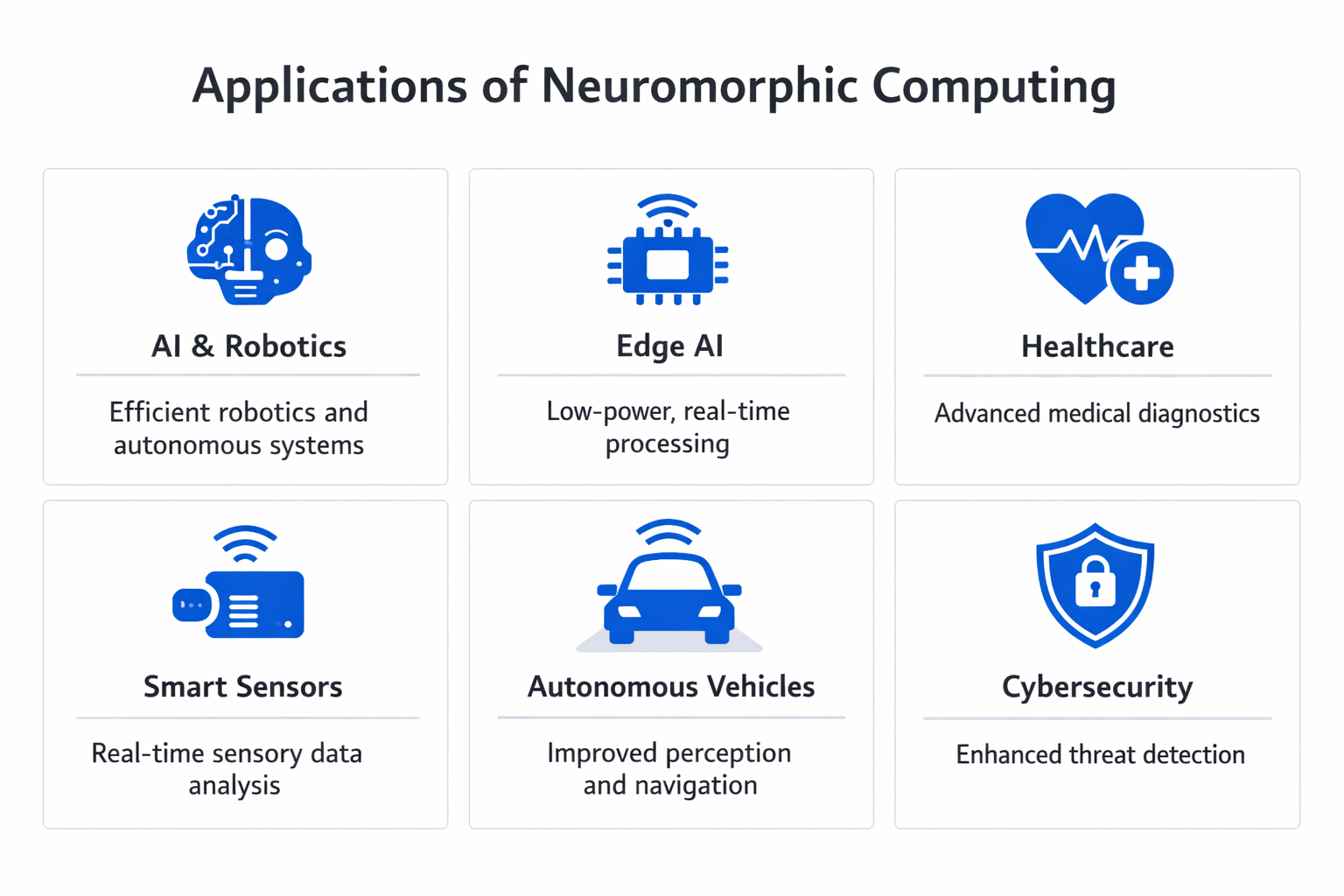
Neuromorphic sensors and processors form a pipeline for vision, audition, and tactile sensing. Event cameras, also called dynamic vision sensors, output asynchronous pixel-level brightness changes instead of synchronous frames. Paired with a neurosynaptic chip, this data stream is processed with sub-millisecond latency and microwatt power consumption.
Applications include high-speed object tracking, drone navigation, and gesture recognition in wearable devices.
In auditory processing, neuromorphic cochlea chips convert sound into spike trains that mirror the encoding performed by the human inner ear. These systems enable keyword spotting, speaker identification, and environmental sound classification at a fraction of the energy required by conventional digital signal processing.
Autonomous Systems and Robotics
Robots operating in unstructured environments need to process sensory data, plan actions, and adapt to changes in real time. Neuromorphic processors provide the low-latency, low-power inference required for continuous operation. A warehouse robot running neuromorphic vision can detect obstacles, track moving objects, and navigate with centimeter precision without the thermal and power overhead of a GPU.
For autonomous vehicles, neuromorphic computing offers a complementary processing layer. While primary driving functions may still rely on conventional neural net processors, neuromorphic coprocessors can handle always-on monitoring tasks like pedestrian detection and anomaly alerting at minimal power cost.
Biomedical Devices and Neural Interfaces
Neuromorphic chips suit brain-machine interfaces and implantable medical devices. Their low power consumption keeps them within the thermal limits of biological tissue, and their spike-based processing aligns with the spike-based communication of real neurons. Research groups have demonstrated neuromorphic processors that decode neural signals for prosthetic limb control and seizure prediction in real time.
Wearable health monitors benefit from neuromorphic inference for continuous cardiac rhythm analysis, sleep staging, and activity classification. The processor remains in an ultra-low-power idle state during normal readings and activates computation only when it detects an anomalous pattern, preserving battery life while maintaining clinical-grade vigilance.
Optimization and Constraint Satisfaction
Neuromorphic architectures have shown promise in solving combinatorial optimization problems, such as graph coloring, scheduling, and routing, that are computationally expensive for conventional processors. The parallel, distributed nature of spiking neural networks allows the system to explore many solution candidates simultaneously, converging on good solutions faster and with less energy than traditional approaches.
This application domain connects neuromorphic computing to cognitive computing, where the goal is to build systems that handle complex, ambiguous problems in ways that resemble human reasoning rather than brute-force search.
Cybersecurity and Anomaly Detection
Network intrusion detection and cybersecurity monitoring require continuous, low-latency analysis of high-volume data streams. Neuromorphic processors can analyze network traffic patterns in real time, detecting deviations from normal behavior with minimal energy. The event-driven architecture means the system consumes negligible power during periods of normal traffic and activates analysis resources only when suspicious patterns emerge.
Challenges and Limitations
Neuromorphic computing is not a universal replacement for existing architectures. It occupies a specific niche, and several challenges constrain its current adoption.
Programming Model Complexity
There is no widely adopted equivalent of Python, TensorFlow, or PyTorch for neuromorphic systems. Programming a spiking neural network requires specifying neuron models, synaptic connectivity, plasticity rules, and spike encoding schemes. The toolchains provided by chip manufacturers, such as Intel's Lava framework for Loihi, are maturing but remain less accessible than conventional deep learning frameworks.
The learning curve is steep for engineers trained on standard machine learning workflows.
This gap slows adoption. Until neuromorphic programming becomes as streamlined as training a convolutional network in PyTorch, the technology will remain accessible primarily to specialized research teams.
Limited Ecosystem and Standardization
The neuromorphic hardware landscape is fragmented. Intel Loihi, IBM TrueNorth, BrainChip Akida, SynSense Xylo, and academic chips like SpiNNaker each have different architectures, instruction sets, and programming interfaces. There is no common standard for model interchange, hardware abstraction, or benchmarking. This fragmentation makes it difficult for organizations to commit to a platform without risking vendor lock-in.
Industry standardization efforts are underway, but the field has not yet reached the level of interoperability that GPU computing enjoys through standards like CUDA and ONNX.
Accuracy Gap for Some Workloads
Spiking neural networks have not yet matched the accuracy of conventional deep neural networks on standard benchmarks like ImageNet or common NLP tasks. The conversion of a trained artificial neural network to a spiking equivalent often incurs an accuracy loss.
Direct training of SNNs using surrogate gradient methods is improving, but the performance gap remains for complex tasks that rely on the representational power of large-scale deep learning models.
For workloads where accuracy is paramount and power efficiency is secondary, conventional accelerators remain the better choice.
Manufacturing and Scale
Neuromorphic chips are not yet produced at the volume or cost point of mainstream GPUs and CPUs. Most available chips are research-grade or early commercial products. The supply chain, testing infrastructure, and manufacturing processes for neuromorphic hardware are still developing. Large-scale deployment depends on these factors reaching the maturity level of established semiconductor products.
How to Get Started
Organizations and individuals interested in exploring neuromorphic computing can begin without access to physical neuromorphic hardware.
Software Simulation
Several open-source frameworks simulate spiking neural networks on conventional hardware:
- NEST is a simulator for large-scale spiking neural network models, widely used in computational neuroscience research.
- Brian2 is a Python-based SNN simulator designed for rapid prototyping and experimentation.
- Norse provides PyTorch-compatible spiking neural network layers, so researchers can build on existing deep learning infrastructure.
- Lava is Intel's open-source framework for developing applications on Loihi and other neuromorphic platforms. It includes simulation capabilities for development without physical hardware.
Starting with simulation allows teams to learn spiking neural network fundamentals, test algorithms, and validate approaches before committing to hardware-specific development.
Hardware Development Kits
For hands-on hardware experience, BrainChip's Akida development kit is commercially available and provides a neuromorphic processor with a Python-based SDK. Intel's Neuromorphic Research Cloud offers remote access to Loihi 2 chips for academic and industry researchers. SynSense provides neuromorphic audio and vision processors with evaluation boards.
Educational Pathways
Building competence in neuromorphic computing requires foundations in several areas:
- Computational neuroscience provides the biological principles behind neuron and synapse models. Understanding spike coding, plasticity, and neural dynamics is essential.
- Digital and analog circuit design helps in understanding how neuron models are implemented in silicon.
- Spiking neural network theory covers learning algorithms, network architectures, and encoding schemes specific to spike-based computation.
- Conventional AI and machine learning provides necessary context, since most neuromorphic algorithms are benchmarked against and inspired by techniques from standard neural network research.
Online courses, university programs, and research papers from groups at Intel Labs, IBM Research, University of Manchester (SpiNNaker), and ETH Zurich provide structured learning paths. For teams already working with AI accelerators, neuromorphic computing extends the hardware-aware AI skillset.
FAQ
How is neuromorphic computing different from conventional AI hardware?
Conventional AI hardware, including GPUs and TPUs, uses clock-driven, batch-oriented processing with separate memory and compute units. Data is moved between memory and processors on every operation, consuming energy regardless of whether the data is informative. Neuromorphic chips use event-driven spiking neurons that integrate memory and computation locally, consuming energy only when a spike occurs. The architecture is asynchronous, massively parallel, and inherently sparse.
This makes neuromorphic hardware more efficient for workloads involving continuous sensory data, real-time inference, and on-device learning, while conventional hardware excels at large-scale batch training and dense matrix computation.
Can existing deep learning models run on neuromorphic hardware?
Not directly. Standard deep learning models use continuous activation values and synchronous layer-by-layer computation. Running them on neuromorphic hardware requires conversion to spiking neural networks, which involves replacing activation functions with spiking neuron models and encoding continuous values into spike trains. Tools like SNNToolbox and Lava's conversion utilities facilitate this process, but the conversion often introduces accuracy loss.
The best results come from training spiking neural networks natively using surrogate gradient methods or spike-based learning rules tailored to the target hardware.
What industries will benefit most from neuromorphic computing?
Industries with demanding requirements for low-power, real-time, and adaptive AI stand to benefit most. These include defense and aerospace (for autonomous systems operating in power-constrained environments), healthcare (for implantable and wearable devices), manufacturing (for always-on quality inspection), automotive (for sensor fusion in autonomous vehicles), and IoT infrastructure (for distributed intelligence at the edge).
Any application where energy efficiency and millisecond-level responsiveness are primary constraints is a strong candidate.
Is neuromorphic computing ready for production deployment?
Neuromorphic computing is transitioning from research to early commercial deployment. BrainChip's Akida processor is available for commercial use in edge AI applications, and Intel's Loihi 2 is accessible through research programs with a growing partner ecosystem. Production readiness depends on the specific use case. For always-on keyword detection, sensor preprocessing, and anomaly monitoring, commercial neuromorphic solutions exist.
For complex tasks requiring the accuracy levels of large-scale deep learning, the technology is still maturing. Organizations should evaluate neuromorphic computing for targeted workloads where its efficiency advantages are decisive, rather than as a wholesale replacement for existing infrastructure.
How does neuromorphic computing relate to cognitive computing?
Cognitive computing is a broad approach to building systems that simulate human reasoning processes, including perception, learning, and decision-making under uncertainty. Neuromorphic computing provides one hardware pathway toward cognitive computing goals by implementing brain-inspired processing at the circuit level.
Cognitive computing can run on any hardware, yet neuromorphic architectures offer a closer substrate for the event-driven, adaptive, and context-sensitive computation cognitive systems require. The two fields are complementary: cognitive computing defines the functional objectives, and neuromorphic hardware provides an efficient physical implementation.


