


Volunteer coordination almost always starts small. A sign-in sheet at the door, a shared spreadsheet, maybe a few reminder emails. That works until the program grows. Suddenly hours are missing, schedules overlap, and reporting becomes a scramble. I’ve seen teams spend more time fixing volunteer data than actually supporting volunteers.
That’s where volunteer tracking tools come in. The best volunteer tracking tools don’t just log hours. They help planning teams stay organized, support learning-focused programs, and make reporting reliable instead of stressful. But not every tool fits every program.
Some platforms are built for large, structured programs. Others work better for events or mobile-first volunteers. In this guide, we look at five volunteer tracking tools that stand out in 2025, breaking down how they work in real programs, where they shine, and where they fall short. The goal is simple: help you choose a tool that fits how your volunteers actually work.
How Volunteer Tracking Has Evolved?
I still remember managing volunteers with a clipboard, a printed sign-in sheet, and a spreadsheet that only I understood. It worked until it didn’t. Hours were missed, names were spelled differently each week, and reporting took far longer than it should have. Many nonprofits in the US and Europe started the same way, simply because there were no better options at the time.
As programs grew, those systems became a liability. Learning-focused organizations needed to know more than who showed up. They needed to track who was trained, who completed onboarding, and who was qualified to support specific activities. A volunteer helping in an adult literacy class or a healthcare setting can’t be managed the same way as a one-day event volunteer.
That’s where centralized systems changed everything. Instead of scattered files, coordinators gained a single place to manage roles, schedules, training records, and participation history. This made it possible to connect volunteer activity to learning outcomes and compliance needs.
The next shift came with mobile access and automation. Volunteers now check in on their phones, receive reminders automatically, and update their own availability. Reporting has also improved. Instead of guessing impact, nonprofits can show clear data to funders and boards. For planning teams, that visibility turns volunteer coordination into a strategic function rather than a reactive task.
What to Look for in the Best Volunteer Tracking Tools
Choosing a volunteer tracking tool is less about flashy features and more about whether it can support how your programs actually run. From a nonprofit planning perspective, the right tool should reduce friction for staff and volunteers while giving leadership the data they need to make decisions.
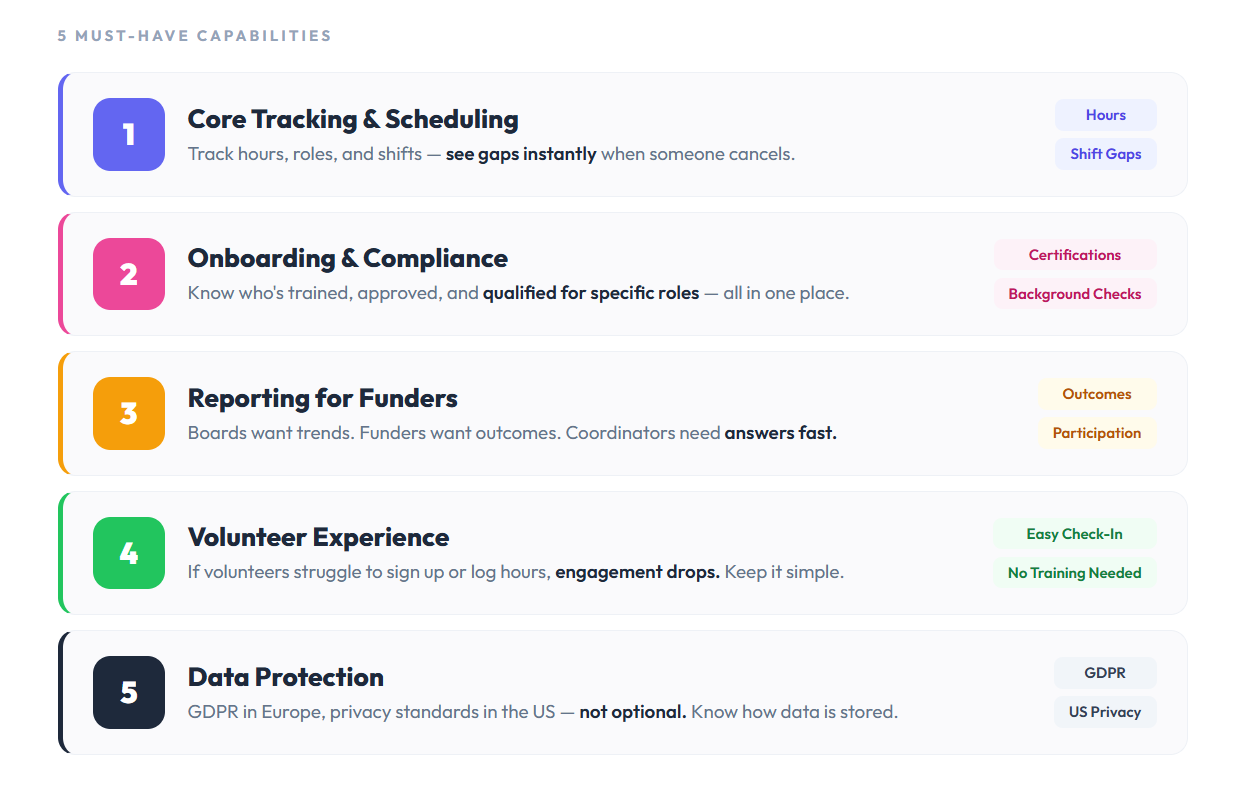
Core Tracking and Scheduling Features
At a minimum, the tool should track hours, roles, and schedules accurately. If someone cancels a shift, coordinators should be able to see gaps quickly and fill them without chasing emails. In learning programs, it’s also important to track what type of activity a volunteer supported, not just how long they were present.
Support for Onboarding, Training, and Compliance
Learning-focused organizations need visibility into who is trained and approved for specific roles. In US healthcare or youth programs, this often includes background checks or certifications. In Europe, public funding frequently requires proof of onboarding and role readiness. A good tool makes this easy to monitor in one place.
Reporting for Learning Outcomes and Funders
Reporting should work for real requirements, not just internal summaries. Funders want clear data on participation and outcomes. Boards want trends. Coordinators need answers fast. The best volunteer tracking tools turn everyday activity into reports you can actually use.
Volunteer Experience and Ease of Adoption
If volunteers struggle to sign up, check in, or log hours, engagement drops. Tools should be simple enough that volunteers don’t need training to use them.
Data Protection Expectation
Volunteer data must be handled responsibly. GDPR compliance in Europe and privacy standards in the US are not optional. Any tool you choose should be transparent about how data is stored and protected.
How We Evaluated These Volunteer Tracking Tools
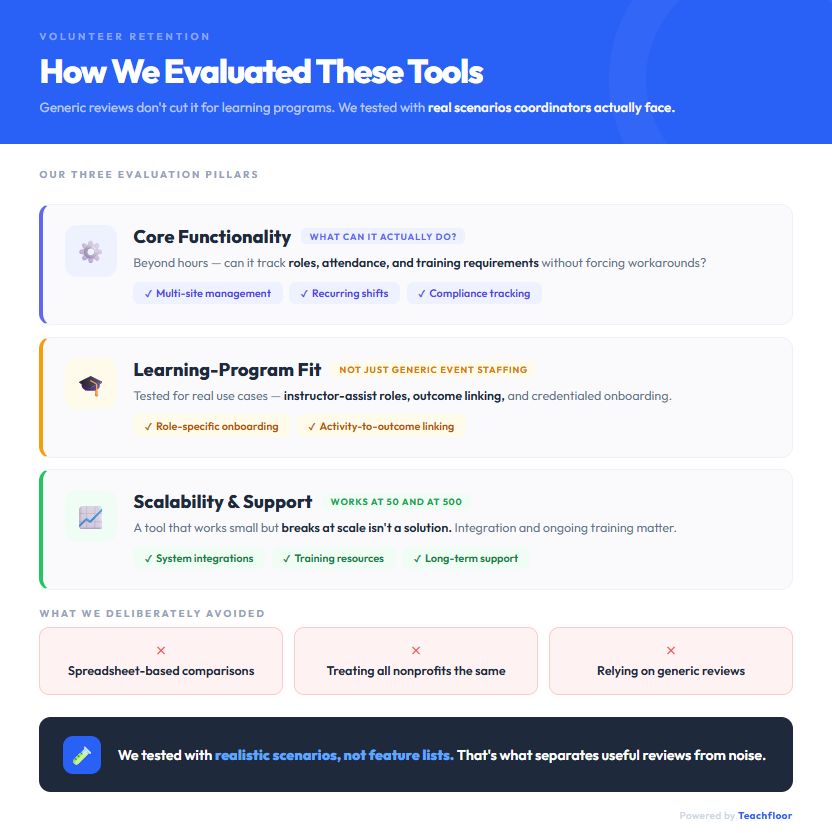
When our team set out to compare the best volunteer tracking tools, we knew that spreadsheets and generic nonprofit reviews would not cut it for learning programs. We needed criteria that genuinely reflect what coordinators use day to day.
First, we looked at core functionality. Can a tool track not just hours, but roles, attendance, and learning activities? Can it handle recurring shifts and special training requirements without forcing you to workaround the system? We tested each platform with realistic scenarios, like managing volunteers across multiple class sites or tracking compliance for credentialed roles.
Next, we focused on environments similar to where we work. Many reviews treat all nonprofits the same. But learning-focused organizations have specific needs, such as onboarding volunteers into instructor-assist roles or linking volunteer activity to outcomes educators care about. We evaluated how each tool performed in these use cases rather than generic event staffing.
We also paid close attention to scalability and usability. A tool may work well for 50 volunteers but become a burden at 500. Long-term support mattered too. Tools that integrate with existing systems and offer ongoing training resources tended to score higher in our evaluation.
The 5 Best Volunteer Tracking Tools for 2025
At this stage, it’s clear that volunteer tracking tools serve very different needs depending on how programs are structured. Some are built for year-round learning environments with strict requirements. Others are better suited for flexible, mobile, or event-based coordination. The best volunteer tracking tools in 2025 are the ones that align with how volunteers are actually managed day to day.
In this section, we review five platforms that stand out for learning-focused organizations. Each overview looks at how the tool functions in practice, its strongest features, its limitations, and the types of programs where it performs best. You’ll also see examples tied to education, healthcare, and community learning settings, so it’s easier to imagine how each tool would fit into your planning process.
Rather than naming a single “best” option, the goal here is to help you identify the tool that supports your programs now and continues to work as they grow.
Golden (Best for Engagement-Driven and Corporate Programs)
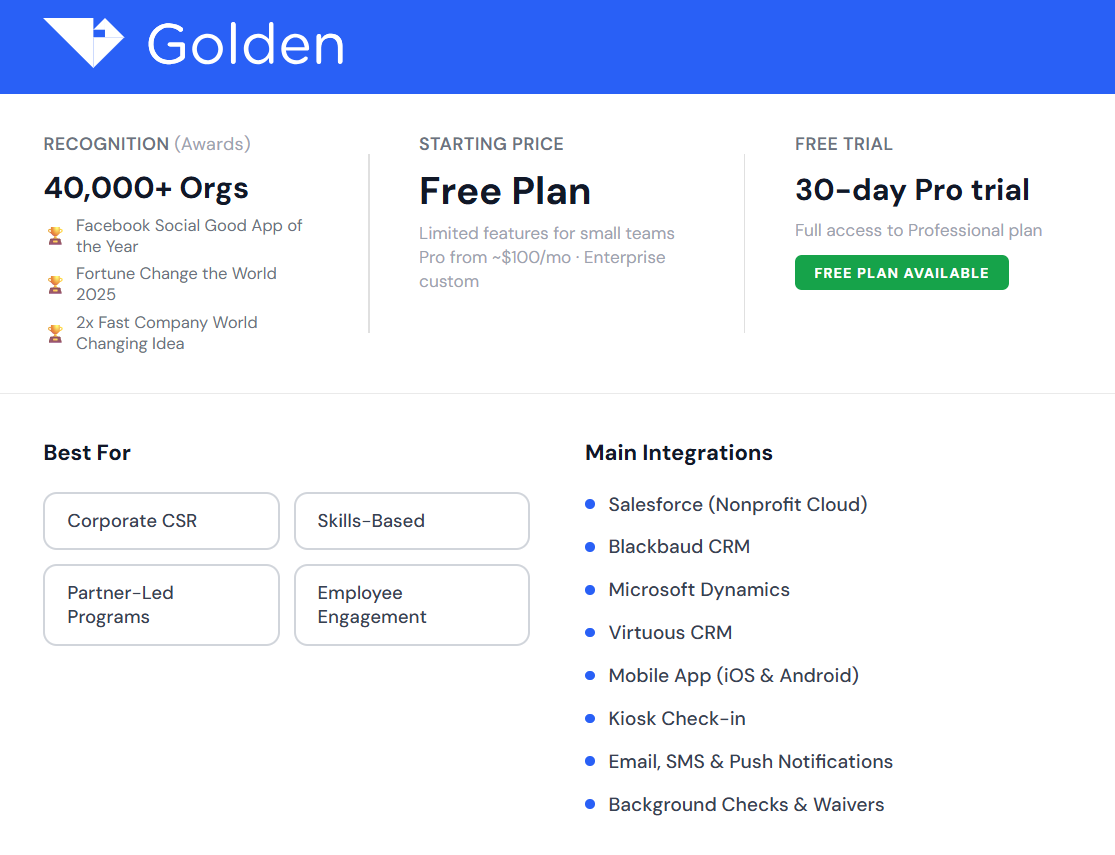
Golden is a good fit when volunteer coordination is closely tied to engagement, recognition, and broader participation goals. From a nonprofit planning perspective, this tool works best when volunteering is part of a bigger ecosystem that includes employees, partners, or supporters who expect a polished experience.
Built for engagement and participation
Golden puts a lot of emphasis on how volunteers feel when they interact with the platform. The interface is clean, and the volunteer journey feels intentional. Volunteers can browse opportunities, track participation, and see their contributions reflected clearly. For planners, this helps reinforce participation without needing constant reminders or follow-ups.
Social recognition and motivation
One feature that often stands out is Golden’s reward and recognition system. Volunteers earn points for participation, which can be tied to incentives or internal recognition. In corporate or partner-led programs, this helps keep engagement high and gives planners an easy way to show appreciation without manual tracking.
Strong fit for corporate and networked programs
Golden is often used in programs where volunteering connects to employee engagement, corporate social responsibility, or multi-partner initiatives. For example, an organization running skills-based volunteering with corporate partners can manage opportunities, participation, and reporting in one place. This structure supports both planning and storytelling around impact.
Limitations to keep in mind
Golden may feel like more than you need if your program is small or highly informal. It is also less focused on detailed training workflows than some other tools, so programs with strict onboarding requirements may need additional processes.
Pricing and plans
Golden offers a free plan with limited features. Paid plans typically start around $100 per month for professional use, with enterprise pricing available for larger or more complex programs. Costs increase based on features, integrations, and scale, and custom quotes are common for advanced needs.
Civic Champs (Best for Mobile-First and Volunteer Engagement)
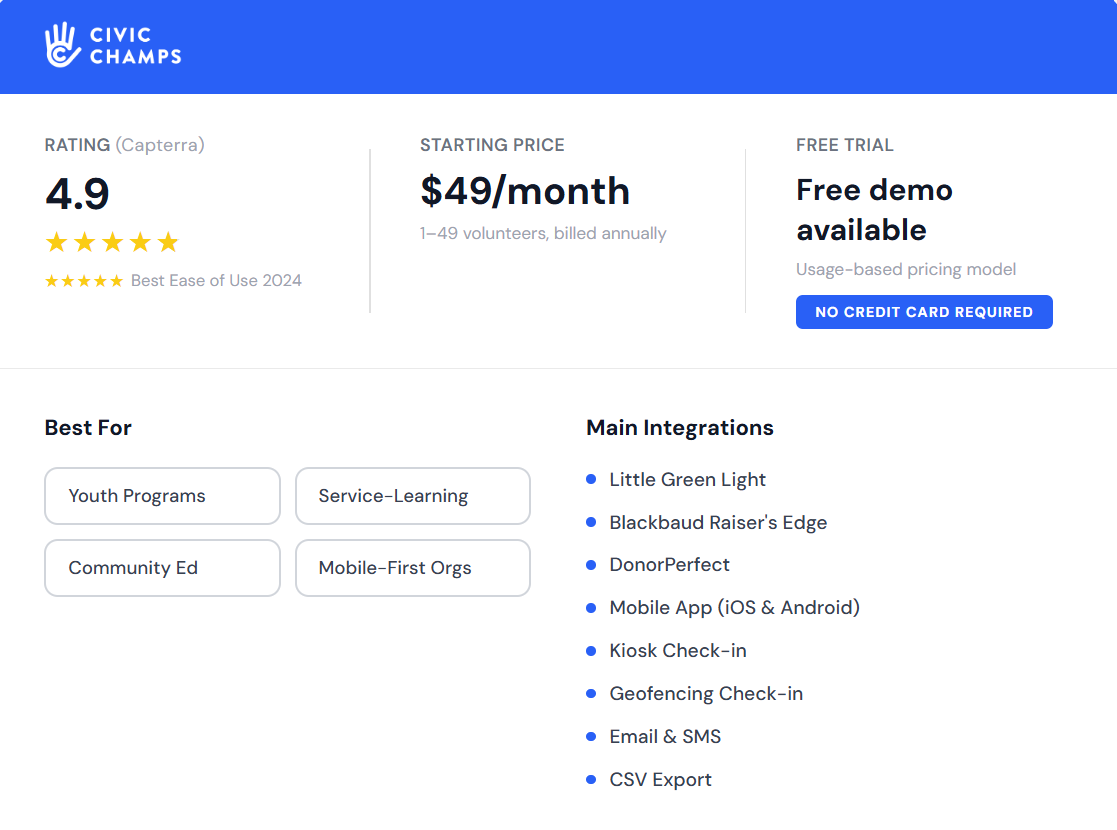
Civic Champs is a strong choice when volunteer participation happens on the move and planning teams want as little friction as possible. From a nonprofit planning standpoint, this tool works best when speed, ease of use, and engagement matter more than layered approvals or complex workflows.
Mobile check-ins that actually get used
The standout feature is mobile check-in with geofencing. Volunteers can log their time directly from their phones when they arrive at a location. In practice, this removes the constant back and forth around missing hours. I’ve seen programs move from weekly reminders to almost perfect attendance data simply because the process became easier for volunteers.
Simple setup and fast adoption
Civic Champs is easy to roll out. Volunteers do not need much explanation to start using it, which is a big win for programs with limited staff capacity. As a planner, this means fewer onboarding sessions and less troubleshooting. Teams often go live in days, not months.
Engagement tools that support learning
Gamification features like badges, leaderboards, and reflections are built into the platform. When used thoughtfully, these tools reinforce learning and participation. For example, youth programs often use reflections after activities to capture what volunteers learned or how they supported others. That qualitative feedback adds context to the numbers.
Real-world use cases
Civic Champs works well in community education initiatives, youth mentoring programs, and service-learning projects where volunteers rotate frequently. Programs that rely on student volunteers or short learning sessions benefit most from the mobile-first approach.
Where it falls short
If your program requires complex scheduling rules or layered approvals, Civic Champs may feel limited. It is best suited for straightforward coordination where ease of use is the priority.
Pricing
Civic Champs uses a usage-based pricing model that charges by the number of active volunteers your organization tracks per year, with plans starting at $49 per month when billed annually for 1–49 volunteers. As your active volunteer count increases, the monthly rate typically rises (for example, about $74/month for 50–249 volunteers, $99/month for 250–499, and $124–$149/month for larger bands).
All plans include unlimited administrators, mobile and kiosk check-ins, hour tracking, event scheduling, messaging, waivers, reflections, and reporting. Additional features like data import and certain third-party integrations may incur extra fees.
VolunteerLocal (Best for Event-Based and Short-Term Programs)
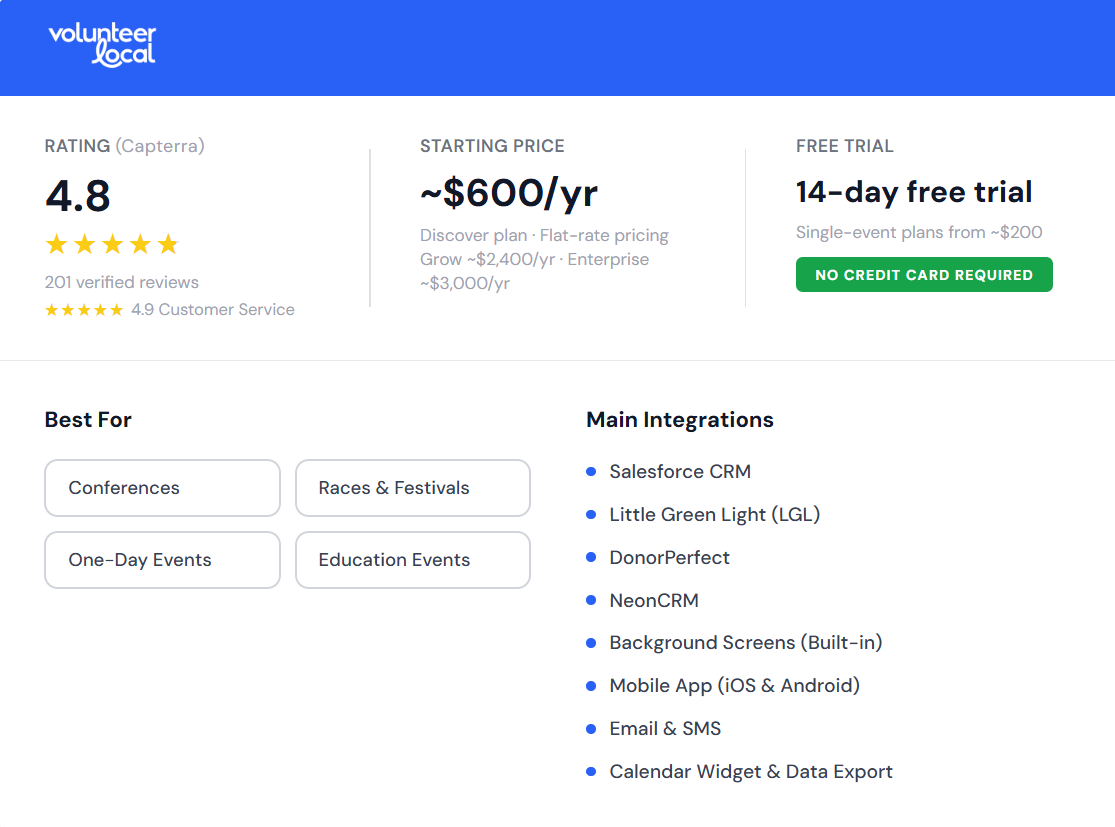
VolunteerLocal is built for moments when nonprofits need to move fast. From a planning perspective, it’s ideal for programs where volunteer involvement is intense but brief. If your calendar is full of events rather than ongoing sessions, this tool fits that reality well.
No-login signup and fast onboarding
The biggest win with VolunteerLocal is how easy it is for volunteers to sign up. There’s no account creation and no passwords to remember. Volunteers choose a shift, enter basic details, and they’re in. For planners, this removes friction and boosts participation, especially when recruiting last-minute help.
Strengths for workshops, conferences, and large events
VolunteerLocal performs best in event-driven environments. Coordinators can view shift coverage in real time, identify gaps quickly, and make adjustments without digging through spreadsheets. This works well for conferences, workshops, races, and large one-day initiatives where timing matters.
Group registration and real-time communication
Group registration is especially helpful when working with corporate teams or student groups. One person can register multiple volunteers at once, saving hours of coordination. Built-in messaging allows planners to send updates quickly if schedules or locations change.
Where it fits and where it doesn’t
VolunteerLocal is a strong choice for education events and fundraising initiatives that rely on short-term support. It’s less suited for year-round learning programs that require training, role progression, or long-term engagement tracking. In those cases, its simplicity can become a limitation rather than an advantage.
Pricing
VolunteerLocal uses a straightforward pricing model based on whether you’re running ongoing programs or single events. For ongoing annual use, plans typically start around $600 per year on the Discover tier.
Larger plans like Grow cost about $2,400 per year, and Enterprise options begin around $3,000 per year with more admin users and event capacity. If you only need tools for individual events, single-event pricing is offered at about $200 for Discover and $800 for Grow. There are no long contracts, and pricing is based on event volume and administrative needs.
Better Impact (Best for Structured and Compliance-Focused Programs)
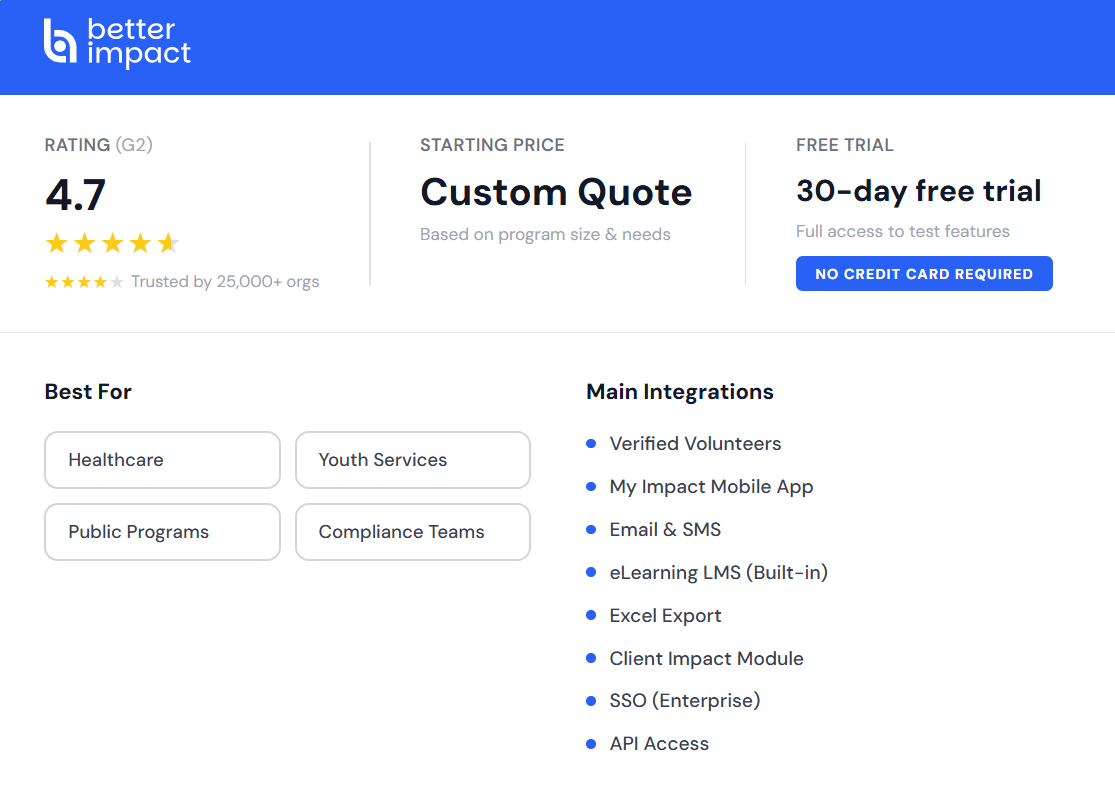
Better Impact is designed for organizations that need clear structure from the moment a volunteer applies to the moment they complete a shift. As a nonprofit planner, this is the kind of tool you look at when volunteers are part of a larger system, not just extra hands. The platform follows a full lifecycle approach, covering applications, approvals, training, scheduling, and ongoing engagement in one place. That makes planning far more predictable.
Onboarding, training, and credential tracking
One of Better Impact’s strongest areas is onboarding and training. Volunteers move through defined steps, and coordinators can require specific documents, learning modules, or approvals before someone is eligible for a role. In practice, this works well for programs where volunteers support learners, patients, or vulnerable groups. You always know who is cleared to participate and who still needs follow-up.
Where Better Impact fits best
This level of control makes Better Impact a strong choice for healthcare, youth services, and public programs. In hospital settings, it’s often used to manage health checks and role approvals. In community education programs, planners rely on it to track training completion for volunteers supporting classes or workshops.
When it may feel like too much
For smaller teams or short-term initiatives, Better Impact can feel heavy. Setup takes time, and coordinators need to commit to using the system properly. If your program is informal or event-based, this structure may slow you down rather than help.
Pricing and Plans
Better Impact does not list a single fixed price publicly. Instead, pricing is based on the size of the volunteer program and the level of functionality required. Costs generally increase as the number of active volunteers grows and as organizations unlock more advanced features.
In practice, many organizations budget anywhere from several hundred dollars per year for smaller setups to several thousand dollars annually for larger, more complex programs. Final pricing is typically provided through a custom quote after discussing program needs with the Better Impact team.
VolunteerHub (Best for Large, Multi-Site Organizations with CRM Needs)
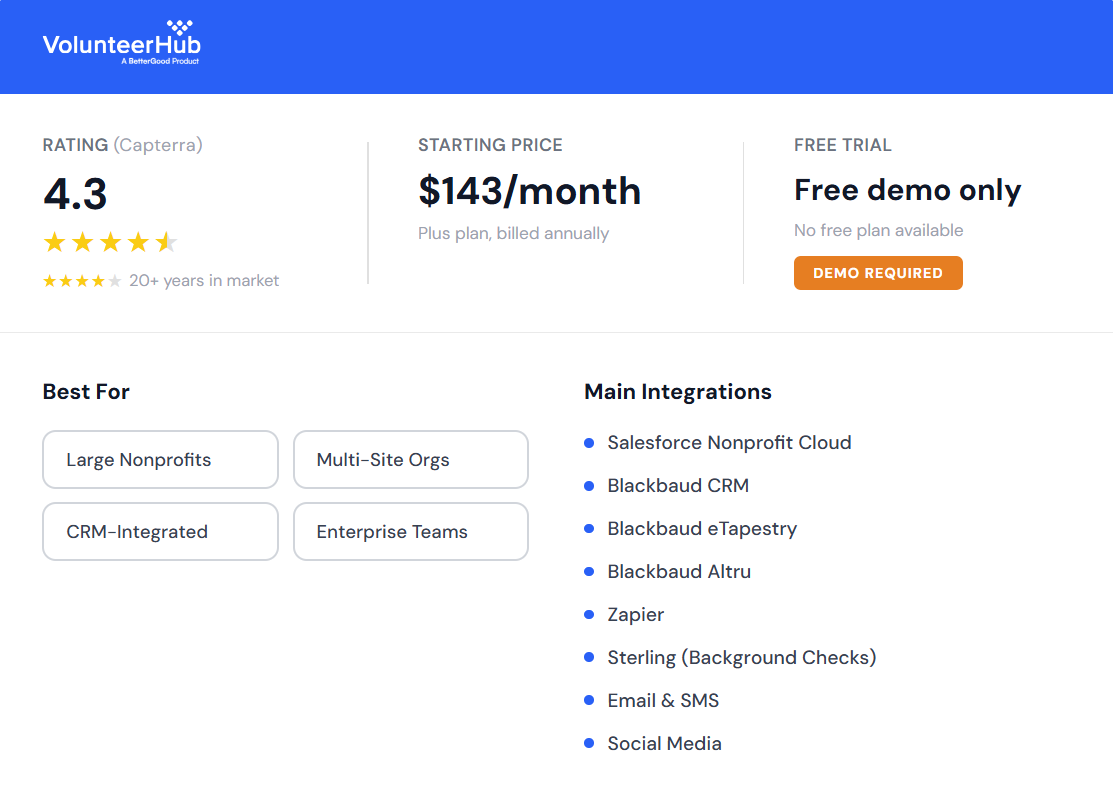
If you’re planning volunteer operations at scale, VolunteerHub is the kind of tool you look at when spreadsheets and lightweight systems have already failed you. It’s built for organizations where volunteer coordination is tied closely to operations, compliance, and long-term engagement tracking. From a planning perspective, this is a platform meant to bring order to complexity.
Centralized scheduling and compliance management
VolunteerHub is strong when it comes to managing large volumes of volunteers across multiple sites. Schedules, shifts, waitlists, and approvals all live in one central system. As a planner, that visibility matters. You can see staffing gaps quickly, adjust assignments, and ensure volunteers meet role requirements before they show up. This is especially useful for learning and outreach programs that run continuously rather than seasonally.
Native integrations with Salesforce and Blackbaud
One of the main reasons organizations choose VolunteerHub is its direct integration with major CRM platforms like Salesforce and Blackbaud. Volunteer data syncs into the same systems used by development and engagement teams. That means volunteer activity is no longer isolated. Planning teams can see how volunteering connects to broader participation, alumni involvement, or donor relationships without exporting files or cleaning data manually.
Strengths for enterprise-scale learning and outreach
VolunteerHub works well in environments like national nonprofits or university systems where programs operate across regions or campuses. For example, a university coordinating service-learning across departments can manage student volunteers, schedules, and compliance while keeping everything aligned with institutional systems.
Cost and setup considerations
VolunteerHub offers tiered pricing based on feature access. The Plus plan starts at $143 per month and includes core scheduling, volunteer tracking, and automated communication tools. The Pro plan is priced at $288 per month and adds advanced features such as kiosk check-in, file storage, and enhanced forms. For large or complex organizations, VolunteerHub also offers an Enterprise plan with custom pricing, which includes deeper CRM integration and expanded support. There is no free plan, so budgeting upfront is required.
Side-by-Side Feature Comparison
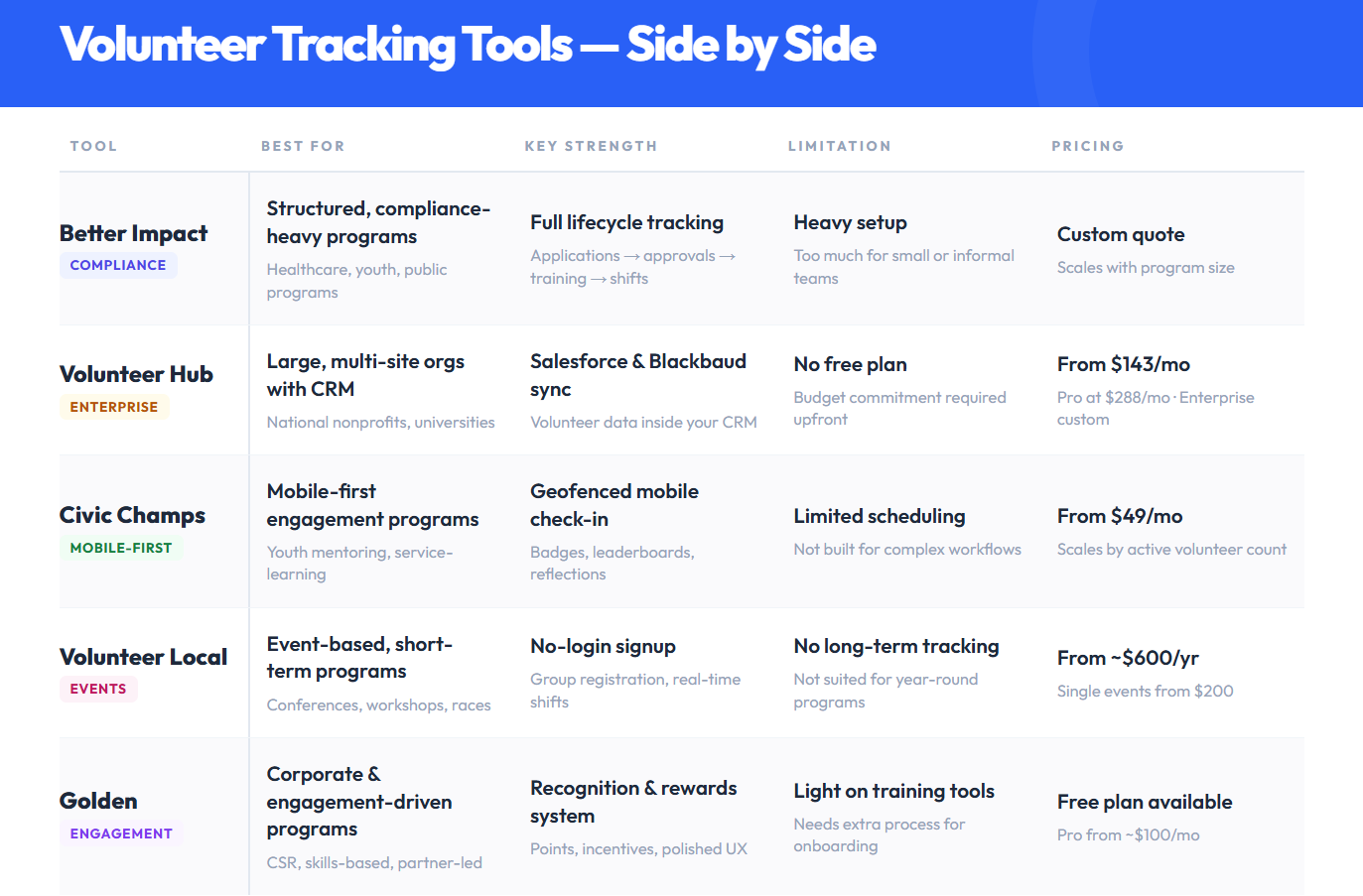
Each volunteer tracking tool solves a different set of problems. The table below shows key features side by side so you can quickly compare strengths, limitations, and best-fit use cases. This makes it easier to identify which tool aligns with your program’s structure and planning needs.
Choosing the Right Volunteer Tracking Tool for Your Program
Selecting a volunteer tracking tool works best when you break the decision into a few practical questions. From a nonprofit planning perspective, clarity upfront prevents expensive changes later.
Start with your learning goals
Think about how volunteers support learning in your program. If they assist with instruction, mentoring, or skills development, you need visibility into training status and role readiness. Programs with informal or short-term learning can often rely on simpler tracking without advanced workflows.
Consider program size and growth
Small programs usually benefit from tools that are quick to launch and easy to manage. Larger programs need systems that handle volume, multiple roles, and more coordination. Choosing a tool that cannot grow with your program often leads to rebuilding processes later.
Account for compliance and reporting needs
Compliance should guide your choice, not follow it. If your program requires background checks, approvals, or structured reporting for funders, the tool must support these needs from the start. Manual workarounds add planning risk.
Prioritize the volunteer experience
Volunteer experience has a direct impact on retention. If signing up, checking in, or tracking hours feels complicated, people disengage. The right tool balances learning, operations, and ease of use so volunteers stay involved without extra effort.
Conclusion
From planning volunteer programs over the years, one lesson stands out: the right tools reduce friction, the wrong ones quietly slow everything down. Volunteer tracking today shapes far more than attendance.
It affects how learning programs operate, how volunteers stay engaged, and how confidently organizations report their impact. There is no one-size-fits-all solution.
Event-based programs, learning-driven initiatives, and large multi-site organizations all need different things. The right choice is the tool that fits how your program actually runs, not how it looks in a demo.

That’s also where learning platforms like Teachfloor come into the picture. Many nonprofits use Teachfloor as the central place to onboard, train, and support volunteers through structured learning paths.
While volunteer tracking tools handle scheduling and hours, Teachfloor focuses on preparing volunteers to succeed in their roles. Together, they help organizations connect training with real-world participation, giving volunteers clarity and giving teams confidence that learning translates into action.


