


If you have ever sat in a board meeting approving a strategic plan and quietly wondered whether it would actually change anything, you are not alone. I have watched many nonprofit organizations invest months into planning, only to see the document lose relevance once daily pressures return.
Strategic planning should not feel like an exercise done for funders or compliance. At its best, it gives people clarity. It helps staff decide what matters today and what can wait. It gives leaders a shared language for hard trade-offs.
This article is written from years of building, fixing, and revisiting a strategic plan for a nonprofit organization in the real world. You will find practical guidance, honest examples, and clear thinking designed to help your strategy stay useful, focused, and alive long after it is approved.
Let's First Understand the Strategic Planning for a Nonprofit
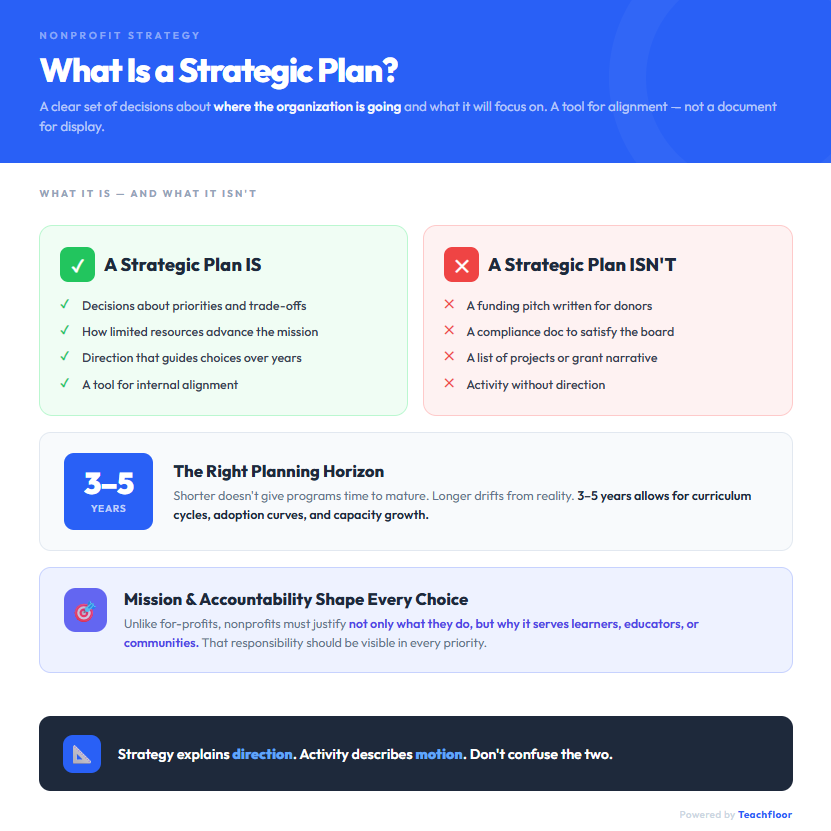
A strategic plan for a nonprofit is a clear set of decisions about where the organization is going and what it will focus on over the next few years. It explains priorities, trade-offs, and how limited resources will be used to advance the mission. At its core, it is a tool for alignment, not a document for display.
What it is not often causes confusion. A strategic plan is not a funding pitch for donors, and it is not a compliance document created to satisfy a board requirement. I have seen many nonprofits, especially in ed-tech and LMS-driven organizations, mistake a list of projects or a grant narrative for strategy. Those documents describe activity. Strategy explains direction.
Most nonprofit strategic plans cover three to five years. Shorter horizons do not give enough time for programs or platforms to mature. Longer horizons tend to drift from reality. In education nonprofits running digital learning platforms or LMS tools, this timeframe allows for curriculum cycles, adoption curves, and capacity growth.
Mission and public accountability shape every strategic choice. Unlike for-profit organizations, nonprofits must justify not only what they do, but why it serves learners, educators, or communities. That responsibility should be visible in every strategic priority.
When a Nonprofit Should Develop or Refresh a Strategic Plan
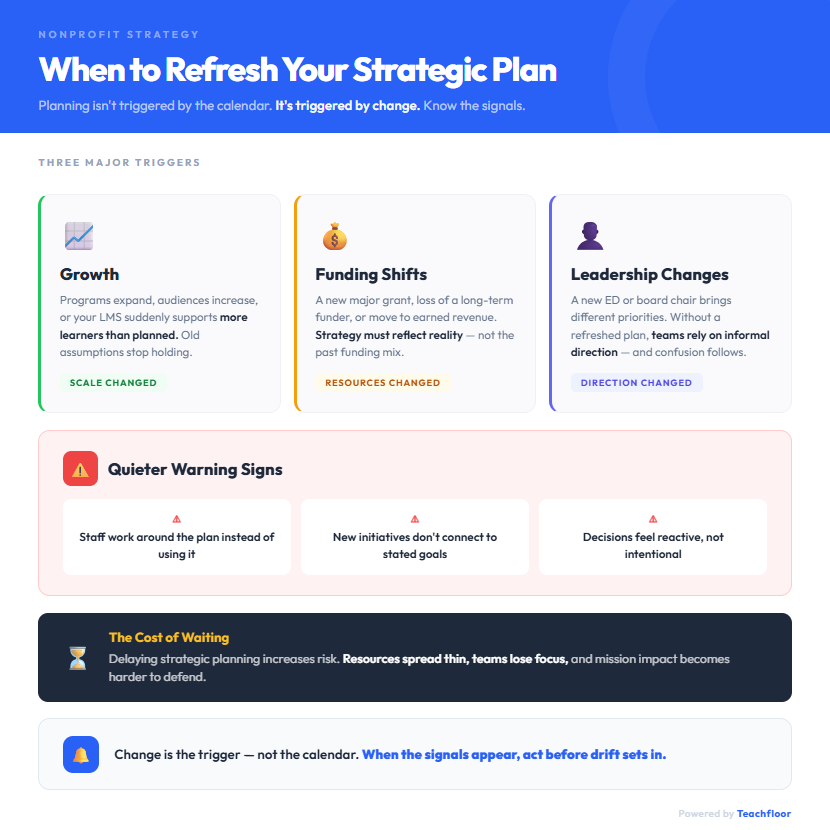
Nonprofits rarely decide to revisit strategy just because the calendar says so. In practice, planning is triggered by change. Growth is a common one. When programs expand, audiences increase, or an LMS platform suddenly supports more learners than originally planned, the old assumptions stop holding.
Funding shifts are another signal. A new major grant, the loss of a long-term funder, or increased reliance on earned revenue changes what is realistic. Strategy needs to reflect that reality, not the past funding mix.
Leadership changes also matter. A new executive director or board chair often brings different priorities and decision styles. Without a refreshed strategic plan, organizations rely on informal direction, which leads to confusion.
There are also quieter signs. Staff work around the plan instead of using it. New initiatives do not clearly connect to stated goals. Decisions feel reactive.
Delaying strategic planning in these moments increases risk. Resources get spread thin, teams lose focus, and mission impact becomes harder to defend.
Who Should Be Involved in the Strategic Planning Process
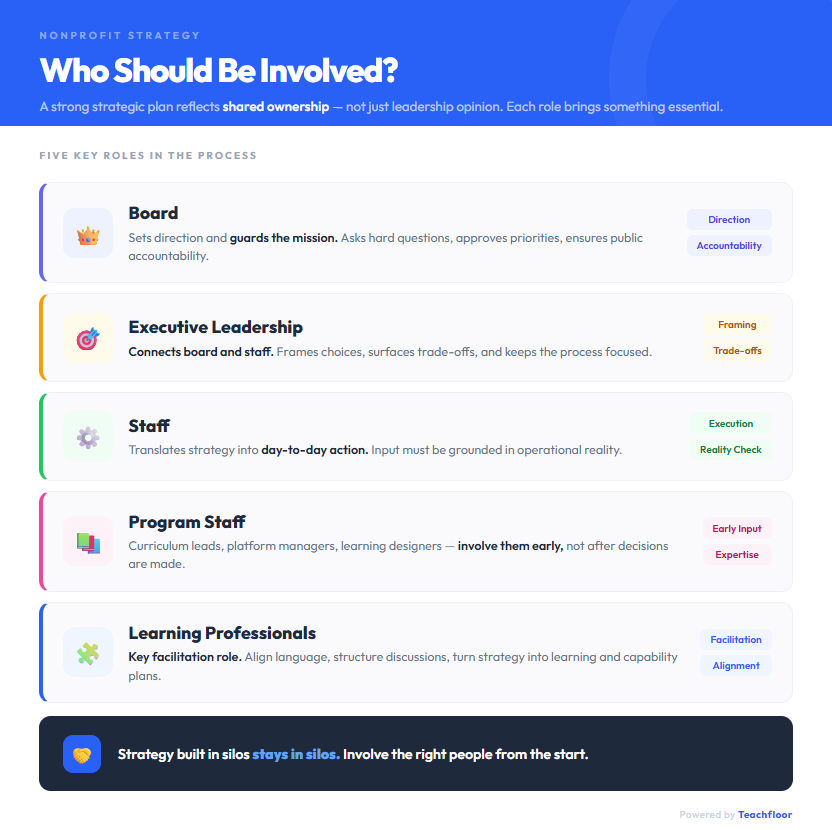
A strong strategic plan for a nonprofit reflects shared ownership, not just leadership opinion. The board sets direction and guards the mission. Their role is to ask hard questions, approve priorities, and ensure public accountability. Staff are responsible for translating strategy into day-to-day action, so their input needs to be grounded in operational reality.
Executive leadership connects the two. They frame choices, surface trade-offs, and keep the process focused. Program staff should be included when their work will be affected. In ed-tech nonprofits or LMS-based organizations, this often means involving curriculum leads, platform managers, or learning designers early, not after decisions are made.
Learning professionals play a key facilitation role. They help teams align language, structure discussions, and turn strategic goals into clear learning and capability plans.
What Are the 7 S’s of Strategic Planning?
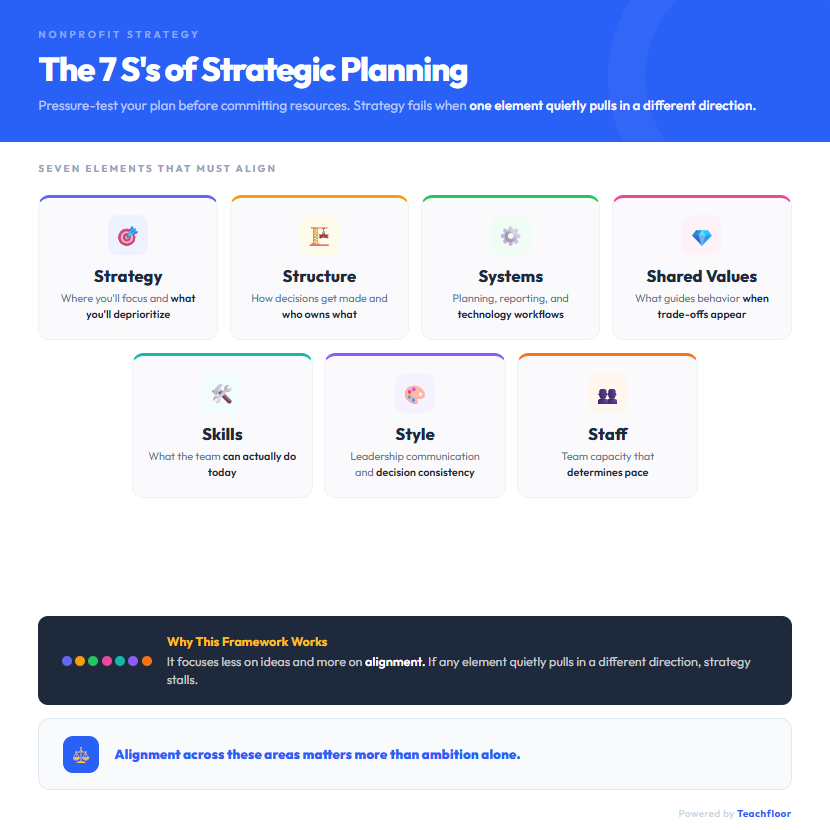
The 7 S framework helps nonprofits pressure-test a strategic plan before committing resources. It works because it focuses less on ideas and more on alignment. Strategy fails most often when one of these elements quietly pulls in a different direction.
Strategy
This is the set of choices about where the nonprofit will focus and what it will deprioritize. In ed-tech organizations, this often shows up as deciding whether the priority is platform growth, content quality, or learner outcomes. Trying to do all three at once usually creates strain.
Structure
Structure defines how decisions get made and who owns what. If an LMS team reports separately from program leadership, coordination problems tend to surface quickly.
Systems
Systems include planning, reporting, and technology workflows. A strategy to scale learning programs breaks down fast if the LMS cannot support onboarding, data tracking, or support requests.
Shared Values
Values guide behavior when trade-offs appear. If innovation is stated but risk is punished, strategy stalls.
Skills
Skills reflect what the team can actually do today. Strategic plans should account for instructional design, data analysis, and platform management skills that already exist.
Style
Leadership style shapes execution. Clear communication and consistent decision-making matter more than vision statements.
Staff
Staff capacity determines pace. Even strong strategies fail when teams are stretched too thin.
Alignment across these areas matters more than ambition alone.
What Is Mintzberg’s Theory of Strategy and How It Applies to Nonprofits
Mintzberg’s theory of strategy explains that strategy is not just what organizations plan, but also what they actually do. He describes five ways to view strategy: plan, pattern, position, perspective, and ploy. Together, they help leaders see the difference between intention and reality.
In nonprofit work, this distinction matters. A strategic plan may call for expanding programs or launching new LMS features, but day-to-day decisions often tell a different story. Time gets redirected. Capacity limits show up. Priorities shift.
This is not failure. It is emergent strategy. By paying attention to patterns in behavior, nonprofits learn what is realistic and what needs adjustment. The strongest strategies are shaped by real actions, not just written goals.
Setting Strategic Priorities That Are Realistic
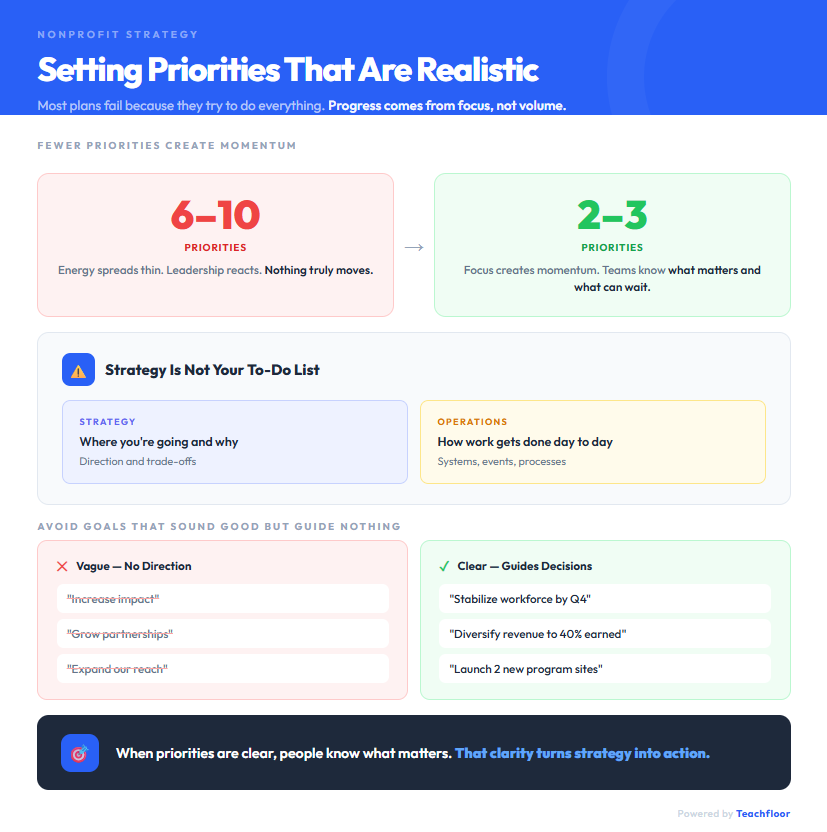
After decades of building and fixing strategic plans for nonprofit organizations, I can say this clearly: most plans fail because they try to do everything.
Fewer priorities create momentum
When a strategic plan lists six, eight, or ten priorities, nothing truly moves. Staff and volunteers spread their energy thin, and leadership ends up reacting instead of leading. In practice, strong nonprofit strategy usually focuses on two or three priorities at a time.
For example, a youth services nonprofit facing staff turnover and unstable funding is better off prioritizing workforce stability and revenue diversification than launching new programs. Progress comes from focus, not volume.
Strategy is not your to-do list
A common mistake is filling the strategic plan with operational tasks. Things like upgrading systems, running events, or improving internal processes are important, but they are not strategy.
Strategy answers where the organization is going and why. Operations explain how the work gets done day to day. Mixing the two creates confusion and weak execution.
Avoid goals that sound good but guide nothing
Goals like “increase impact” or “grow partnerships” feel inspiring but offer no direction. A realistic priority is specific enough to guide decisions and trade-offs.
When priorities are clear, people know what matters and what can wait. That clarity is what turns a strategic plan into action.
Turning Strategy Into Goals and Measures
This is the point where many strategic plans quietly lose their power. The strategy sounds right, the priorities feel reasonable, but once teams try to act on it, no one is quite sure what success actually looks like. That gap usually comes from weak translation between strategy, goals, and measures.
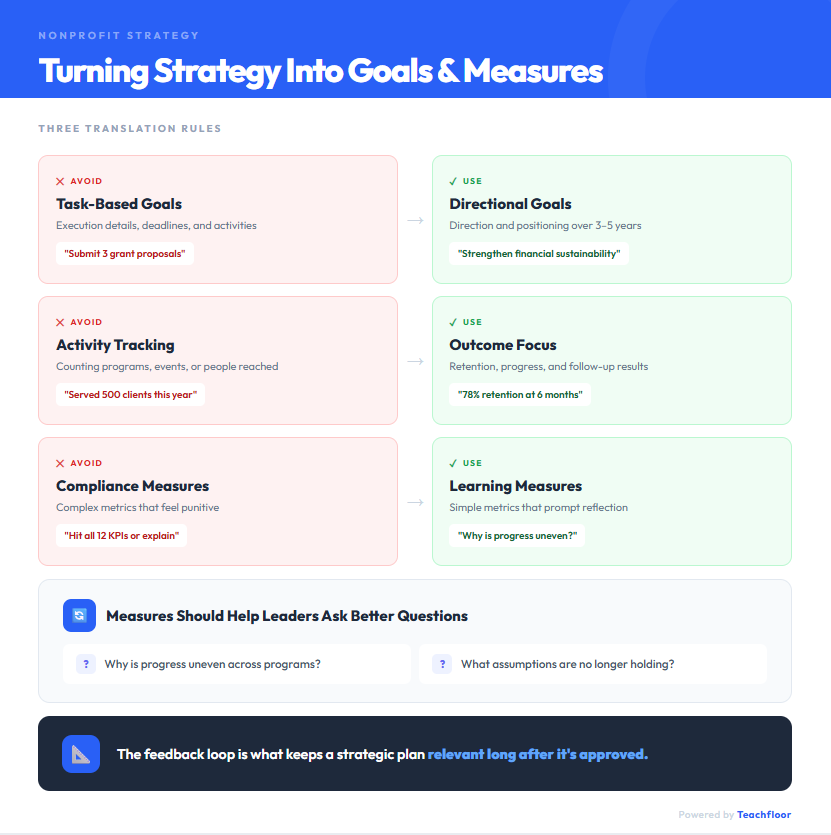
Strategic goals are directional, not task-based
Strategic goals describe the change the organization is trying to create over a defined period. They are about direction and positioning, not execution details. Operational objectives, on the other hand, explain what teams will do in the short term to support that direction.
For example, a strategic goal might be to strengthen long-term financial sustainability. That goal does not list grant deadlines or fundraising events. Those belong in operational plans. Keeping this separation clear helps leaders make trade-offs when resources are limited, which is almost always the case in nonprofit work.
Goals should point to outcomes, not effort
A common trap is writing goals that track activity instead of results. Counting how many programs were delivered or how many people were reached only tells part of the story. It does not tell you whether the strategy is working.
Strong goals are linked to outcomes that reflect real change. For instance, instead of measuring how many clients completed a program, you might track retention, progress, or follow-up outcomes. This keeps the focus on impact rather than volume.
Measures should support learning, not compliance
In experienced nonprofit organizations, measures are used to learn, not to police performance. The best measures help leaders ask better questions. Why is progress uneven across programs? What assumptions are no longer holding true?
When measures are too complex or feel punitive, people disengage. When they are simple and clearly tied to strategic goals, they support reflection and adjustment. That feedback loop is what keeps a strategic plan relevant long after it is approved.
Using the 33% Rule in Nonprofit Strategic Planning
The 33 percent rule is a practical guideline used in nonprofit strategy to reduce financial risk. It suggests that no single funding source should account for more than 33 percent of an organization’s total revenue. The aim isn’t flawlessness, but finding the right equilibrium.
After decades of advising nonprofit organizations, I have seen how reliance on one major funder can limit decision-making and threaten stability. For example, when a single foundation grant covers most operating costs, a funding shift can force sudden program cuts or layoffs.
Revenue diversification matters because it protects mission delivery. A nonprofit with a mix of grants, individual donations, earned income, and contracts has more flexibility when one source declines. This is especially important for organizations serving vulnerable communities where continuity matters.
A common misunderstanding is treating the 33 percent rule as a strict formula. It is not. Smaller nonprofits may exceed it temporarily during growth or transition. The value of the rule lies in using it as a planning lens, not a hard requirement, to guide healthier long-term strategy.
Common Strategic Planning Mistakes Nonprofits Make
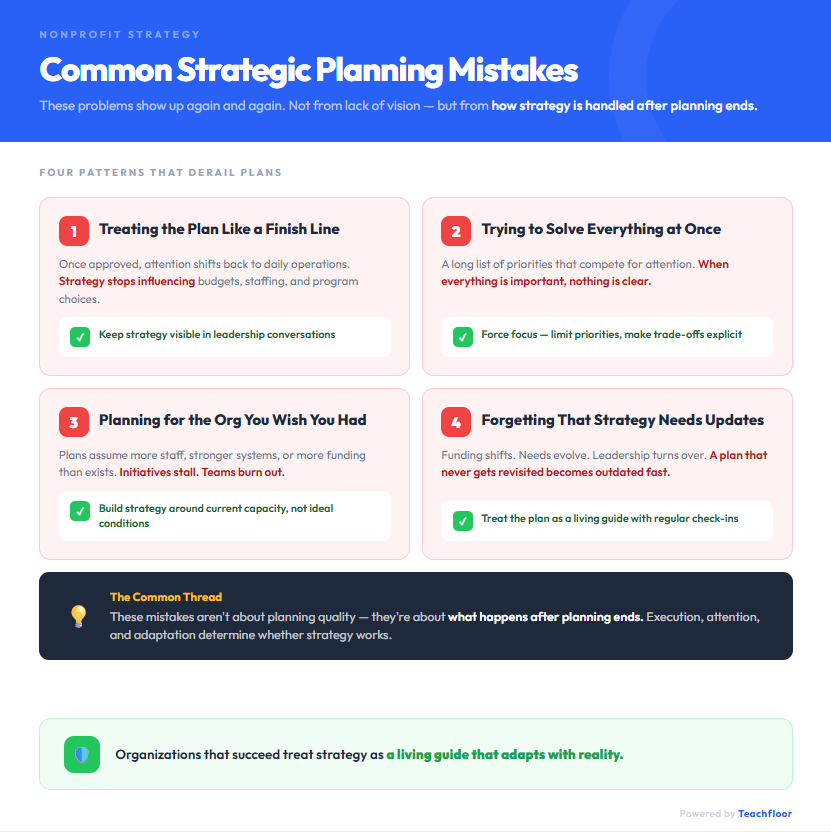
After decades of working with nonprofit organizations, the same planning problems show up again and again. They are not caused by lack of commitment or vision. They come from how strategy is handled once the planning process ends.
Treating the plan like a finish line
Many nonprofits treat strategic planning as something to complete rather than something to use. Once the document is approved, attention shifts back to daily operations and urgent issues.
When strategy is not referenced in budget discussions, staffing decisions, or program choices, it loses its influence. A strategic plan only matters if it stays visible and relevant in leadership conversations.
Trying to solve everything at once
It is tempting to include every challenge and opportunity in the plan. The result is usually a long list of priorities that compete for attention.
When everything is important, nothing is clear. Strong strategic plans force focus by limiting priorities and making trade-offs explicit. Clear direction is what makes meaningful progress possible.
Planning for the organization you wish you had
Another common mistake is building a strategy around ideal conditions instead of current reality. Plans assume more staff time, stronger systems, or greater funding than actually exists.
Capacity includes people, skills, infrastructure, and leadership attention. When these limits are ignored, initiatives stall and teams burn out.
Forgetting that strategy needs updates
Nonprofits operate in changing environments. Funding shifts. Community needs evolve. Leadership turns over. A strategy that never gets revisited quickly becomes outdated.
Organizations that succeed treat their plan as a living guide. Regular check-ins and adjustments keep strategy aligned with reality and useful over time.
Keeping the Strategic Plan Useful Over Time
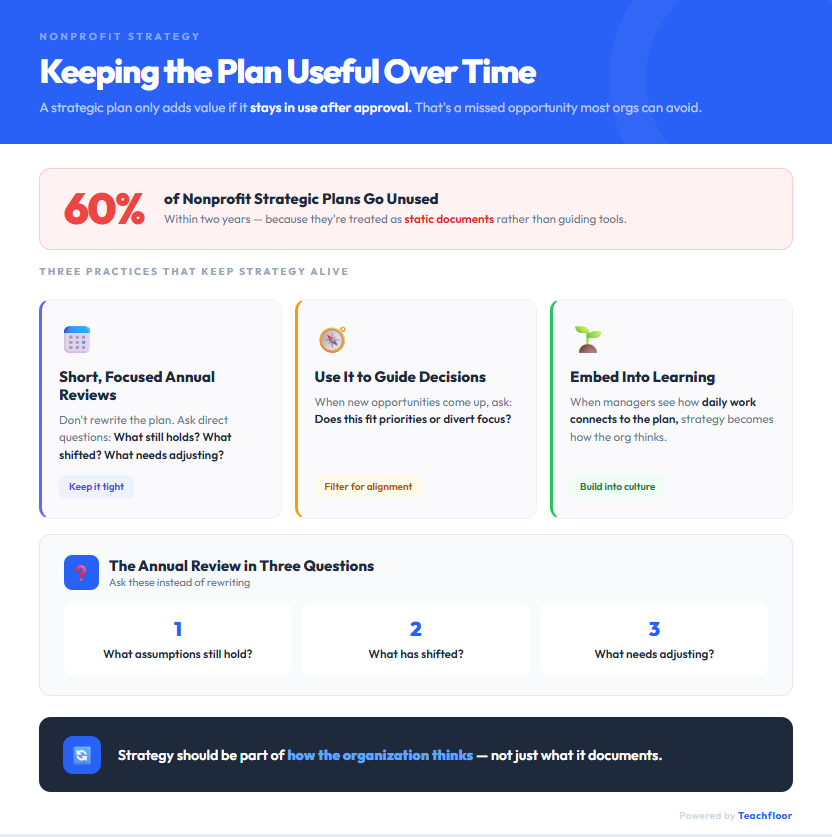
A strategic plan for a nonprofit only adds value if it stays in use after approval. Research shows that nearly 60 percent of nonprofit strategic plans go unused within two years because they are treated as static documents rather than guiding tools. That’s a missed opportunity most organizations can avoid.
Annual reviews work best when they are short and focused. Instead of rewriting the plan, leadership teams should ask a few direct questions: What assumptions still hold? What has shifted? What needs adjusting? For example, after a major funder reduced support, one community health nonprofit paused a planned expansion to strengthen core services first, keeping progress steady instead of stalling entirely.
The plan should also actively guide decisions. When new opportunities come up, leaders can ask whether they fit strategic priorities or risk diverting focus. This keeps the organization aligned, especially during busy periods.
Embedding strategy into leadership development and staff learning helps sustain momentum. When managers understand how their daily work connects to the plan, strategy becomes part of how the organization thinks, not just what it documents.
Conclusion
A strategic plan only earns its place if it helps people do their work better. The nonprofits that succeed long term are not the ones with the most polished plans, but the ones that make strategy visible in everyday decisions, training, and leadership conversations. When people understand the direction and have the skills to support it, strategy stops feeling abstract.
One practical piece many nonprofits underestimate is learning infrastructure. If your strategy depends on stronger staff, better-trained volunteers, or new ways of working, you need a reliable way to support learning at scale. That is where an LMS becomes part of the strategy, not a side tool.

Teachfloor works well for nonprofits because it is designed around real participation. Organizations use it to onboard volunteers, train staff, run cohort-based programs, host live sessions, and encourage peer learning through discussions and feedback.
Features like progress tracking, certificates, and flexible course structures make it easier to turn strategic intent into shared capability. When learning is built in, strategy becomes much easier to carry forward.


