

Teachfloor helps course creators build, manage, and scale their self-paced courses. This guide shares practical tips for creating effective self-paced online courses while you grow your online learning school faster than you might expect.
Whether you are a course creator offering courses to individual learners, a Bootcamp founder offering Bootcamps to companies, or a training manager creating online training programs for your company, we want to guide you on how to build, scale, and manage a successful self-paced course on Teachfloor.
Topics that we will cover:
- What is a self-paced course?
- Its Advantages and Drawbacks
- Tips to help in creating effective self-paced courses on Teachfloor
- How to build your course
- How to scale your course with automation features
What is a self-paced course?
Self-paced learning is a format where courses are stored online and taken by students at their own pace, with no fixed timeframe. Students hold full accountability for when and where they complete the course. Once finished, most courses offer a Certificate of Completion confirming that students worked through the content on their own, passed the assessments, and consumed the materials. It is closely related to asynchronous learning, and while large MOOC platforms popularized the model, self-paced learning is far broader than MOOCs alone.
Self-paced learning grew quickly as more people moved to learning and working from home. Many of these courses are free or less expensive than live classes and webinars. The model reshaped education, since anyone with a laptop, an internet connection, and the motivation to learn can study under top instructors and universities.
However, studies show that this format has a huge disadvantage to effective learning and has been found to have low completion rates. Students cannot finish the entire course due to a lack of accountability, focus, engagement with others, and boredom.
Despite this, self-paced eLearning courses remain prominent. They are not dead; they have simply evolved. So, the main question we want to answer is how to build an online course that is effective and successful. This is exactly where Teachfloor fits in. Teachfloor is built for cohort and social learning, yet many creators also use it for self-paced courses, because its flexibility lets you enrich a self-paced course with built-in community, discussion activities, and peer review. That turns a passive course into an interactive, hybrid experience and directly tackles self-paced learning's biggest problem: low engagement and low completion.
Creators who want an interactive self-paced learning environment need to increase learner engagement. How can they do that? We will break down the practical tips that can change the trajectory of your course.
Before that, let's go through the advantages and drawbacks to fully understand the concept of self-paced courses.
Major Advantages of Self-Paced Online Learning
They are profitable and less expensive.
Creating an evergreen course opens up the possibility of earning five to seven figures per year just by selling online courses. Hard to believe? Successful course creators have proven it year after year. Reporting on major learning platforms has shown that self-paced course revenue continues to grow over time, which is evidence that these courses can be profitable and scalable.
For instance, if you have a self-paced course priced at $50, and 1,000 students buy it, you earn $50,000 in revenue. If you can find ways to make it scale to 10,000 students in a month, then you can earn $50,000 for a month. Not only it is profitable for course creators, but it is also less expensive for students.
If you want to calculate your monthly course revenue, here's a free calculator tool to help you do that.
They are flexible and support different learning preferences.
Since students can take the course through asynchronous learning without a deadline, it is flexible in terms of time and duration. It also supports different learning activities, styles, speeds, and preferences. Learners have full autonomy and accountability in deciding when and where to start and finish the course. While this is an advantage, it can also be a drawback for students who struggle to take full ownership of their own learning journey.
They are accessible and they widen access to education.
These courses are stored online and can be accessed by anyone, regardless of location, background, or social status. Anyone with a laptop and an internet connection can take a course created and taught by leading instructors from top universities. Anyone can earn an online certificate or degree from institutions like MIT, Stanford, or Harvard, or learn from Andrew Ng's machine learning course. Self-paced learning has reshaped how we learn globally.
In addition, it’s usually used for continuing education credits in these top universities. Most of the time, self-paced learning is also used by universities to create a hybrid learning format.
Major Drawbacks of Self-Paced Online Learning
After feeling positive due to the advantages, let's also balance it out and talk about the drawbacks of self-paced learning.
Lacks Accountability.
Because of its flexibility, accountability is at stake. Not all students have the motivation to stay accountable for their learning. In reality, learning on your own is hard, and not everyone enjoys it. So the major drawback of these courses is low completion rates. Students have a hard time finishing the course to the end, for many reasons such as distraction, low motivation, boredom, and a lack of interactive activities.
Solution: Build a learning community so students don't feel alone while learning on their own. They can still watch videos and study independently, but when they want to ask a question or start a conversation, a community of like-minded people is there. They can co-create interactive activities together and set accountability with each other.
No to Low Student Engagement.
Since students learn at their own pace, they don't engage with other students who are also taking the course. A self-paced learning experience doesn't allow the learner to engage in real time with others, which is why learning becomes a one-way street where students only consume information from instructors and no one else.
Solution: Alongside a learning community, Teachfloor includes a peer review feature where instructors can set up students to review each other's assignments, projects, essays, and presentations. This opens up peer learning so students learn from one another and stay engaged, even asynchronously.
Overwhelming Content.
In the past, self-paced learning consisted mostly of text, images, and simple slide decks with a few videos. There were no engaging eLearning activities, so students often found the course boring and overwhelming, which made it harder for them to reach the finish line.
Solution: Thanks to the advancement of technology, content creation has also advanced. Course creators can now create interactive online courses in the learning management system with social learning & gamification.
| Self-paced challenge | How Teachfloor solves it |
|---|---|
| Low accountability and low completion rates | Built-in community where learners ask questions, start conversations, and set accountability with each other |
| Low student engagement and one-way learning | Peer review lets students give and gather feedback on each other's work, turning study into peer learning |
| Overwhelming or boring content | Interactive quizzes, surveys, and activities with social learning keep the course engaging |
Tips for Creating an Effective and Successful Self-Paced Online Course on Teachfloor
Build Your Course
Identify the course topic and target audience
What course topic would you like to create? And who are the people interested in this topic? These two questions should be the first things that come to mind when planning your course. It’s critical to identify your target audience's needs when creating a course. Go deeper into this as much as you can. Read, interact, converse, and collaborate with your audience.
What course topic would you like to create? And who is interested in this topic? These two questions should be the first things you consider when planning your course. It is critical to identify your target audience's needs. Go as deep as you can: read, interact, converse, and collaborate with your audience.
Write clear learning objectives
Outline course content and modules
Now that you have your course objectives, it's time to create an outline of your course content and modules that align with your objectives. Here’s an example:
Course Objective #1: Produce a 3,000-word article using an AI writing tool
Module #1: How to produce a 3,000-word article using an AI writing tool?
Lesson Outline:
- Defining Artificial Intelligence (AI) and how it works
- Discovering the AI landscape in the marketing industry
- Learning how to use an AI writing tool
- Producing 3k words of content using an AI writing tool
- Building in Public: Posting the content on social media and gathering feedback
Module #1 with a five-lesson outline is complete.
Create an engaging course structure
Student engagement can boost your completion rates. However, it’s one of the biggest challenges of self-paced. How can we structure a course where students engage and interact with each other despite learning on their own?
We recommend using Teachfloor’s exciting features to help you out in your course structure:
Built-In Community
Teachfloor’s built-in community is just one click away from your courses. It allows course creators and students to interact with each other as if they are discussing topics in a live session. With features such as channels, walls, direct messaging, group chats, comments, reactions, and a member directory, you don’t need Slack to get your students involved with each other. All you need is Teachfloor’s all-in-one user-friendly LMS.
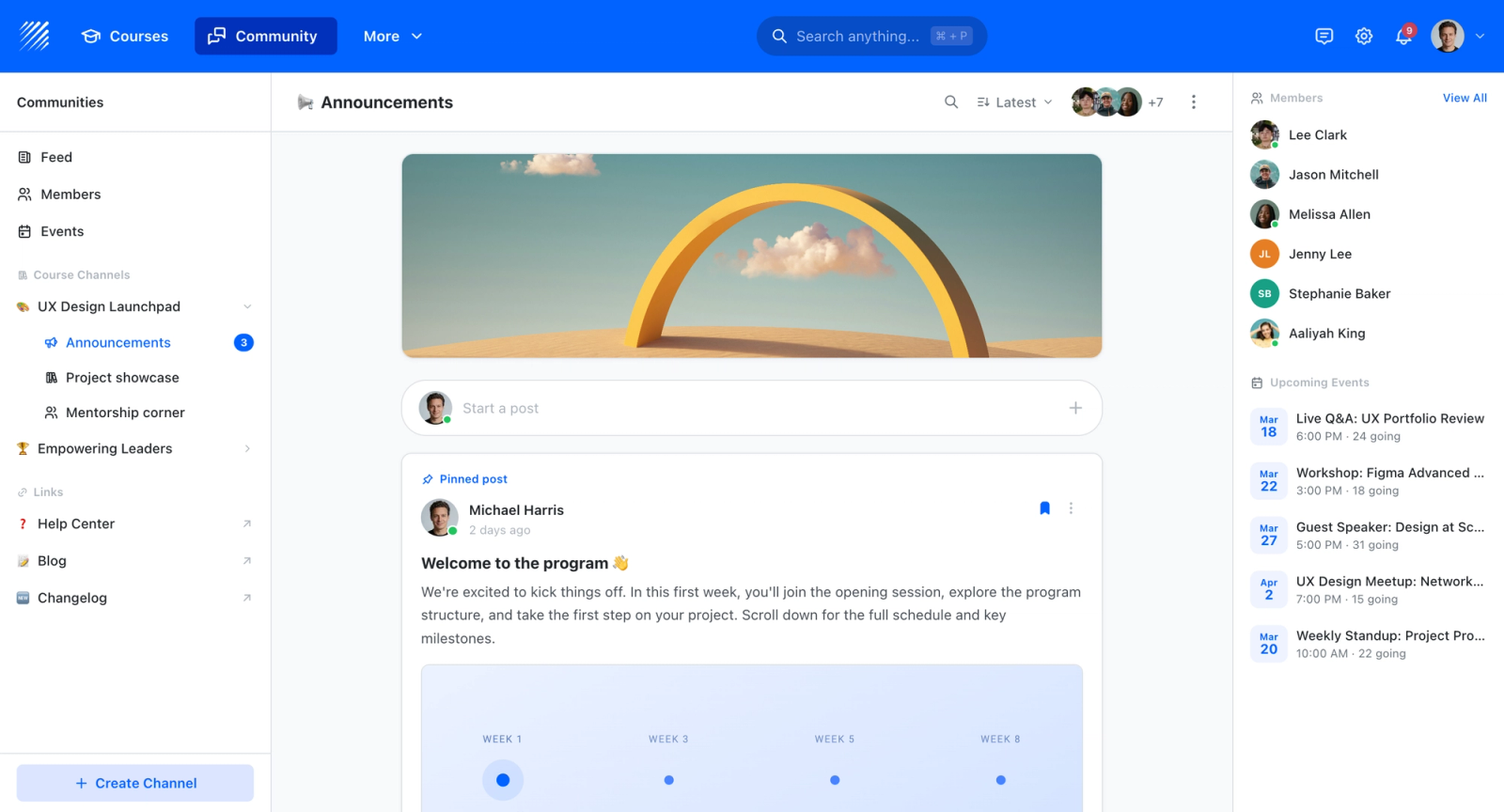
Teachfloor's Built-In Community with channels, a member directory, a student wall, and direct messaging.
Embed Code
There are gems to be found in Teachfloor’s curriculum builder as you explore and navigate the platform. For example, you can embed content from your favorite app into your course. If you are using Miro as an interactive whiteboard, try pasting its embedded code into the platform so students are able to access and interact with the app directly on Teachfloor.
Peer Review and Instructor Review
Peer learning is worth considering when you want high learner engagement, and in Teachfloor it works well for a self-paced learning environment. For instance, you can ask students to submit their 3,000-word article and give or gather peer feedback on the platform. It is easy to set up as an element in the curriculum builder.
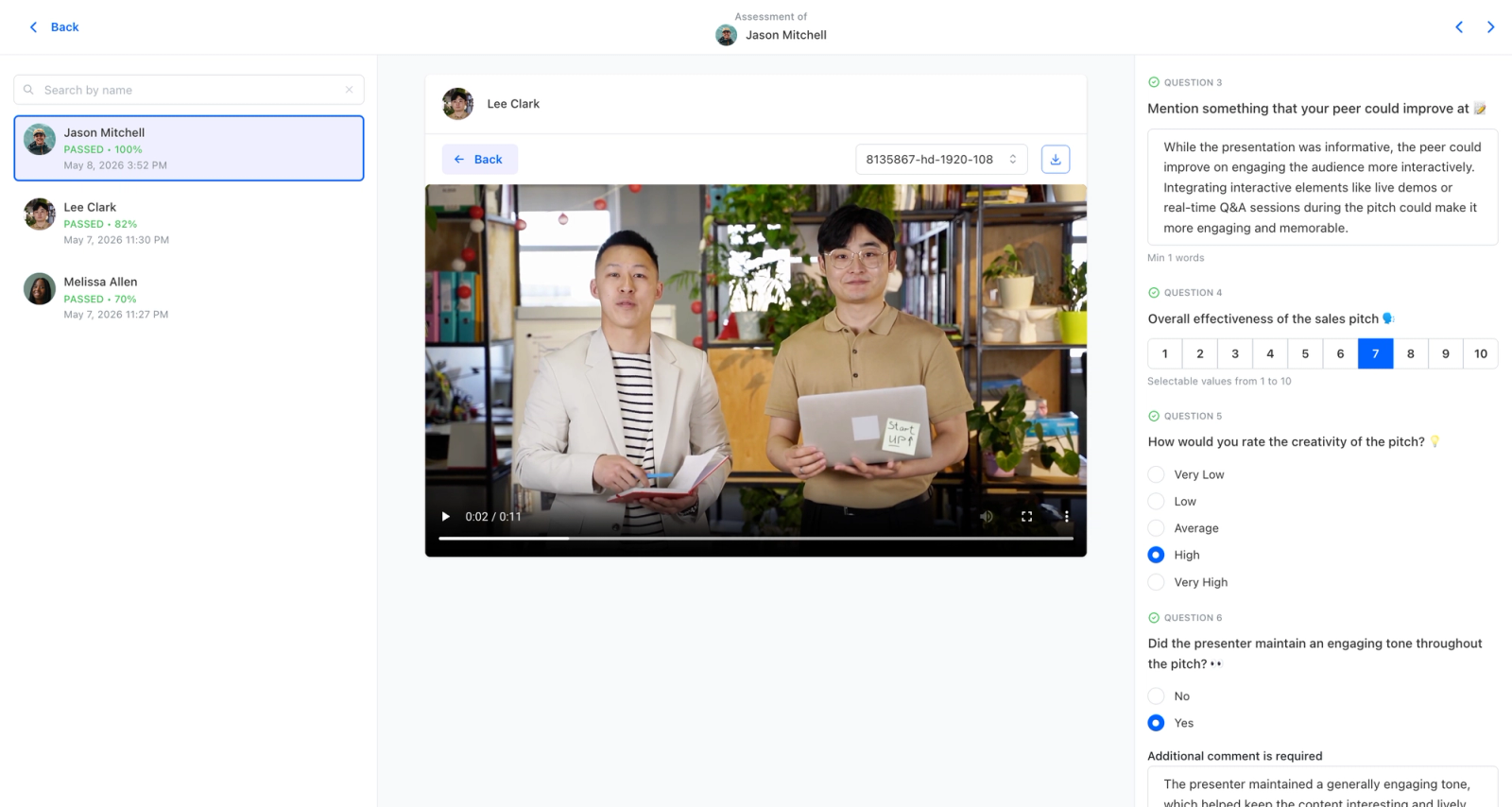
Peer learning activity inside Teachfloor's platform.
Quizzes and Surveys
Of course, we can't forget quizzes and assessments! These are valuable in instructional design to measure your student's learning performance throughout the course. Teachfloor has quiz, survey, and assessment features that allow you to create interactive quizzes, assessments, and survey forms. At the end of the day, there's no need to grade these activities yourself because Teachfloor already performs them for you through student reports and grading automation.
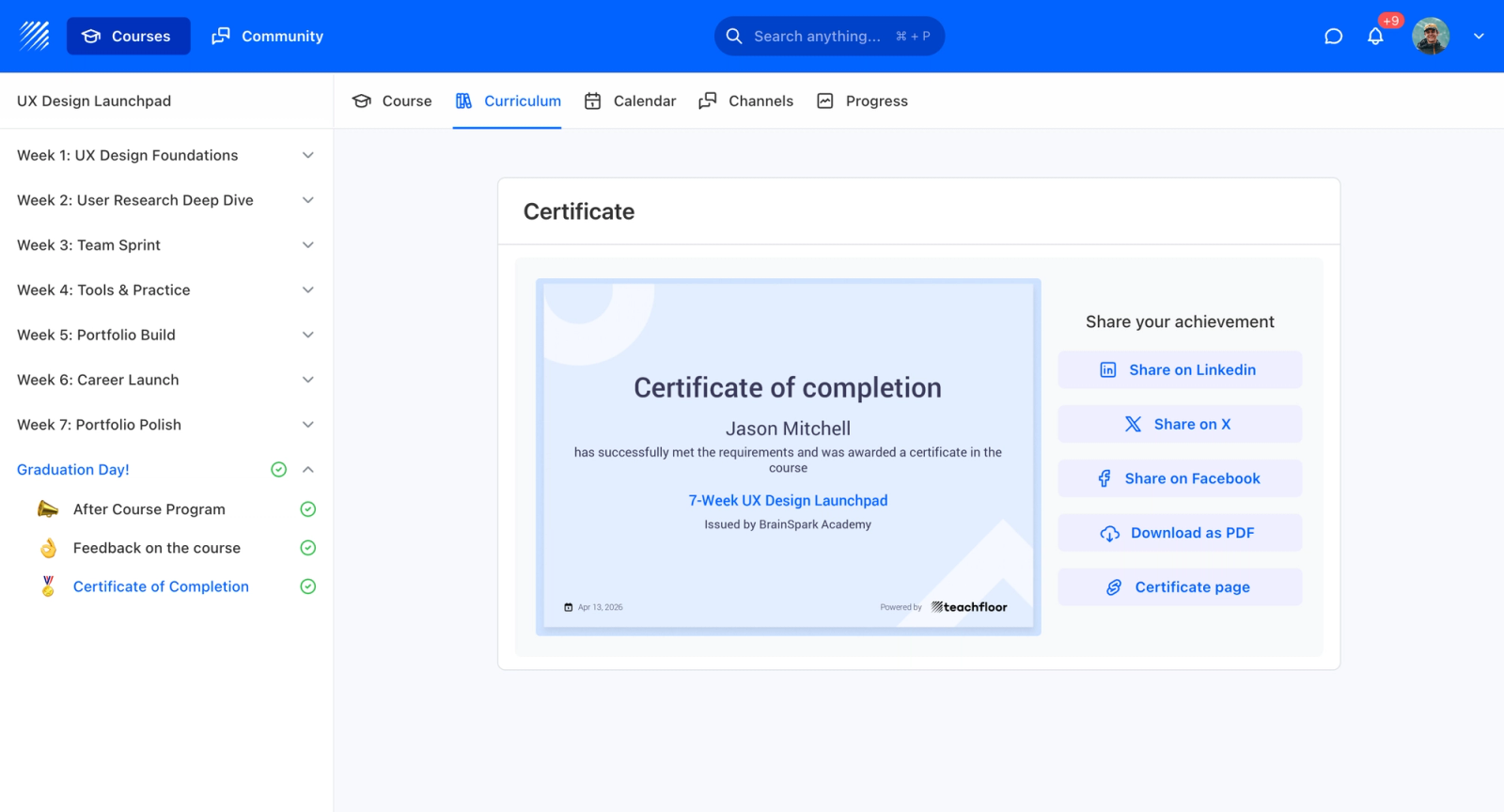
Create interactive survey in minutes!
Launch your course
After planning your course, it's time to launch it! Efficient course creators don't do this by themselves. They look for learning management systems that are tried and true to their mission, and which can help them with their training needs and elearning development.
In Teachfloor, you can build and launch your course in minutes or hours depending on how long and how much content you have. Let's start with its useful features:
Curriculum Builder
Teachfloor is a no-code learning platform that lets any course creator or corporate trainer add elements and courses in the simplest way possible. The curriculum builder is pre-built software with a drag-and-drop interface, so you don't need months or years to build your online course. You just need a few hours to launch it.
It is easy to use, with multiple useful elements, and you can add unlimited bite-sized lessons in one course. You can also create unlimited courses and activities without additional costs.
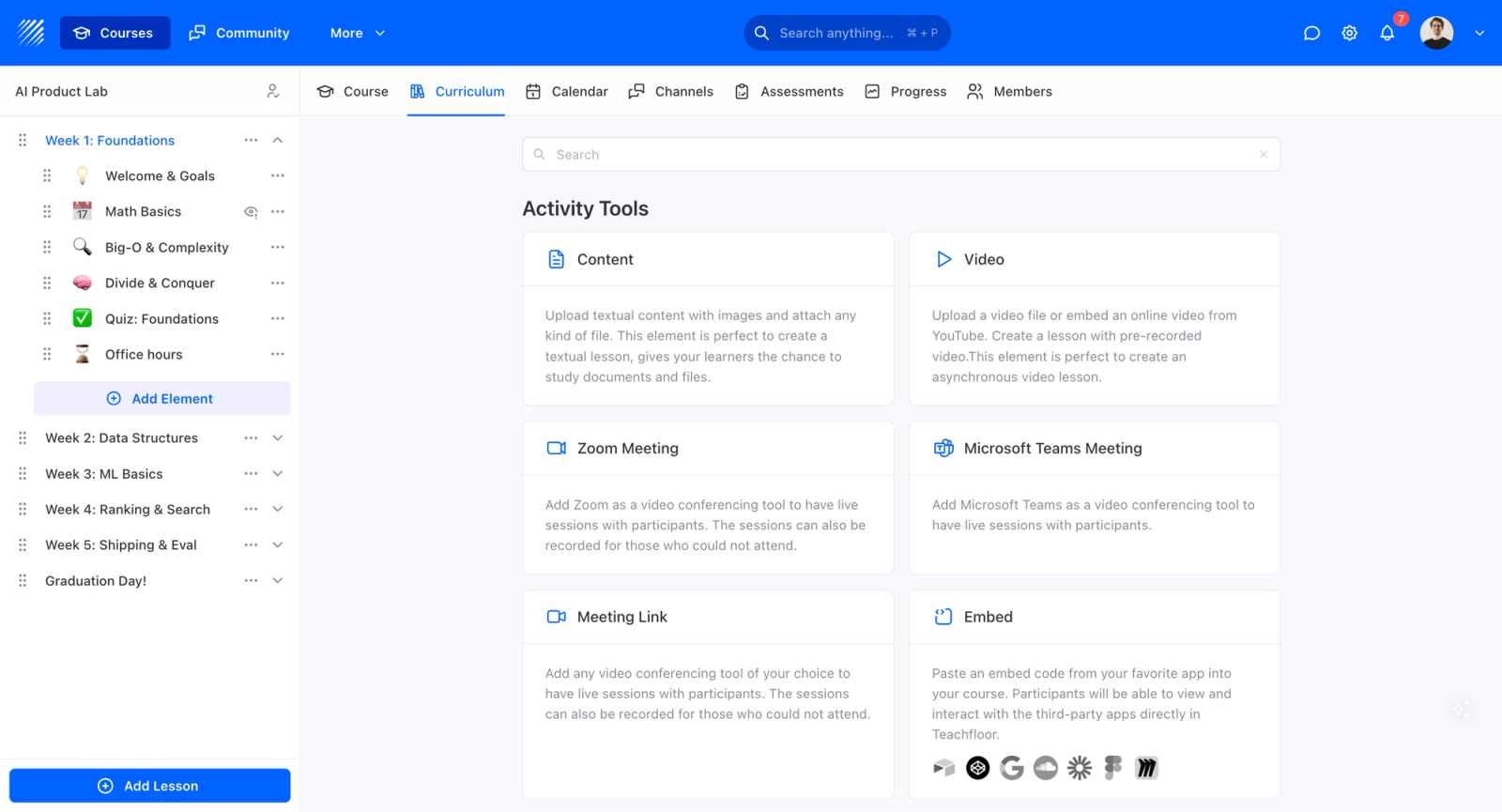
The useful lesson elements available in the curriculum builder.
Right after writing your course objectives and outlines and collecting your course content materials in one place, you can easily upload your course materials and execute your course structure through the curriculum builder.
Course Page
In just minutes, you can easily increase your online presence with an outstanding landing page for sharing upcoming classes, collecting payments, and much more. Once you create a new course, there's an automatic course page created for every course.
Write a compelling brief of your course in the course page!
Here's what you can write on the course page:
- Brief introduction about the course
- Benefits of completing the course
- Tips on how to take and complete the course
- Course structure, milestones, and prepared activities
- Course outline with module and lesson titles
- Links and guides to the learning community
- Best wishes and gratitude
White Labeling
For an online course to sell well, you need to brand it. It doesn't need to be complicated like those huge companies that have their full branding design guidelines. All you need is a business name, a logo, a domain, and a brand identity.
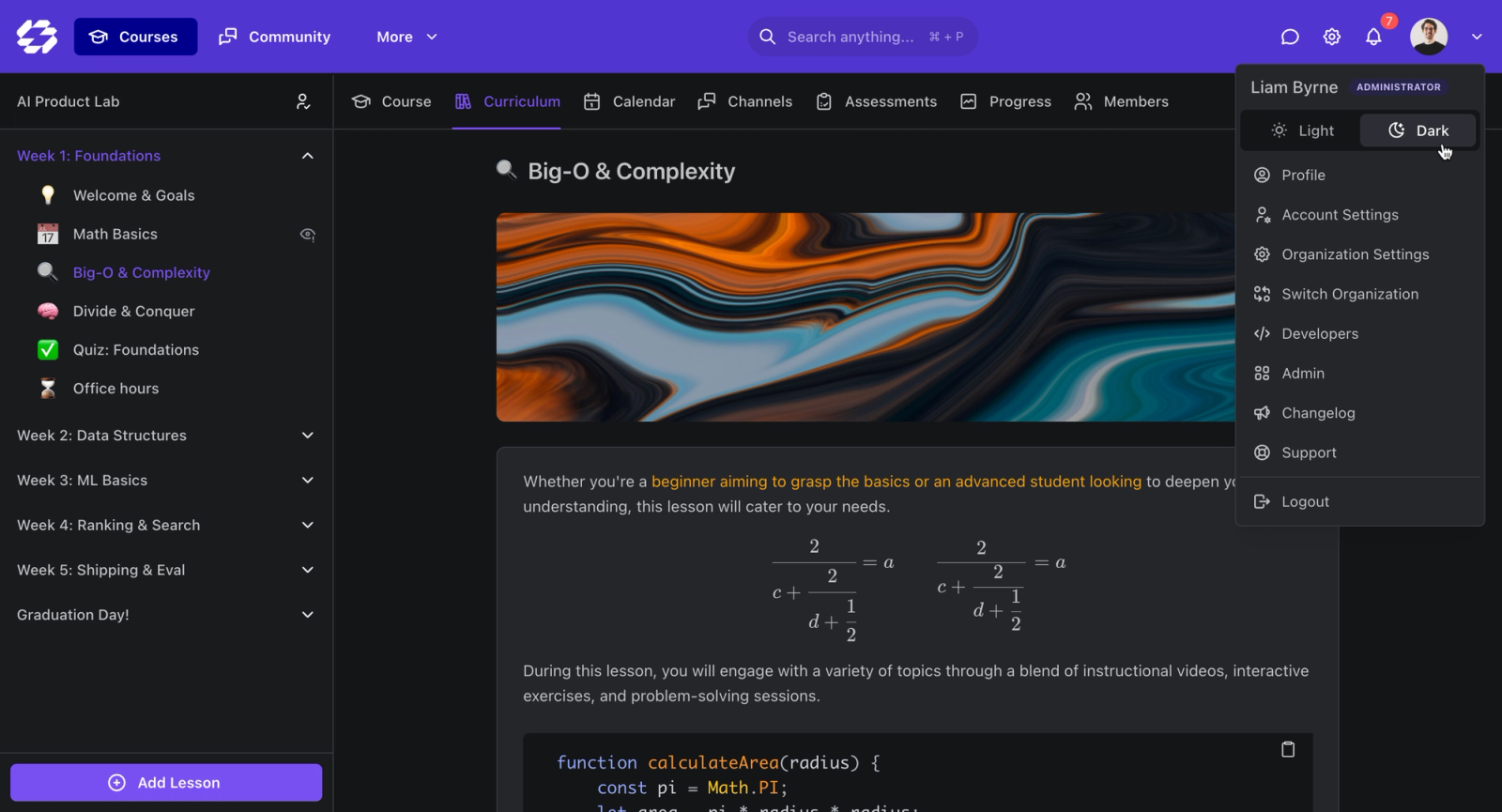
Brand your course to make your own platform.
Think of a business name that makes sense for your course topic or subject. You can create your logo in 5 minutes on canva.com, while you’ll find a domain name on Hostinger.com or Godaddy.com. In more or less 30 minutes, you can establish your branding!
Custom Domain and Single Sign-On
When establishing your brand, you can also secure hosting through your company's domain. Teachfloor also has a Single Sign-On (SSO) feature to streamline the learners' login process and reduce the need for multiple usernames and passwords. Our team can help you integrate SSO with our platform.
Make logins easily accessible to your students with Teachfloor's SSO features!
Multiple Instructors and Admins
Do you plan to collaborate with other instructors to run your online course business? This is possible with Teachfloor. You can add multiple instructors and assign roles across your team with administrator or instructor permissions.

Invite your team member to your platform and assign their roles.
For further reading on creating your course, here's a free ultimate guide to designing your course curriculum effectively. If you want to speed up content creation, this overview of the best AI LMS options is a useful starting point.
Scale Your Course
Maximize our automation features
Thanks to technology, creating a course or starting an educational business has become easier! You can do it in minutes or within 24 hours because of automation. To scale your online course business, you need to maximize the use of automation features in your LMS. If you can accomplish a task in 30 minutes with the use of automation, why would you keep doing it for 4 hours without automation?
At Teachfloor, we offer a variety of automation features to help users save time and focus on the most important tasks. Here's how to use them to scale your course:
Automate the Enrollment Process
Onboard your students without any hassle with our enrollment process automation. With multiple app integrations such as Zapier and Stripe, you don’t need to worry about your onboarding and enrollment process. Through this automation, you can focus your energy and time on marketing and growth strategies to acquire new students who will buy your courses.
Automate Payments
Aside from automating the enrollment process, we can automate payment collection with Teachfloor. Our team can also help you have a smooth checkout process, and manage one-time fees, subscriptions, installments, and online and offline payments. Powered by Stripe Integration, all you need to do is set up your Stripe account (if you don’t have an account yet) and then connect it to the platform. This can accelerate your revenues even while you sleep!
Earn while you sleep by integrating Stripe into your platform.
Custom Integration
Are you using apps other than Teachfloor? Then worry no more, as you can effortlessly integrate your favorite apps into Teachfloor's learning platform. For instance, almost everyone in the tech industry is using AI-generated tools such as ChatGPT for text and DALL-E for images.
Easily integrate as many of your favorite apps in Teachfloor.
If you use ChatGPT to improve your course content creation, you can integrate OpenAI into Teachfloor to make everything faster. Another example is Google Workspace. If you rely on it, integrate it into Teachfloor to manage your content materials more easily and quickly.
Notification Preferences
For self-paced learning, notifications are key. Why? They remind students of the next step they need to take in your course. Just as email newsletters nurture leads and convert them into paying customers, email notifications can remind students to finish your content.
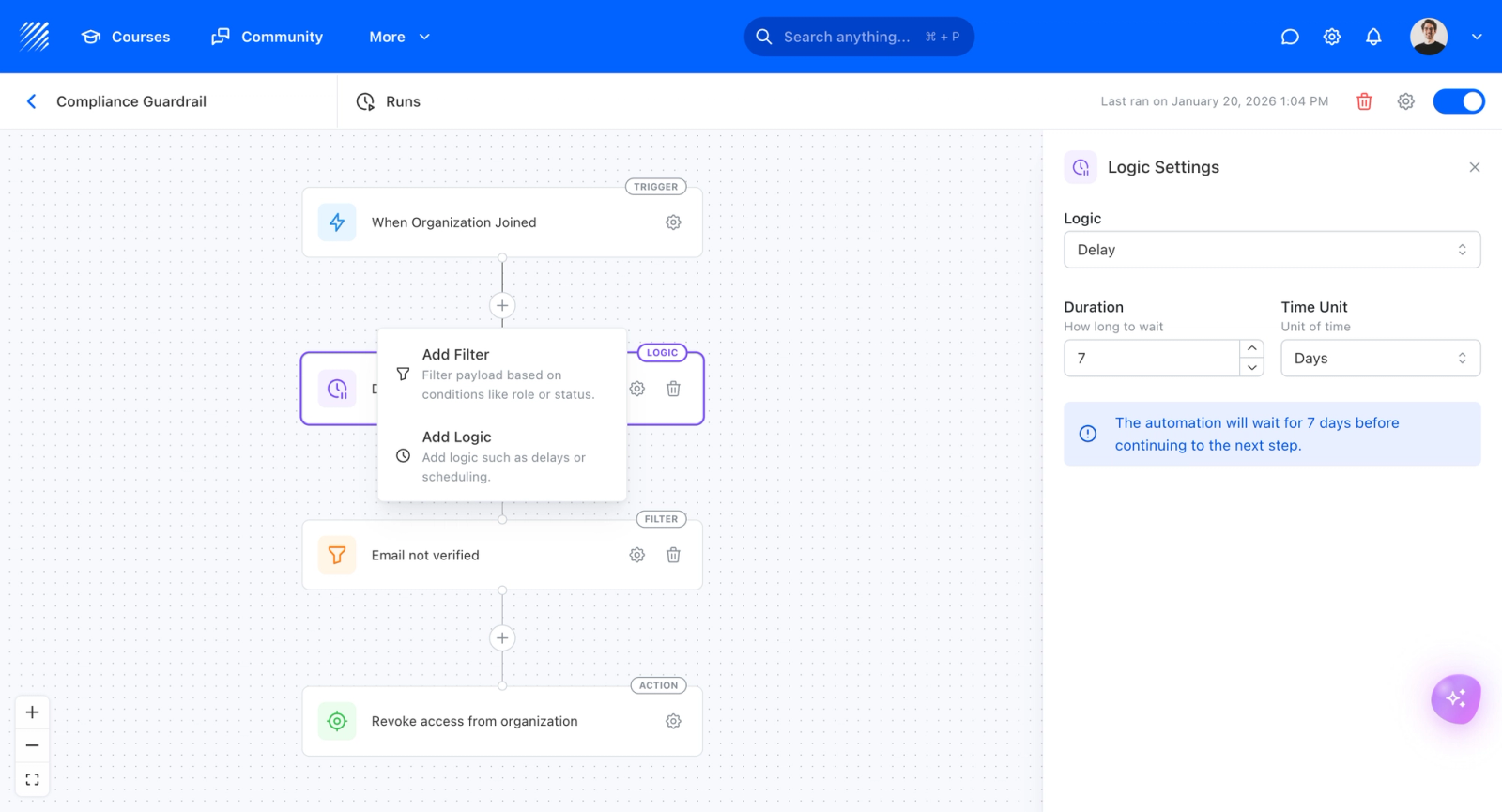
Notify your students according to your preferences.
In Teachfloor, you can customize it based on your preferences. For example, do you want to send participants an email reminder 24 hours before the course starts? Do you want to notify your students whenever the instructor reviews their activity? Do you want to receive an email every time there's a new course sign-up? Tick the box, and you will get notified!
Develop a growth marketing plan
Teachfloor takes care of the boring tasks, so now you can focus on growing your business. Marketing is crucial in an online course business, and developing a growth plan is a must to scale. Fortunately, Teachfloor is a well-rounded platform that can help you with your marketing strategies. How? Let's talk about it.
Marketing Automation
Marketing can be maximized with automation. If you have a multi-channel strategy, we can help you set up marketing automation processes such as drip campaigns, email cadences, newsletters, LinkedIn automation, and conditional messages based on user behaviors.
Since Teachfloor has multiple integrations, we can use no-code automation tools such as Zapier, Mailchimp, and social media automation tools to cross-manage your tasks. Book a demo to explore this service.
Teachfloor Helps You Build a Self-Paced Course With High Learner Engagement
Creating effective self-paced training and courses succeeds only when students stay engaged. Passive courses often fall flat because they lack social learning and accountability. But with an LMS that helps you boost social interaction without taking up too much of your time, the format becomes effective and valuable. This is the core reason creators choose Teachfloor for self-paced learning: its flexibility lets you blend independent study with community, peer learning, and cohort-based elements whenever a topic calls for them, so a self-paced course no longer has to be a one-way street.
Create your course on a learning platform that you can trust, like Teachfloor, so you can focus on the most important tasks. Teachfloor is very intuitive, full of automation features, less expensive than competitors, and supports course creators and training managers to scale their online academies.
Build your course with a dedicated team
Lastly, Teachfloor has just released additional services for first-time course creators and edupreneurs who are building their online businesses. You can either work by yourself or with Teachfloor’s dedicated team to build your online academy.
Do It Yourself
If you want to do it yourself, **start your free trial** and launch your online course by signing up. We have a dedicated support team to help if you feel stuck while exploring the platform. If you would rather talk to us, you can also book a live demo. New to the format? Our guide on how to create online training programs walks through the fundamentals.
Do It With Teachfloor
If you’re stuck in creating your online course and building your website, Teachfloor has just started its eLearning agency where we can help you with a wide array of services! There are founders and course creators who still need full support in taking their businesses to full scale! Teachfloor can help you with that through:
- Optimization and automation of your enrollment process
- CRM & CMS Integrations
- LMS & course setup
- Checkout flow optimization
- Website design and development
- Marketing automation
If you want to learn more about how it works, talk to us!