


What Is Cognitive Search?
Cognitive search is an information retrieval approach that uses artificial intelligence, natural language processing, and machine learning to understand the intent behind a query rather than simply matching keywords. Instead of returning documents that contain exact keyword matches, a cognitive search system interprets context, analyzes meaning, and ranks results based on relevance to the user's actual question.
Traditional enterprise search tools rely on Boolean logic and keyword indexing. A user who searches "how to reduce employee churn in Q4" in a conventional system gets results containing those exact words. A cognitive search system interprets the underlying intent, recognizes that "churn" relates to attrition and retention, and surfaces relevant policy documents, exit interview analyses, and retention strategy reports, even when those documents never use the word "churn."
The distinction matters because enterprise knowledge is fragmented. Organizations store information across intranets, wikis, shared drives, CRM platforms, ticketing systems, and communication tools. Cognitive search unifies these sources by building a semantic understanding of content, not just an index of terms.
How Cognitive Search Works
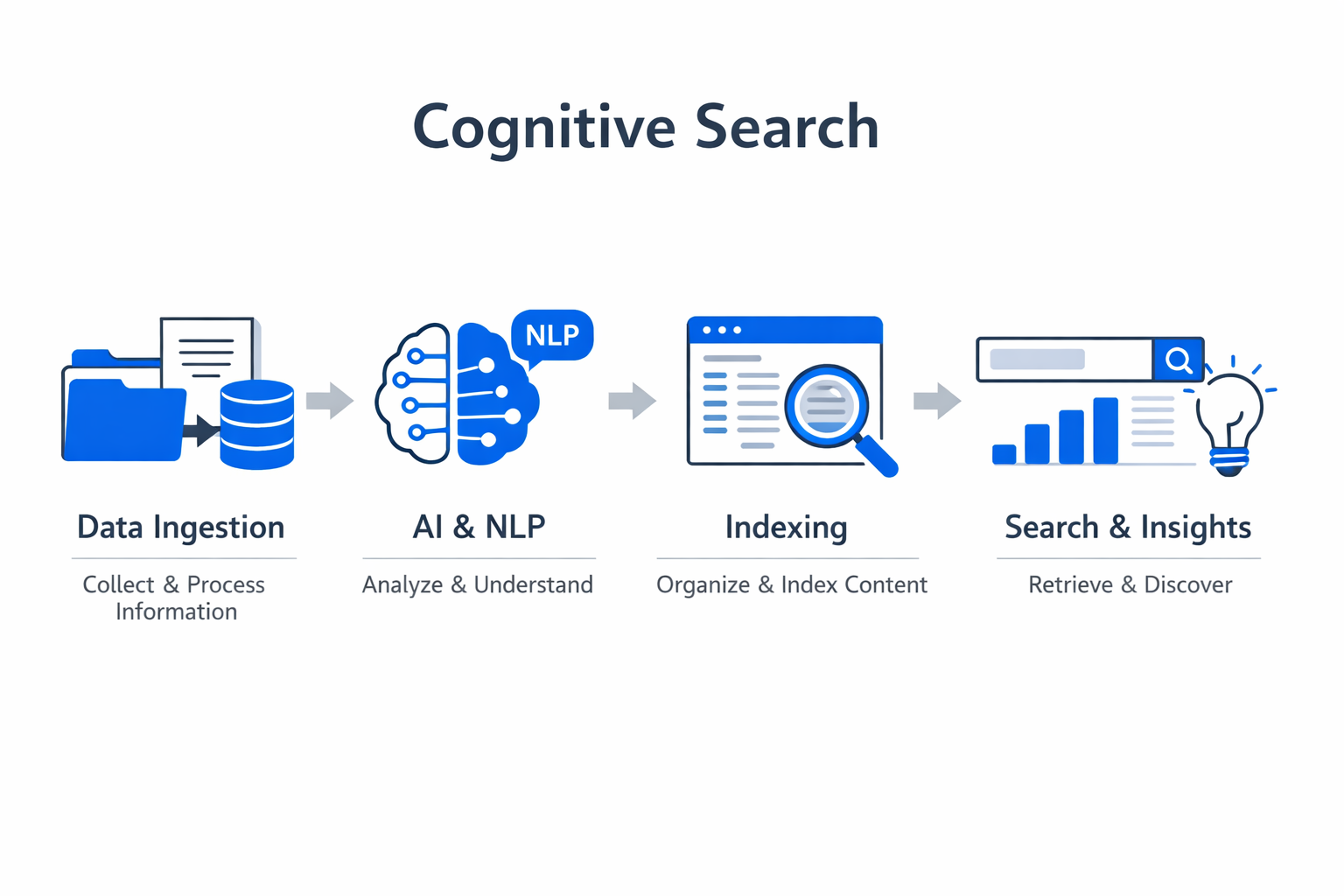
Cognitive search systems combine several AI technologies into a unified retrieval pipeline. Each component addresses a specific limitation of traditional keyword search.
Natural Language Processing
The first layer interprets the query itself. NLP components parse sentence structure, identify entities (people, products, dates, locations), and resolve ambiguity. When a user types "latest compliance requirements for European operations," the system identifies "compliance requirements" as the topic, "European" as a geographic filter, and "latest" as a recency signal, then structures the query accordingly.
NLP also handles synonym recognition and concept mapping. If the enterprise knowledge base uses the term "regulatory obligations" instead of "compliance requirements," the system recognizes these as semantically equivalent and returns those results.
Machine Learning Models
ML models power the ranking and relevance engine. Rather than ranking results purely by term frequency, these models evaluate how well each document answers the specific question. They learn from user behavior signals: which results get clicked, how long users spend on each document, and whether users refine their search after viewing a result.
Over time, the ranking model adapts to organizational patterns. If the legal team consistently finds value in certain document types for compliance queries, the system learns to prioritize those document types for similar queries from legal team members.
Knowledge Graphs and Entity Linking
Knowledge graphs create structured relationships between entities across the organization's content. A knowledge graph might connect a project name to the team members involved, the documents produced, the client associated with it, and the outcomes delivered.
When a user searches for a project by name, the system can surface not just documents containing that name but related deliverables, team communications, and client correspondence. Entity linking ensures the system understands that "Project Atlas," "the Atlas initiative," and "Atlas Q3 deliverables" all refer to the same underlying entity.
Vector Embeddings and Semantic Matching
Modern cognitive search systems convert both queries and documents into vector embeddings, numerical representations that capture semantic meaning. Documents that are conceptually similar end up close together in vector space, even when they share no common keywords.
This is what enables a search for "strategies for keeping new hires engaged" to surface a document titled "Onboarding Program Retention Framework." The two phrases share almost no words, but their vector representations are close because they address the same concept. Semantic matching represents the most significant technical leap from keyword-based search to cognitive retrieval.
| Component | Function | Key Detail |
|---|---|---|
| Natural Language Processing | The first layer interprets the query itself. | NLP also handles synonym recognition and concept mapping |
| Machine Learning Models | ML models power the ranking and relevance engine. | They learn from user behavior signals: which results get clicked |
| Knowledge Graphs and Entity Linking | Knowledge graphs create structured relationships between entities across the. | When a user searches for a project by name |
| Vector Embeddings and Semantic Matching | Modern cognitive search systems convert both queries and documents into vector embeddings. | — |
Why Cognitive Search Matters for Enterprises
Enterprise search has been a persistent pain point for large organizations. The volume of unstructured data, the diversity of storage systems, and the complexity of knowledge work all contribute to a problem where employees spend significant time looking for information they know exists somewhere in the organization.
Reduced Time to Insight
Semantically relevant results help employees find answers faster, and the productivity gain compounds across an organization. A support engineer who locates the correct troubleshooting guide in thirty seconds instead of ten minutes resolves cases faster. A compliance analyst who surfaces all relevant regulatory documents with a single query avoids hours of manual searching.
Breaking Down Information Silos
Most enterprises operate with information trapped in departmental silos. Marketing materials live in one platform, sales enablement content in another, product documentation in a third. Cognitive search indexes across these systems and delivers unified results, making cross-functional knowledge accessible without requiring employees to know which system holds the answer.
Improved Decision Quality
Better access to information leads to better decisions. When a product manager researching a feature decision can surface relevant customer feedback, support tickets, competitive analyses, and internal strategy documents from a single search, the resulting decision draws on a more complete picture. The alternative, where the manager only finds what is stored in the system they happen to search, produces decisions based on partial information.
Scalable Knowledge Reuse
As organizations grow, institutional knowledge becomes harder to locate. Cognitive search turns accumulated content into a reusable knowledge asset. Documents created by a team that no longer exists remain findable because the system understands their content, not just their metadata.
Cognitive Search in Practice: Enterprise Examples
The operational value of cognitive search becomes clearest through concrete applications across different industries and functions.
Customer Support and Service Desks
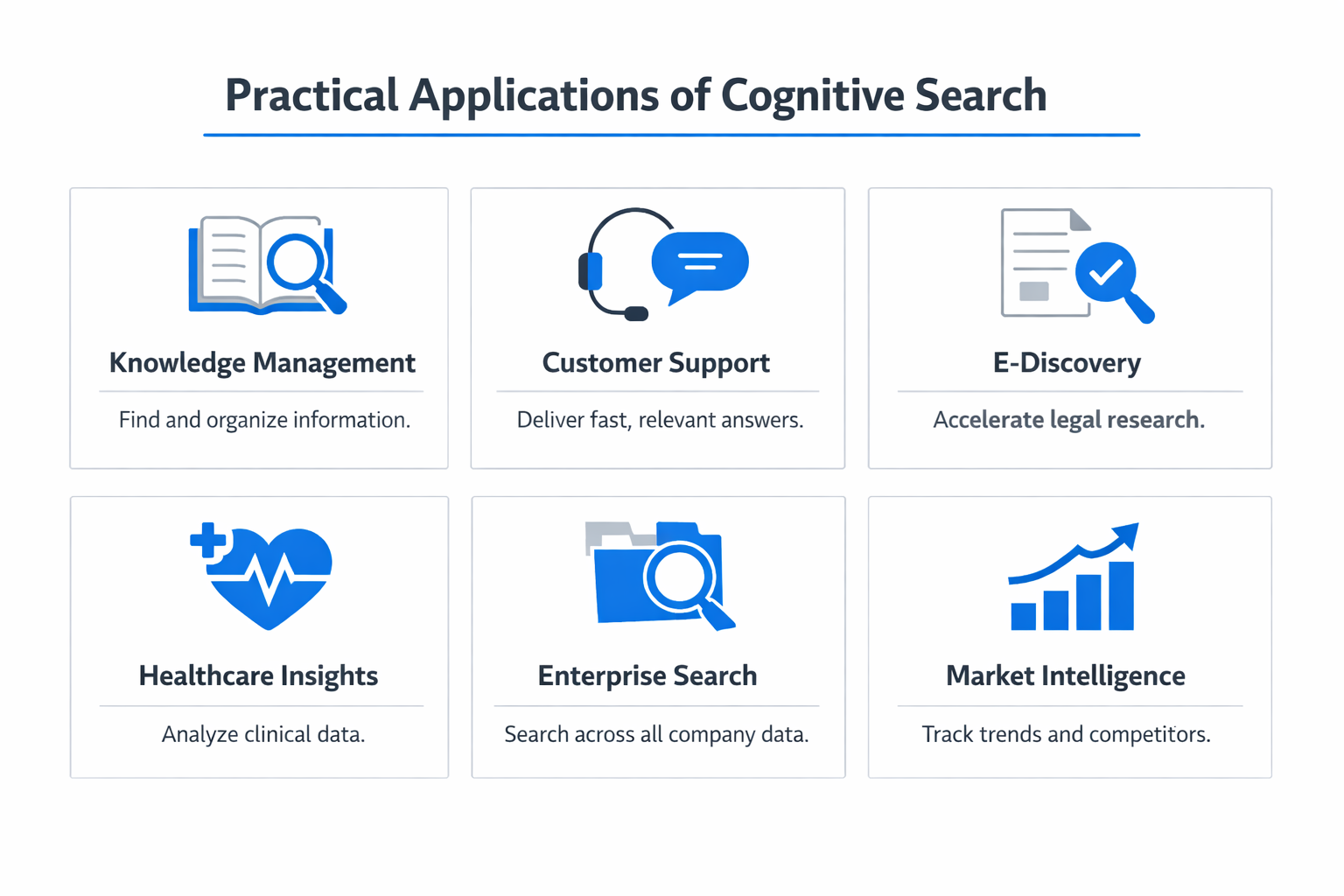
Support teams are among the most common adopters. When an agent receives a complex technical question, cognitive search can instantly surface the most relevant knowledge base articles, past case resolutions, and product documentation. The system understands the problem description in natural language and matches it against solutions, even when the customer describes the issue differently from how it is documented.
A telecommunications company using cognitive search for its support operations reported that agent resolution times decreased because agents could describe problems conversationally and retrieve relevant answers without memorizing exact article titles or navigating folder structures.
Legal and Compliance
Law firms and corporate legal departments manage massive volumes of contracts, case law, regulations, and internal policies. Cognitive search allows attorneys to query this corpus in natural language. A search for "indemnification clauses in supplier agreements from the manufacturing division" returns relevant contract sections regardless of how each contract phrases its indemnification terms.
Compliance teams benefit similarly. When regulations change, cognitive search can identify all internal policies, training materials, and operational documents affected by the change. This capability transforms compliance audits from multi-week manual reviews into focused assessments.
Healthcare and Life Sciences
Healthcare organizations use cognitive search to unify patient records, clinical research, treatment protocols, and pharmaceutical databases. A clinician researching treatment options for a complex case can search across published literature, institutional protocols, and historical patient outcomes simultaneously.
Pharmaceutical companies apply cognitive search during drug development. Researchers searching for prior studies on a specific molecular compound can discover relevant findings across internal research databases, patent filings, and regulatory submissions without needing to use the exact terminology each document employs.
Financial Services
Banks and financial institutions apply cognitive search to risk assessment, regulatory reporting, and client advisory. A risk analyst evaluating a loan portfolio can query across market data, internal risk models, regulatory guidance, and historical performance data using natural language descriptions of the risk scenario rather than precise database query syntax.
Wealth management advisors use cognitive search to prepare for client meetings. A single query about a client's investment profile can surface portfolio performance data, past correspondence, market research relevant to the client's holdings, and recent regulatory changes affecting their investment strategy.
Human Resources and Learning
HR departments use cognitive search to make policy documents, benefits information, and training resources more accessible to employees. Instead of navigating a complex intranet structure, employees can ask questions in natural language and receive direct answers drawn from policy documents.
Learning and development teams apply cognitive search to training content libraries. When an L&D manager is designing a program on leadership development, cognitive search can surface relevant existing modules, assessment templates, and prior program evaluations across the organization's content systems. This prevents redundant content creation and improves program quality by building on what already exists.
Challenges and Limitations
Cognitive search delivers significant value, but implementing it is neither simple nor risk-free.
Data Quality and Preparation
The system is only as good as the content it indexes. Outdated documents, inconsistent formatting, duplicate content, and poor metadata all degrade search quality. Organizations must invest in content governance before expecting cognitive search to perform well. This often means auditing existing content, establishing document lifecycle policies, and standardizing metadata practices.
Integration Complexity
Enterprise environments involve dozens of content repositories, each with different access controls, data formats, and APIs. Connecting cognitive search to all relevant sources requires substantial technical integration work. Security and access permissions must be preserved. Users should only see results they are authorized to access, which requires the search system to respect the permission models of each connected source.
Explainability
When a traditional keyword search returns results, the logic is transparent: these documents contain your search terms. Cognitive search results are less immediately explainable. Users may question why certain results appear and others do not. Building trust requires investment in result explanations, feedback mechanisms, and ongoing tuning based on user input.
The topic of algorithmic transparency applies directly here, as organizations need to understand how their search systems make ranking decisions.
Cost and Maintenance
Running machine learning models, maintaining knowledge graphs, and processing vector embeddings require computational resources, and the costs are ongoing rather than one-time. Models need retraining as organizational language evolves, knowledge graphs require updates as the organization changes, and content indexes need regular refreshing. Budget these operational requirements as continuous expenses.
How to Evaluate Cognitive Search for Your Organization
Selecting and implementing a cognitive search solution requires assessing both technical fit and organizational readiness.
Start with the Search Problem
Before evaluating vendors, document the specific search failures your organization experiences. Common indicators include employees who default to asking colleagues because search tools are unreliable, support teams that maintain personal bookmark lists instead of using the knowledge base, and decision-makers who rely on incomplete information because gathering complete data takes too long.
Assess Content Readiness
Cognitive search performs best when it has high-quality content to index. Evaluate your organization's content across several dimensions:
- Volume and diversity of content sources
- Consistency of metadata and document structure
- Currency of existing documents
- Existing access control and permission models
- Proportion of structured versus unstructured content
Define Success Metrics
Measurable outcomes prevent scope creep and help justify continued investment. Relevant metrics include:
- Time to find information (before versus after implementation)
- Search abandonment rate (queries where users give up and try another method)
- Result click-through rate on first-page results
- Support ticket resolution time
- Employee satisfaction with internal search tools
Plan for Change Management
Introducing cognitive search changes how employees interact with organizational knowledge. Training needs assessment should include evaluating how employees currently search for information and where their frustration points lie. People accustomed to keyword search may need guidance on asking questions in natural language.
Without adoption support, even a technically superior system can underperform a simpler tool that people actually use.
Effective rollouts often start with a single department or use case, prove measurable value, then expand based on results. Pilot groups provide feedback that improves the system before broad deployment. Organizations that treat cognitive search as a technology project rather than a change management initiative tend to see lower adoption rates.
FAQ
What is the difference between cognitive search and enterprise search?
Enterprise search is a broad category that includes any technology for searching across organizational content. Cognitive search is a specific approach within that category that uses AI and NLP to understand query intent and content meaning. Traditional enterprise search relies on keyword matching, while cognitive search interprets context and semantics to deliver more relevant results.
Does cognitive search replace existing search tools?
In most implementations, cognitive search sits as a layer on top of existing content systems rather than replacing them. It connects to document management platforms, intranets, CRMs, and other repositories through connectors and APIs. The underlying storage systems remain in place; cognitive search provides a unified, intelligent interface for querying across them.
How long does it take to implement cognitive search?
Implementation timelines depend on the number of content sources, data quality, integration complexity, and organizational size. A focused deployment connecting three to five content sources typically takes three to six months. Enterprise-wide implementations across dozens of sources can take twelve months or longer. The largest variable is usually content preparation and governance, not the search technology itself.
Is cognitive search only useful for large enterprises?
While large enterprises gain the most from cognitive search because they have the largest volume and diversity of content, mid-sized organizations with fragmented knowledge systems also benefit. The deciding factor is not organization size but the complexity of the search problem. If employees regularly struggle to find information across multiple systems, cognitive search likely adds value regardless of company size.


