


What Is a Knowledge Graph?
A knowledge graph is a structured representation of real-world entities and the relationships between them, stored in a graph format where nodes represent entities and edges represent how those entities are connected. It organizes information so that machines can reason about facts, infer new connections, and answer complex queries that span multiple domains of knowledge.
In practical terms, a knowledge graph turns scattered data points into a connected network of meaning. A node might represent a person, a company, a medical condition, or a scientific concept. An edge between two nodes describes a specific relationship: "works at," "is a symptom of," "was founded by," or "is a subfield of." Each relationship carries semantic meaning that software can interpret and traverse.
Knowledge graphs differ from traditional databases in a fundamental way. A relational database stores data in rigid tables with predefined schemas. A knowledge graph stores data as triples, each consisting of a subject, a predicate, and an object. "Albert Einstein / born in / Ulm" is a triple. "Ulm / located in / Germany" is another.
Linking these triples together creates a network where a system can infer that Albert Einstein was born in a city located in Germany, even if that fact was never explicitly stated.
The concept gained mainstream visibility when Google introduced its Knowledge Graph in 2012 to enhance search results with structured information panels. Since then, knowledge graphs have become foundational infrastructure for artificial intelligence, enterprise data management, and machine learning systems that require structured world knowledge.
How Knowledge Graphs Work
Building and operating a knowledge graph involves several technical layers, from data ingestion to query execution. Each layer serves a distinct function in transforming raw information into a queryable network of facts.
Ontology and Schema Design
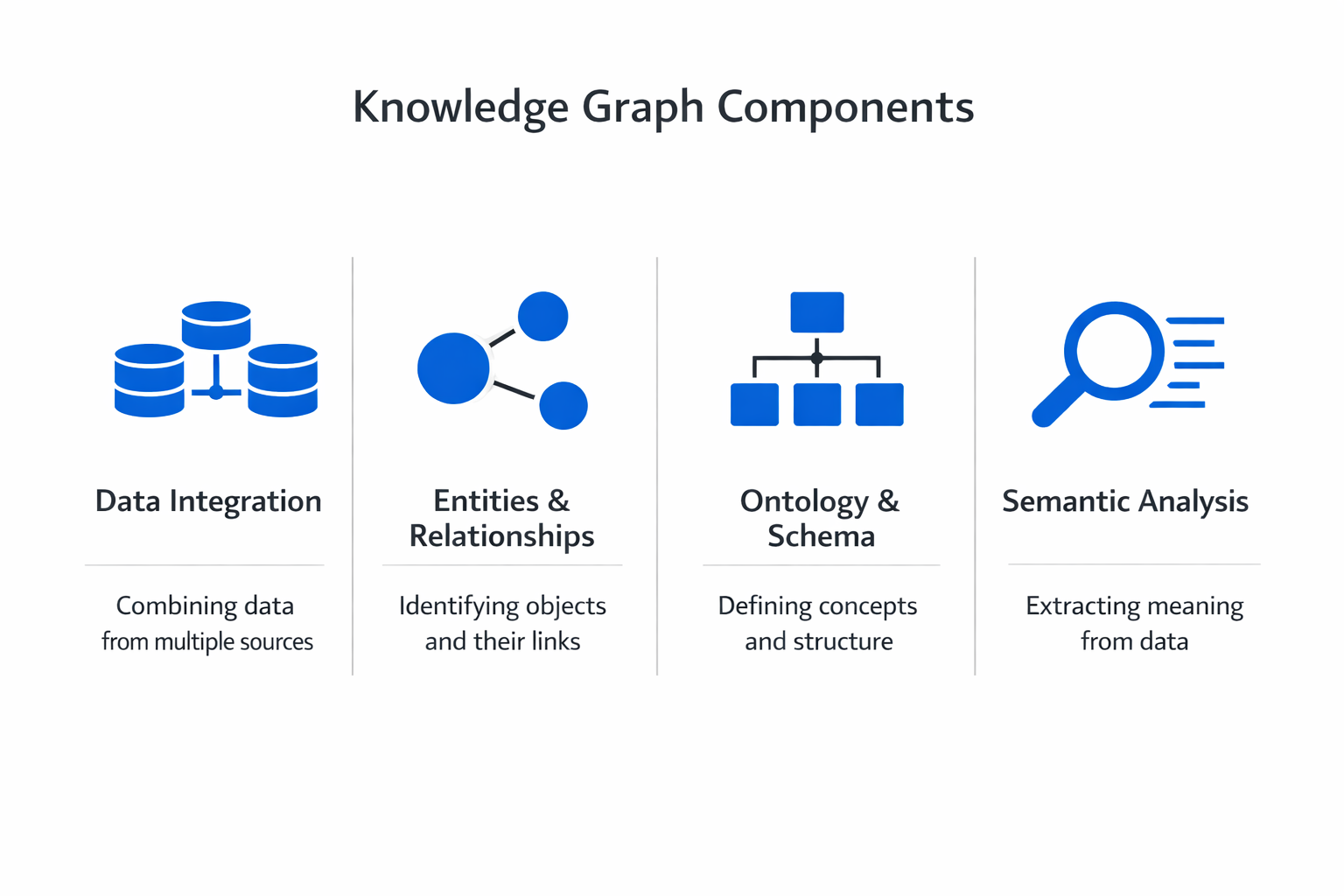
Every knowledge graph begins with an ontology, a formal specification of the types of entities, relationships, and constraints the graph will contain. The ontology defines what categories of nodes exist (people, organizations, locations, products) and what types of edges connect them (employs, manufactures, is located in).
A well-designed ontology balances specificity with flexibility. It must be detailed enough to capture meaningful distinctions but general enough to accommodate new data without constant restructuring. Ontology design draws heavily on knowledge engineering, a discipline focused on capturing and formalizing domain expertise into computable structures.
Entity Extraction and Resolution
Raw data rarely arrives in a graph-ready format. Text documents, databases, APIs, and web pages all contain information about entities and relationships, but that information is embedded in unstructured or semi-structured formats. Entity extraction uses natural language processing to identify mentions of entities within text and classify them into the categories defined by the ontology.
Entity resolution addresses a complementary problem: determining when two different mentions refer to the same real-world entity. "IBM," "International Business Machines," and "Big Blue" all refer to the same company. A person named "J. Smith" in one document might be "Jane Smith" in another. Resolution algorithms compare attributes, context, and co-occurrence patterns to merge duplicate references into a single canonical node.
Relationship Extraction
Once entities are identified and resolved, the system must determine how they relate to each other. Relationship extraction analyzes the context surrounding entity mentions to identify and classify connections. In the sentence "Marie Curie received the Nobel Prize in Physics in 1903," a relationship extraction system identifies three entities (Marie Curie, Nobel Prize in Physics, 1903) and the relationships between them (received, in year).
Modern relationship extraction systems use deep learning models trained on large annotated datasets. These models can identify relationships expressed in varied linguistic forms, capturing the fact that "Curie was awarded the Nobel" and "the Nobel went to Curie" describe the same relationship despite different syntactic structures.
Graph Storage and Querying
Graph querying gets its strength from multi-hop traversal. A single query can follow a chain of relationships to answer questions that would require multiple complex joins in a relational database. "Which researchers at institutions in Germany have published papers on quantum computing cited by authors at MIT?" requires traversing person-to-institution, institution-to-location, person-to-paper, and paper-to-citation relationships, something a graph query handles natively.
The strength of graph querying lies in multi-hop traversal. A single query can follow a chain of relationships to answer questions that would require multiple complex joins in a relational database. "Which researchers at institutions in Germany have published papers on quantum computing cited by authors at MIT?" requires traversing person-to-institution, institution-to-location, person-to-paper, and paper-to-citation relationships, something a graph query handles natively.
Reasoning and Inference
A knowledge graph is not just a static collection of facts. Reasoning engines can apply logical rules to infer new facts from existing ones. If the graph contains the triples "A is a parent of B" and "B is a parent of C," a reasoning engine can infer "A is a grandparent of C" without that fact being explicitly stored.
This capability connects knowledge graphs to the broader field of automated reasoning, where systems derive new conclusions from established premises. The combination of stored facts and inferred facts gives knowledge graphs an expressive power that static databases lack.
It also makes them a core component of neuro-symbolic AI, which merges the pattern recognition strengths of neural networks with the logical reasoning strengths of symbolic systems.
| Component | Function | Key Detail |
|---|---|---|
| Ontology and Schema Design | Every knowledge graph begins with an ontology. | The ontology defines what categories of nodes exist (people |
| Entity Extraction and Resolution | Raw data rarely arrives in a graph-ready format. | Text documents, databases, APIs |
| Relationship Extraction | Once entities are identified and resolved. | — |
| Graph Storage and Querying | Knowledge graphs are stored in specialized graph databases optimized for traversing. | Navigating connected data |
| Reasoning and Inference | A knowledge graph is not just a static collection of facts. | — |
Why Knowledge Graphs Matter
Knowledge graphs address a specific gap in how machines handle information. Raw data in databases, documents, or data streams contains facts, but those facts stay isolated until something connects them. Knowledge graphs supply that connecting layer, and the benefits reach across technology and business.
Structured Context for AI Systems
Machine learning models excel at pattern recognition, but they struggle with structured reasoning over facts and relationships. A language model can generate fluent text, but it may hallucinate facts because it lacks a grounded representation of verified knowledge. Knowledge graphs give AI systems a factual backbone to reference, reducing hallucination and improving accuracy.
This is the principle behind retrieval-augmented generation, where language models retrieve verified facts from a knowledge source before generating a response. When that knowledge source is a graph, the model can follow relationships to gather relevant context, producing answers that are both fluent and factually grounded.
Improved Search and Discovery
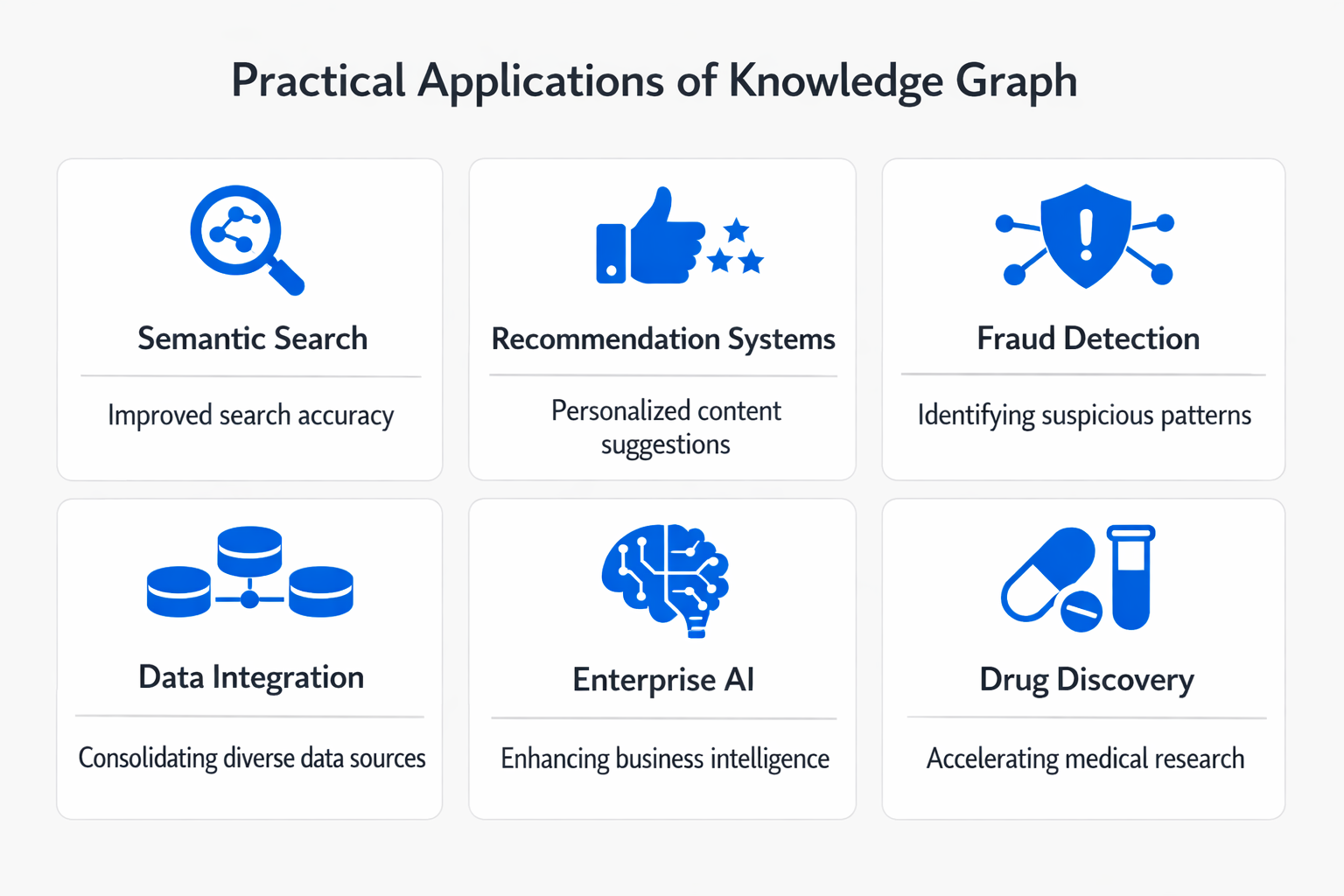
Traditional keyword search matches terms. Semantic search matches meaning. Knowledge graphs take this further by enabling search that understands relationships. A query for "drugs that treat diseases affecting the liver" requires understanding the chain: drugs treat diseases, diseases affect organs, and the liver is an organ. A knowledge graph can resolve this chain directly.
Google, Bing, Amazon, and other platforms use knowledge graphs to power entity-based search features, the information panels, "People also ask" suggestions, and structured answer cards that appear alongside traditional results. These features rely on traversing graph relationships rather than scanning documents.
Data Integration Across Silos
Organizations store data in dozens of systems: CRMs, ERPs, document repositories, data warehouses, and specialized databases. Knowledge graphs serve as a semantic integration layer that maps entities and relationships across these systems. A customer entity in the CRM, the same customer's support tickets in the helpdesk system, and their purchase history in the ERP all connect through the graph.
This integration enables queries that span systems without requiring the systems themselves to be merged. Analysts can ask cross-domain questions and receive unified answers drawn from multiple sources. The graph acts as a connective layer, not a replacement for existing infrastructure.
Enabling Expert Systems
Knowledge graphs are central to modern expert systems, which encode domain expertise in a form that software can apply. A medical knowledge graph might encode relationships between symptoms, conditions, test results, and treatment protocols. When a clinician enters a set of symptoms, the system traverses the graph to suggest possible diagnoses and recommended tests.
The explicit, inspectable nature of knowledge graph reasoning makes these systems more transparent than black-box models. A clinician can trace the path from symptoms to diagnosis through the graph, understanding exactly why the system made a particular recommendation. This kind of reasoning also draws on the principles of case-based reasoning, where past cases inform current decisions through structured comparison.
Knowledge Graph Use Cases
Knowledge graphs have moved from research prototypes to production systems across a range of industries. The following examples illustrate the breadth of their application.
Search Engines and Digital Assistants
Google's Knowledge Graph, Wikidata, and similar projects power the structured answers that appear in search results. When you search for a public figure, the information panel showing their birthdate, occupation, notable works, and related people is generated by traversing a knowledge graph. Digital assistants like Siri and Alexa use knowledge graphs to resolve questions that require entity relationships rather than document retrieval.
Systems like IBM Watson demonstrated early on how knowledge graphs combined with natural language understanding could answer complex factual questions by reasoning over structured knowledge, a capability that extended far beyond simple keyword lookup.
Drug Discovery and Biomedical Research
Pharmaceutical companies build knowledge graphs that connect genes, proteins, diseases, drugs, clinical trials, and scientific publications. These graphs allow researchers to identify potential drug targets by discovering previously unknown connections. If a graph reveals that a protein associated with one disease also interacts with a pathway implicated in another disease, that connection suggests a potential drug repurposing opportunity.
Biomedical knowledge graphs also speed up literature review. Instead of manually searching thousands of papers, researchers query the graph for specific relationship chains, cutting the time needed to find relevant prior work.
Financial Services and Risk Management
Banks and investment firms use knowledge graphs to model relationships between entities for fraud detection, compliance, and risk assessment. A graph might connect individuals, companies, accounts, transactions, and regulatory filings. When suspicious activity appears, analysts can traverse the graph to map the network of related entities and transactions, identifying patterns that might indicate money laundering or insider trading.
Anti-money laundering (AML) systems gain the most from knowledge graphs, since financial crime often involves chains of entities designed to obscure the ultimate beneficial owner. Graph traversal is built to follow those chains.
Recommendation Systems
E-commerce platforms and streaming services use knowledge graphs to power recommendation engines. Rather than relying solely on collaborative filtering (users who bought X also bought Y), graph-based recommendations can traverse attribute relationships. A knowledge graph might recommend a book because its author shares a genre with authors the user has previously enjoyed, or because the book's subject matter connects to topics the user has explored.
This approach produces more diverse and explainable recommendations compared to purely statistical methods. The system can articulate why it recommended an item by pointing to the specific graph path that led to the suggestion.
Enterprise Knowledge Management and Cognitive Search
Large organizations use knowledge graphs to unify institutional knowledge across departments and systems. When combined with cognitive search technology, a knowledge graph enables employees to find information based on entity relationships rather than keywords alone.
A search for a project name returns not just documents containing that name but related team members, deliverables, client communications, and outcomes, all linked through the graph.
Enterprise knowledge graphs also support onboarding by making organizational context navigable. A new employee can explore how teams, projects, systems, and processes connect, building understanding faster than through document reading alone.
Challenges and Limitations
Despite their power, knowledge graphs carry significant practical challenges that influence where and how they should be deployed.
Construction and Maintenance Costs
Building a knowledge graph is resource-intensive. Ontology design requires domain expertise. Entity extraction and resolution require tuned NLP pipelines. Relationship extraction requires training data. Populating the graph with initial data requires substantial engineering effort. And once built, the graph must be continuously maintained as the underlying reality changes. People change roles, companies merge, scientific knowledge evolves, and the graph must keep pace.
Automated knowledge graph construction using machine learning has improved, but fully automated pipelines still produce errors that require human review. The tradeoff between automation and accuracy remains an active area of research.
Incompleteness and Bias
No knowledge graph captures everything. The choice of what entities to include, what relationships to model, and what sources to draw from introduces inherent biases and gaps. A knowledge graph built primarily from English-language sources will underrepresent knowledge from other linguistic traditions. A graph focused on commercial entities may lack coverage of nonprofit or governmental organizations.
Incompleteness also affects reasoning. If a relationship is absent from the graph, the system may incorrectly infer that the relationship does not exist, confusing "not known" with "not true." This is the closed-world assumption problem, and it requires careful handling in any application that relies on graph-based reasoning.
Scalability
As knowledge graphs grow to billions of triples, query performance becomes a concern. Multi-hop queries that traverse many relationships are computationally expensive at scale. Graph databases have improved, but extremely large knowledge graphs, such as those used by major search engines, require distributed storage, caching strategies, and query optimization that add architectural complexity.
Integration with Machine Learning
While knowledge graphs and machine learning are complementary, integrating them is nontrivial. Converting graph structure into a form that neural networks can consume requires techniques like graph embeddings and graph neural networks.
These methods represent graph structure as vector embeddings, numerical vectors that preserve structural relationships, allowing transformer models and other neural architectures to incorporate graph knowledge.
Graph machine learning has advanced quickly, but combining the discrete, symbolic nature of graphs with the continuous, statistical nature of neural networks remains an open research problem at the heart of neuro-symbolic AI.
How to Build a Knowledge Graph
Building a knowledge graph is a multi-stage process that requires both technical infrastructure and domain expertise. The following steps outline the typical workflow from planning to deployment.
Step 1: Define the Scope and Ontology
Start by identifying the domain the graph will cover and the questions it should answer. A narrow scope with clear use cases produces better results than an attempt to model everything. Define the entity types, relationship types, and attribute schemas. Engage domain experts to ensure the ontology captures meaningful distinctions.
- Identify the primary entity types (people, organizations, concepts, products)
- Define relationship types and their directionality
- Specify attribute schemas for each entity type
- Establish naming conventions and identifier standards
Step 2: Identify and Prepare Data Sources
Inventory the data sources that contain relevant entity and relationship information. These might include relational databases, document repositories, APIs, web content, and structured datasets. Assess data quality, coverage, and accessibility for each source.
- Map each data source to the ontology categories it covers
- Evaluate data freshness, completeness, and reliability
- Plan data access pipelines (batch extraction, API integration, web scraping)
- Establish data governance policies for source attribution and update frequency
Step 3: Extract Entities and Relationships
Apply NLP and data extraction techniques to identify entities and relationships from each source. For structured data, this may involve direct mapping from database fields to graph nodes and edges. For unstructured text, it requires named entity recognition, relationship extraction, and coreference resolution.
Modern extraction pipelines often combine rule-based methods for high-precision patterns with deep learning models for broader coverage. Quality assurance at this stage is critical, as errors in extraction propagate through the entire graph.
Step 4: Resolve and Merge Entities
Run entity resolution to identify duplicate entities across sources and merge them into canonical nodes. This step is essential for avoiding a fragmented graph where the same real-world entity appears as multiple disconnected nodes.
Entity resolution techniques range from simple string matching to sophisticated machine learning models that compare entity attributes, context, and network position. High-stakes domains like healthcare and finance require human review of ambiguous cases.
Step 5: Store, Index, and Deploy
Load the resolved triples into a graph database. Configure indexes for common query patterns. Build query APIs that allow applications to access the graph. Implement access controls to ensure sensitive information is appropriately restricted.
- Select a graph database that matches your scale and query requirements
- Design query templates for primary use cases
- Build monitoring for graph health, query performance, and data freshness
- Plan update pipelines for continuous enrichment as new data arrives
Step 6: Iterate and Expand
A knowledge graph is never finished. Plan for continuous improvement through user feedback, automated quality checks, and incremental expansion of both the ontology and the data coverage. Track query patterns to identify gaps where users ask questions the graph cannot yet answer, and prioritize filling those gaps.
FAQ
What is the difference between a knowledge graph and a database?
A traditional relational database stores data in tables with fixed schemas and uses SQL for queries. A knowledge graph stores data as a network of entities and relationships, using graph query languages that are optimized for traversing connections. Databases excel at structured, tabular operations. Knowledge graphs excel at questions that involve navigating chains of relationships across entities.
How do knowledge graphs relate to machine learning?
Knowledge graphs provide structured, factual context that machine learning models can use to improve accuracy and reduce errors. Models can query the graph for verified facts, use graph embeddings as input features, or rely on graph-based reasoning to validate their outputs. The intersection of knowledge graphs and neural networks is a major focus area within neuro-symbolic AI research.
What are the most well-known knowledge graphs?
Google's Knowledge Graph, Wikidata (maintained by the Wikimedia Foundation), DBpedia (structured data extracted from Wikipedia), and YAGO (a knowledge base derived from Wikipedia, WordNet, and GeoNames) are among the most widely referenced. In the enterprise space, companies like Amazon, LinkedIn, and Uber maintain proprietary knowledge graphs tailored to their specific domains.
Can small organizations benefit from knowledge graphs?
Yes, though the approach should be scaled to the organization's needs. A small biotech startup might build a focused knowledge graph connecting genes, proteins, and diseases relevant to its research. A mid-sized consultancy might graph its project history, client relationships, and expertise areas. The key is starting with a clear use case and a narrow scope rather than attempting to model everything at once.
How are knowledge graphs used in education and training?
In education, knowledge graphs can map relationships between learning concepts, prerequisites, and competencies. A knowledge graph for a computer science curriculum might connect topics like algorithms, data structures, and complexity theory, showing how each topic builds on prior knowledge. Learning platforms can use these graphs to recommend personalized learning paths, identify knowledge gaps, and adapt content delivery based on what a learner has already mastered.


