


What Is Prompt Engineering?
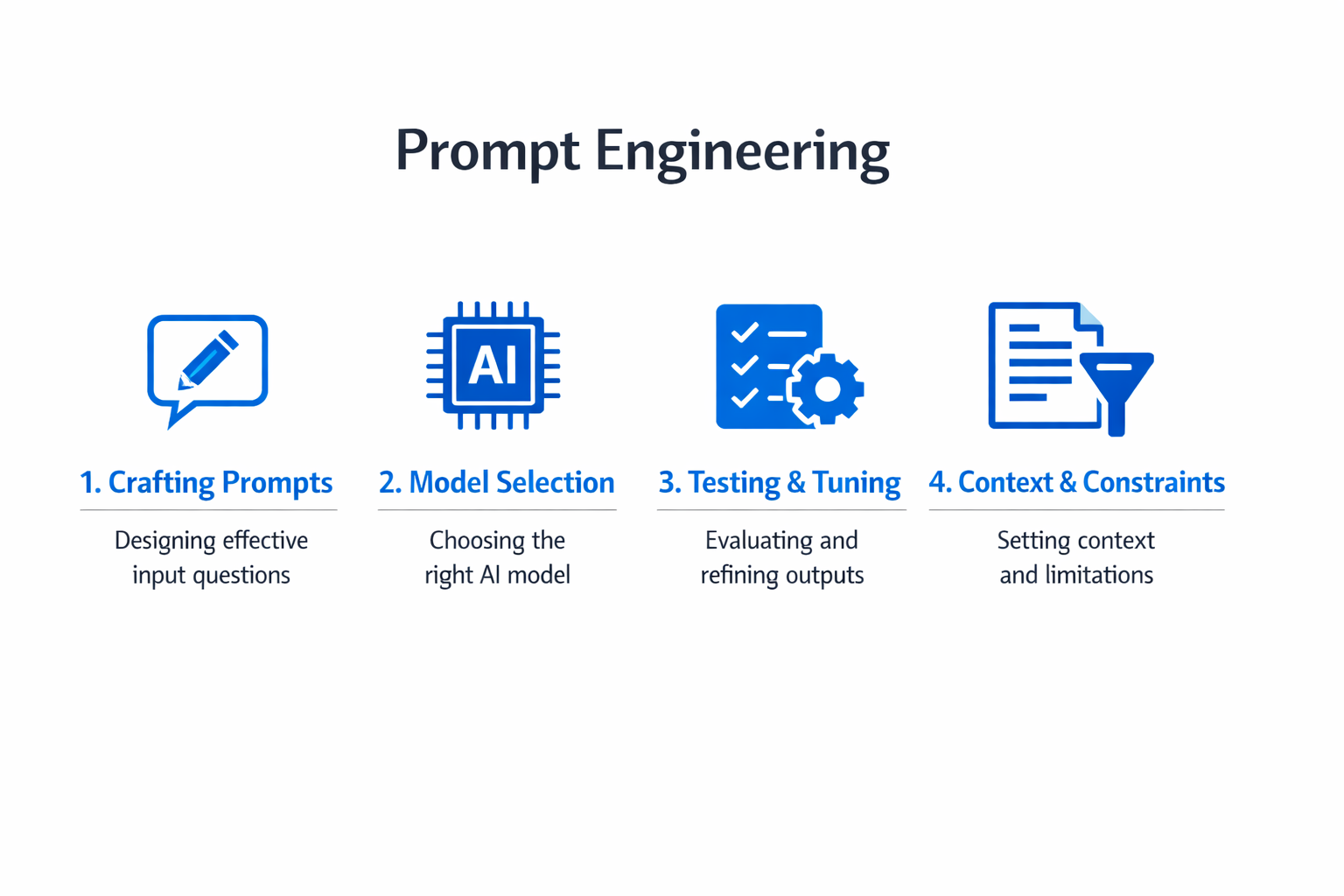
Prompt engineering is the practice of designing, structuring, and refining inputs given to artificial intelligence models to produce accurate, relevant, and useful outputs. It involves crafting text instructions, known as prompts, that guide large language models (LLMs) and other generative AI systems toward specific behaviors, formats, and levels of detail.
The discipline sits at the intersection of linguistics, logic, and applied AI, and it has become a foundational skill for anyone working with modern AI tools.
At its core, prompt engineering treats the interface between humans and AI models as a design problem. The same model can produce vastly different outputs depending on how a request is phrased, what context is provided, and how constraints are communicated. A well-engineered prompt eliminates ambiguity, provides the model with the right context, and establishes clear expectations for the response. A poorly constructed prompt leads to vague, incorrect, or irrelevant results.
The term gained mainstream traction alongside the rise of GPT-3 and subsequent large language models from OpenAI and other providers. As these models grew in capability, practitioners discovered that small changes in prompt wording could produce dramatic shifts in output quality.
This sensitivity to input phrasing created a genuine need for systematic approaches to prompt design rather than trial-and-error experimentation.
Prompt engineering is distinct from model training and fine-tuning. Training involves building a model's capabilities from data. Fine-tuning adjusts a pre-trained model's weights for a specific task. Prompt engineering, by contrast, changes nothing about the model itself. It works entirely at the input layer, shaping results by controlling what information the model receives and how that information is structured.
This makes it the most accessible and immediate way to improve AI output quality without specialized infrastructure.
How Prompt Engineering Works
Prompt engineering operates on the principle that language models generate outputs by predicting the most probable next tokens based on the input they receive. Every word, sentence structure, example, and constraint in a prompt shapes the probability distribution the model draws from when generating its response. Understanding this mechanism is the foundation of effective prompt design.
The Role of Context Windows
Modern LLMs process prompts within a fixed context window, which is the maximum number of tokens the model can consider at once. Everything inside this window, including system instructions, user messages, examples, and prior conversation turns, influences the output. Prompt engineers must balance providing enough context for accuracy against the limits of the context window.
When a prompt includes detailed instructions, relevant background information, and clear formatting requirements, the model's token predictions are constrained toward the desired output space. When a prompt is vague or underspecified, the model fills in the gaps based on statistical patterns from training data, which may not align with the user's intent.
From Input to Output
The generation process follows a consistent sequence. The model tokenizes the prompt, processes it through layers of a transformer model, and begins producing output tokens one at a time. Each generated token becomes part of the context for generating the next token. This autoregressive process means that the quality of early tokens in the response influences everything that follows.
Prompt engineering uses this sequential generation by front-loading critical information. Instructions placed at the beginning of a prompt carry more influence than those buried at the end. Specifying the desired output format early helps the model commit to a consistent structure from the first generated token rather than drifting into an unstructured response.
Why Phrasing Matters
Language models are sensitive to phrasing in ways that can seem unintuitive. Asking "List three benefits of exercise" and "What are some good things about working out?" may produce notably different responses from the same model, even though both questions target similar information. The first prompt signals a structured, concise format. The second invites a more casual, open-ended reply.
This sensitivity exists because models learn from massive text corpora where different phrasings appear in different contexts. Formal, precise language patterns tend to co-occur with detailed, authoritative content in training data. Casual language patterns correlate with informal, abbreviated responses. Prompt engineers use this correlation deliberately, matching their language register to the type of output they need.
Key Prompt Engineering Techniques
Prompt engineering encompasses a range of techniques, each suited to different tasks and complexity levels. These methods have been developed through research and practical application, and they form the toolkit that prompt engineers draw from when designing effective AI prompts.
Zero-Shot Prompting
Zero-shot prompting provides the model with an instruction and no examples. The model relies entirely on its pre-trained knowledge to interpret the task and generate a response. This is the simplest form of prompting and works well for straightforward tasks where the model's training data includes sufficient coverage of the topic.
A zero-shot prompt might read: "Summarize the key differences between synchronous and asynchronous learning in three bullet points." The model receives the task, understands the expected format from the instruction, and generates the summary without needing demonstrations.
Zero-shot prompting is efficient because it minimizes token usage. Its weakness is that models may misinterpret ambiguous instructions when no examples clarify the expected output.
Few-Shot Prompting
Few-shot prompting includes one or more input-output examples before presenting the actual task. These examples teach the model the expected pattern, format, and level of detail. Few-shot prompting is particularly effective when the task involves a non-obvious format or when the model needs to match a specific style.
For instance, a prompt might include two examples of product descriptions written in a particular tone and structure, followed by a new product for which the model should generate a matching description. The model infers the pattern from the examples and applies it to the new input.
Research has shown that the quality and relevance of examples matters more than quantity. Two well-chosen examples consistently outperform five mediocre ones. Examples should represent the full range of expected inputs rather than repeating similar cases.
Chain-of-Thought Prompting
Chain-of-thought prompting instructs the model to break down its reasoning into explicit intermediate steps before arriving at a final answer. This technique dramatically improves performance on tasks involving arithmetic, logic, multi-step analysis, and conditional reasoning.
The simplest form appends "Let's think step by step" to the end of a prompt. More sophisticated versions include worked examples that demonstrate the expected reasoning process. The model mirrors the demonstrated reasoning depth when solving the target problem.
Chain-of-thought prompting works because each intermediate step becomes part of the context that influences subsequent token generation. The model effectively uses its own written reasoning as working memory, enabling multi-step computation that a single-pass generation cannot reliably perform.
Role-Based Prompting
Role-based prompting assigns the model a specific identity, expertise, or perspective before presenting the task. Instructing the model to "act as a senior data analyst reviewing quarterly performance metrics" primes the response toward domain-specific vocabulary, analytical depth, and professional tone.
This technique works because role assignments activate specific clusters of knowledge and language patterns from the model's training data. A prompt that establishes the model as a medical researcher produces different vocabulary, citation habits, and analytical frameworks than one establishing the model as a marketing copywriter.
Role-based prompting pairs naturally with other techniques. Combining a role assignment with chain-of-thought instructions produces expert-level step-by-step reasoning. Combining it with few-shot examples creates outputs that match both the expertise level and the format demonstrated in the examples.
Prompt Chaining
Prompt chaining breaks a complex task into a sequence of simpler prompts, where the output of one prompt serves as input for the next. Instead of asking the model to perform research, analysis, and writing in a single prompt, each step becomes its own focused prompt with targeted instructions.
This technique reduces errors by keeping each step simple enough for the model to handle reliably. It also provides checkpoints where you can review intermediate outputs before proceeding. If step two produces an error, you can correct it before it propagates through the remaining steps.
Prompt chaining is essential for production workflows. Applications built on frameworks like LangChain use prompt chaining to orchestrate multi-step AI workflows that include retrieval, processing, generation, and validation stages.
Retrieval-Augmented Generation (RAG)
Retrieval-augmented generation combines prompt engineering with external knowledge retrieval. Before generating a response, the system searches a knowledge base, database, or document collection for relevant information, then includes that information in the prompt as context.
RAG addresses one of the fundamental limitations of LLMs: their training data has a cutoff date, and their parametric knowledge can be inaccurate or incomplete. By retrieving current, verified information and embedding it in the prompt, RAG systems produce responses grounded in factual sources rather than relying solely on the model's memorized patterns.
Effective RAG requires careful prompt engineering to fold retrieved content cleanly into the request. The prompt must instruct the model to prioritize retrieved information over its internal knowledge, cite sources when appropriate, and acknowledge when the retrieved context does not contain enough information to answer the question.
| Type | Description | Best For |
|---|---|---|
| Zero-Shot Prompting | Zero-shot prompting provides the model with an instruction and no examples. | — |
| Few-Shot Prompting | Few-shot prompting includes one or more input-output examples before presenting the actual. | These examples teach the model the expected pattern, format |
| Chain-of-Thought Prompting | Chain-of-thought prompting instructs the model to break down its reasoning into explicit. | — |
| Role-Based Prompting | Role-based prompting assigns the model a specific identity, expertise. | — |
| Prompt Chaining | Prompt chaining breaks a complex task into a sequence of simpler prompts. | Instead of asking the model to perform research, analysis |
| Retrieval-Augmented Generation (RAG) | Retrieval-augmented generation combines prompt engineering with external knowledge. | Before generating a response, the system searches a knowledge base |
Prompt Engineering Use Cases
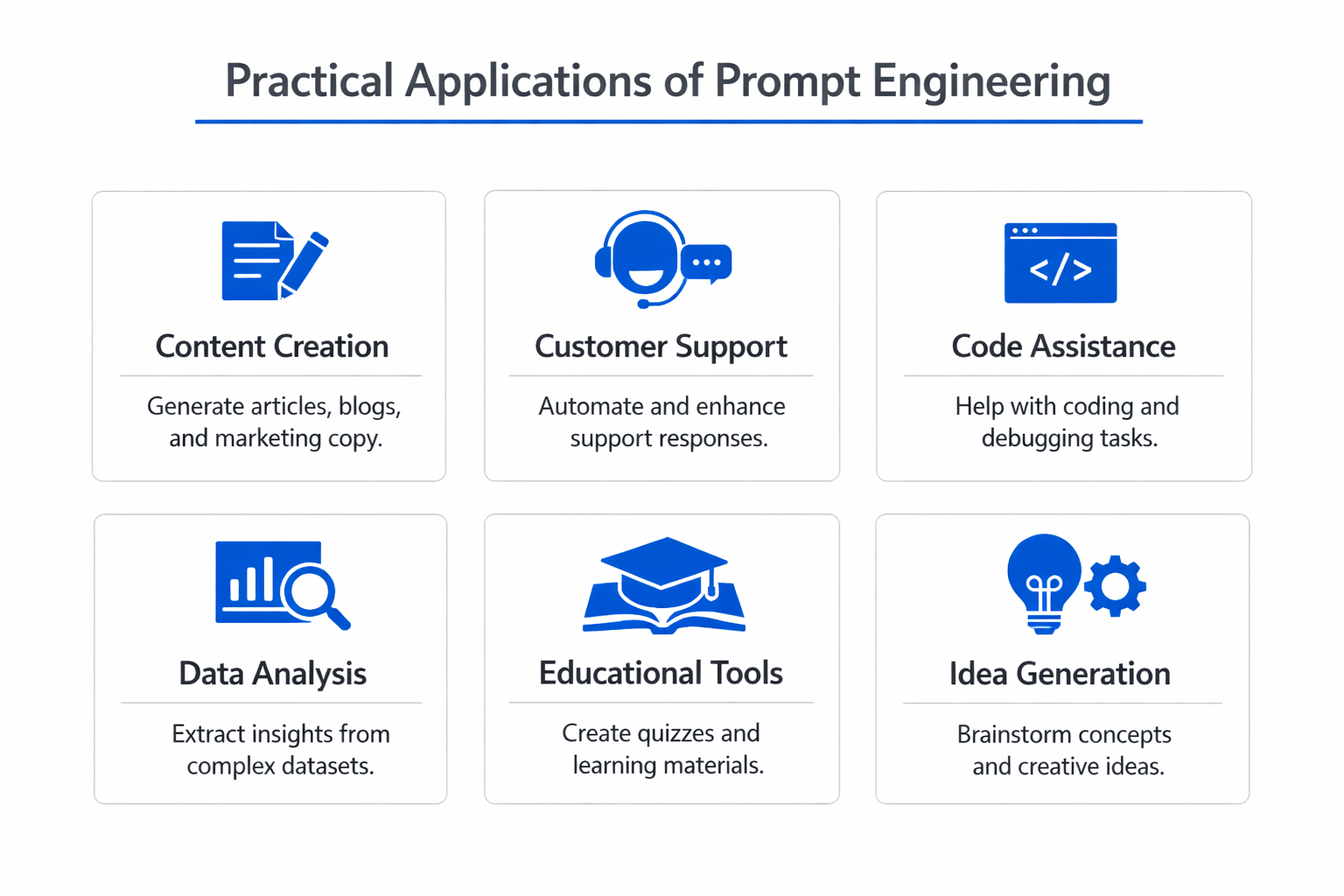
Prompt engineering applies across virtually every domain where AI language models are deployed. The following use cases illustrate the breadth and practical impact of well-designed prompts.
Content Creation and Marketing
Marketing teams use prompt engineering to generate consistent, on-brand content at scale. Prompts specify brand voice, target audience, content format, and key messaging points. A single well-engineered prompt template can produce product descriptions, social media posts, email campaigns, and blog outlines that maintain consistent quality and tone.
The difference between a generic prompt and an engineered one is significant. "Write a blog post about productivity" produces forgettable content. A structured prompt that specifies audience, reading level, key arguments, desired structure, internal linking requirements, and call-to-action format produces publication-ready drafts that require minimal editing.
Software Development
Developers use prompt engineering to generate code, debug errors, write documentation, and translate between programming languages. Effective prompts specify the programming language, framework, coding conventions, error handling requirements, and expected input/output behavior.
Prompt engineering for code generation benefits heavily from few-shot examples. Showing the model two or three examples of functions written in the project's style produces code that integrates cleanly with existing codebases. Without examples, models default to generic patterns that may not match the team's conventions.
Education and Training
In educational contexts, prompt engineering powers AI tutoring systems, automated assessment tools, and adaptive learning content. An AI prompt engineer working in education designs prompts that generate explanations calibrated to specific learning levels, create practice problems of appropriate difficulty, and provide formative feedback that guides learners toward understanding rather than simply revealing answers.
For a practical introduction to building these skills, the guide on AI communication skills and prompting techniques provides actionable starting points.
Prompt engineering also enables the creation of AI-powered course assistants that can answer student questions within the scope of specific course materials. By including course content as context through RAG techniques, these assistants provide accurate, curriculum-aligned responses rather than generic information.
Customer Support
Support teams engineer prompts that enable AI systems to resolve customer inquiries accurately and consistently. These prompts include company policies, product documentation, troubleshooting procedures, and escalation criteria. The prompt design ensures the AI responds within established guidelines while maintaining a professional and empathetic tone.
Effective support prompts also include boundary conditions: situations where the AI should acknowledge its limitations and route the conversation to a human agent. Engineering these boundaries is as important as engineering the productive response paths.
Data Analysis and Research
Researchers and analysts use prompt engineering to extract insights from large datasets, summarize research papers, identify patterns, and generate hypotheses. Prompts for analytical tasks typically include the data schema, analysis objectives, statistical methods to apply, and output format requirements.
Chain-of-thought prompting is particularly valuable in analytical contexts, where the reasoning process is as important as the conclusion. By requiring the model to show its analytical steps, researchers can verify the logic and identify where the model's interpretation may diverge from the data.
LLM Operations
Within LLMOps workflows, prompt engineering is a core operational function. Teams manage prompt libraries, version control prompt templates, run A/B tests on prompt variations, and monitor prompt performance in production. The engineering discipline extends beyond writing individual prompts to managing prompt systems at scale.
Production prompt engineering involves measuring output quality metrics, tracking regression when models are updated, and maintaining prompt consistency across different model versions and providers.
Challenges and Limitations
Prompt engineering is powerful, but it operates within constraints that practitioners must understand to set realistic expectations and avoid common pitfalls.
Sensitivity and Fragility
Small changes in prompt wording can produce disproportionately large changes in output quality. A prompt that works reliably with one model version may break when the model is updated. This fragility makes prompt engineering partly empirical: theoretical understanding guides prompt design, but empirical testing confirms whether a prompt actually works.
This sensitivity also means that prompts developed for one model often do not transfer cleanly to another. A prompt optimized for GPT-4 may produce subpar results when used with Claude or Gemini. Cross-model portability requires testing and adaptation, not assumptions.
Hallucination and Fabrication
Language models sometimes generate plausible but factually incorrect information. Prompt engineering can reduce hallucination through techniques like RAG, explicit instructions to acknowledge uncertainty, and constraints that limit the model to information contained in the provided context. However, no prompting technique eliminates hallucination entirely.
For high-stakes applications, prompt engineering must be paired with validation layers. Human review, automated fact-checking, and output verification against known data sources provide safety nets that prompting alone cannot guarantee.
Context Window Constraints
Every token in a prompt consumes space in the model's context window. Complex prompts with extensive instructions, multiple examples, and large context documents may exceed the window limit or push out relevant information. Prompt engineers must balance thoroughness with conciseness, prioritizing the highest-impact instructions and context.
As tasks grow more complex, prompt engineers face difficult tradeoffs. Including more examples improves output consistency but leaves less room for input data. Adding detailed instructions reduces ambiguity but increases token cost. Managing these tradeoffs is a core skill in production prompt engineering.
Lack of Determinism
Language models are probabilistic systems. The same prompt can produce different outputs on repeated runs, especially at higher temperature settings. Prompt engineering can narrow the output distribution through explicit constraints and low temperature settings, but it cannot guarantee identical outputs across runs.
For applications requiring deterministic behavior, prompt engineering must be combined with output validation, retry logic, and structured output parsing. These engineering layers wrap around the prompt to enforce consistency that the model itself cannot guarantee.
Evolving Model Behavior
Model providers regularly update their models, and these updates can change how models respond to established prompts. A prompt that produced excellent results for months may degrade after a model update without any change to the prompt itself. This creates an ongoing maintenance burden where prompt engineers must monitor performance and adapt promptly to model changes.
Teams managing production AI systems address this through prompt versioning, automated quality monitoring, and regression testing. Treating prompts as software artifacts with lifecycle management is increasingly standard practice in machine learning operations.
How to Get Started with Prompt Engineering
Building prompt engineering skills follows a practical, iterative path. The field rewards experimentation and systematic testing over theoretical study alone.
Learn the Fundamentals of LLMs
Understanding how language models work provides the mental model needed for effective prompt design.
You do not need to understand transformer model architectures at a mathematical level, but grasping the basics of tokenization, context windows, temperature settings, and natural language processing gives you a framework for predicting how models will respond to different prompt structures.
Focus on understanding why models behave the way they do rather than memorizing prompt templates. Knowing that models are autoregressive token predictors explains why instruction placement matters, why examples improve consistency, and why ambiguous prompts produce unpredictable results.
Start with Simple Prompts and Iterate
Begin with straightforward, single-task prompts before attempting complex multi-step designs. Write a prompt, evaluate the output, identify where it falls short, and refine the prompt to address the gap. This cycle of write, test, and refine is the core workflow of prompt engineering.
Keep a log of what works and what does not. Patterns emerge quickly. You will notice that certain instruction formats consistently produce better results, that specific constraint phrasings are more effective than others, and that some tasks benefit from examples while others do not.
Master Core Techniques Progressively
Build your skills in a logical sequence:
- Start with zero-shot prompting to understand baseline model behavior
- Move to few-shot prompting to learn how examples shape outputs
- Practice chain-of-thought prompting for reasoning-intensive tasks
- Experiment with role-based prompting to control tone and expertise level
- Explore prompt chaining for complex, multi-step workflows
Each technique builds on the previous one. Mastering zero-shot prompting teaches you how models interpret instructions. Few-shot prompting teaches you how examples constrain outputs. Chain-of-thought prompting teaches you how reasoning structure improves accuracy.
Build a Prompt Library
As you develop effective prompts, organize them into a reusable library. Categorize prompts by task type, domain, and technique. Document what each prompt does, which model it was tested with, and any known limitations.
A well-maintained prompt library accelerates future work and enables team collaboration. When a new task resembles a previous one, you can adapt an existing prompt rather than starting from scratch. This library becomes a strategic asset as prompt engineering becomes more central to operations.
Practice Across Different Models
Different models respond differently to the same prompt. Practice with models from multiple providers to build intuition for cross-model variation. This experience helps you write more reliable prompts that perform well across different systems and prepares you for production environments that often involve multiple model providers.
Testing across models also reveals which prompt engineering principles are universal and which are model-specific. Some techniques, like chain-of-thought prompting, work across virtually all large models. Others, like specific formatting instructions, may require model-specific adjustments.
Explore Production-Level Tools
As your skills advance, explore tools and frameworks designed for production prompt engineering. Platforms like LangChain provide infrastructure for prompt chaining, retrieval-augmented generation, and workflow orchestration. LLMOps platforms offer prompt versioning, performance monitoring, and A/B testing capabilities.
Understanding these tools connects individual prompt engineering skills to the broader ecosystem of AI application development. Prompt engineering in production is a team discipline that involves collaboration between engineers, domain experts, and product teams.
FAQ
What is the difference between prompt engineering and fine-tuning?
Prompt engineering changes only the input given to a model, while fine-tuning modifies the model's internal weights through additional training on task-specific data. Prompt engineering requires no computational infrastructure beyond access to the model's API. Fine-tuning requires training data, compute resources, and technical expertise.
Prompt engineering is immediate and reversible; fine-tuning produces a permanently altered model variant. Most practitioners start with prompt engineering and move to fine-tuning only when prompting alone cannot achieve the required performance level.
Do I need programming skills to practice prompt engineering?
No. Basic prompt engineering requires only the ability to write clear, structured text instructions. You can practice and achieve strong results using any chat-based AI interface. However, advanced prompt engineering in production contexts often involves programming skills for building prompt chains, integrating APIs, implementing retrieval-augmented generation, and automating prompt testing. Programming skills expand what you can build but are not a prerequisite for getting started.
Which AI models are best for learning prompt engineering?
Any current-generation large language model from a major provider is suitable for learning. Models from OpenAI, Anthropic, and Google all respond well to standard prompt engineering techniques. The specific model matters less than consistent practice and systematic experimentation. Start with whichever model you have access to and expand to others as your skills develop. Practicing across multiple models builds a more versatile skill set.
How long does it take to become proficient at prompt engineering?
Basic proficiency, meaning the ability to write clear prompts that consistently produce useful outputs, can be developed in a few weeks of regular practice. Intermediate proficiency, including mastery of techniques like chain-of-thought prompting, few-shot design, and prompt chaining, typically takes two to three months. Advanced proficiency, including production prompt system design and cross-model optimization, develops over six months to a year of applied practice. The field evolves quickly, so ongoing learning is part of the discipline.
Is prompt engineering a viable career path?
Yes. Organizations across industries are hiring dedicated prompt engineers and AI prompt engineers to optimize their AI systems. The role exists in technology companies, marketing agencies, educational institutions, healthcare organizations, and consulting firms. As AI adoption accelerates, demand for practitioners who can reliably extract high-quality outputs from language models continues to grow.
The skill also complements adjacent roles in data science, product management, content strategy, and software engineering.
What is the relationship between prompt engineering and AI safety?
Prompt engineering intersects with AI safety in several ways. Well-engineered prompts include guardrails that prevent models from generating harmful, biased, or misleading content. Prompt design also plays a role in preventing prompt injection attacks, where malicious inputs attempt to override a system's intended behavior. Understanding how prompts control model behavior is essential for building AI systems that operate safely and reliably within defined boundaries.


