


What Is ChatGPT Enterprise?
ChatGPT Enterprise is OpenAI's business tier of its conversational AI platform, built for organizations that need advanced language model capabilities alongside enterprise-grade security, administration, and compliance controls. Unlike the free or Plus versions, the Enterprise plan removes usage caps, adds dedicated data privacy protections, and includes centralized management tools for teams operating at scale.
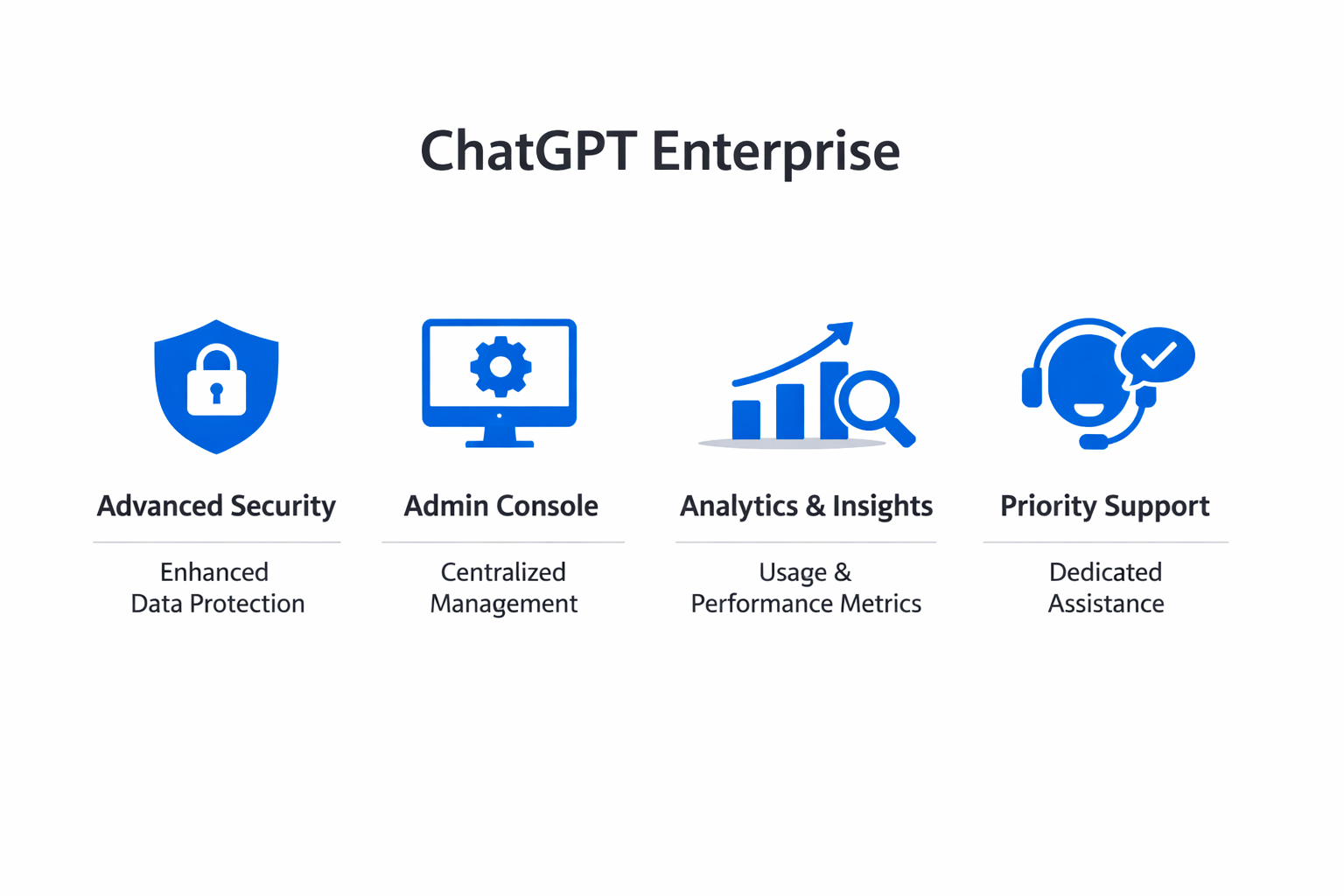
At its core, ChatGPT Enterprise gives every employee unlimited access to GPT-4, OpenAI's most capable model, with no message limits or throttling. The platform adds an admin console for managing users, configuring permissions, and monitoring usage across departments. OpenAI states that Enterprise customer data is not used to train models, and all conversations are encrypted in transit and at rest.
The product sits in a growing category of generative AI tools built for workplace deployment. It competes with Microsoft (Copilot for Microsoft 365), Google (Gemini for Workspace), and a wave of vertical AI solutions. Organizations evaluating ChatGPT Enterprise usually want a centralized, secure way to bring large language model capabilities to multiple teams and functions.
How ChatGPT Enterprise Pricing Works
OpenAI does not publish a fixed price for ChatGPT Enterprise. Pricing is custom and based on factors such as the number of users, contract length, and deployment scope. Organizations must contact OpenAI's sales team directly to receive a quote.
For context, the broader ChatGPT pricing structure includes several tiers:
- Free plan. Access to GPT-3.5 with limited features and slower response times during peak periods.
- Plus plan. Priced at $20 per user per month, offering GPT-4 access with usage caps, faster response, and priority availability.
- Team plan. Priced at $25-30 per user per month (depending on billing cycle), offering higher usage limits than Plus, shared workspace features, and the guarantee that business data is not used for training.
- Enterprise plan. Custom pricing, typically estimated in the range of $50-60+ per user per month depending on scale, with unlimited GPT-4 access, advanced admin tools, SSO, and dedicated support.
Several factors shape the final Enterprise cost. Larger organizations negotiating multi-year contracts or committing to a high seat count tend to secure lower per-user rates. OpenAI also offers volume discounts for deployments across thousands of users.
The pricing model follows a pattern common in enterprise SaaS: the price per seat drops as organizational commitment rises. Expect the negotiation to involve security reviews, data processing agreements, and alignment on deployment timelines, similar to evaluating any enterprise training tool.
Key Features of ChatGPT Enterprise
ChatGPT Enterprise stands apart from lower-tier plans through a set of capabilities focused on security, scale, and organizational control. These features fall into several categories.
Unlimited GPT-4 Access
Enterprise users get unlimited access to GPT-4 with no message caps. Performance is also faster, with OpenAI claiming up to two times higher speed compared to the standard GPT-4 experience. This removes the friction that occurs on Plus plans when users hit daily limits during intensive research, writing, or analysis tasks.
Advanced Data Analysis
The platform includes Advanced Data Analysis (formerly Code Interpreter), which lets users upload files, run Python code in a sandbox, and generate data visualizations. Non-technical users can analyze spreadsheets, build charts, and automate calculations directly in the chat interface.
Enterprise-Grade Security and Privacy
This is the biggest differentiator. OpenAI provides the following protections for Enterprise customers:
- Data exclusion from training. Conversations and uploaded files are not used to train OpenAI models.
- Encryption. Data is encrypted at rest (AES-256) and in transit (TLS 1.2+).
- SOC 2 compliance. OpenAI has achieved SOC 2 Type 2 certification, which covers security, availability, and confidentiality controls.
- Data retention controls. Organizations can configure data retention windows based on internal policies.
For organizations handling sensitive information such as financial data, legal documents, or employee records, these protections answer the main objection most security teams raise when evaluating AI tools for the workplace.
Admin Console and User Management
The admin console gives IT teams centralized control over the deployment. Admins can bulk-provision users, set domain-level verification, manage access through single sign-on (SSO), and review aggregate usage analytics. This visibility shows how the tool is adopted and where it delivers value.
Custom GPTs and Shared Workspaces
Enterprise users can create custom GPTs, specialized versions of ChatGPT configured with specific instructions, knowledge bases, and capabilities. Teams share these internal GPTs across departments, building reusable AI assistants for workflows like drafting contracts, summarizing meeting notes, or answering product questions.
Extended Context Window
ChatGPT Enterprise supports a 128,000-token context window with GPT-4 Turbo, so users can process long documents, detailed reports, or entire codebases in a single conversation. That helps with legal review, research synthesis, and technical documentation tasks where the model needs to weigh large amounts of information at once.
Practical Use Cases Across Industries
The value of ChatGPT Enterprise depends on how organizations integrate it into existing workflows. The following use cases illustrate where the platform delivers measurable impact.
Content and Communication
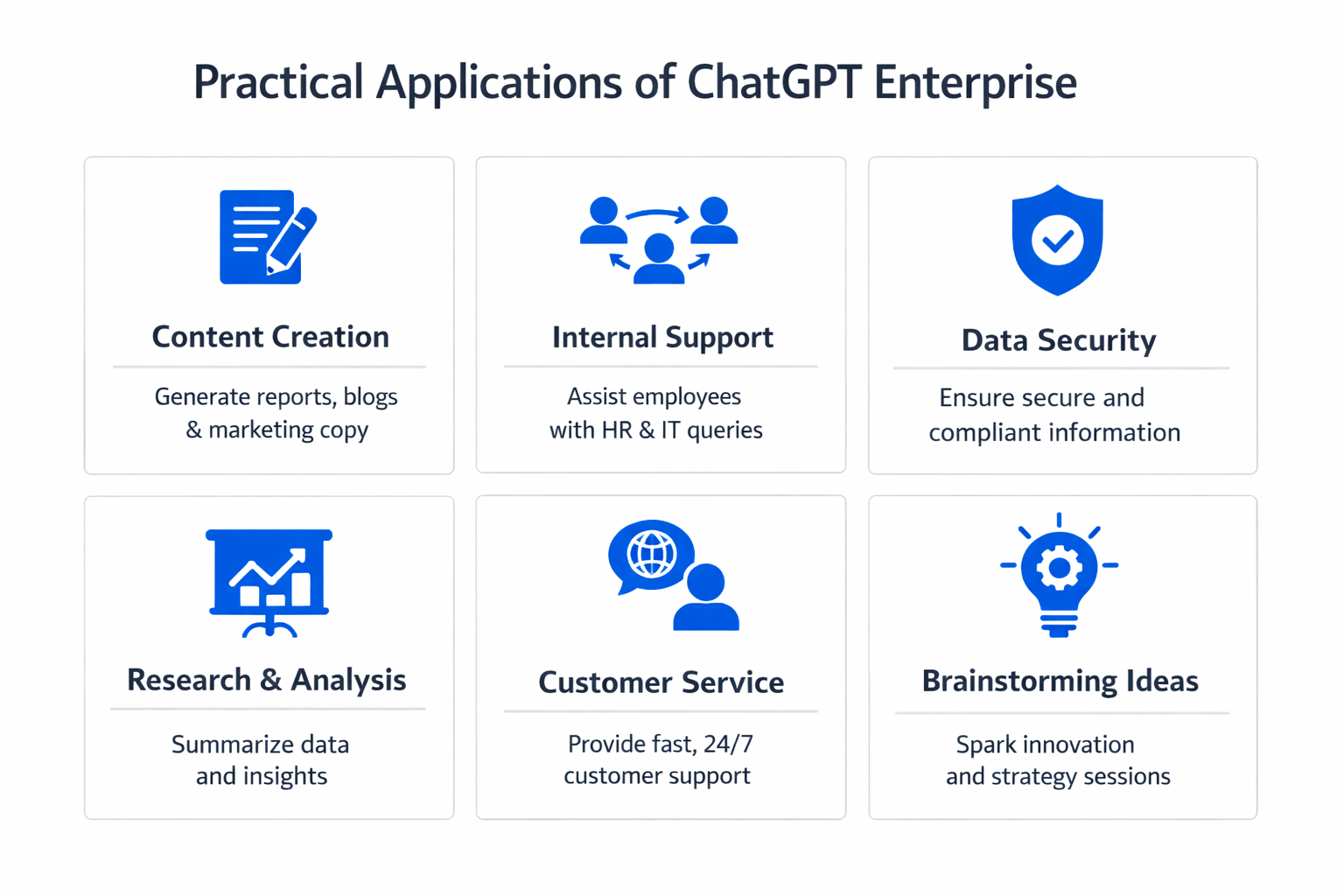
Marketing, communications, and HR teams use ChatGPT Enterprise to draft internal announcements, write customer-facing copy, generate email templates, and produce first drafts of blog posts or reports. Unlimited access lets teams iterate on tone, format, and messaging without hitting usage limits.
Data Analysis and Reporting
Finance, operations, and business intelligence teams upload CSV files, spreadsheets, and datasets to the Advanced Data Analysis feature. The model can summarize trends, flag anomalies, create pivot tables, and generate charts. This reduces the time analysts spend on routine data processing and allows faster turnaround on reporting requests.
Software Development
Engineering teams use ChatGPT Enterprise for code generation, debugging, code review, and documentation. The extended context window lets developers paste entire files or modules and get targeted suggestions. Teams also build custom GPTs that encode internal coding standards or API documentation, cutting onboarding time for new engineers.
Legal and Compliance
Legal departments use the platform to summarize contracts, spot clause variations, and draft standard legal language. The data privacy controls make it practical to use confidential documents that would be off-limits on consumer-grade AI platforms. Organizations in regulated industries can also configure compliance training workflows that include AI-assisted document review.
Customer Support
Support teams build custom GPTs trained on product documentation, FAQs, and troubleshooting guides. These internal tools help agents respond to tickets faster and with greater consistency. Some organizations also use ChatGPT Enterprise to analyze support ticket trends, identify recurring issues, and generate knowledge base articles.
Learning and Development
L&D teams use ChatGPT Enterprise to draft course content, generate quiz questions, build scenario-based training exercises, and summarize feedback from post-training surveys.
The tool can also help instructional designers outline curriculum structures and adapt materials for different audience segments, cutting the time needed to build and update corporate training programs.
ChatGPT Enterprise vs. Team Plan: Which One Fits?
Organizations often evaluate whether the Team plan provides enough functionality or whether Enterprise is necessary. The distinction comes down to scale, security requirements, and administrative control.
The Team plan works well for smaller groups (under 150 users) that need shared workspaces and the assurance that their data is excluded from model training. It includes higher message limits than Plus and basic admin features. For departments or startups that need a quick deployment without a complex procurement process, Team is a practical starting point.
The Enterprise plan becomes necessary when organizations require:
- SSO integration with existing identity providers (SAML)
- Granular admin controls over user provisioning and permissions
- Compliance documentation for security reviews (SOC 2 reports, DPAs)
- Unlimited usage across hundreds or thousands of seats
- Dedicated account management and priority support
- Custom data retention policies aligned with internal governance
The decision often depends on the organization's regulatory environment. Companies in healthcare, financial services, or government contracting typically need Enterprise-level security documentation to satisfy internal audit and compliance requirements. Organizations evaluating this decision should run it through the same training needs analysis framework they apply to any enterprise software purchase.
Limitations and Challenges
ChatGPT Enterprise solves many adoption blockers, but it is not without limitations. Organizations should evaluate these factors before committing.
Cost at Scale
At an estimated $50-60+ per user per month, deploying ChatGPT Enterprise across an organization of 1,000 employees represents a significant annual investment. Not every role will use the tool frequently enough to justify the per-seat cost. Organizations benefit from a phased rollout approach, starting with high-usage departments and expanding based on demonstrated ROI of the investment.
Accuracy and Hallucinations
Large language models can produce plausible but incorrect information. In high-stakes domains like legal, medical, or financial operations, qualified professionals must verify outputs. ChatGPT Enterprise does not solve the hallucination problem; it gives teams better tools for working with AI, but human review stays essential.
Integration Limitations
ChatGPT Enterprise operates primarily through its web interface and API. It does not natively integrate with every enterprise application. Organizations that need deep integration with CRM, ERP, or learning management systems may need to build custom connections using the API or rely on third-party middleware platforms.
Change Management
Deploying an AI tool across an organization takes more than provisioning accounts. Teams need clear guidance on acceptable use, prompt engineering practices, and realistic expectations about what the tool can and cannot do. Without structured employee onboarding for the tool, adoption stays uneven, with some departments using it heavily and others ignoring it.
Model Dependency
Relying heavily on one AI provider creates vendor dependency. If OpenAI changes its pricing, capabilities, or terms of service, organizations with deep integrations may face switching costs. A safer approach keeps awareness of alternatives and avoids architectural decisions that tie the organization entirely to one model provider.
| Challenge | Impact | Mitigation |
|---|---|---|
| Cost at Scale | At an estimated $50-60+ per user per month. | Organizations benefit from a phased rollout approach |
| Accuracy and Hallucinations | Large language models can generate plausible but incorrect information. | Legal, medical, or financial operations |
| Integration Limitations | ChatGPT Enterprise operates primarily through its web interface and API. | It does not natively integrate with every enterprise application |
| Change Management | Deploying an AI tool across an organization requires more than provisioning accounts. | Teams need clear guidance on acceptable use |
| Model Dependency | Relying heavily on a single AI provider creates vendor dependency. | If OpenAI changes its pricing, capabilities, or terms of service |
How to Evaluate ChatGPT Enterprise for Your Organization
Before engaging OpenAI's sales team, organizations should clarify their requirements and evaluate fit through a structured process.
1. Identify high-value use cases. Survey departments to find where employees already use AI tools informally. Focus on roles where language generation, data analysis, or content synthesis represents a significant portion of daily work.
1. Assess security requirements. Involve IT security and compliance teams early. Document the specific data handling requirements, encryption standards, and audit trail capabilities that your organization mandates. Compare these against what ChatGPT Enterprise provides.
1. Estimate total cost of ownership. Go beyond the per-seat price. Factor in onboarding costs, internal training on prompt engineering, time spent building custom GPTs, and the administrative overhead of managing the platform. Compare this against the productivity gains you expect.
1. Run a pilot program. Start with a defined group of 50-200 users across different departments. Set clear success metrics: time saved on specific tasks, quality of outputs, adoption rates, and user satisfaction. Use pilot data to build the business case for broader deployment.
1. Define governance policies. Before full rollout, establish clear policies on data handling, acceptable use cases, output verification requirements, and escalation procedures for sensitive content. This governance layer is what separates a successful enterprise deployment from a chaotic one.
1. Plan for change management. Allocate resources for internal training, create a library of effective prompts, designate departmental champions, and build feedback loops so the organization continuously improves its use of the tool. Effective upskilling programs around AI fluency accelerate adoption.
FAQ
How much does ChatGPT Enterprise cost per user?
OpenAI does not publish fixed pricing for ChatGPT Enterprise. The cost is determined through direct negotiation and depends on the number of users, contract duration, and deployment scope. Industry estimates place the per-user cost in the range of $50-60+ per month, with volume discounts for larger commitments. Organizations must contact OpenAI's sales team for a formal quote.
Is ChatGPT Enterprise SOC 2 compliant?
Yes. OpenAI has achieved SOC 2 Type 2 compliance for ChatGPT Enterprise. This certification covers security, availability, and confidentiality controls. Enterprise customers can request SOC 2 audit reports as part of their security review process. OpenAI also provides data processing agreements and supports configurable data retention policies.
Can ChatGPT Enterprise integrate with existing enterprise tools?
ChatGPT Enterprise provides API access that allows organizations to build integrations with internal tools, CRMs, and knowledge management systems. It does not offer out-of-the-box connectors for every platform. Integration typically requires development resources or the use of middleware platforms. OpenAI continues to expand its integration ecosystem through partnerships and plugin support.
Does OpenAI train on ChatGPT Enterprise data?
No. OpenAI explicitly states that data submitted through ChatGPT Enterprise, including conversations, uploaded files, and usage data, is not used to train OpenAI models. This is a contractual commitment backed by technical controls. Organizations can also configure custom data retention windows to align with their internal data governance policies.
What is the difference between ChatGPT Team and Enterprise?
The Team plan is designed for smaller groups and provides higher usage limits than Plus, shared workspaces, and the same data training exclusion. Enterprise adds unlimited GPT-4 access, SSO through SAML, a full admin console, SOC 2 compliance documentation, custom data retention policies, dedicated support, and the ability to deploy across thousands of users.
The Enterprise plan is built for organizations that require centralized governance, regulatory compliance support, and large-scale deployment capabilities.


