


CEU vs PDH: 7 Key Differences for Training Administrators
What Are CEUs and PDHs? Understanding Continuing Education Credits
Professional licensure requires ongoing education. Most regulated professions mandate that practitioners complete continuing education to maintain their credentials. This requirement protects public safety and ensures professionals stay current with evolving standards.
Two primary systems dominate continuing education tracking: Continuing Education Units (CEUs) and Professional Development Hours (PDHs). While both measure learning time, they operate under different standards, serve different professions, and require distinct compliance approaches. Training administrators who design professional development programs need to understand these differences to award appropriate credits and meet regulatory expectations.
The choice between CEUs and PDHs has practical consequences. It determines which accreditation bodies oversee your program, what documentation formats you must produce, and how cleanly credits transfer across state lines. Organizations running multi-state programs or serving mixed professional audiences will feel this distinction in every renewal cycle.
Continuing Education Units (CEUs) Defined
The International Association for Continuing Education and Training (IACET) introduced the CEU in 1970 to standardize continuing education measurement across professions. One CEU represents 10 contact hours of participation in an organized continuing education experience under responsible sponsorship, capable direction, and qualified instruction.
The calculation is straightforward: a 20-hour course awards 2.0 CEUs. A 5-hour workshop awards 0.5 CEUs. Contact hours refer to actual instructional time, excluding breaks, meals, and non-educational activities.
CEUs apply broadly across healthcare, education, social work, and allied health professions. Nurses, physical therapists, occupational therapists, social workers, and many educators accumulate CEUs to satisfy licensure renewal requirements. The system emphasizes standardized quality through provider accreditation rather than profession-specific approval.
Professional Development Hours (PDHs) Defined
PDHs measure continuing education on a simpler scale: one hour of instruction equals one PDH. There is no conversion formula. A 10-hour seminar awards 10 PDHs.
This system emerged primarily within engineering and technical professions. Most state engineering licensing boards require Professional Engineers (PEs) to complete PDH requirements, typically ranging from 15 to 30 PDHs per renewal cycle. Other technical fields, including surveying and architecture, use similar hour-based systems.
PDH acceptance rules are set by individual state licensing boards rather than a single national body. Some states pre-approve providers, others accept self-reported professional development, and many operate hybrid systems. The result is more flexibility for course providers but less predictability for professionals who hold licenses in several states.
The 7 Key Differences Between CEUs and PDHs
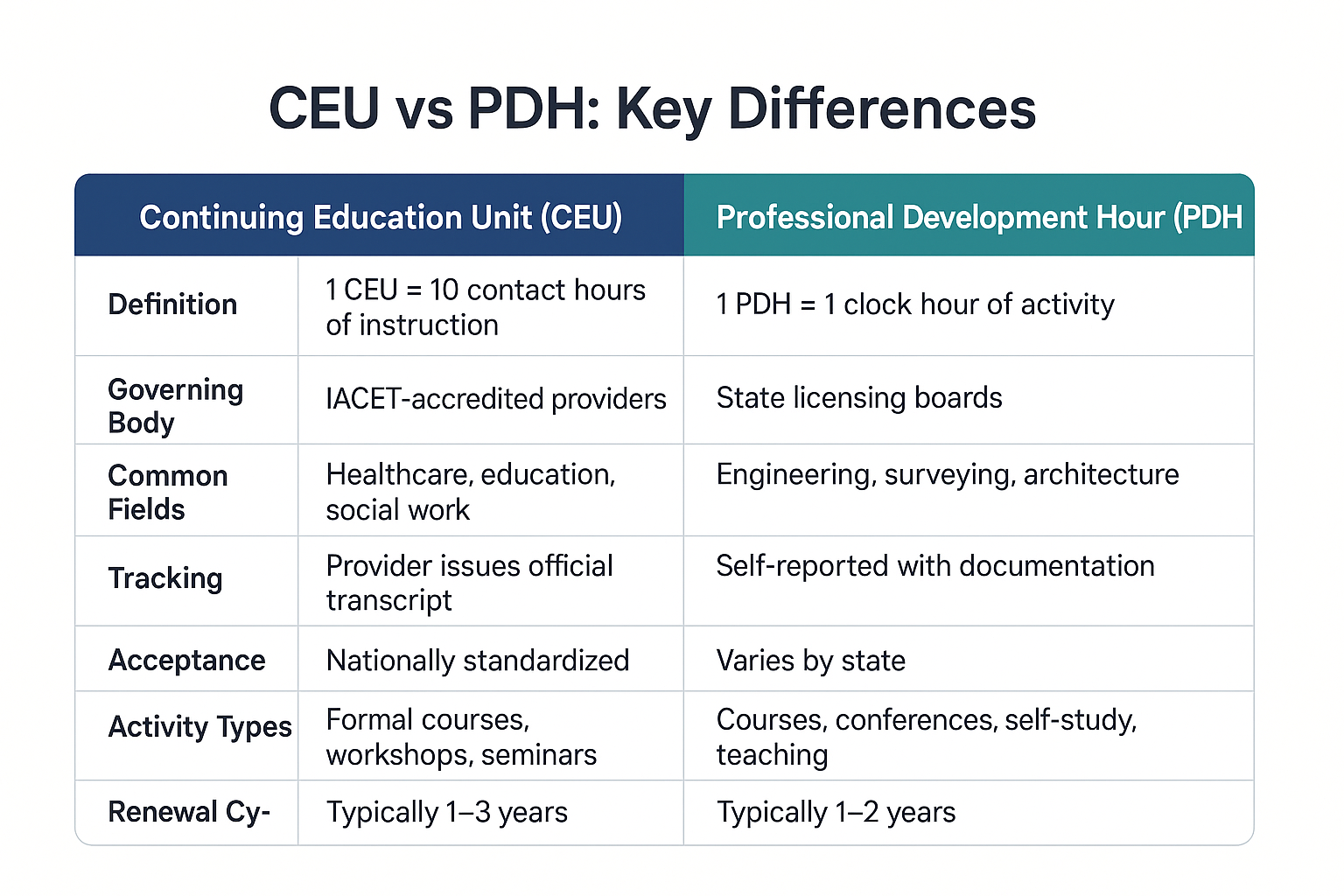
Calculation Method: How Credits Are Measured
The most visible difference lies in how learning time converts to credits. CEUs use a 10:1 ratio. Ten contact hours yield one CEU, so professionals accumulate fractional units: 0.5 CEUs, 1.5 CEUs, 2.3 CEUs. This system requires more careful calculation but compresses large hour totals into smaller numbers.
PDHs operate on direct equivalence. One contact hour equals one PDH. A professional attending an eight-hour workshop earns eight PDHs. This simplicity makes tracking easier for both providers and learners.
For organizations offering the same course to different professions, this creates a documentation challenge. A 15-hour training program must be described as 1.5 CEUs for nurses and 15 PDHs for engineers. Certificates, transcripts, and marketing materials must reflect the appropriate calculation for each audience.
The math is consistent: because one CEU represents 10 contact hours and one PDH represents one contact hour, a course worth 2.0 CEUs covers the same time as 20 PDHs. Whether that conversion ever matters depends entirely on which professions your participants hold licenses in.
Professional Usage: Who Uses Which Credit Type
CEUs dominate healthcare and education. State nursing boards, physical therapy boards, occupational therapy boards, and counseling boards typically specify CEU requirements. Social workers, dietitians, respiratory therapists, and speech-language pathologists also work within CEU systems. The IACET standard provides a common framework across these diverse professions.
PDHs serve engineering and technical disciplines almost exclusively. Civil engineers, mechanical engineers, electrical engineers, and other Professional Engineers accumulate PDHs to maintain state licensure. Surveyors and some architects operate under similar systems. The National Council of Examiners for Engineering and Surveying (NCEES) coordinates standards across states, but each state board maintains final authority.
This professional division creates strategic decisions for training providers. A leadership development program serving both healthcare administrators and facilities engineers must either choose one credit system or pursue dual accreditation. Neither option is simple; CEU accreditation requires formal IACET approval, while PDH acceptance requires understanding regulations across all states where participants hold licenses.
Corporate L&D programs serving a single profession can optimize for that field's requirements. Organizations training multiple regulated professions face layered compliance requirements. Knowing exactly which licensed professions your learners represent is the prerequisite for every downstream decision about accreditation and documentation.
Governing and Accrediting Bodies
IACET controls CEU standards. To award CEUs, a training provider must achieve IACET accreditation by demonstrating compliance with standards covering learning outcomes, assessment, instructional personnel, program administration, and continuous improvement. The accreditation process involves application, self-study, documentation review, and site visits.
Some professions add requirements beyond IACET accreditation. State nursing boards may accept IACET-accredited CEUs but require additional content approval for specific topics. Professions like social work sometimes operate parallel systems where both IACET accreditation and profession-specific approval carry weight.
PDH governance is decentralized. Each state engineering board sets its own rules. The NCEES Model Law provides guidance, but states diverge in implementation. Some states require pre-approval of courses and providers. Others accept any relevant technical education without pre-approval, relying on post-audit verification if questions arise.
National training programs feel this governance gap most acutely. Once a provider holds IACET accreditation, every course the organization offers can award CEUs without additional submissions. Targeting Professional Engineers across the same four states means separate approval applications in California, Texas, Florida, and New York, each with its own documentation checklist and processing timeline.
Accreditation Requirements for Training Providers
Becoming an IACET Authorized Provider requires significant investment. The application fee ranges from $2,000 to $5,000 depending on organization size. The process takes six to twelve months. Organizations must document instructional design processes, assessment methods, instructor qualifications, evaluation systems, and record-keeping procedures.
IACET accreditation is renewable. Authorized Providers reapply every five years, demonstrating continued compliance with standards. This creates ongoing administrative overhead but provides a stable framework for awarding CEUs across all IACET-accepting professions simultaneously.
PDH provider approval varies dramatically. Some state engineering boards charge minimal fees ($100 to $500) for provider approval. Others require no formal provider approval at all, instead evaluating courses individually or accepting self-reported professional development. Florida requires course-by-course approval. Wyoming accepts professional judgment. California operates a pre-approved provider system.
Training organizations must decide whether broad access justifies accreditation costs. IACET accreditation opens multiple healthcare and education markets simultaneously. PDH acceptance requires targeted state-by-state analysis, with effort scaling based on geographic footprint.
Documentation and Reporting Standards
CEU documentation follows standardized formats. IACET Authorized Providers issue certificates or transcripts showing:
- Participant name
- Course title and description
- Number of CEUs awarded
- Completion date
- Provider name and IACET Authorized Provider number
- Unique certificate or transcript number
Providers maintain records for seven years minimum. Participants receive documentation suitable for license renewal applications across all states accepting IACET CEUs. The standardization simplifies multi-state compliance from the learner's perspective.
PDH documentation requirements vary by state. Most require:
- Course title and description
- Hours completed
- Completion date
- Provider information
Some states specify certificate formats. Others accept any documentation showing completion. Engineers licensed in multiple states may need to request state-specific certificates even after completing the same course.
Record retention also varies. Some states require providers to maintain records for five years, others for ten. Audit risk determines how carefully providers must document instructor qualifications, attendance verification, and assessment results.
For training administrators managing compliance at scale, this variability translates directly into staff time. CEU programs operate under a single consistent ruleset. PDH programs require maintaining a state-by-state procedure map that must be updated whenever a licensing board revises its requirements.
Acceptance and Portability Across States
IACET CEUs carry national portability within professions that accept them. A nurse holding licenses in California, Texas, and Florida can typically apply IACET CEUs toward renewal in all three states. Individual state boards may add content-specific requirements, particularly for ethics or state law courses, but the CEU format itself transfers.
This portability benefits both learners and providers. Nurses working across multiple states avoid tracking different credit types. Training providers serve national audiences without customizing certificates for each state's format preferences.
PDH acceptance varies because engineering licensure is state-based. Most states accept PDHs from courses taken anywhere, as long as content relates to professional practice. However, documentation requirements differ. Some states accept self-reporting with audit verification. Others require pre-approved courses or proof of provider credentials.
Reciprocity exists through NCEES records and comity agreements, but continuing education requirements remain state-specific. An engineer practicing in multiple states must satisfy each state's individual PDH requirements, which may differ in quantity, subject matter, and ethics hour mandates.
Organizations running national training programs face a choice: pursue broad provider approval across target states, clearly document PDH eligibility and let engineers self-report, or limit marketing to states where approval processes are manageable.
Provider Flexibility and Approval Process
IACET accreditation is complete but inflexible. Once achieved, it covers all continuing education programming the organization offers. Providers don't submit individual courses for approval; the accreditation applies to the organization's entire instructional system. This creates efficiency for large-scale providers but represents a high barrier for small organizations or those offering occasional professional development.
PDH systems range from highly structured to entirely self-directed. States like Florida require course-by-course approval before PDHs can be awarded. Providers submit course descriptions, learning objectives, instructor credentials, and assessment methods. Approval may take weeks or months.
Other states operate on professional judgment. Engineers determine whether an educational activity qualifies as professional development, claim PDHs, and maintain documentation in case of audit. Providers need not register or seek approval; they simply offer training and let participants decide whether it qualifies.
This flexibility benefits smaller providers and specialized technical training. A weekend workshop on structural software doesn't require IACET accreditation to award PDHs in most states. The same workshop cannot award CEUs without the provider achieving full IACET accreditation.
However, flexibility introduces uncertainty. Engineers must verify their state board's policies. Providers cannot guarantee acceptance. Audit risk shifts to participants. Organizations preferring clear compliance frameworks may find CEU standardization easier to navigate despite higher upfront investment.
Choosing Between CEUs and PDHs: Decision Framework
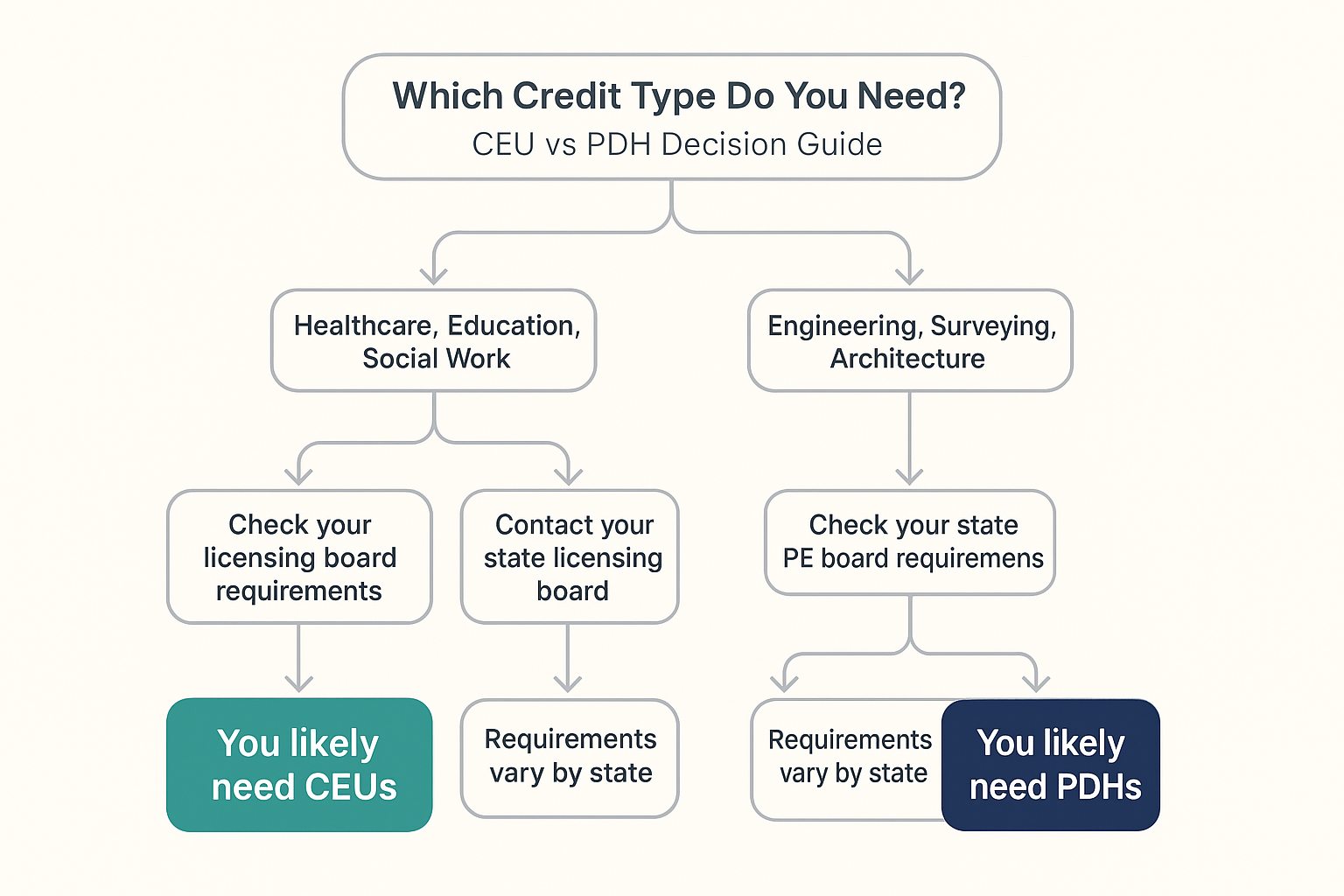
When to Offer CEUs in Your Training Program
Pursue IACET accreditation and CEU credits when your training serves healthcare, education, or social services professions. The investment makes sense if:
- Your audience includes nurses, therapists, counselors, or educators who need CEUs for licensure
- You operate at scale across multiple states and value standardized compliance
- Your organization already maintains quality systems compatible with IACET standards
- Multi-profession training programs benefit from a single credit system spanning diverse fields
The ROI calculation depends on enrollment volume. IACET accreditation costs $2,000 to $5,000 plus ongoing staff time for compliance. If you train 100 nurses annually, the per-learner cost justifies the credential value. If you train 10, the economics may not support formal accreditation.
CEUs also signal quality. IACET accreditation demonstrates commitment to instructional standards, outcome measurement, and continuous improvement. Some organizations pursue it for positioning value beyond regulatory compliance.
When to Offer PDHs in Your Training Program
PDH credits make sense for technical training targeting engineers and related professions. This path works when:
- Your content focuses on engineering, surveying, or architectural practice
- Your audience concentrates in specific states where you can navigate approval processes
- Course topics are clearly technical and related to professional practice
- You prefer flexible approval over standardized accreditation
PDH programs can launch faster than CEU programs. In states accepting self-reported professional development, you can begin offering PDH-eligible training immediately. Clear course descriptions, qualified instructors, and reasonable assessment methods satisfy most state requirements even without formal pre-approval.
The tradeoff is fragmentation. Engineers licensed in California, Texas, and New York may need different documentation formats or state-specific approval confirmation. This administrative complexity scales with geographic reach.
Can You Offer Both? Dual-Credit Strategies
A single course can award both CEUs and PDHs if it meets standards for both systems. This requires:
- IACET accreditation for the organization (to award CEUs)
- Compliance with relevant state PDH requirements (either pre-approval or self-reported eligibility)
- Certificates clearly stating both credit types: "This course awards 1.5 CEUs (15 PDHs)"
Dual crediting expands market reach. A leadership course for healthcare and engineering managers can serve both audiences without creating separate programs. However, the administrative burden is cumulative, not simplified. You must maintain IACET compliance while navigating state-by-state PDH requirements.
The strategy makes sense when audience composition is mixed and course content applies across professions. Technical content specific to engineering practice may not justify CEU accreditation if nurses won't enroll. Clinical content specific to healthcare may not interest engineers enough to warrant PDH approval complexity.
Implementing Credit Systems: Best Practices for L&D Teams
Setting up tracking systems for CEUs and PDHs requires attention to compliance, scalability, and audit readiness. Training administrators should establish clear processes before awarding credits.
Start with certificate generation. Templates must include all required fields for the credit type you're awarding. IACET CEU certificates require specific language and provider identification. PDH certificates need clear course descriptions and hour totals. Automating certificate generation reduces manual errors and ensures consistency.
Attendance verification matters for both systems. Contact hours must reflect actual participation, not course length. If a 10-hour course allows participants to skip sessions, awarded credits must match attended hours. Learning management systems with attendance tracking, quiz completion requirements, or time-on-task monitoring help document participation.
Record retention policies should exceed minimum requirements. IACET mandates seven years; some PDH states require five to ten years. Storing records for 10 years provides safety margin for delayed audits. Digital systems with proper backup procedures prevent data loss that could create compliance gaps.
For organizations tracking credits across multiple team members, centralized reporting systems become essential. Individual learners manage their own transcripts for license renewal, but training administrators need aggregate views showing who completed what, when credits were awarded, and which courses remain pending. Platforms that automate credit tracking reduce administrative overhead as programs scale.
A purpose-built learning platform makes this practical. Teachfloor records course completion, attendance, and certificate issuance in one place, so training administrators get the aggregate transcripts and audit trail that CEU and PDH reviews require without stitching together spreadsheets. For regulated fields, the best LMS options for professional services firms add the compliance reporting that continuing-education programs depend on at scale.
Audit preparation works best as a standing process rather than a crisis response. Documentation of instructor qualifications, learning objectives, assessment methods, and attendance records must be captured at the time of delivery, not reconstructed afterward. State board reviews and IACET evaluations can arrive years after a course runs; programs that build documentation into their delivery workflow produce evidence quickly and cleanly.
Frequently Asked Questions About CEUs and PDHs
Can you convert CEUs to PDHs?
Yes, the math is straightforward. One CEU represents 10 contact hours, so a course awarding 1.5 CEUs covers 15 contact hours and 15 PDHs. The conversion is useful when a certificate needs to show both values. What it cannot determine is acceptance: whether a state engineering board recognizes the course as qualifying professional development is a separate question governed by content and provider eligibility, not unit arithmetic.
Which is better: CEU or PDH?
Neither is inherently superior. The appropriate credit type depends on your profession and licensing requirements. Healthcare professionals typically need CEUs. Engineers typically need PDHs. Check your state licensing board's specific requirements rather than choosing based on preference. Training providers should offer whichever credit type their target audience needs for license renewal.
How many PDHs equal one CEU?
Ten PDHs equal one CEU. The relationship is fixed by definition: one CEU represents 10 contact hours; one PDH represents one contact hour. Documenting the same course under both systems is a labeling decision, not a regulatory one. Always confirm that the destination state board or licensing authority accepts the credit type being reported, since the conversion ratio does not establish acceptance.
Do all professions accept CEUs?
No. CEUs are common in healthcare, education, and social services but not universal. Engineers typically require PDHs instead. Some professions use profession-specific credit systems that differ from both CEUs and PDHs. Always verify your specific licensing board's requirements. State boards publish continuing education requirements on their websites, specifying accepted credit types, required hours, and approved providers.
Can a single course award both CEUs and PDHs?
Yes, if the organization holds IACET accreditation (to award CEUs) and the course content qualifies under relevant PDH requirements. Certificates should clearly state both credit values: "This course awards 2.0 CEUs (20 PDHs)." However, maintaining dual accreditation adds administrative complexity. Most training providers focus on the credit type their primary audience needs rather than pursuing dual crediting unless they serve distinctly mixed professional groups.
How do you track CEUs and PDHs for multiple team members?
Learning management systems with compliance tracking features simplify multi-learner credit management. Look for platforms that generate automated transcripts, maintain completion records, store certificates, and produce reports showing credit totals by learner. For organizations managing professional development across large teams, centralized tracking prevents missed renewals and provides audit documentation. Manual spreadsheet tracking becomes unmanageable beyond 20 to 30 team members, particularly when tracking multiple credit types or state-specific requirements.
Conclusion: Managing Continuing Education Credits with Confidence
CEUs and PDHs measure the same thing, learning time, through different systems serving different professions. CEUs provide standardized compliance across healthcare and education through IACET accreditation. PDHs offer flexible state-based systems for engineering and technical fields.
Training administrators should choose based on audience need: which professions the learners represent, which states they hold licenses in, and what documentation those boards require. Organizations that build their tracking, certificate, and record-retention workflows to match those requirements from the start spend less time responding to compliance questions and more time on program quality.
Credit systems are a compliance layer, not a measure of program value. The underlying priority is learning that genuinely advances professional competence. Documentation exists to demonstrate that the learning happened, not to substitute for it.


