


Why Insurance Companies Need a Specialized LMS
Insurance is one of the most regulation-heavy industries in the world. Every state has its own licensing requirements, continuing education mandates, and product-specific certifications. Managing all of that with spreadsheets or generic training tools creates real operational risk.
CE credit tracking across jurisdictions. Insurance agents and adjusters must earn continuing education credits to maintain their licenses. The catch: requirements vary by state, by license type, and by line of authority. An agent licensed in California, Texas, and Florida may face three completely different CE structures. A general-purpose LMS rarely handles that kind of jurisdictional mapping natively. Platforms built for insurance or regulated industries include automated CE credit tracking, state reporting integrations, and license renewal alerts that prevent costly lapses.
State-by-state compliance management. Beyond CE credits, insurance companies must comply with state-specific regulations on everything from anti-money laundering training to ethics requirements. Each state's Department of Insurance sets its own rules for what qualifies as approved training. An LMS that cannot segment training requirements by state, role, and license type forces compliance teams into manual tracking, which is exactly where errors happen.
Agent onboarding at scale. Insurance carriers and agencies onboard agents continuously, often across multiple geographies. New hires need product knowledge, sales process training, compliance orientation, and system access training, all before they can write their first policy. A structured employee onboarding process that moves agents from hire to productive in weeks rather than months directly affects time-to-revenue.
Product training updates on tight timelines. Insurance products change constantly. New policy forms, updated underwriting guidelines, revised claims procedures, and regulatory amendments all require rapid content updates and redistribution to the field. An LMS that makes content authoring and deployment slow becomes a bottleneck when your underwriting team needs every agent retrained on a new product within 30 days.
Claims handling training. Claims represent the highest-risk interaction an insurance company has with policyholders. Poor claims handling leads to regulatory actions, bad faith lawsuits, and customer attrition. Training programs for claims adjusters need scenario-based exercises, documented completion records, and audit trails that hold up during regulatory examinations.
Distributed workforce management. Most insurance organizations operate with a mix of captive agents, independent agents, brokers, and internal staff spread across dozens of states. Delivering consistent training to a workforce that does not share a single office, and in many cases does not share a single employer, requires an LMS that supports multi-tenant architectures, external learner portals, and role-based content delivery.
What to Look for in an LMS for Insurance
Choosing the right learning management system for an insurance organization is not purely a technology decision. It is an operational one that affects compliance risk, agent productivity, and regulatory exposure. The criteria below reflect the requirements that consistently separate adequate platforms from genuinely fit-for-purpose ones in insurance contexts.
Compliance automation depth. The platform should automate CE tracking, generate state-specific compliance reports, and integrate with state insurance department reporting systems. Manual compliance workflows do not scale when you have agents in 20 or more states. Look for platforms that map training content to specific state requirements automatically.
Content authoring and update speed. Insurance regulation changes frequently. Your LMS should let subject matter experts update courses quickly without depending on an instructional design team for every minor revision. Built-in authoring tools, SCORM/xAPI compatibility, and rapid publishing workflows matter here.
Reporting and audit readiness. During a regulatory examination, you need to produce training completion records, CE transcripts, and compliance documentation quickly. The learning analytics and reporting capabilities of your LMS should support filtered reports by state, license type, role, and date range, exportable in formats regulators accept.
Multi-audience support. Insurance companies train internal employees, captive agents, independent agents, and sometimes policyholders. The LMS must support distinct learning paths, access controls, and content libraries for each audience without requiring separate platform instances.
Mobile accessibility. Field agents and adjusters are rarely at a desk. Mobile-friendly training delivery, including offline access for claims adjusters working in disaster zones, is not a luxury in insurance. It is an operational requirement.
Integration with insurance systems. Look for pre-built or API-based integrations with agency management systems (AMS), policy administration platforms, HR systems, and CRM tools. Data should flow between your LMS and your operational systems without manual entry. Understanding LMS integrations in depth helps you avoid platforms that create data silos.
Scalability and cost structure. Insurance companies range from small agencies with 15 agents to national carriers with 50,000. Your LMS pricing model should align with how you scale. Per-user pricing can be expensive at volume; flat-rate or tiered models often work better for large distributed organizations.
8 Best LMS for Insurance Companies
The platforms below serve different segments of the insurance market, from enterprise carriers managing tens of thousands of agents to regional agencies looking for compliance-ready training without enterprise complexity. Each has been evaluated against insurance-specific requirements: multi-state CE tracking, audit-ready reporting, multi-audience delivery, and content update speed.
Teachfloor
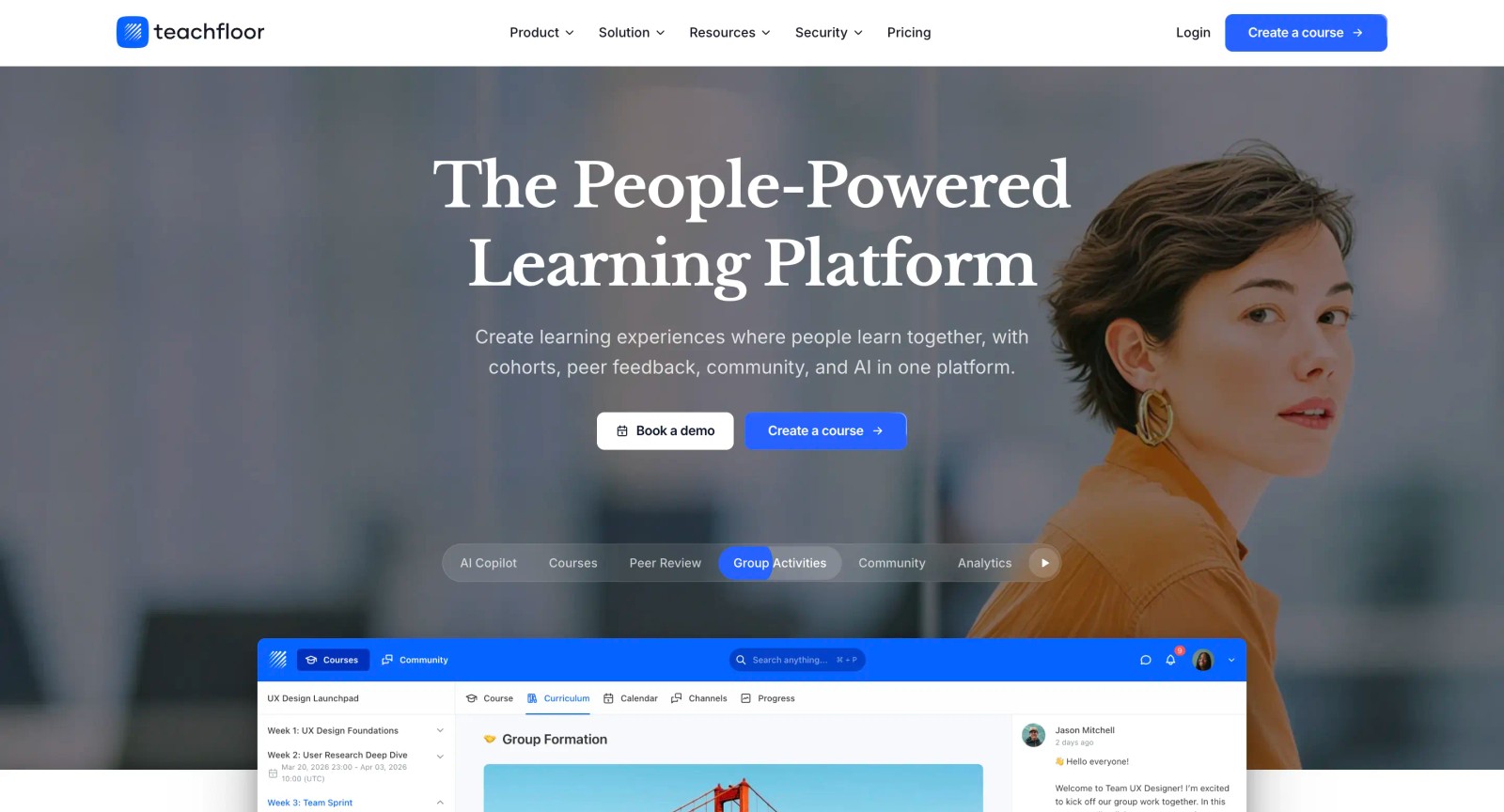
Overview
Teachfloor is a course platform for delivering product, compliance, and continuing-education training and recording who completed it. Agents and adjusters carry licenses with CE requirements that vary by state and product, and the platform keeps that training and its completion certificates in one place. Courses run self-paced, and multi-branch workspaces separate training by region, line of business, or agency while head office retains a single view. White-label delivery on the carrier's own domain keeps training within the company's brand, and AI-assisted authoring is available for updating modules as rules change.
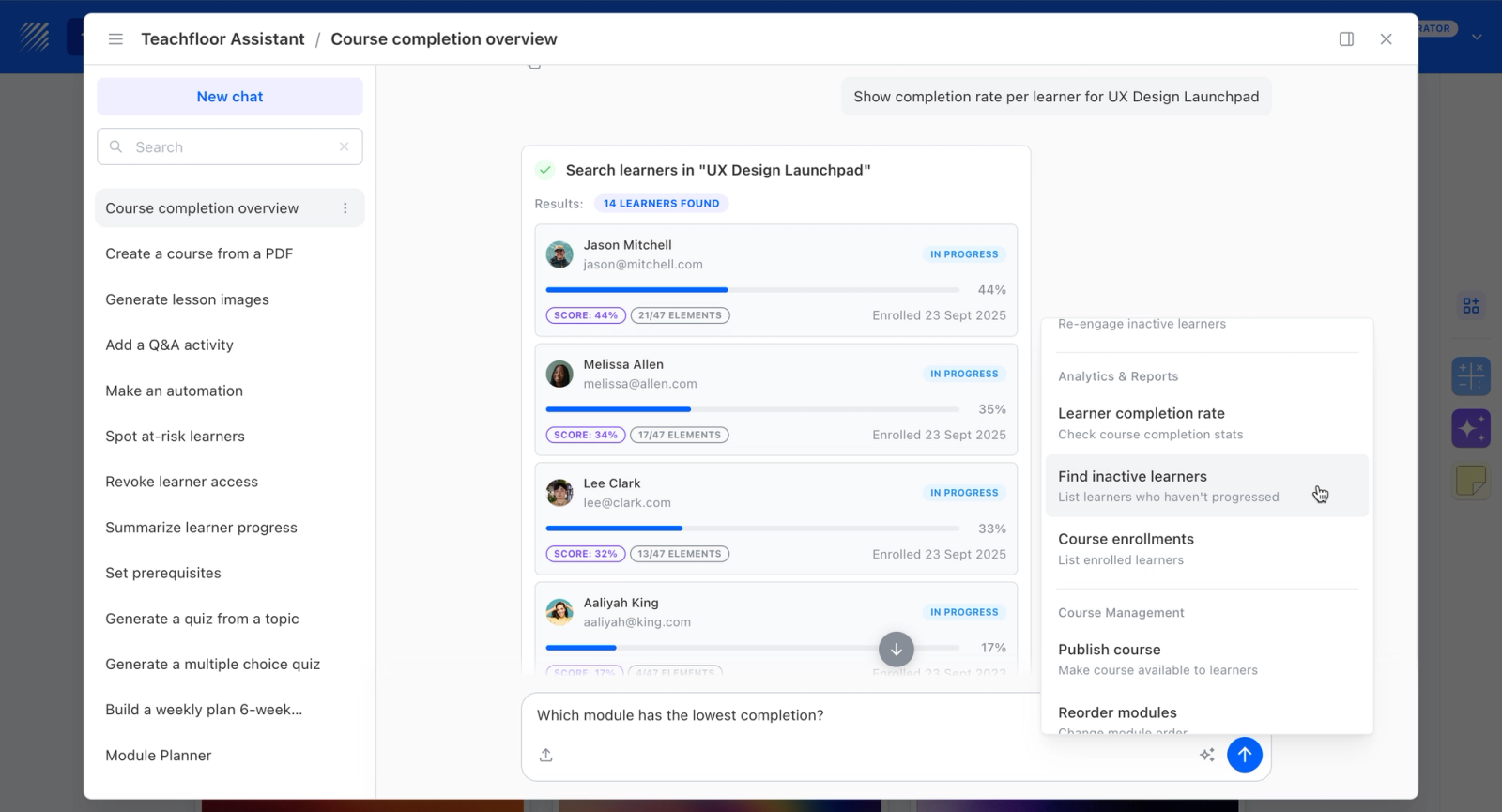
Core Capabilities
- Self-paced courses for product, ethics, suitability, and compliance training, each producing a dated completion certificate
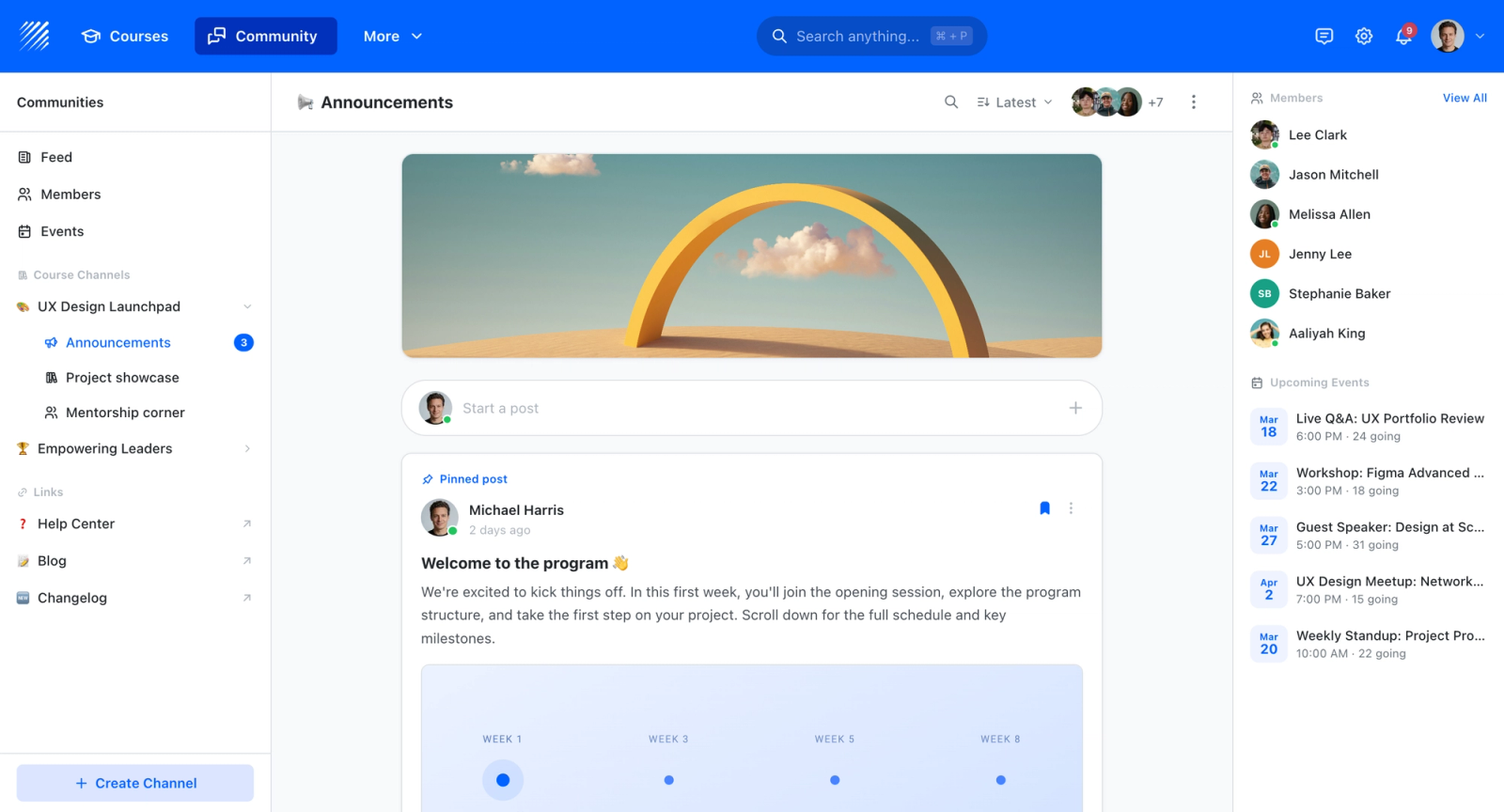
- Multi-branch workspaces to organize training and records by state, line of business, or agency under one org-wide view
- White-label delivery on the carrier or agency's own domain
- AI-assisted authoring for updating product and regulatory modules as filings change
- Quizzes, certificates, and per-agent completion analytics for internal audit
Best For
Carriers, MGAs, and agencies that deliver product and compliance training and need a per-agent, multi-jurisdiction completion record.

Pricing Overview
- Startup plan from $89 per month for up to 50 learners
- Full Features plan with custom pricing, white-label, SSO, and advanced integrations
- 14-day free trial; no permanent free plan
- Nonprofit discounts available
Limitations
- Not an accredited CE provider and does not file approved CE credits to state reporting systems; it records and certifies completion only
- No built-in license-renewal date tracking or automated CE-deadline alerts
- No permanent free plan; pricing starts at $89/mo for up to 50 learners
Quick Comparison Insight
Teachfloor covers branded delivery and per-agent completion records. It does not file accredited CE credits to state reporting systems or track license-renewal deadlines, those functions sit with platforms like Cornerstone, Totara, and LearnUpon, which are built around larger compliance content libraries and HR-suite integration.
Cornerstone OnDemand
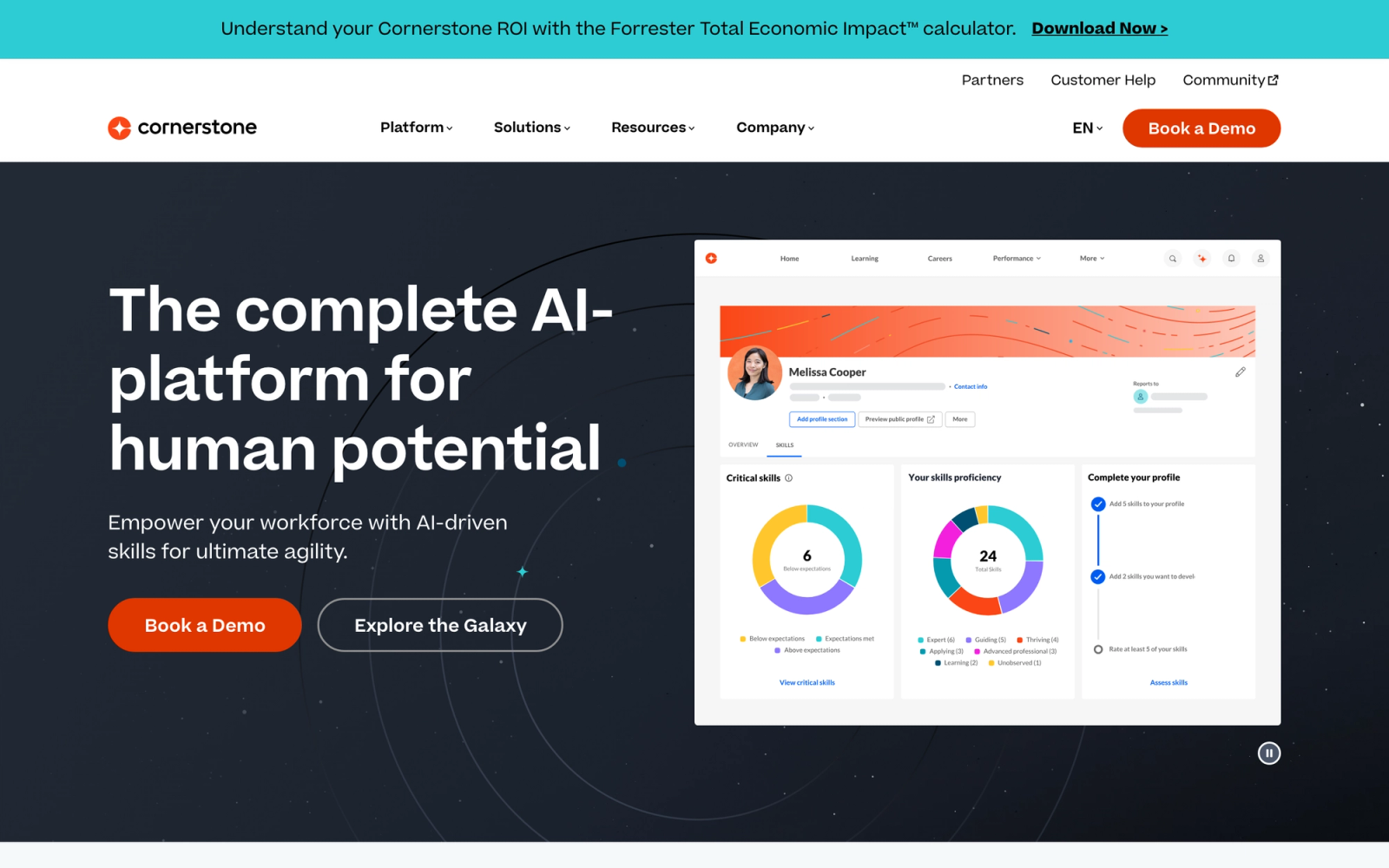
Overview
Cornerstone OnDemand is an enterprise talent management platform that includes a full learning management system as part of its broader HR suite. In the insurance space, Cornerstone is most commonly deployed by large carriers, national agencies, and insurance holding companies that need to unify learning, performance management, and compliance across thousands of employees and agents.
The platform's strength for insurance lies in its compliance engine. Cornerstone can handle complex regulatory training requirements by mapping courses to specific compliance mandates, automating assignment based on role and location, and generating audit-ready completion reports. For carriers managing licensing requirements across all 50 states, that level of automation is not optional.
Core Capabilities
- Automated compliance assignment rules based on role, location, license type, and department
- Configurable CE credit tracking with support for state-specific requirements and renewal cycles
- Multi-format content support including SCORM, xAPI, AICC, video, and virtual classroom integrations
- Advanced reporting engine with scheduled reports, compliance dashboards, and audit trail exports
- Skills and competency management tied directly to learning paths and performance reviews
- Extended enterprise module for training independent agents, brokers, and channel partners
- Mobile app (Cornerstone Learn) with offline content access for field-based staff
- Integration marketplace with pre-built connectors for major HRIS, AMS, and CRM platforms
- AI-driven content recommendations based on role, skill gaps, and compliance status
- Configurable approval workflows for manager sign-offs on completed training
Standout Strength
Cornerstone's defining advantage for large carriers is the connection between learning and talent management. When compliance training, performance reviews, skill assessments, and succession planning live in one platform, L&D teams can tie training outcomes to business results without reconciling data across systems. For carriers running annual performance cycles alongside mandatory compliance training, that integration removes a real operational burden.
Best For
Large insurance carriers, national agencies, and insurance holding companies with 1,000+ employees and agents. Particularly strong for organizations that need learning, compliance, performance, and succession in a single enterprise platform, and have the IT resources to configure and maintain it.
Pricing Overview
- Custom enterprise pricing based on user count and modules selected
- No public pricing; expect six-figure annual contracts for large deployments
- Free demo available upon request
Limitations
- Implementation is lengthy and resource-intensive, often requiring 3 to 6 months with dedicated project management
- The admin interface has a steep learning curve; smaller teams without dedicated LMS administrators may struggle
- Pricing puts it out of reach for small and mid-size agencies
Quick Comparison Insight
More powerful and broader than any other platform on this list, but significantly more complex and expensive. Best suited for organizations that need a full talent suite, not just an LMS.
Absorb LMS
Overview
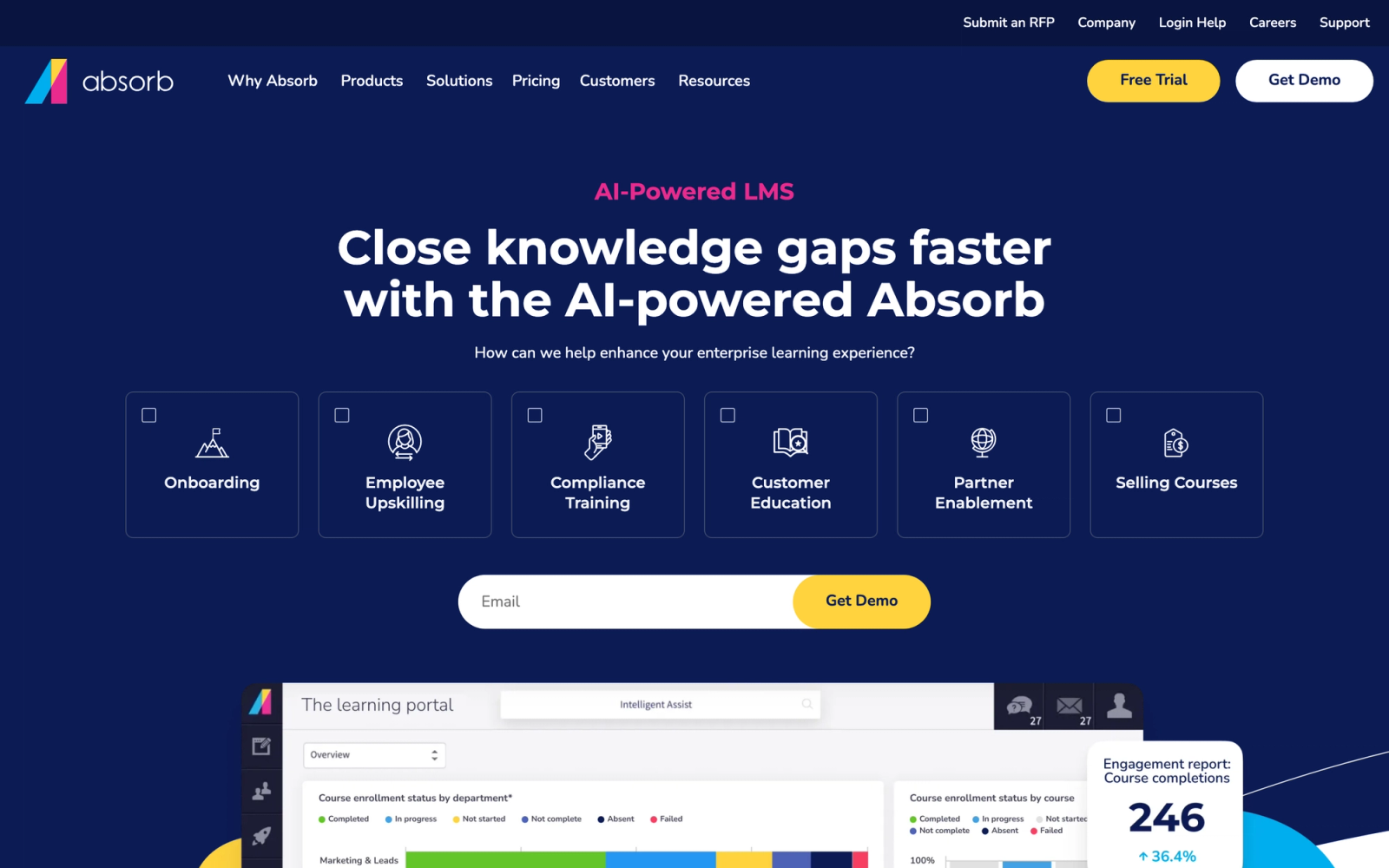
Absorb LMS positions itself as a corporate learning platform built for scale, and its user experience is one of the cleanest in the enterprise LMS market. For insurance companies, Absorb offers a strong balance between compliance rigor and learner experience, which matters when you are training agents who do not sit at a desk all day and have limited patience for clunky interfaces.
Absorb's learner-facing experience is notably polished for an enterprise platform. The interface is modern, the mobile app works well, and the platform surfaces intelligent course recommendations based on role and compliance status. For insurance organizations where agent engagement with training is a chronic problem, that UX investment is not cosmetic, it directly affects completion rates.
Core Capabilities
- Smart administration with automated enrollment rules based on department, role, location, and custom fields
- SCORM, xAPI, and AICC compliance for importing content from third-party insurance training providers
- Absorb Infuse, an embedded learning tool that lets you surface training inside CRM, AMS, or intranet portals
- Absorb Intelligence with AI-powered course recommendations, automated admin tasks, and predictive analytics
- Custom reporting with scheduled delivery, compliance-specific report templates, and data export
- E-commerce module for selling continuing education courses to external agents or brokerages
- Multi-language support for insurers operating across North America and international markets
- Absorb Engage with leaderboards, messaging, and social features to improve learner participation
- Observation checklists for hands-on skills verification in claims handling and field underwriting
- RESTful API and pre-built integrations with Salesforce, ADP, BambooHR, and other enterprise tools
Standout Strength
Absorb delivers enterprise compliance capabilities without the configuration overhead that typically accompanies them. The admin experience is intuitive enough that a compliance officer can manage training assignments without a dedicated LMS administrator. Absorb Infuse is particularly relevant for insurance: it embeds training content directly into the systems agents already use, agency management platforms, CRMs, intranet portals, eliminating the context switch to a separate learning portal.
Best For
Mid-to-large insurance companies with 500 to 20,000 learners who need compliance automation, a strong mobile experience, and a platform their agents will actually use. Especially relevant for carriers that sell CE courses to independent agents through the e-commerce module.
Pricing Overview
- Custom pricing based on active learner count
- Typically starts in the mid-five-figure range annually for mid-size deployments
- Free demo and guided trial available
Limitations
- CE credit tracking requires configuration and sometimes third-party integrations rather than working natively out of the box
- Advanced reporting customization, while capable, can require support involvement for complex compliance queries
- Content authoring is limited compared to platforms with built-in course builders; most teams import SCORM packages
Quick Comparison Insight
Better learner experience than Cornerstone with less implementation overhead. Less depth in talent management, but more focused on the learning and compliance use case that insurance companies prioritize. For a broader comparison, see our review of Absorb LMS alternatives.
SAP Litmos
Overview
SAP Litmos is a cloud-based LMS that prioritizes speed of deployment and ease of use. Originally an independent product, it became part of the SAP stack before operating again as a standalone entity. For insurance companies, SAP Litmos stands out because it can go from contract signing to live training delivery faster than most enterprise LMS platforms, often within days rather than months.
The platform includes a built-in content authoring tool and a library of off-the-shelf compliance courses, which matters for insurance agencies that need to launch regulatory training quickly without building everything from scratch. The authoring tool is designed for speed: a basic compliance module can be built and published in under 30 minutes. That speed matters when a new state regulation requires all agents to complete training within a tight window and an instructional design queue would create a bottleneck.
Core Capabilities
- Built-in course authoring tool for creating SCORM-compliant training without external software
- Pre-built compliance course library covering topics common to insurance, including ethics, anti-fraud, and data privacy
- Automated training assignment based on teams, roles, locations, and custom attributes
- CE tracking with configurable credit types and completion-based certificate generation
- Multi-tenant architecture for managing separate training environments for different business units or agency networks
- Video assessments for evaluating soft skills like customer communication and claims negotiation
- Gamification features including points, badges, and leaderboards to drive course completion
- Mobile app with full course access for field agents and remote adjusters
- Extensive integration library with over 30 pre-built connectors including Salesforce, BambooHR, and Slack
- Automated compliance reporting with scheduled delivery and expiration alerts
Standout Strength
SAP Litmos earns its place in regulated industries primarily through deployment speed. When a regulatory change hits and every agent in a specific state needs retraining within 30 days, the combination of built-in authoring, an off-the-shelf compliance content library, and a deployment cycle measured in days rather than months removes bottlenecks that stall other platforms. The learning path feature lets compliance teams build state-specific training sequences without creating separate courses for each jurisdiction.
Best For
Mid-size insurance companies, MGAs, and agency networks with 200 to 10,000 learners that prioritize fast deployment and need both authored and off-the-shelf compliance content. Particularly strong for organizations with lean L&D teams that need to move quickly without dedicated instructional designers.
Pricing Overview
- Starts at $3 per user per month for the basic plan (minimum user thresholds apply)
- Content library access is an additional subscription
- Free 14-day trial available
Limitations
- Reporting is functional but not as customizable as Cornerstone or Absorb for complex, multi-state compliance queries
- The built-in authoring tool handles basic content well but lacks the depth of standalone tools for complex interactive scenarios
- Some users report that the admin interface feels dated compared to newer platforms like Absorb
Quick Comparison Insight
Faster to deploy than Cornerstone and less expensive than Absorb for mid-size organizations. Trades some reporting depth for speed and simplicity, which is the right trade-off for agencies that need to get compliant quickly.
Docebo
Overview
Docebo is an AI-powered learning platform that has built a strong reputation in the enterprise market. For insurance companies, Docebo's relevance centers on its ability to manage complex learning stacks with multiple audiences, content sources, and compliance requirements in a single platform.
What makes Docebo distinct in the insurance context is its approach to content aggregation. The platform connects to third-party content providers, internal course libraries, and informal learning resources, then uses AI to recommend the right content to each learner based on their role, skills, and compliance status. For a carrier managing training across underwriters, claims adjusters, agents, and back-office staff, that content orchestration solves a real fragmentation problem.
Core Capabilities
- AI-powered content recommendations that match training to individual roles, skills gaps, and compliance needs
- Multi-audience architecture with separate portals for employees, agents, partners, and customers
- Docebo Content Marketplace integration with providers like LinkedIn Learning, Skillsoft, and custom insurance content libraries
- Automated compliance workflows with configurable recertification rules, expiration alerts, and manager notifications
- Built-in social learning features including Q&A forums, expert channels, and peer contributions
- Docebo Shape for converting existing documents and presentations into interactive e-learning modules
- Advanced analytics with customizable dashboards, compliance heatmaps, and predictive completion tracking
- White-label capabilities for creating branded learning portals for different business units or agency networks
- API-first architecture with 400+ integrations including Salesforce, Workday, and Microsoft Teams
- Skills management framework that maps training completion to competency models
Standout Strength
Docebo's main differentiator for insurance is how it handles audience complexity. A large carrier may need separate branded portals for internal employees, captive agents, independent brokers, and policyholders, each with different content libraries, compliance requirements, and access controls. Docebo manages that from a single platform instance, which cuts both licensing cost and the administrative burden of keeping separate systems in sync. For a deeper look at how Docebo compares, see our analysis of Docebo alternatives.
Best For
Large insurance carriers and holding companies with 2,000+ learners across multiple audience types. Ideal for organizations with complex content stacks that need AI-driven recommendations, multi-portal architecture, and deep integrations with existing enterprise tools.
Pricing Overview
- Custom pricing based on number of active users and modules
- Enterprise plans typically start in the mid-five-figure range annually
- Free demo available; no public free trial
Limitations
- Initial setup and configuration for complex multi-audience deployments can take 2 to 4 months
- The breadth of features means a steeper learning curve for administrators new to enterprise LMS platforms
- Smaller organizations may find the platform over-built for their needs and budget
Quick Comparison Insight
More AI-driven than Cornerstone and better at multi-audience management than Absorb. Less focused on talent management, more focused on learning stack orchestration. The right fit when content complexity is your primary challenge.
TalentLMS
Overview
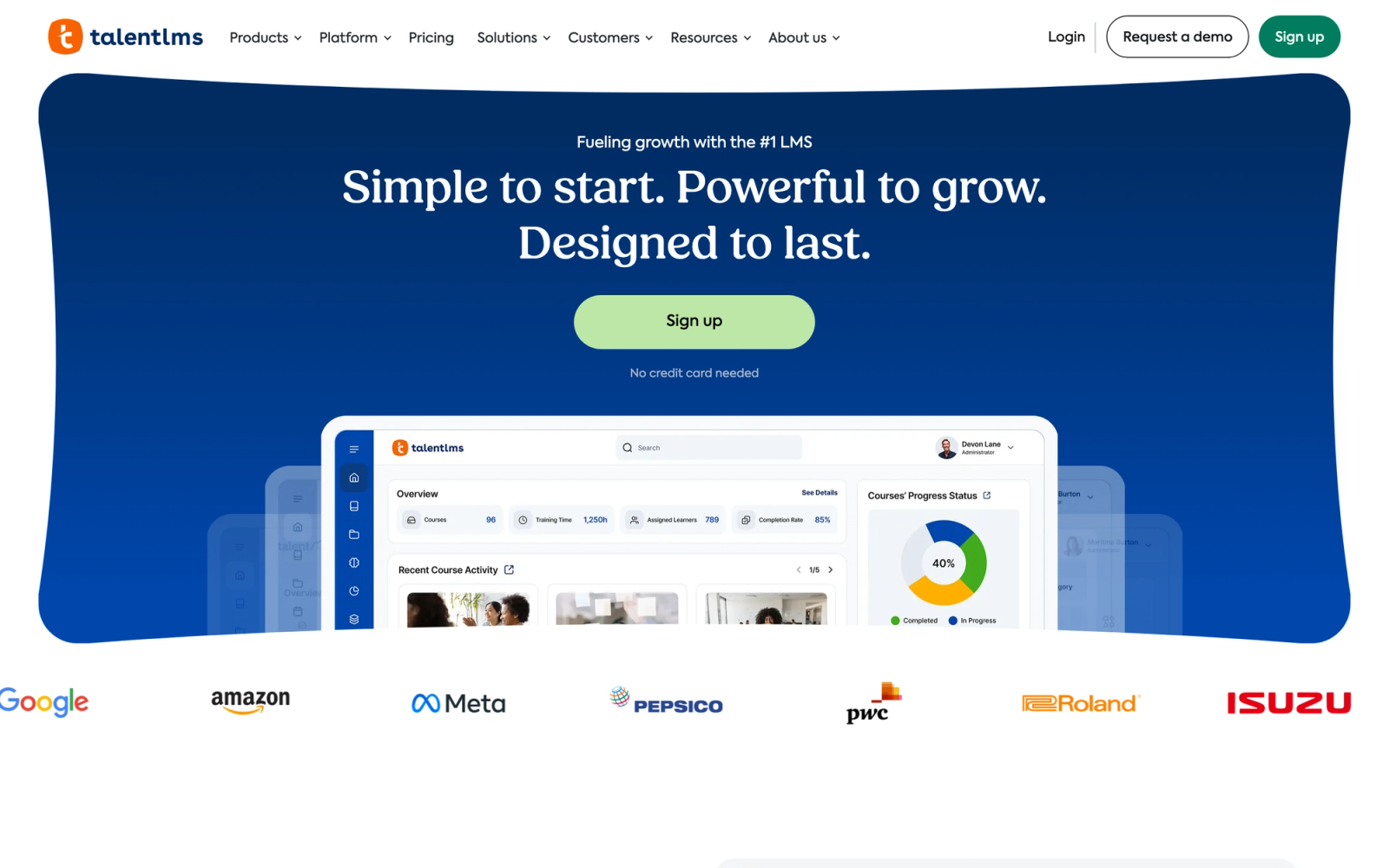
TalentLMS is a lightweight, cloud-based learning management system designed for simplicity and fast setup. It sits at the opposite end of the market from enterprise platforms like Cornerstone and Docebo, serving small to mid-size organizations that need a functional LMS without the configuration burden and cost of enterprise tools.
For small insurance agencies and brokerages, TalentLMS offers an accessible entry point to structured training. The platform lets you create courses, assign them to agents, track completions, and generate basic reports within hours of signing up. Setup time is measured in hours, not months. A compliance course can be published and assigned to a user group in under an hour, which matters for agencies that have been managing training through email attachments and shared drives and need a trackable system without a formal implementation project.
Core Capabilities
- Intuitive course builder with support for text, video, presentations, SCORM, and xAPI content
- Automated course assignment based on user groups, roles, and branches
- Certification management with configurable expiration and automatic re-enrollment
- Built-in assessment engine with multiple question types, randomized question pools, and pass/fail thresholds
- Gamification features including points, badges, leaderboards, and custom achievement levels
- Branch and sub-account structure for managing separate teams or office locations
- E-commerce functionality for selling training courses to external agents
- Pre-built integrations with Zapier, Salesforce, Slack, and videoconferencing tools
- Custom reports with export options and scheduled report delivery
- White-label portal with custom branding, URL, and login page
Standout Strength
TalentLMS removes the barriers to getting started. There is no implementation project, no consultants, and no six-month rollout. For a 50-person agency that needs to get training organized and trackable, the platform delivers core functionality at a price point and complexity level that matches the problem. The 8 best TalentLMS alternatives article covers how it compares to other accessible platforms.
Best For
Small insurance agencies, independent brokerages, and regional carriers with under 500 learners. Strong for organizations launching their first structured training program or replacing informal training processes with a trackable system.
Pricing Overview
- Free plan for up to 5 users and 10 courses
- Starter plan at $69 per month for up to 40 users
- Basic plan at $149 per month for up to 100 users
- Custom pricing for larger deployments
Limitations
- CE credit tracking is manual; the platform does not natively integrate with state insurance department reporting systems
- Reporting is adequate for basic needs but lacks the depth required for complex multi-state compliance audits
- Branch architecture has limits for true multi-tenant scenarios with separate admin hierarchies
Quick Comparison Insight
Significantly easier and cheaper to deploy than Cornerstone, Absorb, or Docebo. Trades compliance automation depth for simplicity, which works for small agencies but becomes a limitation as regulatory complexity grows.
LearnUpon
Overview
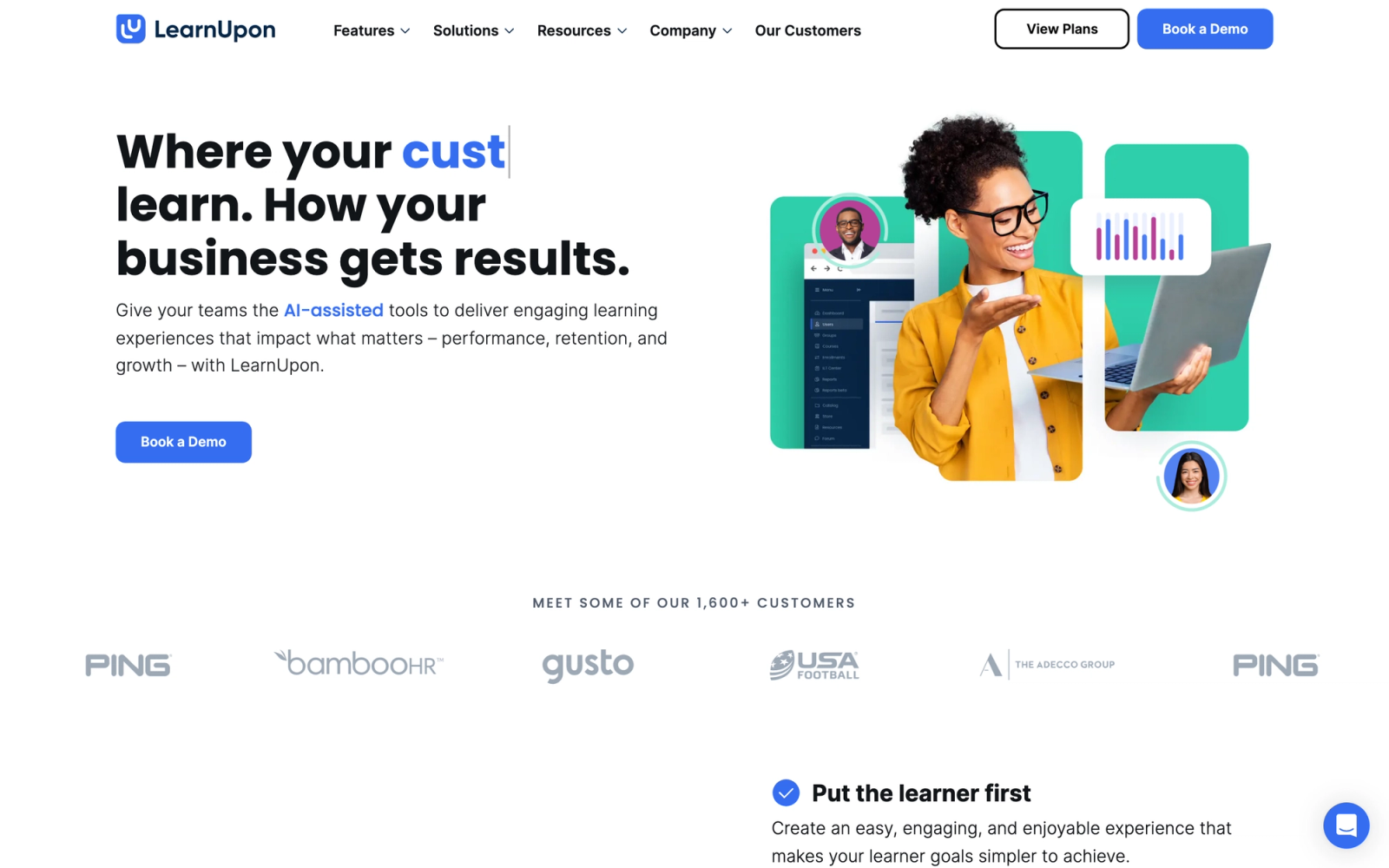
LearnUpon is a corporate LMS that has carved out a strong position in multi-audience training. The platform's portal architecture lets organizations create distinct training environments for different learner groups, each with their own branding, content, and compliance requirements, all managed from a single admin backend.
For insurance companies, this portal model maps directly to how training is structured. A carrier might need one portal for internal underwriting staff, another for captive agents, a third for independent broker training, and a fourth for claims adjuster certification. LearnUpon handles that separation cleanly without requiring separate platform instances, which simplifies administration and reduces cost.
Core Capabilities
- Multi-portal architecture with independent branding, content libraries, and user management per portal
- Automated enrollment rules based on group membership, role, location, and custom user attributes
- Certification and recertification workflows with configurable expiration periods and automatic re-enrollment
- Built-in content authoring alongside SCORM, xAPI, and video content support
- Exam engine with question banks, randomization, proctoring options, and configurable pass marks
- Learning paths that sequence courses for structured agent onboarding and certification tracks
- Webinar and virtual classroom integrations with Zoom, Microsoft Teams, and GoTo
- Salesforce, BambooHR, and Zapier integrations for data synchronization with HR and CRM systems
- Custom reporting dashboards with compliance-focused templates and scheduled report delivery
- E-commerce with Stripe and PayPal integration for selling CE courses to external learners
Standout Strength
LearnUpon's portal model is genuinely differentiated for multi-audience insurance organizations. Each portal operates independently from the learner's perspective, with its own login, branding, and content library. From the admin side, reporting, user management, and content sharing span all portals. For MGAs and carriers managing both internal staff and extended agent networks, that separation without platform duplication is the core value proposition.
Best For
Mid-size insurance companies, MGAs, and managing general agencies with 500 to 15,000 learners across multiple audience types. Ideal for organizations that train both internal staff and external agent networks, and need clean separation between those audiences without running multiple platforms.
Pricing Overview
- Custom pricing based on user count and number of portals
- Mid-market pricing; typically less expensive than Cornerstone or Docebo for comparable user counts
- Free demo and guided trial available
Limitations
- The built-in authoring tool is functional but not as capable as standalone tools for complex interactive content
- AI-driven features like content recommendations are less mature than Docebo's
- Complex portal configurations with many shared content items can require careful planning to avoid duplication
Quick Comparison Insight
Better multi-audience management than TalentLMS and SAP Litmos at a lower price point than Docebo. Less AI sophistication, but the portal architecture is cleaner and simpler to manage for organizations with distinct learner groups.
Totara Learn
Overview
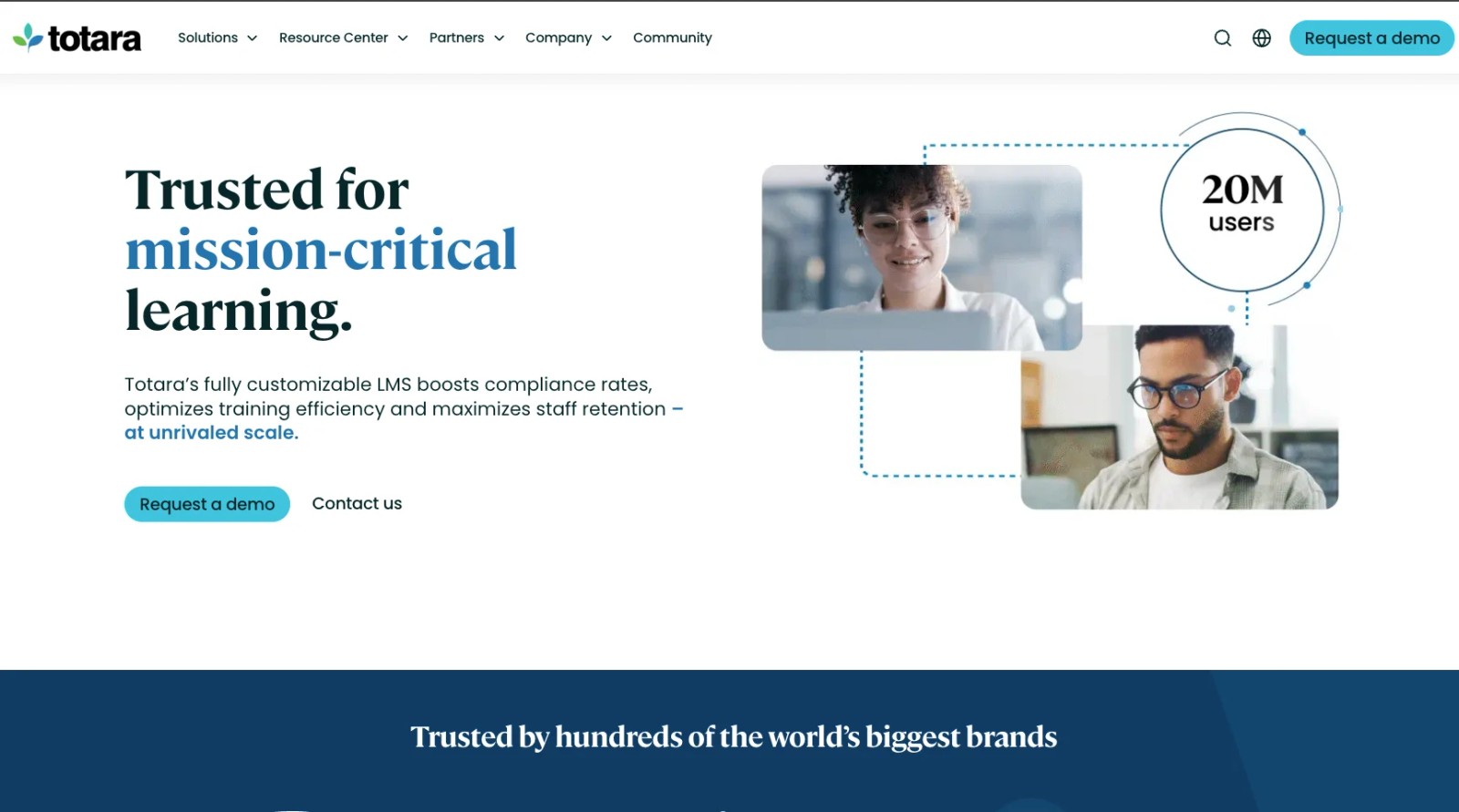
Totara Learn is an open-source enterprise learning management system that gives organizations full control over their platform. Built on a Moodle foundation but significantly re-engineered for corporate use, Totara is deployed by insurance companies that need deep customization, on-premise or private cloud hosting, and the ability to modify the platform's source code to meet specific regulatory requirements.
The open-source model is Totara's defining characteristic. Insurance companies that operate in highly regulated environments sometimes face requirements that no SaaS LMS can accommodate out of the box, like specific data residency rules, custom audit logging, or integration with legacy policy administration systems. Totara's open architecture lets internal teams or implementation partners build those capabilities directly into the platform.
Core Capabilities
- Open-source codebase with full access to modify, extend, and customize platform behavior
- Flexible deployment options including on-premise, private cloud, and managed hosting
- Competency frameworks that map training to role-specific skill requirements and compliance mandates
- Configurable compliance tracking with automated assignment, due date management, and escalation workflows
- Audience-based content delivery with flexible rules for targeting training by role, department, and location
- Seminar and event management for instructor-led training sessions and workshops
- SCORM, xAPI, and AICC content support with detailed learning record tracking
- Custom report builder with SQL-level query access for advanced compliance and audit reporting
- Totara Engage for informal and social learning alongside formal compliance programs
- Program and certification management with multi-course curricula and recertification cycles
Standout Strength
Totara suits insurance organizations that have requirements no SaaS vendor can accommodate without a contract negotiation. Data residency rules that prohibit cloud storage outside specific jurisdictions, legacy policy administration systems that need custom database connectors, regulatory mandates requiring non-standard audit trail formats, Totara's open-source model lets internal teams or implementation partners build those capabilities directly into the platform. For large carriers with dedicated IT staff, that control is worth the trade-off in convenience.
Best For
Large insurance carriers and reinsurers with dedicated IT and L&D teams, typically 2,000+ learners. Ideal for organizations with strict data sovereignty requirements, complex legacy system landscapes, or regulatory mandates that require platform-level customization not available in SaaS products.
Pricing Overview
- Subscription-based licensing through Totara partners (not direct from Totara)
- Pricing varies by partner, deployment model, and user count
- Implementation and hosting costs are separate from licensing fees
- No free trial; demos available through certified partners
Limitations
- Requires technical resources for deployment, customization, and ongoing maintenance; not a self-service platform
- The learner interface, while improved, is not as polished as Absorb or Docebo
- Implementation timelines are typically 3 to 6 months depending on customization scope
Quick Comparison Insight
More customizable than any SaaS option on this list, but that flexibility comes with higher implementation and maintenance costs. The right choice when regulatory or technical requirements eliminate SaaS options, not when you simply want more control.
How to Choose the Right LMS for Your Insurance Organization
Selecting an LMS based solely on feature lists leads to poor decisions. The right platform depends on your organization's specific compliance obligations, training audiences, and operational maturity. The following framework structures the evaluation around the factors that actually determine fit.
Start with your compliance requirements. Map out every state where you have licensed agents, the CE requirements for each state and license type, and the reporting formats your regulators expect. If your compliance footprint is complex (20+ states, multiple license types, frequent regulatory changes), you need platforms with strong automation: Cornerstone, Absorb, SAP Litmos, or Docebo. If your compliance needs are simpler, TalentLMS or LearnUpon can handle the basics.
Define your audience architecture. Count how many distinct learner groups you need to serve. Internal employees, captive agents, independent agents, brokers, and policyholders each have different content needs and access requirements. If you serve three or more distinct audiences, LearnUpon's portal model or Docebo's multi-audience architecture will save you significant administrative overhead compared to platforms that require workarounds for audience separation.
Assess your internal capabilities. Enterprise platforms like Cornerstone and Totara deliver more power but require dedicated administrators, longer implementation cycles, and ongoing technical maintenance. If your team is small, SAP Litmos, TalentLMS, or LearnUpon will get you productive faster with less overhead. An LMS evaluation checklist can help structure this assessment systematically.
Consider what training goes beyond compliance. If your only goal is regulatory training delivery, a compliance-focused LMS is sufficient. But if you also run agent development programs, onboarding academies, or leadership training that benefits from peer interaction and live instruction, consider pairing a compliance LMS with a collaborative platform like Teachfloor for those programs.
Run a pilot before committing. Insurance LMS implementations are expensive to reverse. Use free trials and guided demos to test each platform with real compliance scenarios, real content, and real users. Pay particular attention to how the platform handles your most complex compliance workflow, not the simplest one. How you measure ROI in employee training will depend partly on the data your LMS can actually produce.
FAQ
What is the best LMS for insurance agent compliance training?
For large carriers with complex multi-state compliance requirements, Cornerstone OnDemand and Absorb LMS provide the deepest compliance automation. For mid-size organizations that need strong compliance without enterprise complexity, SAP Litmos and LearnUpon offer a good balance. TalentLMS works for small agencies with straightforward compliance needs.
Can an LMS track CE credits for insurance agents?
Yes, but the depth of CE tracking varies significantly between platforms. Cornerstone, Absorb, and Docebo can be configured to track CE credits by state and license type with automated reporting. SAP Litmos includes built-in CE tracking with certificate generation. TalentLMS handles basic certification tracking but requires more manual management for state-specific CE requirements.
Do insurance companies need a separate LMS for independent agents?
Not necessarily. Platforms like LearnUpon, Docebo, and Cornerstone support multi-tenant or multi-portal architectures that let you create separate training environments for independent agents within the same platform. This is typically more efficient than maintaining separate systems, as it allows content sharing and centralized reporting across all agent types.
How much does an LMS for insurance companies cost?
Pricing ranges widely. TalentLMS offers a free plan for small teams and paid plans starting at $69 per month. Mid-market platforms like SAP Litmos start around $3 per user per month. Enterprise platforms like Cornerstone, Absorb, and Docebo typically involve custom pricing in the mid-five-figure to six-figure annual range depending on user count and features. Understanding LMS pricing models helps you compare total cost of ownership accurately.
What content standards should an insurance LMS support?
At minimum, your LMS should support SCORM 1.2 and SCORM 2004 for importing packaged content from third-party providers. xAPI (Tin Can) support is increasingly important for tracking learning activities beyond traditional course completions, like on-the-job observations and simulations. All eight platforms in this list support SCORM; most also support xAPI to varying degrees.
Can I use an LMS for claims adjuster training specifically?
Yes. Claims training typically involves scenario-based exercises, documented completion records, and audit trails. Platforms like Absorb (with observation checklists), Docebo (with social learning features for case discussions), and Teachfloor (with collaborative case-based training cohorts) each handle claims training differently. The right choice depends on whether your claims training is primarily self-paced compliance content or instructor-led skill development.


