

Online bootcamps reshaped how people learn job-ready skills. This guide explains why the model works and walks you through how to build and launch a successful online bootcamp of your own.
Teachfloor is the platform built for bootcamp founders and course creators who run intensive, cohort-based learning, giving you live cohorts, a built-in community, peer review, and flexible payments in one place.
This guide:
- Defines what a bootcamp is and how it is changing online education
- Introduces the three pillars of a bootcamp business: marketing, education, and operations
- Helps you choose a business model
- Shows you how to find the product-market fit
- Provides practical tips for building an entire bootcamp learning experience on Teachfloor
- Answers the frequently asked questions about creating a successful bootcamp
What is a Bootcamp?
The concept of a bootcamp comes from the fitness bootcamp, an intensive program that builds strength and endurance fast. An online bootcamp does almost the same, but instead of the body, it trains the mind to acquire a skill set needed for the future of work.
Online bootcamps are intensive training programs with short, rigorous curriculums focused on specific skills such as programming, design, data science, and marketing. They are also referred to as accelerated curriculums. Bootcamps stand apart as an education model because of how effectively they bridge the skills gap.
Bootcamp curriculums are designed and taught by industry experts, with mentoring and coaching on the side. It aims to produce graduates who are workforce-ready by focusing on applying skills rather than discussing theoretical frameworks like in traditional classrooms.
Why Online Bootcamps Are Winning
It Bridges the Skills Gap
According to the World Economic Forum, 50% of the workforce needs to reskill by 2025 to stay ahead of the curve. The skills gap is constantly widening, and the less expensive way to solve this within an organization is through upskilling and reskilling programs.
Online Bootcamps are widely known as an effective solution to upskill individuals and employees. Taught by industry experts with the guidance of mentors and coaches, students learn by doing and gain real job experience after they graduate. Compared to degrees, Bootcamps are short, proven effective, and produce job-ready graduates for hiring companies.
Companies Are Leaning Toward Skill-Based Hiring
Skills are now the currency of the workforce. A survey found that 81% of employers are agreeing to hire based on skills rather than degrees.
As a result, more hiring companies rely on bootcamps to connect them with graduates who have the right skills and mindset for in-demand jobs. To meet that demand, bootcamps offer job guarantee programs and career pathways to students who complete the training, with many graduates landing a job within 2-3 months.
Accessible, Fast, and Guaranteed
Compared to degrees, bootcamps are more accessible and faster, and many guarantee job placement. Because they run mostly online or in a hybrid format, they are location-independent. A student based in Japan can join an online coding bootcamp run from Madrid, Spain.
The average duration of Bootcamps is 2-6 months which is faster than a normal undergrad degree. Unlike degree programs, which last for 2-4 years, Bootcamps intensely focus on skill-based learning, where students only need to learn the skill in half a year instead of 4 years.
Financing Options are Available
Bootcamps can be cheap or expensive, depending on where you compare them. The average cost of a Bootcamp is around $2,000 to $20,000, depending on the course topic, online academy, duration, and inclusions.
In reality, not every student has the financial capacity to pay upfront or in installments. To solve this case, Bootcamp providers are partnering with fintech-ed-tech startups that provide financing loans to students who can't pay during the training.
Lambda School, one of the pioneers of the bootcamp model, popularized a business model called the Income Share Agreement (ISA), similar to a Study Now, Pay Later model. The difference is that students promise to pay a set percentage of their future salary once they get hired. Income is shared in exchange for the training.
Instant Portfolio After Graduation
The course design of an online bootcamp is different from most other online courses. Online bootcamps apply the learning sprint model and a project-based learning approach in live classes, where students build real projects while they study.
After finishing the course, students don't only get a certificate, but most importantly, a portfolio of projects to show hiring managers that they acquired the skills needed to enter the workforce.
What a Bootcamp Needs, and Why Teachfloor Is Built for It
A bootcamp is intensive, cohort-based, outcome-driven learning, and that is exactly what Teachfloor is built to run. Live cohorts, a built-in community for accountability, peer review and real projects, structured curriculum, screening and onboarding, and flexible payments all live on one platform. This section covers how to build a successful bootcamp on Teachfloor across the three pillars of a bootcamp business: marketing, education, and operations.
We will help you with:
- choosing your business model,
- finding the product-market fit, and
- understanding the main responsibilities of each team.
Choose a Business Model
Bootcamp business models revolve around these three:
| Model | How it works | Best for |
|---|---|---|
| Upfront | Students pay full tuition before the class starts; you can offer a 5-10% discount. | Fast ROI and simple operations. |
| Installments | Students pay monthly; you can add 5-20% interest since payment is spread out. | Students with financial constraints. |
| ISA / Deferred | Students pay a share of future salary (ISA) or a fintech loan covers tuition (deferred, 1-10% interest). | Programs confident in job placement. |
Upfront Payment
This is the simplest payment option. With this model you reach ROI faster, because you charge students the full tuition before the class starts.
But in reality, not all students have the capacity to pay in full. So either you also offer installment plans or you filter out those qualified students with financial constraints.
Installment or Monthly Payment
This model helps students with financial constraints. ROI is slower, but you can charge interest since you do not receive the payment in full upfront.
Income Share Agreement (ISA) and Deferred Payment
An Income Share Agreement (ISA) is a model where students pay a percentage of their future salary in exchange for the bootcamp. It is only advisable to run an ISA if you are confident you can place students in companies with mid-to-high salaries. If you cannot help graduates get jobs after the program, the model becomes a liability. Used well, an ISA is also a strong marketing angle to encourage students to enroll.
For students who pay upfront, you can offer an incentive such as a 5-10% discount off the full amount. For monthly payers, you can charge 5-20% interest, since you do not receive the full payment before the program. For ISA and deferred payments, the terms depend on your agreements with hiring companies and fintech partners.
Another deferred option is to partner with fintech startups that offer loans to students. They typically charge 1%-10% interest depending on the bootcamp cost. Unlike an ISA, the risk to you is low, and you do not have to place students in order to get paid.
A sample of different payment options.
Here is a simple example of how these options compare:
A sample of different payment options.
For students who pay upfront, you can give them an incentive of a 5-10% discount from the full amount. While for monthly payers, you can charge 5-20% interest since you don't get the full payment before the program.
Lastly, for ISA and deferred payments, it will highly depend on your negotiation/set of rules with your partnerships in companies and fintech partners.
Automate Your Payment Process
Teachfloor makes it easy for founders and their teams to collect payments from students with a customizable, automated payment flow. Whether you run all three business models or just one, you can configure each option once and let payments run on their own.
Decide on your bootcamp price, connect your Stripe account, enter the cost in the platform, and save it.

Launch Your First Cohort
After choosing your business model, it's time to find the product-market fit through experimentation and iteration. Some Bootcamps start with a small cohort of learners to test if their area of expertise or topic is an advantage and interesting enough for students. It's also a way to design the curriculum in a learner-centric way and to discover what works and what does not.
Launching your first cohort can be demanding; however, along the way of several iterations and keen observations, you are likely to build your processes and system flow. Although Bootcamps have similar business models, they operate and prepare their curricula differently. Finding your value proposition through iterations is the best way to do it. In reality, learner-centric Bootcamps survive longer than those that are not.
What you need to launch your first cohort
- A small cohort of 10-30 learners
- 1-2 instructors who are also willing to teach and mentor at the same time (the ratio can be 1 instructor: 15 students, 1 mentor: 5 students)
- A course topic, outline, format, and resources
- A dedicated team of 2-3 people
- A learning platform to make execution fast and easy
Create an Entire Bootcamp Experience on Teachfloor
Teachfloor.com
Bootcamp operations can be challenging, and the checklist keeps growing. To save time, use a learning platform that automates much of the routine work so you can focus on what matters.
Here is how to create an entire bootcamp learning experience with the Teachfloor all-in-one learning platform.
Pre-admission process
Students need time to decide whether to take the opportunity to change careers or venture into tech. It's a huge decision to make, like deciding what program to take in college.
To help them decide, you can organize info sessions, Q&As, and live workshops for potential students. These activities are huge factors in their decision-making and can help them explore the skills that they want to learn.
Zoom integration
You can host these virtual events inside Teachfloor through the Zoom integration. Some users also share a sneak peek of the content materials with prospective students to show what the program offers before training starts. Organizing virtual events and sharing content is straightforward on Teachfloor.
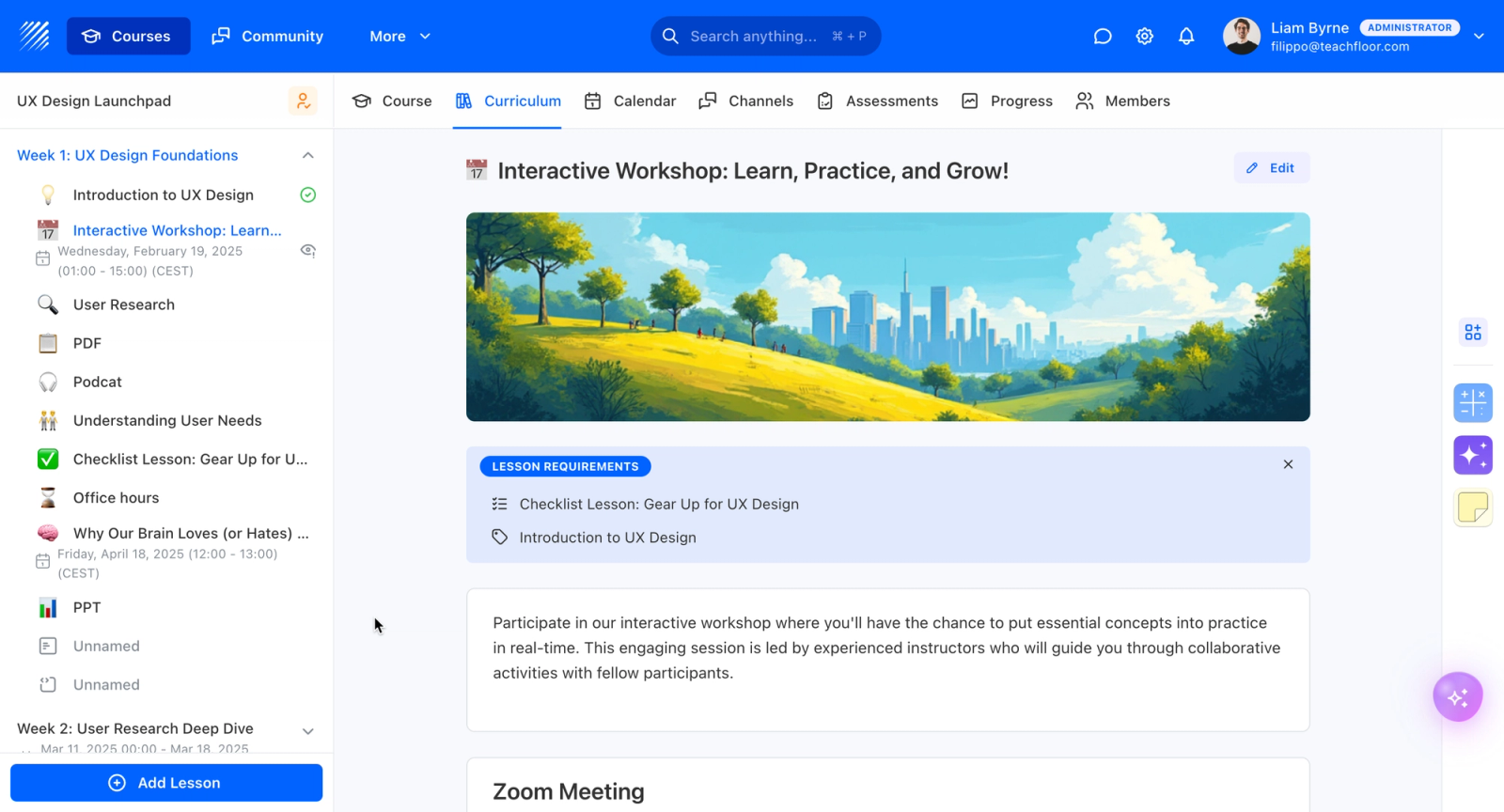
Conduct live classes with Zoom in 3 easy steps!
First, create a new course, named it “Pre-admission workshop”. Next, add a module, and in the module, add elements and choose Zoom. Then copy and paste or connect your Zoom account, and set the time and day of the workshop. Feel free to add another element for students to access the content materials. Lastly, invite members to join and they will receive an automatic email notification to remind them to attend your live workshop.
Assessment
If you decide to offer ISA as a payment option, filtering the best students to join your Bootcamp is crucial. You need to assess if they are a good fit. Do they have the right mindset to complete the training? Can they allot their time to the training? Here are a few metrics to assess the applicants completely:
- Pre-Bootcamp assessment test (do they have the basic skills in this Bootcamp?)
- Admission interview (are they a good fit who will complete the training and start a new career?)
- Financial assessment (are they eligible to pay upfront, installment, deferred, or ISA options?)
Another advantage of being careful in your assessment is to learn the skill level, personality, and other essential data of your students. You can use these to create a learner-centric learning experience later on.
Quizzes and surveys
Create interactive quizzes and survey forms inside Teachfloor and collect student data in one place instead of using Google Forms. Once you build an assessment, grades are checked automatically and student reports are available on the dashboard.
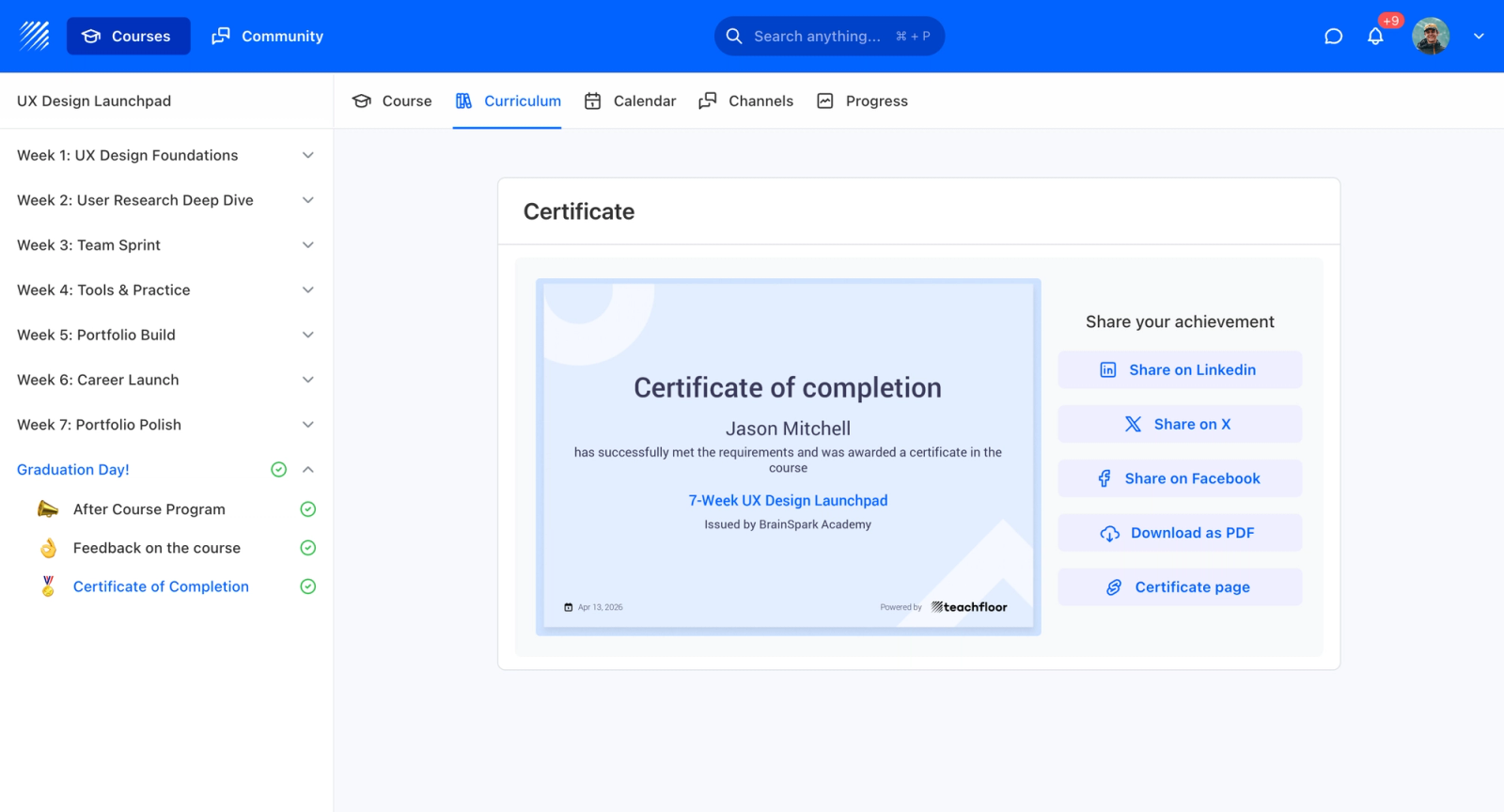
Create interactive survey, quizzes, and feedback form using Teachfloor.
Onboarding and enrollment process
Similar to onboarding a new employee, onboarding students in your Bootcamp can be vital. There are several things to remember, such as student contracts, codes of conduct, info sheets, payment schedules, learning materials, live orientation, etc.
Optimize and automate the enrollment process
By using Teachfloor, you can optimize and automate your enrollment process. Through our payment automation, it is easier to receive payments and customize financing options, unlike in manual payment collection. You can save at least 50% of your time by just automating your enrollment process.
Moreover, Teachfloor gives assistance to founders who want to set up a super-efficient and effortless system, including the integration of financial tools and reporting.
Curriculum design
Curriculum design is the core of the Bootcamp. Bootcamps mostly succeed with word-of-mouth and referrals after launching their first cohort. To achieve this, students need to love your course where they share their experience organically on social media and refer friends who want to study the same thing. And for you to do that, the curriculum itself should be transformational.
Tech Bootcamps become transformational with these most widely-used teaching methods:
- Learning Sprints - students are honed to work in an agile setting like how tech teams work in the real world.
- Project-based Learning - students are creating projects as a portfolio and learn based on the application.
- Cohort-based and community-based learning - students learn alongside a group and a community, which broadens what they pick up beyond the instructor alone.
Curriculum builder
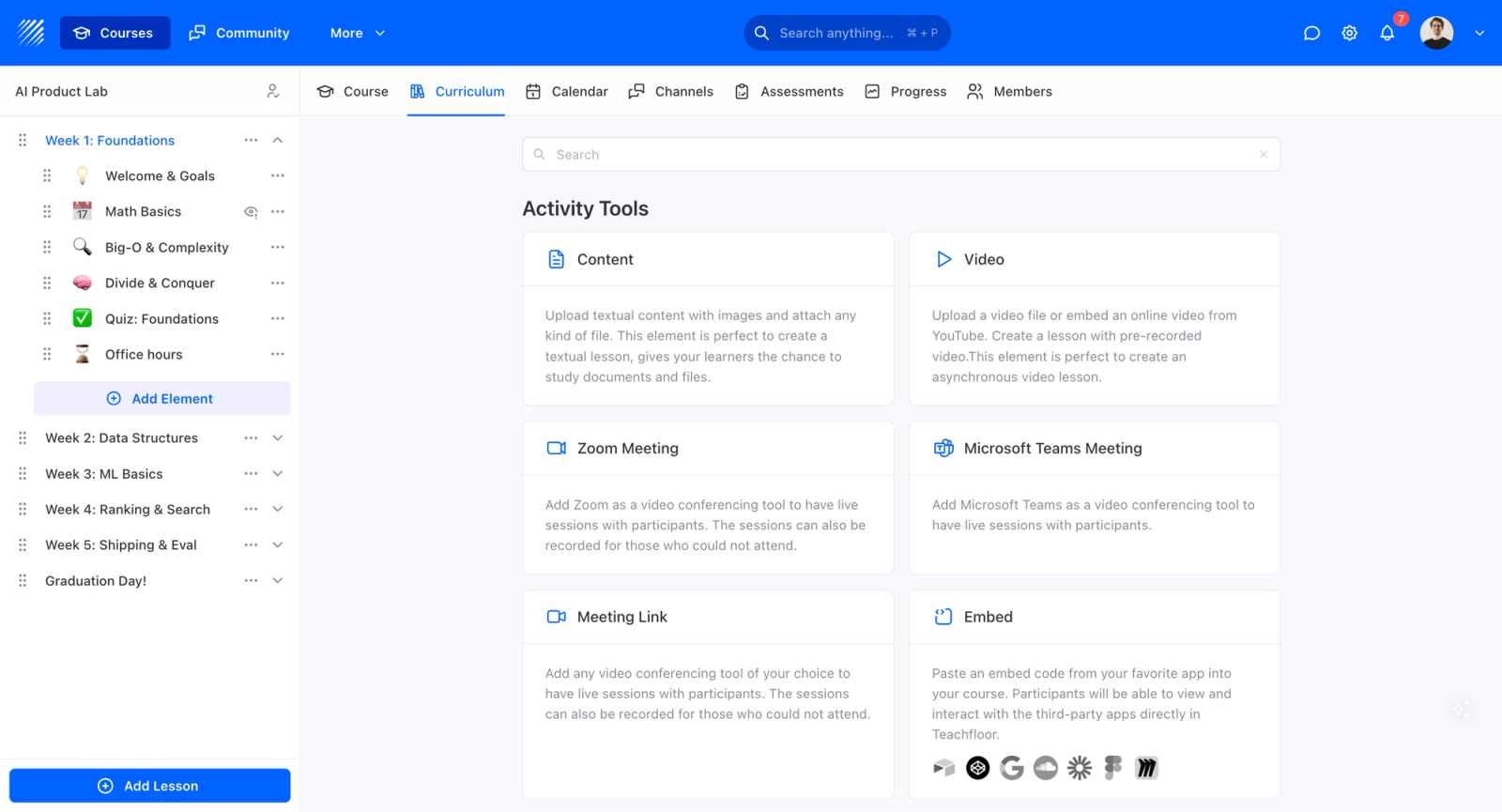
Teachfloor includes a curriculum builder that lets every course creator and instructor build a course in any format. Whether you are building a cohort-based course, a hybrid cohort, community-based learning, or a self-paced course, all of these are possible on Teachfloor.
Build your Bootcamp with our powerful curriculum builder!
Build your Bootcamp by adding elements, lessons, and course pages where you can literally drag and drop the elements and set them up in minutes. The platform’s intuitive design allows you to add Zoom links, write content, upload or link video URLs, embed code, integrate your favorite app, and many more!
Build your bootcamp by adding elements, lessons, and course pages with drag and drop, and set them up in minutes. The platform lets you add Zoom links, write content, upload or link video URLs, embed code, integrate your favorite apps, and more.
Course templates
If you are stuck designing your course, duplicate a Teachfloor course template in seconds so you do not start from scratch. The templates work as a guide with simple instructions, tips, and helpful resources. They are free and included on the platform.
Built-in community
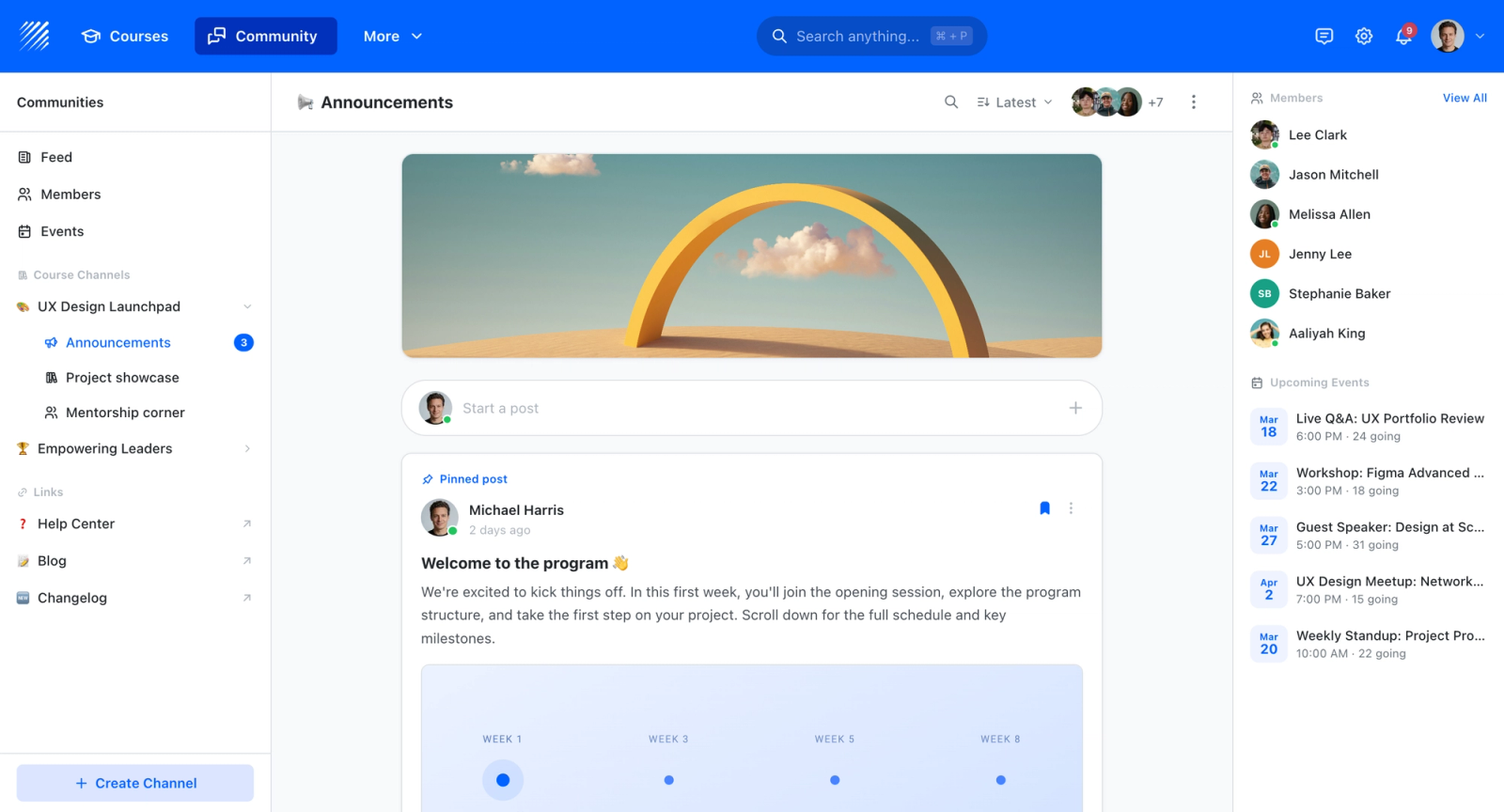
You do not need to build a community for your bootcamp outside Teachfloor. With one click, a built-in community sits alongside the curriculum builder on a single platform. If you currently use Slack, the built-in community offers familiar features such as a student wall, channels, direct messaging, group chats, reactions, and comments.
Scheduling and notifications
Cross out your other tasks, like reminding students to complete their assignments or attend the next live classes, by using the scheduling feature and setting up email notifications according to your preference.
Notify students according to your preference.
Peer review and instructor review
Struggling to keep students engaged? Build peer learning into your course design to increase interaction. With the peer review feature, students give and receive feedback from each other, and you can give structured feedback through instructor review.
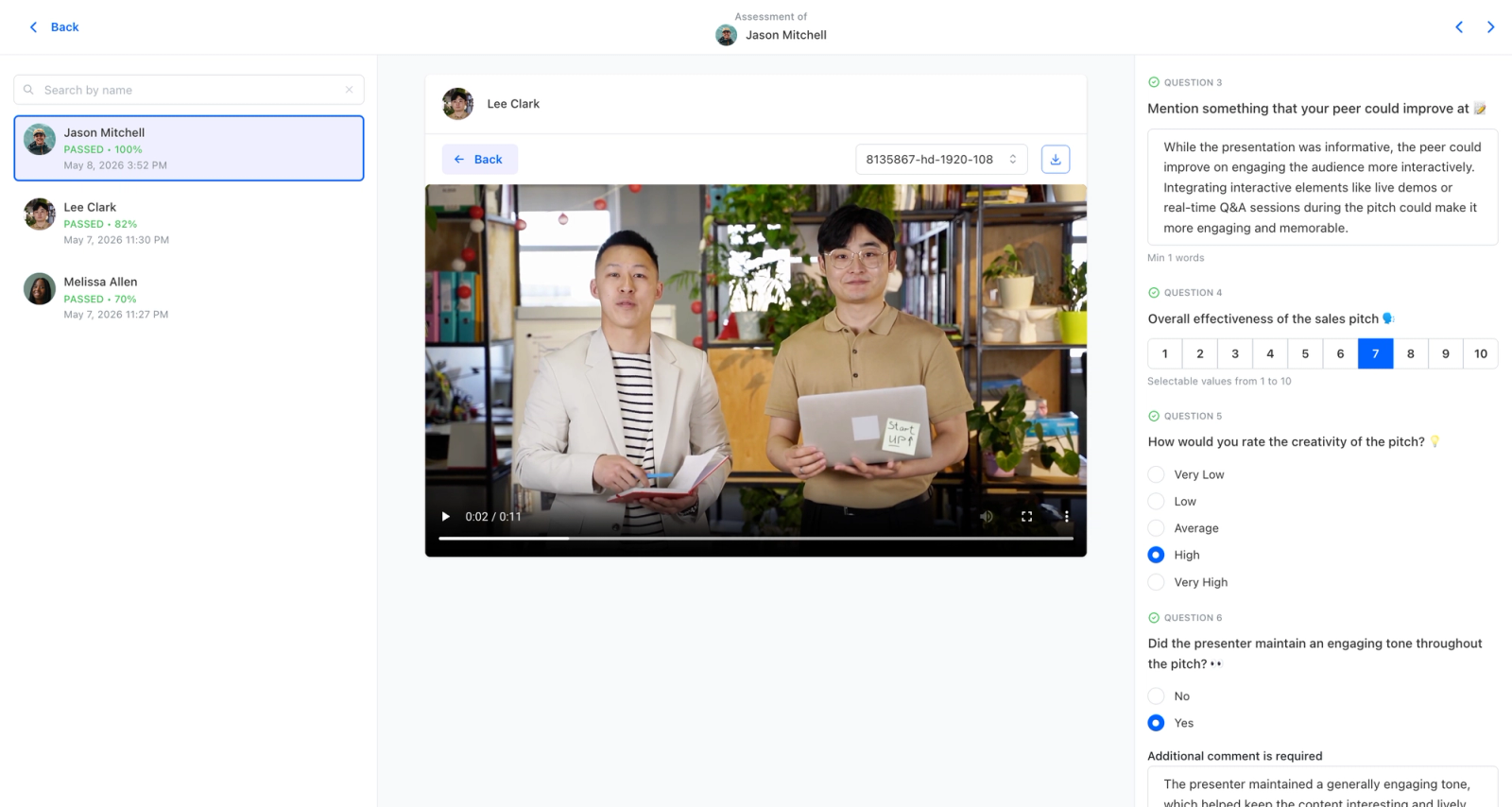
Integrate peer learning into your course to increase interaction among students.
Student reports and analytics
Apply personalized learning without manually checking performance. Student reports and analytics are available for instant tracking of your success metrics.
White-label solution
Lastly, don’t forget to brand your Bootcamp. Set up your logo, domain, and branding colors in Teachfloor’s platform without paying additional costs. This straightforward feature can be done in minutes.
Just go to Settings -> Customize, then you can set up the domain, label, and appearance of your platform.
Brand your Bootcamp on Teachfloor!
Job guarantee
Are you offering a job guarantee? Bootcamps work well because they offer clear career pathways for students after the training. They partner with companies that are hiring for entry-level positions in tech. These companies prefer Bootcamp graduates because they are more equipped than other candidates due to the intensive training that they receive from the Bootcamp experience.
Make sure to clearly state the terms & conditions of the job guarantee in the contract. You may organize a Q&A specifically for job guarantee so students can ask questions to learn the ins and outs before enrolling in the class.
Graduation and alumni community
Learning doesn’t end after the training. It should continue even after students graduate. Some Bootcamps create an alumni community to provide a space for collaboration, and partnership, and to build long-lasting relationships with each other. While others take this opportunity to offer referral programs for alumni, community-based learning, and membership communities.
It’s up to you how you design the after-Bootcamp perks. However, if you want to go further, you should consider these recommendations.
Unlimited activities
Do you have hundreds of course activities and a vast of content materials in your online academy? Teachfloor’s basic to premium subscription plan offers users the ability to create unlimited activities and storage, and enroll an unlimited number of students without paying additional costs. Get these perks for only $59 per month with the basic plan.
Teachfloor’s Basic Features, Unlimited Access
Start launching your cohort!
Feel free to test these steps in launching your first cohort. Observe what works and what does not. Ask for feedback from your students. Every Bootcamp may look similar from the outside, but they differ in internal operations.
Find the product market fit, your value proposition, or the reason “why” students should choose you over other Bootcamp providers. By doing so, you are building a system and processes that will allow you to scale on your 4th or 5th cohort.
It is a lot of work, and that is why Teachfloor removes much of your operational load through automation, so you can focus on the parts that are not scalable. **Start your 15-day trial now.**
Build Your Team
Once you achieve product-market fit after some experimentation, you can build your systems and processes simultaneously. Hiring and building a team should be your next steps.
As mentioned, we are going to tackle the three pillars of a Bootcamp business: Marketing, Education, and Operations. These pillars are all you need to build a team and scale. Here are samples of their tasks.
Marketing and community team
- Create a complete journey for your ideal persona from lead generation to conversion.
- Execute a multi-channel marketing strategy from social media to content marketing to affiliate marketing.
- Build a high-quality landing page that converts through no-code tools.
- Collect case studies, and student stories as social proof, and share them on social media.
- Build a brand, including logo, terms, Bootcamp names, tone of voice, etc.
- Build a self-managing alumni community and offer a referral program to alumni.
Education team
- Create all content materials, including activities, videos, texts, images, gifs, etc.
- Design the course curriculum, modules, and lessons that work well for your students.
- Decide on the course format, teaching methods, etc.
- Create assessment tests, quizzes, and exams.
- Set metrics for student success.
- Facilitate live classes, review sessions, workshops, webinars, info sessions, etc.
- Mentor students on technical skills and career journeys during and after Bootcamp.
Operations team
- Operate the whole Bootcamp experience from the admission process to assisting instructors in live classes and managing the learning platform.
- Hire mentors, coaches, instructors, and new team members.
- Help founders to price the Bootcamp, calculate operational costs and budget, etc.
- Partner with companies for job placement and fintech startups for financing options.
- Organize team meetings, socials, etc.
Teachfloor’s E-Learning Agency
For some founders, it's difficult to manage a small team, which is why they prefer to outsource rather than build a team. We know this, and that's why we offer eLearning services for those who cannot afford to manage a team.
Rather than hiring these people, Teachfloor can help you with these tasks through our eLearning agency. For instance, we help founders with their website development, LMS & Course setup, marketing automation, and optimizing the enrollment process.
Just let us know what your challenges are, and we will work them out for you.
Scale Your Bootcamp Without Losing the Learning Experience
Some say that Bootcamps are hard to scale. Due to their personalized learning and live sessions, it can be challenging to grow. Now that we are advancing technology and automation, scaling a Bootcamp is possible.
Other successful cohort-based courses such as Ship30for30 and the Part-time YouTuber Academy by Ali Abdaal have done it, and so can you. Read how in our free eBook.
Teachfloor is the platform built to run an online bootcamp at scale: live cohorts, community-driven accountability, peer review, structured curriculum, and flexible payments, supported by automation and an eLearning agency at an affordable subscription cost. The intensive, cohort-based model is exactly what the platform is designed for, so growth does not dilute the learning experience.
FAQs on Building a Successful Online Bootcamp
Who should build a Bootcamp?
Before building a Bootcamp, you should ask yourself if you have the expertise, time, and determination to start one. If you are not an expert in a particular skill, you can hire someone who is. Bootcamps take time to build and generate cash flow, so you need time and determination to succeed.
Who are the key players in the field?
The most popular tech or coding Bootcamps are provided by key players such as General Assembly, Flatiron School, CareerFoundry, Springboard, Coding Dojo, and many others. Each of them has its own domain expertise. We have written listicles of the best Bootcamps in different domains, from Entrepreneurship, Digital Marketing to Data Science and UX Design.
What are the differences between Bootcamps and other online courses?
The differences between Bootcamps and other online courses are:
- Bootcamps are intensive training that fully equipped students to start a new career.
- Bootcamps mostly provide career pathways programs or job guarantees after graduation.
- Students learn with cohorts and communities.
While other courses don’t provide these benefits, a regular online course can be taken with or without a group, self-paced, or with a specific duration, and doesn’t guarantee a job at the end of the course.
Why is Teachfloor the best platform for Bootcamps and cohort-based courses?
Teachfloor is built to help bootcamp founders and course creators run and scale their online academies through engaging, interactive courses you can build in minutes. With automation for payments, the curriculum builder, and peer review, founders can test, iterate, and launch a bootcamp quickly. It is purpose-built for cohort-based learning, the exact model bootcamps run on.
To help course creators and founders monetize their expertise, Teachfloor is less expensive compared to other learning management systems that offer scalability and growth.
Are Bootcamps better for bootstrapped or funded?
Although Bootcamps are a gateway to launching an ed-tech startup, founders can choose if they want to bootstrap (fund the business on their own) or look for angel investors and venture capitalists to invest in their initiatives. Many tech Bootcamps are funded by investors since the business model works very well and there is potential to scale.
How much is the potential revenue of a Bootcamp?
Potential revenue and profit depend on the business model of a Bootcamp. If you want to calculate it, here’s a free tool to explore the yearly and monthly potential revenue of your online academy before you even start.