


A self-directed learner is someone who takes initiative for their own learning — diagnosing what they need to know, setting goals, choosing resources and strategies, and evaluating their progress without depending on a teacher or formal curriculum. Self-directed learning is a foundational skill in 2026, when the half-life of professional skills is shrinking and the most valuable learners are those who can pick up new topics on their own.
TL;DR
- Definition: a learner who initiates, plans, executes, and evaluates their own learning — with or without an instructor.
- Origin: Malcolm Knowles' work on andragogy (adult learning theory) in the 1970s.
- Six core skills: goal-setting, self-assessment, resource-finding, time management, reflection, growth mindset.
- Why it matters in 2026: AI tools amplify self-directed learning, but only for learners who already know how to direct themselves.
- Self-directed ≠ alone — most self-directed learners actively use mentors, peer networks, and cohort communities.
What Is a Self-Directed Learner?
A self-directed learner is someone who takes primary responsibility for planning, executing, and evaluating their own learning. Rather than relying on an instructor to define what to study, when to study it, and how to measure progress, a self-directed learner makes those decisions independently, drawing on internal motivation and external resources to reach a learning goal.
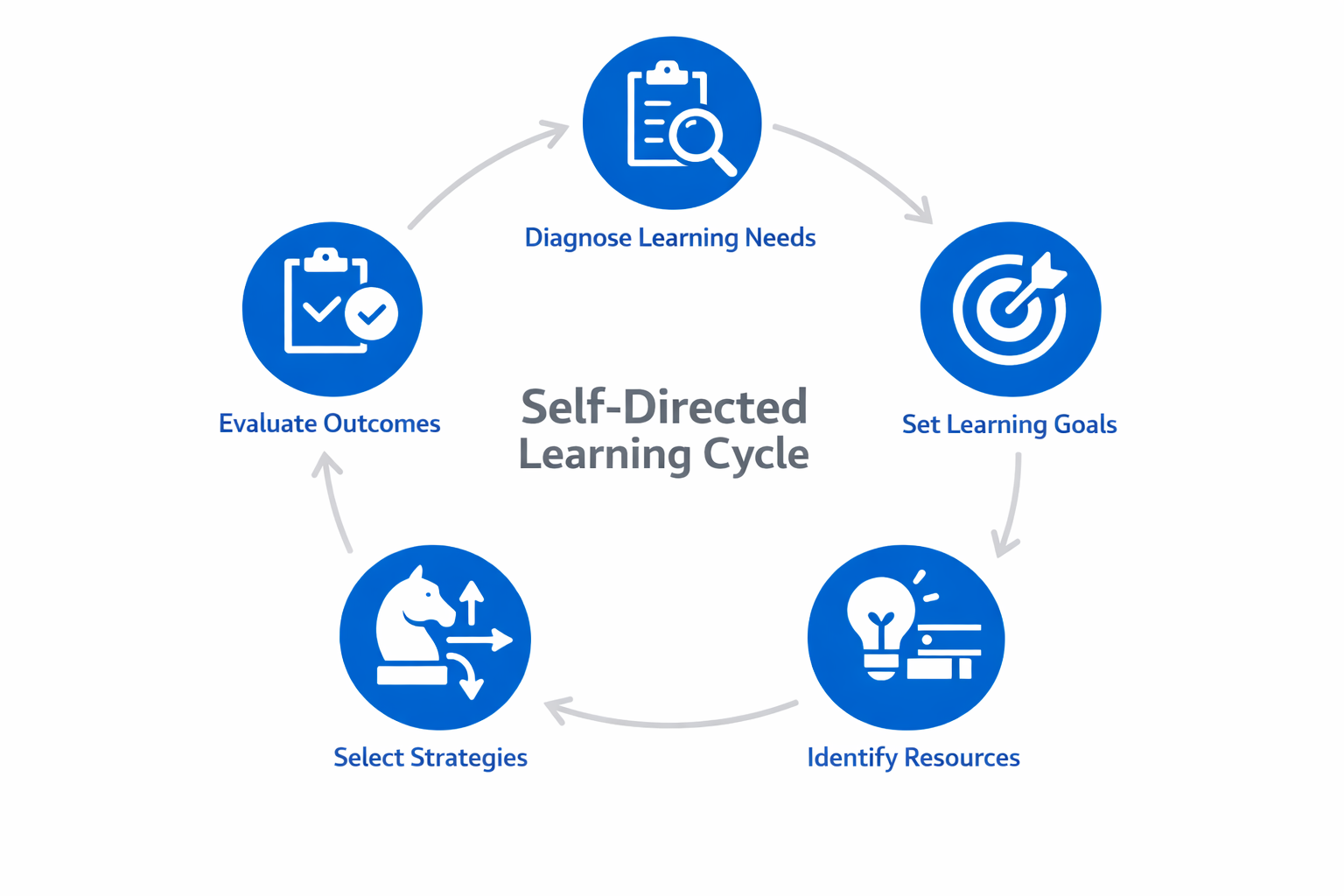
The concept originates in Malcolm Knowles' work on andragogy, the theory of adult learning. Knowles described self-directed learning as a process in which individuals take the initiative to diagnose their learning needs, formulate goals, identify resources, choose strategies, and evaluate outcomes. The learner is not passive. The learner is the architect of the experience.
This is different from self-paced learning, which only means the learner controls the schedule. A self-paced course still has predetermined content, sequences, and assessments. The learner decides when to complete them, not what or how to learn. Self-direction goes further: the learner determines the scope, method, and criteria for success.
It also differs from self-regulated learning, which refers to the cognitive and metacognitive strategies a learner uses within an assigned task. A student using self-regulation might plan study sessions, monitor comprehension, and adjust effort within a course someone else designed. Self-direction includes those skills but extends to shaping the entire learning trajectory, including what to learn in the first place.
Understanding this distinction matters for anyone designing training programs, courses, or professional development pathways. Conflating self-paced delivery with self-directed learning leads to environments that expect autonomy without providing the conditions that support it.
How Self-Directed Learning Works
Self-directed learning is not random exploration. It follows a structured cycle, even when the structure is informal and internally driven. The process typically moves through five phases, though not always in a linear sequence.
Diagnosing learning needs. The learner identifies a gap between what they currently know or can do and what they need to know or do. In a professional context, this might come from a performance review, a project requirement, or personal career ambition. In an academic setting, it might emerge from curiosity about a new discipline or recognition that a prerequisite skill is missing.
Setting learning goals. Once the need is clear, the learner defines specific objectives. These can be formal (complete a certification, build a portfolio project) or informal (understand a new methodology well enough to evaluate it). Effective self-directed learners set goals that are concrete enough to measure but flexible enough to adjust as understanding deepens.
Identifying resources. The learner locates materials, people, and environments that can support the goal. This includes online courses, books, mentors, peer communities, professional networks, open educational resources, and hands-on practice opportunities.
Resource identification is where many learners struggle, because the volume of available material creates a curation challenge, not a scarcity problem.
Selecting learning strategies. How you learn matters as much as what you learn. A self-directed learner chooses methods that match the content and their own cognitive preferences. Someone learning data analysis might combine structured courses with practice datasets. Someone building facilitation skills might join a community of practice and observe experienced facilitators before running their own sessions.
Evaluating outcomes. The learner assesses whether the goal has been met. This is where self-direction requires the most discipline. Without an external evaluator, the learner must develop honest criteria and seek feedback from peers, mentors, or real-world application. Evaluation might be formal (passing an exam, completing a capstone) or practical (successfully applying a skill in a work context).
These five phases form a cycle. Evaluation often reveals new gaps, which restart the process. Over time, experienced self-directed learners move through this cycle faster and with greater precision, because they develop stronger metacognitive skills, a better sense of their own learning patterns, and a wider network of resources.
The environment plays a critical role. Self-directed learning does not happen in a vacuum. It depends on access to quality resources, supportive relationships, and sufficient time and space for reflection. Organizations and institutions that want to foster self-direction need to create conditions where this cycle can operate, not just expect learners to figure it out on their own.
Key Characteristics of Self-Directed Learners
Self-directed learners share a set of observable characteristics. These traits are not binary. They exist on a spectrum, and they can be developed over time. Recognizing them helps educators and program designers identify where learners are on that spectrum and what support they need.
Intrinsic motivation. Self-directed learners are driven by internal interest, professional relevance, or personal meaning rather than external rewards alone. Grades, certificates, and compliance deadlines may play a role, but they are not the primary engine. When the external reward disappears, the learner keeps going because the learning itself matters.
Goal clarity. They translate vague desires into specific learning targets. Instead of "I want to get better at leadership," a self-directed learner defines what aspect of leadership, in what context, and to what standard. Goal clarity is what separates productive learning from aimless consumption of content.
Metacognitive awareness. Self-directed learners monitor their own understanding. They notice when they are confused, when they are making progress, and when a strategy is not working. Metacognition is the ability to think about your own thinking, and it is the skill that allows learners to self-correct rather than drift.
Resourcefulness. Rather than waiting for resources to be provided, self-directed learners seek them out. They know how to find credible sources, evaluate competing information, and build relationships with people who can help. Resourcefulness is as much a social skill as it is a research skill, because the most valuable learning resources are often other people.
Persistence through difficulty. Learning anything meaningful involves confusion, frustration, and temporary failure. Self-directed learners expect these moments and have strategies for working through them. They recognize the difference between productive struggle (which leads to deeper understanding) and unproductive spinning (which signals a need to change approach).
Reflective practice. Self-directed learners regularly step back to evaluate what they have learned, how they learned it, and what they would do differently. Reflection converts experience into insight. Without it, learners accumulate hours of activity without proportional growth in capability.
These six characteristics reinforce each other. Metacognitive awareness sharpens goal clarity. Resourcefulness supports persistence. Reflective practice deepens intrinsic motivation by helping learners connect effort to meaningful outcomes.
The most important practical insight is that these traits are developable. They are not fixed personality attributes. A learner who struggles with goal clarity today can build that skill through structured exercises. A learner who lacks resourcefulness can improve by being exposed to diverse learning environments.
Programs that treat self-direction as a teachable competency produce better outcomes than programs that treat it as a prerequisite for entry.
CharacteristicDescriptionWhy It MattersGoal settingDefines clear, specific learning objectives independently.Provides direction and measurable progress.Self-motivationMaintains engagement without external pressure or deadlines.Sustains learning over long periods without supervision.ResourcefulnessIdentifies and accesses learning materials, mentors, and tools.Removes dependency on a single curriculum or instructor.Self-assessmentEvaluates own progress and adjusts strategies accordingly.Prevents wasted effort and ensures continuous improvement.Time managementAllocates dedicated time and maintains consistent learning habits.Turns intention into consistent action.
Self-Directed Learning in Practice
Self-directed learning appears across workplace training, higher education, and professional development. What varies is how much structure surrounds it and how explicitly organizations support the process.
Workplace L&D. In corporate training environments, self-directed learning often emerges when employees pursue skill development beyond what formal training provides. An engineer who teaches herself a new programming language to solve a project problem. A marketing manager who studies behavioral economics through online resources to improve campaign design.
The most effective L&D teams recognize these organic learning efforts and provide infrastructure to support them: curated resource libraries, dedicated learning time, mentorship matching, and platforms that let employees track their own development paths.
Some organizations build self-directed learning into their talent development strategy. They give employees learning stipends and the freedom to choose how to use them. They create internal knowledge-sharing forums where employees teach each other.
They replace prescribed training catalogs with competency frameworks that describe what good looks like and let employees find their own path to get there.
Higher education. In academic settings, self-directed learning is embedded in capstone projects, independent study courses, research programs, and problem-based learning curricula. A graduate student designing a thesis topic is engaged in self-directed learning: they identify a gap in the literature, formulate a research question, choose methodologies, and evaluate their own findings.
Undergraduate programs increasingly use project-based approaches that require students to define their own learning objectives within a broader framework. The instructor provides scaffolding, feedback, and domain expertise, but the student drives the investigation. This model develops self-direction as a competency, not just as a byproduct.
Professional development. Many professionals are self-directed learners by necessity. Doctors keep up with medical research. Lawyers track evolving case law. Software developers learn new frameworks as the industry shifts. In these fields, formal continuing education covers only a fraction of what professionals need. The rest comes from self-initiated reading, experimentation, conference attendance, peer discussion, and practice.
Professional communities of practice play a significant role here. When professionals join groups organized around shared challenges, they gain access to curated resources, peer feedback, and diverse perspectives that accelerate self-directed learning. The community does not replace self-direction; it amplifies it by providing a richer environment for the learning cycle to operate.
Challenges and Misconceptions
Several misconceptions about self-directed learning persist among educators, trainers, and organizational leaders. These misunderstandings often lead to poorly designed programs.
Misconception: self-directed learning means learning alone. This is the most common error. Self-direction refers to who controls the learning process, not whether the process involves other people. Self-directed learners frequently seek out peers, mentors, instructors, and communities. The difference is that they choose when and how to engage those relationships rather than having engagement prescribed for them.
Programs that equate self-directed learning with isolation miss the point and create unnecessarily lonely learning experiences.
Misconception: self-directed learning requires no structure. Removing all structure and expecting learners to thrive is not self-directed learning. It is neglect. Effective self-directed learning depends on structure: clear competency expectations, accessible resources, feedback mechanisms, and milestones that help learners gauge progress. The structure exists to support the learner's decisions, not to replace them. Think of it as guardrails on a road the learner chooses to drive.
Misconception: self-direction is an innate trait. Some learners arrive with stronger self-direction skills than others, but the capacity is not fixed. Research in adult education consistently shows that self-direction can be developed through deliberate practice, scaffolded experiences, and environments that progressively increase learner responsibility. Treating self-direction as a prerequisite rather than a learning outcome excludes learners who would benefit most from developing it.
Beyond misconceptions, real operational challenges exist.
Overwhelm and decision fatigue. When learners face unlimited choices about what to study and how to study it, some become paralyzed. The abundance of online content, courses, and resources can make it harder, not easier, to learn effectively. Without curation support, learners spend more time searching than studying.
Resource quality evaluation. Self-directed learners must judge the credibility and relevance of resources on their own. Not everyone has the domain expertise to distinguish a well-designed course from a superficial one, or a rigorous article from a misleading summary. This skill develops over time, but early-stage self-directed learners are vulnerable to poor sources.
Uneven readiness across learner populations. In any organization or classroom, learners arrive with different levels of self-direction capability. A program designed entirely around self-direction may work well for experienced professionals but frustrate early-career employees who have never had to structure their own learning. The solution is not to abandon self-direction but to scaffold it, meeting learners where they are and building their capacity over time.
How to Support Self-Directed Learners
Fostering self-directed learning is a design challenge, not a motivational one. Program designers, instructors, and organizational leaders can create conditions that develop and sustain self-direction.
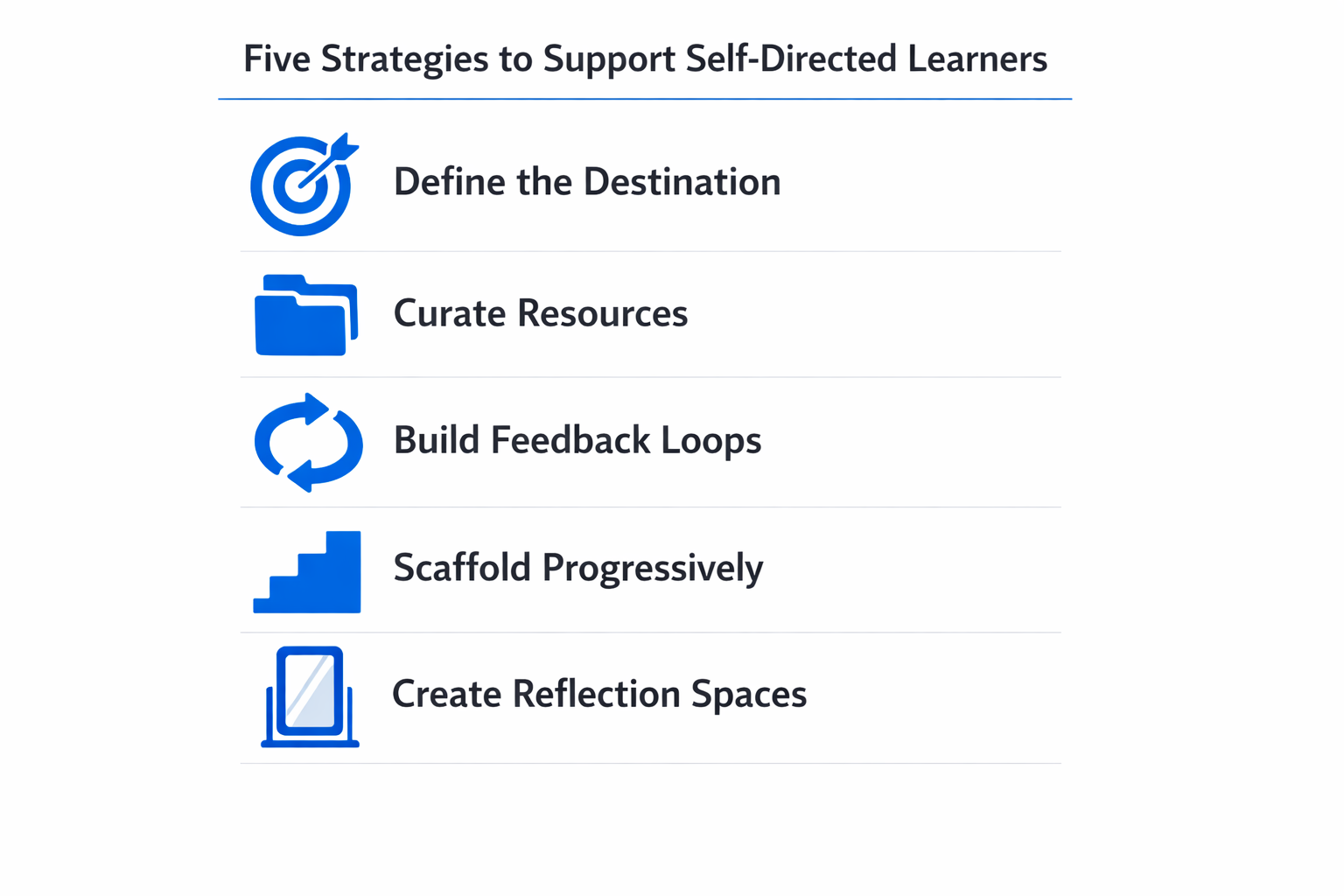
Define the destination, not the route. Provide clear competency frameworks, learning outcomes, or skill benchmarks that describe what learners need to achieve. Let learners choose how to get there. This gives self-directed learners the autonomy they need while giving less experienced learners a concrete target to work toward. When learners know what "good" looks like, they can assess their own progress and make better decisions about where to focus.
Curate, do not prescribe. Instead of assigning a single course or textbook, provide curated collections of resources at different levels and in different formats. Include articles, videos, courses, practice exercises, and community links. Curation reduces the overwhelm problem without removing choice. It signals trust in the learner's judgment while acknowledging that finding quality resources is genuinely difficult.
Build feedback into the system. Self-directed learners need feedback to calibrate their progress. Design opportunities for peer review, self-assessment, instructor check-ins, and real-world application. Feedback should be frequent, specific, and tied to the competency framework. Without feedback, self-direction degrades into guesswork.
Scaffold progressively. For learners who are new to self-directed approaches, start with more structure and gradually release control. Early in a program, provide a recommended learning path with clear milestones. As learners develop confidence and metacognitive skills, offer more open-ended projects and let them define their own goals. This graduated approach builds self-direction as a competency rather than assuming it already exists.
Create spaces for reflection and peer exchange. Reflection is where learning consolidates. Build in regular opportunities for learners to document what they have learned, assess what worked, and identify next steps. Pair this with peer learning spaces where learners share insights, resources, and challenges.
These spaces make self-directed learning visible and social, which reinforces motivation and accelerates skill development.
Technology plays a supporting role. Learning platforms that allow flexible navigation, progress tracking, resource bookmarking, and community discussion give self-directed learners the tools they need without imposing rigid sequences. The platform should serve the learner's plan, not the other way around.
The instructor's role shifts in a self-directed environment. Instead of delivering content and assessing compliance, the instructor becomes a facilitator, mentor, and feedback provider. Instructors help learners refine their goals, connect them with resources, challenge their thinking, and validate their progress. This is not a diminished role. It requires deeper expertise and stronger relational skills than traditional lecturing.
FAQ
Is self-directed learning the same as self-paced learning?
No. Self-paced learning means the learner controls the timeline for completing pre-defined content. The course structure, content, and assessments are still determined by someone else. Self-directed learning goes further: the learner determines what to learn, how to learn it, and how to evaluate whether learning has occurred. A self-paced course can be part of a self-directed strategy, but the two concepts are not interchangeable.
Can self-directed learning work in a structured training program?
Yes, and the combination is often more effective than either approach alone. Structured programs provide competency frameworks, curated resources, and feedback mechanisms. Self-direction allows learners to personalize their path within that structure. The key is designing programs that define clear outcomes while leaving the route open for learner choice.
How do you assess whether someone is a self-directed learner?
Look for observable behaviors rather than personality labels. Does the learner set their own goals? Do they seek out resources independently? Do they reflect on what they have learned? Do they adjust their approach when something is not working? These behaviors can be assessed through self-reflection tools, learning journals, and conversations about learning strategy. The goal is not to sort learners into categories but to understand where each person needs support.
What is the role of technology in supporting self-directed learners?
Technology provides tools for resource access, progress tracking, peer connection, and reflection. Platforms that offer flexible learning paths, community features, and self-assessment tools serve self-directed learners well. The technology should reduce friction in the learning process, not impose a rigid structure. The most useful tools are those that adapt to the learner's plan rather than requiring the learner to adapt to the platform.
Frequently asked questions
What is a self-directed learner?
A self-directed learner is someone who takes responsibility for their own learning — identifying what they need to know, setting goals, finding resources, choosing strategies, and evaluating their own progress. They drive the learning process, with instructors or peers in supporting roles.
What are the key characteristics of a self-directed learner?
Self-directed learners are typically goal-oriented, curious, comfortable with ambiguity, skilled at self-assessment, good at time management, growth-minded, and resourceful. They are also self-motivated — they don't need external pressure to start or finish learning.
How do you become a self-directed learner?
Start small: pick one topic, write three specific learning goals, build a study plan, find your own resources, and schedule weekly check-ins with yourself. Reflect on what worked. Then expand to more topics. Self-directed learning is a habit built through deliberate practice, not a personality trait.
What's the difference between self-directed and self-paced learning?
Self-paced learning means you control the speed of a predefined curriculum. Self-directed learning means you control what's in the curriculum in the first place — including goals, sources, and assessment. Self-paced is a subset of self-directed when the learner also chose the program.
How does self-directed learning work in cohort-based courses?
In well-designed cohort courses, the curriculum and pace are structured, but self-directed learners take additional initiative — exploring extra resources, setting personal goals beyond the syllabus, and using peer cohorts as accountability rather than authority. The best cohorts amplify self-direction; they don't replace it.


