


Why Look for a ChurchCRM Alternative?
ChurchCRM occupies a unique position in the church management market as one of the few genuinely free, open-source platforms available. Built on PHP and MySQL, it gives churches full data ownership and zero licensing costs. But that freedom comes with real trade-offs that drive many congregations to explore other options.
Self-hosting demands technical skills. ChurchCRM requires a church to provision, configure, and maintain its own web server running PHP and MySQL. That means handling software updates, database backups, security patches, and server monitoring. Churches without a technically skilled volunteer or staff member face a steep operational burden, and the consequences of neglecting server maintenance (data loss, security vulnerabilities) are serious.
The interface shows its age. ChurchCRM's user interface reflects an earlier era of web design. Navigation patterns, form layouts, and visual styling feel dated compared to modern cloud-based platforms. For church staff and volunteers accustomed to consumer-grade software, this friction reduces adoption. Training new administrators takes longer when the interface works against intuition rather than with it.
No native online giving. ChurchCRM tracks donations after the fact but does not process them. Churches need a separate payment platform for online giving, text-to-give, or recurring donations, then manually enter contribution data into ChurchCRM. This creates double entry, synchronization headaches, and a disconnected experience for both staff and congregants.
Limited integrations and no mobile app. ChurchCRM does not offer a member-facing mobile application or a rich integration stack. Connecting it with streaming services, email marketing tools, or church website builders requires custom development or manual workarounds. In a ministry landscape where mobile-first community engagement is expected, this gap becomes harder to justify.
Community support only. There is no vendor support line to call when something breaks. ChurchCRM relies on community forums and documentation, which can leave churches waiting for answers during critical situations like a server failure before Sunday morning.
If your church values the cost savings of open source but needs a more polished experience, built-in giving, mobile access, or managed hosting, these alternatives address those gaps while offering varying levels of flexibility and affordability.
What to Consider When Choosing Church Management Software
Before moving away from ChurchCRM, evaluate what your church actually uses and what it genuinely needs.
Hosting preference. Decide whether your church wants to continue self-hosting (maintaining control of data and infrastructure) or move to a cloud-hosted platform where the vendor handles uptime, backups, and updates. Self-hosting saves subscription costs but requires ongoing technical capacity.
Data migration complexity. ChurchCRM stores member records, families, groups, attendance, and contributions in MySQL. Assess how much historical data needs to transfer and whether your target platform offers CSV import tools, API-based migration, or dedicated migration support.
Budget reality. ChurchCRM costs essentially nothing beyond basic hosting fees. Moving to a subscription platform introduces monthly costs. Map your actual budget against what each platform charges, factoring in whether the time your technical volunteer currently spends maintaining ChurchCRM has an opportunity cost.
Feature priorities. Not every church needs every feature. Rank whether online giving, worship planning, volunteer scheduling, member onboarding, check-in systems, or communication tools matter most. A platform strong in your top priorities but limited elsewhere may serve you better than a feature-rich system your staff never fully adopts.
Congregation size trajectory. A platform that fits a church of 80 may not scale to 400. Consider your growth path when evaluating options and weight long-term scalability alongside current needs.
10 Best ChurchCRM Alternatives
These platforms range from enterprise-grade open-source systems to simple cloud tools designed for volunteer-led churches. Each addresses specific limitations that ChurchCRM leaves open.
Tool Pricing Best For Planning Center Free plan available; paid from $19/mo Churches of any size (50 to 10,000+ members) that want leading worship Breeze ChMS From $72/mo Small to mid-size churches (50 to 500 members) that want straightforward church Realm No free plan; paid from $50 to $100/mo Mid-size to large churches (200 to 5,000+ members) that need unified membership Elvanto Free plan available; paid from $50/mo Small to mid-size churches (50 to 1,500 members) that want a modern interface TouchPoint From $50 to $80/mo Mid-size to large churches (500 to 10,000+ members) with IT staff or developer ChurchSuite Contact for pricing UK and European churches of any size that need GDPR compliance built into their ShelbyNext No free plan Mid-size to large churches (300 to 5,000+ members) that need integrated Rock RMS Free Medium to large churches (500+ members) with technical staff or budget for a ChMeetings Free plan available; paid from $5 to $15/mo Small churches (under 200 members) and church plants with minimal or zero One Church Software From $49 to $79/mo Small to mid-size churches (50 to 500 members) that want to launch or
Planning Center
Overview
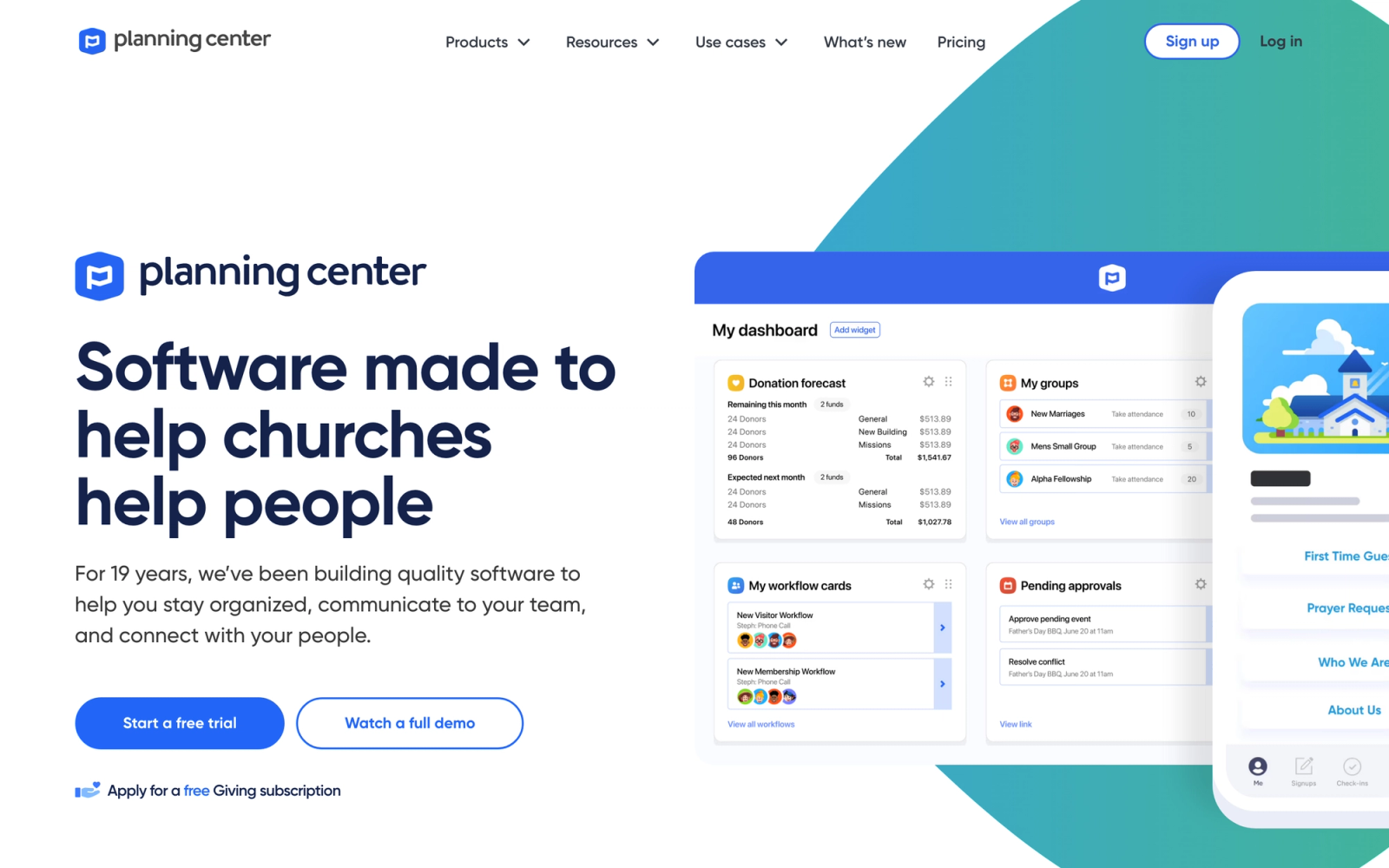
Planning Center is the modular, cloud-based church management platform that has become the most widely adopted system among mid-size Protestant churches. Instead of offering a monolithic product, Planning Center breaks functionality into separate apps: People, Services, Giving, Groups, Registrations, Check-Ins, Calendar, and Publishing. Churches subscribe only to the modules they need and expand over time.
Compared to ChurchCRM's all-in-one-but-limited approach, Planning Center delivers significantly deeper functionality in every category. The trade-off is cost: what ChurchCRM provides for free, Planning Center charges per module and per active-record tier. But for churches frustrated by ChurchCRM's dated interface and missing features, Planning Center's polish and reliability are a substantial upgrade.
Core Capabilities
- Modular app suite covering people, services, giving, groups, registrations, check-ins, calendar, and publishing
- Worship service planning with song libraries, set lists, key management, and rehearsal tools
- Online and in-app giving with recurring donations, ACH/credit card processing, and donor statements
- Volunteer scheduling with automated reminders, conflict detection, and team coordination
- Child check-in system with security labels, allergy alerts, and room capacity management
- Event registration with custom forms, payment collection, and waitlists
- Custom branded church app through the Publishing module
- Open REST API with integrations for Mailchimp, ProPresenter, and third-party tools
Standout Strength
The Services module is widely considered the best worship planning tool available. No competitor matches its depth for scheduling musicians, managing song arrangements, building set lists, and coordinating live service elements across multiple teams and campuses.
Best For
Churches of any size (50 to 10,000+ members) that want leading worship planning and the flexibility to adopt modules incrementally. Especially strong for contemporary worship-style congregations with active volunteer teams.
Pricing Overview
- Each module priced independently based on active records in the database
- Free tier available for each module (typically up to 75 people)
- Paid tiers start at $19 per month per module
- Full suite for a mid-size church ranges from $150 to $500+ per month
- No long-term contracts required
Limitations
- Costs compound quickly when using multiple modules simultaneously.
- No built-in accounting, payroll, or fund management capabilities.
- Communication tools within People are basic compared to dedicated email platforms.
Quick Comparison Insight
Far more polished and feature-deep than ChurchCRM in every category, but introduces significant monthly costs where ChurchCRM charges nothing.
Breeze ChMS
Overview
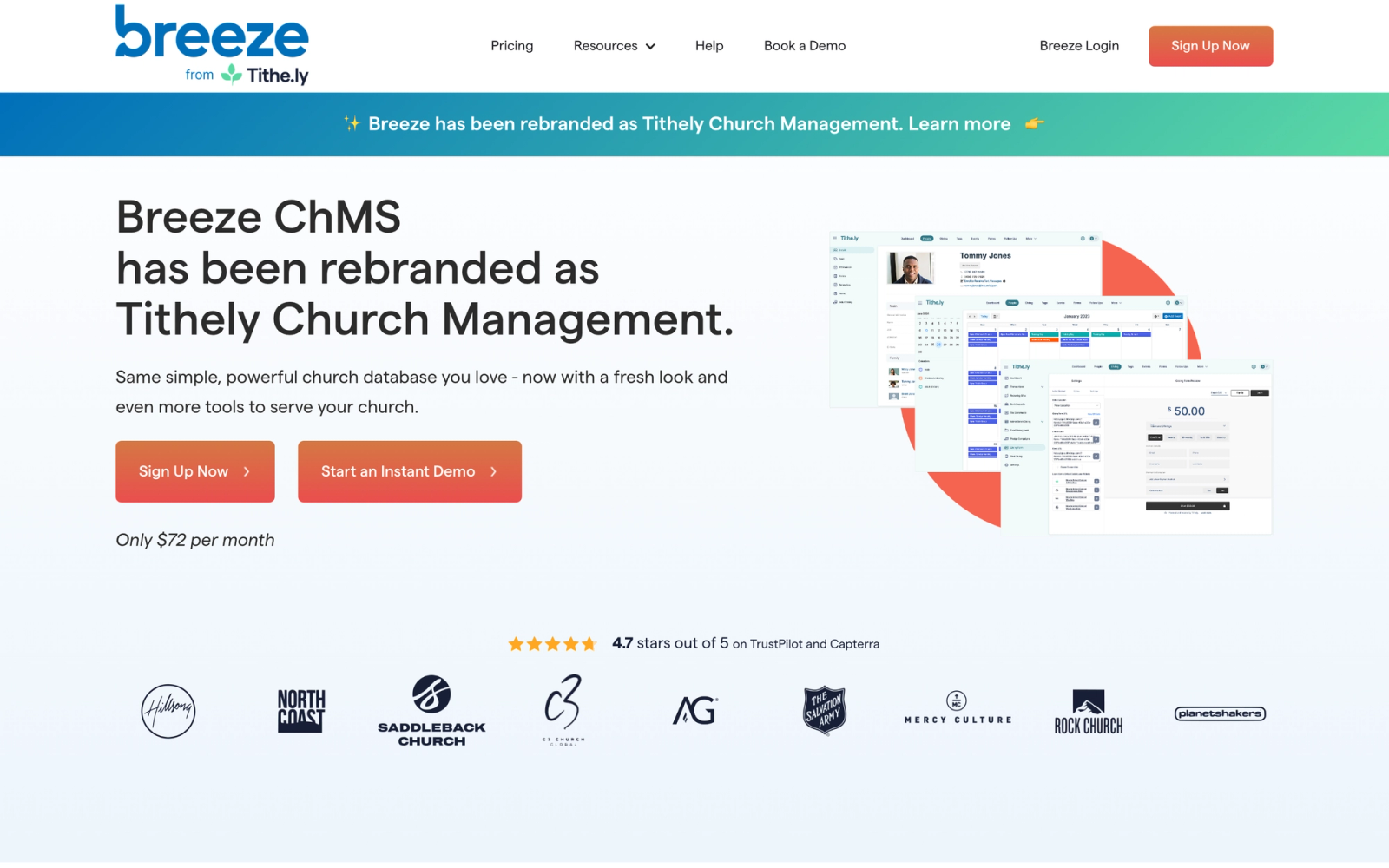
Breeze ChMS is the simplicity champion of church management software. Where ChurchCRM tries to do everything through an open-source codebase, Breeze strips church management down to the essentials and wraps them in an interface that any volunteer can navigate without training. The platform targets small to mid-size churches that find enterprise platforms overwhelming and open-source solutions too maintenance-heavy.
The contrast with ChurchCRM is stark. Breeze requires zero technical setup, includes online giving natively, offers free data migration, and provides phone and email support. For churches whose ChurchCRM experience has been defined by server maintenance headaches and interface frustrations, Breeze eliminates both problems entirely.
Core Capabilities
- Member database with custom fields, family linking, and smart filters
- Online and offline contribution tracking with donor statements
- Event management with registration forms and RSVP tracking
- Volunteer scheduling and automated coordination reminders
- Attendance tracking across services, events, and groups
- Email and text communication tools with segmented sending
- Custom tags and filters for member segmentation
- Child check-in with security labels and allergy alerts
- Reporting dashboard covering giving trends and attendance patterns
- Mobile-responsive member portal for self-service access
Standout Strength
Flat, predictable pricing with every feature included. Starting at $72 per month regardless of church size, Breeze eliminates the per-module costs and per-person fees that make budgeting unpredictable with other platforms.
Best For
Small to mid-size churches (50 to 500 members) that want straightforward church management with zero technical maintenance. Especially strong for churches with volunteer-led administration and limited technology budgets.
Pricing Overview
- Single plan starting at $72 per month
- All features included at every tier
- Unlimited users and records
- No long-term contracts
- Free data migration from other platforms
- Online giving processing fees apply separately
Limitations
- Limited depth for churches above 500 members with complex organizational needs.
- No worship service planning module comparable to Planning Center Services.
- Reporting capabilities are basic compared to CCB or Realm.
Quick Comparison Insight
Trades ChurchCRM's zero-cost advantage for a dramatically easier user experience, built-in giving, and managed hosting with no technical burden.
Realm
Overview
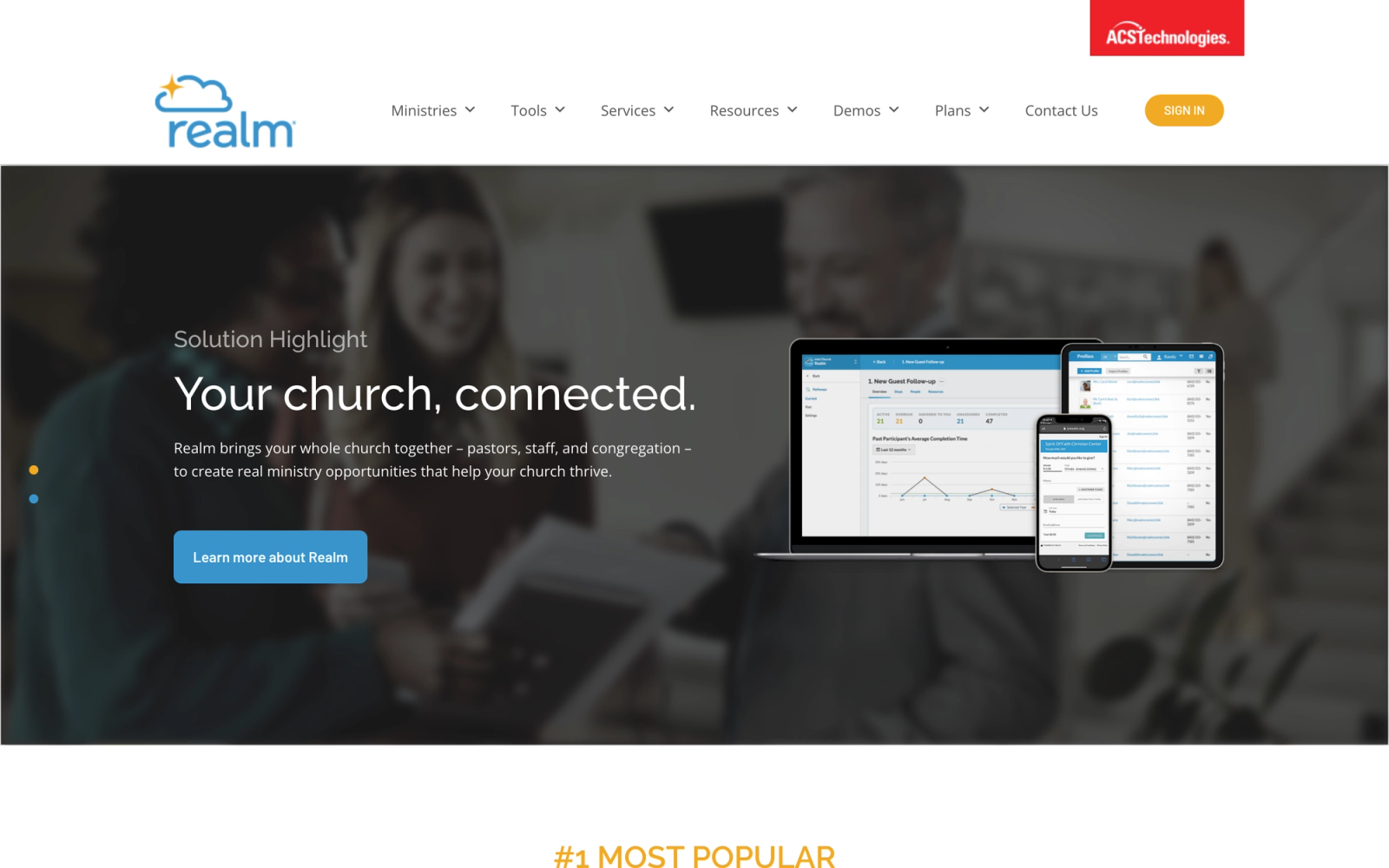
Realm by ACS Technologies is the cloud-based successor to one of the oldest names in church management software. Where ChurchCRM focuses on core database and contribution tracking, Realm wraps a complete church management platform around integrated fund accounting, which makes it one of the few cloud-based systems that can replace both a ChMS and separate accounting software like QuickBooks.
For churches outgrowing ChurchCRM's financial tracking limitations, Realm's native general ledger, accounts payable and receivable, budgeting tools, and bank reconciliation fill a gap that most other ChMS platforms leave open. The platform also includes a member-facing app where congregants can update profiles, browse groups, give online, and access the church directory, creating engagement that ChurchCRM's server-only interface cannot provide.
Core Capabilities
- Detailed member profiles with family management, custom fields, and involvement history
- Integrated fund accounting with general ledger, AP/AR, budgeting, and bank reconciliation
- Online and mobile giving with text-to-give, recurring gifts, and donor statements
- Small group management with leader tools, group directories, and sign-ups
- Event registration with payment collection and room scheduling
- Volunteer scheduling with serving team management and automated reminders
- Child and event check-in with security printing and allergy alerts
- Email, text, and in-app messaging tools
- Member-facing portal and app for self-service engagement
- complete financial and ministry reporting
Standout Strength
A real general ledger built into the ChMS. Realm is one of the few cloud-based platforms with native fund accounting, accounts payable, accounts receivable, budgeting, and bank reconciliation, so finance teams can close the books without exporting to a separate accounting package.
Best For
Mid-size to large churches (200 to 5,000+ members) that need unified membership management and financial accounting in a single platform. Especially strong for churches with dedicated bookkeeping staff and significant financial reporting requirements.
Pricing Overview
- Quote-based pricing scaled by church size
- Base subscriptions start at approximately $50 to $100 per month
- Full suite with accounting typically $150 to $400+ per month
- No free tier
- Giving processing fees apply separately
- Implementation and data migration fees may apply
Limitations
- Steep learning curve, especially for the accounting module which requires financial knowledge.
- Member app adoption depends on congregation willingness to download another app.
- No dedicated worship service planning module comparable to Planning Center Services.
Quick Comparison Insight
Substantially more capable than ChurchCRM for financial management and member engagement, but the subscription cost and accounting-module learning curve make it a poor fit for very small congregations.
Elvanto
Overview
Elvanto is a cloud-based church management platform originally built in Australia that has gained traction globally for its clean, modern interface and strong volunteer rostering tools. Now part of the Tithe.ly stack, Elvanto strikes a balance between ChurchCRM's do-everything approach and the focused simplicity of platforms like Breeze.
What stands out immediately when moving from ChurchCRM to Elvanto is the visual design. Elvanto's interface feels contemporary and intuitive in a way that ChurchCRM's PHP-era layout does not. The platform's service planning and volunteer scheduling tools are particularly strong, offering drag-and-drop rostering with automated conflict detection that eliminates the manual coordination many ChurchCRM users handle through spreadsheets.
Core Capabilities
- Contact database with household grouping, custom fields, and member directories
- Visual drag-and-drop service and volunteer scheduling with conflict detection
- Small group management with leader tools and attendance tracking
- Online giving integration through the Tithe.ly platform
- Child and event check-in with security codes and allergy alerts
- Automated workflows for new visitor follow-up and membership pathways
- Email and SMS communication with templates and segmented sending
- Reporting on attendance trends, giving patterns, and group participation
- Mobile app and member portal for self-service profile updates and giving
- Calendar management with event scheduling and registrations
Standout Strength
Service planning and volunteer rostering. Elvanto's visual roster builder with automated scheduling based on availability preferences and frequency rules is among the best in the mid-market, offering a dramatic upgrade from ChurchCRM's manual approach to volunteer coordination.
Best For
Small to mid-size churches (50 to 1,500 members) that want a modern interface with strong volunteer and worship team scheduling. Especially appealing for churches transitioning from self-hosted open-source tools and wanting a polished cloud experience.
Pricing Overview
- Tiered pricing based on the number of people in the database
- Plans start at approximately $50 per month for smaller churches
- Scales upward with congregation size
- No permanent free plan; free trial available
- Pricing may shift as Tithe.ly integration deepens
Limitations
- Long-term product roadmap unclear following the Tithe.ly acquisition.
- No built-in fund accounting or payroll capabilities.
- Website builder and live streaming require separate platforms.
Quick Comparison Insight
Delivers the modern, intuitive experience ChurchCRM lacks, with particularly strong volunteer scheduling, but introduces monthly costs and acquisition-related uncertainty.
TouchPoint
Overview
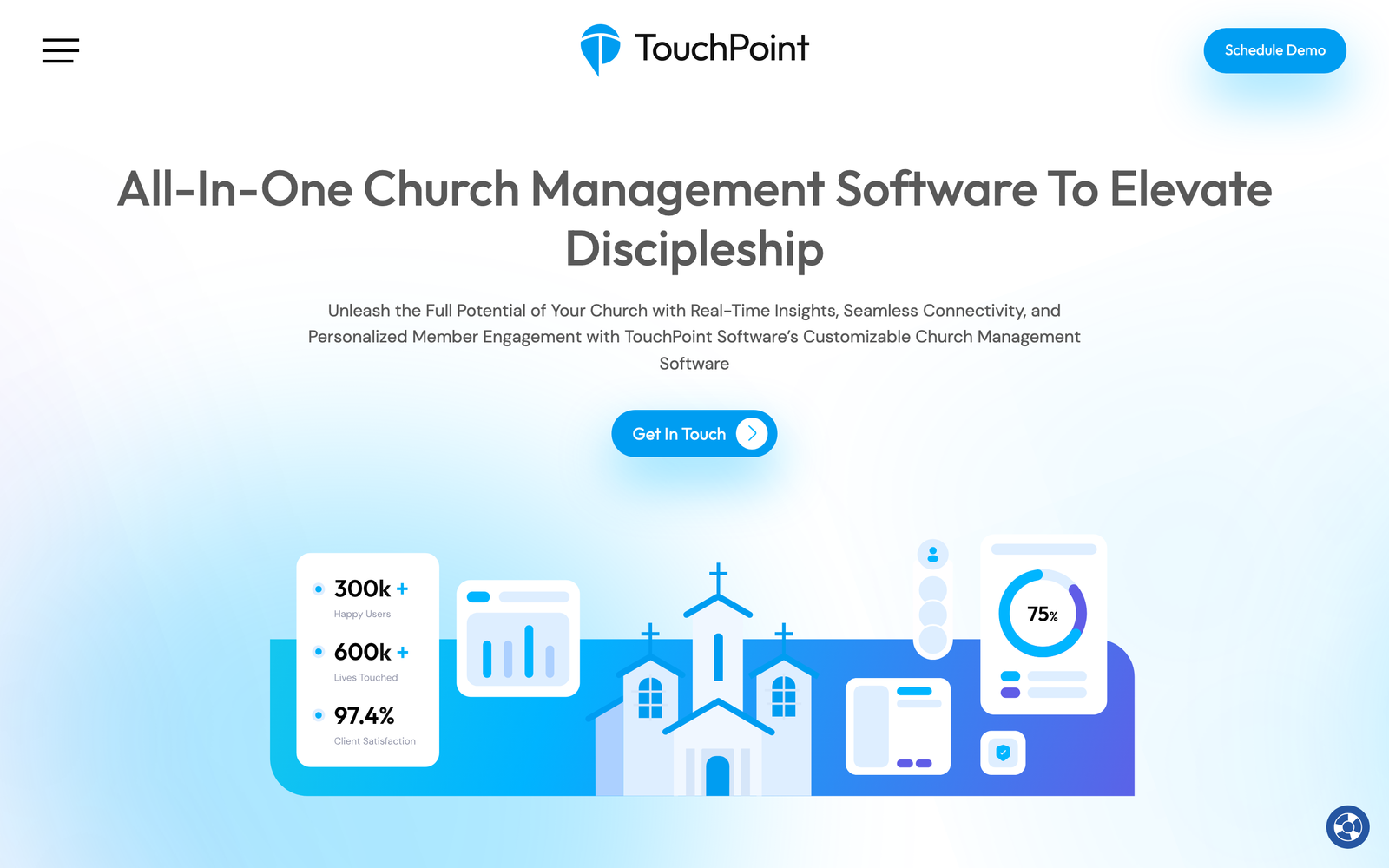
TouchPoint is an open-source church management system built for mid-size to large and multi-campus churches that need enterprise-grade data management. Originally developed by Bellevue Baptist Church for its own use, TouchPoint shares ChurchCRM's open-source philosophy but operates at a fundamentally different scale and sophistication level.
For churches that appreciate ChurchCRM's open-source ethos but have outgrown its feature set, TouchPoint represents the natural step up. Its search builder allows staff to construct complex queries across any combination of data points: attendance patterns, giving history, group involvement, demographics, and custom fields. The multi-campus architecture is genuinely built into the data model rather than bolted on as an afterthought.
Core Capabilities
- Member database with families, sub-groups, custom fields, and detailed involvement tracking
- Native multi-campus and multi-site support within a single database
- Advanced search builder with dozens of filter criteria for custom people queries
- Online registration with custom forms and payment processing
- Groups and classes with attendance tracking and leader tools
- Contribution tracking with pledge management, giving statements, and fund designations
- Secure child and event check-in with label printing and allergy alerts
- Volunteer scheduling and ministry team management
- Email communication with segmented sending and tracking
- Open-source codebase on GitHub with full REST API
Standout Strength
The search and query builder. TouchPoint lets staff construct deeply layered queries across virtually any data point in the system, producing precise lists and reports that no simpler ChMS can match. Combined with the open-source codebase, technically capable churches can customize TouchPoint in ways that closed-source platforms prohibit.
Best For
Mid-size to large churches (500 to 10,000+ members) with IT staff or developer resources, particularly multi-campus organizations that need advanced data querying, custom workflows, and full control over their church management platform.
Pricing Overview
- Subscription-based, tiered by church size
- Starting at approximately $50 to $80 per month for smaller implementations
- Mid-size churches typically pay $150 to $300 per month
- Open-source code available on GitHub
- Hosted and supported version is the paid subscription
- Self-hosting is possible but not the recommended path
Limitations
- Steep learning curve due to the depth and complexity of the platform.
- User interface prioritizes function over modern design aesthetics.
- Smaller user community means fewer third-party integrations and resources.
Quick Comparison Insight
Shares ChurchCRM's open-source DNA but offers enterprise-grade querying and multi-campus support that ChurchCRM cannot approach. Requires similar technical comfort.
ChurchSuite
Overview
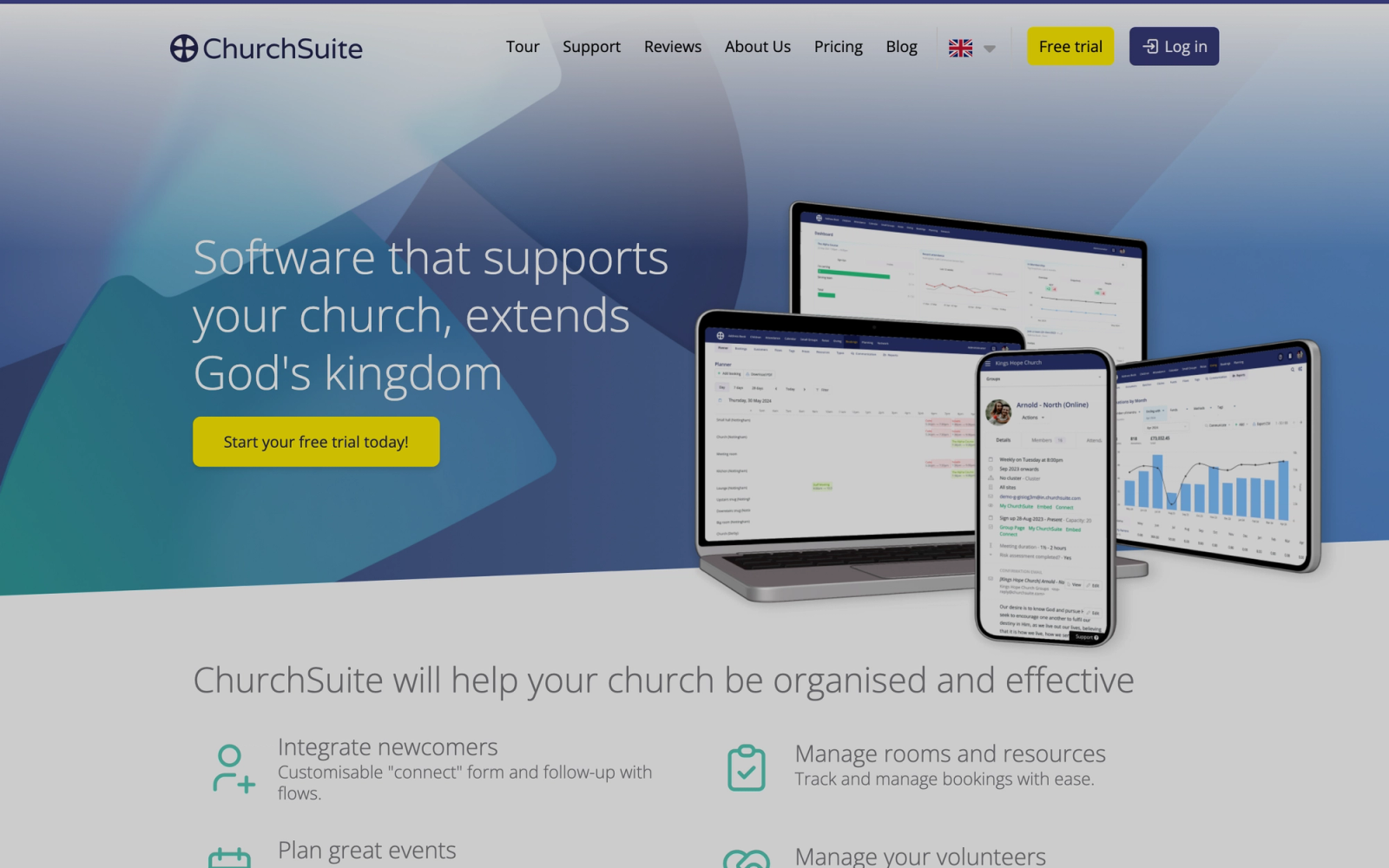
ChurchSuite is a UK-built, cloud-based church management platform that has become the dominant ChMS in the British market and is expanding into other regions. While ChurchCRM serves a global audience of technically inclined churches, ChurchSuite speaks specifically to congregations operating under European regulatory frameworks and UK-specific financial mechanisms.
The platform's GDPR compliance is architectural, not retrofitted. For churches operating in Europe or handling data of European members, this matters significantly. ChurchSuite's native Gift Aid management, a UK tax-efficient giving scheme that can increase donation value by 25%, is a feature no American-built platform handles natively. The modular pricing structure lets churches start small and expand, mirroring the flexibility that draws some churches to ChurchCRM's free model.
Core Capabilities
- Contact database with UK-formatted addresses, GDPR-compliant consent tracking, and household linking
- Dedicated children and youth ministry module with DBS (safeguarding) check management
- Small group management with leader tools, meeting locations, and group finder
- Giving and finance module with native Gift Aid management and direct debit integration
- Rota (volunteer scheduling) management with availability tracking and automated reminders
- Event booking with ticketing, capacity management, and payment collection
- Shared church calendar with room and resource booking
- Email and SMS communication with GDPR-compliant opt-in management
- Member portal (My ChurchSuite) for profile updates, rota viewing, group browsing, and giving
- Flexible reporting with saved searches and tagging for segmentation
Standout Strength
Purpose-built GDPR compliance and native Gift Aid management. No American-built church platform handles UK safeguarding requirements (DBS checks), Gift Aid declarations, or European data privacy regulations as naturally as ChurchSuite does.
Best For
UK and European churches of any size that need GDPR compliance built into their platform, Gift Aid tracking for tax-efficient giving, and DBS safeguarding management. Increasingly relevant for churches in Australia, New Zealand, and South Africa.
Pricing Overview
- Modular pricing; churches choose which modules to subscribe to
- Individual modules start at approximately GBP 3 to 5 per month
- Full platform bundles range from GBP 30 to 80 per month depending on size and modules
- Discounted tiers available for very small congregations
- Pricing in British Pounds
Limitations
- Integration stack is heavily UK-centric with limited North American third-party tools.
- Online giving module built around UK payment infrastructure; less smooth for US churches.
- Very large multi-campus churches may outgrow the platform's depth.
Quick Comparison Insight
Solves the specific regulatory and financial needs of UK and European churches that ChurchCRM's generic architecture does not address, but is less suited for North American congregations.
ShelbyNext
Overview
ShelbyNext is the cloud iteration of Shelby Systems, one of the oldest names in church management software. Now owned by Ministry Brands, ShelbyNext positions itself as an enterprise-grade church administration platform with particular depth in financial management and clergy-specific payroll processing, features that neither ChurchCRM nor most modern cloud competitors offer.
Where ChurchCRM handles basic contribution tracking, ShelbyNext provides full fund-based accounting: general ledger, accounts payable and receivable, budgeting, and financial reporting built for nonprofit church structures. The integrated payroll module handles clergy-specific tax situations including housing allowances and self-employment tax treatment. For churches that currently run ChurchCRM alongside QuickBooks and a payroll service, ShelbyNext consolidates all three.
Core Capabilities
- Membership database with family linking, custom fields, and involvement tracking
- Full fund-based accounting with general ledger, AP/AR, and budgeting
- Clergy-specific payroll with housing allowance and dual-status tax handling
- Contribution entry with batch processing, pledge tracking, and donor statements
- Online giving through ShelbyGiving and EasyTithe integration
- Small group and class management with attendance tracking
- Child and event check-in with security features and label printing
- Event management with registration and calendar
- Email communication and member portal for self-service
- Extensive financial and contribution reporting
Standout Strength
Clergy payroll and fund accounting in a single product. ShelbyNext handles housing allowances, dual-status tax treatment, and nonprofit fund accounting natively, a combination that no other platform on this list offers.
Best For
Mid-size to large churches (300 to 5,000+ members) that need integrated accounting and payroll alongside membership management, and denominations or church networks with complex financial reporting requirements.
Pricing Overview
- Custom quote-based pricing; not published transparently online
- Estimated range of $200 to $500+ per month for mid-size churches
- Individual modules can be purchased separately
- No free plan; demos available by request
- Multi-year contracts are common
Limitations
- Pricing is opaque and generally higher than cloud-native competitors.
- Interface lags behind modern platforms in design and intuitiveness.
- Cloud migration from legacy Shelby desktop software has been challenging for some churches.
Quick Comparison Insight
Significantly more capable for financial management and payroll, but the cost and complexity are substantial, especially for congregations moving from free software for the first time.
Rock RMS
Overview
Rock RMS is the closest philosophical match to ChurchCRM in this list. Both are free, open-source church management platforms. But where ChurchCRM runs on a basic PHP/MySQL stack for small congregations, Rock RMS operates as an enterprise-grade relationship management system built on .NET and SQL Server, with a visual workflow engine that makes it comparable in ambition to Salesforce for churches.
Originally developed at NewSpring Church, Rock RMS is used by some of the largest and most technically sophisticated congregations in the country. The platform is completely free to download and self-host, with revenue coming from optional managed hosting, support plans, and the Rock Shop plugin marketplace. For churches that love ChurchCRM's open-source philosophy but need dramatically more power, Rock RMS is the upgrade path.
Core Capabilities
- Deep CRM-style member profiles with relationship tracking, custom attributes, and data segmentation
- Visual drag-and-drop workflow engine for automating multi-step processes
- Connection request system for tracking visitor-to-member assimilation pipelines
- Multi-campus check-in with kiosk support, label printing, and room balancing
- Online giving with batch entry, financial accounts, and contribution statements
- Full website CMS built in with page builder and theming
- Email, SMS, and push notification communication engine
- flexible data views and SQL-powered reporting
- Rock Mobile framework for building custom church apps
- Plugin marketplace (Rock Shop) with community and commercial extensions
- Full REST API and open-source C# codebase on GitHub
Standout Strength
The visual workflow builder. Rock's automation engine lets churches build custom multi-step processes for virtually anything: new visitor follow-up sequences, volunteer application pipelines, facility request approvals, and pastoral care workflows. No other ChMS matches this depth of process automation.
Best For
Medium to large churches (500+ members) with technical staff or budget for a Rock implementation partner. Ideal for multi-campus organizations that need enterprise-grade customization, deep reporting, and the flexibility of open source without ChurchCRM's feature constraints.
Pricing Overview
- Software license: completely free and open source (Apache 2.0)
- Self-hosting: free if you manage your own Windows Server with IIS and SQL Server
- Managed hosting through Spark Development Network: starting at approximately $249 to $500+ per month
- Plugin marketplace with both free and premium extensions
- Implementation partner services range from a few thousand to tens of thousands of dollars
Limitations
- Steep learning curve and significant implementation effort compared to any SaaS alternative.
- Self-hosting requires Windows Server, IIS, and SQL Server expertise.
- The "free" software carries hidden costs in infrastructure and technical expertise.
Quick Comparison Insight
Shares the open-source philosophy but runs at a fundamentally different scale. The workflow engine, multi-campus check-in, and full REST API represent capabilities that are simply out of reach for a PHP/MySQL codebase. The trade-off is a steeper implementation effort and ongoing technical overhead.
ChMeetings
Overview
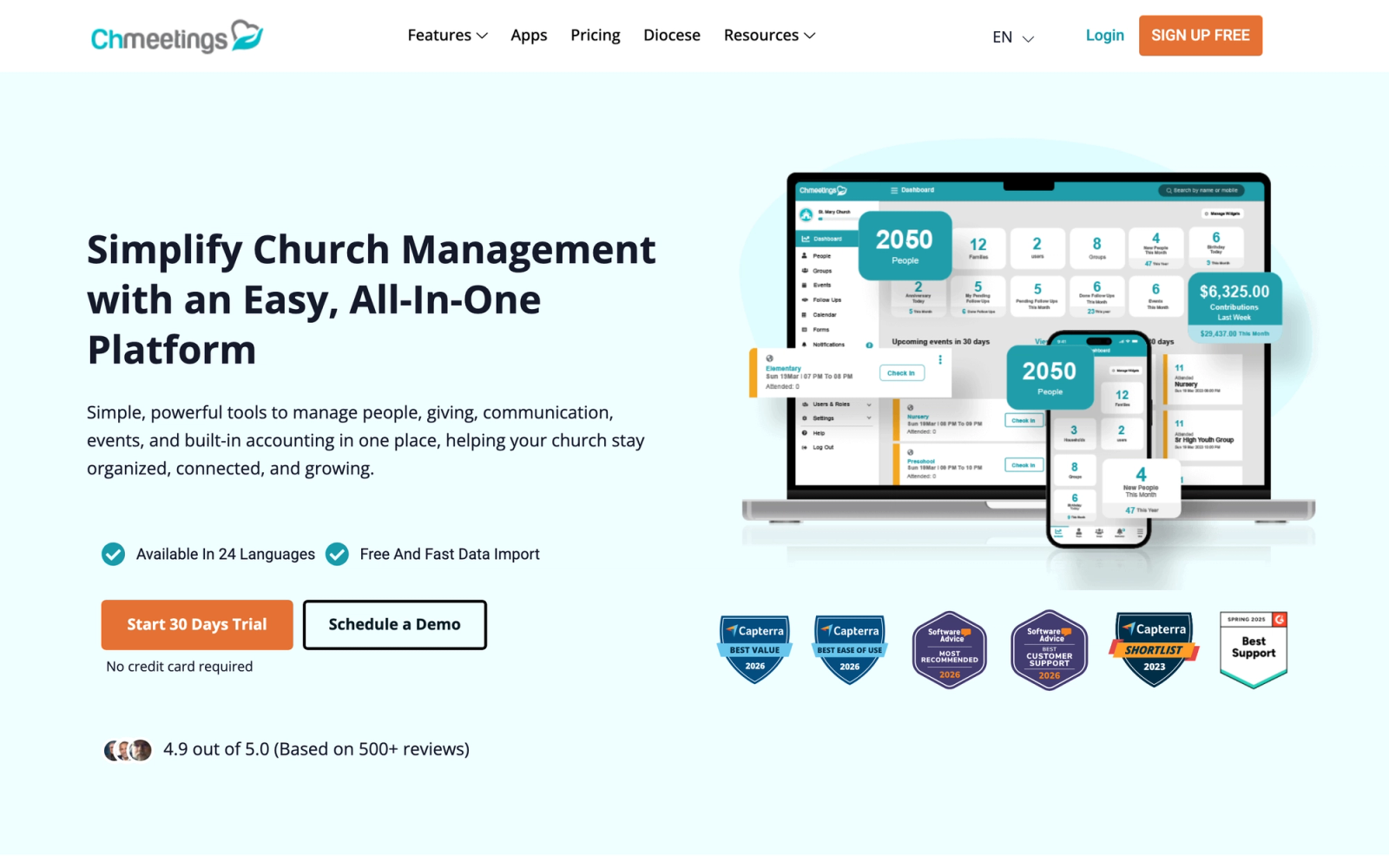
ChMeetings is the budget-conscious cloud alternative that comes closest to matching ChurchCRM's price point while eliminating the self-hosting burden. Built for small churches and church plants, ChMeetings offers a genuinely usable free tier that supports up to approximately 100 people with core features included, not just a trial period with an expiration date.
For churches currently running ChurchCRM primarily because it is free, ChMeetings offers a path to cloud-hosted management without adding significant cost. The platform handles member records, groups, attendance, giving, volunteer coordination, and basic communication in a straightforward interface that requires no technical setup, no server maintenance, and no PHP expertise.
Core Capabilities
- People and family management with custom fields and member directories
- Groups management for small groups, Bible studies, and ministry teams
- Attendance tracking for services, events, and groups including child check-in
- Event management with calendar scheduling and registrations
- Online giving and donation tracking with contribution statements
- Email and SMS communication to members, groups, or custom lists
- Volunteer management with scheduling and role assignments
- Custom forms and surveys for registrations and follow-up
- Attendance and giving reports with growth metrics
- Mobile app for member access to directories, giving, and events
Standout Strength
A genuinely usable free tier for small churches. Unlike most competitors that offer time-limited trials, ChMeetings provides core ChMS functionality at no cost for congregations under approximately 100 people, making it the most accessible cloud-based entry point for budget-constrained churches.
Best For
Small churches (under 200 members) and church plants with minimal or zero software budgets. Strong for international churches or missions that need affordable, cloud-based management without technical infrastructure requirements.
Pricing Overview
- Free plan supporting approximately 100 people with core features
- Paid tiers starting at approximately $5 to $15 per month
- Pricing scales based on the number of people managed
- No long-term contracts typically required
Limitations
- Feature depth is limited compared to larger platforms for advanced workflows or reporting.
- Fewer third-party integrations than Planning Center or Breeze.
- Less suitable for churches above 300 to 400 members who need more sophisticated tools.
Quick Comparison Insight
The closest cloud-based match to ChurchCRM's free pricing model, but with modern hosting, online giving, and no server maintenance in exchange for limits on congregation size.
One Church Software
Overview
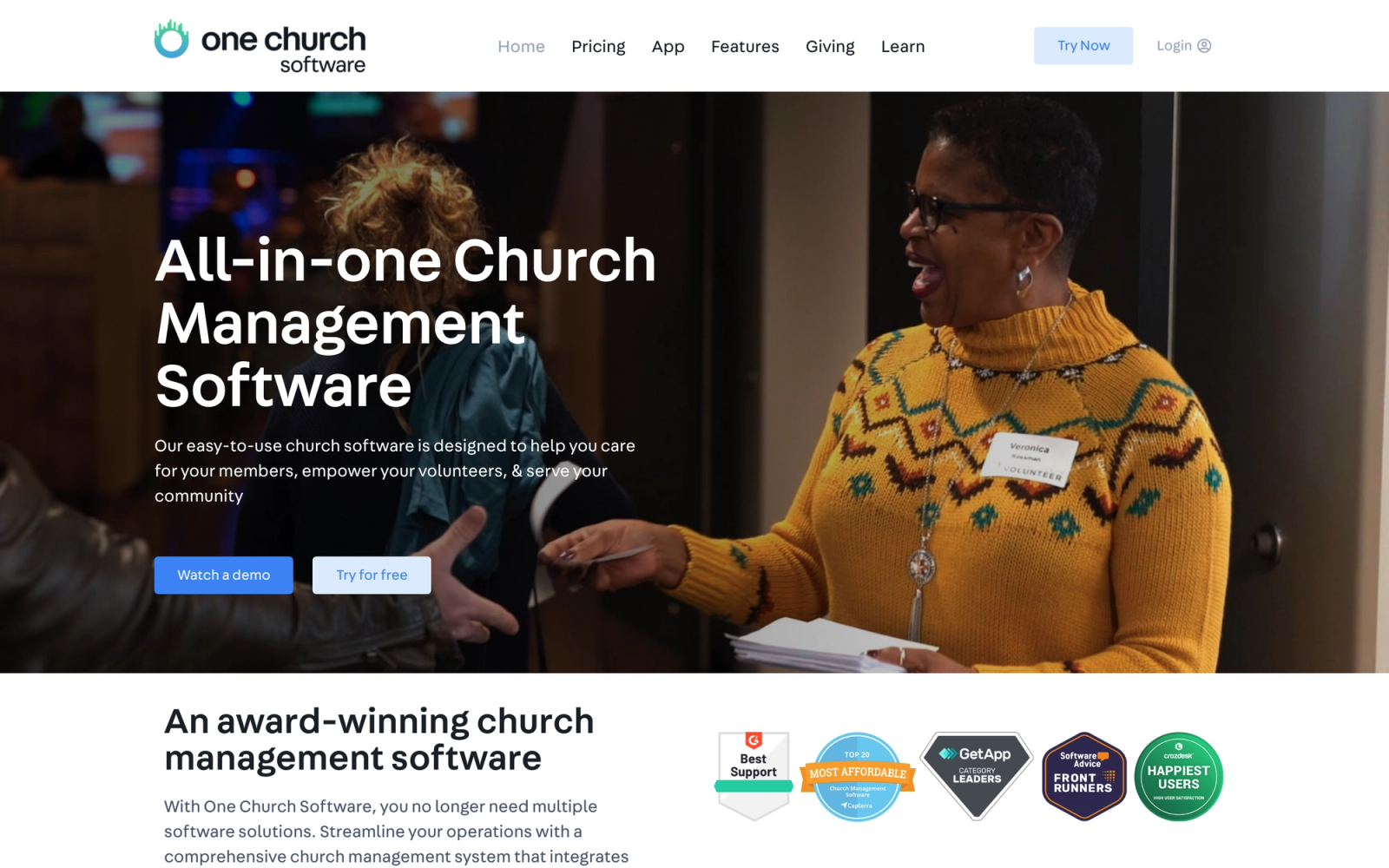
One Church Software takes a different approach than every other platform on this list by bundling church management, a website builder, a branded mobile app, and media hosting into a single subscription. Where ChurchCRM handles management only and leaves churches to find separate solutions for their website, app, and streaming, One Church Software consolidates the entire digital presence under one roof.
For churches currently juggling ChurchCRM alongside a separate website host, a streaming service, and possibly a giving platform, One Church Software's consolidation pitch is compelling. A church replacing three or four separate subscriptions with a single platform can simplify administration and potentially reduce total costs, even though the individual ChMS features may not match the depth of dedicated platforms.
Core Capabilities
- Church website builder with drag-and-drop editing and church-specific templates
- Custom branded mobile app for iOS and Android with push notifications
- People and member database with family linking and custom fields
- Online giving portal with recurring donations and contribution tracking
- Live streaming integration for services
- Event management with calendar pages and online registration
- Small group management with directories, communication, and sign-ups
- Sermon and media library for organizing audio and video content
- Email and push notification communication tools
- Child and volunteer check-in system
Standout Strength
True all-in-one bundling that replaces separate subscriptions for a website, mobile app, ChMS, and streaming with a single platform. For churches currently patching together multiple free or low-cost tools alongside ChurchCRM, the consolidation simplifies both administration and budgeting.
Best For
Small to mid-size churches (50 to 500 members) that want to launch or consolidate their entire digital presence, including website, app, and management system, under one vendor. Especially strong for churches that currently lack a website or mobile app.
Pricing Overview
- Starter tier available at low cost
- Full all-in-one plans typically range from $49 to $79 per month
- Pricing may scale based on features enabled or church size
- The value proposition replaces 3 to 4 separate subscriptions
Limitations
- Each bundled component is competent but individually less deep than leading dedicated tools.
- Vendor lock-in risk: website, app, database, and giving all on one platform makes migration difficult.
- Less suited for large or multi-campus churches with complex reporting needs.
Quick Comparison Insight
Replaces ChurchCRM plus a separate website, app, and giving platform with a single subscription, trading individual feature depth for consolidation and simplicity.
Where Teachfloor Fits
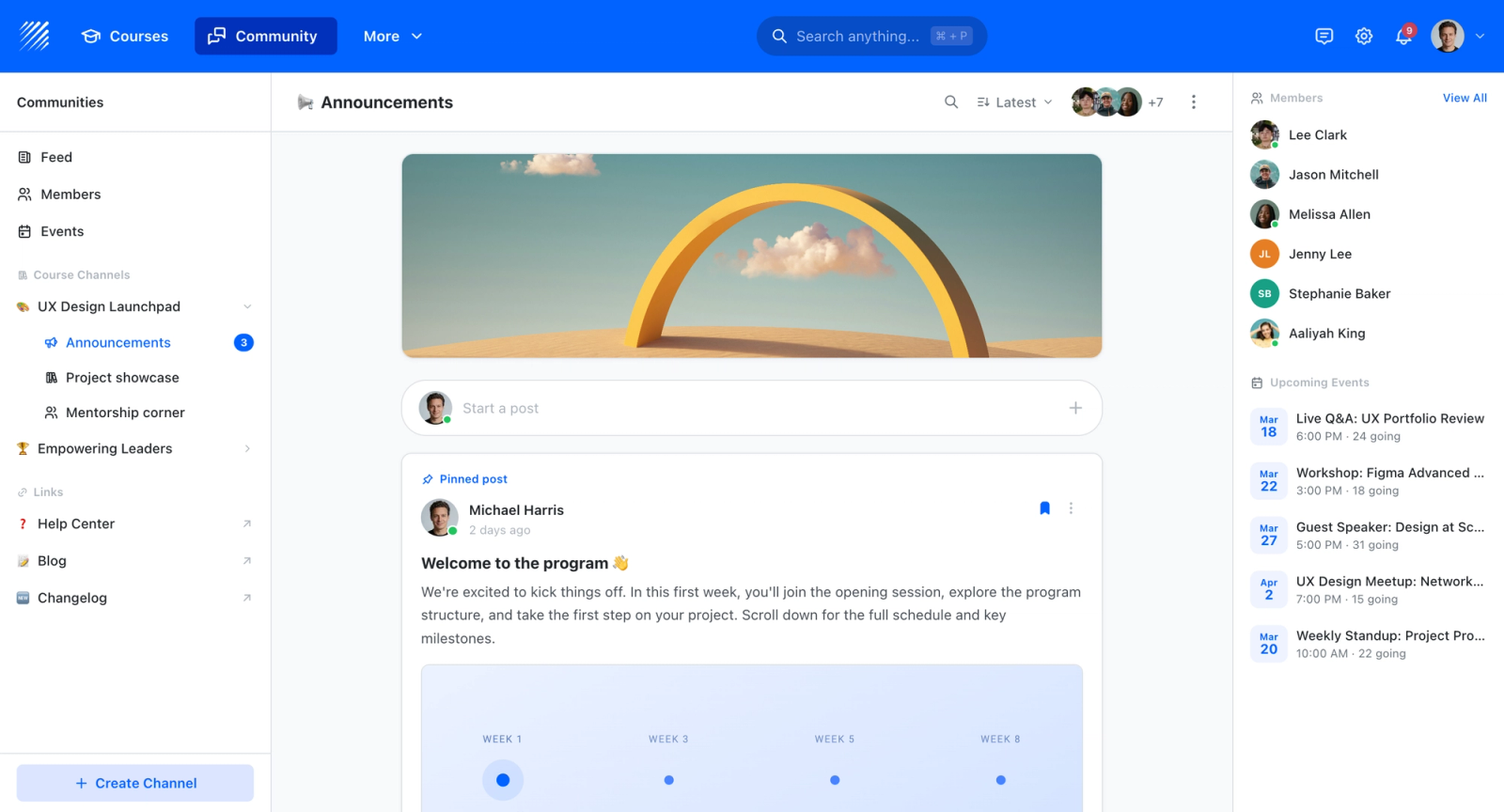
The tools above handle ChurchCRM. To actually build, deliver, and manage the courses or training programs around them, you need a learning platform. Teachfloor is a flexible course and training platform: run programs self-paced, social, live, or in cohorts, with built-in community, peer review, AI course creation, certificates, and white-label branding on your own domain. It pairs well with the tools on this list, hosting and structuring the learning experience around them.
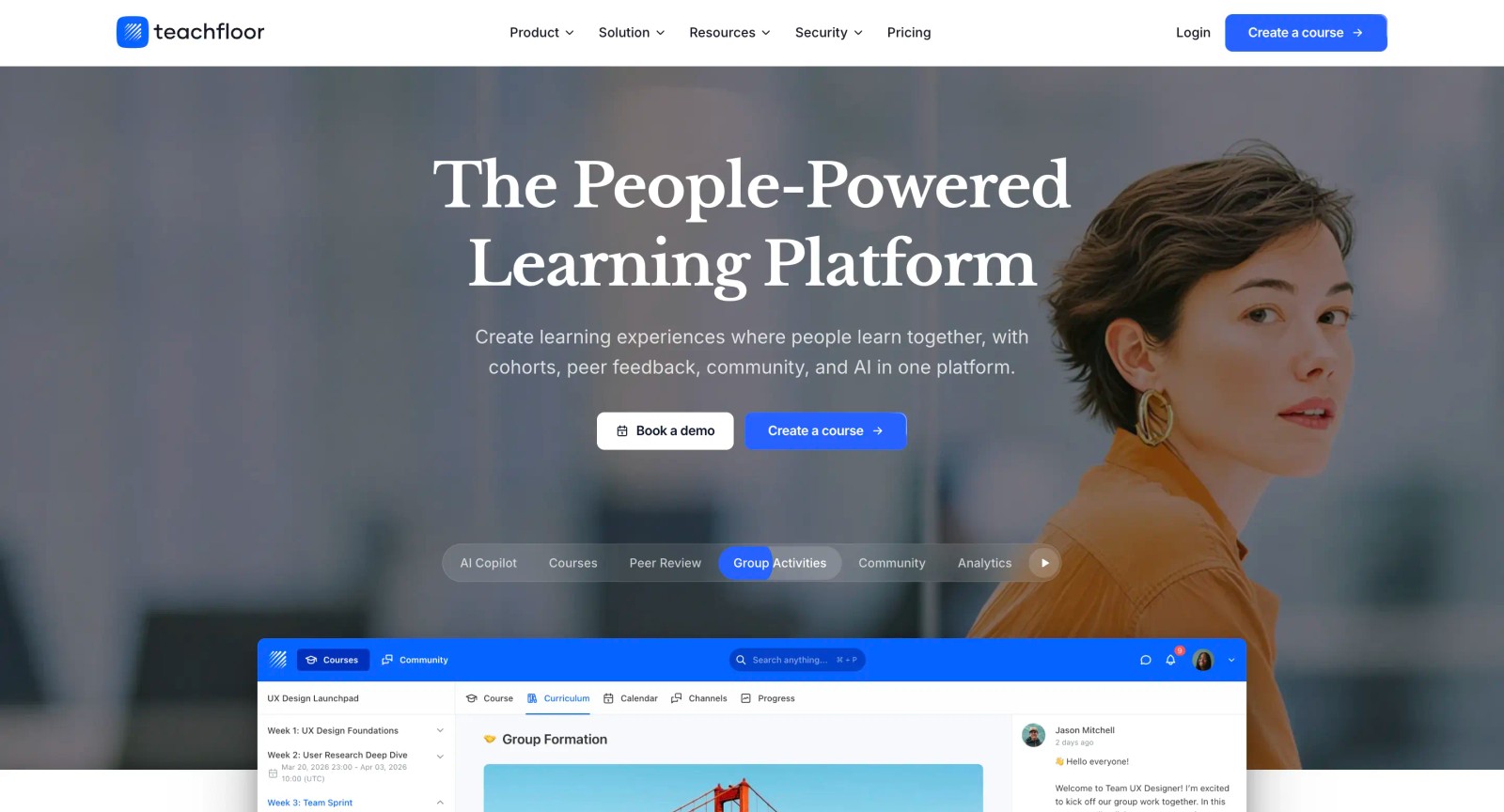
If you are choosing a home for your courses rather than a single-purpose tool, Teachfloor is worth a look. It starts at $89 per month with a 14-day free trial.
How to Choose the Right ChurchCRM Alternative
The right platform depends on what drove you to ChurchCRM in the first place and what is driving you away.
If cost is the primary concern, ChMeetings offers the closest match with a free tier that supports small congregations. Rock RMS is also free to self-host if your church has Windows Server expertise and wants to stay open source but with far more power.
If you want the easiest transition from self-hosted to cloud, Breeze and ChMeetings require zero technical setup and include free data migration support. Both can have a church operational within a day.
If your church has outgrown ChurchCRM's features, Planning Center, Realm, or TouchPoint each provide significantly deeper capabilities. Planning Center excels at worship planning, Realm at integrated accounting, and TouchPoint at advanced data querying for large congregations.
If you need integrated accounting and payroll, Realm and ShelbyNext are the only platforms on this list that include real fund accounting. ShelbyNext additionally handles clergy-specific payroll.
If your church operates in the UK or Europe, ChurchSuite is purpose-built for GDPR compliance, Gift Aid management, and UK church culture in ways that no American-built platform replicates.
If you value open source, Rock RMS and TouchPoint both offer open-source codebases. Rock operates at enterprise scale with a visual workflow engine; TouchPoint provides deep querying power for multi-campus organizations.
If you want everything under one roof, One Church Software bundles ChMS, website, app, and streaming into a single subscription, and Elvanto offers strong volunteer scheduling within the growing Tithe.ly stack.
The training delivery methods your church uses for volunteer and staff onboarding should also factor into the decision. A platform your team cannot adopt effectively delivers no value regardless of its feature depth.
FAQ
Is ChurchCRM still maintained?
ChurchCRM remains an active open-source project with community contributors. However, development pace is slower than commercial platforms, and new features arrive less frequently than with funded SaaS competitors.
Can I migrate my data from ChurchCRM to another platform?
Yes. ChurchCRM stores data in MySQL, which can be exported to CSV. Most platforms on this list accept CSV imports for member records, families, groups, and contributions. Some platforms offer dedicated migration assistance.
Are there other free church management options besides ChurchCRM?
ChMeetings offers a free tier for small churches, and both Rock RMS and TouchPoint are open-source with free self-hosting options. Planning Center also provides free tiers for each module (limited to small congregations).
Do I need technical skills for cloud-based ChMS platforms?
No. Cloud-based platforms like Breeze, ChMeetings, Elvanto, and ChurchSuite handle all hosting, updates, and maintenance on their end. Church staff log in through a browser or mobile app without touching server configuration, which makes the switch from a self-hosted system like ChurchCRM largely invisible to end users.


