

Building learning software for most of the last decade has taught us one thing above all: there is no such thing as the perfect learning platform.
Every academy, training company, and education business eventually needs something slightly different. A workflow that reflects how they actually run their programs. An integration with a tool only their team uses. A dashboard that makes sense for their organization and nobody else's. An automation so specific that no other customer may ever ask for it.
That is not a flaw in any particular product. It is the nature of learning.
Context matters enormously in education. Who is learning, why they are learning, who they are learning with, and how a program is delivered all change what the software around it needs to do.
For years, there was only one real answer when the platform did not fit perfectly: ask the software company to build what was missing.
AI is about to change that.
What we learned building Teachfloor
We started Teachfloor to build for the kind of learning we believe in most: cohort-based, collaborative, and social learning.
The kind of learning where outcomes depend on people.
An instructor who cares. Peers who challenge each other. A community that keeps you moving when motivation drops.
From the beginning, the people using Teachfloor have shaped the product with us. Our roadmap has always been heavily influenced by customer requests. When customers told us their programs needed something, we listened and, whenever we could, we built it.
Sometimes we even built features that only one organization needed.
That may not always look like the most scalable way to build software, but in learning, a niche request is often not a distraction. It reflects something very real about how that organization teaches.
We are proud of building Teachfloor this way, and we are not going to stop.
But there is an obvious limit.
No matter how fast a product team moves, it cannot build every workflow, integration, dashboard, automation, or feature that every customer can imagine.
And paradoxically, the most specific requests, the ones that might matter enormously to one organization, are often the hardest for a software company to prioritize.
That made us rethink what customization should mean.
From customizable software to programmable software
For most of the software era, customization has meant configuration.
Settings. Toggles. Options. Custom fields. Admin panels.
They are useful, but they all share the same limitation: you can only customize the things the software company decided in advance should be customizable.
Add enough options and eventually you end up with a more complicated product that is still missing the one thing a particular customer needs.
That is the ceiling every buyer eventually hits. It is why choosing between customizable LMS platforms so often comes down to whose set of options is least limiting, rather than whether the platform can become exactly what you need.
So we decided to make a different bet.
Instead of trying to anticipate every possible feature our customers might need, we are making Teachfloor programmable.
The platform is no longer just a finished product that you configure.
It is becoming a foundation you can extend.
You keep the powerful core that we build, maintain, secure, and improve. But when your organization needs something highly specific, you can build that last piece yourself instead of waiting for it to appear on our roadmap.
That dramatically changes the customization ceiling of the platform.
| Approach | What you can change | The limit |
|---|---|---|
| Vendor-built | Whatever you ask for | You wait on the roadmap, and niche requests rarely make it |
| Configurable | The options we exposed | Only what we decided in advance |
| Programmable | Anything you can describe | Nothing off-limits |
AI changes who can build software
Programmable platforms are not new.
What is new is who can program them.
Until recently, building something on top of a software platform meant understanding APIs, reading technical documentation, writing code, testing it, deploying it, and maintaining it.
In other words, you needed a developer.
AI changes that interface.
Through the Teachfloor MCP server, an AI coding assistant can understand your Teachfloor environment and interact with the platform. You can then describe what you want in plain language, in the language you are most comfortable using, and let the assistant turn that idea into a working application.
You might describe something specific to how your own organization works:
- “Build a quoting calculator our sales learners use inside the lesson, loaded with our own product prices, so they practice on real numbers instead of made-up examples.”
- “Add a panel to each learner's profile that shows their account status from our internal CRM, so our instructors can tell paying customers from trials while they coach them.”
- “Give our program team a private board, visible only inside our organization, where they plan which mentor is assigned to each incoming cohort.”
Not long ago, any of those could have meant writing requirements, finding a developer, reading API documentation, building the integration, testing it, and waiting weeks before seeing the result.
Now the distance between the idea and the software can become a conversation.
Describe what you need.
See what the AI builds.
Ask it to change something.
Test it.
Refine it again.
Ship it.
That, to us, is the important shift.
This is not simply a faster way to submit a feature request. It is a collapse of the barrier between describing the software you need and being able to create it.
And we believe that has implications far beyond Teachfloor.
AI is not the protagonist of learning
There is an important distinction here.
We do not believe the future of education is AI replacing instructors.
We do not believe the best learning experiences happen when a machine becomes the center of the classroom.
Teachfloor is the People-Powered Learning Platform for a reason.
Cohort-based, collaborative, and social learning work because of people: instructors who care, peers who challenge each other, conversations that change how we think, and communities that keep us accountable.
Software does not create those things.
AI does not create those things.
AI is not the protagonist of learning. People are.
What AI can do is give those people capabilities that, until recently, belonged mainly to software companies and engineering teams.
It can help an instructor turn an idea into a tool.
It can help an academy adapt software around its teaching model instead of adapting its teaching model around software.
It can help an education entrepreneur build something useful without first building an engineering team.
That is the role of AI that excites us.
Not replacing the people doing the work, but increasing what those people are capable of doing.
People-powered learning, augmented by AI.
This is already happening
This is not a concept for some future version of Teachfloor.
Apps are already running on the platform today.
There are apps for live Polls and collaborative Idea Boards. Office Hours for managing instructor availability. Net Promoter Score tools for collecting feedback. Integrations with products such as Intercom and Segment.
And this is only the beginning.
Some apps will be broadly useful across thousands of organizations. Others may solve an extremely specific problem for a single academy.
Both are valuable.
That is the point.
The platform no longer has to force every organization toward the same set of features.
Three apps we built ourselves
To show what this makes possible, here are three apps our own team built on Teachfloor. Each one adds a capability the core product did not ship with, and each is live in the marketplace today.
Idea Board
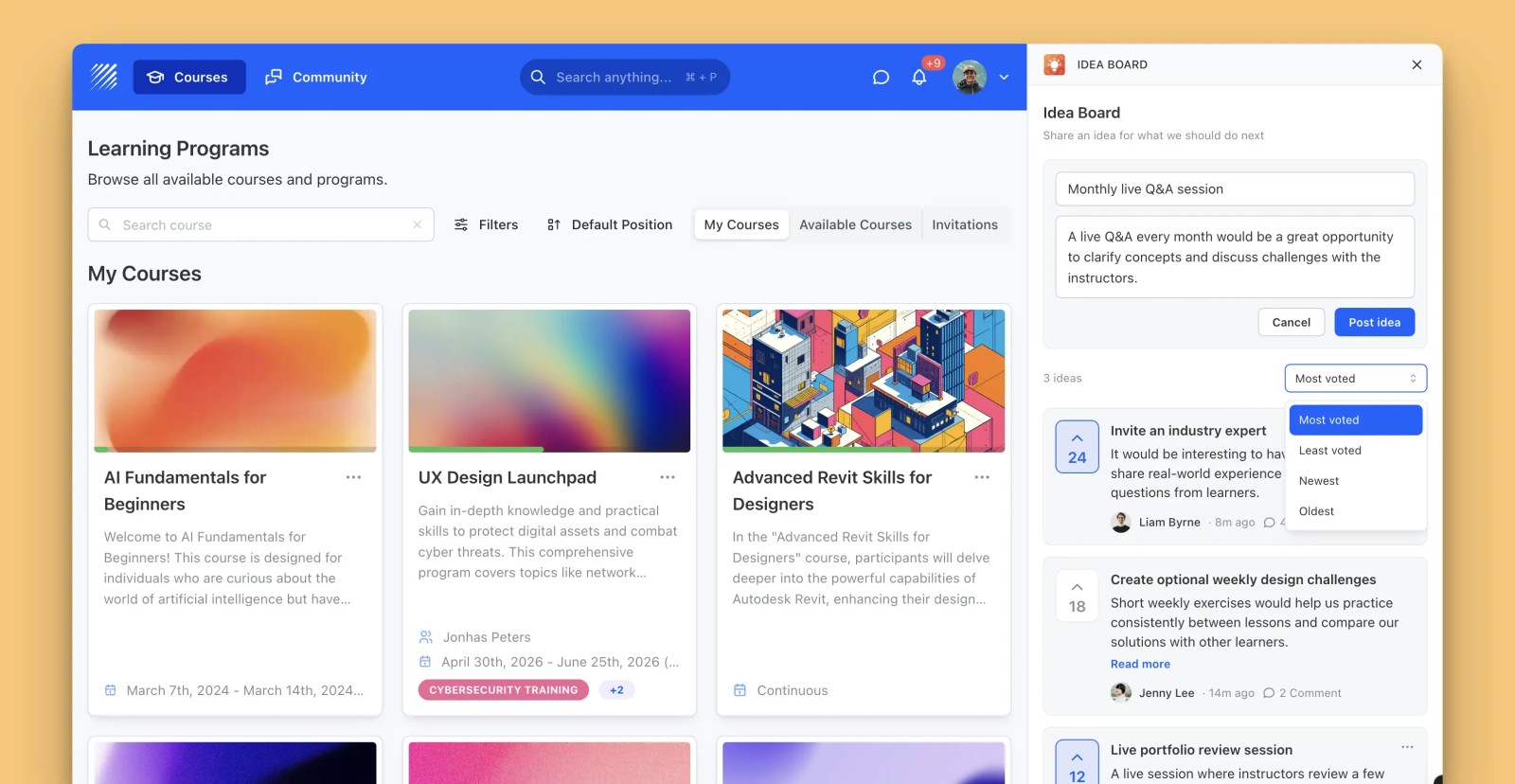
A Product Hunt style board inside your academy: members post an idea with a title and description, and the whole community upvotes the ones they want most. Sort by most voted to see what people actually care about right now, choose whether everyone or only staff can submit, and watch a messy pile of requests turn into a ranked, public roadmap signal. It is the exact loop this article is about, running as an app.
Lesson Comments
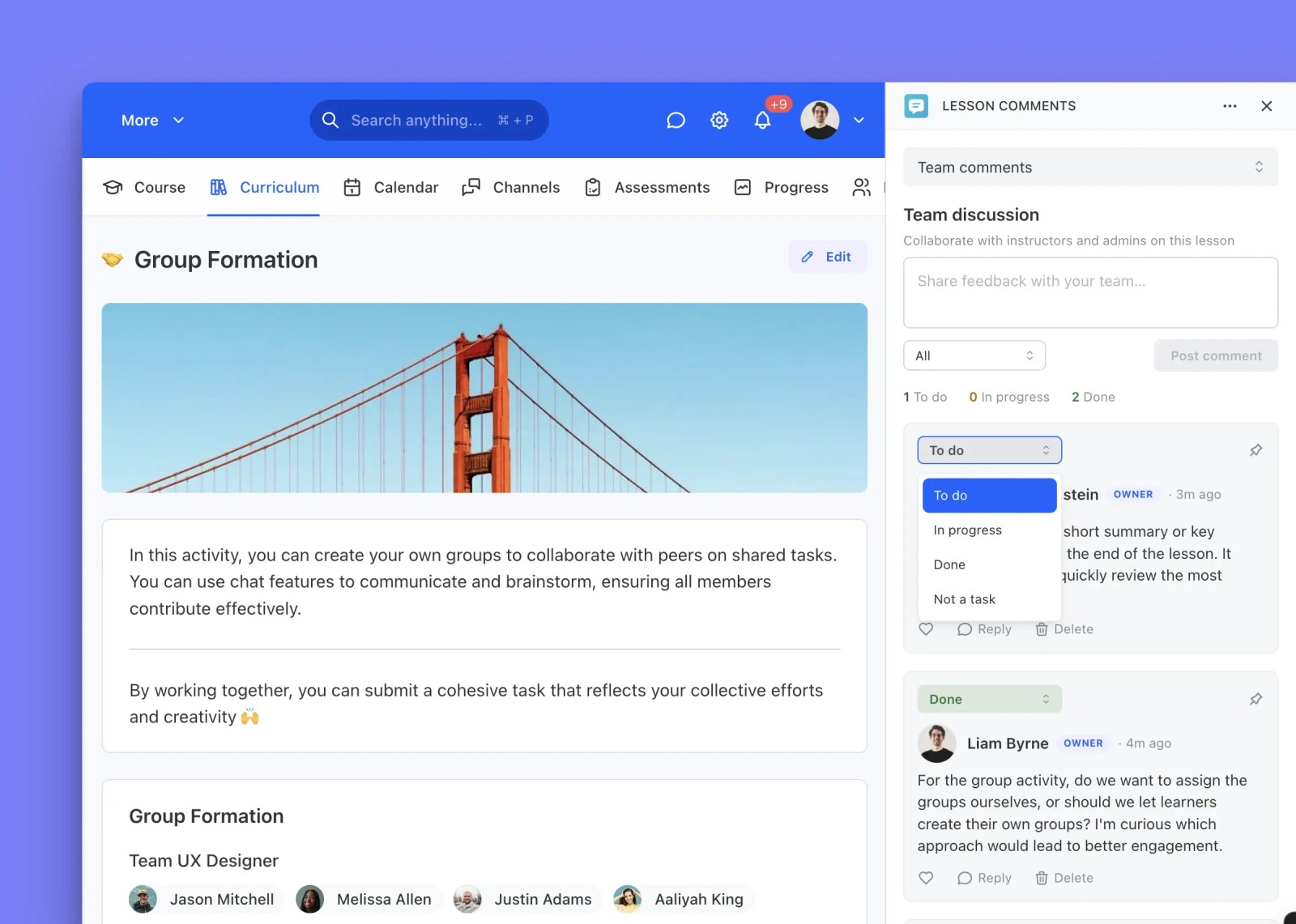
An asynchronous discussion thread on every lesson that turns passive content into social learning. Learners comment, reply, and like the most helpful answers in a public Community channel, while instructors and admins coordinate privately in a staff-only Team channel on the same lesson. Any comment can become a task with a To do, In progress, or Done status, and the important ones pin to the top, so feedback on the content becomes trackable work instead of vanishing into chat.
Reaction buttons
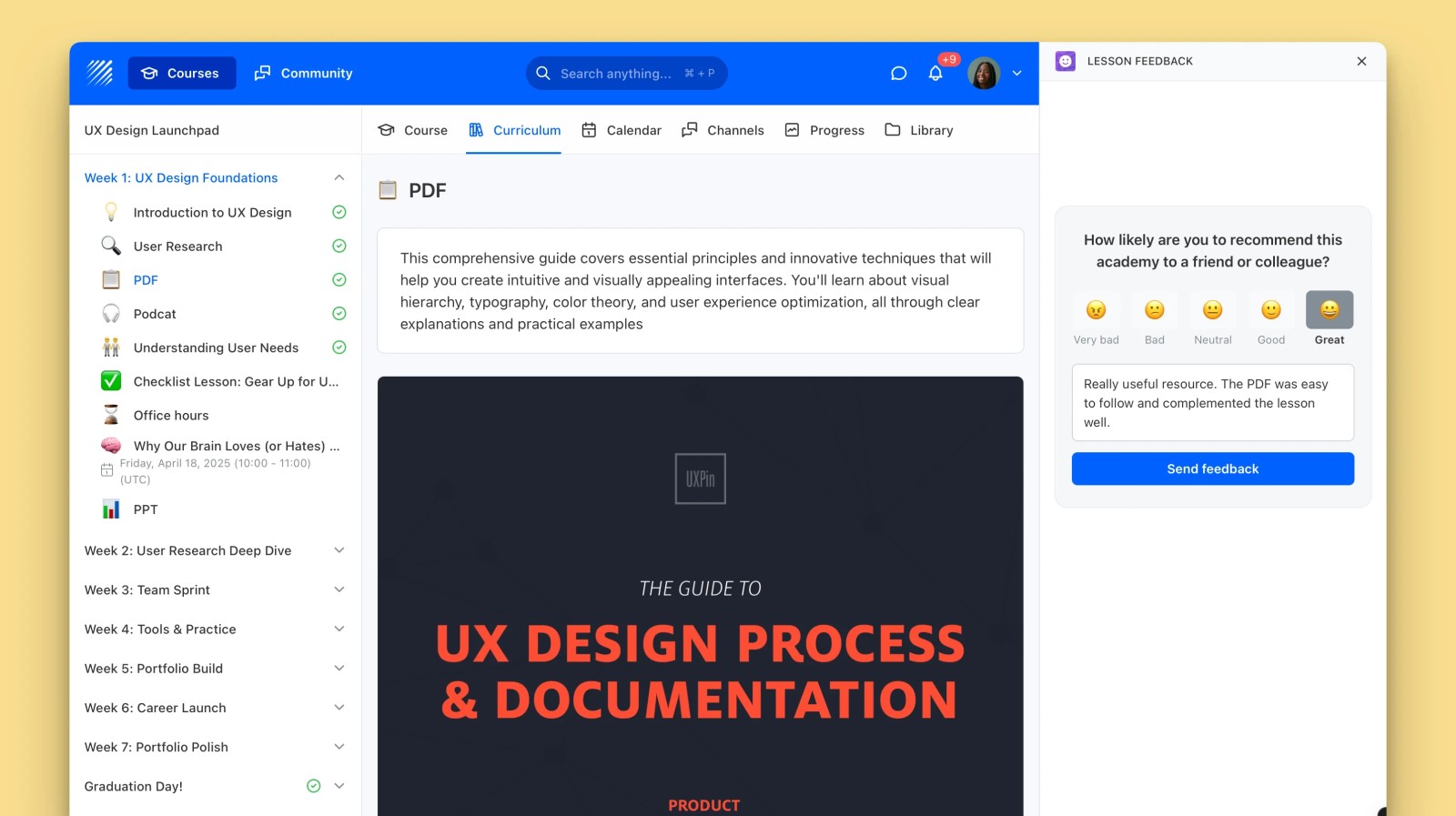
A one-question Net Promoter Score survey for your academy: learners answer the single question that matters most on a familiar 0 to 10 scale, with room to explain their score. Responses roll up into a headline NPS with a plain-language rating from Poor to Excellent, plus a clean split of promoters, passives, and detractors with percentages and counts. You stop guessing how your content lands and start measuring it.
Build your first Teachfloor app
Creating one starts with a simple connection.
First, you connect the Teachfloor MCP server to a supported AI coding assistant such as Claude or Cursor.
This gives the assistant the context and tools it needs to understand your Teachfloor environment and build against it.
From there, the development process becomes surprisingly conversational.
Describe it. Explain what you want the app to do in plain language.
Watch it build. The assistant creates the app and you can see it running inside Teachfloor.
Refine it. Ask for changes exactly as you would explain them to another person: move this section, add this field, calculate this metric, show this only to admins.
Ship it. Once it works the way you want, publish it to your organization or submit it to the marketplace if you want other Teachfloor customers to use it too.
You can go from an idea to a working first app in a single session without writing the code yourself.
We have also created a full step-by-step guide for anyone who wants to build one from scratch.
The last mile is yours
For years, software companies have competed by shipping more features.
We think AI changes that model.
The future of software is not simply a longer feature list.
It is software that the people using it can reshape themselves.
Teachfloor will continue building the powerful, opinionated core: the infrastructure for cohort-based, collaborative, and social learning.
We will continue listening to customers, improving the platform, and building the capabilities that should belong in the core product.
But increasingly, the last mile will belong to you.
The workflow unique to your academy.
The dashboard only your team needs.
The integration that connects your learning program to the rest of your business.
The small idea that would never make sense as a global product feature but makes perfect sense for you.
For the first time, those things no longer have to wait for us.
The platform is still people-powered. Now those people can shape the platform too.


