


Deep tech is a category of startups and companies built around significant scientific or engineering breakthroughs — typically requiring years of R&D, specialized expertise, and capital before reaching market. In 2026, deep tech encompasses AI foundation models, biotechnology, quantum computing, robotics, climate and energy innovation, advanced materials, and space — sectors where the moat is hard science, not software UX.
TL;DR
- Definition: companies built on real scientific or engineering breakthroughs (not just software product/market fit).
- Top 2026 sectors: AI foundation models, biotech (gene editing, drug discovery), quantum, climate & energy, robotics, advanced materials, space.
- Time to market: 5–15+ years from research to product — vs. 1–3 years for typical software startups.
- Funding profile: heavier seed rounds, longer time to Series A, more grant/strategic capital, lower exit multiples but bigger absolute outcomes.
- Why it matters in 2026: deep tech is where most of the next decade's most valuable companies and biggest societal shifts will originate.
What Is Deep Tech?
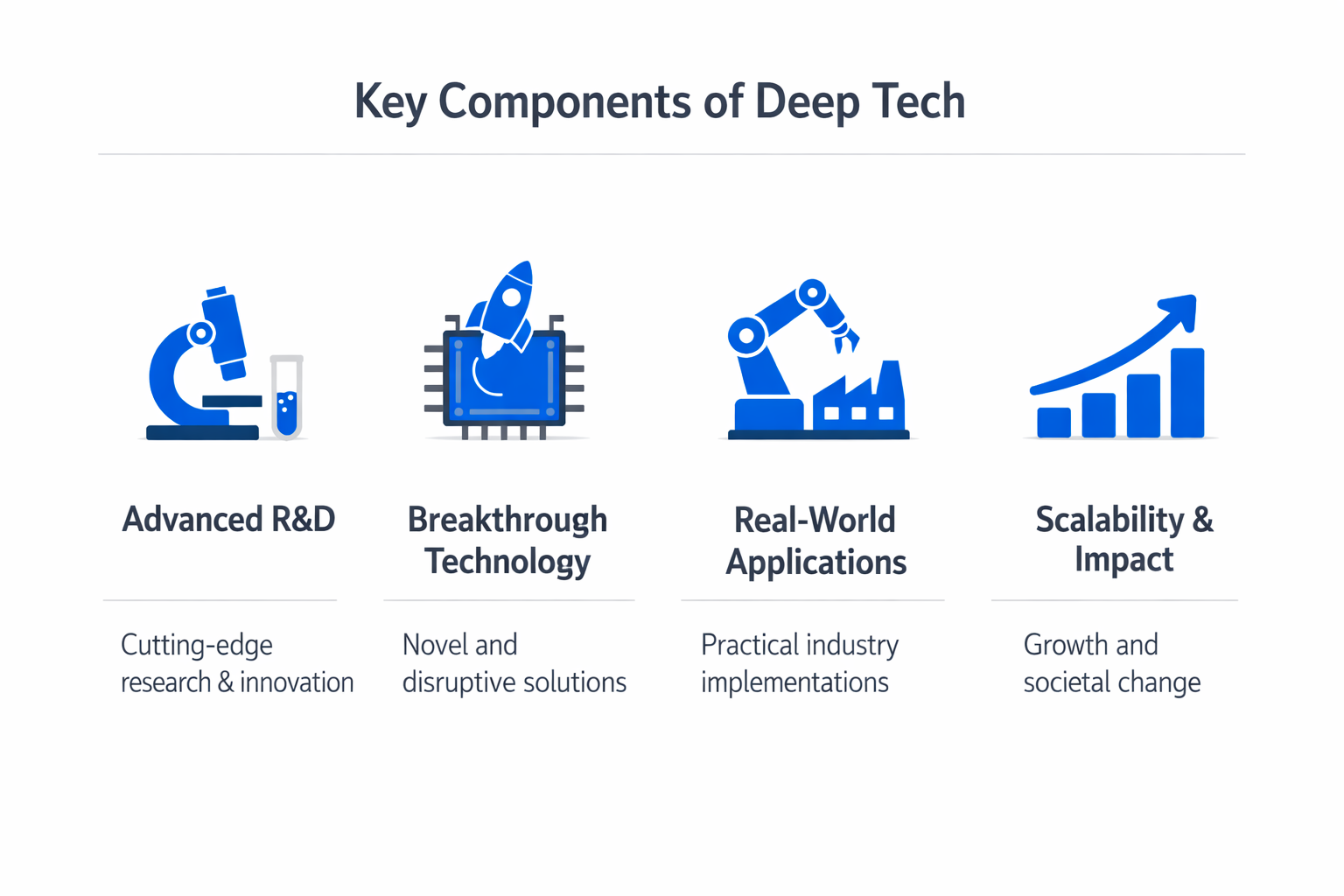
Deep tech refers to a class of startups and ventures built on substantial scientific or engineering breakthroughs rather than incremental product improvements. These companies develop technology rooted in tangible research, often originating from university labs, government-funded programs, or corporate R&D divisions. The defining characteristic is that the core innovation involves a hard technical problem that cannot be replicated simply by assembling existing software components.
What separates this category from conventional technology ventures is the depth of the underlying science. A typical software startup can build a minimum viable product in weeks and iterate based on user feedback. A deep tech company may spend years in research and development before producing a working prototype, because the challenges are scientific, not just engineering or design problems.
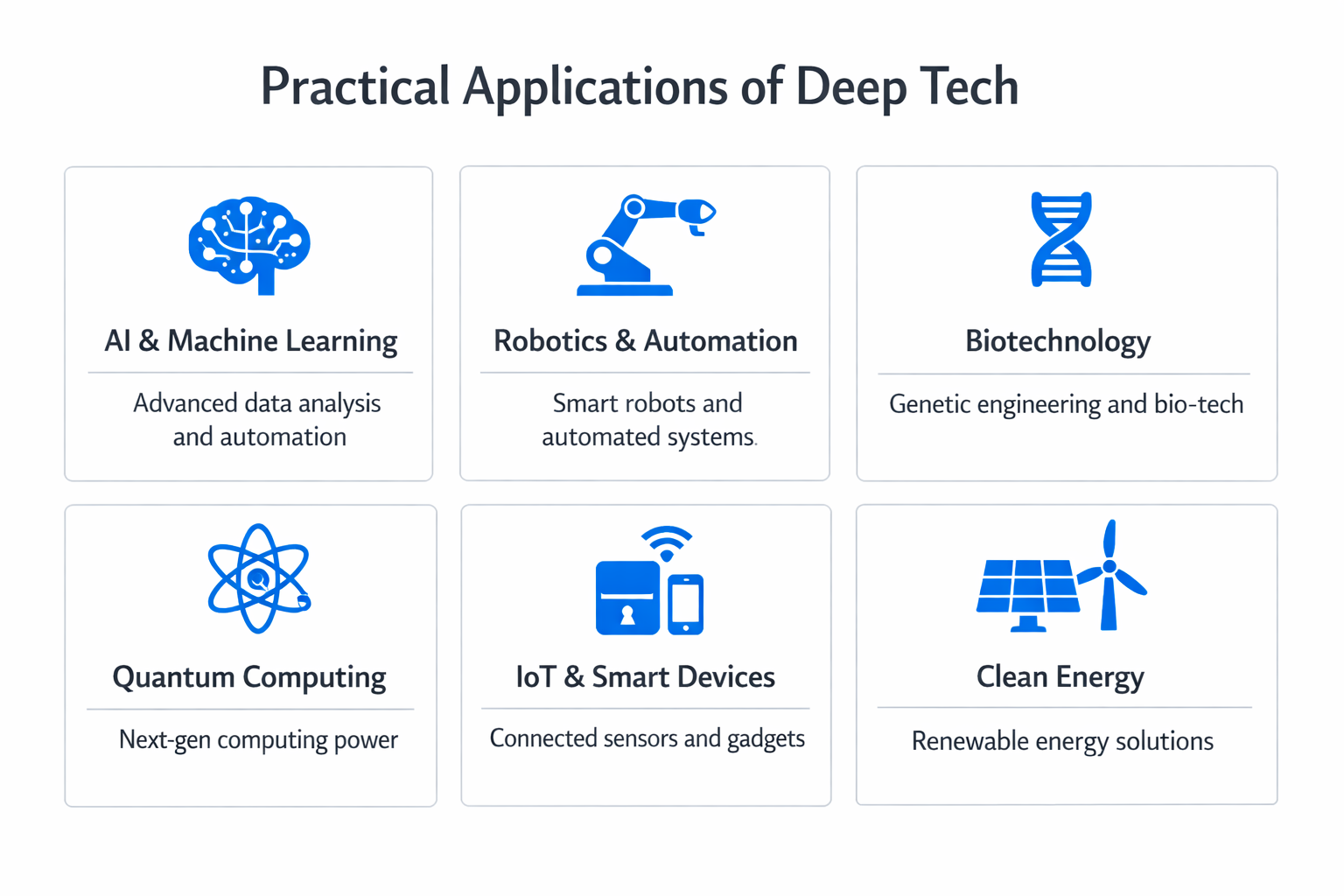
The term covers a broad range of domains: artificial intelligence, quantum computing, advanced materials, synthetic biology, robotics, clean energy, semiconductor design, and aerospace. What unites them is not a single field but a shared profile: high technical risk, long development timelines, significant capital requirements, and the potential for outsized impact if the science works.
How Deep Tech Differs from Other Technology Ventures
The distinction between deep tech and conventional tech is structural, not merely a matter of complexity.
Conventional tech ventures, including most SaaS platforms and consumer apps, compete primarily on execution speed, user experience, distribution, and business model innovation. The technology itself is often built from existing components: open-source libraries, cloud services, standard frameworks. Barriers to entry come from network effects, brand, and go-to-market execution rather than from the underlying technology.
Deep tech ventures face a fundamentally different competitive landscape. The primary barrier to entry is the technology itself. Replicating a working quantum processor or a novel CRISPR gene-editing technique requires not just funding but specialized scientific talent, proprietary data, years of experimentation, and often custom hardware. This creates a durable competitive moat that is difficult for fast-moving competitors to erode.
The risk profile also diverges sharply. In conventional tech, the dominant risk is market risk: will customers adopt the product? In deep tech, the dominant risk is technical: will the science work at all? A biotech company developing a new drug compound faces years of uncertainty about whether the molecule will perform as hypothesized in clinical trials.
A quantum computing startup faces the open question of whether error correction can be achieved at the scale required for practical applications.
This risk structure has direct implications for funding, talent acquisition, and organizational design. Deep tech teams tend to be research-heavy, with PhD-level scientists forming the core rather than product managers and designers. Funding cycles are longer, and investors must be comfortable with extended pre-revenue periods.
Core Sectors and Examples
Deep tech spans multiple scientific and engineering domains. Each sector has distinct characteristics, maturity levels, and commercial pathways.
Artificial Intelligence and Machine Learning
AI sits at the boundary between deep tech and conventional tech. Training large-scale foundation models, developing novel architectures, and building specialized AI adaptive learning systems require significant research investment and technical expertise. Companies like DeepMind, OpenAI, and Anthropic operate in this space, pushing the boundaries of what neural networks can accomplish.
The distinction matters at the infrastructure level. Building a chatbot wrapper on top of an existing API is not deep tech. Designing a new transformer architecture, developing custom AI accelerator hardware, or creating training methods that fundamentally improve model efficiency qualifies.
Quantum Computing
Quantum computing represents one of the highest-risk, highest-potential sectors. Companies like IBM, Google Quantum AI, IonQ, and Rigetti Computing are developing hardware that uses quantum mechanical phenomena to solve computational problems intractable for classical computers. Applications include drug discovery, materials science, cryptography, and optimization problems in logistics and finance.
The field remains in an early stage. Current quantum processors are noisy, limited in qubit count, and far from the fault-tolerant systems required for most practical applications. The investment thesis rests on the conviction that these engineering challenges will eventually be overcome.
Biotechnology and Synthetic Biology
Biotech has been a deep tech sector long before the term existed. Companies developing novel therapeutics, gene therapies, and diagnostic tools operate on timelines measured in decades. Moderna's mRNA platform, which enabled rapid vaccine development, illustrates how years of foundational research can produce breakthrough applications when conditions demand them.
Synthetic biology extends this further, engineering biological systems to produce materials, fuels, food ingredients, and chemicals. Companies like Ginkgo Bioworks design custom organisms for industrial applications, blending biology with software-driven design.
Advanced Materials and Nanotechnology
New materials unlock capabilities across industries. Graphene, advanced composites, metamaterials, and nanostructured surfaces are enabling lighter aircraft, more efficient batteries, better medical implants, and improved semiconductor performance. The path from laboratory discovery to commercial product is often long and capital-intensive, requiring specialized manufacturing processes that do not yet exist at scale.
Clean Energy and Climate Tech
Energy storage, nuclear fusion, carbon capture, green hydrogen, and next-generation solar technologies all fall under the deep tech umbrella. The scientific challenges are immense: achieving net energy gain from fusion, making carbon capture economically viable, or developing battery chemistries that outperform lithium-ion on cost, density, and longevity.
Companies such as Commonwealth Fusion Systems, Climeworks, and QuantumScape illustrate the range of approaches. The market demand is clear, driven by decarbonization targets, but the technical pathways remain uncertain.
Robotics and Autonomous Systems
Robotics combines mechanical engineering, sensor technology, computer vision, and AI into systems that interact with the physical world. Deep tech robotics companies build machines for manufacturing, agriculture, surgery, warehouse logistics, and undersea exploration. The challenge is not just software. It requires solving problems in dexterity, perception, safety, and reliability that remain at the frontier of engineering research.
TypeDescriptionBest ForArtificial Intelligence and Machine LearningAI sits at the boundary between deep tech and conventional tech.Training large-scale foundation modelsQuantum ComputingQuantum computing represents one of the highest-risk, highest-potential sectors.Drug discovery, materials science, cryptographyBiotechnology and Synthetic BiologyBiotech has been a deep tech sector long before the term existed.Moderna's mRNA platform, which enabled rapid vaccine developmentAdvanced Materials and NanotechnologyNew materials unlock capabilities across industries.Graphene, advanced composites, metamaterialsClean Energy and Climate TechEnergy storage, nuclear fusion, carbon capture, green hydrogen.Commonwealth Fusion Systems, ClimeworksRobotics and Autonomous SystemsRobotics combines mechanical engineering, sensor technology, computer vision.Deep tech robotics companies build machines for manufacturing
Why Deep Tech Matters for the Economy
Deep tech matters because it addresses problems that conventional technology cannot solve. Climate change, pandemic preparedness, food security, energy independence, and computing limitations are not challenges that can be overcome with better user interfaces or faster software deployment cycles.
From an economic perspective, deep tech ventures create long-lasting competitive advantages for the regions and countries that support them. Intellectual property generated through fundamental research, patents on novel processes, and proprietary manufacturing techniques produce defensible market positions that persist for decades.
Deep tech also produces significant spillover effects. Research into quantum computing advances materials science. AI research improves drug discovery pipelines. Aerospace innovation drives improvements in manufacturing precision. These cross-domain benefits compound over time, strengthening entire innovation ecosystems.
For workforce development, deep tech creates demand for highly skilled roles that span science, engineering, and business. Training programs, certification programs, and accelerator programs designed around deep tech domains are becoming essential infrastructure for regions seeking to compete in the knowledge economy.
The knowledge economy increasingly favors countries and institutions that invest in the scientific foundations from which deep tech companies emerge.
The Deep Tech Investment Landscape
Investing in deep tech requires a different playbook than investing in conventional startups. The timelines are longer, the capital requirements are higher, and the evaluation criteria lean heavily on scientific credibility rather than market traction.
Funding Stages and Structures
Deep tech companies typically progress through distinct phases that do not map neatly onto the standard seed-to-Series-A framework:
- Discovery phase. Research is conducted in academic or government labs. Funding comes from grants, fellowships, and institutional budgets. No commercial entity may exist yet.
- Translation phase. A founding team forms around a specific scientific insight and attempts to demonstrate feasibility outside the lab. Early-stage venture capital, government innovation grants, and corporate venture arms provide initial funding.
- Scale-up phase. The technology has demonstrated proof of concept. The company needs significant capital to build pilot manufacturing, secure regulatory approvals, or develop commercial-grade prototypes. Growth-stage investors, strategic partners, and sovereign wealth funds become involved.
- Commercialization phase. The product reaches market. Revenue begins, but the company may still require substantial capital for manufacturing scale, global distribution, and continued R&D.
Investor Profiles
Not all investors are equipped for deep tech. The category attracts specialized participants:
- Government and institutional funding through agencies like DARPA, the European Innovation Council, and national science foundations provides non-dilutive grants and early validation.
- Specialized deep tech venture capital firms such as DCVC, Lux Capital, and Breakthrough Energy Ventures have the scientific expertise and patience required for long investment horizons.
- Corporate venture arms from companies like Google, Samsung, and Bosch invest strategically to gain early access to technologies that may disrupt or enhance their core businesses.
- Sovereign wealth funds from countries investing in economic diversification, particularly in the Middle East and Southeast Asia, are increasingly active in deep tech portfolios.
Market Sizing and Trends
The global deep tech ecosystem has grown significantly in recent years. Boston Consulting Group has identified deep tech as a category where venture investment has outpaced conventional tech in certain metrics, particularly in sectors aligned with climate, health, and national security priorities.
Government policy is a major driver. The U.S. CHIPS Act, the European Chips Act, and similar programs in Japan, South Korea, and India are directing billions into semiconductor manufacturing, quantum research, and AI infrastructure. These policy commitments create market opportunities that did not exist a decade ago.
Challenges and Risks in Deep Tech
Deep tech carries inherent risks that founders, investors, and policymakers must understand clearly.
Technical Risk
The most fundamental challenge is that the science may not work. Unlike software, where iteration is fast and failure is cheap, deep tech failures can consume years of effort and hundreds of millions in capital. A fusion energy startup that cannot achieve net energy gain has no fallback product.
Technical risk cannot be eliminated through better management or faster execution. It is inherent to the domain. Organizations must build cultures that tolerate failure, invest in rigorous experimental design, and maintain intellectual honesty about results.
Talent Scarcity
Deep tech companies compete for a limited pool of scientists and engineers with specialized expertise. A quantum physicist, a synthetic biologist, or an advanced materials researcher cannot be trained through a typical software engineering bootcamp. The talent pipeline depends on decades of investment in graduate education and research programs.
This scarcity drives compensation higher and limits the speed at which companies can grow. It also creates geographic concentration, as talent clusters around universities and research institutions that produce these specialists.
Regulatory Complexity
Many deep tech sectors operate in heavily regulated environments. Biotech companies must navigate FDA approval processes. Nuclear energy ventures face oversight from national nuclear agencies. Autonomous vehicle companies deal with evolving transportation regulations across multiple jurisdictions.
Regulatory timelines can add years to product development and require dedicated legal and compliance teams. Companies that underestimate regulatory burden often run out of capital before reaching the market.
Capital Intensity
The physical infrastructure required for deep tech, laboratories, clean rooms, testing facilities, pilot manufacturing lines, demands capital at a scale that pure software companies never face. A semiconductor fabrication facility can cost upwards of ten billion dollars. Even smaller deep tech ventures typically require tens of millions before generating any revenue.
This capital intensity filters out underfunded teams and creates a natural advantage for ventures backed by patient, well-resourced investors.
Long Time to Market
Deep tech products can take five to fifteen years from initial research to commercial availability. During that period, market conditions shift, competing approaches emerge, and founding teams face sustained pressure. The reskilling workforce needed to support deep tech ecosystems must be built and maintained over similarly long horizons.
Organizations involved in training needs assessment for deep tech sectors must account for these extended timelines when designing learning programs.
How Deep Tech Companies Go to Market
Commercializing deep tech requires strategies distinct from conventional product launches.
Technology Licensing
Some deep tech companies monetize through licensing their intellectual property rather than building end products. A company that develops a novel battery chemistry may license the technology to automotive manufacturers rather than building batteries itself. This approach reduces capital requirements but also limits upside.
Platform Models
Companies that develop foundational technologies often evolve into platform providers. Cloud computing providers offer AI infrastructure. Synthetic biology companies offer design-build-test platforms. This model generates recurring revenue and creates ecosystem lock-in.
Strategic Partnerships
Deep tech ventures frequently partner with established corporations that have manufacturing capacity, distribution networks, and regulatory experience. These partnerships accelerate time to market but require careful negotiation to protect intellectual property and maintain strategic independence.
Government Contracts
Defense, intelligence, and space agencies are major customers for deep tech. Companies in quantum computing, advanced materials, robotics, and cybersecurity often secure government contracts that provide revenue, validation, and access to classified requirements.
How to Evaluate Deep Tech Opportunities
Whether evaluating a deep tech startup as an investor, potential employee, or training program designer, several criteria provide a useful framework.
- Scientific foundation. Is the core technology based on published, peer-reviewed research? Has it been validated independently?
- Team composition. Does the founding team include scientists with deep domain expertise and a track record of meaningful contributions to the field?
- Intellectual property. Does the company hold or have clear paths to defensible patents, trade secrets, or proprietary processes?
- Funding and runway. Is the company funded by investors who understand deep tech timelines, and does the current capital provide enough runway to reach the next technical milestone?
- Regulatory pathway. Has the company mapped out the regulatory requirements for its target market, and does it have a realistic plan for navigating them?
- Market timing. Is there a credible market that will exist when the technology is ready, or is the company building for a market that may not materialize?
These criteria apply whether you are assessing a quantum computing company, a biotech venture, or a digital transformation initiative built on deep tech foundations.
FAQ
What is the difference between deep tech and hard tech?
The terms are often used interchangeably, but some distinctions exist. Hard tech typically refers to companies building physical products or hardware, emphasizing the difficulty of manufacturing. Deep tech is broader, encompassing any venture where the core innovation requires solving a fundamental scientific or engineering challenge. A synthetic biology company is deep tech but may not produce traditional "hard" products.
In practice, most hard tech companies are also deep tech, but not all deep tech companies build physical hardware.
Can a software company be considered deep tech?
Yes, if the software solves a problem rooted in fundamental scientific research. Companies developing novel AI architectures, advanced cryptographic systems, or computational biology platforms qualify. The distinction is whether the core challenge is scientific rather than primarily a matter of product design, distribution, or user experience. Building a mobile app with standard frameworks is not deep tech.
Developing a new approach to generative AI that requires original research is.
How long does it take for a deep tech company to reach profitability?
Timelines vary dramatically by sector. Software-based deep tech companies, such as AI firms, may reach profitability within five to seven years. Hardware and biotech companies often require ten to fifteen years or more. Some sectors, like fusion energy, may take even longer. The timeline depends on technical milestones, regulatory requirements, manufacturing complexity, and market readiness. Investors in deep tech plan for these extended horizons accordingly.
What role does government funding play in deep tech?
Government funding is often critical in the earliest stages, when technical risk is highest and commercial returns are most uncertain. Agencies like DARPA in the United States, the European Innovation Council, and equivalent bodies globally provide grants, contracts, and infrastructure that de-risk research before private capital enters.
Many of the most commercially significant technologies of the past half-century, including the internet, GPS, and mRNA vaccines, originated from government-funded research programs.
Frequently asked questions
What is deep tech?
Deep tech refers to startups and companies built around significant scientific or engineering breakthroughs — including AI, biotech, quantum, robotics, advanced materials, climate technology, and space. The defining characteristic is that the moat is hard science or proprietary engineering, not just software product/market fit.
What are examples of deep tech companies in 2026?
2026 examples include OpenAI, Anthropic and DeepMind (AI), Moderna and Recursion (biotech), Rigetti and IBM Quantum (quantum), Boston Dynamics and Figure (robotics), Commonwealth Fusion Systems (fusion), Climeworks (climate), and SpaceX and Rocket Lab (space). Each is built on years of fundamental R&D, not just product iteration.
How is deep tech different from regular tech?
Regular tech (SaaS, marketplaces, consumer apps) competes mostly on product, distribution, and execution. Deep tech competes on scientific or engineering breakthroughs — meaning longer R&D cycles (5–15+ years), deeper technical teams, more capital-intensive, and harder-to-replicate moats.
How is deep tech funded?
Deep tech requires patient capital — typically a mix of dedicated deep-tech VC funds (Lux Capital, DCVC, Playground), strategic corporate investors, government grants (SBIR, DARPA, Horizon Europe), and increasingly sovereign wealth funds. Seed rounds are often larger than in software, and time-to-Series A is longer.
Is AI considered deep tech?
Frontier AI (foundation models, robotics, autonomous systems) is firmly deep tech — built on years of ML research, specialized infrastructure, and PhD-heavy teams. Wrapper apps and AI features layered on top of existing models are software, not deep tech.


