


Why Curriculum Management Software Matters in Higher Ed
Managing curriculum at a college or university is an operational challenge that touches every academic department, every accreditation cycle, and every student who reads a course catalog. When that process runs on spreadsheets, email threads, and Word documents passed between committee members, the consequences are predictable: outdated catalogs, compliance gaps, approval bottlenecks, and a lack of real-time visibility into what programs actually look like.
Manual catalog updates create version control problems. A single course change can affect prerequisites, degree maps, program requirements, and the public-facing catalog. When those updates happen in disconnected systems, the published catalog drifts from reality. Students register for courses that no longer exist, advisors reference outdated requirements, and registrar offices spend hours reconciling discrepancies.
Accreditation compliance requires documentation trails. Regional and programmatic accreditors expect institutions to demonstrate how curriculum decisions are made, who approved them, and how learning outcomes map to program goals. Without a centralized system, assembling that evidence for a site visit becomes a manual excavation project across email archives, meeting minutes, and departmental files.
Disconnected approval workflows slow down curriculum changes. A new course proposal might need sign-off from a department chair, a college curriculum committee, a university senate, and the provost's office. When that workflow lives in email, proposals stall without visibility into where they are in the pipeline or who is responsible for the next action.
Lack of real-time program visibility limits strategic planning. Deans and provosts need to see the current state of programs across the institution, not a snapshot from the last catalog cycle. Without centralized curriculum data, answering questions like "How many programs require this course?" or "Which programs have updated their outcomes in the last three years?" requires manual research.
Curriculum management software addresses these problems by centralizing proposals, automating approval routing, connecting curriculum data to catalog publishing, and providing audit trails for accreditation. The platforms below approach these challenges from different angles, and the right choice depends on your institution's size, governance complexity, and integration needs.
What to Look for in Curriculum Management Software
Before evaluating individual platforms, it helps to anchor on the criteria that separate adequate tools from the ones that genuinely reduce institutional friction.
Approval workflow configuration. Every institution has its own governance structure. The software needs to support multi-step, role-based approval workflows that reflect your actual committee structure, not a generic three-step process. Look for conditional routing (different paths for new courses versus modifications), parallel approvals, and the ability for administrators to reconfigure workflows without developer support.
Accreditation and outcomes mapping. If your institution undergoes regional or programmatic accreditation reviews, the platform should allow you to map course-level and program-level learning outcomes to institutional goals and accreditation standards. The ability to generate reports showing outcome alignment across programs saves weeks of preparation before a site visit.
Catalog publishing. Some platforms handle curriculum governance only and leave catalog publishing to a separate tool. Others integrate both. If your institution manages its own catalog, look for platforms that can publish directly to a web-based catalog, with options for PDF generation and mobile-responsive formatting.
SIS and registrar integration. Curriculum changes need to flow into the student information system. Without this connection, approved changes still require manual data entry in Banner, Colleague, PeopleSoft, or whatever SIS your institution runs. Native integrations or well-documented APIs reduce the risk of data discrepancies between what the curriculum system approves and what the SIS reflects.
Reporting and analytics. Administrators need to track proposal status, approval timelines, and curriculum trends. Look for dashboards that show pending proposals by stage, time-to-approval metrics, and historical change logs. These reports support both operational management and strategic course design decisions.
Faculty usability. Curriculum management software fails if faculty will not use it. The proposal submission interface needs to be intuitive enough that a professor who submits one course proposal per year can navigate it without training. Overly complex interfaces push faculty back to emailing Word documents to their department coordinator.
8 Best Curriculum Management Software
The platforms below cover the full curriculum pipeline, from governing proposals and mapping outcomes to publishing the catalog and delivering approved programs. They are organized by primary strength. Pricing and free-trial availability are noted in each section's Pricing Overview so you can shortlist before reading the detail.
| Platform | Best for | Catalog publishing | SIS integration | Starting price | Free trial |
|---|---|---|---|---|---|
| Teachfloor | Delivering approved curriculum (cohort, self-paced, live, social) | No (program delivery, not catalog) | API and webhooks | $89/mo | 14 days |
| Coursedog | Curriculum plus scheduling and catalog in one platform | Yes | Banner, Colleague, PeopleSoft | Custom (contact vendor) | Demo only |
| Modern Campus Curriculum | Granular governance workflow modeling | Via Modern Campus Catalog | Configurable | Custom (contact vendor) | Demo only |
| Kuali Curriculum Management | Configurable, higher-ed-native workflows | No (pairs with a catalog tool) | Banner, Colleague, PeopleSoft | Custom (contact vendor) | Demo only |
| Simple Syllabus | Syllabus consistency and policy compliance | No (syllabus focused) | SIS roster and section sync | Custom (contact vendor) | Demo only |
| Modern Campus Catalog | Web-based academic catalog publishing | Yes (its core function) | Via Modern Campus Curriculum | Custom (contact vendor) | Demo only |
| Watermark Curriculum Strategy | Curriculum tied to assessment and accreditation | Yes | API and SIS connectors | Custom (contact vendor) | Demo only |
| CourseLeaf | Large research universities, deep configuration | Yes (CourseLeaf CAT) | Banner, Colleague, PeopleSoft | Custom (contact vendor) | Demo only |
Teachfloor
Overview
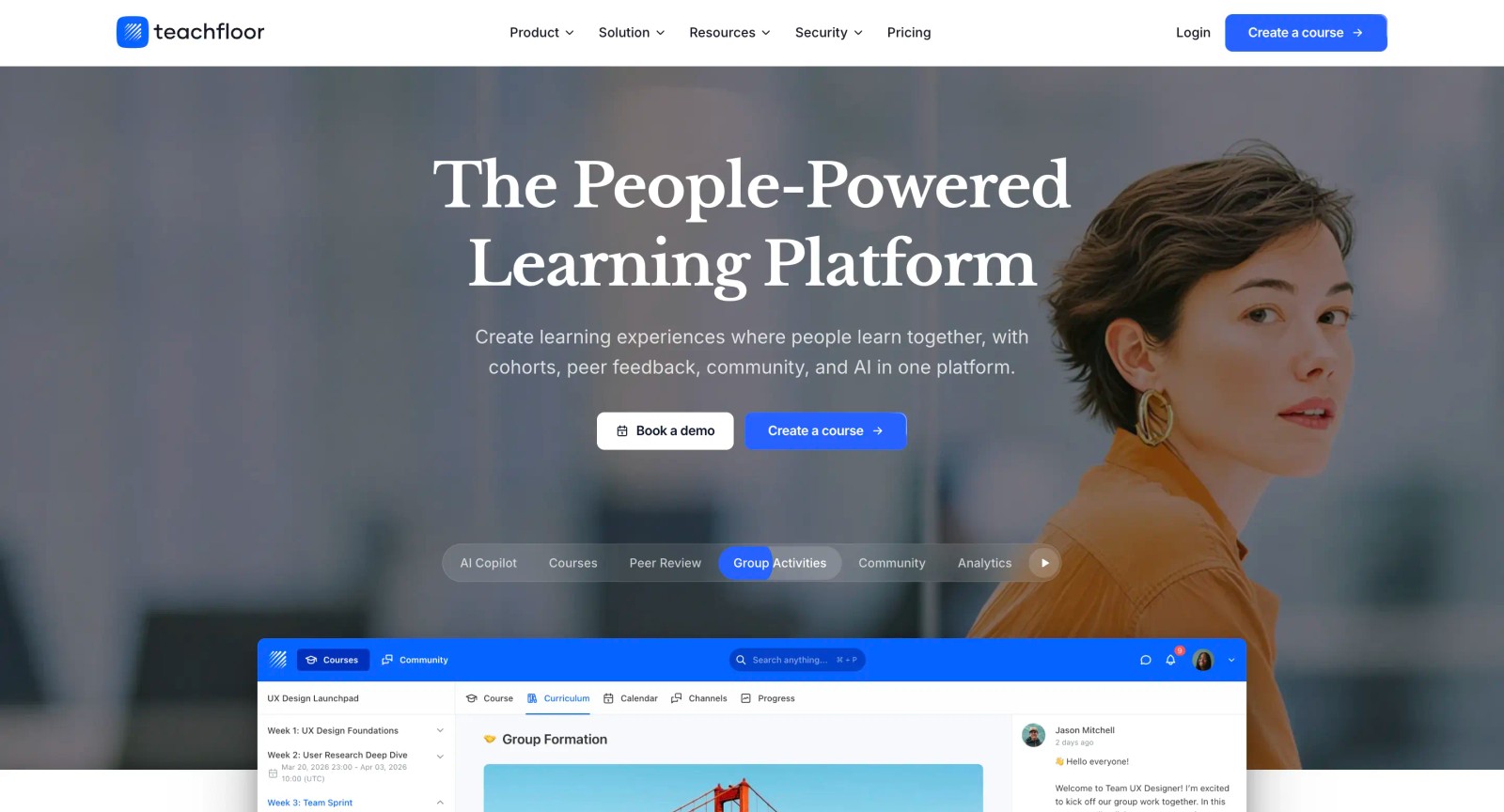
Teachfloor is not a curriculum governance tool, and it does not pretend to be one. Platforms like Coursedog, Kuali, and Modern Campus handle the proposal, approval, and catalog side: the workflow that decides what a course officially is. Teachfloor is where an approved course actually gets taught. For institutions running continuing education, professional certificates, or non-credit programs that still need a real delivery environment, it complements the governance stack by taking the signed-off curriculum and delivering it with self-paced, live, or cohort options, peer review, and certificates. It belongs on this list as the delivery counterpart to the approval and catalog systems above, not a replacement for them.
Core Capabilities
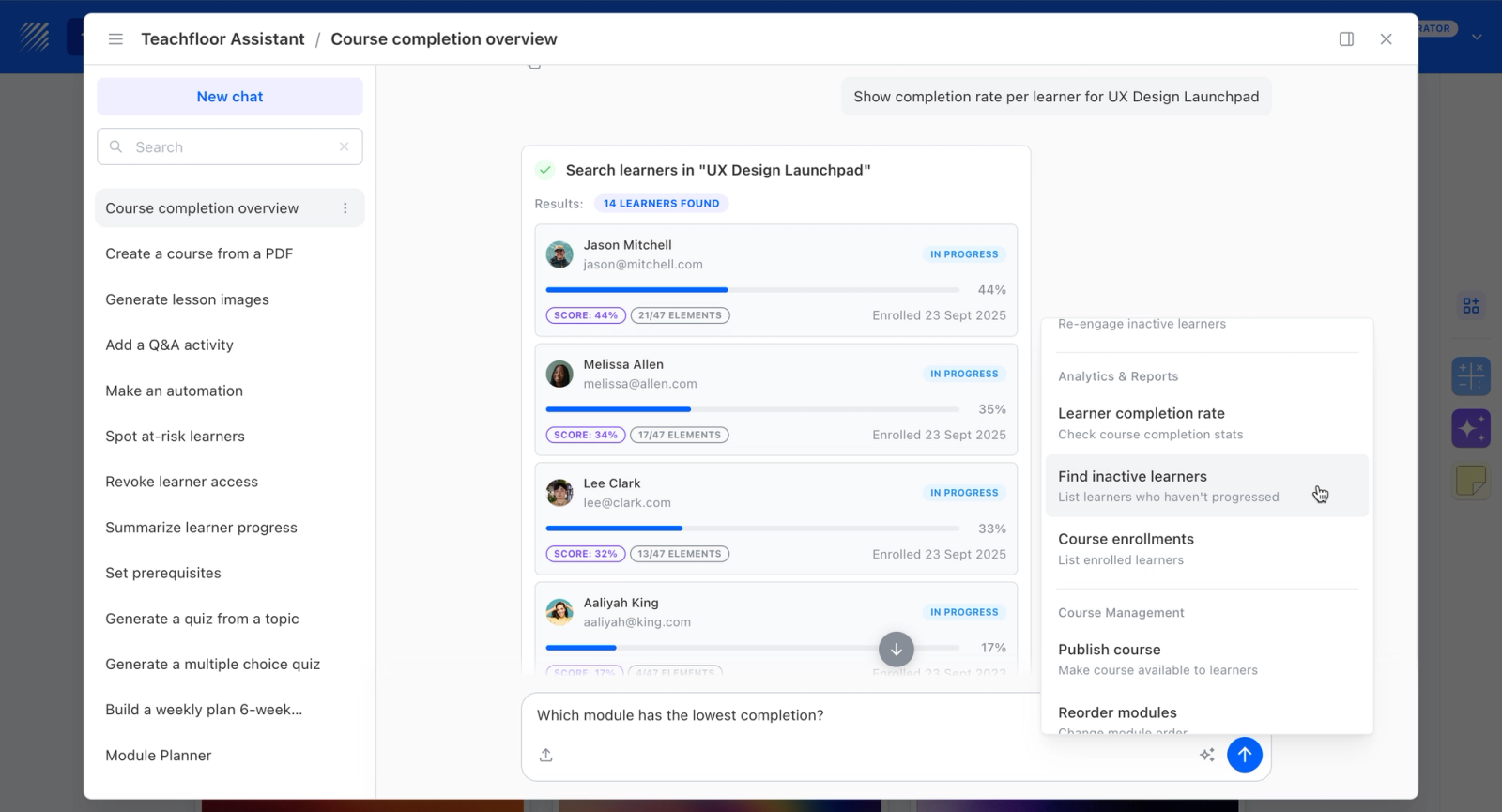
- Delivery of approved courses in self-paced, live, or cohort formats from a single platform
- Certificates and completion records for non-credit and professional programs that sit outside the registrar's system
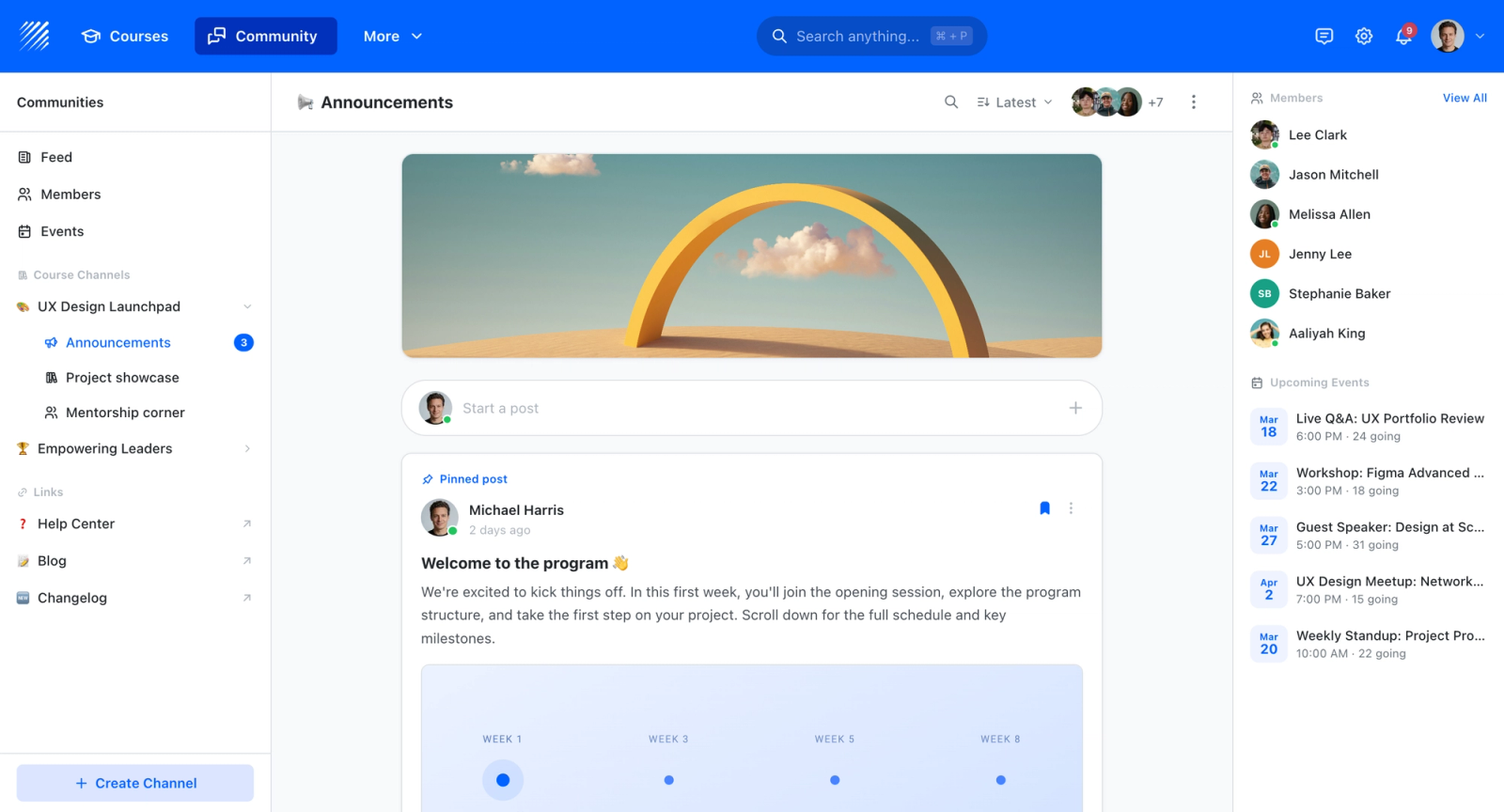
- Rubric-based peer review and course-attached community for programs where interaction is part of the curriculum
- Multi-branch structure to run separate programs or departments under one account
- AI-assisted authoring to build out course content from approved curriculum documents
- White-label delivery on the institution's own domain
Best For
Continuing education, professional development, and non-credit units that need a capable place to deliver curriculum once it is approved, working alongside (not instead of) a governance, catalog, or syllabus system like Coursedog, CourseLeaf, or Simple Syllabus.

Pricing Overview
- Startup plan from $89 per month for up to 50 learners
- Full Features plan with custom pricing, white-label, SSO, and advanced integrations
- 14-day free trial; no permanent free plan
- Nonprofit discounts available
Limitations
- No curriculum proposal, committee approval, or governance workflow; it does not manage the approval lifecycle
- No academic catalog publishing like Modern Campus Catalog or accreditation-mapping like Watermark
- Does not integrate with the student information system for official registration and credit
- Built for delivering courses, not for managing the institutional curriculum-of-record
Quick Comparison Insight
A flexible delivery platform for approved curriculum (continuing-ed, certificates, non-credit), complementing governance and catalog tools rather than replacing them.
Coursedog
Overview
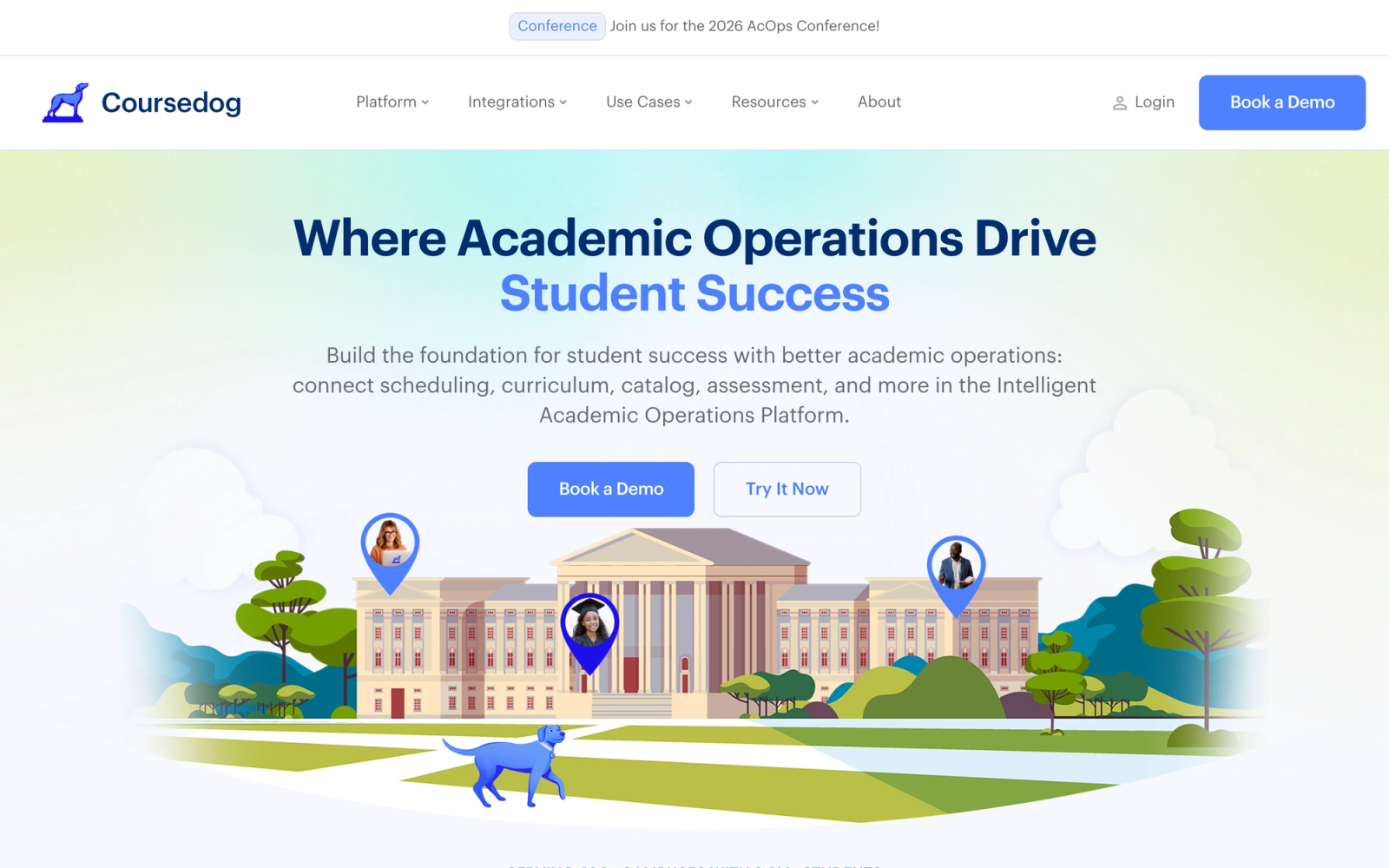
Coursedog has built its reputation on a platform that connects curriculum management, scheduling, and catalog publishing into a unified system. Where many curriculum tools treat course proposals in isolation, Coursedog links curriculum decisions to their downstream effects on section scheduling, room assignments, and catalog content.
Coursedog treats curriculum management as part of a broader academic operations problem rather than an isolated governance workflow. Approving a new course triggers downstream updates to scheduling templates, catalog entries, and degree audit requirements. Connecting those steps in a single system removes the manual handoffs that create errors at most institutions.
Core Capabilities
- Configurable multi-step approval workflows with conditional routing based on proposal type (new course, modification, deactivation, new program)
- Curriculum proposal forms with institution-specific fields, required attachments, and inline validation
- Direct integration between curriculum approvals and catalog publishing
- Cross-listing and prerequisite dependency tracking that updates automatically when course changes are approved
- Section scheduling module that reflects curriculum changes in real time
- SIS integrations with Banner, Colleague, and PeopleSoft through pre-built connectors
- Accreditation reporting with outcomes mapping at course, program, and institutional levels
- Role-based access controls that mirror institutional governance hierarchies
- Historical audit trails for every proposal action, comment, and vote
- Analytics dashboards showing proposal pipeline status, approval velocity, and bottleneck identification
Standout Strength
Coursedog connects curriculum governance to scheduling and catalog operations in a single platform. This eliminates the gap between "the course was approved" and "the course actually appears in the schedule and catalog," which is where many institutions lose time and accuracy.
Best For
Mid-to-large universities and college systems that manage complex governance workflows across multiple colleges or campuses. Particularly relevant for institutions that need to modernize academic scheduling alongside curriculum management, since Coursedog handles both in one platform.
Pricing Overview
Custom enterprise pricing based on institution size and modules selected. Coursedog typically prices by FTE enrollment bands. Demo available through their website.
Limitations
- The breadth of the platform means implementation timelines can be longer than single-purpose curriculum tools, often six to twelve months for full deployment.
- Institutions that only need curriculum management without scheduling may find the platform broader than necessary.
- Pricing is not transparent; smaller institutions may find the cost structure designed for larger schools.
Quick Comparison Insight
Used across 160-plus campuses, Coursedog is broader than most curriculum-only tools because it connects governance to scheduling and catalog publishing. More operational depth than platforms like Simple Syllabus or Modern Campus Catalog, but also a larger implementation commitment.
Modern Campus Curriculum (formerly Curriculog)
Overview
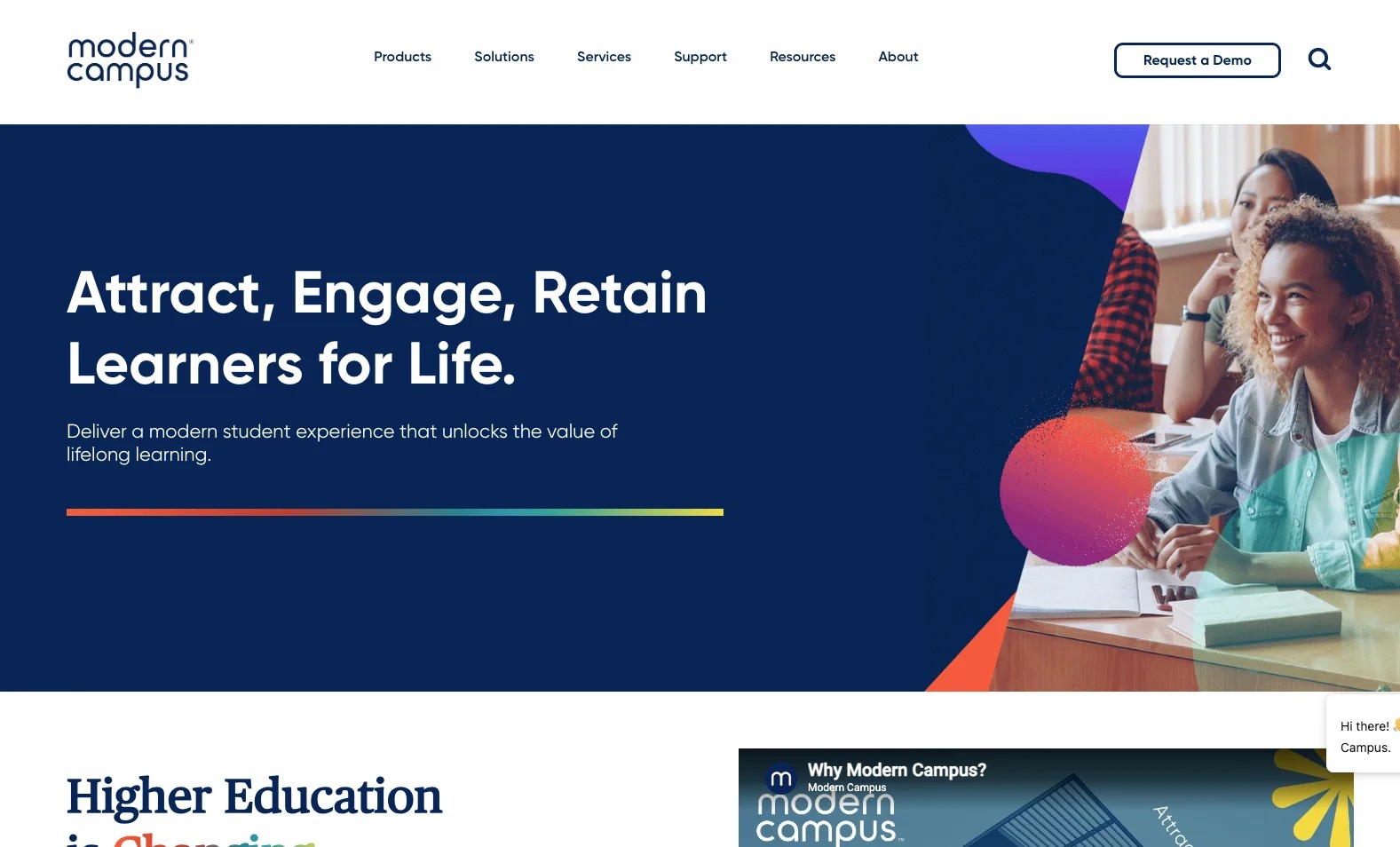
Modern Campus Curriculum is a curriculum management platform built on the foundation of Curriculog, which became part of the Modern Campus suite when the company acquired DIGARC in 2021. It focuses on curriculum proposal workflows, program management, and the governance processes that higher education institutions use to approve and track academic changes.
Those roots in purpose-built higher-education governance show in the workflow engine, which is more flexible than most competitors for modeling committee structures and approval hierarchies that differ between departments, colleges, and institution-wide bodies. For institutions with layered governance, that configurability is a more practical differentiator than interface polish.
Core Capabilities
- Multi-path approval workflows with support for parallel committee reviews and sequential escalation
- Curriculum proposal templates customizable by proposal type, with conditional field logic
- Program management tools for tracking degree requirements, concentrations, and certificate programs
- Integration with Modern Campus Catalog (formerly Acalog) for catalog publishing, sold as a separate module
- Accreditation crosswalk tools that map student learning outcomes to program goals and institutional standards
- Notification and reminder system for pending approvals with configurable escalation rules
- Reporting module for tracking proposal progress, approval timelines, and committee workload
- Support for general education requirement tracking and assessment alignment
- Role-based permissions aligned with institutional governance roles (faculty proposer, chair, dean, provost)
- Historical versioning of all curriculum proposals with full diff comparison between versions
Standout Strength
Modern Campus Curriculum stands out for institutions that need granular control over governance workflows. The ability to model complex committee structures with different approval paths for different proposal types gives curriculum offices precise control over how changes move through the system.
Best For
Community colleges and mid-size universities with established governance procedures that need a curriculum management system flexible enough to mirror their existing committee structures. Particularly strong for institutions already using other Modern Campus products.
Pricing Overview
Custom pricing based on institutional size and product configuration. Often bundled with Modern Campus Catalog for institutions that need both curriculum management and catalog publishing. Contact Modern Campus for a quote.
Limitations
- The interface can feel dated compared to newer competitors. Faculty who expect consumer-grade UX may need more onboarding support.
- Integration with non-Modern Campus products requires additional configuration. Institutions not already in the Modern Campus product suite face more setup work for SIS connections.
- The learning curve for administrators configuring workflows is steeper than simpler platforms.
Quick Comparison Insight
Deeper governance workflow modeling than Coursedog, but narrower in scope since it does not extend into scheduling. Best understood as a governance-first platform rather than an academic operations suite.
Kuali Curriculum Management
Overview
Kuali started as a community-source project in higher education and has since transitioned to a commercial SaaS model while retaining its higher-ed DNA. Kuali Curriculum Management is one module in a broader suite that includes research administration, financial management, and other institutional tools.
Kuali's origins in the higher education community shape how the platform handles academic governance in ways that generic business-process tools rarely match. The workflow engine accommodates the specific quirks of faculty senate proposals, layered committee structures, and multi-campus governance rather than approximating them through workarounds.
Core Capabilities
- Drag-and-drop workflow builder that allows curriculum offices to create and modify approval paths without developer involvement
- Pre-built proposal forms for common actions (new course, course modification, program creation, program modification, course deactivation)
- Co-requisite and prerequisite dependency visualization showing the impact of proposed changes across programs
- Real-time proposal tracking with status dashboards for proposers, committee chairs, and administrators
- Integration capabilities with Banner, Colleague, and PeopleSoft through API connectors
- Outcomes mapping at course and program levels with exportable accreditation reports
- Document attachment support for syllabi, resource justifications, and committee meeting minutes
- Comment and feedback threads tied to specific proposals, preserving institutional deliberation history
- Mobile-responsive interface that allows committee members to review and approve proposals from any device
- Bulk action tools for managing large-scale curriculum changes (such as general education reform)
Standout Strength
Kuali combines workflow flexibility with ease of configuration. The drag-and-drop workflow builder lets curriculum offices adjust approval paths as governance structures evolve, without submitting IT tickets or waiting for vendor customization.
Best For
Research universities and state university systems that need a curriculum management tool deeply aligned with higher education governance. Particularly suited to institutions already running other Kuali modules or to IT teams comfortable managing API-based SIS integrations.
Pricing Overview
Custom pricing based on institutional FTE and modules selected. Kuali offers modular pricing, so institutions can subscribe to curriculum management independently or as part of a broader suite. Free demo available.
Limitations
- The broader Kuali suite can create pressure to adopt additional modules, which increases total cost and implementation complexity.
- Catalog publishing is not a native strength; institutions typically pair Kuali with a separate catalog tool such as Modern Campus Catalog or Watermark Curriculum Strategy.
- Reporting capabilities, while functional, are less visually polished than some competitors.
Quick Comparison Insight
More configurable than Modern Campus Curriculum for workflow design, but lacks native catalog publishing. Best positioned as a governance and workflow engine rather than a full curriculum-to-catalog pipeline.
Simple Syllabus
Overview
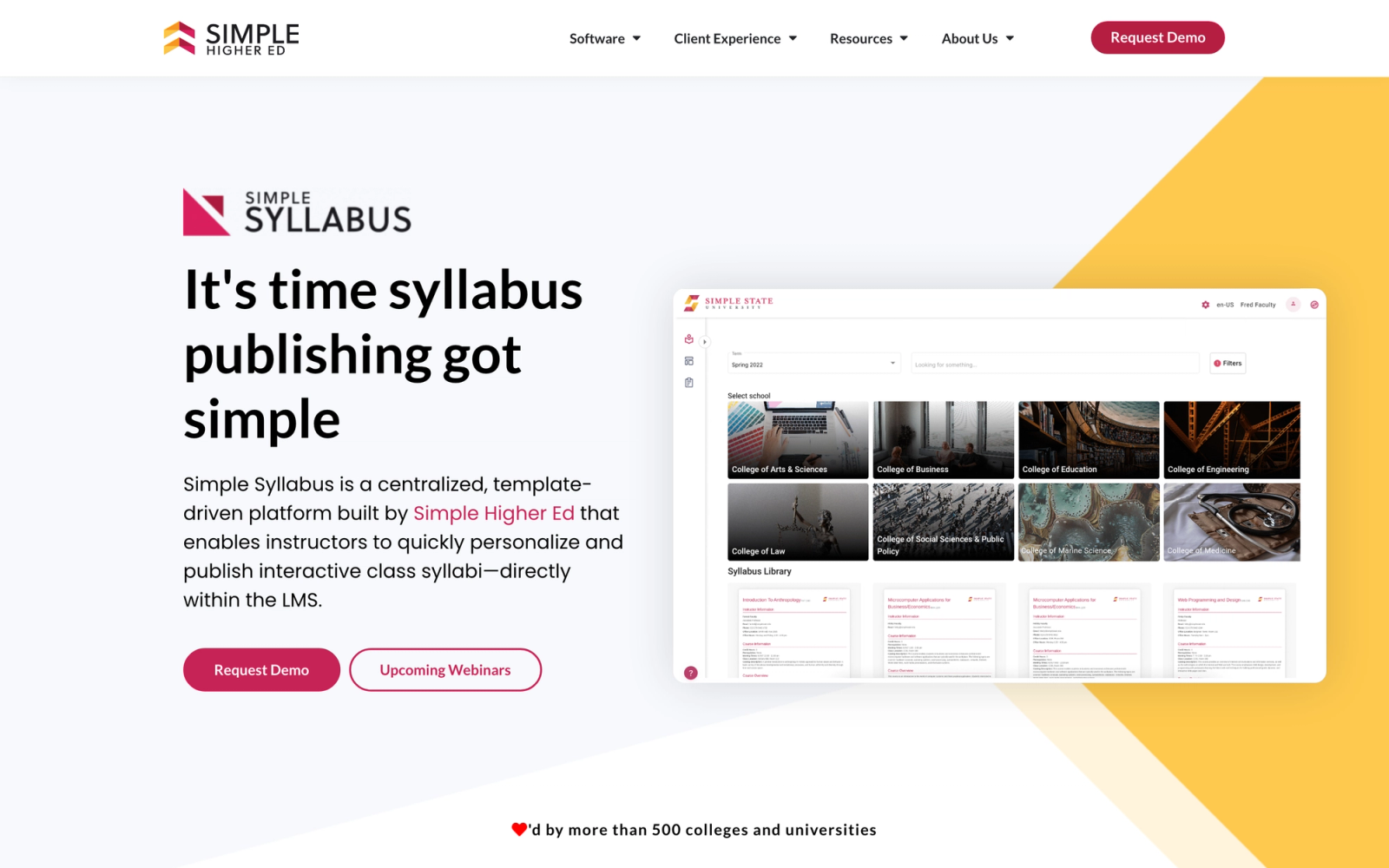
Simple Syllabus takes a different approach than the governance-focused platforms above. Instead of centering on curriculum proposals and committee approvals, it focuses on the syllabus itself as the primary document connecting institutional policy, course content, and student-facing information.
Simple Syllabus solves a problem that most curriculum management platforms overlook: the gap between approved curriculum and what students actually see in a syllabus. Faculty often create syllabi in Word documents that may or may not reflect current institutional policies, approved course descriptions, or required ADA statements. Simple Syllabus closes that gap by pulling approved data directly into syllabus templates.
Core Capabilities
- Centralized syllabus template management with institution-controlled sections (policies, ADA statements, grading scales) and faculty-editable sections (schedule, assignments, readings)
- Automatic population of approved course data (description, outcomes, prerequisites) from the institution's curriculum records
- Student-facing syllabus portal where enrolled students access current syllabi for all their courses
- Compliance tracking that flags syllabi missing required institutional elements
- Analytics on syllabus publishing rates, faculty adoption, and student access patterns
- LMS integration with Canvas, Blackboard, Brightspace, and Moodle for syllabus delivery within the learning management system
- Accessibility-compliant output that meets WCAG standards for student-facing content
- Multi-language syllabus support for institutions with diverse student populations
- Bulk syllabus publishing tools for department chairs managing dozens of sections
- API connections to SIS platforms for automatic course roster and section data
Standout Strength
Simple Syllabus bridges the gap between curriculum governance and the student experience. By ensuring every syllabus reflects current approved content and institutional policy, it reduces compliance risk and creates a consistent experience for students across departments.
Best For
Institutions primarily concerned with syllabus consistency, policy compliance, and the student-facing presentation of course information. Provost offices focused on instructional design standardization and ADA compliance across all sections will find it directly addresses those priorities.
Pricing Overview
Custom pricing based on institutional size and enrollment. Simple Syllabus typically prices per institution rather than per user. Demo and pilot programs available.
Limitations
- Not a full curriculum governance tool. It does not handle course proposals, approval workflows, or committee voting. Institutions need a separate platform for curriculum governance.
- Adoption depends on faculty willingness to use the platform instead of their own Word templates. Change management is a real barrier.
- Limited reporting on curriculum-level analytics; the focus is on syllabi, not on program-level curriculum data.
Quick Comparison Insight
Solves a different problem than Coursedog or Kuali. Best used alongside a curriculum governance tool rather than as a replacement. Stronger on the student experience and compliance side than on institutional governance.
Modern Campus Catalog (formerly Acalog)
Overview
Modern Campus Catalog, formerly Acalog, is one of the most widely used academic catalog platforms in higher education, part of a Modern Campus suite serving more than 1,200 institutions. It is not a curriculum governance tool in the traditional sense, but it is the point in the process where approved curriculum changes become visible to students, advisors, and the public, making it a central piece of how institutions present their academic offerings.
The catalog is the institutional record of what an institution offers. The strength is clear: it handles the complexity of publishing and maintaining a web-based academic catalog that stays synchronized with curriculum changes. For institutions where the catalog is the primary pain point, Modern Campus Catalog addresses that directly.
Core Capabilities
- Web-based catalog publishing with responsive design for desktop and mobile access
- Program, course, and policy page management with WYSIWYG editing and structured content templates
- Catalog versioning and archiving that maintains historical catalogs for compliance and student right-to-know requirements
- Search and filter functionality that lets students find programs, courses, and requirements by keyword, department, or credit hours
- Degree planner integration that connects catalog content to advising tools
- PDF catalog generation for print-on-demand or archival purposes
- Integration with Modern Campus Curriculum for automated updates when curriculum changes are approved
- Custom page types for institutional policies, faculty directories, and accreditation disclosures
- ADA-compliant output meeting WCAG accessibility standards
- Multi-catalog support for institutions managing separate catalogs for undergraduate, graduate, and continuing education programs
Standout Strength
Modern Campus Catalog fits institutions that need a reliable, accessible, and maintainable web catalog. Its wide adoption means strong community knowledge, established implementation workflows, and a track record of handling catalogs with thousands of programs and courses.
Best For
Institutions of all sizes that need to modernize their academic catalog from PDF or static web pages to a searchable, mobile-responsive, and ADA-compliant web catalog. Particularly valuable for institutions already using Modern Campus Curriculum as the governance layer.
Pricing Overview
Custom pricing based on institutional size. Typically sold as an annual subscription. Often bundled with Modern Campus Curriculum at a combined rate. Contact Modern Campus for pricing.
Limitations
- Modern Campus Catalog is a catalog publishing tool, not a curriculum governance tool. It does not handle proposals, approvals, or workflow routing. Institutions need a separate system for governance.
- The content management interface, while functional, requires training for catalog editors. It is not as intuitive as consumer CMS platforms.
- Customization of catalog design and layout requires working within the platform's template framework, which can be restrictive for institutions with specific branding requirements.
Quick Comparison Insight
The catalog publishing complement to governance tools like Coursedog, Kuali, or Modern Campus Curriculum. Best understood as the final publication layer in the curriculum workflow rather than a standalone governance solution.
Watermark Curriculum Strategy (formerly SmartCatalog)
Overview
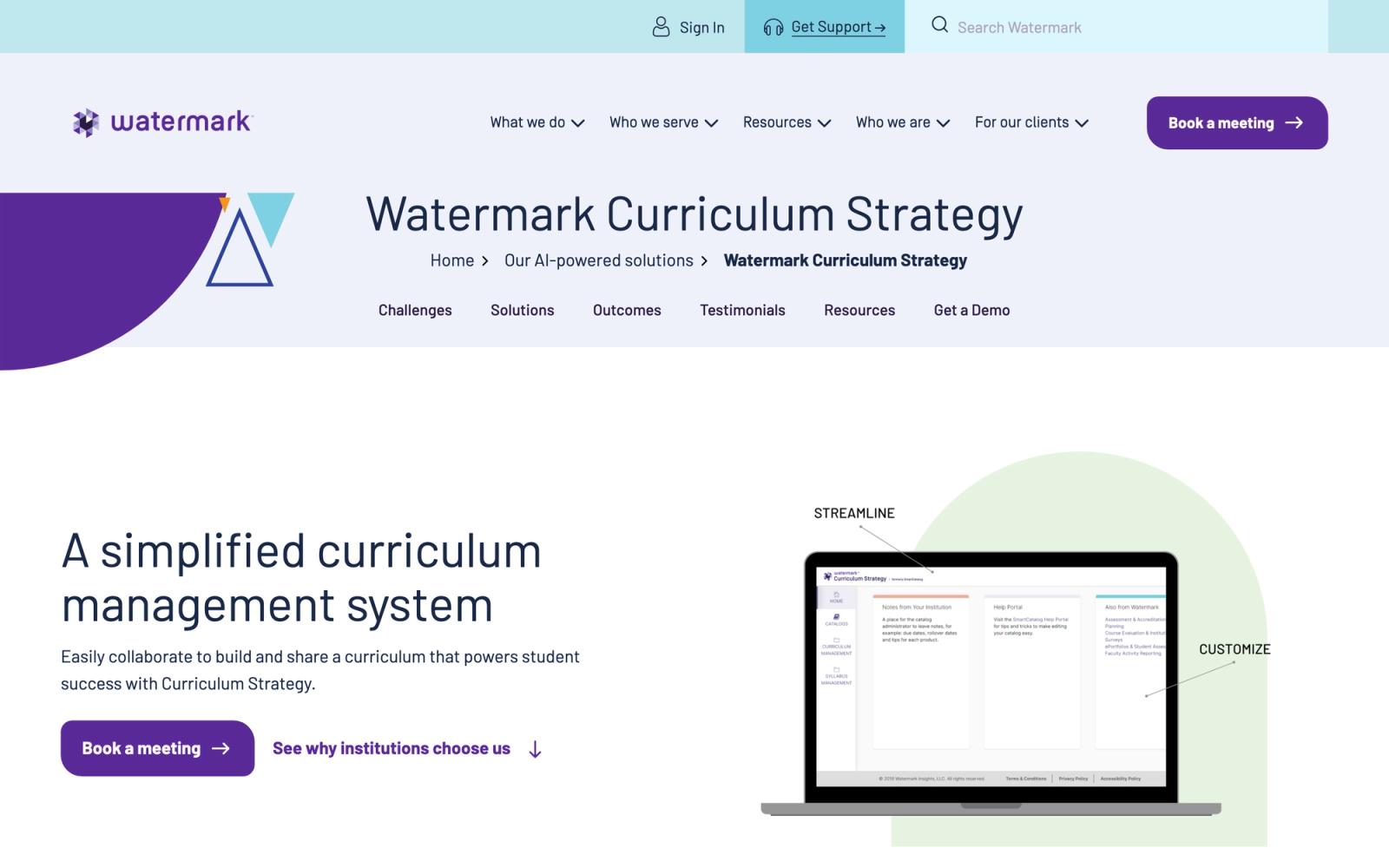
Watermark built its institutional effectiveness suite through a series of acquisitions, including Digital Measures and Taskstream, and positions Curriculum Strategy as one component of a broader platform that spans faculty activity reporting, assessment tools, and program review. The result is a curriculum management product oriented toward continuous improvement rather than standalone governance.
What distinguishes Watermark from pure curriculum workflow tools is the connection between curriculum data and assessment data. When curriculum changes are linked to assessment results, institutions can answer questions like "Did the program modification we approved two years ago actually improve student outcomes?" That feedback loop is what accreditors increasingly expect.
Core Capabilities
- Curriculum proposal and approval workflows with configurable routing based on institutional governance
- Outcomes mapping that connects course outcomes to program outcomes to institutional goals
- Integration with Watermark's assessment management tools for closing the assessment loop
- Faculty activity reporting that ties teaching loads and scholarly work to curriculum responsibilities
- Program review workflows that pull curriculum data, assessment results, and faculty productivity into a unified review process
- Accreditation reporting with pre-built templates for common regional and programmatic accreditors
- Curriculum mapping visualizations showing outcome coverage and gaps across programs
- Comment and feedback tools for committee deliberation on proposals
- Historical data tracking for longitudinal analysis of curriculum changes and their effects
- API integrations with common SIS platforms and data warehouse tools
Standout Strength
Watermark Curriculum Strategy fits institutions that want curriculum management connected to assessment and institutional effectiveness. The platform's value increases when paired with other Watermark modules, creating a data pipeline from curriculum decisions through assessment results to program review.
Best For
Institutions preparing for or maintaining accreditation that need to demonstrate the connection between curriculum decisions and student outcomes. Assessment offices and institutional effectiveness teams that already use Watermark's other modules will get the most from the platform, since the data flows between curriculum, assessment, and program review without additional integration work.
Pricing Overview
Custom enterprise pricing based on institutional size and modules selected. Watermark typically prices its suite on an annual subscription model. Institutions already using Watermark for assessment or faculty activity reporting may receive bundled pricing.
Limitations
- The full value of the platform depends on adopting multiple Watermark modules. As a standalone curriculum management tool, it is less compelling than dedicated governance platforms.
- The interface prioritizes data completeness over ease of use. Faculty submitting proposals may find the forms more complex than necessary for simple course modifications.
- Implementation can be extensive when integrating across the full Watermark suite, requiring significant coordination between curriculum offices, assessment teams, and IT.
Quick Comparison Insight
Broader institutional effectiveness focus than Coursedog or Kuali, but more complex to implement as a standalone curriculum tool. Best value when used as part of the full Watermark suite for accreditation and assessment integration.
CourseLeaf (by Leepfrog Technologies)
Overview
CourseLeaf, developed by Leepfrog Technologies, is a curriculum and catalog management platform that is widely used in higher education, particularly at research universities and large state systems. The platform consists of modular components: CourseLeaf CAT for catalog management, CourseLeaf CIM for curriculum inventory management (proposals and approvals), and CourseLeaf CLSS for section scheduling.
The depth of configuration available for curriculum proposals is a defining feature of CourseLeaf. The system can model approval workflows that accommodate the specific governance quirks of individual institutions, including bifurcated paths where undergraduate and graduate proposals follow entirely different committee structures. That level of specificity reflects the fact that Leepfrog works exclusively in higher education.
Core Capabilities
- CourseLeaf CIM for curriculum proposal management with configurable multi-step approval workflows
- CourseLeaf CAT for web-based catalog publishing with search, filtering, and mobile-responsive design
- Impact analysis tools that show how a proposed course change affects programs, prerequisites, and degree requirements across the institution
- Side-by-side diff views comparing proposed curriculum changes to current approved content
- Workflow automation with notifications, reminders, and escalation rules for overdue approvals
- Integration with Banner, Colleague, PeopleSoft, and other SIS platforms
- PDF catalog generation alongside the web catalog
- Catalog archiving for historical compliance and student right-to-know requirements
- Role-based access with granular permissions for proposers, reviewers, editors, and administrators
- CourseLeaf CLSS for section scheduling that reflects approved curriculum changes (separate module)
Standout Strength
CourseLeaf stands out for its depth of configuration and its exclusive focus on higher education. The impact analysis tools, which show how a single curriculum change ripples across the entire institution, help committees make informed decisions rather than approving changes in isolation.
Best For
Research universities, flagship state universities, and large multi-campus systems that need deep curriculum governance paired with catalog publishing. Institutions where a single curriculum change creates cross-institutional dependencies, shared courses across colleges, blended programs, or complex prerequisite chains, will find CourseLeaf's impact analysis tools particularly useful.
Pricing Overview
Custom enterprise pricing based on institutional FTE and modules selected. CourseLeaf is typically priced as an annual subscription with implementation fees. Leepfrog does not publish pricing publicly.
Limitations
- Implementation can be lengthy. Large institutions often report six to twelve months for full deployment of CIM and CAT together.
- The modular pricing model means costs can escalate as institutions add CAT, CIM, and CLSS components. Total cost of ownership is higher than simpler platforms.
- The interface, while functional, reflects a focus on power users. Occasional faculty proposers may need more guidance than the platform provides out of the box.
Quick Comparison Insight
Similar in scope to Coursedog but with a longer track record at large research institutions. More established in the R1 university market, but potentially slower to implement and less modern in interface design.
How to Choose the Right Platform
The right curriculum management software depends less on feature checklists and more on what specific problem is causing the most pain at your institution.
If your primary problem is governance and approvals: Coursedog, Kuali, Modern Campus Curriculum, and CourseLeaf all offer configurable, multi-step workflow engines. Kuali provides the most user-friendly workflow configuration, while CourseLeaf offers the deepest impact analysis for large institutions. Coursedog adds scheduling integration, which matters if course scheduling is part of the same operational bottleneck.
If your primary problem is catalog publishing: Modern Campus Catalog (formerly Acalog) is a market leader for catalog management specifically. Watermark Curriculum Strategy (formerly SmartCatalog) offers a combined governance-and-catalog approach for institutions that want a single platform. CourseLeaf CAT provides catalog publishing alongside its governance module.
If your primary problem is accreditation and assessment integration: Watermark Curriculum Strategy connects curriculum data to assessment outcomes and program review, making it the strongest choice for institutions where accreditation reporting drives the technology decision.
If your primary problem is syllabus consistency: Simple Syllabus is purpose-built for this use case and does it well. It pairs naturally with any governance platform for institutions that need both.
If you are a smaller institution with limited IT resources: Watermark Curriculum Strategy (formerly SmartCatalog) bundles governance and catalog in one product, avoiding the complexity of integrating separate systems. It offers less depth than specialized tools but reduces total implementation effort. If your real bottleneck is delivering approved programs rather than governing them, Teachfloor adds structured, interactive delivery at a published $89 per month.
If you are a large research university or multi-campus system: CourseLeaf and Coursedog are the most common choices in this tier. Both offer the governance depth and integration capabilities that complex institutions require. The choice often comes down to scheduling needs (Coursedog advantage) versus established R1 market presence (CourseLeaf advantage).
FAQ
Is this list for K-12 or higher education curriculum management?
These platforms are built for higher education curriculum governance: course proposals, committee approvals, accreditation and outcomes mapping, catalog publishing, and SIS integration with systems like Banner, Colleague, and PeopleSoft. K-12 curriculum mapping tools (such as Chalk or Atlas) solve a different problem focused on standards alignment and lesson planning, so they are intentionally out of scope here.
We already have a curriculum management system. Where does Teachfloor fit?
Governance tools confirm a program exists and is approved; they do not run the learning experience. Teachfloor delivers approved curriculum as structured cohort, live, social, or self-paced programs with community, peer review, and AI course creation, and publishes it under your own branded domain. Continuing education divisions and professional programs commonly govern curriculum in a tool above and deliver it in a platform like Teachfloor.
Do I need curriculum management software or a learning management system?
If your problem is approving, documenting, and publishing what gets taught, you need curriculum management software. If your problem is teaching and engaging learners, you need a learning platform. Many institutions use both. For the delivery side specifically, our guide to the best LMS for higher education compares platforms built to teach students rather than govern catalogs.
What is the difference between curriculum management software and a learning management system?
Curriculum management software handles the governance, approval, and documentation of academic programs and courses at the institutional level. It manages what gets taught and how programs are structured. A learning management system handles the delivery of course content to students, including assignments, discussions, and grades. They solve different problems and typically operate at different organizational levels. Curriculum management is an administrative and governance function; an LMS is an instructional delivery function. If your search is really about delivering courses to students, see our guide to the best LMS for higher education.
Can curriculum management software help with accreditation?
Yes, and this is one of the primary reasons institutions adopt these platforms. Most tools in this category allow you to map learning outcomes at the course and program level to institutional goals and accreditation standards. They also maintain audit trails of every curriculum decision, including who proposed changes, who approved them, and the rationale behind each decision. This documentation is exactly what accreditors review during site visits.
How long does implementation typically take?
Implementation timelines vary with institution size and governance complexity. Simpler, narrower tools like Simple Syllabus can be operational in two to four months. Full-featured governance platforms typically require longer: Coursedog, CourseLeaf, and Kuali generally take six months to a year when workflow configuration, SIS integration, data migration, and faculty training are all included. The limitations sections for each platform above note where vendor-reported timelines are available.
Do these platforms integrate with Banner, Colleague, or PeopleSoft?
Most curriculum management platforms built for higher education offer integrations with the major SIS platforms. Coursedog, Kuali, CourseLeaf, and Modern Campus Curriculum all provide pre-built connectors or API-based integrations with Ellucian Banner, Ellucian Colleague, and Oracle PeopleSoft. The depth and maintenance quality of these integrations varies, so it is worth asking vendors for reference institutions running your specific SIS during the evaluation process.


