


What Is an AI Prompt Engineer?
An AI prompt engineer designs, tests, and optimizes the instructions given to large language models and other generative AI systems. The role sits at the intersection of linguistics, software engineering, and domain expertise. Instead of writing traditional code, a prompt engineer builds structured inputs that guide AI models toward accurate, consistent, and useful outputs.
The role emerged because AI models are sensitive to how instructions are framed. Small changes in wording, structure, or context can produce very different results. A prompt engineer understands these sensitivities and uses them to get reliable value from AI systems across business functions.
This goes beyond casually asking a chatbot questions. Professional prompt engineering involves systematic testing, version control of prompt templates, evaluation frameworks, and close work with product and engineering teams. The role demands both technical depth and communication precision, a mix that sets it apart from traditional software engineering or content writing.
Organizations investing in AI in online learning, customer support automation, content generation, and internal tooling increasingly see that model performance depends as much on prompt quality as on model architecture. That shift drives demand for dedicated prompt engineering talent.
What Does an AI Prompt Engineer Do?
The daily work of a prompt engineer varies by organization and industry, but several core responsibilities define the role across contexts.
Designing and Testing Prompts
The primary task is creating prompts that produce reliable, high-quality outputs. This means writing initial drafts, running them against test cases, analyzing outputs for accuracy and consistency, and iterating until the results meet defined standards.
Prompt engineers maintain libraries of tested templates for different use cases. They document which approaches work for specific model versions, which parameters affect output quality, and which edge cases need special handling. This systematic approach mirrors software practices like version control and regression testing.
Collaborating with Product and Engineering Teams
Prompt engineers rarely work in isolation. They partner with software engineers to integrate prompts into production systems, with product managers to translate business requirements into effective prompt strategies, and with domain experts to ensure outputs meet professional standards.
In organizations building training programs powered by AI, the prompt engineer works with instructional designers to ensure generated content aligns with pedagogical goals. In customer-facing applications, they collaborate with UX teams to shape how AI responses feel to end users.
Evaluating and Improving Model Outputs
Prompt engineers set evaluation criteria and performance metrics for AI-generated outputs. They build test suites that measure accuracy, relevance, tone, and safety. When outputs degrade after a model update or the system meets new types of input, the prompt engineer diagnoses the issue and adjusts.
This evaluation work often means measuring results against business objectives. A prompt that generates technically correct output but fails to drive the desired user behavior still needs work. The prompt engineer connects model capability to business value.
Managing Prompt Infrastructure
At scale, prompt engineering becomes an infrastructure problem. Engineers build and maintain prompt management systems, template registries, A/B testing frameworks, and monitoring dashboards. They track prompt performance over time, flag regressions, and make sure updates in one system do not break outputs in another.
This operational side is what separates a senior prompt engineer from someone who simply writes good prompts. The role treats prompts as production software components that need governance, testing, and lifecycle management.
Core Skills for AI Prompt Engineers
The skill set for prompt engineering draws from multiple disciplines. Effective practitioners combine technical knowledge with strong communication and analytical abilities.
Technical Skills
Natural language processing fundamentals. Knowing how language models tokenize, process, and generate text helps prompt engineers predict model behavior. Familiarity with attention mechanisms, temperature settings, and token limits informs prompt design decisions.
Programming proficiency. Most prompt engineers write code to automate testing, build evaluation pipelines, and integrate prompts into applications. Python is the dominant language, and API interactions, data processing, and scripting are essential. Knowing the types of AI systems and their architectures helps engineers fit prompts to specific model families.
Data fluency. Prompt engineers work with datasets to test outputs, evaluate quality, and fine-tune approaches. Comfort with data analysis, statistical reasoning, and structured evaluation methods is necessary for rigorous prompt development.
API and system integration. Prompts rarely exist in isolation. They feed into larger systems through APIs, orchestration layers, and workflow engines. Prompt engineers need to know how their work connects to production infrastructure and how latency, token costs, and rate limits shape prompt design.
Soft Skills
Precise written communication. Prompt engineering is fundamentally a writing discipline. Expressing instructions with clarity, specificity, and minimal ambiguity is the most important soft skill. Vague prompts get vague outputs.
Critical thinking and experimentation. Effective prompt engineers approach their work scientifically. They form hypotheses about why a prompt produces certain outputs, design experiments to test those hypotheses, and draw conclusions from results. This iterative mindset is more valuable than any single technique.
Domain knowledge. A prompt engineer working in healthcare needs to understand medical terminology and clinical workflows. One working in compliance training needs to understand regulatory frameworks. Domain expertise determines whether a prompt produces technically impressive but practically useless output, or output that genuinely serves professional needs.
Collaboration and translation. Prompt engineers constantly translate between technical and non-technical stakeholders. They explain model limitations to product managers, translate business requirements into technical specifications, and communicate evaluation results in terms that executives understand.
AI Prompt Engineer Salary and Career Outlook
Compensation for prompt engineers reflects the role's scarcity and the value organizations place on effective AI deployment. Salary data shows significant variation based on experience, location, industry, and the scope of responsibilities.
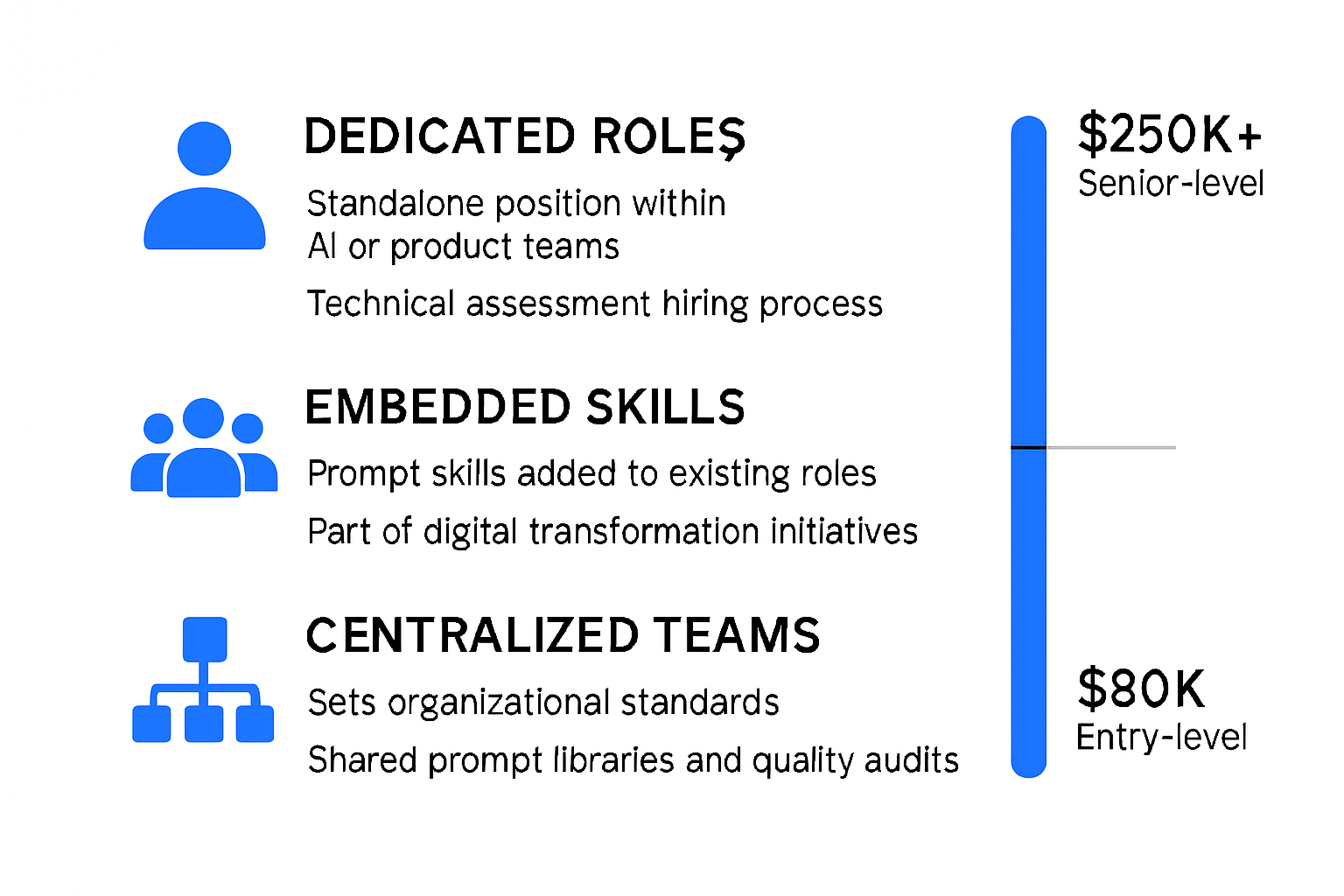
Entry-level prompt engineers with foundational AI knowledge and some practical experience typically earn between $80,000 and $110,000 annually in the United States. Mid-level practitioners with demonstrated production experience and a portfolio of deployed prompt systems command $120,000 to $160,000. Senior prompt engineers and those in lead roles at major technology companies earn $170,000 to $250,000 or more, particularly when compensation includes equity.
Several factors influence where an individual falls within these ranges. Geographic location matters, with San Francisco, New York, and Seattle offering the highest base salaries. Industry sector affects compensation as well. Financial services, healthcare technology, and major AI platform companies tend to pay at the top of the range.
Conversely, organizations exploring AI for the first time may hire prompt engineers at lower salary bands, reflecting both budget constraints and an earlier stage of AI maturity.
The career outlook is strong but shifting. As AI tools spread across industries, demand grows for people who can improve their performance. The role itself will change, though. Some routine prompting tasks will be absorbed by better model interfaces. The work that remains, and grows, centers on system-level prompt architecture, evaluation framework design, and cross-functional AI strategy.
Career progression typically moves from individual contributor prompt engineer to senior prompt engineer, then into roles like AI solutions architect, AI product manager, or head of AI operations. Professionals who combine prompt engineering skill with deep learning and development domain expertise or other specialized knowledge command premium compensation and broader career options.
How to Become an AI Prompt Engineer
There is no single pathway into prompt engineering. The role attracts professionals from diverse backgrounds, including software engineering, linguistics, technical writing, data science, and even philosophy. What unites successful practitioners is a combination of structured thinking, technical curiosity, and communication precision.
Build Foundational AI Knowledge
Start with a solid understanding of how large language models work. You do not need to train models from scratch, but you should grasp transformer architectures at a conceptual level, know how tokenization affects outputs, and understand the link between training data and model behavior.
Free and paid courses from platforms specializing in adaptive learning and AI education cover these fundamentals. Focus on practical understanding over pure theory. The goal is to predict model behavior and design prompts accordingly, not to publish research papers on model architecture.
Develop Hands-On Prompting Skills
Practice is non-negotiable. Work with multiple models across different providers. Experiment with various prompting techniques: zero-shot, few-shot, chain-of-thought, role-based framing, and structured output formatting. Document what works and what fails. Build a portfolio of prompt solutions that demonstrate your ability to solve real problems.
Engage with open-source prompt engineering communities and contribute to shared resources. The field moves fast, and practitioners who learn from each other advance more quickly than those who work in isolation.
Practice is non-negotiable. Work with multiple models across different providers. Test various techniques: zero-shot, few-shot, chain-of-thought, role-based framing, and structured output formatting. Document what works and what fails. Build a portfolio of prompt solutions that show you can solve real problems.
Invest in Python programming, API usage, and basic software engineering practices. These skills let you automate prompt testing, build evaluation pipelines, and integrate prompts into production workflows. Familiarity with L&D tools and AI platforms used in your target industry adds value beyond raw technical skill.
Version control, automated testing, and continuous integration concepts from software engineering transfer directly to prompt engineering workflows. Treat prompts as code: versioned, tested, reviewed, and deployed systematically.
Build Domain Expertise
Choose an industry or functional area to specialize in. A prompt engineer who understands employee onboarding processes can build onboarding AI tools that a generalist cannot. Someone with expertise in legal compliance can create prompt systems for regulatory analysis that outperform generic approaches.
Domain expertise is a durable competitive advantage. Prompting techniques change as models evolve. Deep understanding of a professional field stays valuable no matter which AI platform leads the market.
Pursue Relevant Credentials
While no universally recognized certification for prompt engineering exists, several credentials signal competence to employers. AI-focused certifications from major cloud providers, competency assessments in machine learning fundamentals, and portfolio projects demonstrating production prompt engineering all strengthen a candidate's position.
The Coursera guide to prompt engineering careers provides a useful overview of educational pathways and expected qualifications.
| Component | Function | Key Detail |
|---|---|---|
| Build Foundational AI Knowledge | Start with a solid understanding of how large language models work. | You do not need to train models from scratch |
| Develop Hands-On Prompting Skills | Practice is non-negotiable. | Work with multiple models across different providers |
| Learn Supporting Technical Skills | Invest in Python programming, API usage, and basic software engineering practices. | Your target industry adds practical value beyond raw technical skill |
| Build Domain Expertise | Choose an industry or functional area to specialize in. | — |
| Pursue Relevant Credentials | While no universally recognized certification for prompt engineering exists. | The digital transformation initiatives. Software engineers, data analysts, product managers, and content professionals add prompt skills to their existing competencies. This approach works well for organizations where AI augments existing workflows rather than forming the core product. A marketing team that uses AI for content generation may train its writers in prompt engineering rather than hiring a specialist. HR analytics teams learning to use AI for workforce analysis follow a similar pattern. Prompt Engineering Teams Large enterprises building AI into multiple products or functions sometimes establish centralized prompt engineering teams. These teams set organizational standards for prompt design, maintain shared prompt libraries, conduct bias training audits on AI outputs, and provide consulting support to product teams. Centralized teams ensure consistency across the organization. They prevent duplication of effort, establish best practices, and maintain quality standards. They also serve as a knowledge hub, tracking how different models respond to different prompting strategies and sharing that intelligence across the company. Evaluating Prompt Engineering Candidates Organizations evaluating prompt engineering candidates look beyond traditional technical interviews. Key assessment criteria include the ability to decompose vague requirements into specific prompt strategies, systematic testing and iteration methodology, awareness of unconscious bias training principles as applied to AI outputs, understanding of content validity in generated content, and clear documentation and communication practices. The strongest candidates demonstrate not just the ability to write effective prompts but the judgment to know when prompting alone is insufficient and a different technical approach, fine-tuning, retrieval-augmented generation, or traditional software, is more appropriate. Organizations also value candidates who understand cybersecurity awareness principles as they apply to AI systems, including prompt injection risks, data leakage through model outputs, and secure handling of sensitive information within prompt workflows. Frequently Asked Questions Do I need a computer science degree to become a prompt engineer? No. Prompt engineering attracts professionals from many backgrounds, including linguistics, philosophy, technical writing, and liberal arts. A computer science degree helps, particularly for the programming and system integration aspects of the role, but demonstrated skills and a strong portfolio carry more weight than formal credentials. Many successful prompt engineers are self-taught practitioners who built expertise through hands-on experimentation and continuous learning. Will AI eventually automate the prompt engineer role? Partial automation is likely. AI models are improving at interpreting vague instructions, reducing the need for meticulous prompt formatting in simple use cases. However, complex prompt architecture, evaluation framework design, cross-system prompt management, and domain-specific optimization require human judgment that current models cannot replicate. The role will evolve rather than disappear, shifting toward higher-level system design and strategic AI deployment. How does prompt engineering differ from machine learning engineering? Machine learning engineers build, train, and deploy models. They work with datasets, model architectures, training pipelines, and inference infrastructure. Prompt engineers work with models that already exist, optimizing how those models receive and process instructions to produce better outputs. The two roles are complementary. Machine learning engineers create the tools, and prompt engineers maximize the value those tools deliver to end users and business processes. |


