
Cohort-Based Courses as the Future of Education
After becoming a trend, research shows that MOOCs and self-paced learning have real disadvantages on learner engagement and completion rates. The main challenge with self-paced learning is the lack of engagement and motivation to finish a course.
Let's be honest: unless your learning style is studying entirely on your own, learning at your own pace isn't easy. Humans are social beings, and we learn best through interaction with others.
To solve this, educators developed a new model called the Cohort-based Course (CBC), or Cohort-based Learning (CBL). The model grew quickly as the world moved online, and many experts now describe it as a core format for the future of education. The format works for two audiences at once: independent creators and academies building paid courses, and companies running corporate training, onboarding, and upskilling programs. This guide is written for both.
Reports, case studies, and businesses have shown that cohort-based learning works. It now sits behind professional bootcamps, creator academies, and a growing share of enterprise L&D programs. The patterns are consistent: more engagement, higher completion, and real skill change. Let's look at what makes it work, and how you can apply it to your own course or training program.
Whether you are a creator democratizing access to a skill or a company building an internal academy, the same playbook applies. Let's explore what cohort-based courses do well, and how you can build one that transforms learners and scales as a business.
As a cohort-based learning platform built for both creators and companies, we want to help you design courses that transform learners while returning a reasonable result on the effort you put into building them.
Building an online academy, or simply creating a single cohort-based course, is not for the faint-hearted. You need stackable skills to design your curriculum, define your audience, and run the course. It is real work, especially when you are starting something new on your own.
That is why we wrote this guide: to help you design a cohort-based course that is...
- transformational to your learners,
- scalable as a digital business, and
- worth your time and effort
Who this guide is for
- course creators who want to turn their self-paced courses into a scalable cohort-based course
- founders and educators using the cohort-based model who want to scale their online academies, micro-schools, tech bootcamps, and accelerator or incubation programs
- subject matter experts, thought leaders, and consultants who are serious about turning their knowledge into a cohort-based course
- instructional designers, eLearning experts, and L&D / corporate trainers who run cohort-based learning inside organizations for onboarding, upskilling, leadership development, and customer or partner training
- education enthusiasts who simply want to start their online course and they want to learn how to scale a cohort-based course
Learn more about The evolution of online education: from MOOC to Cohort-Based Courses.
The Promise of this eBook
We made a simple pact: in exchange for your time, we share the most useful knowledge we have for building and scaling a cohort-based course. This guide collects proven pedagogies and strategies you can use to scale your program while transforming your learners.
It covers why cohort-based courses are effective, who uses the model today, and the underlying challenges that come with it. After a lot of research, we landed on a practical approach to the two biggest issues, scalability and affordability. You will find our findings throughout this guide.
**A note on results:** the strategies here are drawn from real programs. To get the most from them you still need execution, experimentation, and iteration. Some tactics will fit your course well and some will not; it depends on the context of your program. If you want to share what worked (or what didn't), reach us on LinkedIn or X.
What is a Cohort-based Course?
A Cohort-based Course (CBC), or Cohort-based Learning (CBL), is a learning environment where a group of students learn and collaborate together. It is highly engaging and learner-centric. Students learn alongside peers, led by an instructor, within a set timeframe. It works because it is time-bound: students move through a specific topic together, on a shared schedule, with their peers. Unlike self-paced learning, it is bi-directional, community-led, real-time, and well suited to building skills. Cohort-based learning is not new; schools used it long before the pandemic. It simply became more visible once teaching and learning moved online. For a side-by-side view, see cohort-based learning vs self-paced learning.
Another definition from Gad Allon is, “it’s a collaborative learning style where a group of students progresses through an educational program collectively.”
Teachfloor is purpose-built for cohort-based courses, for creators and companies alike. It brings live sessions, a built-in learning community and accountability, peer and project-based learning, curriculum, and the async-plus-sync 70-30 model this guide describes into one platform. Independent course creators use it to run paid academies; L&D teams use it for corporate training, onboarding, and customer education. The rest of this guide explains the methods; Teachfloor is where you put them into practice.
| Dimension | Cohort-based | Self-paced |
|---|---|---|
| Pace | Shared schedule, time-bound | Anytime, learner sets pace |
| Interaction | Peer-led, community-driven, live | Mostly solo, content-only |
| Completion | Higher; accountability built in | Often low; motivation drops |
| Best for | Skill-building, transformation | Reference, broad knowledge transfer |
| Scalability | Limited alone; scales with the 70-30 hybrid | Scales easily but less transformative |
Who uses the Cohort-based model?
Cohort-based learning was used in classrooms well before the pandemic. Even though the term became popular through online learning, educational institutions had already proven its effect on student success. So who uses the model today? It spans four broad groups: corporate L&D and enterprise training, professional bootcamps, creators and academies, and customer or partner education.
Corporate L&D and enterprise training
This is now one of the fastest-growing uses of the cohort-based model. L&D teams found that upskilling and reskilling existing employees often beats hiring, so companies build internal academies and run training in cohorts. The cohort format is used for onboarding, role-based upskilling, leadership development, and customer or partner enablement, often gamified to increase knowledge retention and keep learning engaging. Learn how teams apply it on our corporate training platform.
Professional bootcamps
Tech and professional bootcamps design their programs in cohorts so students work in teams. It mirrors how real teams operate and builds job-ready skills through hands-on, time-bound projects. See our online bootcamp guide for how these programs are structured.
Creators, academies, and coaching
Creators, subject-matter experts, and coaches use cohorts to turn knowledge into a transformative, paid program. This includes group coaching, where a facilitator guides a focus group through a longer-term experience, and full creator academies built on a community-based learning model. See how creators run these on our course creators platform.
Accelerators and incubators
Learning is a huge part of accelerator and incubator programs. Pitching and raising funds is just the North Star, but the whole process lies down in learning. Accelerators & Incubators use cohort-based learning to implement their programs alongside the pitch and networking opportunities.
What makes Cohort-based Courses effective?
Community-led.
Most successful cohorts started in a community. Since cohort-based learning is bi-directional and peer-led, the approach takes away the concept of star instructors where all information comes from the instructor.
In self-paced learning you typically learn only from materials the instructor provides. Cohort-based learning is community-led: open discussions, forums, and debates are encouraged, and everyone learns from each other. For the foundations, see what is cohort-based learning.
Real-time & live.
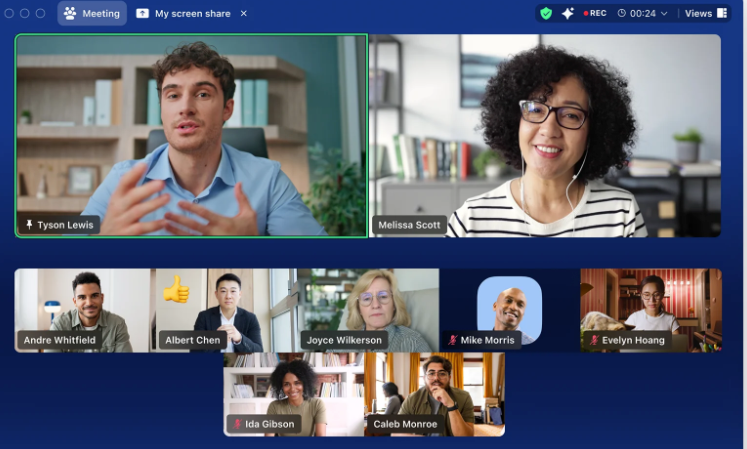
Technology made learning virtual, global, and diverse. It is now possible to learn with a cohort in real-time, live sessions. The value comes from interleaving: students learn in different modalities, with breakouts, discussions, debates, and group work happening live. The result is highly interactive, engaging, and social.
Time-bound.
One of the challenges in self-paced learning is the flexibility of starting & finishing the course. The sense of urgency and limitations with time can force students to take the course and complete it. Having a specific timeline is the reason why completion rates are high and students don’t slack off in finishing what they’ve started.
Skills-building.
This is hardly possible in a self-paced because it’s more of a knowledge transfer than skills-building. In cohort-based, instructors can build up skills with hands-on practice and learning by doing approach.
Career Pathways.
Cohort-based learning prepares students for the real world with a hands-on approach. It’s inevitable not to think about the career path of your students when you apply cohort-based in your course or training. That’s why most tech Bootcamps and training programs prepare students’ pathways even after the program.
"Interleaving in learning is often described as a method that involves studying parts of different courses or topics within the same period, as opposed to finishing one before moving to the next. It refers to mixing multiple subjects to improve learning." -_brainhackerexpert.com_
Challenges and Solutions
Why cohort-based courses are hard to scale?
Cohort-based Courses are about transformation. That's why it's hard to scale. But who says we cannot do both at the same time? It might be difficult, but it's not impossible. So what are the current challenges of cohort-based courses?
| Scaling challenge | Solution |
|---|---|
| Zoom fatigue & time zones | Shift most content to async; keep live sessions focused and few |
| Instructor overload | Delegate to mentors and guests; let a self-sustaining community carry more |
| Cohort size cap | Break large cohorts into mentor-led sub-groups |
| High price / affordability | Use the 70-30 hybrid to lower delivery cost per learner |
| Manual admin work | Automate scheduling, notifications, grading, and payments on one platform |
Zoom fatigue & time zone difference
We enjoyed the diversity of our cohorts due to online learning. However, we also suffered from Zoom fatigue and time zone difference. Most cohorts are real-time and live to capture learning in the best way possible. But, challenges arise with interacting with others virtually during live sessions. Staring at your computer, speaking in front of the camera, listening, and checking your face from time to time on the screen. Not only that, but due to time zone differences, some folks need to learn real-time at 1 or 3 in the morning.
Expensive Price
Because it’s time-bound and students have direct interaction with the instructor who happens to be an expert or a celebrity in his field, instructors charge more in exchange for their time & effort. It’s good for instructors. However, it isn’t helpful for students who don’t have the budget to pay for an expensive course.
Active Involvement of Instructors
The biggest difference between cohort-based to self-paced learning is that instructors aren’t so much involved in self-paced learning. Whereas in cohort-based, instructors are highly involved as they need to facilitate sessions in real-time rather than create pre-recorded videos. This costs the instructor to do everything all at once. Unfortunately, even though cohort-based learning is community-led, it still needs someone who leads, moderates the conversation, and supports the members when problems boil up.
The maximum number of students & different skill levels
MOOCs are designed to scale. As a creator, you do the work for a few weeks, launch, and thousands or even millions of learners can buy the course with little additional time from you. A cohort is different: you can usually admit only 50-100 students at a time. On its own it does not scale; it takes real work, time, and dedication. The good news is that the hybrid model covered later closes much of this gap.
The “Sweet Spot”
MOOCs sold well because of their scalability and affordability. While cohort-based courses sell well because it is transformative. Unfortunately, the reason why MOOCs fell down is that transformation is hard. Completion rates are low which means learning is not effective.
On the other hand, the cohort-based model hinders aspiring course creators to turn their courses into cohort-based because of the challenges that we discussed above. It also hinders students to join a cohort-based course because of the pricing.
So what is the sweet spot of scalability and transformative learning? After our thorough research on how we can improve the cohort-based model, we came up with a new model.
Originally, Nomadic Learning coined the term semi-synchronous collaborative learning, using it to run corporate training programs for medium and large companies. Case studies showed the model improved the learning experience for employees.
Building on that idea, we use what we call a hybrid cohort-based course. Anyone running cohort-based learning can benefit from it: bootcamps, accelerators, corporate L&D, and creator courses alike. For a deeper dive, see hybrid cohort-based course: how to make your course scalable.
The Hybrid Cohort-based Courses
Hybrid means "having or produced by a combination of two or more distinct elements."
A cohort-based course is where students learn a specific topic together in live sessions, led by an instructor.
Putting the context of hybrids in a cohort-based course derives us into the right mixture of asynchronous (self-paced) and synchronous (live or cohort-based) learning.
The hybrid cohort-based course is the sweet spot of MOOCs and Cohort-based Courses where we pick what works and leave what’s not of these two models. MOOCs for their scalability, and Cohort-based Courses for their transformational aspect.
Why is ‘hybrid’ the next big thing?
Now that the pandemic is ‘quite’ over and we’re in the post-pandemic era, schools are opening up again and students are getting back to school in in-person classes. But did everything go back to normal like what we had in pre-pandemic? Of course not.
Unfortunately, universities and colleges especially in the US are having a decrease in college enrollees and a shortage of teachers. Because we’ve found out that acquiring skills doesn’t only mean getting a degree, college students prefer to learn online (taking Bootcamps, reading articles, watching videos, and looking for apprenticeships) than paying for expensive college tuition loans that will make them pay for a long time.
How we learn dramatically changed over the years. Technology totally disrupts education. So what’s my point? Online learning is here to stay in all education categories—from K-12, Higher Ed, Workforce Development, to Corporate Training. That’s why the hybrid model is here to stay.
Hybrid learning has different types. It goes with
- asynchronous & synchronous
- online & in-person
- traditional & flipped classroom
- lecture-based & student-centered
Although all of these are crucial in online learning, we are focusing our model on how we can maximize both the asynchronous & synchronous. But before that, let’s tackle first how different types work.
How does 'hybrid' work?
Asynchronous & Synchronous
It's where you conduct your lessons either in live sessions where you and the learners are in a live class or with pre-recorded videos & online materials that learners can consume without your presence.
Online & In-person
This is also called the 'blended learning approach where you mix up online learning into physical learning. You can conduct an online class for discussions and lectures. Meanwhile, if you have exercises, activities, or presentations that are better with physical connection, you may conduct these in an in-person setup.
Traditional & Flipped Classroom
A traditional classroom is where students learn the theory in the class together with the teacher. For example, reading happens during the class and then the teacher summarizes the material. On the other hand, the flipped classroom approach is where consuming content materials happens at the student’s own pace.
It happens before the class starts. Instead of consuming the materials altogether, the class is designed for open discussions, debates, and group work that are relatable to the consumed materials.
Lecture-based & Student-centered
Who leads the discussion in your sessions, you or your students? Lecture-based means you, the instructor or trainer, lead. Student-centered means learners lead and you facilitate. You can mix the two for better learning outcomes. For how this maps to self-paced delivery, see our self-paced course guide.
Asynchronous vs Synchronous Learning
Asynchronous learning is a form of learning that does not occur at the same place, at the same time, or that is offline. Students learn at their own pace, at their own time with a variety of instructional interactions with content materials. Examples are:
Online discussion boards
Commonly seen in community platforms, web apps, etc
Community channels
Like discussion boards, these are channels in your private learning community. Where students can chat, ask questions, give comments, and react to one another regarding any topic.
Chats and email exchanges
Learning can also happen in chat and email with the instructors and mentors.
Peer-to-peer feedback
Peer-to-peer is usually curated and facilitated by the course provider or instructors. You can do this in one of your community channels or if not, with a built-in LMS feature.
Game-based tasks
Usually, homework group tasks are fun and full of milestones, and the winning group will earn a prize afterward.
Meanwhile, Synchronous learning is a form of learning that is life and does occur at a specific time. Students learn together, with instructors, and live. Examples are:
Live lectures
Virtual classroom type where live discussion is led by teachers or instructors
Class reviews
1-2 hrs of a review session for complex topics
Workshops
1-3 hrs of group work and discussion led by a facilitator, mentor, or expert
Webinars
Live talks with subject matter experts with live Q&A at the end of the presentation
Networking events
Social gathering from people of similar interests, projects, and program
Ask Me Anything (AMA)
Open space for questions directly answered by guest speakers, experts, celebrities, or famous people.
Fireside Chat
Open discussion with 2 or more invited guests talking about a specific topic, followed by open Q&A from the audience
Socials
Capacity building virtual calls to socialize and strengthen relationships among students, employees, and learners.
Strategies to Scale
There are three biggest things that we want to solve in cohort-based courses: scalability, affordability, and transformative learning. As mentioned above, MOOCS are scalable and affordable, while Cohort-based Courses are transformational. We combine these all and we get the hybrid cohort-based courses.
After assessing the key players with cohort-based courses like Ship30for30, BeOnDeck, and Part-time Youtuber Academy, we collected the strategies that help them to scale and to transform their students. And here they are:
The 70-30 strategy
Mixing up the pros of self-paced or asynchronous learning plus the pros of live sessions or synchronous learning can scale up your cohort-based course in real-time. This mixture also solves time zone differences, the time commitment of instructors, and Zoom fatigue.
All you need to do is to create or reuse your content with pre-recorded videos, texts, and images where students can learn at their own pace. Lessen the live sessions from 5x a week to 1-2x a week where you openly discuss, debate, or work with groups on the main topic. Then for other live group sessions, make it peer-led and coaches or mentor-led. This is where cohort-based learning happens not with the instructor but with the community itself.
How to do it?
A successful and scalable cohort-based course is not just mixing up these two formats together. There's a formula that can work well for your courses or eLearning business.
70% asynchronous learning session
- Design your curriculum. Feel free to use some instructional design principles such as backward design and the ADDIE process. Break down your course topics into modules and lessons. Remember to chunk it into bits to avoid information overload. After doing this, identify the lessons that are better for self-paced learning and are good for live sessions.
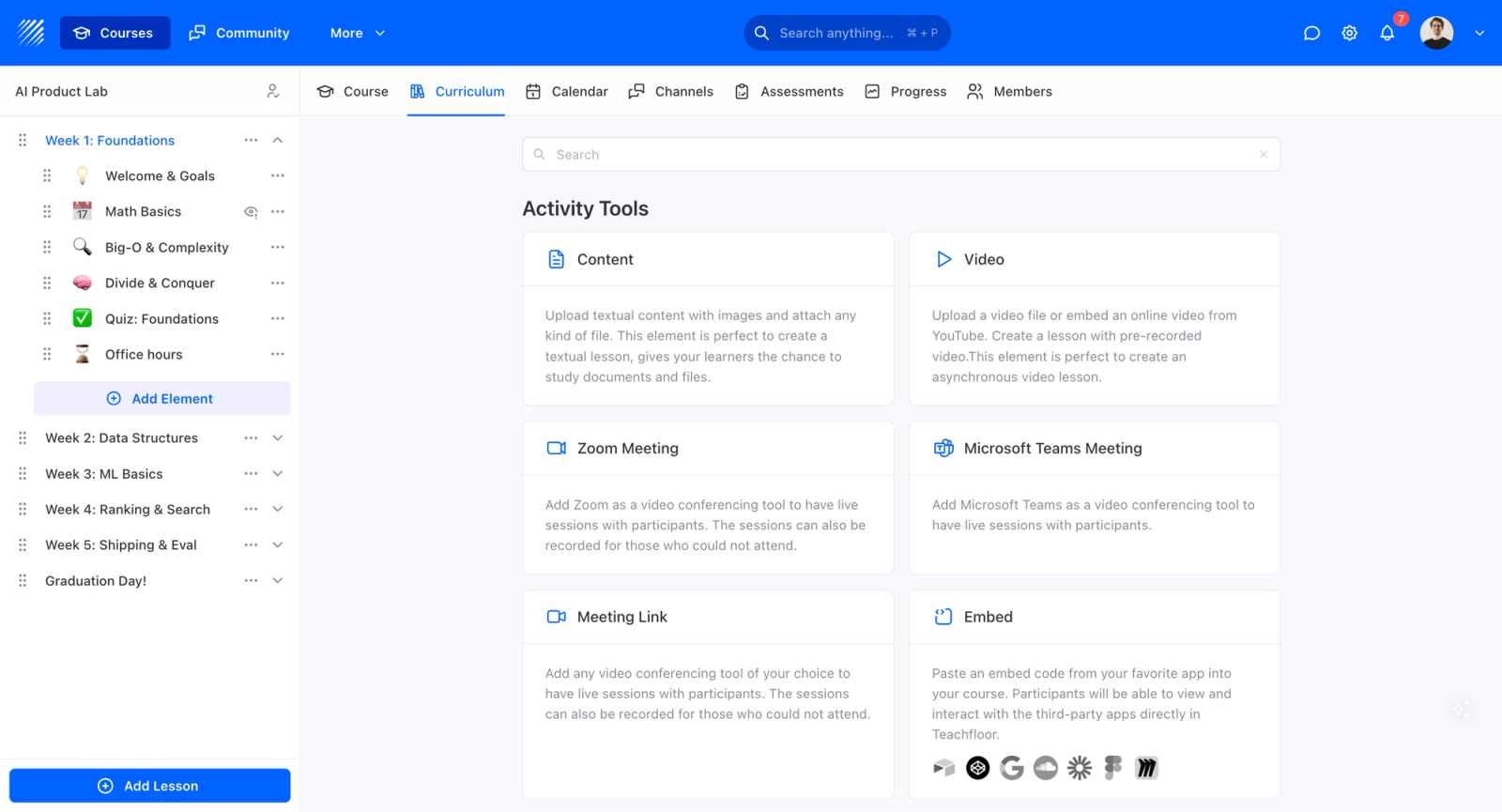
- Create or reuse your current materials. It’s up to you what materials to reuse and create for your self-paced resources. Are the materials outdated? Recreate them. Are the materials still useful? Reuse them.
- Put them in one place. To make your life easier, put everything in one place. Look for a learning platform that suits your needs and goals.
- Add an online learning community. Scalability means you don’t need to come up with everything for your students. What you need to do is to help them learn from each other and sustain a learning environment without you in the center. Adding a learning community can create more collaboration, engagement, and long-term relationships among your learners.
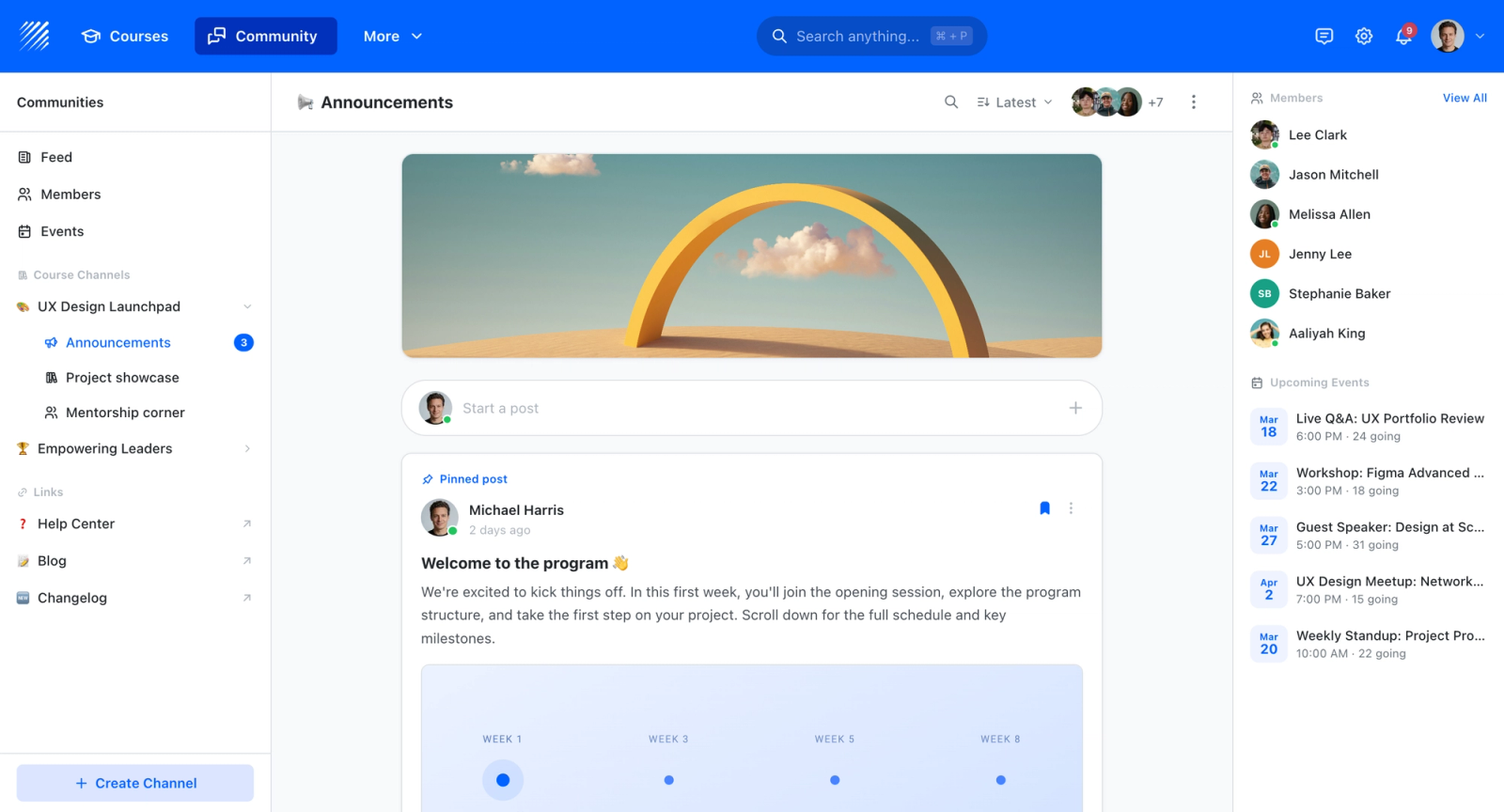
Teachfloor is designed for scalable cohort-based courses. You can create unlimited courses and upload different formats, including_ SCORM files_, videos, PDFs, text, and slides.
30% synchronous learning session
- Scheduling: Now that you’re finished with the self-paced materials, it’s time to complete the puzzle of course design. When are you going to conduct your live sessions? Schedule them on your platform for automation.
- Design your live sessions: How is the flow of your live session? What activities are you going to conduct? Don’t forget the concept of interleaving learning where different activities are interchanging in one session to increase the participation and motivation of your learners.
- Here are tips on how to make your synchronous sessions engaging:
- Start with a get-to-know-each-other or networking session: Your students are best when they learn from and with peers. Social learning is key.
- Organize at least 1 live class each week to tackle the asynchronous content, assignments, and games you have provided to them for the week.
- Invite guest speakers so you don't need to teach everything, and not everything will come from you.
- Give them a prompt each week along with the live class. Gamify and make it group work to increase peer-to-peer learning.
Automate and optimize
We are in an era where you can automate routine work. Use technology through automation and optimization with an all-in-one learning platform, so your time goes to teaching and facilitation instead of admin. Once your course is designed in the 70-30 hybrid model, the right platform handles scheduling, notifications, peer review, community, grading, and content delivery for you.
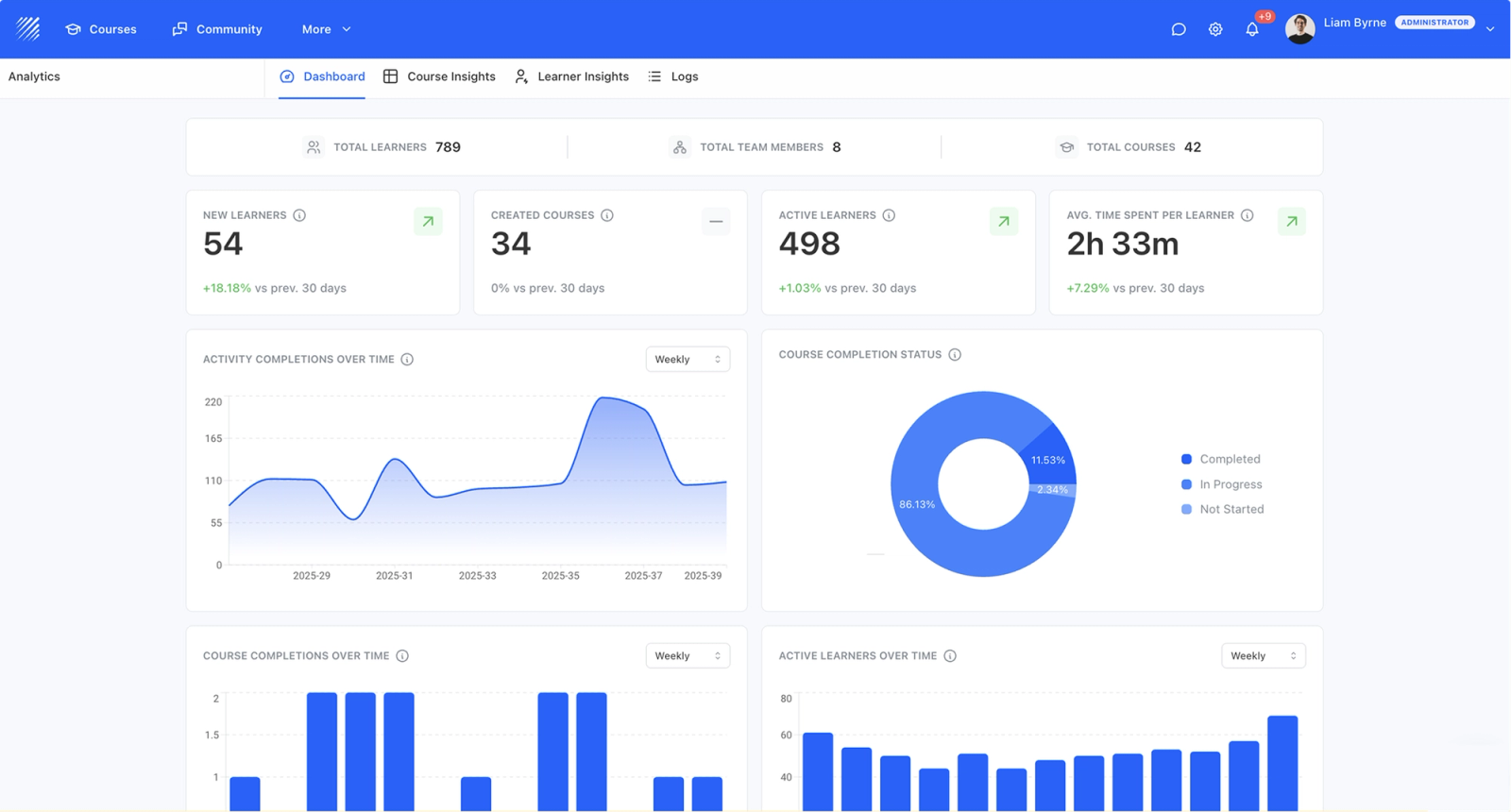
You do not need to break the bank for this. Platforms like Teachfloor offer a free trial, after which a recurring monthly fee covers unlimited students and unlimited courses, so cost does not scale linearly with your cohort.
A good all-in-one platform should let you automate work such as:
- Email notifications
- Class scheduling
- Class attendance
- Checking of grades
- App integrations
- Payment collection
- Student report
- Scheduling of lessons
- And sometimes, the course design itself
Write the SOPs of your course
When you launch your first cohort, there is too much work because you are just starting out. Along the way, the tasks seem lighter because you’re discovering what does and what does not work after executing at least 2 to 3 cohorts.
The best way to capture this information is to write it down. After some time, you can create a manual or an SOPof your course once you have the system in place.
Delegate tasks
No instructor can do this alone. Although in some cases, this is the reality for other solopreneurs. But if you can onboard mentors, coaches, and community support in building your course, the scaling won’t be too hard for you. Because you can delegate the tasks to your team and you can do something else that gives you bigger outcomes. What are the tasks that you can delegate?
Live classes facilitation
For this, you can invite experts to facilitate a workshop or speak in AMA or fireside chat. Experts always want to share their insights and expertise, so you might get their presence for free or ex-deal.
Mentoring and coaching
Looking for part-time mentors or coaches is one of the best things you can do without decreasing the quality of your course. It’s like multiplying yourself 5x to 10x. It depends on how large your cohort is, but you can start with 5-10. They absolutely help the transformation as it diversifies the learning experience of the learners.
Community and course operations
Community management is a huge aspect of the cohort-based model. Delegate this task to a part-time or full-time community manager and ops to moderate your learning community.
Course or content design
In some cases, you can look for a co-instructor to design your course. Delegating more tasks to others can help you focus on other important things. But if you are the face of your cohort-based course—meaning students enrolled to have direct access to you, leave up the main live sessions for yourself to facilitate.
Course distribution
Look for a kick-ass marketer to do the course distribution for you. Marketing is a long game for cohort-based courses if you do this alone. Or else, you will stay dependent on word-of-mouth and alumni referrals.
Break down the cohorts
Can you imagine the chaos of one Zoom room with 500 students? It does look more like a webinar than a class! Well, you can only make this possible by breaking the 500 students into sub-groups.
The best cohort size is around 30-100. More than a hundred is hardly manageable. In a hybrid cohort-based, you can at least admit 100-500 students and divide them into sub-groups. Then let the coaches or mentors lead these small groups for a tight-knit, intensive, and intimate learning experience.

You can break down the cohorts into sub-groups by:
- course topic
- interests
- time zone or regions
- hobbies
- skillset
- industry
- work title
- learning goals
- personal stories
- aspirations
- etc
These are just examples. It still depends on the context of your course.
Self-sustaining community
Scale your cohort-based course by creating a self-sustaining community that doesn’t need you to be present all the time. That’s actually the good part about cohort-based courses that are community-led. It slashes out the concept of star instructors where you as the instructor of the course need to be present in all activities all the time.
A self-sustaining community has several benefits for both you and your learners. You don’t need to be involved in every activity. Learners can learn not just from you, but from the learning environment that you build with them.
Read What is an Online Learning Community.
Strategies to Transform
Project-based Learning
One of the famous pedagogies is Project-based Learning or commonly known as PBL. This approach is widely used in K-12 classes. Because of its proven effectiveness, tech Bootcamps and cohort-based courses adopted it and use it in their curriculum design.
Why is it effective? The Project-based Learning approach allows learners to learn by application which is crucial for transformative learning. Instead of mere discussions and lectures, this pedagogy enables students to learn with projects where they gain the top skills that are needed for the 21st-century workforce. Most of the time, PBL is done in groups, solving a real-world problem, and using the design thinking method.
Another benefit is, instructors are more of a facilitator, mentors, or coaches in the class. The class is not centered on the instructor, but on the learners and the projects.
Learn how you can apply this approach by reading How to use Project-Based Learning approach to build learning environments.
Gamification
The gamification market has grown into a multi-billion-dollar category, and it keeps expanding. Educators, creators, and corporate trainers all use gamification to teach online and offline.

Gamification works well in education because it gives students the feeling of fun, a challenge, and belongingness. These three factors can make learning better and more effective. Successful examples are Duolingo and Kahoot!, two of the most famous EdTech startups that change the way we learn online.
Learn how to apply gamification by reading How to use Gamification in Corporate Training.
Peer-driven learning
When students don’t learn solely from teachers, and they learn from peers, from their environment—that’s when transformation happens.
Learning doesn’t happen inside the classroom alone. It actually happens outside the classroom. It’s when students team up for a group activity on campus. It’s when they go out for a field trip to visit museums, parks, the national library, local places, and so on. It’s when they are learning from their peers and from their learning environment which happens to be the real world.
For cohort-based courses, these physical activities are hard to execute. What we can do is organize a tour in virtual museums, group activity in breakout rooms, and meet-ups in certain cities. Sometimes, simply integrating peer review and peer teaching can also help us in integrating peer learning activities into the course.
For more on building peer learning into a cohort, see our peer-learning platform and these reads:
- Peer Learning - The Future of Online Education
- Peer Review: How to Apply Feedback-Based Learning Methodology
- Peer Teaching: How It Improves Collaborative Learning In Your Virtual Classrooms?
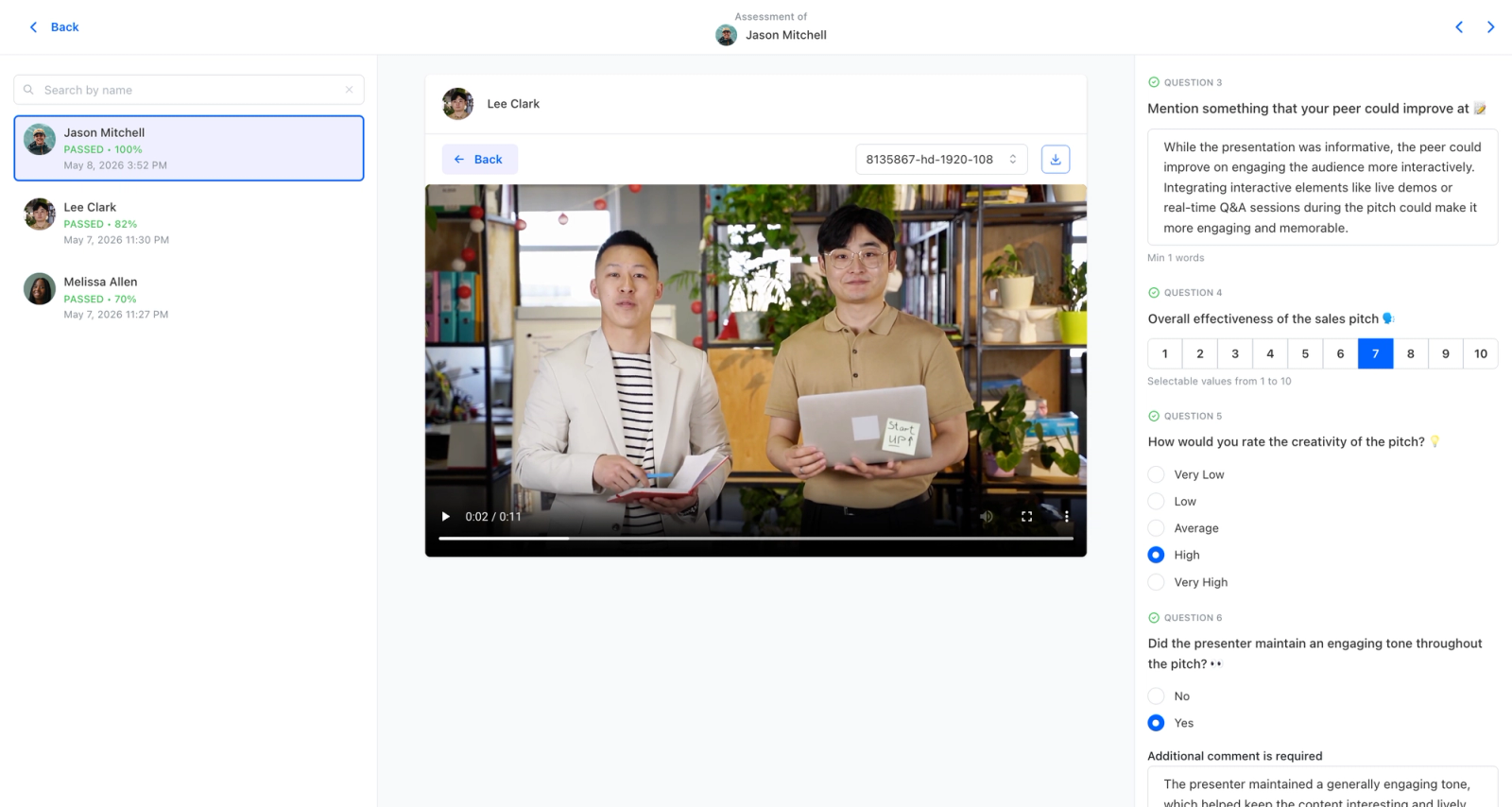
The best thing about this is, some learning platforms out there support peer-driven learning. You can automate and integrate peer reviews in your class by using these platforms. We have integrated a feature of peer review and instructor review in Teachfloor to make sure your course would have a more collaborative learning experience.
Personalized Learning
Last on our list is Personalized Learning: today, this is one of the most sought-after strategies for learning. Edtech startups integrate personalized learning in their tools, apps, and services to ensure quality and transformative education. Companies are using personalized learning in their corporate training.
One of the reasons why MOOCs didn’t work is because it’s nothing personal. Remember, learners have different learning styles, skill levels, and learning goals. Performing a cohort-based course can help you in discovering these differences, while personalized learning can bridge these differences among your learners.
You can integrate Personalized Learning in your cohort-based course through:
- Coaching and mentoring
- Daily or weekly check-in
- Individual or group check-in
- Tracking of learning goals
- Personal development plan (PDP)
- Support channel
Where cohort-based courses work best
Cohort-based learning is not tied to one type of program. The same core methods, live sessions, community, accountability, and project work, show up across very different settings. Below are the patterns where the model consistently performs well, from enterprise training to creator academies. For real-world examples, see our roundup of cohort-based courses.
| Use case | Who | Focus |
|---|---|---|
| Corporate L&D & upskilling | Enterprise L&D teams | Onboarding, reskilling, leadership development |
| Professional bootcamps | Bootcamp & academy founders | Job-ready skills, team projects, career outcomes |
| Creator / academy courses | Creators, experts, coaches | Transformation, community, paid cohorts |
| Customer & partner education | Customer education / enablement teams | Product adoption, certification, partner enablement |
Corporate L&D and upskilling
Inside companies, cohorts are used for onboarding, role-based upskilling and reskilling, leadership development, and compliance or product training. Learning together on a shared schedule raises completion and retention compared with passive e-learning, and managers get a clear view of progress. The 70-30 model keeps it scalable across large teams and time zones.
Professional bootcamps
Bootcamps run intensive, time-bound cohorts built around team projects that mirror real work. The structure, deadlines, peer accountability, and mentor feedback is what produces job-ready skills. See our online bootcamp guide for how to structure one.
Creator and academy courses
Creators, subject-matter experts, and coaches use cohorts to turn knowledge into a transformative paid program. A community-led format means learners support each other, which raises completion and fuels word-of-mouth and referrals. Many start with a small first cohort, gather testimonials, then grow. See our community-based learning guide for the community side.
Customer and partner education
Companies run cohort-based programs to onboard customers, drive product adoption, and certify users or partners. A live, community-driven format helps customers reach value faster than a static help center, and certification cohorts turn partners into capable advocates. The same async-plus-sync structure keeps these programs running at scale.
Closing
That is the core of the method. Learning and education keep evolving, so treat this as a living guide; we update it as the model matures.
Some notes for our readers:
- If you think there are still things to improve here, feel free to reach out to us on LinkedIn and Twitter. We would like to hear your feedback and iterate the eBook.
- If you want to learn more about eLearning and how to build your online academy, you can also look into our blogs which serve as the best resource center to learn the latest trends, concepts, and how-tos of designing better content, courses, and curriculum for your learners.
- If you are ready to apply what you have read and you need one place to run live sessions, community, peer review, and curriculum, the next section explains what Teachfloor does for both creators and companies.
Teachfloor: the cohort-based course platform for creators and companies
Interesting facts about us:
- Teachfloor is purpose-built for cohort-based courses. Live sessions, a built-in community with accountability, peer and project-based learning, curriculum, and the async-plus-sync 70-30 model this guide describes all live in one platform, for independent creators and for company L&D teams.
- Registered business in the San Francisco Bay Area, we are composed of a small team from different places around the world working remotely to build a great learning infrastructure for our educators, edupreneurs, trainers, and learners. This is our way to contribute to the advancement of education and learning.
- We serve both sides of the cohort market: course creators, consultants, coaches, and thought leaders running paid academies, and companies running corporate training, onboarding, upskilling, and customer or partner education. The same platform supports a solo creator's first cohort and an enterprise rolling out training across teams.
- Creating a cohort-based course on your own is not easy, and neither is standing up a company training program. We want to be part of that journey for creators, founders, and L&D teams. Explore the features that power academies and training programs of every size.
- We do not only help you automate and save time. We also help you scale and earn a reasonable return on your effort. That is why:
- We offer a basic plan with $59 monthly where you can create unlimited courses, admit unlimited students, and add up to 4 instructors to help you out.
- You can test it out for free within 14 days to see if the platform fits your needs as a course creator, edupreneur, founder, and trainer.
For a step-by-step walkthrough, read how to build your online academy using Teachfloor. For more on running the model end to end, see the best strategies to build and launch a cohort-based course and our guide to pricing strategies for your cohort-based courses.