


Here is a number that usually makes volunteer managers pause: in the US, nearly one out of three volunteers stop volunteering within their first year. Not because they dislike the mission, but because the experience slowly stops working for them.
If you manage volunteers, you have seen this happen. Someone joins with energy and good intentions. They show up, help out, seem engaged. Then responses slow down. Schedules get harder. Eventually, they step away.
This article is written for that moment.
It is for learning professionals and nonprofit leaders who want to understand how to retain volunteers in a realistic, sustainable way. Not by adding more programs or incentives, but by fixing the parts of the experience that quietly push people out.
What follows is practical, field-tested insight drawn from real volunteer programs across the United States. The kind of guidance that helps you keep volunteers engaged long after the excitement of day one wears off.
Understanding Volunteer Motivation (The Foundation of Retention)
Most people trying to learn how to retain volunteers are really asking one thing:
“Why do good volunteers stop showing up?”
The answer usually has nothing to do with the mission. It has everything to do with how the experience feels over time.
Volunteers do not wake up one day and decide to quit. They slowly lose the reason that made volunteering worth their time. That reason is motivation, and it is more fragile than most organizations realize.
What motivates volunteers in real life
Some volunteers join because they care deeply about the cause. Others are there to learn, to feel useful, or to connect with people who share their values. None of these motivations are better than the others. They are just different.
The problem starts when everyone is treated the same. When roles never evolve. When effort goes unnoticed. When no one checks whether the experience still fits the person doing the work.
Motivation changes. Always. If the volunteer experience stays static while the person grows, disengagement is almost guaranteed.
How motivation becomes a retention advantage
Retention improves when you stop guessing and start asking. Not in a formal, corporate way, but in a human one.
Simple conversations. Quick check-ins. Honest questions like “What do you enjoy most right now?” or “What would make this easier for you?”
These small moments tell volunteers they are not just filling a gap. They are choosing to be there, and that choice matters.
When people feel understood, staying feels natural. This sits at the heart of everything else.
The Golden Rule of Volunteering
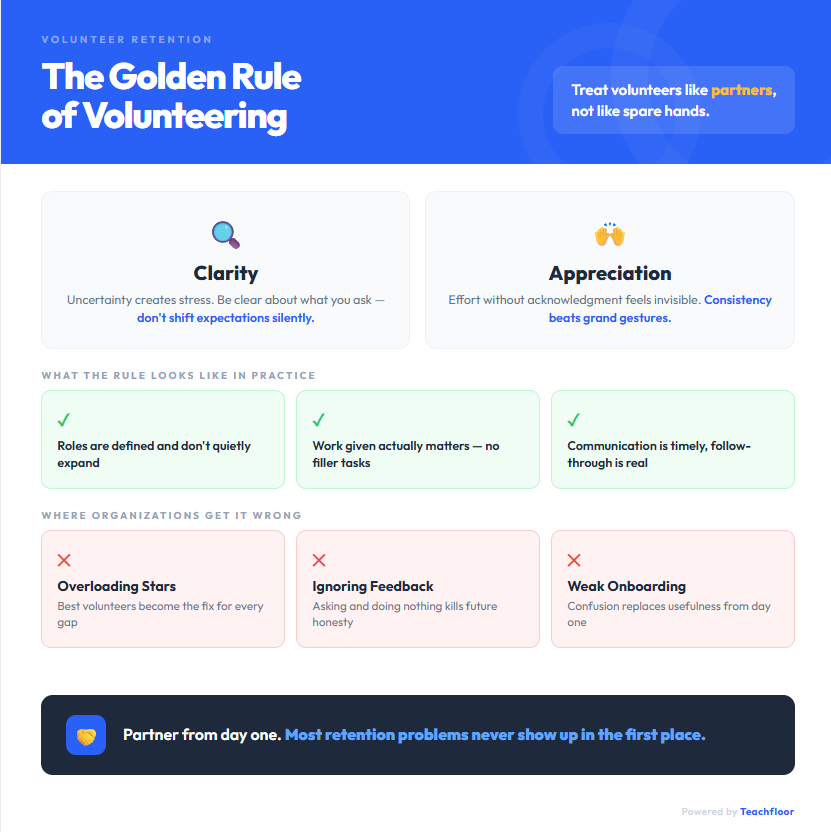
The golden rule of volunteering is simple: treat volunteers like partners, not like spare hands.
Most retention problems start when this line gets crossed. Not intentionally. Just slowly. Tasks pile up. Communication gets shorter. Appreciation becomes occasional instead of consistent. Volunteers feel it immediately.
They may not say anything, but they notice when their time is treated as unlimited, or their effort is taken for granted.
What this rule really means
Volunteers are choosing to be there. They are not obligated to stay, and they are not there to absorb friction inside the organization.
Respect means being clear about what you are asking for. It means not changing expectations without a conversation. It means remembering that volunteers have full lives outside your program.
Clarity matters because uncertainty creates stress. Appreciation matters because effort without acknowledgment feels invisible. When those two are missing, commitment fades, no matter how strong the mission is.
How the golden rule shows up in real work
You see it when roles are clearly defined and do not quietly expand over time. You see it when volunteers are given work that actually matters, not filler tasks just to keep them busy.
You also see it in communication. When messages are timely. When updates are shared. When someone follows through on what they said they would do. These small signals tell volunteers that their time is being taken seriously.
Where things usually go wrong
The most common mistake is relying too heavily on the volunteers who perform well. They become the default solution for every gap. Over time, that turns appreciation into pressure.
Another issue is asking for feedback and doing nothing with it. Volunteers stop sharing once they feel unheard.
Weak onboarding is another problem. When people are thrown into roles without enough context, they spend their early energy feeling confused instead of useful.
If you want to improve how to retain volunteers, start here. When volunteers are treated like partners from day one, most retention problems never show up in the first place.
Why Do Volunteers Quit? (And How to Prevent It)
If volunteers stop showing up, it usually feels confusing. Things seemed fine. No complaints. Then suddenly, they are gone. What actually happened is much simpler than it looks.
Below are the most common reasons volunteers quit, explained the way they experience them, plus what you can do in the moment to stop that from turning into a goodbye.
They are not sure what they are supposed to do
When a volunteer has to guess what their role is, it drains energy fast. They second-guess decisions, wait for direction, or worry about stepping on toes. Over time, that uncertainty becomes exhausting.
This is easy to prevent. Be very clear about what they own, what they do not, and who they go to when something changes. A short conversation that resets expectations can do more than any formal process.
They cannot see the impact of their time
Volunteers want to feel useful. When tasks feel disconnected from real outcomes, people start wondering if their effort matters at all. That doubt grows quietly.
You prevent this by closing the loop. Share what happened because of their work. Say “this helped” or “this moved us forward.” When people understand the impact, showing up feels worth it.
The commitment slowly becomes too heavy
This happens a lot. A volunteer says yes to one thing, then another, then another. No one checks in. Suddenly the role feels bigger than what they signed up for.
The fix is not pushing through. It is pausing and asking what still fits. Make it normal to adjust commitments. When volunteers know they can step back without letting anyone down, they are far more likely to stay involved.
They do not feel supported when things get tricky
Every volunteer hits a moment where something feels confusing, uncomfortable, or frustrating. If they do not know who to talk to, disengagement becomes the easiest option.
Support does not need to be complicated. Regular check-ins, open communication, and a clear signal that questions are welcome go a long way. When volunteers feel backed up, quitting feels unnecessary.
If you want to improve how to retain volunteers, focus less on why people leave and more on removing these everyday points of friction. When the experience feels clear, meaningful, and manageable, most volunteers choose to stay.
The Four Levels of Retention Strategies
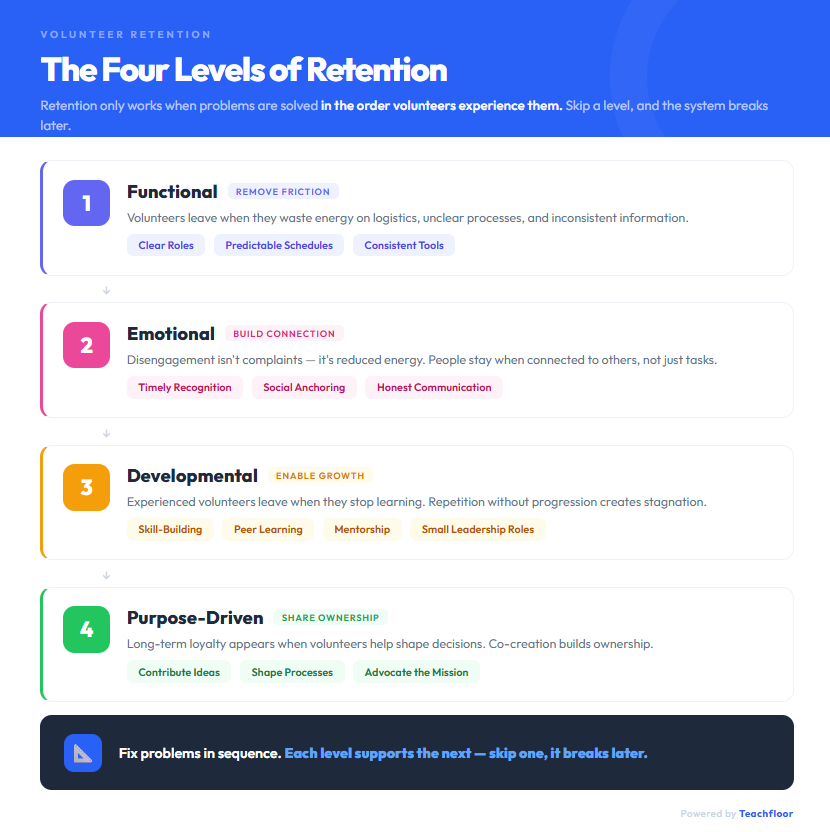
Most organizations struggle with how to retain volunteers because they try to fix the wrong problem first. They jump straight to appreciation, culture, or purpose while basic friction is still unresolved. Retention only works when problems are addressed in the order volunteers experience them.
These four levels reflect that order.
Level 1: Functional retention
This is where most volunteer programs quietly lose people.
When systems are unreliable, volunteers waste energy navigating logistics instead of contributing. Late schedules, unclear processes, or inconsistent information force volunteers to compensate for gaps that are not theirs to fix. Over time, this creates fatigue.
Functional retention improves when you remove decision-making from the volunteer’s plate. Clear role definitions, predictable schedules, and consistent tools reduce mental load. Volunteers should not have to chase information or guess what comes next. When the experience runs smoothly, people have space to engage rather than endure.
Level 2: Emotional retention
Once operations are stable, the next problem is emotional distance.
Volunteers disengage when effort feels unnoticed or when relationships stay transactional. This does not show up as complaints. It shows up as reduced energy and weaker commitment.
Emotional retention improves when recognition is timely and specific, not occasional or generic. It also improves when volunteers feel socially anchored. People stay longer when they feel connected to others, not just to tasks. Trust grows when communication is honest and consistent, especially when something is not working.
If volunteers do not feel emotionally safe or appreciated, no amount of structure will keep them long term.
Level 3: Developmental retention
This is where many programs stall.
Experienced volunteers often leave not because they are unhappy, but because they are no longer learning. Repetition without progression creates stagnation. Volunteers who joined to build skills or contribute at a higher level eventually look elsewhere.
Developmental retention means intentionally creating pathways, not promotions. Skill-building opportunities, peer learning, and mentorship allow volunteers to deepen their involvement without pressure. Small leadership responsibilities help retain people who want more ownership but not more workload.
Growth does not need to be formal, but it does need to be visible.
Level 4: Purpose-driven retention
Long-term commitment only appears when volunteers feel trusted at a strategic level.
At this stage, volunteers want their perspective to matter. They want to understand how decisions are made and how their work connects to real outcomes. When volunteers are excluded from conversations that affect them, disengagement follows quietly.
Purpose-driven retention grows when volunteers are invited to contribute ideas, help shape processes, and advocate for the mission. Co-creation builds ownership. Ownership builds loyalty.
This is where volunteers stop asking “What do you need me to do?” and start asking “How can we make this better?”
If you want sustainable volunteer retention, you have to fix problems in sequence. Each level supports the next. Skip one, and the system breaks later, usually when you least expect it.
Designing an Effective Volunteer Onboarding Experience
If volunteer retention problems start early, onboarding is usually where they begin. Not because onboarding is missing, but because it is treated as a checklist instead of an experience. For anyone serious about how to retain volunteers, onboarding needs to be designed the same way you would design learning.
Onboarding as a learning journey
The first few interactions shape how volunteers interpret everything that follows. When too much information is delivered at once, people feel overwhelmed. When too little is shared, they feel unprepared. Both lead to hesitation instead of confidence.
Managing cognitive load matters here. Volunteers need just enough context to understand what they are doing, why it matters, and what success looks like in the first few weeks. Anything beyond that can come later.
Setting expectations early prevents most frustration down the line. Volunteers should know what is expected of them, how much time is realistic, and what support looks like if something feels unclear. When expectations are vague, people fill the gaps themselves, and usually in the wrong way.
Best practices that actually work
Effective onboarding starts with structure, not paperwork. A clear orientation helps volunteers understand the mission, the flow of work, and how decisions are made. It should focus on what they need to do now, not everything they might need someday.
Role-specific training is where confidence is built. Volunteers need practical guidance tied directly to what they will be doing, not general information that feels disconnected from their role. Short, focused training works better than long sessions that try to cover everything.
Social integration matters from day one. Volunteers who meet people early feel more comfortable asking questions and staying engaged. Simple introductions, buddy systems, or small group check-ins help volunteers feel part of something instead of on the outside looking in.
When onboarding feels intentional and supportive, volunteers settle in faster. That early sense of clarity and belonging makes a big difference in how long they choose to stay.
Preventing Burnout and Sustaining Energy
Burnout is one of the quietest reasons volunteers disengage. No complaints. No big moment. Just less energy over time. If you want to improve how to retain volunteers, you need to catch burnout before it turns into withdrawal.
Burnout usually starts with good intentions
The volunteers who burn out are often the most reliable ones. They say yes. They show up. They help when something is missing. Over time, their role grows without a clear reset point.
What makes this worse is that many volunteers do not want to disappoint anyone. Instead of asking for less, they quietly stretch themselves until volunteering starts to feel heavy.
Preventing burnout starts with paying attention to workload patterns, not just output. If the same people are always stepping in, that is a signal, not a success.
Energy is sustained through balance, not pressure
Volunteers stay energized when their commitment feels manageable. That means normalizing boundaries and revisiting availability regularly. A quick check-in about time and capacity does more than pushing through another busy period.
Rotating responsibilities helps avoid fatigue. Encouraging breaks helps people come back engaged instead of drained. When stepping back is treated as acceptable, volunteers are more likely to stay connected long term.
Sustaining energy is not about asking for more motivation. It is about designing an experience that respects limits. When volunteering fits into life instead of competing with it, burnout becomes much easier to prevent.
Measuring Volunteer Retention and Engagement
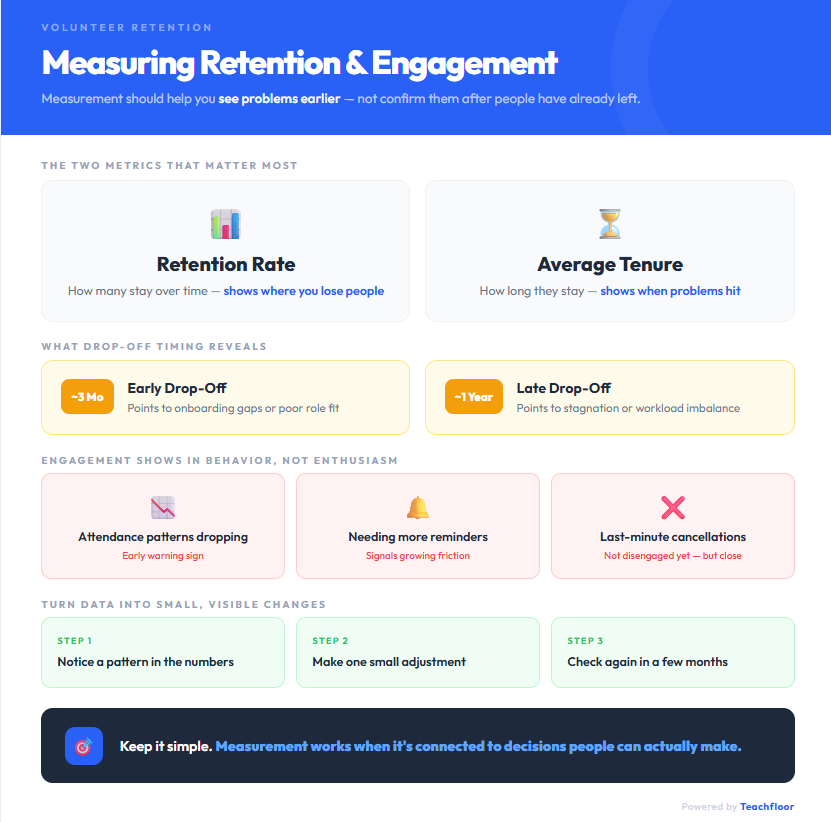
If you are trying to improve how to retain volunteers, measurement should help you see problems earlier, not confirm them after people have already left. In most US nonprofit programs, the goal is not perfect data. It is usable insight that fits into real operations.
The metrics that actually matter
Start with retention rate and average tenure. These two numbers tell you where to look. If most volunteers drop off after three months, that points to onboarding or early role fit. If people stay a year and then leave, the issue is usually growth or workload balance.
Engagement shows up in behavior, not enthusiasm. Look at attendance patterns, missed shifts, and how often volunteers need reminders. In many programs, a volunteer who starts canceling last minute is not disengaged yet. They are signaling friction.
Short pulse surveys can help, especially after major milestones like the first month or first project. The key is follow-up. If volunteers share feedback and nothing changes, they stop answering and eventually stop showing up.
Using data to improve retention strategies
Data only helps if it leads to small, visible adjustments. In practice, this looks like noticing a pattern, making one change, and checking again a few months later. For example, if new volunteers stop attending after orientation, shorten the orientation or break it into parts.
Segmentation makes this easier. New volunteers, long-term regulars, and highly involved volunteers need different support. A retired volunteer helping twice a week has different needs than a college student volunteering during the semester. Grouping volunteers by motivation and lifecycle helps you respond with relevance instead of treating everyone the same.
Measurement works best when it stays simple and connected to decisions people can actually make.
Building a Long-Term Volunteer Retention Framework
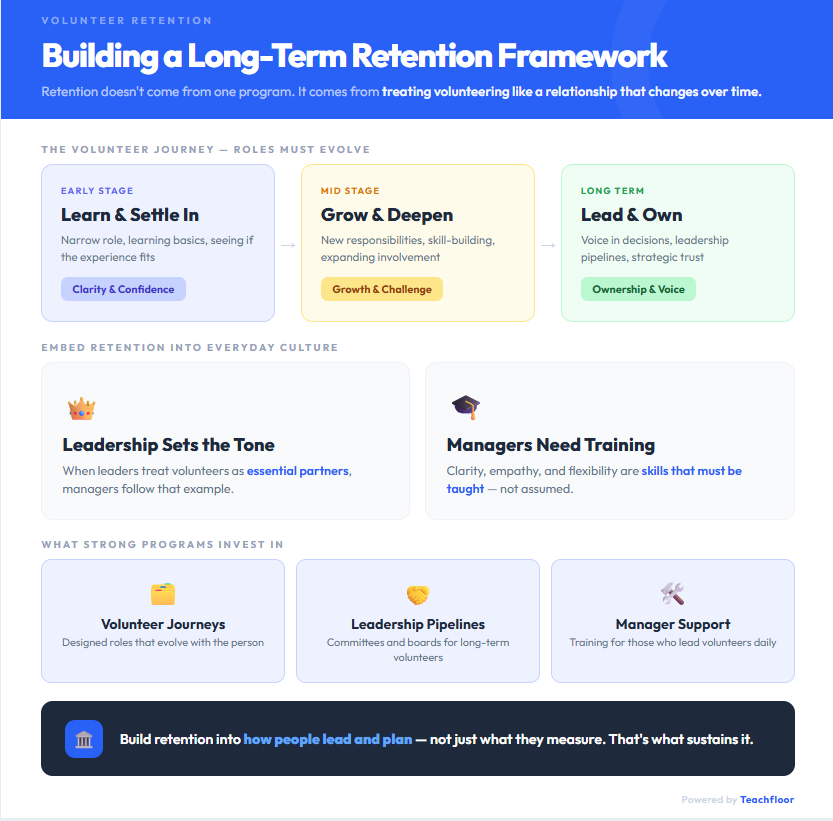
Long-term retention does not come from one program or initiative. It comes from treating volunteering like a relationship that changes over time.
From short-term help to long-term partnership
Most volunteers begin with a narrow role. They want to help, learn the basics, and see if the experience fits. Over time, the volunteers who stay want more context and more trust.
Designing volunteer journeys means thinking about how roles evolve. Early stages focus on clarity and confidence. Mid-stage involvement often benefits from new responsibilities or skill-building. Long-term volunteers usually want a voice and a sense of ownership.
This approach is common in strong US nonprofit programs, especially those with board pipelines or volunteer leadership committees. It keeps experienced volunteers engaged without overloading them.
Embedding retention into everyday culture
Retention cannot live only with the volunteer coordinator. Leaders set the tone by how they talk about volunteers and how decisions account for volunteer impact. When leadership treats volunteers as essential partners, managers follow that example.
Managers also need training. Leading volunteers requires clarity, empathy, and flexibility. These skills are not always taught, but they make a measurable difference. Programs that invest in manager support see fewer drop-offs and stronger long-term commitment.
When retention is built into how people lead and plan, not just what they measure, volunteer engagement becomes easier to sustain.
Conclusion
Volunteer retention comes down to experience, not effort. Most volunteers want to stay. They leave when expectations drift, support fades, or the work no longer feels connected to why they showed up. For nonprofit leaders and learning professionals, the real skill is spotting friction early and addressing it while people are still engaged. When volunteering is treated as an ongoing relationship rather than a transaction, long-term commitment becomes much easier to build.
One way strong organizations support that relationship is through consistent learning and alignment. Volunteers who understand their role, feel confident in their skills, and see how they grow over time are far more likely to stay involved. That is where an LMS fits naturally into a volunteer retention strategy.

Nonprofits use Teachfloor to onboard volunteers, deliver ongoing training, run cohort-based programs, and create space for discussion and reflection. By supporting learning as a shared experience, Teachfloor helps organizations turn engagement into continuity and sustain volunteer commitment over time.


