


People learn from other people. That observation is not new. Albert Bandura formalized it in his social learning theory decades ago, showing that observation, imitation, and modeling drive skill acquisition more reliably than isolated study. Research published in the Journal of Applied Psychology confirms that informal learning through social interaction accounts for a significant portion of what employees actually retain and apply on the job.
The challenge is not whether social learning works. The challenge is designing it into training programs so it happens consistently rather than by accident. Most organizations rely on self-paced content libraries and expect learning to occur through consumption. That model ignores how adult learning actually works: adults learn best when they can connect new information to existing experience, discuss it with peers, and apply it in context.
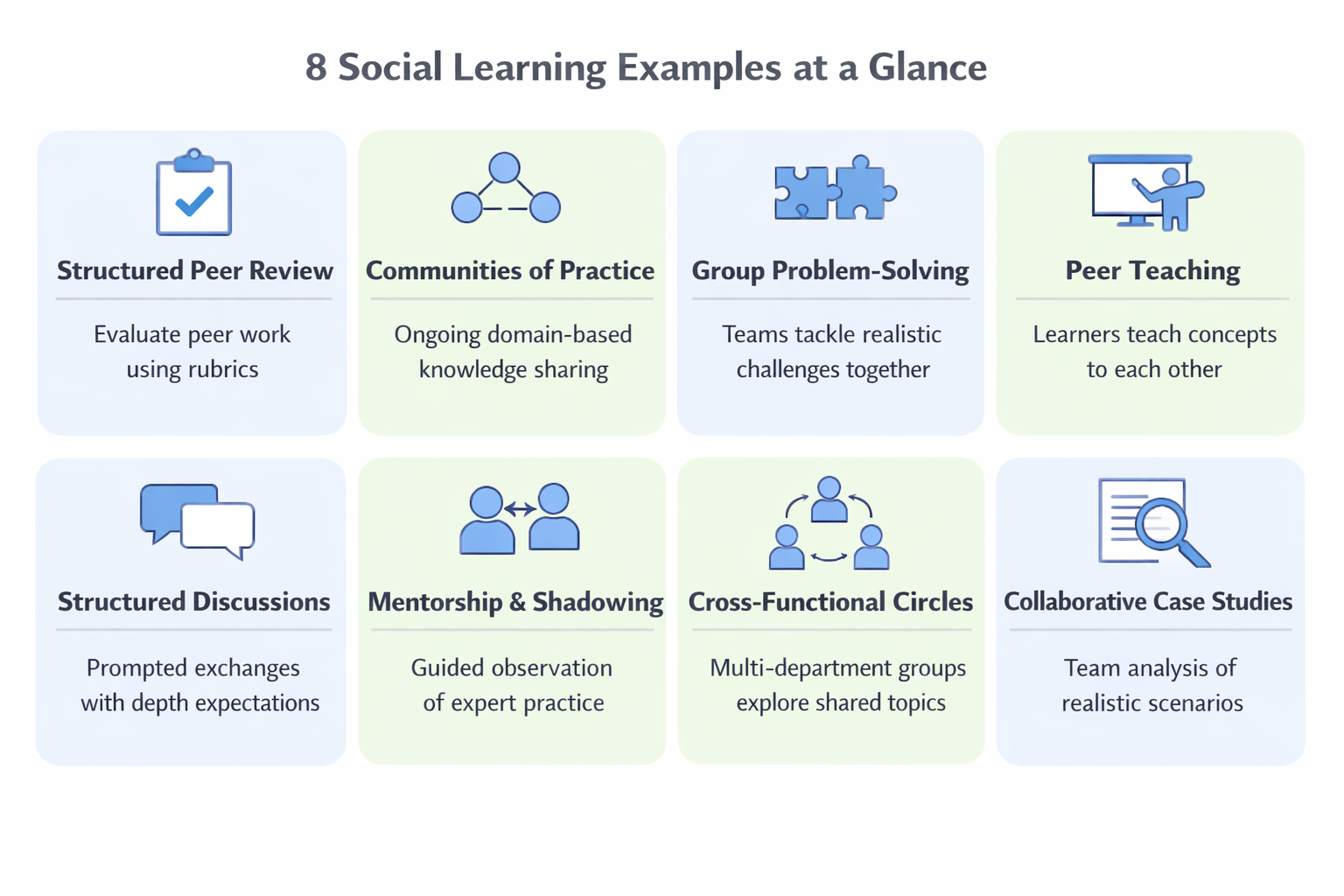
This guide presents eight social learning examples that translate the theory into operational practice. Each example is specific enough to implement and explains the mechanism that makes it effective.
What Is Social Learning (and Why It Matters in Training)
Social learning is the process of acquiring knowledge, skills, or behaviors through observation, interaction, and collaboration with others. It contrasts with individual study models where learners work through content alone.
In a training context, social learning means learners gain understanding not only from instructors or materials but from each other. They watch how peers approach problems. They explain concepts in their own words. They receive feedback from multiple perspectives. This process strengthens retention because it forces active processing rather than passive consumption.
Social learning matters in training for three practical reasons. First, it improves retention: explaining a concept requires organizing your own understanding rather than passively consuming someone else's. Second, it creates accountability: learners who work with peers are less likely to drop off because their absence affects others. Third, it surfaces varied experience: a group of practitioners brings different contexts to any topic, and structured interaction makes those contexts available to the whole group.
The distinction between social learning and collaborative learning is worth noting. Collaborative learning is a subset of social learning where people work together on shared tasks. Social learning is broader: it includes observation, modeling, and informal interaction alongside structured collaboration.
8 Social Learning Examples That Work in Practice
Structured Peer Review With Rubrics
Peer review asks learners to evaluate each other's work against defined criteria. The key word is "structured." Without rubrics and clear expectations, peer review becomes superficial feedback like "looks good" or vague encouragement.
How it works: After completing an assignment, each learner reviews two or three peers' submissions using a rubric that specifies what to evaluate and how to score it. Reviewers must justify their ratings with specific observations. The original author receives multiple perspectives on their work and revises based on the feedback.
Why it works: Reviewing someone else's work is itself a learning activity. It forces the reviewer to apply evaluation criteria, recognize quality differences, and articulate reasoning. The person receiving feedback gets input from multiple viewpoints, not just one instructor. Research from Stanford's cooperative learning literature shows that peer assessment improves both the reviewer's and the author's learning outcomes. Platforms like Teachfloor support structured peer review workflows that make rubric-based assessment operationally manageable even in larger cohorts.
Communities of Practice
A community of practice is a group of people who share a professional domain and learn from each other through ongoing interaction. Unlike a training cohort with a start and end date, communities of practice persist over time.
How it works: Organizations create dedicated spaces where practitioners in a shared domain can post questions, share solutions, discuss challenges, and document what they learn. A facilitator or rotating moderator keeps discussions focused and surfaces recurring themes. Members contribute based on real work problems, not hypothetical scenarios.
Why it works: Communities of practice turn knowledge sharing from an occasional event into a continuous process. New employees learn from experienced practitioners. Experienced practitioners refine their thinking by explaining it. The community builds a collective knowledge base that no single training program could replicate. This model works because it is grounded in actual work, not artificial exercises.
Group Problem-Solving Exercises
Group problem-solving places small teams in front of a realistic challenge and asks them to develop a solution together. The problems should be complex enough that no single person can solve them alone.
How it works: Teams of three to five learners receive a case study, scenario, or project brief drawn from real organizational challenges. Each team member brings different knowledge and experience. The group must discuss approaches, divide tasks, integrate their thinking, and present a unified solution. A facilitator provides guidance but does not give answers.
Why it works: This example activates experiential learning principles. Learners apply concepts to realistic situations rather than memorizing definitions. The social component adds cognitive diversity: team members challenge each other's assumptions, propose alternatives, and negotiate solutions. This mirrors how work actually happens in organizations.
Peer Teaching and Explanation Sessions
Peer teaching assigns learners the role of instructor for specific topics. Each person prepares to teach a concept to their peers, then delivers a short explanation or demonstration.
How it works: Divide the learning content into sections. Assign each section to a learner or pair of learners. They study the material, prepare a brief presentation or walkthrough, and teach it to the rest of the group. The audience asks questions and provides feedback. This approach is common in peer learning models and scales well in both live and asynchronous formats.
Why it works: The "protege effect" is well documented: people learn material more thoroughly when they expect to teach it. Preparing to explain a concept requires deeper processing than simply reading it. The teacher must anticipate questions, organize information logically, and identify the most important points. The audience benefits from hearing explanations in a peer's language rather than formal instructional prose.
Discussion-Based Learning With Structured Prompts
Discussion-based learning uses carefully designed prompts to drive substantive conversation among learners. This is not an open forum where people post and forget. It is a structured exchange with clear expectations for depth and engagement.
How it works: After consuming content (a reading, video, or exercise), learners respond to a prompt that requires them to apply the concept, connect it to their experience, or evaluate a scenario. Each learner also responds to at least two peers' posts with substantive commentary. Prompts are specific: "Describe a situation where this approach would fail in your organization and explain what you would do instead" is far more productive than "What did you think of this module?"
Why it works: Structured discussion forces thinking into the open. Learners must articulate a position and defend it rather than nodding along. Reading peers' responses exposes them to different interpretations and applications of the same material, widening comprehension in ways that re-reading the original content rarely achieves.
Mentorship and Shadowing Programs
Mentorship pairs a less experienced learner with a more experienced practitioner for guided observation and conversation. Shadowing adds a hands-on component: the learner watches the mentor perform real work and then discusses the reasoning behind decisions.
How it works: Organizations match mentors and mentees based on role, skill gaps, or career goals. Pairs meet on a regular schedule with defined topics or goals for each session. In shadowing programs, the mentee observes the mentor handling actual tasks, client interactions, or decision-making processes. Post-observation debriefs turn observation into learning.
Why it works: Mentorship is one of the oldest forms of social learning because it works through direct modeling. The mentee sees not just what the expert does but how they think. Tacit knowledge, the kind that cannot be written in a manual, transfers through observation and conversation. This model is especially effective for employee training in complex roles where judgment and context matter as much as procedural knowledge.
Cross-Functional Learning Circles
Learning circles bring together small groups from different departments or functions to explore a shared topic. The diversity of perspectives is the point.
How it works: Groups of five to eight people from different roles meet regularly (weekly or biweekly) around a defined theme. Each session has a facilitator who prepares a discussion guide or activity. Members share how the topic applies in their function, what challenges they face, and what approaches have worked. Sessions rotate facilitation responsibility so every member leads at least one meeting.
Why it works: Most training happens within functional silos, sales teams train with sales content, engineering teams with engineering content. Cross-functional circles break that pattern by forcing people to translate their domain knowledge for a different audience. An operations manager explaining a process to a product designer creates mutual understanding that a course module cannot. These circles also build internal networks that outlast the sessions themselves, improving day-to-day collaboration.
Collaborative Case Study Analysis
Collaborative case study analysis assigns teams to dissect real or realistic scenarios, identify problems, evaluate options, and recommend actions. Unlike individual case studies, the collaborative version requires negotiation and synthesis across different viewpoints.
How it works: Teams receive a detailed case study relevant to their industry or role. Each member reads and analyzes the case individually first, then the team convenes to compare analyses. They must identify where they agree, where they disagree, and why. The final deliverable is a team recommendation that accounts for multiple perspectives. Facilitators guide debrief sessions to extract lessons that apply beyond the specific case.
Why it works: Individual analysis followed by group synthesis layers personal reflection with collective intelligence. Disagreements within the team are productive: they force each member to examine their assumptions and articulate their reasoning rather than deferring to a single expert. The case study format grounds the discussion in concrete scenarios, which means the communication and negotiation skills practiced here transfer directly to how learners handle ambiguous situations on the job.
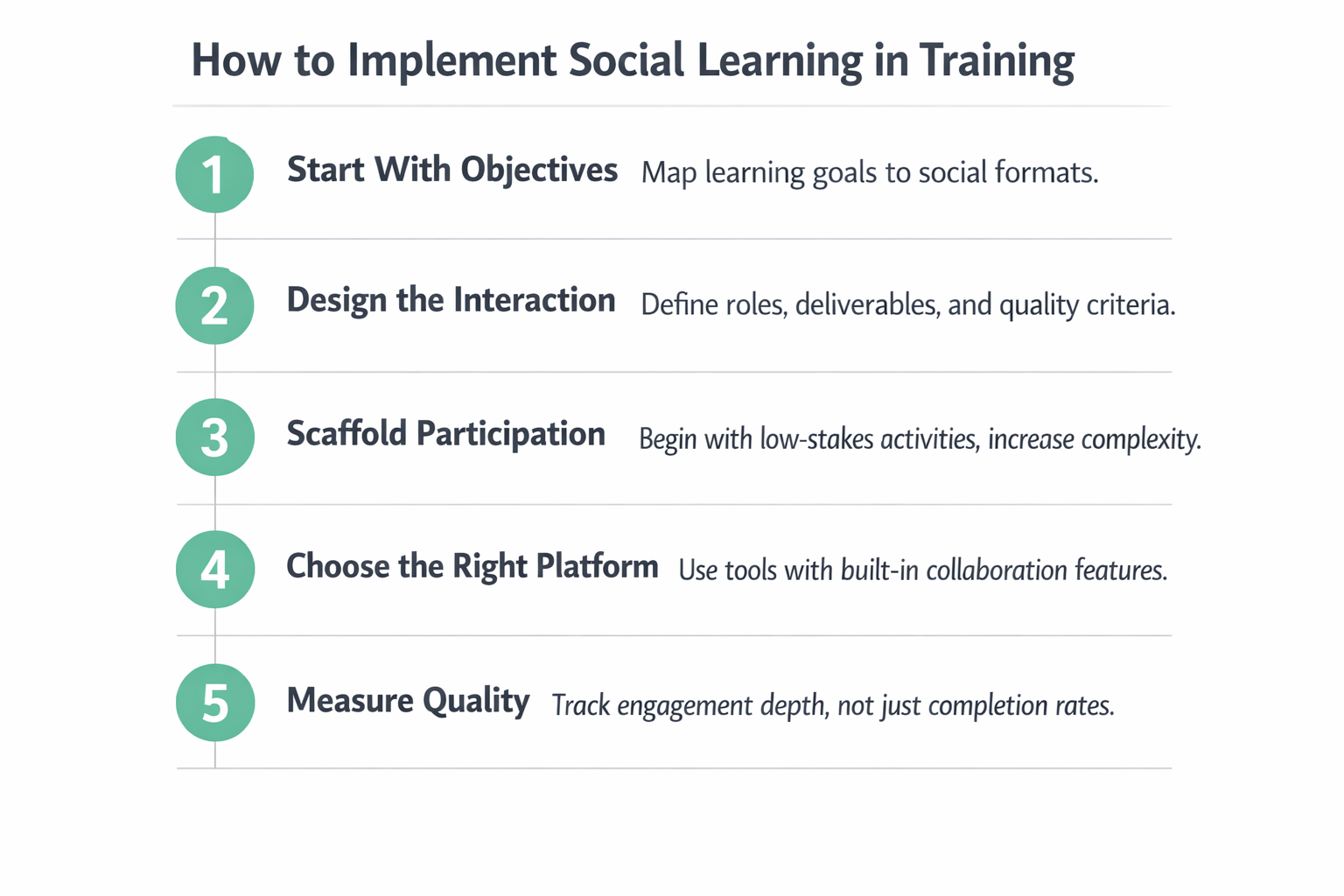
How to Implement Social Learning in Your Training Programs
Moving from theory to practice requires deliberate design. Social learning does not happen by adding a discussion forum to an existing course. It requires structural choices about how learners interact, what they produce, and how their contributions are evaluated.
Start with the learning objectives, not the format. Identify which objectives benefit from social interaction. Factual recall might not need peer discussion, but application, analysis, and evaluation almost always improve with collaboration. Map each objective to the social learning format that best supports it.
Design the interaction, not just the content. For each social learning activity, specify: who participates, what they produce, how they interact, and what constitutes quality. A peer learning strategy without these specifications defaults to informal chat, which rarely produces consistent outcomes.
Build scaffolding for participation. Not every learner is comfortable contributing immediately. Start with lower-stakes activities (short reflections, pair discussions) before progressing to higher-stakes formats (peer review, group presentations). Give clear instructions and model the expected quality of contribution.
Use a platform that supports interaction by design. A traditional LMS built for content delivery typically requires workarounds to support peer review, discussion threads, and group activities as first-class features, workarounds that often get abandoned when facilitation workload grows. Teachfloor, for example, is built around cohort-based and peer interaction workflows rather than treating them as add-ons.
Measure participation quality, not just quantity. Track whether learners are engaging substantively, not just logging in. Monitor the depth of discussion posts, the quality of peer feedback, and the outcomes of group activities. These indicators matter more than completion rates for assessing whether social learning is actually producing results. Strong employee engagement in social activities correlates with improved retention and application.
Common Mistakes When Introducing Social Learning
Treating discussion forums as social learning. Dropping a forum into a self-paced course and calling it social learning produces empty threads and generic posts. Discussion only works with structured prompts, clear expectations for response quality, and active facilitation.
Skipping the structure. "Collaborate with your peers" is not a learning design. Every social learning activity needs defined roles, deliverables, timelines, and evaluation criteria. When those elements are missing, participation becomes an obligation people resent and deprioritize rather than an activity that produces any measurable outcome.
Ignoring group dynamics. Not all groups function well by default. Some learners dominate. Others stay silent. Facilitators need to monitor group interactions and intervene when dynamics undermine learning. Assigning clear roles within groups (facilitator, note-taker, challenger) helps distribute participation.
Scaling too fast. Pilot social learning formats with small groups first. Observe what works, what fails, and what needs adjustment before rolling out to larger populations. Social learning activities that work with 15 people may break down with 150 without operational changes.
Neglecting asynchronous participants. Social learning is not limited to live sessions. Many learners participate asynchronously due to time zones, schedules, or work demands. Design social activities that work across synchronous and asynchronous modes so no one is excluded from the learning experience.
Final Thoughts
Social learning is not a trend or a feature to bolt onto existing training. It is a fundamental mechanism of how people develop skills and knowledge. The eight examples in this guide share a common thread: they all require deliberate design, clear structure, and active facilitation.
The shift from content-centered training to socially-driven learning is a design challenge, not a technology problem. Start by selecting one or two of these examples that fit your current programs. Build the structure, run the activity, gather feedback, and iterate. The goal is not to transform your entire training operation overnight. It is to create consistent opportunities for learners to interact with each other in ways that deepen understanding and improve performance.
The outcomes, higher completion rates, stronger retention, better on-the-job transfer, follow from specific design decisions: structured prompts, defined roles, rubrics, facilitation. They do not follow from giving people a forum and hoping collaboration emerges on its own.


