


What Is the Robot Economy?
The robot economy is an economic system in which robots, autonomous AI systems, and intelligent machines perform a significant share of productive work traditionally carried out by humans.
It encompasses everything from physical robots assembling products in factories to software agents executing financial trades, managing logistics, and delivering customer service without human involvement.
This is not a hypothetical scenario. Warehouse robots already pick and pack millions of orders per day. Algorithmic trading systems execute the majority of equity trades on major exchanges. Self-driving cars operate commercial ride-hailing services in select cities. Robo-advisors manage hundreds of billions of dollars in client assets. Each of these represents a fragment of the robot economy in motion.
What sets the robot economy apart from earlier automation is scope and intelligence. Previous industrial revolutions mechanized specific physical tasks. The robot economy pushes automation into cognitive work, decision-making, and complex coordination.
Powered by advances in machine learning, sensor technology, and intelligent process automation, today's robotic systems can perceive their environments, learn from data, adapt to new conditions, and collaborate with each other at a scale that fundamentally reshapes how economic value is created.
The robot economy also includes the infrastructure and supply chains that support robotic systems themselves. Companies that design, manufacture, program, maintain, and regulate robots form their own economic ecosystem. As robots become more prevalent, this supporting economy grows in parallel, creating new industries even as it transforms existing ones.
How the Robot Economy Works
The robot economy operates through the integration of physical robotics, artificial intelligence, data infrastructure, and networked communication systems. These components work together to enable machines to perform tasks that range from simple repetition to complex judgment.
Physical Automation
At the foundation, physical robots perform manual labor. Industrial robotic arms weld, paint, and assemble components on manufacturing lines. Mobile robots transport materials through warehouses and fulfillment centers. Agricultural robots plant, monitor, and harvest crops.
Surgical robots assist physicians with procedures that demand precision beyond human capability. Telepresence robots allow remote workers to maintain a physical presence in offices and facilities. These machines replace or augment human labor in environments where speed, consistency, endurance, or safety make automation advantageous.
Cognitive Automation
Beyond physical tasks, the robot economy extends into knowledge work. AI systems analyze legal documents, generate financial reports, write code, grade assignments, and diagnose equipment failures. Intelligent process automation platforms combine robotic process automation with machine learning to handle end-to-end business workflows.
These cognitive robots do not have physical bodies, but they perform economic work that was previously the exclusive domain of human professionals.
Machine-to-Machine Commerce
A defining feature of the emerging robot economy is the rise of machine-to-machine transactions. Autonomous systems increasingly negotiate with each other, execute contracts, allocate resources, and settle payments without human intermediaries. A fleet of delivery drones might autonomously bid on charging station slots. A smart factory's inventory system might automatically reorder raw materials from a supplier's automated fulfillment platform.
These interactions point toward an economy where a growing share of transactions occurs between machines rather than between people.
The Data Layer
Data is the fuel of the robot economy. Robots generate vast quantities of operational data through their sensors, interactions, and outputs. This data feeds back into machine learning systems that improve robot performance, predict maintenance needs, and optimize resource allocation.
The loop between robotic action and data-driven improvement compounds. As robots generate more data, they grow more capable, take on more complex work, and produce even more data.
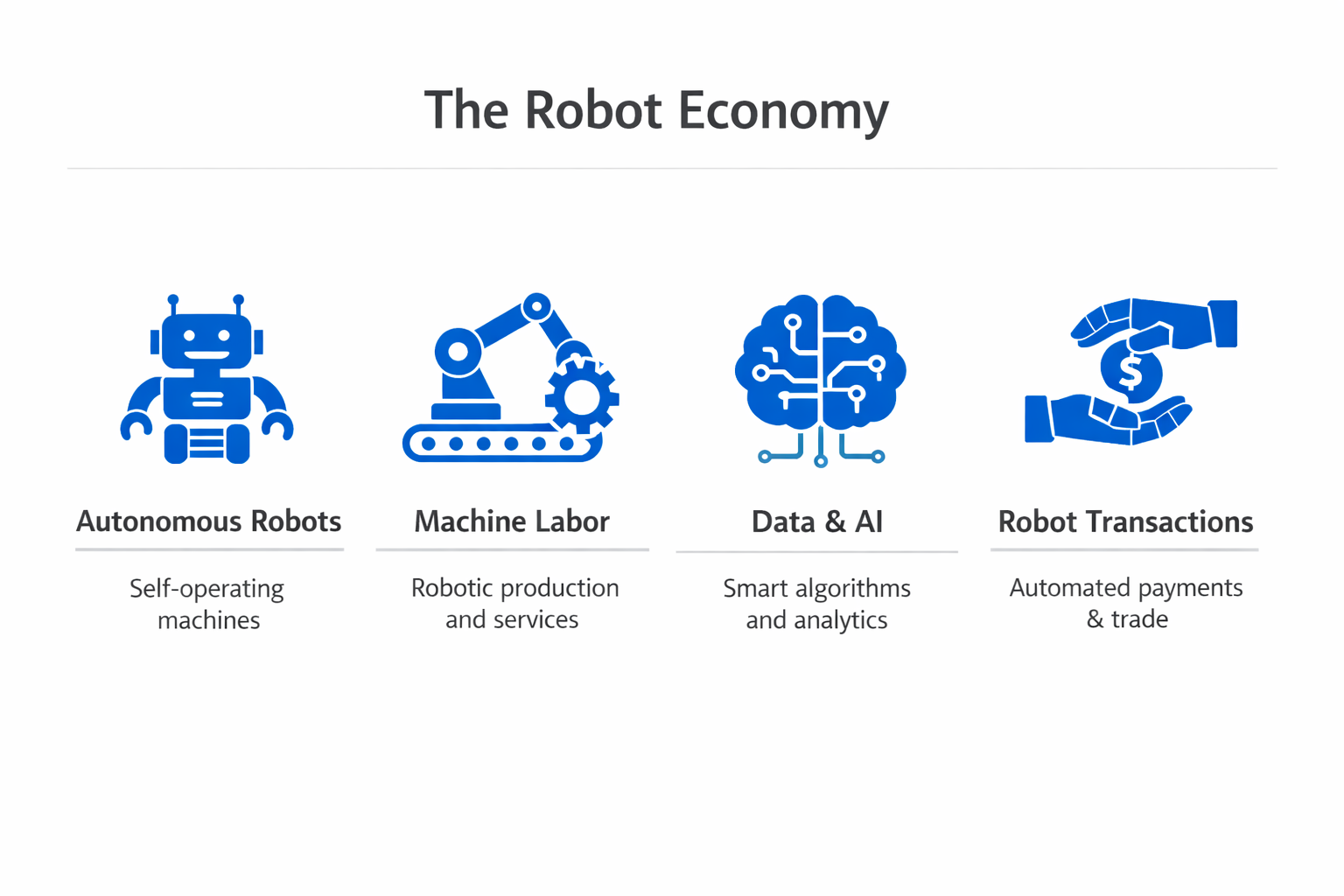
| Component | Function | Key Detail |
|---|---|---|
| Physical Automation | At the foundation, physical robots perform manual labor. | Industrial robotic arms weld, paint |
| Cognitive Automation | Beyond physical tasks, the robot economy extends into knowledge work. | AI systems analyze legal documents, generate financial reports |
| Machine-to-Machine Commerce | A defining feature of the emerging robot economy is the rise of machine-to-machine. | Autonomous systems increasingly negotiate with each other |
| The Data Layer | Data is the fuel of the robot economy. | — |
Why the Robot Economy Matters
The robot economy is not a peripheral trend. It restructures how goods are produced, services are delivered, and wealth is distributed. The stakes are concrete for business leaders, policymakers, educators, and workers.
Productivity and Economic Growth
Robots run continuously without fatigue, breaks, or quality drift. A single robotic system can cover multiple human shifts with greater precision and fewer errors. Deployed at scale, robotic labor sharply increases output per unit of input. That gain can accelerate economic growth, lower the cost of goods and services, and free up surpluses to reinvest in innovation and infrastructure.
Labor Market Transformation
The robot economy does not simply eliminate jobs. It restructures labor markets in complex ways. Some roles disappear entirely as machines take over routine tasks. Other roles shift in scope, with humans focusing on oversight, exception handling, and creative problem-solving while robots handle execution. Entirely new roles emerge to design, build, operate, monitor, and regulate robotic systems.
The net effect on employment depends on how quickly new roles are created relative to how quickly existing roles are automated, and whether workers can transition between them.
Cost Reduction and Accessibility
Robotic automation reduces the cost of production across sectors. Manufacturing costs decline as robotic assembly lines operate with fewer errors and less waste. Healthcare costs can decrease as robotic systems handle administrative tasks and assist with diagnostics. Financial advisory services become accessible to people with modest portfolios through robo-advisors that charge a fraction of what human advisors do.
Over time, these cost reductions make goods and services accessible to broader populations.
Competitive Dynamics
Organizations that adopt robotic automation effectively gain significant competitive advantages in speed, cost, and quality. Those that delay adoption risk falling behind. This dynamic creates pressure across industries to invest in robotics and AI, accelerating the pace of transformation. For nations, competitiveness in the robot economy depends on investment in research, education, infrastructure, and regulatory frameworks that enable responsible deployment.
Robot Economy Use Cases
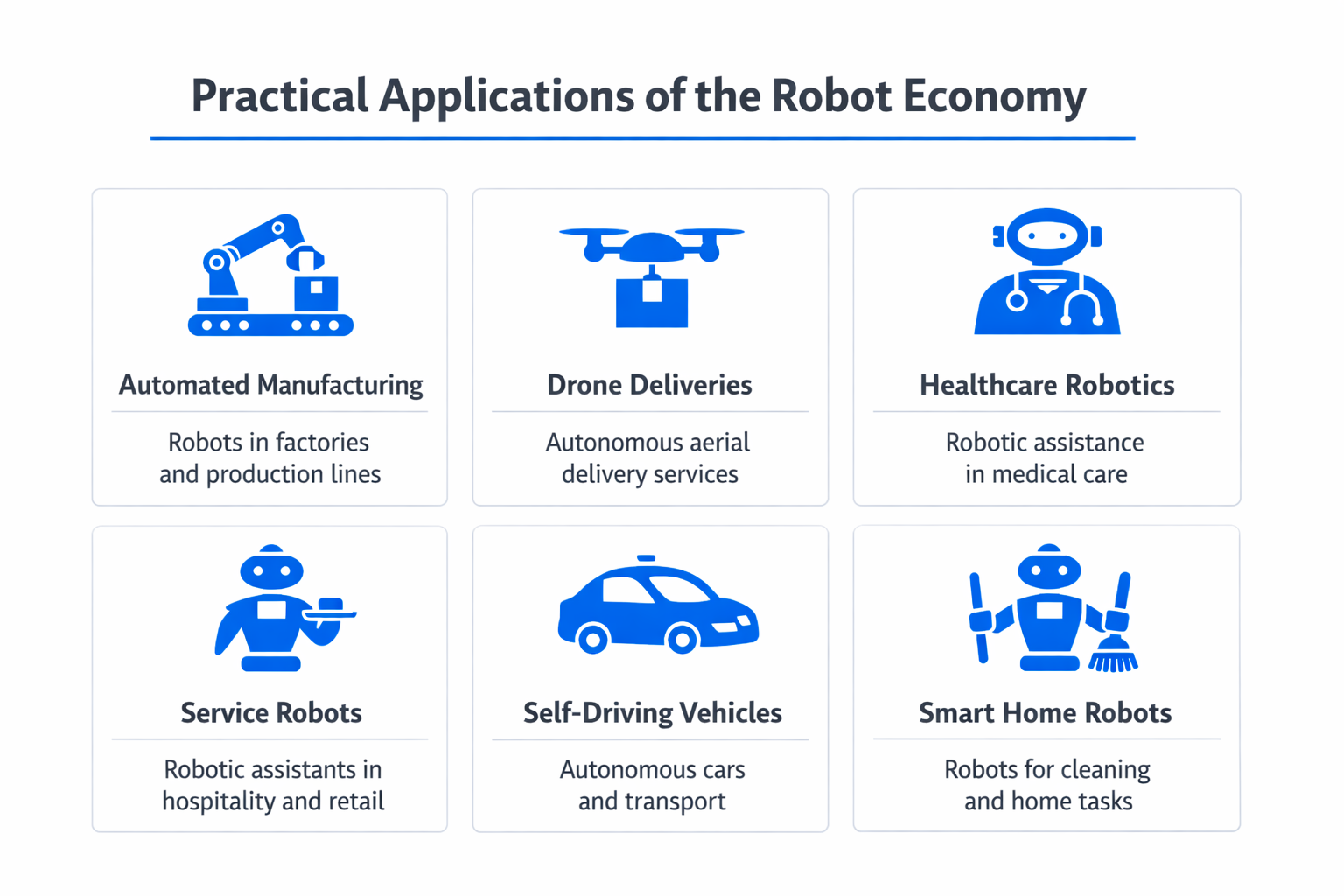
The robot economy is already active across multiple sectors. The following examples illustrate its range and depth.
Manufacturing and Supply Chain
Automotive, electronics, and consumer goods manufacturers use robotic systems for assembly, quality inspection, packaging, and palletizing. Robots equipped with computer vision detect defects at rates and accuracy levels that exceed human inspectors. In supply chains, autonomous mobile robots sort packages, manage inventory, and load trucks. Predictive analytics systems, powered by data from robotic operations, optimize production schedules and reduce downtime.
Healthcare and Pharmaceuticals
Surgical robots assist with minimally invasive procedures. Pharmacy robots dispense medications with near-zero error rates. Robotic exoskeletons support physical rehabilitation.
In pharmaceutical manufacturing, robots handle hazardous materials and maintain the sterile conditions required for drug production. Social robots are used in elder care and therapeutic settings, providing companionship and cognitive engagement for patients with dementia or limited mobility.
Agriculture
Agricultural robots handle planting, weeding, spraying, and harvesting. Drone-based monitoring systems survey crop health across thousands of acres and identify areas requiring intervention. Autonomous tractors plow and seed fields with GPS-guided precision. These systems address labor shortages in farming while reducing chemical usage through targeted application and improving yields through data-driven cultivation practices.
Financial Services
Algorithmic trading systems dominate equity, futures, and foreign exchange markets. Robo-advisors construct and rebalance investment portfolios based on client risk profiles and market conditions. Automated underwriting systems evaluate loan and insurance applications. Fraud detection robots monitor transactions in real time and flag anomalies for review.
The financial sector demonstrates how cognitive robots can reshape service industries as thoroughly as physical robots have reshaped manufacturing.
Transportation and Logistics
Self-driving cars and trucks are being deployed for ride-hailing, long-haul freight, and last-mile delivery. Autonomous ships and port systems manage cargo loading and routing. Delivery drones serve rural and hard-to-reach areas. These systems aim to reduce transportation costs, improve safety by eliminating human error, and extend service coverage to areas where traditional logistics are uneconomical.
Customer Service and Retail
Conversational AI systems handle millions of customer inquiries daily across banking, telecommunications, and e-commerce. Robotic systems in retail manage shelf stocking, inventory tracking, and in-store navigation assistance. Automated checkout and cashier-free store concepts eliminate transaction friction. These deployments reduce operational costs while maintaining or improving service availability.
Challenges and Risks
The robot economy also introduces serious challenges. Left unaddressed, they risk economic disruption, social instability, and safety failures that erode the benefits.
Job Displacement and Inequality
The most immediate concern is job displacement. Workers in routine manual and cognitive roles face the highest risk of automation. Without proactive intervention, the robot economy could widen income inequality as the economic benefits of automation concentrate among capital owners and highly skilled workers. Communities built around industries vulnerable to robotic disruption, such as trucking hubs, call center towns, and assembly plant regions, face particularly acute transitions.
Safety and Reliability
Robots operating in physical environments alongside humans must meet stringent safety standards. A malfunctioning industrial robot can cause serious injury or death. An error in an autonomous vehicle's perception system can result in a collision.
Ensuring that robotic systems are reliable across the full range of conditions they encounter requires extensive testing, redundancy, and fail-safe mechanisms. Responsible AI practices must be embedded into the design, deployment, and monitoring of every robotic system that interacts with people or critical infrastructure.
Governance and Regulation
The robot economy raises governance questions that existing regulatory frameworks are not equipped to answer. Who is liable when an autonomous system causes harm? How should robotic labor be taxed? What safety standards should apply to machine-to-machine transactions? AI governance frameworks are still maturing, and the pace of technological development often outstrips the pace of regulatory adaptation.
Policymakers face the challenge of regulating fast enough to protect the public without stifling innovation.
Cybersecurity Vulnerabilities
A networked economy of autonomous machines presents a large and expanding attack surface. Compromising a fleet of delivery robots, a network of autonomous vehicles, or an automated trading system could cause physical harm, financial losses, or systemic disruption. Security must be treated as a first-order design requirement, not an afterthought.
Robotic systems need strong authentication, encrypted communications, intrusion detection, and the ability to operate safely in degraded modes when under attack.
Ethical Considerations
The robot economy raises ethical questions about the nature of work, human dignity, and the distribution of prosperity.
If machines can do most productive work, what role remains for human labor? How should societies distribute the wealth generated by robotic systems? What obligations do organizations have to workers displaced by automation? Sustainable AI frameworks push organizations to consider the environmental and social costs of robotic deployment alongside the economic benefits.
The Singularity Question
Some researchers and futurists raise the possibility that accelerating robotic and AI capability could eventually reach a singularity, a point where machine intelligence surpasses human intelligence and begins to improve itself recursively. While this remains speculative, the trajectory of the robot economy makes the conversation relevant.
Even short of a singularity scenario, the concentration of economic power in increasingly capable autonomous systems demands careful oversight and proactive governance.
Preparing for the Robot Economy
Preparing for the robot economy takes coordinated action from individuals, organizations, educational institutions, and governments. The transition is already underway, and the advantage goes to those who move early.
Workforce Reskilling and Education
Workers need new skills to participate in the robot economy. Technical skills in robotics, programming, data analysis, and AI operations are increasingly valuable. Equally important are human-centric skills that machines cannot replicate: creative problem-solving, ethical judgment, interpersonal communication, and strategic thinking. Educational institutions must update curricula to reflect the realities of a robot-integrated economy.
Corporate training programs should prioritize reskilling for workers in roles at high risk of automation.
Organizational Strategy
Organizations should assess which functions are candidates for robotic automation and develop phased implementation roadmaps. This involves evaluating the technical feasibility, economic viability, and workforce implications of each automation opportunity. Successful organizations treat robotics as a strategic initiative rather than a cost-cutting exercise, investing in the infrastructure, talent, and governance structures needed to deploy and operate robotic systems effectively.
Policy and Social Safety Nets
Governments play a critical role in managing the transition to a robot economy. Policy options include investing in education and retraining programs, strengthening social safety nets, exploring tax policies that account for robotic labor, and funding research into responsible robotics. Universal basic income, portable benefits, and transition assistance programs are among the policy ideas being debated as responses to large-scale labor displacement.
AI Governance and Standards
Strong AI governance frameworks are necessary to ensure that the robot economy develops in ways that are safe, fair, and accountable.
This includes setting technical standards for robotic safety, establishing liability rules for autonomous systems, creating audit and certification mechanisms, and building enforcement capacity. Responsible AI principles should guide the design and deployment of every robotic system, with transparency and human oversight as non-negotiable defaults.
Building Adaptive Institutions
The institutions that govern economic life, from labor laws to financial regulations to educational systems, were built for an economy run primarily on human labor. Adapting them for a robot economy is a generational project that requires ongoing collaboration between technologists, policymakers, educators, labor representatives, and civil society.
The organizations and societies that build the most adaptive institutions will be best positioned to capture the benefits of the robot economy while managing its risks.
FAQ
What is the difference between the robot economy and traditional automation?
Traditional automation mechanizes specific, repetitive tasks using fixed machinery and predefined instructions. A conveyor belt or an assembly line actuator follows the same sequence every time. The robot economy goes further by incorporating artificial intelligence, sensor-based perception, and adaptive learning.
Robots in the robot economy can handle variable tasks, respond to changing conditions, make decisions, and improve their performance over time. The shift is from rigid mechanization to flexible, intelligent automation that spans both physical and cognitive work.
Will the robot economy eliminate all human jobs?
No. The robot economy will eliminate some jobs, transform many others, and create new ones. Roles involving routine, predictable tasks are the most vulnerable to automation. Roles requiring creativity, complex judgment, emotional intelligence, and physical dexterity in unstructured environments remain difficult to automate with current technology. History shows that major technological transitions create new categories of work that are difficult to predict in advance.
The key variable is not whether jobs will exist, but whether workers can access the training and support needed to transition into them.
How does the robot economy affect small businesses?
Small businesses face both opportunities and challenges in the robot economy. On one hand, declining costs of robotic and AI tools make automation accessible to smaller organizations that previously could not afford it. Cloud-based AI services, affordable robotic kits, and automation-as-a-service platforms lower the barrier to entry.
On the other hand, large enterprises with greater capital and technical resources can deploy robotics at a scale that smaller competitors cannot match, potentially widening competitive gaps. Small businesses that identify and adopt the right automation tools for their specific needs can compete effectively.
What skills are most valuable in the robot economy?
Technical skills in robotics, programming, data science, and AI system management are in high demand. Beyond technical capability, the robot economy places a premium on skills that complement machine strengths rather than compete with them. These include critical thinking, creative problem-solving, ethical reasoning, leadership, communication, and the ability to work effectively at the interface between human teams and robotic systems.
Continuous learning and adaptability are perhaps the most important meta-skills, given the pace at which the robot economy is evolving.
Is the robot economy the same as the singularity?
No. The robot economy describes the current and near-term economic transformation driven by robotic and AI technologies. It is observable, measurable, and already underway. The singularity is a theoretical future event in which machine intelligence surpasses human intelligence and begins to improve itself recursively, leading to rapid and potentially uncontrollable technological change.
The robot economy may or may not lead toward a singularity. The two concepts operate on different timescales and carry different levels of certainty.


