


What Is Intelligent Process Automation?
Intelligent process automation (IPA) is an approach to business process optimization that combines robotic process automation (RPA) with artificial intelligence technologies such as machine learning, natural language processing, and cognitive computing.
The result is a system that can handle not only repetitive, rules-based tasks but also processes that require judgment, interpretation, and adaptation.
Traditional RPA works well for structured, predictable workflows. It follows scripted instructions to move data between systems, fill in forms, or generate reports. But it breaks down when processes involve unstructured data, ambiguous inputs, or decisions that depend on context. IPA addresses this limitation by layering AI capabilities on top of automation, enabling systems to read documents, understand intent, make probabilistic decisions, and improve over time.
The concept marks a meaningful shift in enterprise automation. Rather than automating isolated tasks, IPA targets entire end-to-end processes, including the cognitive steps that previously required human involvement. That makes it applicable to a wide range of business functions, from customer service and claims processing to supply chain management and compliance monitoring.
IPA is not a single product or platform. It is an architectural pattern that integrates multiple technologies into a unified automation pipeline. The specific combination of tools varies depending on the use case, the data environment, and the level of decision complexity involved.
How IPA Works
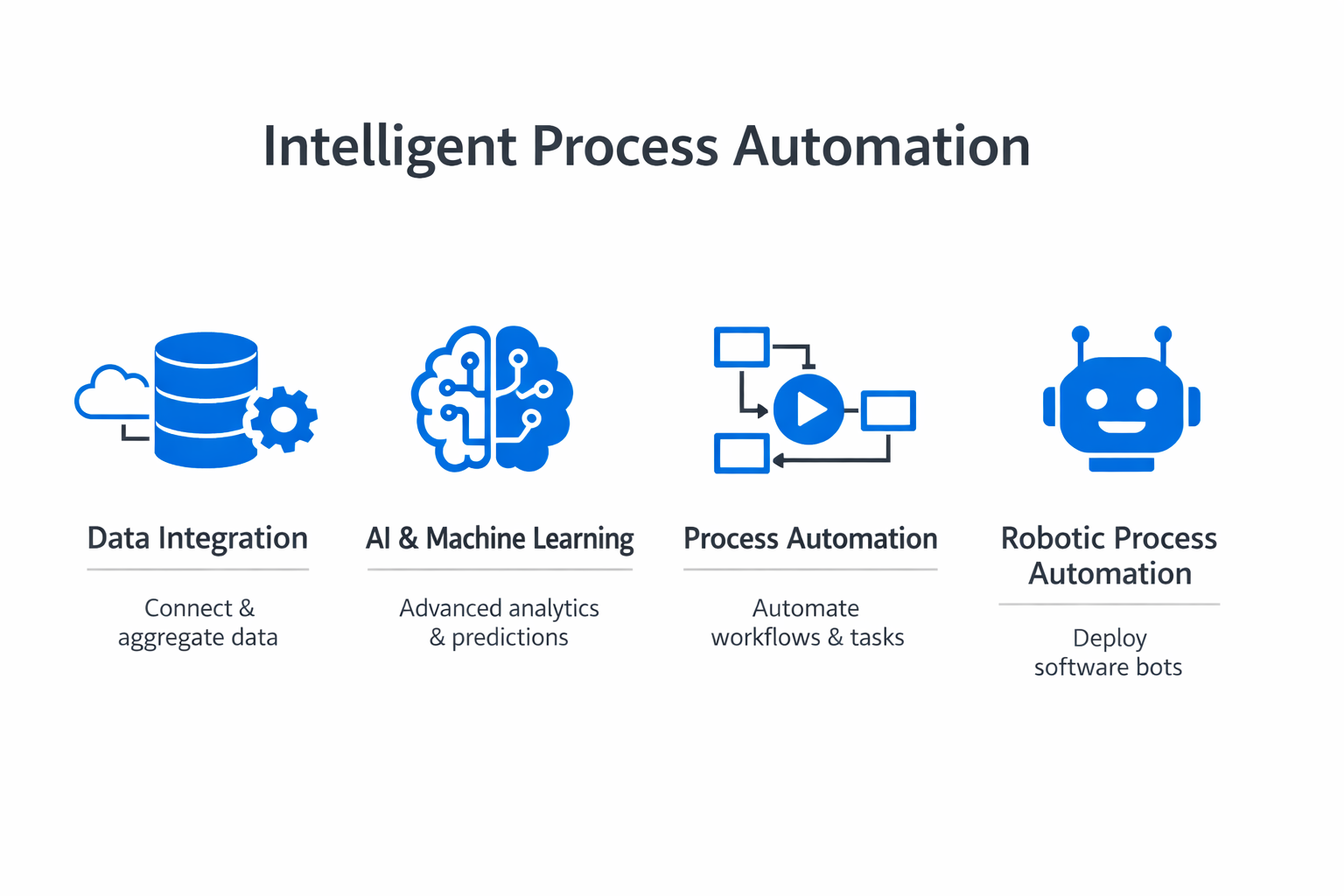
Intelligent process automation operates through the coordinated interaction of several technology layers. Each layer handles a different aspect of the automation pipeline, from data capture to decision-making to execution.
Robotic process automation (RPA). RPA serves as the execution layer. Software bots interact with applications, databases, and user interfaces to perform structured tasks: data entry, file transfers, record updates, and report generation. RPA handles the high-volume, deterministic portions of a workflow with speed and consistency.
Machine learning and predictive analytics. Machine learning models allow IPA systems to identify patterns in historical data and make predictions about future outcomes. In insurance claims processing, for example, a predictive modeling component might assess the likelihood that a claim is fraudulent based on patterns observed across thousands of prior cases.
These models learn from feedback and improve their accuracy over time, often using supervised learning techniques to train on labeled datasets.
Natural language processing and understanding. Natural language processing enables IPA systems to interpret unstructured text: emails, contracts, support tickets, regulatory filings, and chat messages. Natural language understanding goes further by extracting meaning, identifying entities, and determining intent.
This capability is essential for processes that begin with human-generated input, such as customer inquiries or document reviews.
Computer vision and document intelligence. IPA platforms often include optical character recognition (OCR) and image analysis capabilities. These tools extract data from scanned documents, photographs, invoices, and forms that are not machine-readable in their original format.
Advanced implementations use deep learning models trained on large datasets of document types to achieve high extraction accuracy even with inconsistent layouts.
Decision engines and business rules. Not every decision requires a machine learning model. IPA systems also incorporate rule-based engines that apply predefined logic to route workflows, approve transactions, or escalate exceptions. The combination of rules and models gives the system flexibility: simple decisions are handled deterministically, while complex or ambiguous cases are evaluated probabilistically.
Orchestration layer. An orchestration platform coordinates the interaction between all components. It manages workflow sequencing, monitors bot performance, handles exceptions, and ensures that each step in the process receives the correct inputs. This layer is what transforms individual automation capabilities into a cohesive end-to-end process.
The practical effect is a system that can receive a document, read and interpret its contents, extract relevant data, make a decision about what to do with it, execute the required actions across multiple systems, and log the outcome for audit purposes. All of this happens with minimal or no human intervention for straightforward cases, while complex exceptions are routed to human operators with contextual information to support their decision.
| Component | Role | Example |
|---|---|---|
| Robotic process automation (RPA) | Automates repetitive, rule-based tasks across applications. | Data entry, form filling, and report generation. |
| Machine learning | Enables systems to learn from data and improve over time. | Fraud detection patterns and demand forecasting. |
| Natural language processing | Interprets and generates human language from documents and messages. | Email classification and contract analysis. |
| Cognitive computing | Handles complex decisions requiring judgment and context. | Insurance claims assessment and medical triage. |
| Process mining | Analyzes existing workflows to identify automation opportunities. | Finding bottlenecks and inefficient handoffs. |
Why IPA Matters
Intelligent process automation addresses a fundamental constraint in enterprise operations: the gap between what traditional automation can handle and what organizations actually need automated. Closing this gap has direct implications for cost, speed, quality, and scalability.
Expanding the scope of automation. Traditional RPA automates roughly 30 to 40 percent of tasks in a typical business process, primarily those that are fully structured and rules-based. IPA extends automation to the remaining tasks by adding cognitive capabilities. This means organizations can automate entire workflows rather than isolated steps, reducing handoff delays and manual intervention points.
Reducing operational costs. By automating end-to-end processes, IPA reduces the labor required for data entry, document review, exception handling, and routing. The cost savings compound over time as machine learning models improve and fewer exceptions require human attention. Organizations deploying IPA at scale typically report cost reductions of 40 to 75 percent for targeted processes.
Improving accuracy and consistency. Human operators introduce variability into processes through fatigue, distraction, and inconsistent interpretation of guidelines. IPA systems apply the same logic to every case, reducing error rates in data extraction, classification, and routing.
When combined with neural network models trained on large datasets, IPA can achieve accuracy levels that match or exceed human performance on specific tasks.
Accelerating cycle times. Processes that previously took days because they moved through multiple human queues can be completed in minutes or hours when automated end to end. In mortgage processing, for example, IPA can reduce application review times from weeks to days by automating document verification, credit assessment, and compliance checks in parallel.
Enabling scalability without proportional headcount growth. As transaction volumes increase, IPA systems scale by deploying additional bot instances or expanding compute resources. This allows organizations to handle seasonal spikes, market growth, or regulatory changes without proportional increases in operational staff.
Supporting compliance and auditability. Every action an IPA system takes is logged with timestamps, decision rationale, and data inputs. The result is a complete audit trail that simplifies regulatory compliance and internal governance. Organizations operating under strict regulatory frameworks gain the most from this traceability.
The strategic value of IPA reaches past cost reduction. It lets organizations move staff from routine processing to higher-value work such as analysis, relationship management, and strategic planning. In industries where operational efficiency and customer experience set companies apart, that shift counts as a competitive advantage.
IPA Use Cases
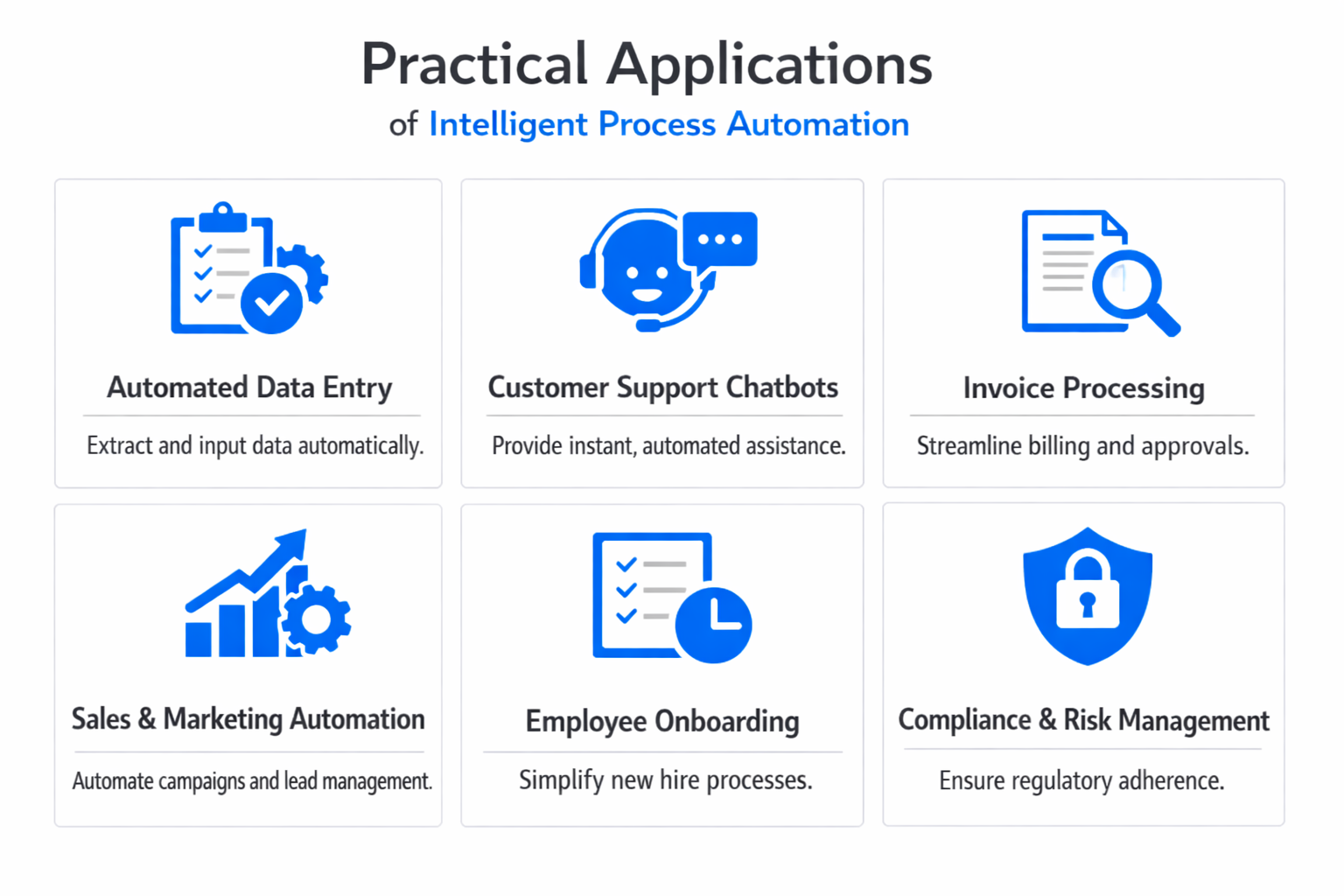
Intelligent process automation is deployed across a wide range of industries and functions. The following examples illustrate how organizations apply IPA to solve specific operational challenges.
Invoice processing and accounts payable. IPA systems receive invoices in multiple formats (email attachments, scanned documents, electronic data interchange), extract key fields such as vendor name, amount, line items, and payment terms, validate the data against purchase orders and contracts, and route approved invoices for payment. Exceptions such as mismatched amounts or missing information are flagged for human review with contextual detail.
Customer onboarding in financial services. Banks and fintechs use IPA to automate know-your-customer (KYC) and anti-money laundering (AML) processes.
The system collects customer documents, extracts identity data, verifies information against external databases, performs risk scoring, and generates compliance reports. AI agents within the pipeline can handle follow-up communication with applicants when additional documentation is needed.
Claims processing in insurance. IPA automates the intake, assessment, and adjudication of insurance claims. The system reads claim submissions, extracts relevant data, cross-references policy details, applies underwriting rules, and routes straightforward claims for automatic approval. Complex claims are escalated to adjusters with a pre-assembled summary of relevant information, reducing investigation time.
Healthcare administration. Hospitals and health systems use IPA to automate patient registration, insurance verification, prior authorization requests, and medical coding. Natural language processing components extract diagnosis and procedure information from clinical notes, reducing the manual effort required for accurate billing and compliance documentation.
IT service management. IPA handles routine IT support requests such as password resets, access provisioning, software installation, and system monitoring alerts. Conversational AI interfaces allow employees to submit requests in natural language, while the automation backend executes the required changes across IT systems without manual ticket routing.
Supply chain and procurement. IPA optimizes procurement workflows by automating purchase order creation, supplier evaluation, contract analysis, and inventory replenishment decisions. Machine learning models analyze demand signals and supplier performance data to recommend optimal order quantities and timing.
Human resources operations. From resume screening and candidate communication to benefits enrollment and offboarding procedures, IPA automates HR workflows that are document-intensive and process-heavy. Intelligent agents can assess candidate qualifications against job requirements and rank applicants before human recruiters conduct interviews.
Regulatory compliance and reporting. Organizations in banking, pharmaceuticals, and energy use IPA to automate the collection, validation, and submission of regulatory reports. The system aggregates data from multiple internal sources, applies formatting and validation rules, and generates submission-ready documents, reducing the risk of late or inaccurate filings.
Each of these use cases follows a common pattern: the process involves multiple steps, requires interaction with structured and unstructured data, and benefits from the combination of rule-based execution and cognitive decision-making that IPA provides.
Challenges and Limitations
IPA delivers significant value when implemented well, but it is not without challenges. Organizations should evaluate these limitations carefully during the planning phase.
Process complexity and readiness. Not every process is a good candidate for IPA. Processes that are highly variable, poorly documented, or dependent on tacit knowledge are difficult to automate effectively. Before deploying IPA, organizations need to map, standardize, and optimize their target processes. Automating a broken process simply produces broken outcomes faster.
Data quality and availability. IPA systems depend on data to make decisions. If input data is incomplete, inconsistent, or trapped in legacy systems with limited API access, the automation pipeline will struggle. Data preparation and integration often consume more time and budget than the automation development itself.
Change management and workforce impact. Introducing IPA changes how people work. Roles that were previously centered on data entry and manual processing shift toward exception handling, oversight, and analysis. This transition requires deliberate change management, including communication about the purpose of automation, retraining programs, and clear definition of new responsibilities.
Organizations that neglect the human dimension of IPA adoption frequently encounter resistance and underperformance.
Integration with legacy systems. Many enterprise environments include legacy applications that were not designed for automated interaction. IPA platforms can use screen scraping and UI-based automation as workarounds, but these approaches are fragile and prone to breaking when interfaces change. Sustainable IPA implementations require API-based integration wherever possible.
Governance and oversight. As IPA systems make more decisions autonomously, the need for governance increases. Organizations must establish clear policies for what decisions can be automated, what thresholds trigger human review, and how responsible AI principles apply to automated workflows. Without governance frameworks, IPA deployments risk producing biased outcomes or operating outside acceptable risk parameters.
Scalability of AI components. While RPA bots scale relatively easily, the AI components of IPA, particularly custom machine learning models and NLP pipelines, require ongoing maintenance. Models degrade over time as data distributions shift, a phenomenon known as model drift. Organizations must plan for continuous monitoring, retraining, and validation of their AI components.
Measuring ROI accurately. IPA benefits extend past simple labor cost savings, yet many organizations struggle to quantify gains in speed, accuracy, compliance, and customer satisfaction. Without a clear measurement framework, it becomes hard to justify continued investment or prioritize the next wave of automation targets.
These challenges do not diminish the value of IPA, but they underscore the importance of a disciplined, realistic approach to implementation. Success depends as much on organizational readiness as it does on technology capability.
How to Get Started with IPA
Adopting intelligent process automation requires a structured approach. Organizations that treat IPA as a technology project rather than a business transformation initiative typically underperform. The following steps provide a practical framework for getting started.
Identify high-impact processes. Begin by cataloging business processes that are high-volume, labor-intensive, and prone to errors or delays. Prioritize processes where automation would deliver measurable improvements in cost, speed, or quality. Good candidates typically involve repetitive tasks combined with some degree of judgment or unstructured data handling.
Assess current process maturity. Before automating, evaluate how well the target process is documented, standardized, and measured. Processes with high variability or heavy reliance on undocumented tribal knowledge need to be re-engineered before automation can succeed. Process mining tools can help map actual workflows and identify bottlenecks.
Build a cross-functional team. IPA implementation requires collaboration between business operations, IT, data science, and compliance. Business stakeholders define the process requirements and success metrics. IT manages integration and infrastructure. Data scientists build and maintain the AI components. Compliance ensures the automated process meets regulatory requirements.
Select the right technology stack. IPA is not a single product. It typically involves an RPA platform, an AI/ML framework, document processing tools, and an orchestration layer. Evaluate vendors based on their ability to integrate these components and their track record in your industry. Avoid over-investing in capabilities you do not need in the first phase.
Start with a pilot. Choose a single process or subprocess for the initial implementation. Define clear success criteria: target accuracy rates, processing times, exception rates, and cost per transaction. A bounded pilot generates measurable results, builds internal expertise, and creates a reference case for broader adoption.
Implement feedback loops. IPA systems improve through feedback. Establish mechanisms for human operators to flag errors, confirm correct decisions, and provide labeled data for model retraining. These feedback loops are what differentiate a static automation from an autonomous AI system that improves continuously.
Plan for scale. Once the pilot demonstrates value, develop a roadmap for scaling IPA across additional processes and business units. Scaling requires investment in shared infrastructure, reusable automation components, center-of-excellence teams, and governance frameworks. Organizations that plan for scale from the beginning avoid the common trap of accumulating disconnected automation projects that do not deliver enterprise-wide impact.
Monitor and optimize continuously. IPA is not a set-and-forget deployment. Establish ongoing monitoring for bot performance, model accuracy, exception rates, and business outcomes. Use this data to identify optimization opportunities and trigger model retraining when performance degrades.
The path to successful IPA adoption is iterative. Organizations that start small, measure rigorously, and scale deliberately consistently outperform those that attempt large-scale transformation in a single initiative. The technology is mature enough to deliver real value today, but capturing that value requires the same operational discipline that characterizes any successful business transformation.
FAQ
What is the difference between IPA and RPA?
RPA automates structured, rules-based tasks by following scripted instructions. It does not understand context, interpret unstructured data, or make judgment-based decisions. Intelligent process automation extends RPA by adding AI capabilities such as machine learning, natural language processing, and computer vision.
This allows IPA to handle processes that involve unstructured inputs, probabilistic decisions, and continuous learning. RPA is a component of IPA, not a substitute for it.
What technologies make up an IPA system?
A typical IPA system combines robotic process automation, machine learning, natural language processing, computer vision, decision engines, and workflow orchestration. Some implementations also incorporate expert systems for domain-specific reasoning and deep learning models for complex pattern recognition tasks such as document classification and image analysis.
How long does it take to implement IPA?
Implementation timelines vary based on process complexity, data readiness, and organizational maturity. A focused pilot on a single process can typically be delivered in 8 to 16 weeks. Scaling IPA across multiple processes and business units is an ongoing effort that unfolds over months or years. The key variables are integration complexity, data quality, and the availability of skilled resources.
Does IPA eliminate jobs?
IPA changes the nature of work rather than eliminating positions outright. Tasks involving manual data entry, document handling, and routine decision-making are automated, but new responsibilities emerge in areas such as bot management, exception handling, process optimization, and AI model oversight. Organizations that invest in reskilling and role redesign alongside IPA deployment tend to retain talent while improving operational performance.
What industries benefit most from IPA?
Industries with high transaction volumes, regulatory complexity, and significant document processing requirements benefit most from IPA. Financial services, insurance, healthcare, manufacturing, telecommunications, and government are among the leading adopters. However, any organization with repetitive, multi-step processes that combine structured and unstructured data can benefit from intelligent process automation.
How does IPA relate to AI agents?
AI agents are autonomous software entities that perceive their environment, make decisions, and take actions to achieve specific goals. IPA systems may incorporate AI agents as decision-making components within a broader automation pipeline. While an AI agent operates with a degree of autonomy, IPA provides the end-to-end process framework that coordinates agent actions with RPA execution, data integration, and human oversight.


