


What Is LLMOps?
LLMOps (Large Language Model Operations) is the set of practices, tools, and workflows used to build, deploy, monitor, and maintain large language models in production environments. It extends the principles of MLOps to address the distinct operational requirements of working with large language models, including prompt management, fine-tuning orchestration, inference optimization, and ongoing model evaluation.
Traditional MLOps focuses on the lifecycle of conventional machine learning models: collecting data, engineering features, training models, and deploying them for inference. LLMOps inherits that foundation but adapts it for the reality that large language models are fundamentally different in scale, behavior, and operational demands.
These models contain billions of parameters, require specialized infrastructure for inference, and interact with users through natural language rather than structured inputs.
The scope of LLMOps covers every stage from initial model selection through production deployment and continuous improvement.
It includes choosing between proprietary and open-source foundation models, designing and versioning prompts, implementing retrieval-augmented generation pipelines, orchestrating fine-tuning runs, managing inference infrastructure, tracking costs, evaluating output quality, and ensuring compliance with organizational and regulatory standards.
How LLMOps Works
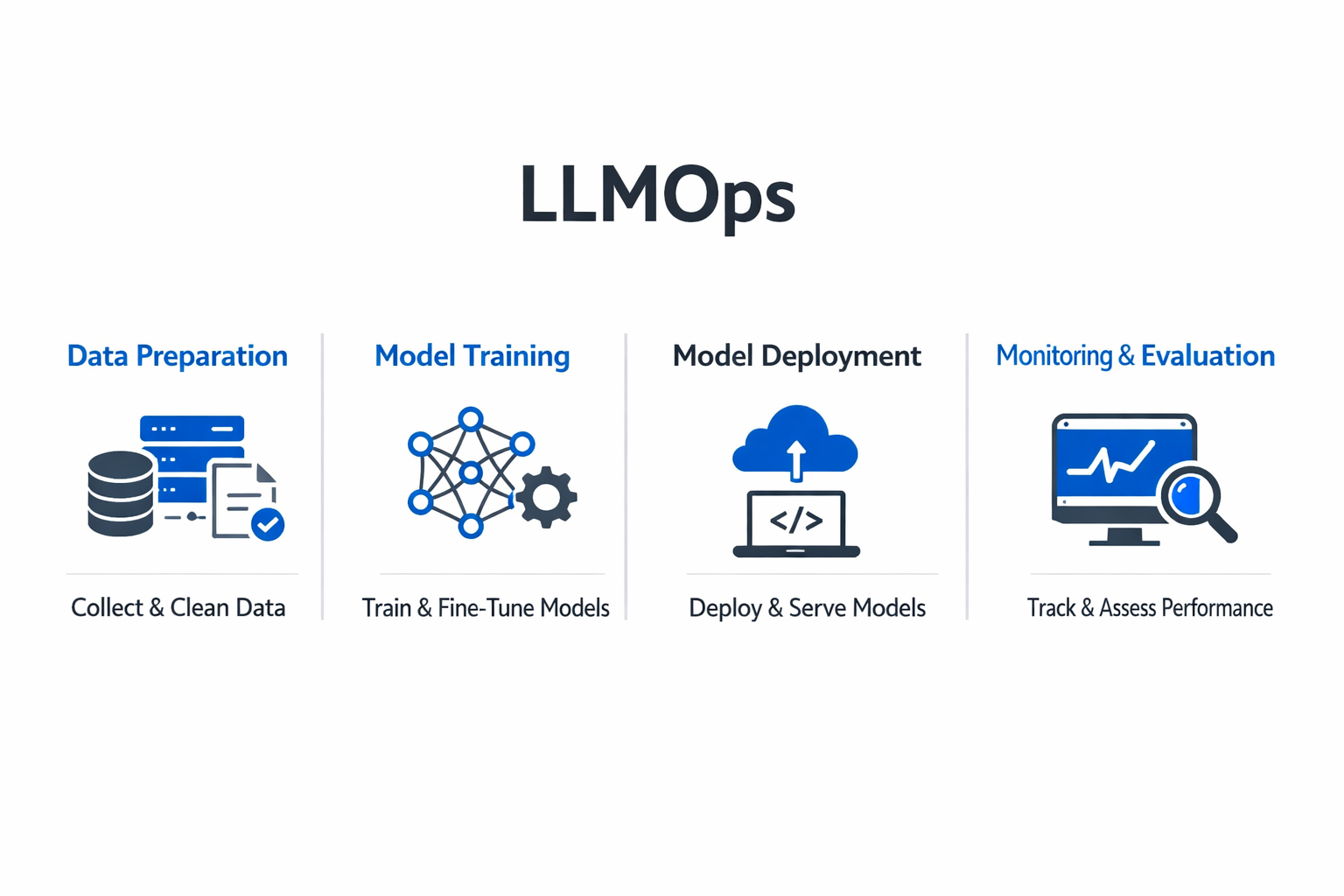
LLMOps operates across a pipeline that mirrors the software development lifecycle but introduces stages specific to language model management. Each stage has its own tooling, processes, and success criteria.
Model Selection and Foundation
The pipeline begins with selecting the appropriate foundation model for the task. Teams evaluate models from providers like OpenAI, Google Gemini, or open-source alternatives hosted through platforms such as Amazon Bedrock.
Selection criteria include model capability, latency requirements, cost per token, data privacy constraints, and the level of customization needed.
Some applications require only a general-purpose model accessed through an API. Others demand a model fine-tuned on domain-specific data using frameworks like PyTorch. LLMOps provides the decision framework for making this choice and the infrastructure for executing either path.
Prompt Engineering and Management
Prompt engineering is a core operational concern in LLMOps. Prompts are the primary interface between the application and the model, and small changes in prompt wording can dramatically alter output quality. LLMOps treats prompts as versioned artifacts, storing them in dedicated registries, tracking changes over time, and linking prompt versions to evaluation results.
Prompt management systems maintain libraries of tested prompts, support A/B testing between prompt variants, and enable rollbacks when a new prompt performs worse than its predecessor. This systematic approach replaces the ad hoc experimentation that characterizes early-stage LLM development.
Data Pipeline and Context Engineering
LLMOps pipelines handle the preparation and delivery of contextual data to the model. This includes building and maintaining vector embeddings databases for retrieval-augmented generation, preprocessing documents into chunks suitable for embedding, and managing the indexing infrastructure that enables fast semantic search.
Context engineering also involves defining how retrieved documents are formatted and injected into prompts, setting relevance thresholds for document retrieval, and handling edge cases where the retrieval system returns insufficient or irrelevant results. These pipelines must be monitored for freshness, accuracy, and latency just like any other production data system.
Fine-Tuning and Customization
When prompt engineering and retrieval augmentation are insufficient for a task, LLMOps orchestrates the fine-tuning process. This involves curating training datasets, configuring training hyperparameters, executing training runs on GPU infrastructure, evaluating the resulting model against benchmarks, and registering the fine-tuned model for deployment.
Fine-tuning in the LLM context differs from traditional model training. Techniques such as LoRA (Low-Rank Adaptation) and QLoRA allow teams to customize large models without retraining all parameters, reducing compute costs significantly. LLMOps tooling manages these parameter-efficient fine-tuning workflows, tracks experiments, and maintains lineage from training data through to deployed model versions.
Deployment and Inference
Deploying large language models requires specialized infrastructure. Models with billions of parameters demand substantial GPU memory, and inference latency must be managed to meet application requirements. LLMOps addresses deployment through model quantization, batching strategies, caching layers, and load balancing across inference endpoints.
Production deployments also require API gateway management, rate limiting, authentication, and usage tracking. LLMOps infrastructure handles autoscaling based on traffic patterns, distributing requests across model replicas, and routing different request types to appropriately sized models to optimize cost and performance.
Monitoring and Evaluation
Continuous monitoring is where LLMOps diverges most sharply from traditional MLOps. Language model outputs are open-ended text, not numerical predictions, making automated evaluation inherently more difficult. LLMOps monitoring systems track output quality through a combination of automated metrics (relevance scores, factual consistency, toxicity detection) and human evaluation workflows.
Monitoring also covers operational metrics: latency per request, tokens consumed per interaction, error rates, cost per query, and infrastructure utilization. Drift detection systems watch for changes in input distributions that may indicate the model is being used outside its intended domain. These signals feed back into prompt refinement, retrieval tuning, or model re-fine-tuning decisions.
| Component | Function | Key Detail |
|---|---|---|
| Model Selection and Foundation | The pipeline begins with selecting the appropriate foundation model for the task. | Amazon Bedrock |
| Prompt Engineering and Management | Prompt engineering is a core operational concern in LLMOps. | — |
| Data Pipeline and Context Engineering | LLMOps pipelines handle the preparation and delivery of contextual data to the model. | — |
| Fine-Tuning and Customization | When prompt engineering and retrieval augmentation are insufficient for a task. | LoRA (Low-Rank Adaptation) |
| Deployment and Inference | Deploying large language models requires specialized infrastructure. | Models with billions of parameters demand substantial GPU memory |
| Monitoring and Evaluation | Continuous monitoring is where LLMOps diverges most sharply from traditional MLOps. | Language model outputs are open-ended text, not numerical predictions |
Why LLMOps Matters
Organizations deploying generative AI applications face operational complexity that grows rapidly with scale. A prototype chatbot running in a notebook is simple to manage. A production system handling thousands of requests per minute, serving multiple user populations, and integrating with business-critical workflows requires disciplined operations. LLMOps provides that discipline.
Cost control at scale. Large language model inference is expensive. Every API call consumes tokens, and costs scale linearly with usage. Without LLMOps practices, organizations frequently discover that their LLM-powered features cost far more than anticipated. LLMOps introduces token budgeting, model routing (sending simple queries to smaller, cheaper models), caching strategies, and cost attribution that ties spending to specific features and user segments.
Output quality assurance. Language models can produce confident, fluent text that is factually wrong, biased, or off-topic. In production, these failures reach end users and can damage trust, create legal liability, or produce harmful outcomes. LLMOps evaluation pipelines catch quality regressions before they affect users by running automated checks against every model update, prompt change, or retrieval pipeline modification.
Reproducibility and debugging. When a language model produces an unexpected output, teams need to reconstruct exactly what happened: which model version was called, what prompt was used, what context was retrieved, and what parameters governed generation. LLMOps logging and tracing infrastructure makes this reconstruction possible, turning opaque model behavior into debuggable system events.
Compliance and governance. Regulated industries require audit trails for automated decisions. Responsible AI frameworks demand documentation of model behavior, bias testing results, and safety evaluations. LLMOps provides the infrastructure to generate and maintain these records as part of normal operations rather than as a separate compliance burden.
Team velocity. Without standardized operational practices, every team building with LLMs reinvents the same infrastructure: prompt versioning, evaluation harnesses, deployment pipelines, monitoring dashboards. LLMOps establishes shared platforms and workflows that enable teams to move faster by building on proven operational patterns rather than starting from scratch.
LLMOps Use Cases
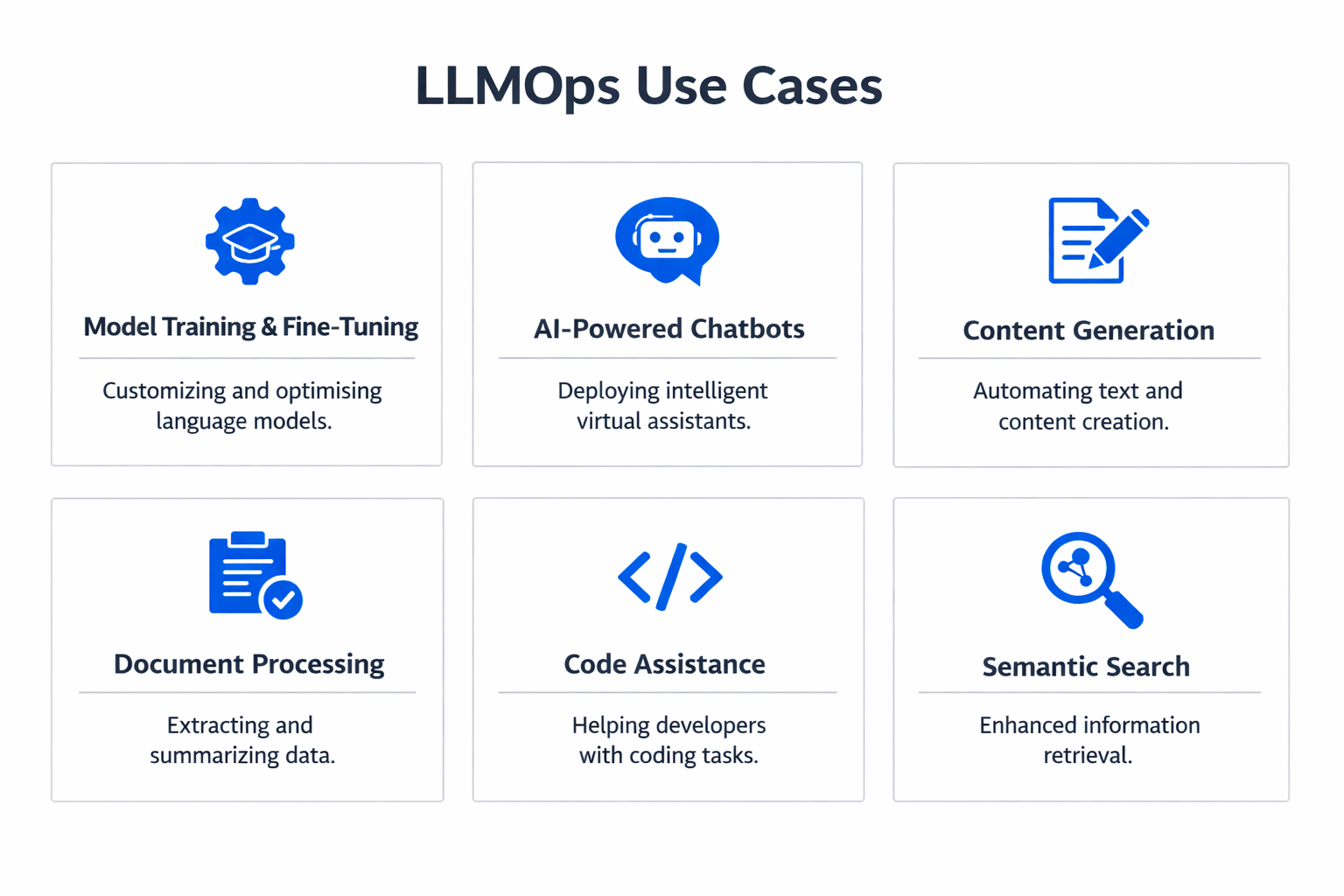
LLMOps applies wherever organizations deploy large language models beyond prototyping. The operational requirements vary by use case, but the core practices remain consistent.
- Enterprise search and knowledge management. Organizations use LLMs combined with retrieval-augmented generation to build internal search systems that answer questions using corporate documents. LLMOps manages the embedding pipeline, vector database, prompt templates, and quality monitoring for these systems.
- Customer support automation. LLM-powered chatbots and agent assistants handle customer inquiries at scale. LLMOps ensures response quality through continuous evaluation, manages fallback logic when the model cannot answer confidently, and tracks cost per resolution.
- Content generation pipelines. Marketing, documentation, and communication teams use LLMs to draft content. LLMOps manages the prompt libraries, style guides embedded in system prompts, review workflows, and output quality metrics that keep generated content consistent and on-brand.
- Code generation and developer tools. Development teams integrate LLMs into coding assistants and code review tools. LLMOps handles model selection for different programming languages, evaluation of code correctness and security, and monitoring of developer adoption and satisfaction.
- Data extraction and transformation. LLMs parse unstructured documents (contracts, invoices, reports) into structured data. LLMOps manages the extraction prompts, validation rules, accuracy monitoring, and exception handling for records that fail automated processing.
- Educational applications. Artificial intelligence is reshaping how educational content is created and delivered. LLMOps supports the deployment of tutoring systems, automated grading tools, and personalized learning path generators, ensuring that outputs are accurate, pedagogically sound, and safe for learners.
Challenges and Limitations
LLMOps is a maturing discipline, and teams adopting it face genuine challenges that do not have simple solutions.
Evaluation remains an unsolved problem. Unlike classification models where accuracy is straightforward to measure, evaluating free-text output quality is inherently subjective and context-dependent. Automated metrics capture only a fraction of output quality. Human evaluation is expensive and does not scale. LLM-as-judge approaches (using one model to evaluate another) introduce their own biases.
Teams must combine multiple evaluation methods and accept that no single metric captures the full picture.
Model dependencies create vendor risk. Organizations building on proprietary models depend on the provider's pricing, availability, and model behavior. A provider changing their model's behavior in an update can break downstream applications. LLMOps mitigates this through abstraction layers that allow model swapping, but achieving true portability across providers remains difficult in practice.
Latency and cost trade-offs. Larger models produce better outputs but cost more and respond more slowly. Smaller models are cheaper and faster but may produce lower-quality results. Quantized models reduce resource requirements but can sacrifice accuracy. LLMOps gives teams a framework for weighing these trade-offs, though the trade-offs themselves are inherent to the technology.
Security and data privacy. Sending sensitive data to third-party model APIs raises data privacy concerns. Running models on-premises addresses privacy but requires significant infrastructure investment. Prompt injection attacks can cause models to ignore their instructions and behave in unintended ways. LLMOps must include security practices, but the attack surface of language model applications is still being mapped.
Skill gaps across teams. LLMOps requires expertise in deep learning, infrastructure engineering, natural language processing, and software operations. Professionals with all of these skills are scarce.
The machine learning engineer role is evolving to encompass LLMOps responsibilities, but many organizations find that their teams need significant upskilling to operate language model systems effectively.
A fast-moving field. The tools, models, and best practices in LLMOps change quickly. A deployment pattern that is optimal today may be obsolete in months as new models, frameworks like LangChain, and infrastructure options appear. Teams must balance adopting current best practices with building systems flexible enough to absorb future changes.
How to Get Started with LLMOps
Adopting LLMOps does not require implementing every practice simultaneously. A staged approach builds capability incrementally while delivering value at each step.
Step 1: Audit your current LLM usage. Before building operational infrastructure, understand what you are operating. Catalog every LLM integration in your organization: which models are used, how prompts are managed, what data flows into and out of the model, and who is responsible for each integration. This audit reveals the scope of operational exposure and identifies the highest-priority areas for LLMOps investment.
Step 2: Implement prompt versioning and logging. Store all prompts in a version-controlled system. Log every model call with its prompt, input context, parameters, and output. This foundational step provides the traceability needed for debugging, evaluation, and compliance. It requires minimal tooling and delivers immediate value.
Step 3: Build an evaluation pipeline. Define quality criteria for each LLM use case and build automated checks that run against model outputs. Start with simple rule-based checks (output length, format compliance, keyword presence) and progressively add more sophisticated evaluations (semantic similarity, factual verification, toxicity screening). Evaluation pipelines are the feedback mechanism that makes continuous improvement possible.
Step 4: Establish cost monitoring and controls. Instrument every model call to track token usage and cost. Build dashboards that show spending by use case, team, and time period. Set alerts for spending anomalies. Implement token budgets for high-volume use cases. Cost visibility often reveals optimization opportunities that pay for the LLMOps investment many times over.
Step 5: Standardize deployment and infrastructure. Move from ad hoc model integrations to standardized deployment patterns. Use API gateways to manage model access, implement retry logic and fallback models, configure rate limiting, and establish health checks for inference endpoints. Standardization reduces operational risk and enables infrastructure teams to manage LLM deployments using familiar patterns.
Step 6: Invest in team development. LLMOps is a team capability, not a tool purchase. Train engineers on transformer model architecture so they understand the systems they are operating. Build prompt engineering skills across the team. Develop evaluation expertise. Create internal documentation that captures your organization's LLMOps practices and lessons learned.
Understanding foundational concepts like how GPT-3 and its successors work gives operational teams the technical grounding to make informed decisions.
Step 7: Iterate and mature. LLMOps maturity is a spectrum. Early stages focus on visibility and cost control. Intermediate stages add automated evaluation, CI/CD for prompt and model updates, and multi-model routing. Advanced stages include automated retraining triggers, sophisticated A/B testing frameworks, and self-healing infrastructure. Progress through these stages based on the scale and criticality of your LLM deployments.
Organizations exploring enterprise-grade LLM platforms such as ChatGPT Enterprise will find that LLMOps practices are essential for governing usage, controlling costs, and maintaining output quality across large user populations.
Similarly, teams working with specialized architectures like BERT for classification or extraction tasks benefit from LLMOps discipline even when the model is smaller in scale.
FAQ
What is the difference between LLMOps and MLOps?
MLOps covers the full lifecycle of traditional machine learning models: data preparation, feature engineering, model training, deployment, and monitoring. LLMOps addresses the additional operational challenges specific to large language models, including prompt management, context window optimization, retrieval-augmented generation pipelines, token-based cost management, and the evaluation of free-text outputs.
MLOps is a subset of the concerns that LLMOps must address, but LLMOps introduces operational categories (prompt versioning, embedding pipeline management) that do not exist in traditional MLOps.
Do I need LLMOps if I only use LLMs through APIs?
Yes. API-based LLM usage still requires prompt versioning, output evaluation, cost tracking, and compliance logging. The infrastructure burden is lower because you are not managing model hosting, but the operational practices around quality, cost, and governance apply regardless of whether the model runs on your infrastructure or a provider's.
What tools are commonly used in LLMOps?
The LLMOps toolchain includes prompt management platforms, vector databases for retrieval-augmented generation, evaluation frameworks, model observability tools, orchestration libraries like LangChain, experiment tracking systems, and inference serving platforms. Many organizations also use general-purpose CI/CD, monitoring, and logging tools adapted for LLM-specific requirements.
How does LLMOps handle model updates from providers?
LLMOps practices include pinning to specific model versions when possible, running evaluation suites against new model versions before adoption, maintaining abstraction layers that decouple application logic from specific models, and keeping fallback models configured for rapid switching. These practices reduce the risk that a provider's model update breaks production functionality.
What skills does an LLMOps team need?
An effective LLMOps team combines software engineering skills (deployment, infrastructure, monitoring), machine learning expertise (model evaluation, fine-tuning, data pipeline management), and domain knowledge relevant to the application.
Familiarity with natural language processing concepts and deep learning fundamentals is valuable for understanding model behavior. As the field matures, dedicated LLMOps roles are emerging alongside the existing machine learning engineer and platform engineer positions.


