


What Is Multimodal AI?
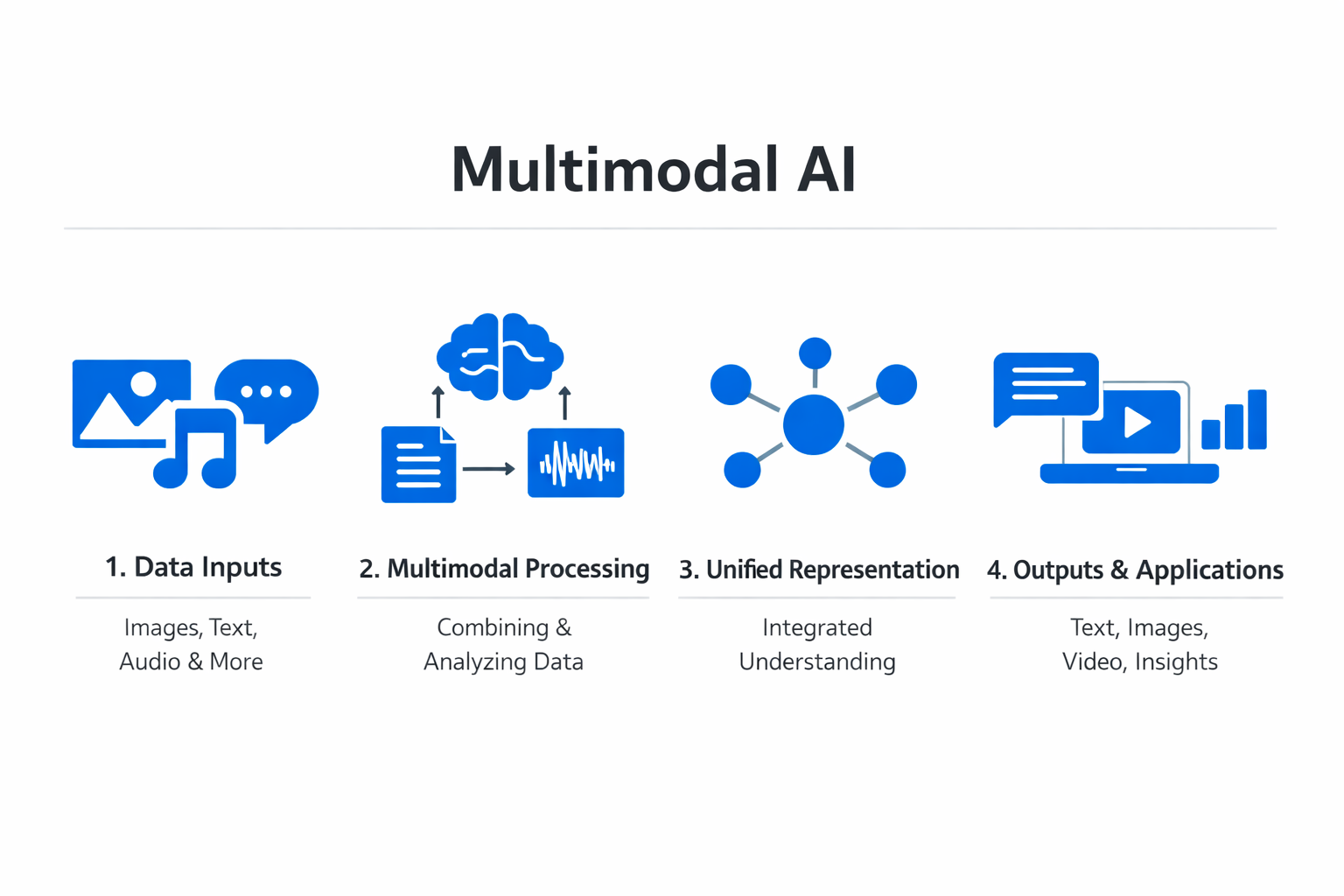
Multimodal AI refers to artificial intelligence systems that can process, understand, and generate information across multiple types of data simultaneously. These data types, called modalities, include text, images, audio, video, and structured data such as tables or sensor readings.
Rather than operating on a single input format, multimodal AI integrates signals from different sources to form a more complete understanding of the information it receives.
Traditional AI models are typically unimodal. A text classifier processes only text. An image recognition system processes only images. A speech recognizer handles only audio. Multimodal AI breaks this constraint by combining two or more modalities within a single model or system architecture. This lets the model draw on complementary information that no single modality can provide on its own.
The concept reflects how humans naturally perceive the world. People do not process sight, sound, and language in isolation. When watching a lecture, a student simultaneously processes the instructor's spoken words, facial expressions, body language, slide visuals, and on-screen text. Multimodal AI attempts to replicate this integrated perception by building models that jointly reason across different data types.
Prominent examples of multimodal AI include Google Gemini, which natively processes text, images, audio, and video within a single architecture, and GPT-4 from OpenAI, which accepts both text and image inputs and generates text outputs. DALL-E operates in a cross-modal direction, converting text descriptions into images.
These systems represent a shift from specialized, single-purpose models toward general-purpose AI that operates across the full range of human communication formats.
How Multimodal AI Works
Input Encoding Across Modalities
The foundational challenge in multimodal AI is representing different data types in a way that allows a single model to process them together. Text, images, and audio have fundamentally different structures. Text is a sequence of discrete tokens. Images are grids of pixel values. Audio is a waveform of amplitude values over time. Each modality requires its own encoding mechanism to convert raw data into a numerical representation the model can work with.
For text, the standard approach uses tokenization followed by embedding layers, a technique refined through years of natural language processing research. Models like BERT and GPT-3 established the paradigm of converting text tokens into dense vector representations that capture semantic meaning.
For images, convolutional neural networks were the dominant encoder for years, extracting spatial features through learned filters. More recently, Vision Transformers (ViTs) have become the preferred approach, dividing images into patches and processing them with the same attention mechanisms used for text.
This architectural convergence is significant because it allows text and image representations to share more of the processing pipeline.
Audio is typically converted into spectrograms or mel-frequency representations, then processed either by convolutional architectures or by transformer encoders that treat audio frames similarly to image patches. Video encoding extends image processing with a temporal dimension, capturing both spatial content within frames and motion patterns across frames.
Fusion Strategies
Once each modality is encoded into a vector representation, the system must combine them. This step, called fusion, is where multimodal AI diverges most significantly from unimodal approaches. There are three primary fusion strategies.
Early fusion combines raw or lightly processed inputs before any significant feature extraction. The modalities are concatenated or interleaved at the input level and processed jointly from the start. This approach allows the model to learn cross-modal interactions from the earliest layers, but it requires the architecture to handle heterogeneous input formats and can be computationally expensive.
Late fusion processes each modality independently through separate encoder networks, then combines the resulting high-level representations near the output layer. This approach is simpler to implement because each encoder can be a pretrained unimodal model. The trade-off is that the model has limited opportunity to learn fine-grained interactions between modalities, since the combination happens only after each modality has been fully processed.
Cross-attention fusion uses attention mechanisms to allow representations from one modality to attend to representations from another at intermediate layers. A transformer model processing text can attend to image patch embeddings at each layer, allowing text and visual information to influence each other throughout the processing pipeline.
This approach is the most flexible and has become the standard in state-of-the-art multimodal systems.
Shared Embedding Spaces
A key insight behind modern multimodal AI is that different modalities can be mapped into a shared vector embedding space where semantically similar concepts cluster together regardless of their original format. An image of a dog, the word "dog," and the sound of a dog barking can all be represented as nearby points in the same high-dimensional space.
Contrastive learning methods, most notably CLIP (Contrastive Language-Image Pre-training), pioneered this approach at scale. CLIP trains paired text and image encoders so that matching text-image pairs have similar embeddings while non-matching pairs are pushed apart. The resulting shared space enables zero-shot transfer: the model can classify or retrieve images based on text descriptions it has never explicitly been trained on.
This shared representation is what makes cross-modal tasks possible. Image search using text queries, image captioning, visual question answering, and text-to-image generation all depend on the model's ability to bridge modalities through a common representational framework.
The Role of Deep Learning Architectures
Multimodal AI is built on the foundation of deep learning and, more specifically, on the transformer architecture. The self-attention mechanism in transformers is inherently modality-agnostic. It operates on sequences of vectors regardless of whether those vectors originated from text tokens, image patches, or audio frames. This flexibility is why transformers have become the backbone of nearly all leading multimodal systems.
Large multimodal models often extend the architecture of large language models by adding visual or audio encoders and projecting their outputs into the same token space that the language model processes. The language model then serves as a general-purpose reasoning engine that operates over a mixed sequence of text and non-text tokens.
This design pattern, used in models like Gemini and LLaVA, reuses the strong reasoning capabilities developed during text-only pretraining while extending them to new modalities.
| Component | Function | Key Detail |
|---|---|---|
| Input Encoding Across Modalities | The foundational challenge in multimodal AI is representing different data types in a way. | Text, images, and audio have fundamentally different structures |
| Fusion Strategies | Once each modality is encoded into a vector representation, the system must combine them. | — |
| Shared Embedding Spaces | A key insight behind modern multimodal AI is that different modalities can be mapped into. | An image of a dog, the word "dog |
| The Role of Deep Learning Architectures | Multimodal AI is built on the foundation of deep learning and, more specifically. | Models like Gemini and LLaVA |
Why Multimodal AI Matters
Multimodal AI represents a qualitative shift in what AI systems can do, not just an incremental improvement in accuracy on existing benchmarks. Several factors explain why this matters for practitioners, organizations, and the broader trajectory of machine learning.
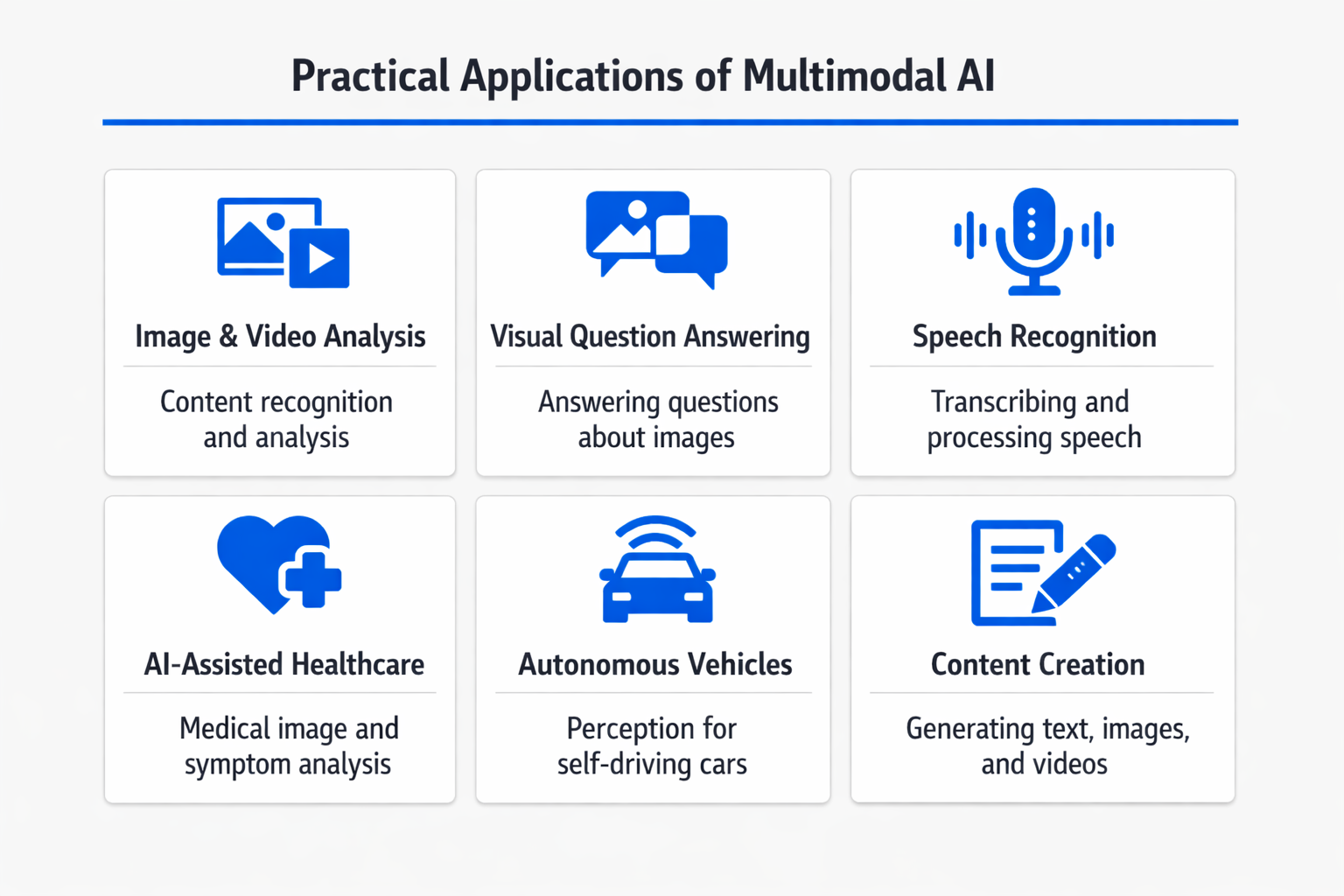
First, real-world problems are inherently multimodal. Medical diagnosis draws on imaging scans, patient histories, lab reports, and physician notes. Autonomous driving requires simultaneous processing of camera feeds, lidar point clouds, radar signals, and map data. Customer support interactions involve text, screenshots, voice recordings, and sometimes video.
AI systems that can process only one modality at a time force awkward workarounds where humans must manually translate information between formats. Multimodal AI eliminates this bottleneck.
Second, combining modalities improves robustness and accuracy. Text alone can be ambiguous. An image alone lacks context. But text and image together often resolve ambiguities that neither could address independently. Research consistently shows that multimodal models outperform unimodal baselines on tasks where multiple input types are available. The complementary information across modalities acts as a form of error correction, reducing the chance of misinterpretation.
Third, multimodal AI enables entirely new categories of applications. Vision-language models that jointly process images and text can answer open-ended questions about visual content, generate image descriptions for accessibility, or create images from natural language instructions. These capabilities did not exist in any practical form before multimodal architectures matured. They represent not just better performance on old tasks but the creation of new ones.
Fourth, multimodal AI is a stepping stone toward more general intelligence. Systems that perceive and reason across modalities more closely approximate the flexibility of human cognition. While current multimodal models are far from artificial general intelligence, their ability to integrate diverse information types is a meaningful advance along that trajectory.
Multimodal AI Use Cases
Education and Training
Multimodal AI carries direct implications for education technology. Intelligent tutoring systems can analyze a student's written response, spoken explanation, and on-screen work at once to assess understanding more accurately than any single-channel analysis could. A system that processes both what a learner writes and how they interact with visual materials can spot misconceptions that text-only assessment would miss.
Content creation for courses benefits as well. Generative AI tools with multimodal capabilities can produce training materials that combine text explanations with generated illustrations, diagrams, and audio narrations. Instructors can describe a concept in natural language and receive visual aids generated to match.
This accelerates course development and makes high-quality multimedia content accessible to educators who lack graphic design or audio production skills.
Healthcare and Medical Imaging
Healthcare is one of the strongest application domains for multimodal AI. Clinical decision support systems that combine medical imaging (X-rays, MRIs, CT scans) with electronic health record data and clinical notes produce more accurate diagnoses than systems that analyze images or records in isolation.
The model can correlate visual findings in a scan with a patient's medication history, prior diagnoses, and lab results to surface patterns that would require significant manual effort to detect.
Pathology, radiology, and dermatology have all seen multimodal approaches that exceed the performance of single-modality baselines. The key advantage is contextual reasoning: an abnormality in an image means different things depending on the patient's age, medical history, and current symptoms. Multimodal AI can incorporate all of these factors simultaneously.
Autonomous Systems and Robotics
Self-driving vehicles are inherently multimodal systems. They fuse camera images, lidar depth data, radar velocity measurements, GPS coordinates, and high-definition map information to build a real-time understanding of the driving environment. No single sensor provides sufficient information for safe navigation. The multimodal fusion layer is what enables the vehicle to detect obstacles, predict the behavior of other road users, and plan safe trajectories.
Robotics more broadly benefits from multimodal perception. A robot manipulating objects in an unstructured environment processes visual input (to locate and identify objects), tactile feedback (to calibrate grip strength), and sometimes audio cues (to detect that an object has been dropped or that a machine is malfunctioning). Multimodal AI provides the integration layer that allows these diverse sensors to inform a unified decision-making process.
Content Creation and Creative Tools
Creative work has shifted with multimodal generative AI tools. Text-to-image systems like DALL-E and Midjourney, which rely on diffusion models conditioned on text embeddings, are inherently multimodal.
They take text as input and produce images as output, requiring the model to bridge linguistic and visual understanding.
Video generation extends this further by adding temporal coherence to the cross-modal challenge. Audio generation tools that produce music or sound effects from text descriptions represent yet another multimodal application. The common thread is that these tools accept input in one modality and produce output in another, or accept inputs across multiple modalities and produce integrated outputs.
Search and Information Retrieval
Multimodal search allows users to query across data types. A user can upload an image and ask a question about it in natural language. A researcher can search a database of scientific papers using a combination of text queries and diagram sketches. An e-commerce platform can let shoppers find products by uploading a photo and specifying modifications in text ("like this, but in blue").
These capabilities depend on the shared embedding spaces described earlier. By mapping text and images into a common representational space, multimodal search systems can match queries in one modality against results in another, dramatically expanding the flexibility and utility of information retrieval.
Accessibility
Multimodal AI enables powerful accessibility tools. Automatic image description systems generate natural language captions for visual content, making images accessible to users with visual impairments. Audio description systems can narrate visual events in videos. Speech-to-text systems with visual context (such as lip-reading integration) improve transcription accuracy in noisy environments.
Sign language recognition, which requires joint processing of visual hand and body movements with linguistic structure, is another multimodal accessibility application. These tools translate between modalities to bridge sensory gaps, directly improving access to information and communication for people with disabilities.
Challenges and Limitations
Data Alignment and Pairing
Multimodal models require training data where modalities are meaningfully aligned. A text-image model needs image-caption pairs where the caption accurately describes the image. A video-language model needs transcripts synchronized with video content. Collecting, curating, and aligning multimodal datasets is far more expensive and complex than assembling single-modality datasets.
Misalignment in training data leads to models that produce plausible but incorrect cross-modal associations. An image captioning model trained on noisy web-scraped data may learn spurious correlations between visual features and text descriptions. The quality of multimodal alignment in training data directly determines the reliability of cross-modal reasoning in the deployed model.
Computational Cost
Multimodal models are typically larger and more computationally demanding than unimodal models. Processing multiple modalities requires more parameters, more memory, and more compute per inference call. Training multimodal models at the scale of Gemini or GPT-4 with vision requires infrastructure investments that are accessible only to well-resourced organizations.
The computational overhead extends to inference. A model that processes both an image and a text query requires more resources per request than a text-only model. For applications that need to serve high volumes of multimodal queries, infrastructure costs can be a significant constraint. Efficient architectures, model distillation, and quantization techniques help mitigate this, but the cost premium over unimodal systems remains meaningful.
Modality Imbalance
Not all modalities are equally informative for every task. In some scenarios, one modality dominates the model's decision-making while others contribute little. This imbalance can lead the model to effectively ignore certain inputs, reducing to a unimodal system despite its multimodal architecture.
Training techniques must account for this risk. Strategies like modality dropout (randomly masking one modality during training), balanced loss weighting, and curriculum learning help ensure the model learns to use all available modalities rather than collapsing to a single dominant input.
Evaluation Complexity
Evaluating multimodal models is harder than evaluating unimodal ones. Standard benchmarks for text or image tasks do not capture the quality of cross-modal reasoning. A model might generate a grammatically perfect image caption that fails to describe the actual content of the image, or produce a visually appealing image that does not match the text prompt.
Developing evaluation frameworks that assess genuine multimodal understanding, rather than surface-level competence in individual modalities, remains an open research challenge. Human evaluation is often necessary for tasks involving subjective quality judgments, but it is expensive and difficult to scale.
Bias and Fairness
Multimodal models can amplify biases present in their training data, and the interaction between modalities can introduce new bias patterns. A vision-language model trained on internet data may associate certain visual characteristics with stereotypical text descriptions.
These biases can be harder to detect and mitigate than biases in unimodal systems because they emerge from cross-modal correlations that are not visible when examining any single modality in isolation.
Organizations deploying multimodal AI must invest in systematic bias auditing across all input and output modalities. Testing should examine not just the accuracy of individual modality processing but the fairness of cross-modal associations and the potential for harm when modalities interact.
How to Get Started with Multimodal AI
Getting started with multimodal AI depends on the specific goal, whether that is building applications on top of existing multimodal models or developing custom multimodal systems.
For most practitioners, the most practical entry point is through APIs and pretrained models. Google Gemini, OpenAI's GPT-4 with vision, and Anthropic's Claude accept multimodal inputs through straightforward API calls. These APIs allow developers to send text alongside images, receive text responses that reference visual content, and build multimodal workflows without training any models from scratch. This is the fastest path from concept to working prototype.
For teams that need more control, open-source multimodal models offer a middle path. Models like LLaVA, InstructBLIP, and open-weight versions of multimodal architectures can be fine-tuned on domain-specific data. Fine-tuning a pretrained multimodal model on a specialized dataset (medical images with clinical notes, for example) is far more practical than training a multimodal system from scratch.
For researchers and advanced engineering teams building custom multimodal systems, the typical approach involves selecting or training unimodal encoders for each modality, designing a fusion mechanism, and training the integrated system on aligned multimodal data. Frameworks like PyTorch and Hugging Face Transformers provide the components needed for this work, and reference implementations from published research papers are widely available.
Key considerations for any team exploring multimodal AI include:
- Define the modalities that matter. Not every application needs every modality. Identify which data types are available and which combinations provide genuine value for the target task.
- Start with pretrained components. Training a neural network from scratch for each modality is rarely necessary. Reuse pretrained encoders and focus training effort on the fusion and task-specific layers.
- Invest in data quality. The alignment between modalities in training data is critical. Poorly paired data produces models with weak cross-modal reasoning.
- Plan for evaluation. Decide early how you will measure whether the multimodal approach genuinely outperforms simpler unimodal alternatives. Without clear metrics, it is difficult to justify the added complexity.
- Monitor for bias. Audit model outputs across modality combinations and demographic groups. Cross-modal biases can be subtle and require targeted testing to detect.
Building organizational capability in multimodal AI is an investment in a technology that is rapidly becoming foundational. As the tools and models mature, teams that have developed hands-on experience with multimodal systems will be better positioned to integrate these capabilities into their products and workflows effectively.
FAQ
What is the difference between multimodal AI and unimodal AI?
Unimodal AI systems process a single type of data. A text classifier works only with text. An image recognition model works only with images. Multimodal AI processes two or more data types simultaneously within a single system.
The main advantage of multimodal AI is that it can draw on complementary information across modalities, resolving ambiguities and enabling tasks that require understanding relationships between different data formats, such as answering questions about an image using natural language.
What are some examples of multimodal AI models?
Prominent multimodal AI models include Google Gemini, which natively processes text, images, audio, and video; GPT-4 with vision from OpenAI, which accepts text and image inputs; CLIP, which creates a shared embedding space between text and images; and DALL-E, which generates images from text prompts. Open-source options include LLaVA, InstructBLIP, and Whisper (for audio-to-text).
How is multimodal AI used in education?
In education, multimodal AI enables broader learner assessment by analyzing written responses, spoken explanations, and visual interactions at once. It supports content creation by generating multimedia materials from text instructions. It powers accessibility tools that produce image descriptions, audio narrations, and real-time captioning.
And it enables richer tutoring systems that can respond to both what a student says and what they show, providing more contextually appropriate feedback and guidance.
Is multimodal AI the same as generative AI?
No. Generative AI refers to AI systems that create new content, whether text, images, audio, or video. Multimodal AI refers to systems that process multiple data types. These categories overlap but are distinct. A text-only language model is generative but not multimodal. An image classification system that also processes metadata is multimodal but not generative.
Models like Gemini and GPT-4 with vision are both generative and multimodal, which is why the terms are sometimes conflated.
What are the biggest challenges in building multimodal AI?
The primary challenges are data alignment (collecting training data where modalities are accurately paired and synchronized), computational cost (multimodal models require more resources to train and run than unimodal models), modality imbalance (preventing the model from ignoring less informative inputs), evaluation complexity (measuring genuine cross-modal understanding rather than surface-level performance), and bias management (detecting and mitigating biases that emerge from interactions between modalities).


