


What Is Image-to-Image Translation?
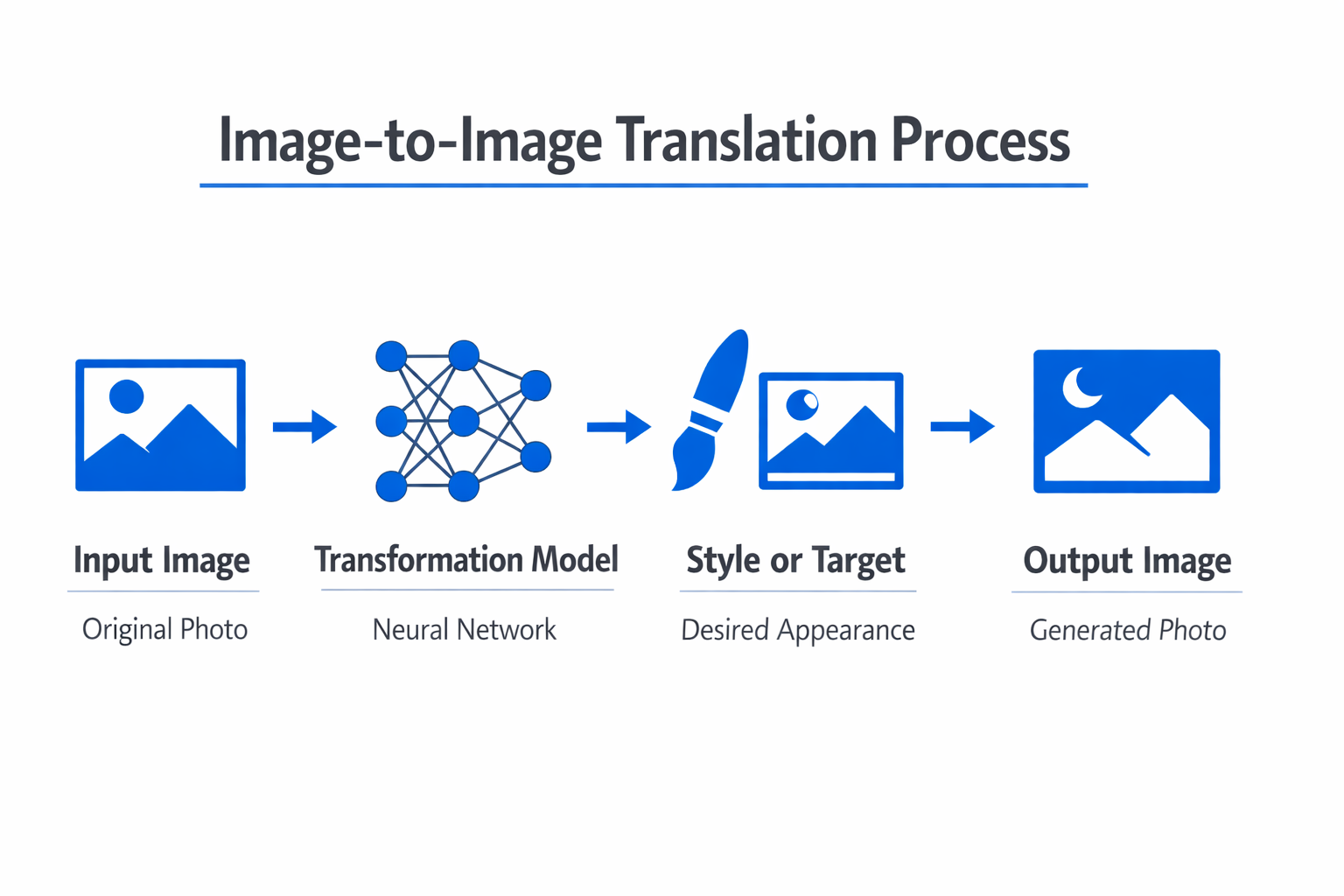
Image-to-image translation is a class of generative AI tasks in which a model learns to convert an input image from one visual domain into a corresponding output image in another domain. The input and output share the same underlying spatial structure, but differ in appearance, style, texture, or semantic content.
A sketch becomes a photorealistic rendering, a daytime street scene becomes a nighttime version, a satellite photograph becomes a map, or an MRI scan becomes a CT scan.
The concept is rooted in the broader idea of machine learning as function approximation. Given sufficient training data representing the relationship between two image domains, a model can learn a mapping function that transforms any input from domain A into a plausible output in domain B.
This learned mapping preserves the spatial layout and structural relationships in the source image while changing the visual properties that define the target domain.
Image-to-image translation differs from other generative model tasks like text-to-image synthesis or unconditional image generation. In those tasks, the model creates images from scratch or from non-visual inputs. Image-to-image translation always starts from an existing image and produces a structurally aligned transformation of it.
This constraint makes the task both more tractable and more useful for applications where spatial correspondence between input and output matters.
The field gained significant momentum with the introduction of the Pix2Pix framework in 2017, which showed that conditional generative adversarial networks could learn general-purpose image-to-image mappings from paired training data.
Since then, the range of architectures and training strategies has expanded considerably, with approaches based on diffusion models, variational autoencoders, and transformer models each contributing distinct advantages.
How Image-to-Image Translation Works
The Core Principle: Domain Mapping
Image-to-image translation operates on the principle that two visual domains can be connected by a learnable mapping function. The model takes an image from a source domain and produces an image in the target domain that preserves the spatial structure of the input while changing domain-specific visual characteristics.
This mapping is learned through a deep learning pipeline that processes the input image through an encoder-decoder architecture. The encoder extracts hierarchical features from the input, capturing both low-level details (edges, textures, colors) and high-level semantics (object identities, spatial relationships).
The decoder then reconstructs these features into an output image that conforms to the visual conventions of the target domain.
Paired vs. Unpaired Training
A central distinction in image-to-image translation is whether training data comes in aligned pairs or as unmatched collections from each domain.
In paired training, every input image has a corresponding ground-truth output image. A dataset might contain thousands of paired examples: sketch and corresponding photograph, daytime and nighttime versions of the same scene, or segmentation mask and real photograph. The model learns by comparing its generated output directly against the ground-truth target, using pixel-level or perceptual loss functions. Pix2Pix is the canonical example of a paired approach.
In unpaired training, the model receives two separate collections of images, one from each domain, with no explicit correspondence between individual images. The training set might include a collection of landscape photographs and a collection of Monet paintings, but no image in one set is specifically paired with an image in the other. CycleGAN, introduced shortly after Pix2Pix, pioneered a cycle-consistency approach to learn meaningful translations without paired data.
Adversarial Training
Most image-to-image translation systems use adversarial training, building on the generative adversarial network framework. The generator network produces the translated image, and a discriminator network evaluates whether the output looks like a genuine sample from the target domain. This adversarial dynamic pushes the generator to produce increasingly realistic outputs.
The discriminator in image-to-image translation often operates at the patch level rather than on the entire image. A PatchGAN discriminator classifies whether each local patch of the output image looks realistic, rather than making a single judgment about the whole image. This patch-based approach captures local texture and style information effectively and encourages sharp, detailed output.
Loss Functions and Regularization
Image-to-image translation models typically combine multiple loss functions. The adversarial loss ensures realism. A reconstruction loss (often L1 or perceptual loss) ensures that the output preserves the structure of the input. For unpaired methods, cycle-consistency loss requires that translating an image from domain A to domain B and back to domain A recovers something close to the original image.
Perceptual loss functions, computed using feature representations from pretrained convolutional neural networks, are particularly important. They measure similarity in a learned feature space rather than raw pixel space, which encourages outputs that are semantically faithful to the input even when low-level pixel values differ substantially.
Architecture Patterns
The generator in most image-to-image translation systems follows one of two architectural patterns. The U-Net architecture uses skip connections to pass fine-grained spatial information from encoder layers directly to corresponding decoder layers, preserving detailed structure across the translation.
The ResNet-based architecture uses a series of residual blocks between the encoder and decoder, which is effective for translations that require significant changes in appearance while maintaining global structure.
Both architectures process the input through downsampling layers, a bottleneck that captures compressed representations, and upsampling layers that reconstruct the output at full resolution. The choice between them depends on how much fine spatial detail needs to be preserved. U-Net architectures tend to excel when pixel-level alignment between input and output is critical.
| Component | Function | Key Detail |
|---|---|---|
| The Core Principle: Domain Mapping | Image-to-image translation operates on the principle that two visual domains can be. | — |
| Paired vs. Unpaired Training | A central distinction in image-to-image translation is whether training data comes in. | — |
| Adversarial Training | Most image-to-image translation systems use adversarial training. | The generator network produces the translated image |
| Loss Functions and Regularization | Image-to-image translation models typically combine multiple loss functions. | The adversarial loss ensures realism |
| Architecture Patterns | The generator in most image-to-image translation systems follows one of two architectural. | Translations that require significant changes in appearance while |
Types and Approaches
Conditional GANs (Pix2Pix)
Pix2Pix, formally known as "Image-to-Image Translation with Conditional Adversarial Networks," established the foundational approach for paired image-to-image translation. It combines a conditional GAN with a U-Net generator and a PatchGAN discriminator. The model is conditioned on the input image, meaning the generator receives the source image as input and produces the translated output, while the discriminator sees both the input and output together.
Pix2Pix is effective across a wide range of paired translation tasks: labels to facades, edges to photographs, day to night, black-and-white to color. Its main limitation is the requirement for paired training data, which is expensive or impossible to collect for many practical translation tasks.
CycleGAN and Unpaired Methods
CycleGAN addressed the paired data requirement by introducing cycle consistency. The framework uses two generators and two discriminators. One generator translates from domain A to domain B, and the other translates back from B to A. The cycle-consistency loss enforces that an image translated to the other domain and back again closely resembles the original.
This constraint prevents the model from collapsing to trivial solutions (like ignoring the input entirely) without requiring paired examples. CycleGAN enabled translation tasks where paired data does not exist, such as converting horses to zebras, photographs to paintings, or summer scenes to winter scenes. Related approaches like UNIT and MUNIT extended unpaired translation to handle multiple styles and multimodal outputs.
Pix2PixHD and High-Resolution Methods
Pix2PixHD extended the original Pix2Pix framework to handle high-resolution output (up to 2048x1024 pixels). It introduced a coarse-to-fine generator with multiple resolution stages, multi-scale discriminators that evaluate the output at different resolutions, and an improved training procedure that stabilizes learning at high resolutions.
This work was significant because early image-to-image translation methods struggled to produce sharp, coherent output at resolutions above 256x256. Pix2PixHD demonstrated that the conditional GAN framework could scale to produce photorealistic results at practical resolutions, making it viable for applications in urban scene synthesis, architectural visualization, and machine vision tasks.
SPADE and Semantic Synthesis
Spatially-Adaptive Normalization (SPADE) introduced a way to inject semantic layout information directly into the normalization layers of the generator. Instead of passing the semantic map only as input, SPADE modulates the activations at every layer of the generator based on the local semantic label at each spatial position.
This architecture produces particularly strong results for semantic image synthesis, where a segmentation map is converted into a photorealistic image. Each labeled region (sky, road, building, vegetation) is rendered with appropriate texture and appearance. SPADE models generate images where visual quality varies meaningfully across different semantic regions, producing outputs that are significantly more realistic than earlier label-to-image methods.
Diffusion-Based Translation
Recent advances have brought diffusion models into the image-to-image translation space. Instead of adversarial training, diffusion-based methods use an iterative denoising process to transform images between domains.
Approaches like SDEdit add controlled noise to the source image and then denoise it using a model trained on the target domain, producing a translated version that preserves the input's structure while adopting the target domain's visual style.
Instruction-based methods like InstructPix2Pix combine diffusion models with natural language conditioning, allowing users to specify desired transformations in plain text (for example, "make it winter" or "change the lighting to sunset").
These methods build on pretrained vision-language models and large-scale text-to-image diffusion models, offering a more flexible and user-friendly approach to image translation than traditional paired or unpaired methods.
Neural Style Transfer
Neural style transfer is a related technique that separates the content of one image from the style of another and recombines them. While not always classified under the same umbrella, style transfer shares the core idea of transforming an image from one visual domain to another.
Early methods used optimization-based approaches applied to pretrained neural network features, while later feed-forward approaches enabled real-time style transfer using trained encoder-decoder networks.
Adaptive instance normalization (AdaIN) and similar techniques allow a single network to apply arbitrary styles at inference time, rather than requiring a separate model for each style. This flexibility makes neural style transfer a practical tool for artistic applications and a building block within more complex image-to-image translation pipelines.
Use Cases
Medical Imaging
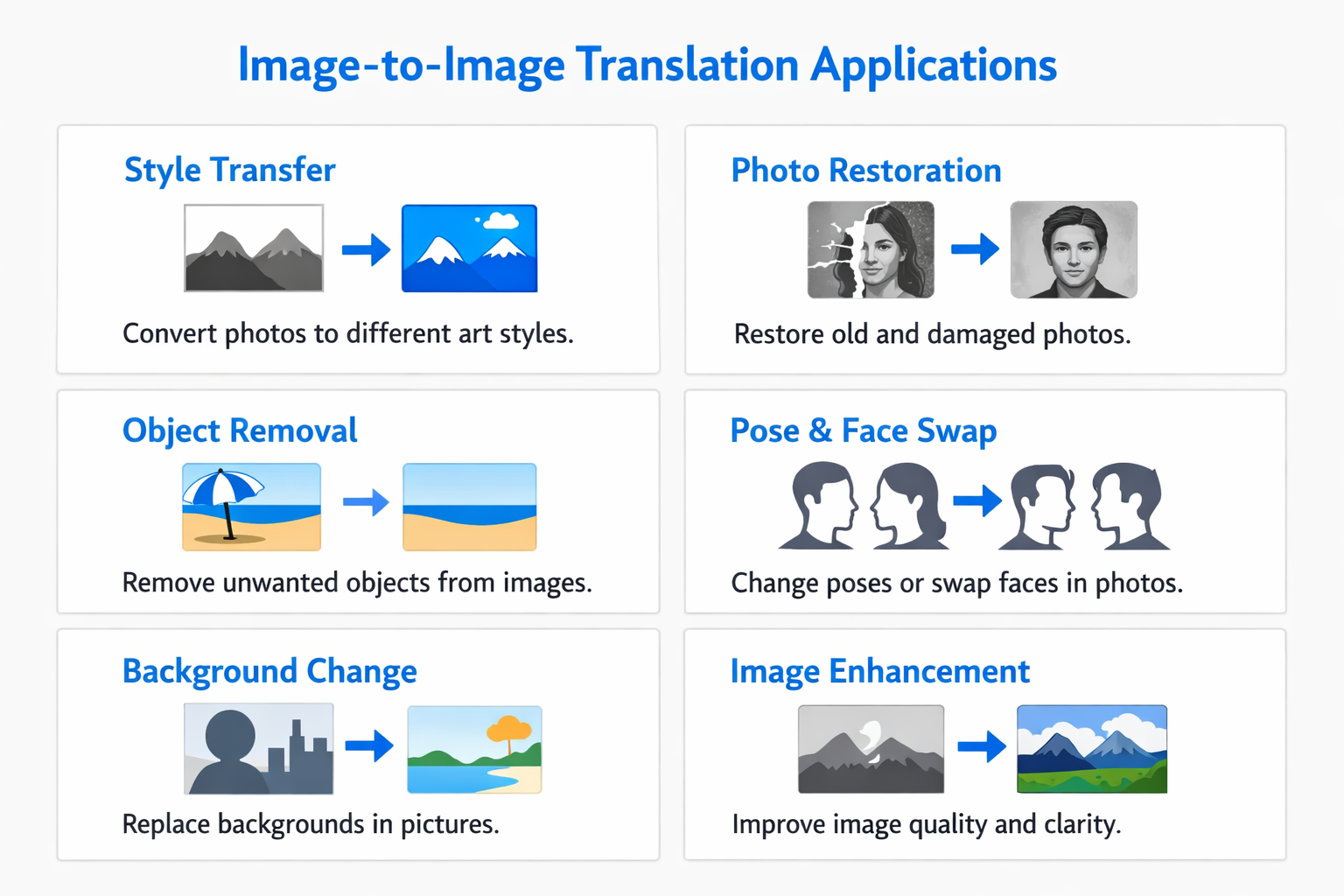
Image-to-image translation has significant applications in medical imaging. Models can learn to translate between imaging modalities, such as converting MRI scans to CT scans, synthesizing PET images from MRI data, or enhancing low-dose medical images to resemble high-dose acquisitions. These cross-modality translations reduce the need for redundant scans, lower patient radiation exposure, and provide clinicians with complementary views of the same anatomy.
Stain normalization in histopathology is another medical application. Tissue samples stained with different protocols produce images with varying color profiles, which can confuse automated image recognition systems. Image-to-image translation models normalize staining variations, enabling more consistent automated analysis across different laboratories and preparation methods.
Autonomous Driving and Robotics
Self-driving systems and robotic platforms use image-to-image translation for domain adaptation and data augmentation. A model trained on synthetic driving scenes can perform poorly on real-world roads due to the visual gap between rendered and photographed images. Image-to-image translation bridges this gap by converting synthetic training data to look photorealistic, or by translating between different environmental conditions (clear weather to rain, day to night).
This approach reduces the cost and risk of collecting real-world training data in dangerous or rare conditions. Teams can generate photorealistic training examples of scenarios like heavy snowfall or nighttime driving from synthetic renderings, improving the robustness of perception systems that rely on supervised learning from labeled datasets.
Architecture and Design
Architects and designers use image-to-image translation to convert rough sketches and floor plans into photorealistic renderings. A simple line drawing of a building facade can be translated into a detailed visualization showing materials, lighting, and environmental context. This accelerates the design review process by providing clients with realistic previews without requiring manual rendering.
Interior design applications translate segmentation layouts into furnished room images, allowing designers to explore multiple material palettes and furniture arrangements rapidly. Urban planning teams use similar tools to visualize proposed changes to streetscapes, parks, and public spaces before construction begins.
Creative Arts and Entertainment
Artists and content creators use image-to-image translation for style transfer, colorization, and visual effects. Black-and-white photographs or film footage can be colorized automatically. Sketches can be rendered in specific artistic styles. Season or weather conditions in landscape photographs can be altered.
In game development and film production, image-to-image translation supports rapid concept art generation and environment design. Artists produce rough sketches or low-fidelity mockups, and translation models produce detailed renderings that serve as reference material for final production assets. Tools built on DALL-E and similar systems increasingly incorporate image-to-image capabilities for professional creative workflows.
Satellite and Aerial Imagery
Remote sensing applications use image-to-image translation to convert between map types and sensor modalities. Satellite photographs can be translated into labeled maps, land-use classifications, or elevation models. Conversely, map data can be rendered as realistic aerial imagery for simulation and training purposes.
These translations support urban planning, environmental monitoring, disaster response, and military intelligence analysis. The ability to automatically generate one representation from another reduces the manual effort required to maintain and update geospatial datasets.
Data Augmentation for Machine Learning
Image-to-image translation also works as a data augmentation strategy for training other artificial intelligence models. When labeled training data is scarce or expensive to collect, translation models can generate synthetic examples by transforming existing images into new variations.
A model trained to translate between visual conditions (lighting, weather, viewpoint) can expand a small dataset into a much larger and more diverse collection.
This application is particularly valuable in domains where data collection is constrained by cost, safety, or privacy concerns. Medical imaging, industrial inspection, and security surveillance all benefit from synthetic data generated through image-to-image translation pipelines.
Challenges and Limitations
Mode Collapse and Artifacts
GAN-based image-to-image translation models can suffer from mode collapse, where the generator produces a limited range of outputs regardless of input variation. The model might learn to generate plausible-looking images that lack the diversity present in the target domain. Visual artifacts, including checkerboard patterns, blurring, and inconsistent textures, are common failure modes, especially at high resolutions or with complex scenes.
These issues stem from the fundamental instability of adversarial training. Balancing the generator and discriminator requires careful tuning of learning rates, loss weights, and architectural choices. When this balance breaks down, the output quality degrades in ways that can be difficult to diagnose and correct. Diffusion-based approaches mitigate some of these stability concerns but introduce their own trade-offs in speed and controllability.
Semantic Consistency
Maintaining semantic consistency during translation is a persistent challenge. A model translating daytime scenes to nighttime should change lighting and color temperature without altering the objects in the scene. In practice, models sometimes add, remove, or distort objects during translation, producing outputs where a car changes shape, a building gains extra windows, or a person's face is altered.
This problem is especially acute in unpaired translation, where the model has no explicit guidance about which elements should remain fixed and which should change. Unsupervised learning approaches like CycleGAN mitigate this with cycle consistency, but the constraint is not always sufficient to prevent semantic drift in complex scenes.
Domain Gap and Generalization
Image-to-image translation models learn specific domain mappings from their training data. A model trained to translate summer landscapes to winter will perform well on scenes similar to its training set but may fail on out-of-distribution inputs like urban environments, indoor scenes, or aerial views. The model's understanding of "winter" is limited to the patterns it has seen during training.
Generalization across diverse inputs remains an open problem. Fine-tuning on new domains is often necessary, which requires additional labeled or curated data. Transfer learning and domain randomization techniques help improve robustness, but no current approach fully solves the generalization challenge for arbitrary input images.
Evaluation Difficulty
Measuring the quality of translated images is inherently subjective. Standard metrics like Frechet Inception Distance (FID) and Inception Score (IS) provide quantitative benchmarks but do not always correlate well with human perception of quality and faithfulness. A translated image might score well on FID while containing subtle artifacts that are immediately obvious to a human viewer.
Evaluating structural faithfulness, the degree to which the translated output preserves the spatial layout of the input, adds another dimension of complexity. Metrics that capture both visual quality and structural alignment are still an active area of research. For production applications, human evaluation remains the most reliable assessment method, though it is expensive and difficult to scale.
Paired Data Scarcity
Many compelling image-to-image translation tasks lack naturally paired training data. Collecting pixel-aligned pairs of images from two domains requires either controlled capture setups (photographing the same scene under different conditions) or manual annotation (creating segmentation maps for existing photographs). Both approaches are labor-intensive and do not scale well.
Unpaired methods like CycleGAN reduce this requirement but sacrifice some control over the translation quality. The trade-off between data requirements and output fidelity remains a fundamental tension in the field. Synthetic data generation and self-supervised pretraining are promising directions for reducing the reliance on manually curated training pairs.
How to Get Started
Getting started with image-to-image translation depends on whether the goal is to apply existing tools or build custom models from scratch.
For practitioners exploring the field for the first time, pretrained models and high-level libraries offer the fastest path to results.
Hugging Face's Diffusers library includes image-to-image pipelines based on Stable Diffusion that can transform images using text prompts with minimal code. PyTorch-based implementations of Pix2Pix and CycleGAN are available as open-source projects with tutorials and pretrained weights for common translation tasks.
For teams building custom translation models, the process involves several key steps:
- Define the translation task. Identify the source and target domains clearly. Determine whether paired training data is available or whether an unpaired approach is necessary.
- Prepare the dataset. Collect or curate images from both domains. For paired methods, ensure pixel-level alignment between input and output images. For unpaired methods, assemble representative collections from each domain. Data quality and diversity directly affect output quality.
- Select an architecture. Choose between GAN-based approaches (Pix2Pix for paired data, CycleGAN for unpaired data) and diffusion-based approaches (SDEdit, InstructPix2Pix) based on the task requirements, available data, and computational resources.
- Train and iterate. Start with published hyperparameters and training schedules from reference implementations. Monitor training with both quantitative metrics and visual inspection of generated outputs. Adjust loss weights, learning rates, and architectural details based on observed failure modes.
- Evaluate rigorously. Use a combination of automated metrics (FID, LPIPS, structural similarity) and human evaluation to assess output quality. Test on held-out data that represents the full range of inputs the model will encounter in production.
Hardware requirements vary by approach. Fine-tuning a pretrained diffusion model for image-to-image translation is feasible on a single GPU with 16 GB or more of VRAM. Training a GAN-based model from scratch on a custom dataset typically requires similar resources, though high-resolution models (Pix2PixHD and above) benefit from multi-GPU setups.
Teams building production systems around image-to-image translation should invest in understanding the underlying deep learning principles, not just the API surface of existing tools. Knowledge of encoder-decoder architectures, loss function design, and adversarial training dynamics enables more effective debugging, customization, and deployment of translation systems at scale.
FAQ
What is the difference between image-to-image translation and style transfer?
Style transfer is a specific type of image-to-image translation that focuses on separating and recombining the content of one image with the visual style of another. Image-to-image translation is the broader category that includes style transfer along with many other types of transformations: semantic synthesis, cross-modality conversion, colorization, super-resolution, and domain adaptation.
Style transfer preserves the content structure of the input while changing its artistic appearance, whereas other image-to-image translation tasks might change semantic content, add or remove elements, or convert between fundamentally different visual representations.
Do I need paired training data?
Not necessarily. Paired approaches like Pix2Pix produce high-quality results when aligned input-output pairs are available, but unpaired methods like CycleGAN can learn translations from two unmatched collections of images. Diffusion-based methods like InstructPix2Pix can perform translations guided by text instructions without any task-specific paired data at all. The choice depends on what data is available and what level of control over the translation is required.
Paired methods generally offer tighter control over the output, while unpaired methods offer greater flexibility in task definition.
How does image-to-image translation relate to GANs and diffusion models?
Image-to-image translation is a task, while generative adversarial networks and diffusion models are architectures used to accomplish that task. Early image-to-image translation systems were predominantly GAN-based, using adversarial training to produce realistic outputs.
More recent approaches use diffusion models, which offer greater training stability and the ability to incorporate text-based conditioning. Both architectures can be used for image-to-image translation, and the choice involves trade-offs in training complexity, output quality, inference speed, and flexibility.
What are common quality issues with translated images?
The most frequent issues include blurring or loss of fine detail, checkerboard artifacts from upsampling operations, color inconsistencies between the translated region and its surroundings, and hallucinated or missing objects. Semantic drift, where the model changes elements that should remain fixed during translation, is especially problematic in unpaired methods.
High-resolution translations may also exhibit local inconsistencies where different regions of the image appear to have been translated with slightly different parameters. Careful architecture selection, loss function tuning, and evaluation against human judgments help mitigate these issues.
Can image-to-image translation work with video?
Yes, but extending image-to-image translation to video introduces additional challenges around temporal consistency. Applying a translation model independently to each frame of a video often produces flickering and inconsistent results, because the model makes slightly different translation decisions for each frame.
Video-specific approaches add temporal constraints, either through recurrent connections, temporal discriminators, or optical flow-based warping, to ensure that translated frames form a smooth and coherent sequence. This is an active research area with rapid progress, particularly as diffusion models improve their ability to handle temporal dimensions.


