


For years, Learning Management Systems have been built around a centralized model, where content is created, stored, and delivered within a single platform.
While this approach has provided structure and control, it has also introduced a clear limitation: learning often exists separately from the tools, workflows, and environments where work actually happens.
Today, that gap is becoming more visible.
Organizations operate across a growing number of systems, from product environments and customer platforms to internal tools and data pipelines. At the same time, knowledge is no longer stable. Product updates, process changes, and new requirements emerge continuously, requiring learning experiences that can evolve just as quickly.
Headless LMS platforms were introduced as a response to this shift. By separating the front-end experience from the back-end infrastructure, they allow organizations to deliver learning across different surfaces, integrate with existing systems, and move beyond the constraints of a single interface.
However, while this architectural change improves flexibility, it does not fundamentally change how learning is created, maintained, or adapted over time.
In the context of artificial intelligence, a new opportunity is emerging: systems that not only expose capabilities through APIs, but can also act on them.
Learning is no longer something that is simply delivered. It becomes something that can be continuously updated, orchestrated, and aligned with real-world events.
This is where the concept of an Agentic Learning System begins.
In this article, we explore what a Headless LMS is, how it works, and why it is becoming the foundation for a more adaptive, intelligent approach to learning.
What Is a Headless LMS
A Headless Learning Management System is an architecture where the learning infrastructure is separated from the experience through which it is delivered.
In traditional LMS platforms, these layers are tightly coupled. The same system manages content, users, and progress while also controlling how learning is presented through a predefined interface. This simplifies deployment, but limits flexibility in how and where learning can be delivered.
A headless approach introduces a clear separation between these responsibilities.
The back-end remains responsible for core learning operations, including content management, user data, progress tracking, permissions, and reporting. The front-end, by contrast, is no longer fixed. It can be designed and delivered independently, depending on the context in which learning needs to appear.
This separation is enabled by APIs, which allow external systems, applications, or custom interfaces to interact with the LMS in a structured and scalable way.
Learning is no longer confined to a single platform, but can be embedded into products, integrated into workflows, or delivered across multiple environments while maintaining consistency in data and management.
In this sense, a headless LMS functions less as a standalone application and more as a learning infrastructure. It provides the operational layer required to manage learning, while allowing organizations to define how that learning is experienced.
This distinction becomes increasingly relevant as organizations move toward more distributed, interconnected systems, where learning is expected to exist within the flow of work rather than outside of it.
Traditional LMS vs Headless LMS vs Agentic Learning System
| Dimension | Traditional LMS | Headless LMS | Agentic Learning System |
|---|---|---|---|
| Architecture | Front-end and back-end are tightly coupled | Front-end and back-end are decoupled | API-based infrastructure orchestrated by intelligent agents |
| Learning delivery | Delivered inside a fixed LMS interface | Delivered across custom interfaces and connected environments | Delivered across systems, workflows, and dynamic touchpoints |
| Course management | Mostly manual and UI-driven | Still manual, but more flexible | Continuously updated through automation and AI agents |
| Role of APIs | Limited or secondary | Core to the architecture | Foundational for orchestration across tools |
| Adaptation to change | Slow and manual | Faster to distribute, but still mostly manual | Responsive to real-time events and operational data |
| Main strength | Centralized control | Flexibility and integration | Continuous orchestration and adaptability |
| Main limitation | Rigid experience and isolated delivery | Decouples delivery, but not learning operations | Requires strong infrastructure, governance, and interaction design |
| Human interaction | Often limited or secondary | Depends on the front-end design | Must be intentionally structured to remain effective |
How a Headless LMS Works
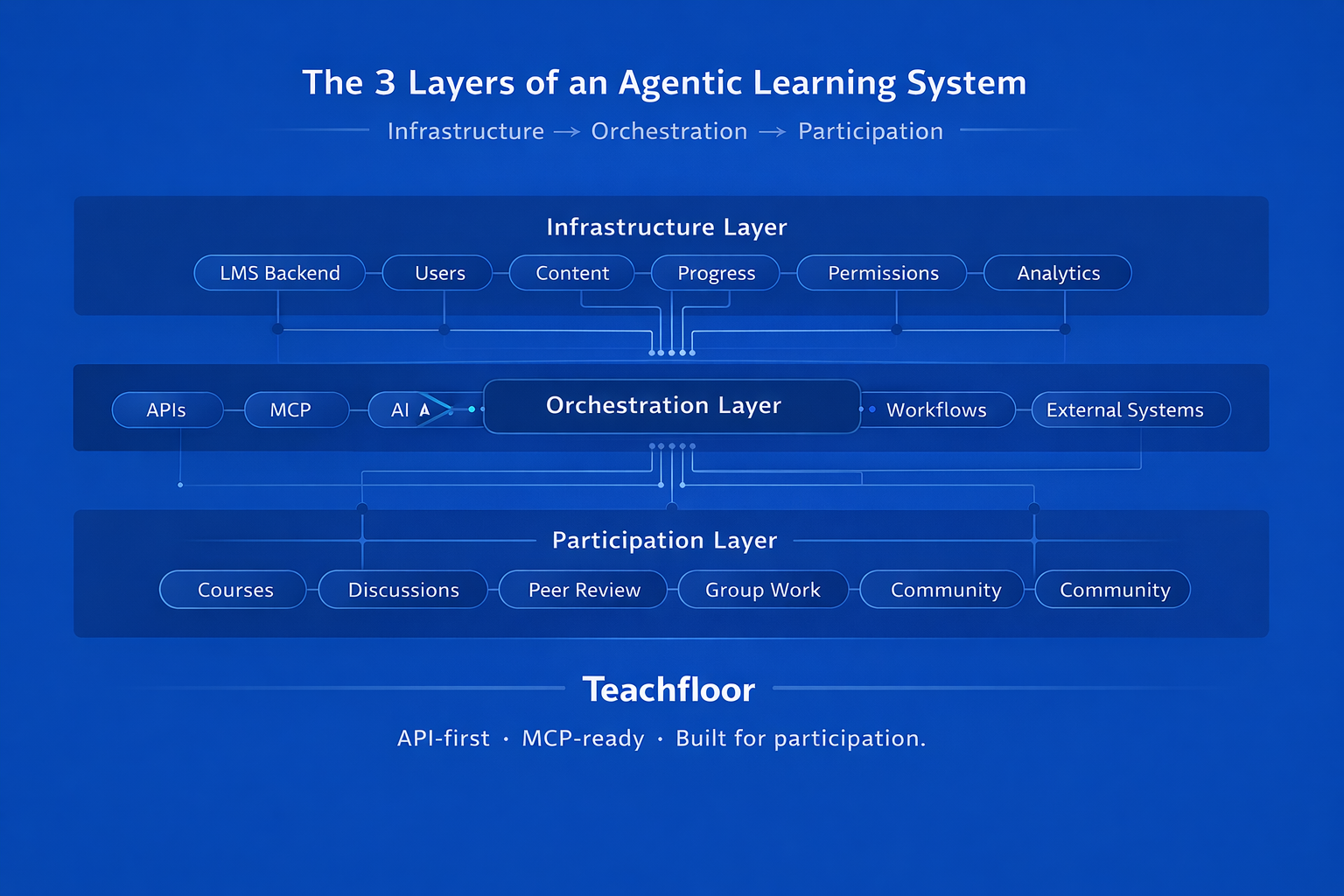
A headless LMS operates by separating the systems that manage learning from the interfaces that deliver it, allowing each layer to evolve independently.
At its core, the back-end remains responsible for all learning operations. This includes storing and organizing content, managing users and permissions, tracking progress, handling completion logic, and maintaining reporting and analytics. It is where the structure of the learning experience is defined and enforced.
What changes in a headless architecture is how these capabilities are accessed.
Instead of interacting with the system through a fixed interface, external applications communicate with the LMS through APIs. These APIs expose the underlying functionality of the platform, making it possible to retrieve content, assign courses, track progress, or update learning paths from any connected environment.
On the front-end side, organizations are free to design and deliver their own learning experiences. This can take many forms: a custom web interface, a mobile application, an internal tool, or even an embedded component inside a product or customer portal. The front-end becomes a layer of presentation and interaction, while the back-end continues to manage consistency, logic, and data.
This architecture introduces a clear separation between three layers:
- The learning infrastructure, where content, users, and progress are managed
- The API layer, which exposes these capabilities in a structured way
- The experience layer, where learning is delivered and consumed
Understanding this separation is essential. While the front-end can be customized or replaced entirely, the back-end remains critical. It ensures that learning experiences are consistent, traceable, and aligned with organizational rules, regardless of where or how they are delivered.
As organizations adopt more interconnected systems, this model allows learning to move beyond a single platform and become part of a broader operational ecosystem.
What Is an Agentic Learning System
An Agentic Learning System is a model in which learning is no longer created and managed only through manual processes, but continuously orchestrated through intelligent agents that can observe, decide, and act across connected systems.
In this context, learning is no longer treated as a fixed set of courses that require periodic updates. It becomes a dynamic system that evolves in response to real-world events, such as product changes, new processes, user behavior, or external requirements.
This shift is enabled by the combination of three foundational elements.
First, an API-based infrastructure that exposes learning capabilities programmatically. This allows external systems and agents to interact with the LMS without relying on a predefined interface, making learning operations accessible beyond a single platform.
Second, a growing ecosystem of data sources, including product environments, user activity, support interactions, and internal systems. These inputs provide the context required to understand when learning needs to be updated or adapted.
Moreover intelligent agents capable of interpreting this context and triggering actions, such as updating course content, creating new learning modules, assigning training to specific audiences, or adapting learning paths over time.
The interaction between these elements is increasingly standardized through protocols such as Model Context Protocol (MCP). Rather than relying on custom integrations or direct API calls, MCP allows agents to discover available capabilities, access relevant data, and trigger actions across systems in a consistent way.
This introduces a critical shift. APIs expose what a system can do. MCP enables agents to use those capabilities as part of a broader, coordinated workflow that spans multiple tools.
As a result, the LMS is no longer just a system that delivers learning. It becomes part of an operational layer where learning can be continuously maintained, updated, and aligned with how the organization actually works.
In an agentic model, the focus moves from building courses to orchestrating learning. The system becomes responsive to change, reducing the gap between how knowledge evolves and how it is delivered.
This does not replace the need for structure or governance. Instead, it adds a new layer of automation on top of it, allowing learning to remain both controlled and continuously aligned with reality.
Why Human Interaction Still Matters
As learning systems become more automated, it is easy to assume that content generation and orchestration alone are enough to improve outcomes. In practice, this is rarely the case.
While AI can significantly reduce the effort required to create and maintain learning materials, it does not address a more fundamental aspect of learning: how people engage with knowledge and with each other.
In most organizations, the primary challenge is not access to information. It is the ability to apply it, discuss it, question it, and integrate it into real work. These processes are inherently social and contextual. They depend on interaction, feedback, and shared experience.
This is where purely automated models tend to fall short.
If learning is reduced to content delivery, even when that content is dynamically generated, it risks becoming passive. Users consume information, but do not necessarily internalize it or translate it into action. Without mechanisms for participation, there is limited accountability and little opportunity to deepen understanding.
Effective learning systems address this gap by structuring interaction.
This can take different forms, including discussions, peer feedback, collaborative activities, and guided reflection. These elements create a layer of engagement that cannot be replicated through content alone, regardless of how advanced the underlying technology is.
In this context, automation and human interaction are not opposing forces. They operate at different levels.
Automation can ensure that learning stays relevant, updated, and aligned with the organization. Human interaction ensures that learning is meaningful, applied, and retained.
The most effective systems combine both: they use intelligent orchestration to manage complexity, while preserving the conditions that allow people to learn from each other.
Teachfloor: Headless and Agentic by Design
The shift toward headless and agentic learning systems is not only conceptual. It requires a platform that can support both programmable infrastructure and structured interaction.
Teachfloor is designed with this dual requirement in mind.
At the infrastructure level, Teachfloor follows an API-centric approach that allows learning operations to be accessed and orchestrated programmatically.
Courses, users, activities, and learning flows can be managed through external systems, enabling integration with tools such as product platforms, HR systems, analytics environments, and internal workflows.
This makes it possible to move beyond manual course management and introduce automated processes that keep learning aligned with real-time changes across the organization.
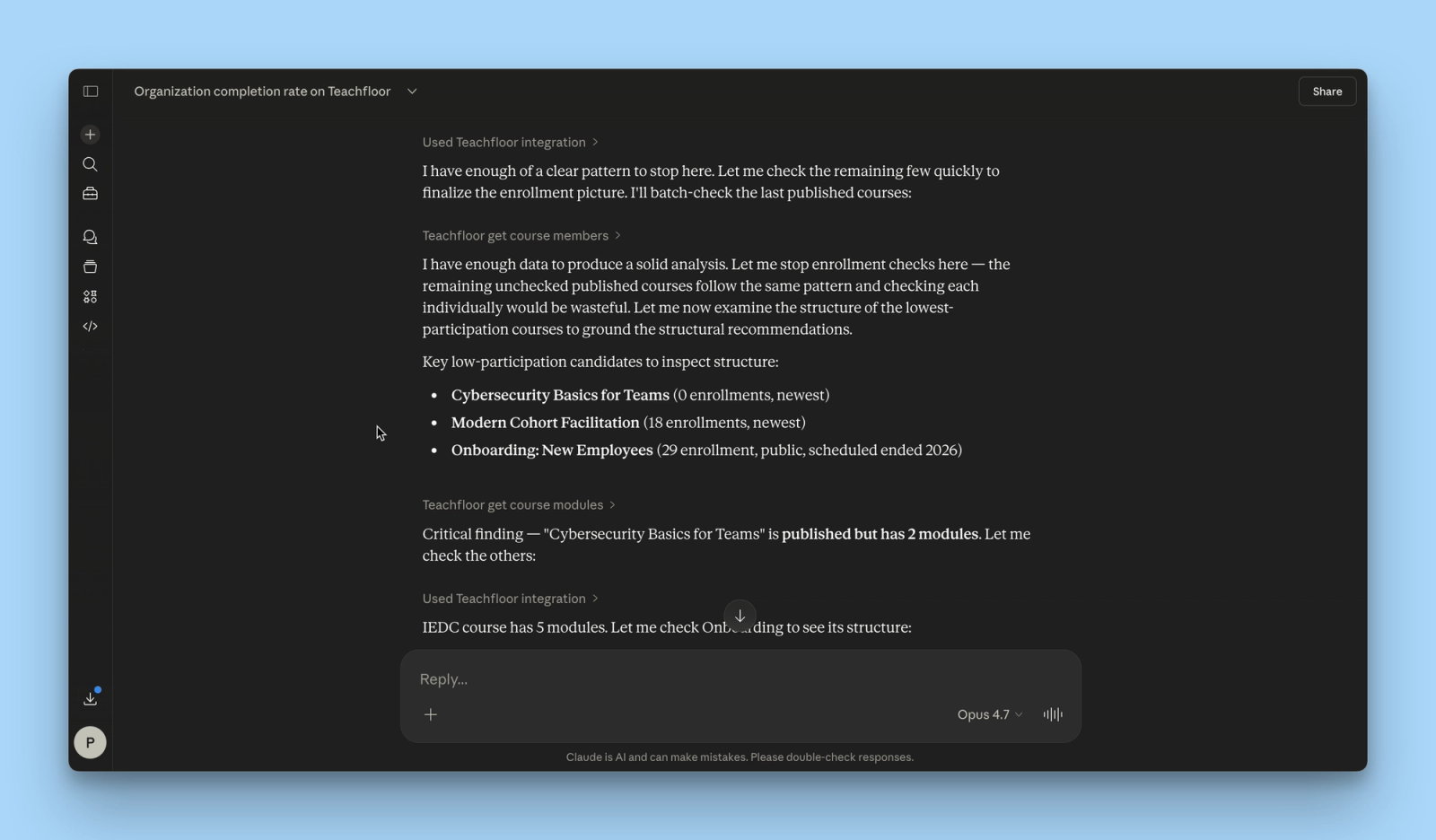
In addition to its API-first architecture, Teachfloor supports agent-based orchestration through MCP-compatible systems, allowing intelligent agents to interact directly with the platform and trigger actions across learning environments.
At the same time, Teachfloor is built around structured interaction, ensuring that learning remains an active and participatory process.
In practice, this means:
- API-first infrastructure that allows courses, users, and learning flows to be managed programmatically
- MCP-compatible architecture enabling AI agents to orchestrate learning actions across systems
- Seamless integration with external tools such as HR platforms, CRMs, product environments, and analytics systems
- Dynamic learning management, where courses can be updated and adapted based on real-time events
- Built-in interaction models, including discussions, peer review, and group activities
- Support for collaborative learning, ensuring that learning is not limited to content consumption
- Structured learning flows that combine automation with participation and accountability
By combining programmable infrastructure with structured human interaction, Teachfloor enables organizations to build learning environments that are both adaptive and effective.
FAQs About Headless LMS and Agentic Learning
What is the difference between a traditional LMS and a headless LMS?
A traditional LMS combines content management, user tracking, and the learner interface within a single platform. A headless LMS separates the back-end infrastructure from the front-end experience, allowing learning to be delivered across different systems and environments through APIs.
What are the main benefits of a headless LMS?
A headless LMS provides greater flexibility in how learning is delivered, making it easier to integrate with other systems, embed learning into products or workflows, and support multiple audiences with different experiences. It also creates a foundation for automation and scalable learning operations.
What is an Agentic Learning System?
An Agentic Learning System is a model where learning is continuously managed and updated by intelligent agents. Instead of relying solely on manual course creation, these systems can adapt learning content, structure, and delivery based on real-time data and events across the organization.
Does a headless LMS replace the need for a user interface?
No. A headless LMS changes how the interface is delivered, not whether it exists. Organizations can design custom interfaces or embed learning into existing tools, while the LMS continues to manage data, logic, and learning operations in the background.
Can AI fully automate learning?
AI can automate parts of the learning process, such as content updates, assignment, and orchestration. However, effective learning still requires human interaction, including discussion, feedback, and collaboration. Automation supports learning, but does not replace participation.
Is Teachfloor a headless LMS?
Teachfloor follows an API-centric approach that enables headless learning architectures. It also supports agent-based orchestration and includes built-in tools for interaction and collaboration, combining flexible infrastructure with structured learning experiences.


