


What Is Lemmatization?
Lemmatization is a text normalization technique in natural language processing that reduces words to their base dictionary form, known as a lemma. Unlike cruder reduction methods, lemmatization considers a word's part of speech and morphological structure to produce a valid, meaningful root word. For example, "running," "ran," and "runs" all lemmatize to "run," while "better" lemmatizes to "good."
The purpose of lemmatization is to collapse inflectional variants of a word into a single canonical form, so computational systems treat different grammatical forms of the same concept as equivalent. Without this step, a search engine or text classifier would see "organize," "organizes," "organized," and "organizing" as four separate tokens, fragmenting the signal that all four point to the same action.
Lemmatization sits within computational linguistics and is a foundational preprocessing step in most natural language understanding pipelines. It relies on vocabulary dictionaries and morphological analysis, so it needs knowledge of the language being processed.
This linguistic awareness separates lemmatization from simpler techniques. It makes the method more accurate, but also more computationally involved.
The term comes from the Greek "lemma," meaning "that which is assumed" or "premise." In lexicography, a lemma is the headword of a dictionary entry. Lemmatization maps any inflected form back to its headword. That grounding in linguistic theory gives lemmatization a precision that purely algorithmic methods cannot match.
How Lemmatization Works
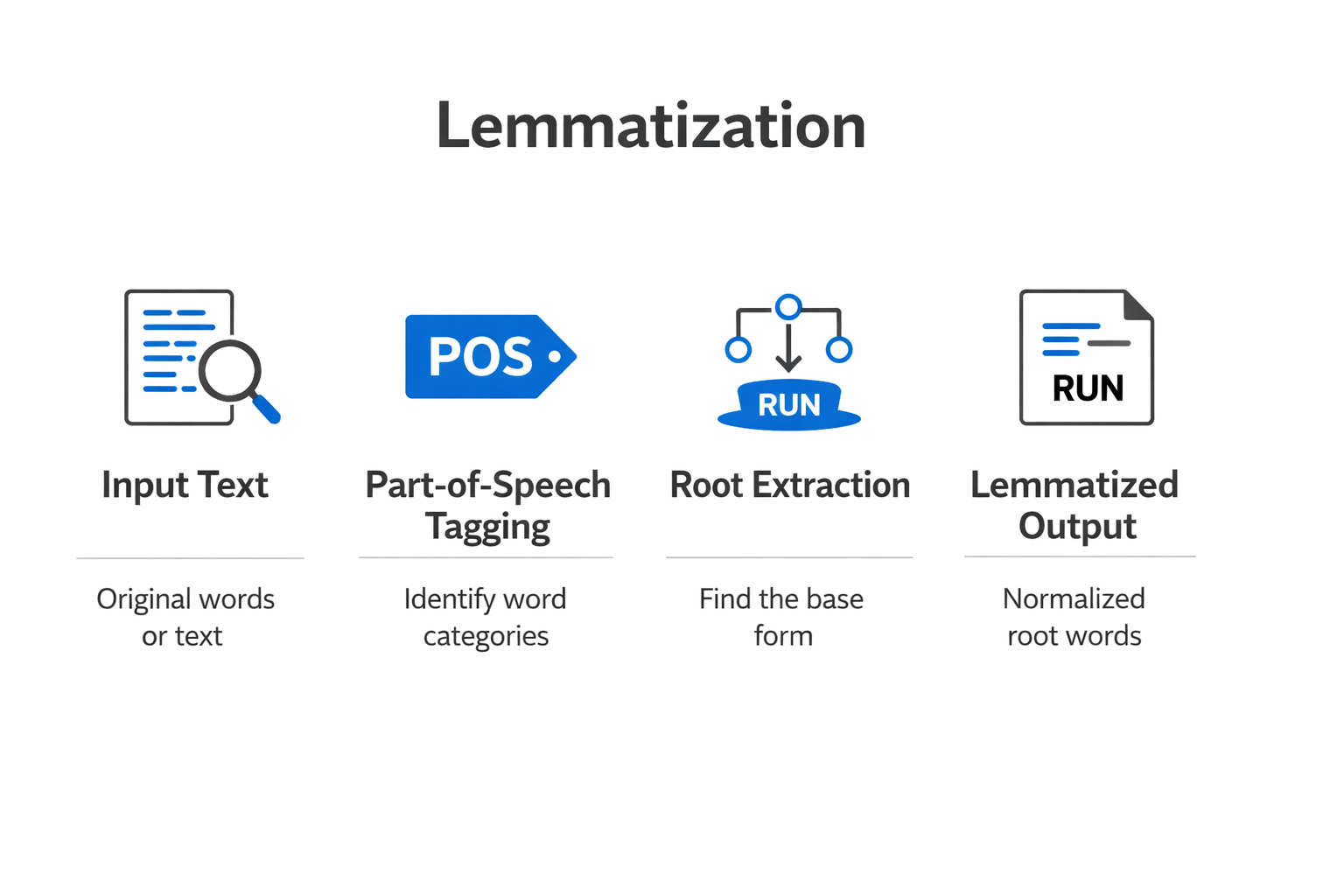
Lemmatization analyzes both the form and the grammatical role of a word in a sentence. The process runs through several coordinated steps that draw on linguistic resources and context.
The first step is tokenization, where raw text is split into individual words or tokens. Once the text is segmented, a part-of-speech (POS) tagger assigns a grammatical category to each token. This is a critical step because the correct lemma depends on whether a word functions as a noun, verb, adjective, or another part of speech. The word "saw," for instance, lemmatizes to "see" when used as a verb but remains "saw" when used as a noun referring to a cutting tool.
After POS tagging, the lemmatizer consults a morphological dictionary or a set of linguistic rules to identify the correct base form. For regular words, this can involve stripping suffixes and applying transformation rules.
The verb "walking" loses its "-ing" suffix and returns to "walk." For irregular words, the system relies on lookup tables that map forms like "went" to "go" or "mice" to "mouse." These lookup tables are language-specific and must be curated for each language the system supports.
Some lemmatizers also apply morphological analysis to decompose words into their constituent morphemes. This is particularly useful for agglutinative languages like Turkish or Finnish, where a single word can contain multiple suffixes that each carry grammatical meaning. In such languages, lemmatization is not simply a matter of stripping one ending but rather of parsing a chain of morphological components.
Modern lemmatization systems often combine rule-based approaches with statistical or machine learning models. A rule-based component handles regular patterns and known irregular forms, while a trained model handles ambiguous cases where context determines the correct lemma.
This hybrid approach balances coverage with accuracy and represents the standard in production natural language processing systems.
The output is a normalized token sequence where each word is replaced by its dictionary form. This text then feeds downstream tasks such as text classification, information retrieval, topic modeling, or semantic search. By shrinking vocabulary size and collapsing morphological variants, lemmatization sharpens the statistical signals these models depend on.
Lemmatization vs Stemming
Lemmatization and stemming are both text normalization techniques that reduce words to a common base form, but they differ fundamentally in approach, accuracy, and output quality.
Stemming works by applying a set of heuristic rules to strip prefixes or suffixes from words, without consulting a dictionary or considering grammatical context. The Porter Stemmer, for example, applies a sequence of suffix-removal rules to produce a stem. This process is fast but imprecise. It might reduce "studies" to "studi," "university" to "univers," or "organization" to "organ," producing fragments that are not valid words.
Stemming does not differentiate between parts of speech, so it applies the same rules regardless of whether a word is a noun, verb, or adjective.
Lemmatization, by contrast, always produces a valid dictionary word. It uses vocabulary lookups, morphological rules, and part-of-speech context to find the correct base form. "Studies" becomes "study," "better" becomes "good," and "was" becomes "be." The output is linguistically meaningful and human-readable, which matters for applications where the normalized text will be displayed to users or used for generation tasks.
The tradeoff is computational cost. Stemming is faster because it requires no dictionary lookups, no POS tagging, and no contextual analysis. For large-scale indexing tasks where speed matters more than precision, stemming can be the practical choice. Lemmatization requires more processing time per token because of its reliance on linguistic resources and disambiguation.
Accuracy differs significantly between the two methods. Stemming frequently produces errors through over-stemming (collapsing words with different meanings into the same stem) and under-stemming (failing to group words that share a root). Lemmatization avoids most of these errors by grounding its decisions in linguistic knowledge.
For tasks where meaning preservation matters, such as sentiment analysis, question answering, or machine translation, lemmatization is the preferred choice.
In practice, the decision between lemmatization and stemming depends on the application. Search engines and information retrieval systems sometimes use stemming for its speed advantages, while language modeling pipelines and text analytics applications favor lemmatization for its accuracy. Some systems use both, applying stemming as a fallback when the lemmatizer encounters unknown words.
| Feature | Lemmatization | Stemming |
|---|---|---|
| Approach | Uses vocabulary and morphological analysis. | Applies rule-based suffix stripping. |
| Output | Returns valid dictionary words (lemmas). | May return non-words (e.g., "studi" from "studies"). |
| Accuracy | Higher — considers part of speech and context. | Lower — ignores word meaning and grammar. |
| Speed | Slower due to linguistic analysis. | Faster due to simple rules. |
| Best for | Tasks requiring precision: search, NLU, text analytics. | Tasks prioritizing speed: quick indexing, prototyping. |
Lemmatization Use Cases
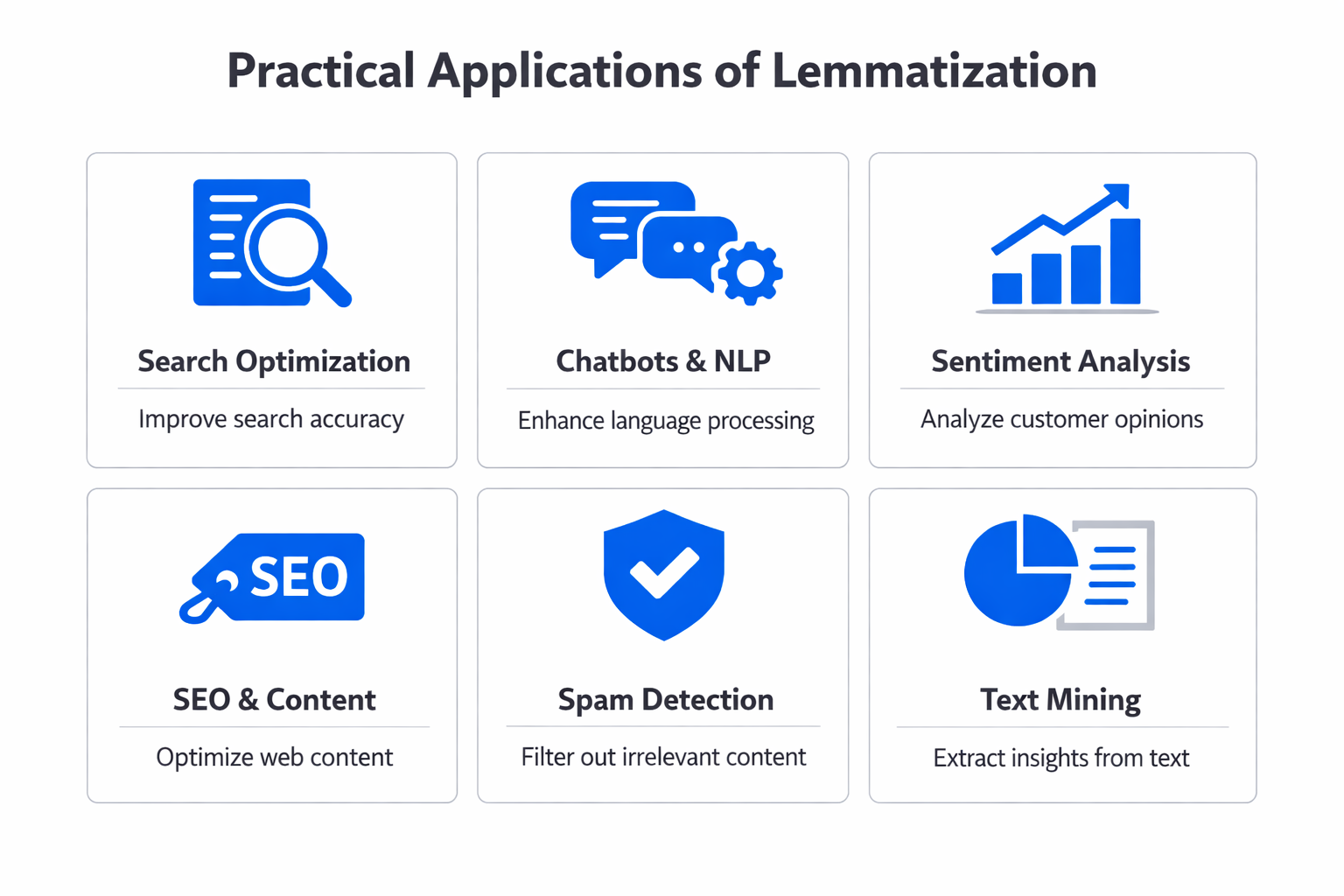
Lemmatization shows up in nearly every area of natural language processing where reducing vocabulary complexity improves performance. The cases below show its practical value.
- Information retrieval and search. Search systems benefit from lemmatization because it allows a query for "running" to match documents containing "run," "runs," or "ran." Without lemmatization, the system would miss relevant results that use different inflected forms. This is particularly important for semantic search systems that build vector embeddings from normalized text, where consistent vocabulary reduces noise in the embedding space.
- Text classification and sentiment analysis. Classifiers trained on lemmatized text often outperform those trained on raw text because lemmatization reduces the feature space without losing meaning. A sentiment classifier analyzing product reviews does not need separate features for "loved," "loves," "loving," and "love." Collapsing these into "love" produces cleaner training data and stronger classification signals.
- Topic modeling. Algorithms like Latent Dirichlet Allocation (LDA) assign words to topics based on co-occurrence patterns. Lemmatization ensures that morphological variants of the same word are counted together, producing more coherent and interpretable topics. Without lemmatization, topic models tend to split related terms across different topics.
- Machine translation. Machine translation systems benefit from lemmatization during both training and inference. Reducing source-language vocabulary through lemmatization helps translation models learn more strong mappings between languages, especially for morphologically rich languages where a single root can appear in dozens of inflected forms.
- Chatbots and conversational AI. Virtual assistants and chatbots use lemmatization to normalize user input before intent classification. A user might type "booking," "booked," or "book a flight," and the system needs to recognize all three as expressions of the same intent. Lemmatization provides this normalization layer, improving intent recognition accuracy.
- Text summarization and natural language generation. When generating summaries or producing text, lemmatization helps systems identify the core vocabulary of a document. Natural language generation pipelines that build from lemmatized input can more easily identify key terms and themes, producing summaries that capture the essential content without being confused by morphological variation.
- Educational technology. In language learning applications, lemmatization powers vocabulary tracking and frequency analysis. A system can count how many unique lemmas a learner has encountered, regardless of the inflected forms that appeared in reading passages. This supports vocabulary acquisition research and adaptive content delivery.
Challenges and Limitations
Lemmatization is effective, but it carries constraints that practitioners need to understand before relying on it.
Language dependency is the most significant limitation. Lemmatization requires language-specific resources: dictionaries, morphological rules, POS taggers, and exception tables. These resources are well-developed for English, Spanish, French, German, and a handful of other high-resource languages. For the thousands of languages with limited computational resources, lemmatization tools are either unavailable or unreliable. This language gap restricts the global applicability of NLP systems that depend on lemmatization.
Ambiguity resolution remains difficult. Even with POS tagging, some words are genuinely ambiguous in context. The word "meeting" could be a noun ("the meeting starts at noon") or a verb form ("she is meeting the client"). When the POS tagger misidentifies the part of speech, the lemmatizer produces the wrong base form. These errors propagate to downstream tasks, potentially affecting the quality of classification, retrieval, or translation outputs.
Irregular morphology requires extensive exception handling. Every language contains irregular forms that do not follow standard patterns. English alone has hundreds of irregular verbs ("swim" to "swam" to "swum"), irregular plurals ("children," "criteria," "phenomena"), and comparative forms ("worse" from "bad"). Each of these must be explicitly encoded in the lemmatizer's resources. Maintaining and expanding these exception lists is labor-intensive, and gaps in coverage lead to errors.
Computational overhead limits throughput. Compared to stemming, lemmatization is significantly slower because it involves dictionary lookups, POS analysis, and disambiguation. For real-time applications processing millions of queries per second, this overhead can be a bottleneck. Organizations must weigh the accuracy benefits of lemmatization against the latency and infrastructure costs it introduces.
Domain-specific vocabulary poses challenges. Technical, medical, and legal texts contain specialized terminology that general-purpose lemmatizers may not handle correctly. A biomedical lemmatizer needs to know that "metastases" is the plural of "metastasis," while a legal lemmatizer must correctly process Latin terms and domain-specific compound nouns.
Building domain-adapted lemmatization resources requires expertise in both the domain and computational linguistics.
Lemmatization can obscure meaningful distinctions. In some cases, different inflected forms carry information that matters for the task at hand. Tense markers, for example, distinguish between completed and ongoing actions. Collapsing "completed" and "completing" into "complete" loses temporal information that might be relevant for event extraction or timeline construction. Practitioners must evaluate whether lemmatization helps or hurts for their specific application.
How to Implement Lemmatization
Implementing lemmatization in production means picking the right tools, configuring them for your language and domain, and slotting the step into your preprocessing pipeline. These approaches cover the most common paths.
Using spaCy. spaCy is a widely used Python library for natural language processing that includes built-in lemmatization. When you process a document through spaCy's pipeline, each token automatically receives a lemma attribute based on the language model loaded. SpaCy's lemmatizer uses a combination of lookup tables and rule-based morphological analysis.
To use it, install spaCy and download a language model (for example, "en_core_web_sm" for English), then access the .lemma_ property of each token after processing.
Using NLTK with WordNet. The Natural Language Toolkit (NLTK) provides the WordNetLemmatizer, which uses the WordNet lexical database to find lemmas. This approach requires you to specify the part of speech for each word, or it defaults to treating every token as a noun. For best results, combine the WordNetLemmatizer with NLTK's POS tagger, mapping Penn Treebank tags to WordNet's simpler POS categories (noun, verb, adjective, adverb) before passing them to the lemmatizer.
Using Stanza. Developed by the Stanford NLP Group, Stanza offers neural network-based lemmatization that handles both regular and irregular forms through trained models rather than lookup tables. Stanza supports over 60 languages and produces high-accuracy lemmatization, especially for morphologically complex languages.
It integrates well with PyTorch-based workflows and is a strong choice for multilingual projects.
Building a custom lemmatizer. For specialized domains or underserved languages, you may need to build a custom lemmatization system.
This typically involves compiling a morphological dictionary for the target vocabulary, defining suffix-stripping rules for regular patterns, encoding irregular forms as exception tables, and training a disambiguation model for ambiguous cases. Deep learning approaches, particularly sequence-to-sequence models built on transformer architectures, have shown strong results for lemmatization as a character-level transduction task.
Integration considerations. Regardless of the tool you choose, lemmatization should be positioned in the preprocessing pipeline after tokenization and POS tagging but before feature extraction or model input. The order matters because lemmatization depends on POS tags for accuracy, and downstream components depend on lemmatized tokens for vocabulary consistency.
Cache lemmatization results when processing repeated text to avoid redundant computation, and benchmark your lemmatizer's throughput against your latency requirements.
Evaluation. Measure lemmatization quality by computing accuracy against a gold-standard annotated corpus. Pay particular attention to out-of-vocabulary words, irregular forms, and ambiguous tokens, as these are the cases most likely to produce errors. Tracking lemmatization accuracy alongside downstream task performance helps you determine whether improvements to the lemmatizer translate into meaningful gains for your application.
FAQ
What is the difference between a lemma and a stem?
A lemma is the canonical dictionary form of a word. It is always a valid word that you would find as a headword in a dictionary. The lemma of "running" is "run," and the lemma of "better" is "good." A stem, by contrast, is the result of applying heuristic suffix-stripping rules and may not be a real word. The stem of "studies" might be "studi," which is not a valid English word.
Lemmatization prioritizes linguistic correctness, while stemming prioritizes speed and simplicity.
Why is part-of-speech tagging important for lemmatization?
Part-of-speech tagging tells the lemmatizer how a word functions in its sentence, which determines the correct base form. Without POS information, the lemmatizer cannot distinguish between "saw" as a past-tense verb (lemma: "see") and "saw" as a noun (lemma: "saw"). POS tagging resolves this ambiguity and is essential for producing accurate lemmas, especially in languages with extensive homography.
Which languages are supported by common lemmatization tools?
Major NLP libraries support lemmatization for English, Spanish, French, German, Italian, Portuguese, Dutch, and several other European languages. Stanza provides models for over 60 languages, including many Asian and African languages. However, the quality of lemmatization varies significantly by language.
Languages with rich morphological systems, such as Finnish, Hungarian, or Turkish, benefit from specialized tools, while low-resource languages may lack reliable lemmatization support entirely.
Can lemmatization be used with deep learning models?
Lemmatization is commonly used as a preprocessing step before feeding text into deep learning models. However, many modern architectures, particularly those based on transformer models like BERT, use subword tokenization instead of lemmatization.
These models learn contextual representations that implicitly capture morphological relationships. Lemmatization remains valuable for smaller models, classical machine learning pipelines, and applications where explicit vocabulary normalization improves interpretability.
Does lemmatization improve search engine performance?
Lemmatization generally improves recall in search systems by ensuring that queries match documents containing different inflected forms of the same word. A search for "analyzing" will also retrieve documents about "analysis," "analyze," and "analyzed." The tradeoff is a slight reduction in precision, since collapsing forms can occasionally match unrelated meanings.
Most search systems find that the recall benefits outweigh the precision costs, particularly when combined with other ranking signals.
How does lemmatization relate to artificial intelligence?
Lemmatization is a core technique within artificial intelligence, specifically in the subfield of natural language processing. It enables AI systems to process human language more effectively by reducing morphological complexity.
Virtually every text-based AI application, from chatbots to translation systems to content recommendation engines, either uses lemmatization directly or relies on techniques that serve a similar vocabulary normalization function. As AI systems become more sophisticated, lemmatization continues to serve as a reliable preprocessing step that improves the quality of downstream language understanding.


