


Most leadership development programs invest heavily in presentation skills, strategic thinking, and decision-making. Facilitation rarely makes the list. That gap is becoming expensive.
As organizations shift toward distributed teams, cohort-based programs, and hybrid delivery models, the ability to guide groups toward outcomes through structured interaction is no longer optional.
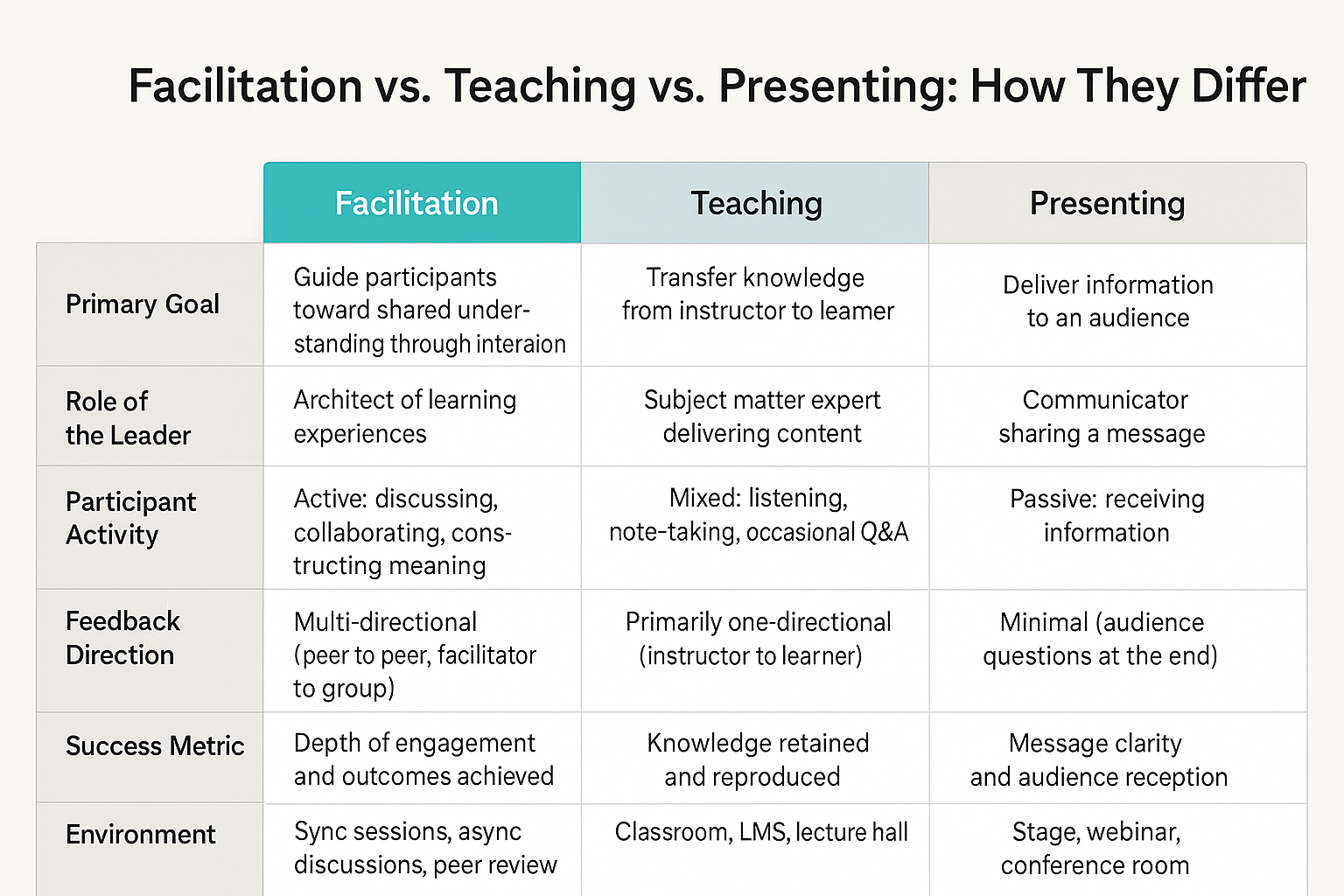
Facilitation is not teaching. Teaching centers on content delivery; facilitation is the practice of creating conditions where people learn through interaction, questioning, and structured collaboration. It is not presenting either. Presenting transfers information.
Facilitation designs experiences where participants construct understanding together. In practical terms, facilitation skills encompass active listening, strategic questioning, interaction design, feedback systems, and data-informed iteration.
The facilitation skills that matter in 2026 span far beyond running a good meeting or leading a single workshop. They cover live sessions, asynchronous engagement, community building, feedback systems, and data-informed iteration. The 10 skills outlined here reflect that full scope.
How We Selected These 10 Skills
We prioritized skills that apply across both synchronous and asynchronous environments, not just live workshop techniques. Our selection aligns with and extends frameworks like the IAF core competencies for facilitators, adapted for the realities of hybrid and cohort-based program delivery.
Each skill was selected because it scales beyond one-off events to structured, multi-week programs where engagement must be sustained over time.
We excluded generic soft skills already covered extensively elsewhere and focused on professional facilitation skills with measurable impact on participation, completion, and learner outcomes. The result is a set of effective facilitation techniques that leaders can apply immediately.
1. Active Listening and Adaptive Responding
Active listening in facilitation is the ability to read verbal and non-verbal signals, interpret engagement patterns, and adjust the facilitation approach in real time. It goes beyond staying quiet while someone else talks.
What It Looks Like in Practice
An effective facilitator tracks verbal and non-verbal cues during live sessions: hesitation in a response, energy dropping after a long content block, one participant dominating while others go silent. Based on those signals, the facilitator adjusts.
They slow down, change the activity, or ask a targeted follow-up question. In 2026, active listening extends well beyond the live session. Facilitators must read engagement signals in async discussion threads, video comments, and written reflections. A pattern of short, generic replies in a discussion forum is a signal, just as much as crossed arms in a conference room.
The Common Mistake
Treating silence as agreement or comprehension. In virtual and asynchronous contexts, silence more often signals confusion, disengagement, or poorly framed prompts. Skilled facilitators probe silence rather than accept it.
2. Strategic Questioning
The quality of a facilitated session is often determined by the quality of its questions. Strategic questioning is the deliberate design of questions that guide participants toward specific cognitive outcomes, rather than a conversational reflex.
What It Looks Like in Practice
Strong facilitators ask open-ended questions with a clear cognitive target. As research on the power of questions has documented, the structure and specificity of a question directly shapes the quality of the response.
Instead of "What do you think about this framework?" they ask "Which element of this framework would fail first in your context, and why?" The first invites vague opinion.
The second forces analysis. This skill applies equally in live discussions and async environments. Whether in workshop planning or cohort program design, a well-designed discussion prompt can generate deeper engagement than a full lecture, provided it asks participants to do specific cognitive work.
The Common Mistake
Defaulting to questions that are either too broad ("Any thoughts?") or too narrow ("Is this clear?"). Effective facilitation questions sit in the middle: structured enough to focus thinking, open enough to allow genuine exploration.
3. Designing Structured Interactions
Collaboration does not happen because you put people in a group. It happens because someone designed the interaction with clear outcomes, roles, and accountability.
What It Looks Like in Practice
Skilled facilitators plan collaborative activities where the learning outcome is specific, not just "discuss the topic." They facilitate structured peer review using rubrics and guidelines so feedback is substantive rather than polite. They balance autonomy and guidance in group work, providing enough structure to be productive and enough freedom to be meaningful.
In modern cohort-based programs, designing structured interactions means building collaborative activities within platforms, not just on whiteboards. Platforms designed for cohort-based learning, such as Teachfloor, provide built-in peer review workflows and group activity structures that make this operationally manageable at scale.
The Common Mistake
Designing activities that feel collaborative but lack accountability. Without clear roles, deliverables, and evaluation criteria, group work defaults to social loafing or one person carrying the load.
4. Managing Group Dynamics
Every group has a power structure. Effective facilitators see it and shape it without calling people out.
What It Looks Like in Practice
Whether in a team meeting or a multi-week program, managing group dynamics involves balancing dominant and quiet voices through structural choices, not confrontation. Instead of asking the over-talker to stop, a facilitator might shift to written responses before verbal discussion, giving reflective participants equal footing. In hybrid settings, this becomes more complex.
Remote participants are easily sidelined when in-room conversations gain momentum. Facilitators must build contribution equity into the session design itself: rotating speaking roles, using shared documents for input, and structuring turn-taking so presence in the room does not equal influence in the discussion.
The Common Mistake
Letting two or three voices dominate while assuming quiet participants are engaged. In virtual settings, this dynamic intensifies because non-verbal cues are harder to read and the barrier to interrupting feels higher.
5. Facilitating Asynchronous Engagement
Most facilitation guides focus almost entirely on live sessions. That is only half the picture, especially for remote and hybrid teams. Asynchronous facilitation is the practice of designing and guiding learning activities that happen between live sessions, including discussions, peer reviews, and reflective exercises.
What It Looks Like in Practice
Effective async facilitators design discussion prompts that require specific, substantive responses, not "share your reflections." They facilitate threaded conversations by responding to patterns, synthesizing contributions across posts, and redirecting when threads drift.
They treat asynchronous spaces as genuine learning environments that need the same intentional facilitation as a live workshop, a principle reinforced by the distinction between emergency remote instruction and intentional online learning design that emerged during the rapid shift to virtual delivery. Platforms like Teachfloor support this by providing structured discussion spaces and community threads integrated directly into the course experience, rather than relegating async work to a disconnected forum.
The Common Mistake
Treating async activities as filler between "real" sessions. When asynchronous work is an afterthought, participation drops and the learning gap between sessions widens. Asynchronous engagement is not homework. Asynchronous engagement is where a significant portion of applied learning happens.
6. Creating Continuous Feedback Loops
Feedback is not an event at the end of a program. It is a system that runs throughout the learning experience, and facilitating that system is a distinct skill.
What It Looks Like in Practice
Strong facilitators build assessment into the learning flow. The continuous feedback loop follows a clear sequence:
(1) learners submit work(
2) peers provide feedback guided by feedback rubrics for peer evaluation,
(3) learners revise based on that feedback, and (4) instructors provide final review.
The cycle then repeats with each new milestone. This is different from collecting assignments and returning grades. It requires designing revision opportunities so feedback has somewhere to go.
Teachfloor supports this through rubric-based peer review and instructor feedback workflows that make continuous assessment operationally feasible without overwhelming the facilitator.
The Common Mistake
Collecting feedback but never closing the loop. If learners submit work, receive a score, and move to the next module without revision, the feedback had no learning impact. The loop must close with action.
7. Time and Energy Management in Facilitated Sessions
A well-facilitated session is not one where every minute is filled. It is one where energy is managed deliberately across activities, pauses, and transitions.
What It Looks Like in Practice
Skilled facilitators alternate between input, interaction, and reflection. They know that extended content delivery tends to produce diminishing returns, with attention often declining after 15 to 20 minutes, so they break sessions into focused segments.
They design transitions that let participants reset. In multi-week programs, energy management extends beyond individual sessions. Facilitators must balance the cognitive load across synchronous meetings, asynchronous activities, and community interactions so participants are not overwhelmed at any single point in the program arc.
The Common Mistake
Cramming too much content into live sessions because "we have so much to cover" compresses interaction time, reduces engagement, and shifts the session back toward lecture.
When facilitators prioritize content coverage over participant processing time, the session loses its facilitative purpose. If everything is urgent, nothing gets processed.
8. Building and Sustaining Learning Community
Community is not a social feature bolted onto a course. In cohort-based programs, it is an active facilitation space where learning continues between scheduled sessions.
What It Looks Like in Practice
Effective facilitators foster belonging within their online learning community from the first interaction: introductions with purpose, shared challenges that create identity, and norms that make participation feel safe.
Over time, they encourage peer-to-peer support that reduces dependence on the facilitator. Learners begin answering each other's questions, sharing resources, and holding each other accountable.
Peer-to-peer support only develops sustainably when community is embedded in the learning environment. Teachfloor integrates community directly alongside courses so that facilitation remains continuous rather than fragmented across separate tools.
The Common Mistake
Creating a community space and expecting engagement to happen on its own. Communities require active facilitation: seeding conversations, recognizing contributions, connecting members with shared interests, and modeling the interaction patterns you want to see.
9. Using Technology Strategically
Technology should reduce friction for facilitators and learners, not introduce new layers of complexity. The skill here is restraint as much as adoption.
What It Looks Like in Practice
Effective facilitators choose tools that simplify logistics, allowing them to focus energy on human interaction. They automate scheduling, reminders, and progress tracking so their time goes to high-value facilitation activities.
They ensure learners experience a coherent environment rather than navigating a patchwork of disconnected applications.
In 2026, AI-assisted facilitation is becoming practical for specific tasks: generating session summaries, analyzing discussion transcripts for engagement patterns, and flagging learners who may need additional support. The principle remains the same. Technology serves the learning design, not the other way around.
The Common Mistake
Adding tools without removing friction. Every new application introduces cognitive overhead for both facilitators and participants. If the technology does not simplify the experience, it is not strategic; it is clutter.
10. Measuring and Iterating on Engagement
The skill that makes all other facilitation skills improvable is measurement. Without data, facilitation improvement is guesswork.
What It Looks Like in Practice
Facilitators who measure well track participation depth, not just attendance. They monitor discussion quality, peer interaction frequency, feedback turnaround times, and completion patterns.
They use this data to identify disengaged learners early, before those learners drop out. Effective facilitators adapt their facilitation approach based on what the data reveals. Teachfloor provides reporting and analytics that surface these engagement signals, turning measurement into an ongoing facilitation input rather than a post-program report.
The Common Mistake
Equating activity metrics with engagement. High login counts and video completion rates do not mean learners are developing skills. Facilitators need to track qualitative signals: the depth of discussion contributions, the quality of peer feedback, and whether interaction patterns are improving over time.
Frequently Asked Questions
What are facilitation skills and why do leaders need them?
Facilitation skills are the abilities required to guide group learning, collaboration, and problem-solving toward defined outcomes. Leaders need them because modern work involves running workshops, training programs, retrospectives, and structured learning experiences where content delivery alone does not produce results. Effective leadership facilitation skills drive participation, retention, and skill application across teams.
What is the difference between facilitation and teaching?
Teaching centers on content delivery: transferring knowledge from instructor to learner. Facilitation centers on creating conditions for learning through interaction, questioning, and structured collaboration. A teacher presents information. A facilitator designs experiences where learners construct understanding together. Both are valuable, but they require different skill sets and produce different outcomes.
How do you facilitate learning in virtual or hybrid environments?
Virtual and hybrid facilitation requires intentional design for both synchronous and asynchronous participation. Use structured breakout activities, design discussion prompts that demand specific responses, and build contribution equity so remote participants have equal voice. The key is treating virtual and async spaces as real facilitation environments, not reduced versions of in-person experiences.
What are the most important facilitation techniques for cohort-based programs?
Cohort-based programs require facilitation that sustains engagement over weeks, not hours. The most important techniques include structured peer review, async discussion facilitation, continuous feedback loops, and community building. Unlike one-off workshops, cohort facilitation means designing for learning between sessions and building relationships that support long-term persistence and completion.
How can I improve my facilitation skills?
Start by observing your current patterns: where do participants disengage? Where does conversation stall? Practice designing questions and activities before sessions, not just content slides. Collect specific feedback from participants after every session. Watch other facilitators work. Treat facilitation as a design practice that improves through deliberate iteration, not a personality trait you either have or lack.
How do you measure whether facilitation is effective?
Track participation depth rather than attendance, discussion quality rather than post count, peer interaction frequency, feedback turnaround times, and completion rates. Effective facilitation produces observable signals: learners contributing without prompting, peer feedback improving in specificity over time, and engagement sustained across both async and sync activities. Combine quantitative metrics with qualitative observation for the clearest picture.
Conclusion
Facilitation is not performance. It is design work that demands the same rigor as curriculum architecture or program operations. The 10 skills outlined here are not independent checkboxes; they are interconnected leadership facilitation skills. They form an integrated practice where active listening informs questioning, questioning shapes interaction design, interaction design generates feedback, and feedback drives iteration.
The shift is clear: from facilitator as entertainer to facilitator as architect of learning experiences. As programs become more distributed, more hybrid, and more reliant on asynchronous engagement, facilitation skills become more critical, not less. Leaders who invest in developing facilitation skills will run programs that consistently produce measurable outcomes, because structured facilitation directly increases participation depth, feedback quality, and learner retention. Leaders who treat facilitation as improvisation will continue to see participation decline after week two, because unstructured engagement cannot sustain itself over time.


